Imitation-Firearm Law · Volume 5
Selling Abroad: Britain, Canada and Australia
The United Kingdom's offence of selling or importing a realistic imitation firearm and its list of unrealistic colours, Canada's classification of replica firearms as prohibited devices, and Australia's import ban on imitations of any material or colour: why a realistic MP7 light gun cannot be exported to any of them
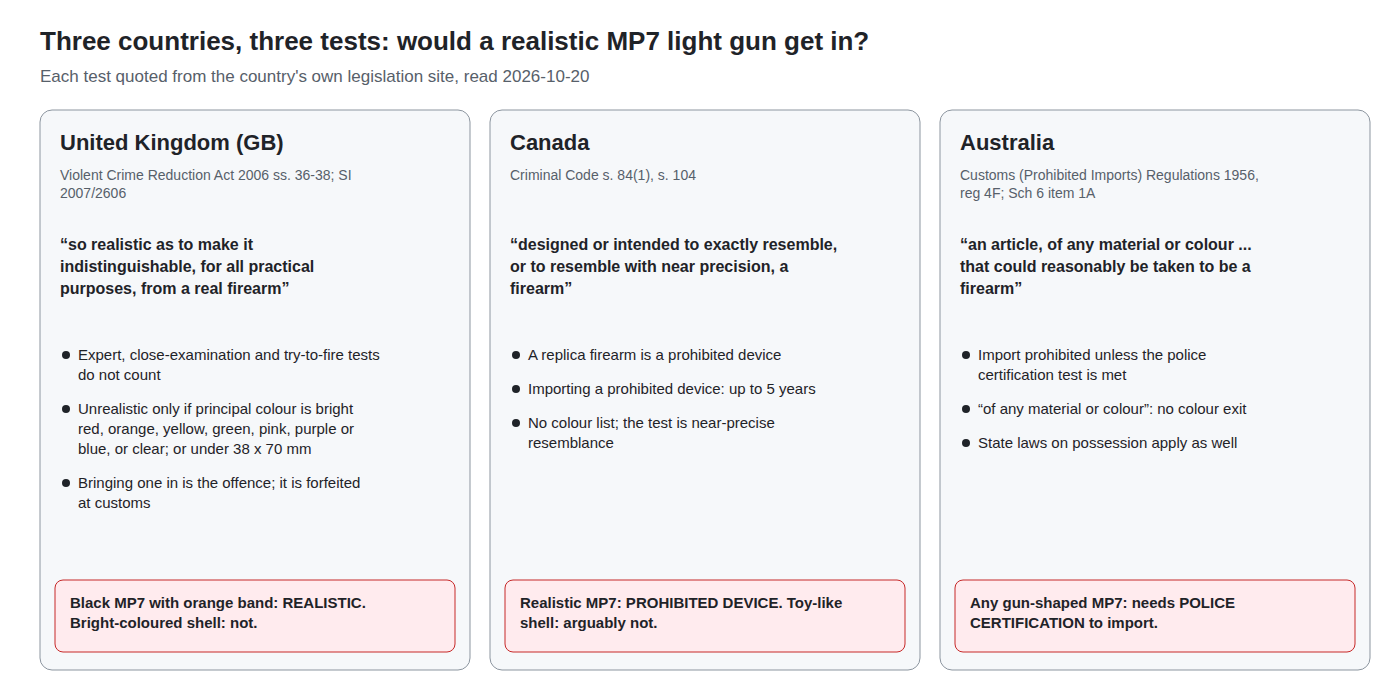
5.1 Why export is a separate question
US law does not stop a US seller exporting a replica gun. California even exempts sales “solely for export” from its ban (Volume 2). The constraint is at the other end. The buyer’s country decides what may come in, and in the three English-speaking markets most likely to want a light-gun kit, a realistic gun-shaped object may not. Each was read on its own government’s legislation site on 2026-10-20.
5.2 United Kingdom: realistic imitation firearms
The Violent Crime Reduction Act 2006, in force for this purpose since 1 October 2007, made four acts offences in Great Britain:1
36 (1) A person is guilty of an offence if— (a) he manufactures a realistic imitation firearm; (b) he modifies an imitation firearm so that it becomes a realistic imitation firearm; (c) he sells a realistic imitation firearm; or (d) he brings a realistic imitation firearm into Great Britain or causes one to be brought into Great Britain.
On summary conviction in England and Wales the penalty is up to 51 weeks’ imprisonment, a level 5 fine, or both. A realistic imitation brought into Great Britain “shall be liable to forfeiture under the customs and excise Acts”. A UK buyer who orders one commits the offence of bringing it in, and a US seller who ships it “causes one to be brought” in.
The definition in s. 38 turns on what an ordinary observer sees:
(1) … “realistic imitation firearm” means an imitation firearm which— (a) has an appearance that is so realistic as to make it indistinguishable, for all practical purposes, from a real firearm …
(2) … an imitation firearm is not … to be regarded as distinguishable from a real firearm for any practical purpose if it could be so distinguished only— (a) by an expert; (b) on a close examination; or (c) as a result of an attempt to load or to fire it.
Section 38(3)(b) gives the way out: an imitation is distinguishable “if its size, shape or principal colour is unrealistic for a real firearm”. The 2007 regulations fix the size and the colours.2 An imitation is too small to be realistic only if it is less than 38 mm high and 70 mm long. A colour is unrealistic only if it is one of:
(a) bright red; (b) bright orange; (c) bright yellow; (d) bright green; (e) bright pink; (f) bright purple; and (g) bright blue.
Transparent material also counts. Two differences from the US federal list matter. White is not on the UK list. And the test is the principal colour, not a marking. A black MP7 with an orange muzzle band has black as its principal colour. It satisfies the US rule and is a realistic imitation firearm in Britain.
The defences in s. 37 and the regulations cover museums, theatre, film and television, historical re-enactment, Crown service, and “permitted activities”: “the acting out of military or law enforcement scenarios for the purposes of recreation”, which is the airsoft skirmisher’s defence, available only to an organiser holding public liability insurance. Playing video games at home is none of these.
A UK sale is therefore possible only for a gun whose principal colour is on the list: an MP7 shell printed in bright blue, say. Northern Ireland has parallel provisions in Schedule 2 to the Act, which were not read here.
5.3 Canada: a replica firearm is a prohibited device
Canada’s Criminal Code, current to 30 September 2026, defines a replica firearm by how closely it copies a real gun:3
replica firearm means any device that is designed or intended to exactly resemble, or to resemble with near precision, a firearm that is designed or adapted to discharge a shot, bullet or other projectile at a muzzle velocity exceeding 152.4 m per second and at a muzzle energy exceeding 5.7 Joules, and that itself is not a firearm, but does not include any such device that is designed or intended to exactly resemble, or to resemble with near precision, an antique firearm …
The same section lists “a replica firearm” among the prohibited devices, and s. 104 makes it an offence to import or export a prohibited device “otherwise than under the authority of the Firearms Act”. The offence is indictable, with up to five years.4
A light gun printed to H&K’s dimensions is designed “to resemble with near precision” a real MP7, which fires well above 152.4 m/s. It is a prohibited device in Canada and cannot be imported. The definition has no colour list. A bright-coloured shell is still arguably a near-precise copy in shape, so colour is a weaker defence in Canada than in Britain. A shell that departs from the MP7’s outline, not just its colour, is the safer Canadian product.
5.4 Australia: an imitation needs police certification
Australia controls imports federally, through the Customs (Prohibited Imports) Regulations 1956 (compilation 147, 13 July 2026). Regulation 4F prohibits importing “a firearm … or an imitation” unless the requirements of Schedule 6 are met. The definition is the broadest of the three:5
imitation means an article, of any material or colour: (a) that: (i) is a copy or reproduction of a firearm; or (ii) has the appearance of a firearm; and (b) that is not capable of discharging shot, bullets or other projectiles by means of an explosive charge or a compressed gas; and (c) that could reasonably be taken to be a firearm; and (d) that is not a blank-fire firearm.
Schedule 6, item 1A: “An imitation of a firearm. The importation must comply with the police certification test.” In practice the buyer’s state or territory police must certify the import first. An ordinary parcel without that certification is a prohibited import. “Of any material or colour” closes the colour route: what matters is whether it “could reasonably be taken to be a firearm”. Each state’s own firearms or weapons law then governs possession; those laws were not read here.
5.5 The carriers agree
The carriers’ international rules (Volume 4) settle the question before a customs officer sees the parcel. FedEx’s international list prohibits “Firearms (including antiques and replicas thereof), weaponry, and their parts”. UPS does not accept “Replicas or simulated Firearms … internationally except as a contractual service”. USPS defers to each destination country’s restrictions.
5.6 What could be exported
Table 1 — 5.6 What could be exported
| Product | UK | Canada | Australia |
|---|---|---|---|
| Realistic MP7 shell, orange band | No (s. 36) | No (prohibited device) | Only with police certification |
| MP7 shell, principal colour bright blue | Yes, by the colour rule | Doubtful: shape still “near precision” | Only with police certification |
| Arcade-style shell, not an MP7 outline | Yes, if not “indistinguishable” from a real gun | Yes, if not a near-precise copy | Yes, if it could not “reasonably be taken to be a firearm” |
| Electronics only (board, camera, solenoid, cable) | Yes | Yes | Yes |
Every country’s own product rules then apply to the electronics: UKCA or CE marking, Canadian ICES radio rules, Australian RCM, and battery shipping. These belong to Licensing, IP and Kits, not to this dive.
5.7 What could not be verified
- Northern Ireland’s provisions (Schedule 2 to the 2006 Act).
- The CBSA’s guidance on replica firearms at the Canadian border. Only the Criminal Code was read.
- The Australian states’ possession laws for imitation firearms, and how the police certification test is administered.
- Other countries. The EU states, Japan and the rest were not read. Several are commonly said to regulate realistic replicas; none of that was checked here, so no other country should be treated as open.
Sources
Footnotes
-
Violent Crime Reduction Act 2006 (c. 38), ss. 36, 37, 38, legislation.gov.uk, https://www.legislation.gov.uk/ukpga/2006/38/section/36 (and /37, /38), read 2026-10-20; s. 36 in force 1 October 2007 by S.I. 2007/2180. ↩
-
The Violent Crime Reduction Act 2006 (Realistic Imitation Firearms) Regulations 2007, S.I. 2007/2606, regs 2–7, https://www.legislation.gov.uk/uksi/2007/2606/made, read 2026-10-20. ↩
-
Criminal Code (R.S.C., 1985, c. C-46), s. 84(1), Justice Laws Website, https://laws-lois.justice.gc.ca/eng/acts/c-46/section-84.html, read 2026-10-20 (“Act current to 2026-09-30 and last amended on 2026-07-18”). ↩
-
Criminal Code s. 104, https://laws-lois.justice.gc.ca/eng/acts/c-46/section-104.html, read 2026-10-20. ↩
-
Customs (Prohibited Imports) Regulations 1956, Compilation No. 147 (13 July 2026), reg 4F and Schedule 6 Part 2 item 1A, Federal Register of Legislation, https://www.legislation.gov.au/F1996B03651/latest/text, read 2026-10-20. ↩
Comments (0)