Remington 870 Express Tactical · Volume 7
The Gun Documented Here, and the Rules It Lives Under
The configuration as recorded in September 2026, what the record does not say, the photographs owed, and the federal and Michigan limits that bear on an 18½-inch pump
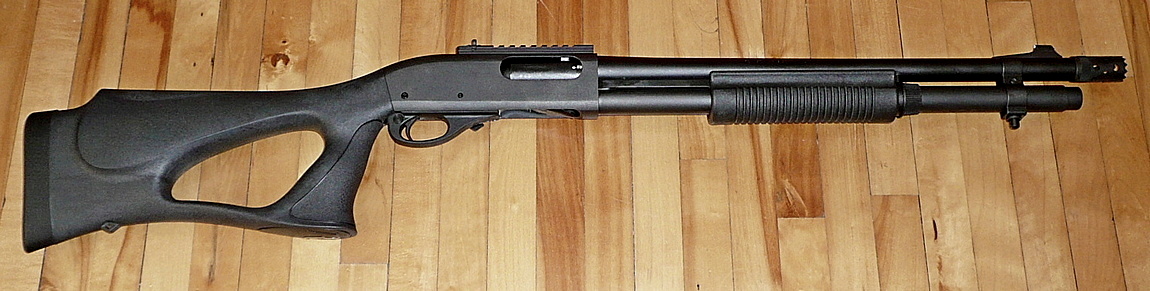
The previous six volumes are about the pattern: what an 870 Express Tactical is, how it works, how to keep it working and what can be fitted to it. This volume is about the one gun, as its configuration stood on a particular date. Configuration changes; the record behind this volume was last modified on 17 September 2026, and everything below is dated to it. The volume ends with the law that bears on a pump shotgun with an 18½-inch barrel in Michigan, most of which the hub already documents and this volume links.
7.1 The Configuration, as Documented in September 2026
Table 1 — The Configuration, as Documented in September 2026
| As recorded | |
|---|---|
| Model | Remington 870 Express Tactical with ghost-ring sights |
| Gauge | 12 |
| Barrel | Recorded as 18 in; the model is catalogued at 18½ in (below) |
Table 2 — The Configuration, as Documented in September 2026
| Part | Status, September 2026 | Covered in |
|---|---|---|
| Fab Defense PR-870 forend | Installed | Volume 5 |
| ATI T3 six-position adjustable stock, TactLite pattern, with recoil pad and pistol grip | Installed | Volume 5 |
| Holosun HS403A micro red dot, recorded as 2 MOA, on an AR-height riser | Installed | Volume 5 |
| Hydraulic buffer stock, which would replace the ATI stock | Planned | Volume 5 |
| Vertical foregrip with LED | Planned | Volume 5 |
| Mesa Tactical SureShell shotshell carrier | Planned | Volume 5 |
| Remington jumbo safety | On hand, not fitted | Volume 5 |
“Planned” and “on hand” both mean the part is not on the gun. Several of the planned parts may already be to hand and waiting to be fitted; none of them is described anywhere in this dive as fitted.
7.2 What Is Factory and What Is Not
Set against the catalogue item (Volume 1), the gun documented here has:
- Replaced: the factory synthetic stock (14-inch length of pull, conventional drop) by the ATI T3, an AR-pattern stock on a tube; and the factory tactical fore-end by the Fab Defense PR-870, a railed polymer forend on the same fore-end tube.
- Added: the Holosun HS403A red dot on a riser.
- Presumably retained, not recorded: the XS blade front sight, the XS ghost-ring rear sight on its receiver rail, the factory two-shot magazine extension, and the extended ported tactical choke tube.
The combination is coherent. The AR-pattern stock raises the eye; the riser raises the dot to meet it; the railed forend gives a place for the light and grip that are planned. The planned hydraulic buffer stock would replace the ATI stock again, and whichever sidesaddle is chosen decides whether the receiver-top rail stays (Volume 5, “How the Parts Interact”).
7.3 What the Record Does Not Say
These are the facts about the gun documented here that the record leaves blank. None is inferred in this dive.
Table 3 — What the Record Does Not Say
| Question | Why it matters | How to settle it |
|---|---|---|
| Barrel length: 18 or 18½ in? | The model is catalogued only at 18½ in; the federal threshold is “less than 18 inches” | Measure (below) and read the barrel’s markings |
| Is the factory tactical cylinder tube fitted? | The manual forbids firing a Rem Choke barrel without its tube; the tube decides patterns | Look at the muzzle |
| Year of manufacture, and Remington or RemArms era | The 2005 Express differences and the early-2000s chamber problem are period-specific | Barrel and receiver markings |
| Flexi Tab carrier? | It decides whether the 870 jam can be cleared by forcing the action | The U-shaped cut-out in the carrier, visible through the loading port |
| Trigger-plate material | Polymer on the 2005 Express, metal on the Police gun | Look at the plate with the gun upside down |
| Key-lock (ISS) safety? | Present on some commercial guns of the period | Look for a keyway in the safety |
| Extractor type | Powder metal on the 2005 Express | Look at the bolt face with the bolt out |
| Finish | Bead-blast blue on the 2005 Express; care differs | Look |
| Where the riser and dot sit | Whether the ghost ring is still usable as a back-up | Look |
| Which SureShell | A saddle type replaces the receiver rail; a side type does not | The planned part number |
| Which buffer stock and which foregrip | Fit and function (Volume 5) | The planned parts |
| How the factory magazine extension is retained | Barrel removal and the waterfowl plug | Inspect with the gun empty |
7.4 Photographs and Measurements Owed
The photographs below exist nowhere in the public record for this particular gun, and several would settle questions in the table above. They are listed in order of value.
The measurements owed, set out as tests in Volume 6, are the buckshot patterns at 5, 10, 15 and 25 yards through this barrel and tube, and a slug group at 50 yards.
7.5 Federal Law: Half an Inch From the Line
Under the National Firearms Act, a “firearm” subject to registration includes “(1) a shotgun having a barrel or barrels of less than 18 inches in length; (2) a weapon made from a shotgun if such weapon as modified has an overall length of less than 26 inches or a barrel or barrels of less than 18 inches in length”.1
The Express Tactical is catalogued with an 18½-inch barrel and an overall length of 38½ inches.2 It is a Title I shotgun by half an inch of barrel and by twelve inches of overall length. The ATI stock changes the overall length by changing the length of pull, but even at its shortest setting it leaves the gun far longer than 26 inches.
The owner’s record says 18 inches. An 18-inch barrel is not “less than 18 inches”, so even the record’s figure does not cross the line; but a barrel recorded as 18 inches is a barrel worth measuring, because the statute’s words are a threshold and the difference between “18” and “just under 18” is the difference between an ordinary shotgun and a registered one. How the measurement is to be made is not set out in this dive; the barrel’s own markings and a careful measurement from the closed breech are the place to start.
If an owner ever wanted a shorter barrel, it would be a short-barrelled shotgun requiring registration before it is made. The hub’s Suppressor Law dive covers the registration process and the change of 1 January 2026, when Public Law 119-21 set the making and transfer tax to $0 for short-barrelled shotguns among other items; its Volume 3 sets out exactly what changed. That is not restated here, and nothing in the configuration documented here engages it.
7.6 Michigan: the Short-Barrel Statute
Michigan defines the same thing in the same terms. MCL 750.222(l): “‘Short-barreled shotgun’ means a shotgun having 1 or more barrels less than 18 inches in length or a weapon made from a shotgun, whether by alteration, modification, or otherwise, if the weapon as modified has an overall length of less than 26 inches.”3
MCL 750.224b prohibits making, transferring or possessing a short-barrelled shotgun except one “lawfully made, manufactured, transferred, or possessed under federal law”, and adds requirements for carrying the federal registration. The hub’s AR Pistol .300 BLK dive quotes the whole section from the Legislature’s own publication, and it is not repeated here. For the gun documented here the point is the same as the federal one: at 18½ inches of barrel and well over 26 inches overall, it is outside both definitions.
7.7 Michigan Deer: the Zone Is Gone, and the Six-Shell Rule Names Semi-Automatics
The limited firearms deer zone has been eliminated, effective 12 September 2026. The hub’s .450 Bushmaster AR-15 dive documents the change from the Department of Natural Resources’ current regulations and the Natural Resources Commission’s release. The hub’s reloading dive on the .450 Bushmaster points to the same volume. The VR80 dive’s Volume 6 adds the point that matters for shotguns: the old rule already allowed “A shotgun with a smooth or rifled barrel” in the zone, so a shotgun was always legal there. What the change removed was the shotgun’s near-monopoly in the south of the state, not its legality.
The six-shell rule is unchanged, and the .450 dive quotes it from the current digest: “You cannot hunt deer with a semi-automatic shotgun or semi-automatic rifle that can hold more than six shells in the barrel and magazine combined.” It also notes that the Wildlife Conservation Order’s version reaches possession “in an area frequented by animals” as well as hunting.
The quoted rule names semi-automatics. The 870 is a pump. On the words of the rule as that dive quotes them, the 870’s capacity of six in the tube and one in the chamber — seven — is not limited by it. That is a reading of the quoted text, not a check of the full current Wildlife Conservation Order, which this dive did not read; a hunter should confirm it against the current digest before the season. The VR80 dive works through the semi-automatic side, where the factory five-round magazine sits exactly at the limit.
Slugs, buckshot and rifles. What may be used for deer in each zone, including buckshot, is set by the current digest, and the .450 dive is the hub’s reference for it. This dive does not restate the list, because the list changed four months before this was written and the digest governs.
7.8 Waterfowl: the Gun the Plug Rule Was Written For
The federal migratory-bird rule, 50 CFR 20.21(b), prohibits taking migratory game birds “With a shotgun of any description capable of holding more than three shells, unless it is plugged with a one-piece filler, incapable of removal without disassembling the gun, so its total capacity does not exceed three shells”, with exceptions for certain goose seasons. The VR80 dive’s Volume 6 quotes it and its exceptions in full, and observes that the text was written for tube-magazine guns.
The 870 is exactly that gun. Its manual supplies the plug and the instructions: “A magazine plug which limits the magazine capacity to two (2) shells must be installed according to The Federal Migratory Bird Treaty Act and some state laws”, fitted inside the magazine spring behind the spring retainer.4 Two in the magazine and one in the chamber is three.
⚠ The manual’s plug is written for the standard magazine tube. The gun documented here has a factory two-shot extension, and the manual does not address the extended tube. Whether the plug supplied with the gun limits the extended magazine to two shells, or whether a longer plug is needed, is not stated in any source located. The rule is about total capacity, so the test is simple and should be made before any waterfowl season: with the plug fitted, count how many shells the magazine actually accepts.
References
Footnotes
-
26 U.S.C. § 5845(a), definitions, as published by the Legal Information Institute, https://www.law.cornell.edu/uscode/text/26/5845, consulted 2026-09-19. ↩
-
RemArms, “Model 870 Synthetic Tactical Ghost Ring”, https://www.remarms.com/shotguns/tactical/model-870-synthetic-tactical-ghost-ring, consulted 2026-09-19 — 18½-inch barrel; 38½ inches overall; capacity 6 plus 1. ↩
-
Michigan Compiled Laws § 750.222(l), Michigan Legislature, https://www.legislature.mi.gov/Laws/MCL?objectName=mcl-750-222, consulted 2026-09-19. ↩
-
RemArms, LLC, Owner’s Manual — Model 870 & 870 Super Magnum, form RD 7058 Rev 0526, consulted 2026-09-19 — the magazine plug warning and instructions, written for the standard tube. ↩
Comments (0)