Remington 870 Express Tactical · Volume 2
Wingmaster, Express, Police — the Quality Argument, and Remington After 2020
Remington's own 2005 list of what the Express lacked, what it proves and what it does not, the trigger settlement the 870 was never in, and what the bankruptcy changed
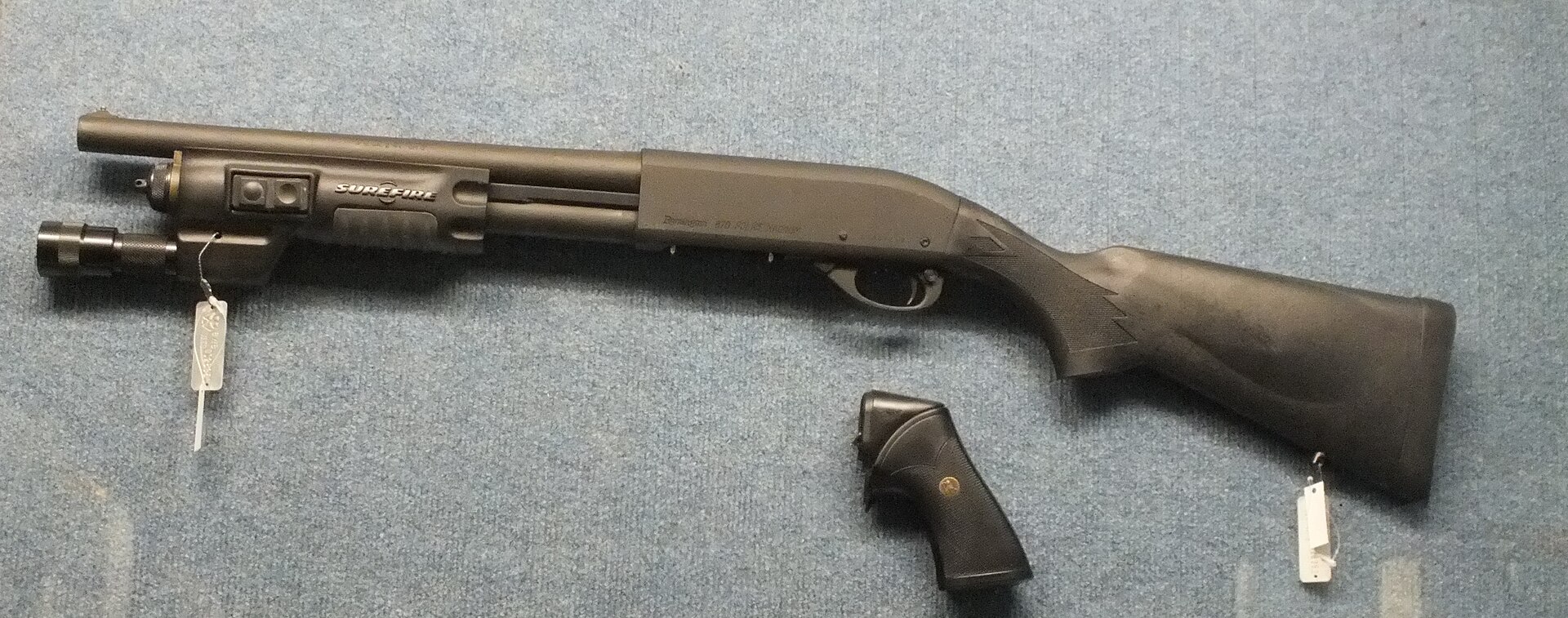
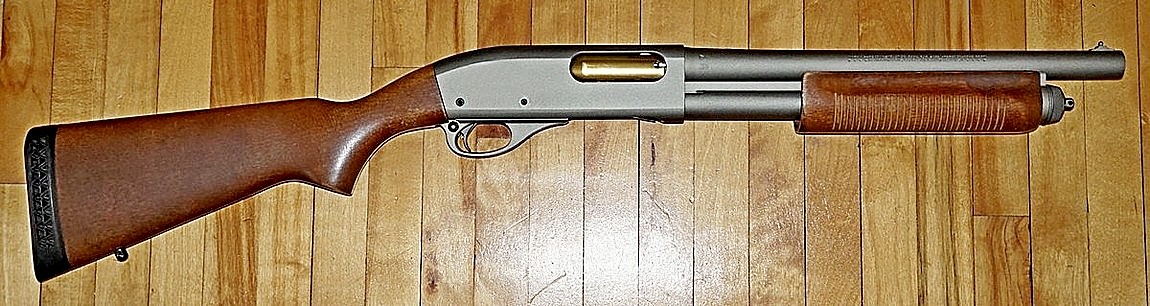
The Model 870 has been sold as a dozen lines and hundreds of configurations, but three of them carry the argument about its quality. The Wingmaster is the original blued-and-walnut gun of 1950. The Express, introduced in 1987, is the lower-cost line that sold in the millions. The Police gun, the 870P, is the one built for agencies. The gun documented in these volumes is an Express Tactical, so the question this volume answers is a practical one: what exactly was cheaper about an Express, and does any of it matter?
The volume then takes up the two corporate events that bear on an owner today: the trigger class action that reached most of Remington’s rifles but not this shotgun, and the 2020 bankruptcy that put the 870 in the hands of a new company.
2.1 Three Lines, One Design
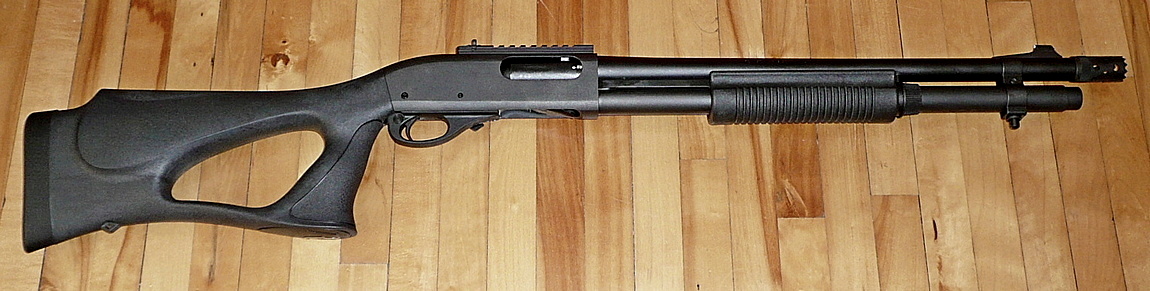
Field & Stream’s account of the Express is the one usually quoted: “A budget version of the 870, it had a hardwood stock in place of walnut and a lower level of polish inside and out, but in all other ways it was identical to the original.”1 That was true of the design. It turns out not to be true of every part, and the evidence for that is Remington’s own.
2.2 The Document at the Centre
In 2005 Remington’s military and law-enforcement website published a single page titled “Important differences between Remington 870 Police and 870 Express shotguns”. Its file name carries the date 30 June 2005, and the Internet Archive holds a copy captured in February 2008.2 It was written to persuade agencies not to buy the cheaper gun, and should be read as a sales document. It is also the only place the maker listed, in one place and in its own words, what the Express did without.
It opens by defending the Express:
“The 870 Express has been an important part of Remington’s offering to the sporting market. It was designed to meet a price point in the commercial market while still providing classic 870 functionality. All of Remington’s 870’s have interchangeable parts, even if they have cosmetic differences.”2
Then it lists the differences. They are reproduced here in full, rearranged into a table, with Remington’s wording kept.
Table 1 — The Document at the Centre
| 870 Express | 870 Police | |
|---|---|---|
| Build | Standard production | ”special 23 station check list”; assembled in a “special build area” at Ilion, secured, “with the same factory personnel working at that assignment each shift”; “All parts … visually inspected by hand” |
| Magazine spring | Standard | ”longer magazine spring which ensures positive feed and function” |
| Sear spring and trigger | Standard | ”heavier sear spring … reliable, positive trigger pull between 5 and 8 lbs” |
| Carrier dog spring | Standard | ”heavier carrier dog spring” so the elevated shell is “held there until the bolt can push it into the chamber” |
| Safety | ”ISS (Integrated Safety System) which is a locking mechanism on the safety of commercial shotguns" | "standard, proven, cross bolt safety” without the key lock |
| Fore-end | ”longer and not compatible with many police shotgun vehicle racks” | Shorter; SPEEDFEED stocks and fore-ends |
| Magazine extension | ”will not allow for the addition of an extension tube without physical modification to the tube and barrel, which can nullify the warranty” | Not stated |
| Finish | ”BEAD BLAST BLUE" | "High Luster bluing or Parkerization” |
| Trigger housing | ”synthetic" | "compressed metal” |
| Barrel lock-down | ”a lesser grade ‘synthetic magazine spring retainer’ lock down" | "‘ball detent’ system in conjunction with the magazine cap” |
| Receiver | Standard | “‘vibra honed’ to smooth out rough finishes and remove burrs” |
| Extractor and ejector | ”powdered metal cast" | "machined” |
Every row after the first is a place where the Express saved money. Most of them are springs, finishes and inspection, which an owner can match or improve. Three of them go to the durability of specific parts, and they are the three the quality argument is really about.
2.3 Powdered Metal: What the Maker Actually Said
The claim most often made about the Express is that its small parts are “MIM”, metal-injection-moulded. Remington’s 2005 page does not use that term. It says the Express extractor and ejector are “powdered metal cast”, against “machined” parts in the Police gun.2
The distinction matters for what can be claimed. Metal injection moulding is one powder-metallurgy process among several; press-and-sinter is another. “Powdered metal cast” identifies the family, not the process, and no Remington document located for this dive says which process was used or for which years. What the maker’s own document establishes is narrower and firmer:
- by mid-2005, the Express extractor and ejector were powder-metal parts, and the Police gun’s were machined;
- Remington regarded that as a difference worth telling agencies about;
- and Remington also said the parts are interchangeable across the 870 line, so the machined part fits the Express.
The extractor is the part this bears on. It is a small spring-loaded claw at the right edge of the bolt face, held by a plunger and spring (Volume 3), and it takes the full shock of ripping a fired hull out of the chamber on every stroke. It is the first thing to suspect when a gun starts leaving hulls in the chamber, and Volume 4 treats it as the owner’s most likely repair. Whether a particular Express Tactical left the factory with a powder-metal or a machined extractor, and whether that changed after 2005, could not be established from any maker document; it can be established on the gun by looking at the part (Volume 7 lists it as an owed photograph).
2.4 Bead-Blast Blue and the Rust Reputation
The Express is widely said to rust faster than other 870s. No maker statement, test or published comparison supporting that was located in this work, and the claim is therefore not made here as fact. What is documented is the finish. Remington described the Express finish as “bead blast blue”, and the Police finishes as “High Luster bluing or Parkerization”.2
A reading of that difference, offered as reasoning rather than as a sourced finding: bluing is a thin conversion coating with little corrosion resistance of its own, and it depends on the oil film it carries. A polished blued surface is smooth; a bead-blasted surface is textured, with more real surface area and a matte texture that is easy to leave dry. Parkerizing, a phosphate coating, is porous by design so that it holds oil. On that reading, a bead-blast blue gun needs oil where a Parkerized gun holds it, and an owner who treats the matte Express like a Parkerized service gun will see rust sooner. That is consistent with the reputation; it is not proof of it.
The owner’s manual gives the practical rule for any 870: “A thin coat of oil is all that is needed to prevent the possibility of rusting”, with storage requiring the gun to be “carefully cleaned and thoroughly oiled” and outside surfaces “wiped with a light coat of oil occasionally”.3 Volume 4 turns that into a routine.
The current RemArms page lists the ghost-ring model’s receiver finish only as “Matte Black”, without saying how it is produced.4 The finish on the gun documented here is not recorded.
2.5 Chambers, Trigger Housings and the Magazine Tube
Chambers. Field & Stream’s gun editor writes that “Sometime in the early 00s, 870 Express quality control slipped. The most common problem you see in those guns is fired shells sticking in poorly finished chambers, most often with inexpensive target loads”, and that polishing the chamber or replacing the extractor usually cured it.1 That is the testimony of an experienced writer rather than a maker’s admission or a measured survey, and it is attributed as such. It is consistent with the 2005 list in one respect: the Police gun’s receiver was “vibra honed” to remove burrs, which says Remington knew where roughness lived.
Trigger housing. The Express trigger plate is “synthetic”; the Police gun’s is “compressed metal”.2 The trigger plate carries the hammer, sear, trigger, connectors, carrier and action-bar lock, and it is retained by two pins through the receiver (Volume 3). A polymer plate is not in itself a defect: the plate is not a pressure-bearing part. It is a wear consideration at the pin holes and the carrier pivot, and it is the reason aftermarket aluminium plates exist. Whether the gun documented here has a polymer or a metal plate is not recorded.
The magazine tube. The 2005 list says the Express “will not allow for the addition of an extension tube without physical modification to the tube and barrel”, and that its barrel is held by a “synthetic magazine spring retainer” rather than the Police gun’s ball detent.2 The current owner’s manual explains the first point without meaning to: it describes two kinds of magazine spring retainer, one with a round hole that pries out, and one with a slot that is pushed in and turned 90 degrees to lock against “the detents on the top and bottom of the magazine tube”.3 Those detents are dimples pressed into the tube, and an extension that screws onto the tube’s end has to pass them. That is the physical modification Remington meant, and it is where the phrase “dimpled magazine tube” comes from. Volume 4 separates it from the unrelated problem of a tube that has been dented.
The Express Tactical documented here left the factory with its two-shot extension already fitted, so the Express’s resistance to extensions was solved at the factory for this model.5 How Remington fitted it, and whether the tube still carries the detents, is not stated in any source located.
2.6 The Quality Argument, Argued
Put together, the evidence supports a narrower conclusion than either side of the usual argument.
What is established. The Express is the 870 design, with parts Remington said are interchangeable across the line. It saved money on finish, inspection, springs, the trigger-plate material, the barrel lock-down, and — by Remington’s own statement — on a powder-metal extractor and ejector. A period of poor chamber finishing in the early 2000s is reported by a credible writer.
What is not established. That the Express rusts faster (plausible from the finish, not shown); that its powder-metal parts fail at a measurable rate (no failure data located); that quality returned to any particular standard in a particular year (Field & Stream says it improved, without a date that can be pinned).
What follows for an owner. Nothing in the list touches the locking system, the barrel extension or the receiver’s job, which Volume 3 shows is to guide and not to hold pressure. Every item on the list is a part or a finish that can be inspected, replaced with the Police-grade equivalent, or maintained. An Express that feeds, extracts and ejects cleanly with the loads it will be used with, and whose chamber releases a fired hull without a fight, has passed the only test that matters. One that does not is a known list of suspects, in a known order: chamber, extractor, and then the springs Remington itself upgraded for police use.
2.7 The Police Gun in Service
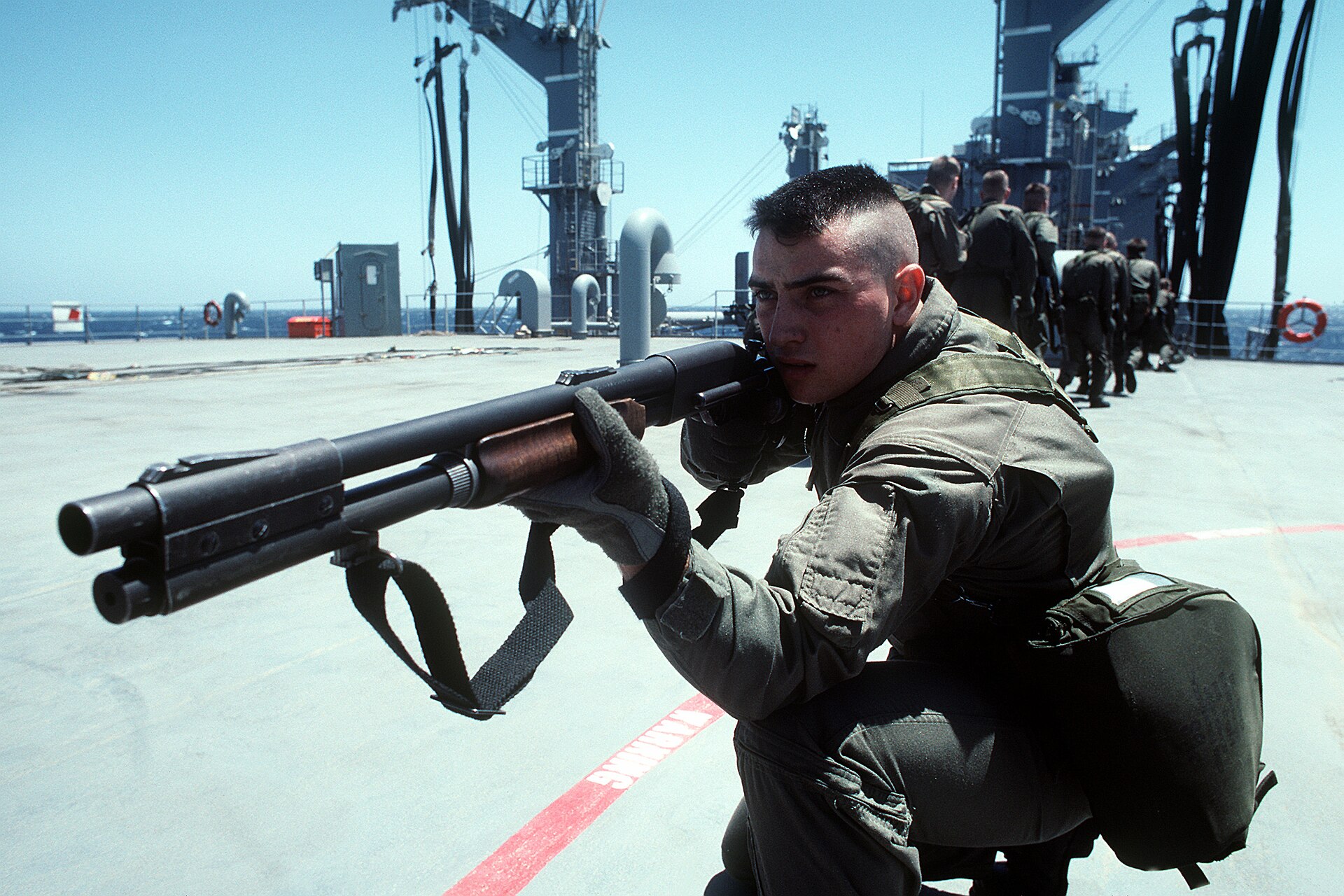
The Police line is how the 870 went to war. The reference literature lists the US military designation M870 and the British L74A1, among dozens of military and police users; the Remington Military site of 2010 advertised the 870P as “the pump shotgun of choice for government agencies”, with “dual, non-binding action bars”.67
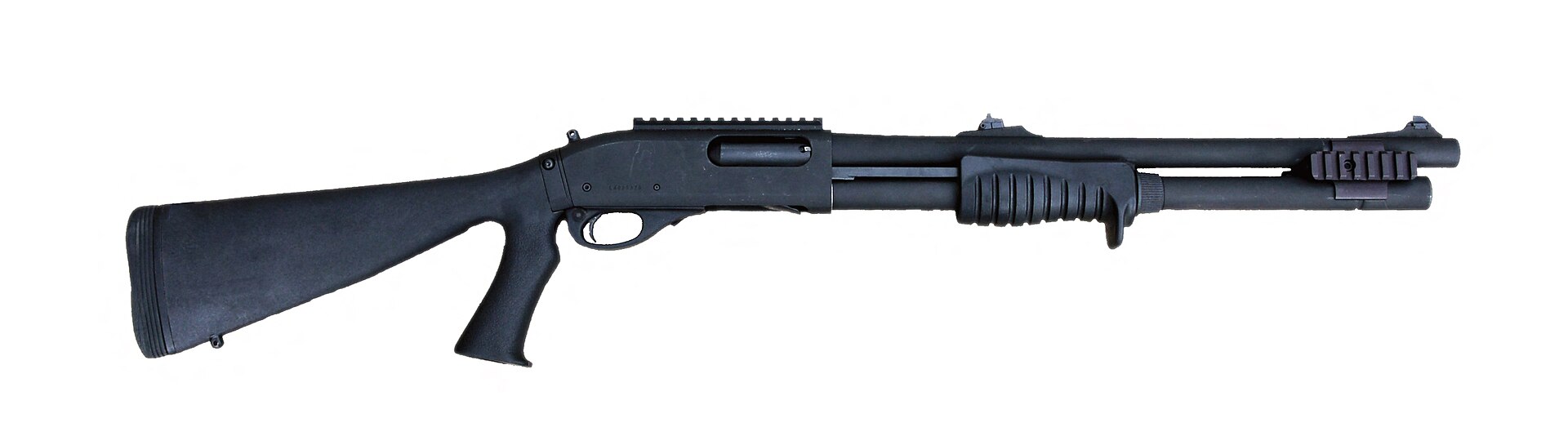
The most unusual military variant is the Modular Combat Shotgun, which the US Air Force describes as having a primary function of “Anti-personnel, breaching and less-than-lethal”, with a length of 35.75 inches, a weight of 7.3 pounds and a “Maximum effective range: 68 meters”.8 Remington’s military site described the MCS as a system of interchangeable barrels, magazine extensions and stocks built on one 870 receiver; that page is archived but was not read in full here.
2.8 The Walker Trigger Settlement: the 870 Was Not In It
Remington’s best-known legal history concerns the trigger of its bolt-action rifles, and the hub’s Remington 700 dive documents it from the court record: the 2013 class action over the “Walker Fire Control”, the 2014 X-Mark Pro recall, and the 2017 final approval of the settlement in Pollard v. Remington Arms Co. That material is not restated here.
The question for this dive is whether the 870 was ever part of it. It was not. The amended complaint, as the court summarised it, sought relief for “all Model 700, 721, 722, 725, Seven, Sportsman 78, 600, 660, 673, XP-100, 710, 715 and 720 firearms” with trigger mechanisms using a connector, plus the X-Mark Pro Model 700 and Seven, and the settlement classes and their valuations list the same rifle models together with the Model 770.9 A search of the full text of the court’s opinion for “870” and for “shotgun” returns nothing.
One detail explains why the question gets asked. The 870’s fire control also contains parts called connectors — the RemArms parts list has a “Connector, Left” and a “Connector, Right”, and the 1953 patent describes a “connector assembly” with right and left arms.310 But it is a hammer-fired trigger plate descending from Crittendon’s own 1949–1951 fire-control patents, not the Walker bolt-action mechanism, and the class was defined by model, not by the word “connector”. No separate 870 recall or 870 class action was located in this work; that is recorded as “none located”, not as proof that none exists.
2.9 2020: the Bankruptcy and the Split
The corporate sequence is given as the reference literature gives it, with the underlying reports named, because the primary court filings were not read for this dive.1112
Table 2 — 2020: the Bankruptcy and the Split
| Date | Event | As reported by |
|---|---|---|
| 1993 | DuPont sells Remington to Clayton, Dubilier & Rice | New York Times, 22 October 1993 |
| June 2007 | Cerberus Capital Management acquires Remington; it becomes part of Freedom Group | New York Times, 6 April 2007 |
| 2015 | Freedom Group renamed Remington Outdoor Company | Reference literature |
| 2018 | First Chapter 11 filing; the company emerges | USA Today, 13 February 2018 |
| 28 July 2020 | Second Chapter 11 filing; assets sold to several buyers | New York Times, 28 July 2020 |
| 2020 | Firearms business, excluding Marlin, sold to Roundhill Group, LLC, and operated as RemArms, LLC; the Remington brand and the ammunition plant go to Vista Outdoor; Marlin goes to Sturm, Ruger | Time, 18 August 2022; Reuters, 28 September 2020; Ruger, 30 September 2020 |
| Early 2021 | RemArms obtains a federal firearms licence and resumes production at Ilion | Times Telegram, 8 January 2021 |
| November 2021 | RemArms announces a move of its headquarters to LaGrange, Georgia | Reference literature |
| March 2024 | RemArms operations at Ilion end, with roughly 250 to 300 employees affected | Spectrum News, 4 March 2024 |
The maker’s own documents confirm the brand arrangement. The back cover of the current 870 manual, and the footer of every RemArms web page, carry the notice that the Remington marks “are licensed trademarks owned by Ammunition Operations, LLC and are used under license and Ammunition Operations, LLC is not a manufacturer, endorser, or seller of any products manufactured or sold by Remarms, LLC”.34 The name on the receiver is licensed; the company that makes the gun is RemArms.
2.10 What Changed Under RemArms, and What Did Not
What did not change, from primary documents.
- The catalogue item. Remington’s 2012 page lists the ghost-ring Express Tactical as order number 81198: 18½-inch barrel, 38½ inches overall, 7½ pounds, Rem Choke, XS ghost-ring rail on the receiver, two-shot extension. The RemArms page of 2026 lists SKU R81198 with the same barrel length, overall length, weight, sights and capacity.134
- The manual. The current owner’s manual is form RD 7058, revised May 2026. Its disassembly, reassembly and lubrication instructions are those used throughout Volume 4.3
- The design. The parts list names the same parts the 1950 patents describe: two shell latches, a carrier and carrier dog, a locking block, connectors, a sear and a hammer.310
What changed, from primary documents.
- The name. “Express” does not appear in the RemArms 870 catalogue. Field guns are sold as Fieldmaster and the tactical guns as Synthetic Tactical, alongside the Wingmaster.4
- The warranty. RemArms states that it “has elected not to provide any written-warranty, either ‘limited’ or ‘full’, rather than to attempt to comply with the provisions of the Magnuson-Moss Act”, leaving only the implied warranties of state law, and that firearms returned for service “will be evaluated to determine if services will be provided at a fee or free of charge”.14
- The service network. Repairs go through RemArms directly or through independent “Remington Full-Service” facilities listed on the RemArms site, some of which list the 870 among their specialities; the list also marks shops run by a “REMARMs LLC Authorized Armorer School Instructor”.15
- The factory. Manufacture at Ilion, New York, where the 870 was designed and built from 1950, ended in March 2024 as reported. Where current 870s are made was not confirmed from a RemArms page and is not stated here.
What an owner of an older gun should take from this. A Remington-era 870 and a RemArms-era 870 are the same design with the same parts list, sold under different names by different companies. Parts for the older gun are sold by RemArms, and the manual’s warning applies to both: “USE ONLY REMINGTON PARTS IN REMINGTON FIREARMS.”3
2.11 What Could Not Be Verified
- Which powder-metal process Remington used for Express extractors and ejectors, and in which years; the maker’s word is “powdered metal cast”, and it is not equated here with MIM.
- Any rust-rate evidence for the Express finish. The finish description is the maker’s; the reputation is not tested here.
- A date for the end of the early-2000s chamber problem that Field & Stream reports.
- The primary bankruptcy filings. The corporate timeline rests on the news reports the reference literature cites.
- Where RemArms makes 870s after the Ilion closure.
- The finish, trigger-plate material and extractor type of the gun documented here (Volume 7, owed photographs).
References
Footnotes
-
Phil Bourjaily, “The Story of the Remington 870”, Field & Stream, https://www.fieldandstream.com/story/guns/history-of-the-remington-870/, page dated 23 January 2026, consulted 2026-09-19 — the Express’s hardwood and lower polish; the early-2000s chamber problem and its usual cures. ↩ ↩2
-
Remington Arms, “Important differences between Remington 870 Police and 870 Express shotguns”, http://www.remingtonmilitary.com/articles/870ExpvsPol6-30-05.pdf, archived by the Internet Archive on 16 February 2008 (https://web.archive.org/web/20080216043916/http://www.remingtonmilitary.com/articles/870ExpvsPol6-30-05.pdf), consulted 2026-09-19 through the shared fetch engine. Every quoted difference in this volume’s table is from this single page. ↩ ↩2 ↩3 ↩4 ↩5 ↩6
-
RemArms, LLC, Owner’s Manual — Model 870 & 870 Super Magnum Pump Action Shotguns, form RD 7058 Rev 0526 (document created 2021, revised May 2026), https://www.remarms.com/sites/default/files/2026%20Revised%20OMs/870%20Manual%20RD7058%20(REV%200526).pdf, consulted 2026-09-19 — lubrication and storage; the two magazine spring retainers and the tube detents; the parts list; the trademark notice; “USE ONLY REMINGTON PARTS IN REMINGTON FIREARMS”. ↩ ↩2 ↩3 ↩4 ↩5 ↩6 ↩7
-
RemArms, “Model 870 Synthetic Tactical Ghost Ring”, https://www.remarms.com/shotguns/tactical/model-870-synthetic-tactical-ghost-ring, and the Model 870 range page https://www.remarms.com/shotguns/pump-action/model-870/, consulted 2026-09-19. ↩ ↩2 ↩3 ↩4
-
Remington Arms, press release “Remington Expands Popular Model 870 Express Tactical Line” (2009), archived 13 February 2018 — the factory-installed two-round extension. ↩
-
“Remington Model 870”, English Wikipedia, wikitext consulted 2026-09-19 — users table, including the US designation M870 and the UK designation L74A1. ↩
-
Remington Military, “870P” page, remingtonmilitary.com, archived 18 October 2010 — “the pump shotgun of choice for government agencies”; “dual, non-binding action bars”. The same site’s “Part/Tech Manuals” page of the same date reads “Coming Soon…” behind a login. ↩
-
US Air Force, image description for “MCS 870 Modular Combat Shotgun”, 3 February 2012, via Wikimedia Commons, https://commons.wikimedia.org/wiki/File:MCS_870_Modular_Combat_Shotgun_(7414624938).jpg — primary function, length, weight and maximum effective range as quoted. ↩
-
Pollard v. Remington Arms Co., 320 F.R.D. 198 (W.D. Mo. 2017), order of 14 March 2017 granting final approval, https://www.courtlistener.com/opinion/8793105/pollard-v-remington-arms-co/, consulted 2026-09-19 — the amended complaint’s model list; the settlement classes and valuations. The full opinion text was searched for “870” and “shotgun” with no match. ↩
-
L. R. Crittendon and P. R. Haskell, US Patent 2,645,873 (filed 31 January 1950, issued 21 July 1953) — the connector assembly with right and left arms, and the fire control’s descent from US 2,570,772. ↩ ↩2
-
“Remington Arms”, English Wikipedia, wikitext consulted 2026-09-19 — the corporate timeline and the news sources cited for each step. ↩
-
“RemArms”, English Wikipedia, wikitext consulted 2026-09-19 — Roundhill Group; the federal licence and Ilion restart in 2021; the LaGrange headquarters announcement; the Ilion closure in March 2024. ↩
-
Remington Arms, “Model 870 Express Tactical” product page, remington.com, archived 14 October 2012 — order number 81198 and its specification row. ↩
-
RemArms, “Firearm Warranty Information”, https://www.remarms.com/support/firearm-warranty-information/, consulted 2026-09-19. ↩
-
RemArms, “Find Authorized Parts & Repair Centers”, https://www.remarms.com/support/find-authorized-parts-and-repair-centers, consulted 2026-09-19. ↩
.jpg)
Comments (0)