Remington 870 Express Tactical · Volume 1
Origins — Four Engineers, a Patent Family, and the Best-Selling Shotgun Ever Made
Why Remington replaced the Model 31 in 1950, what the 1950 patents say the design was for, and three production figures that do not agree
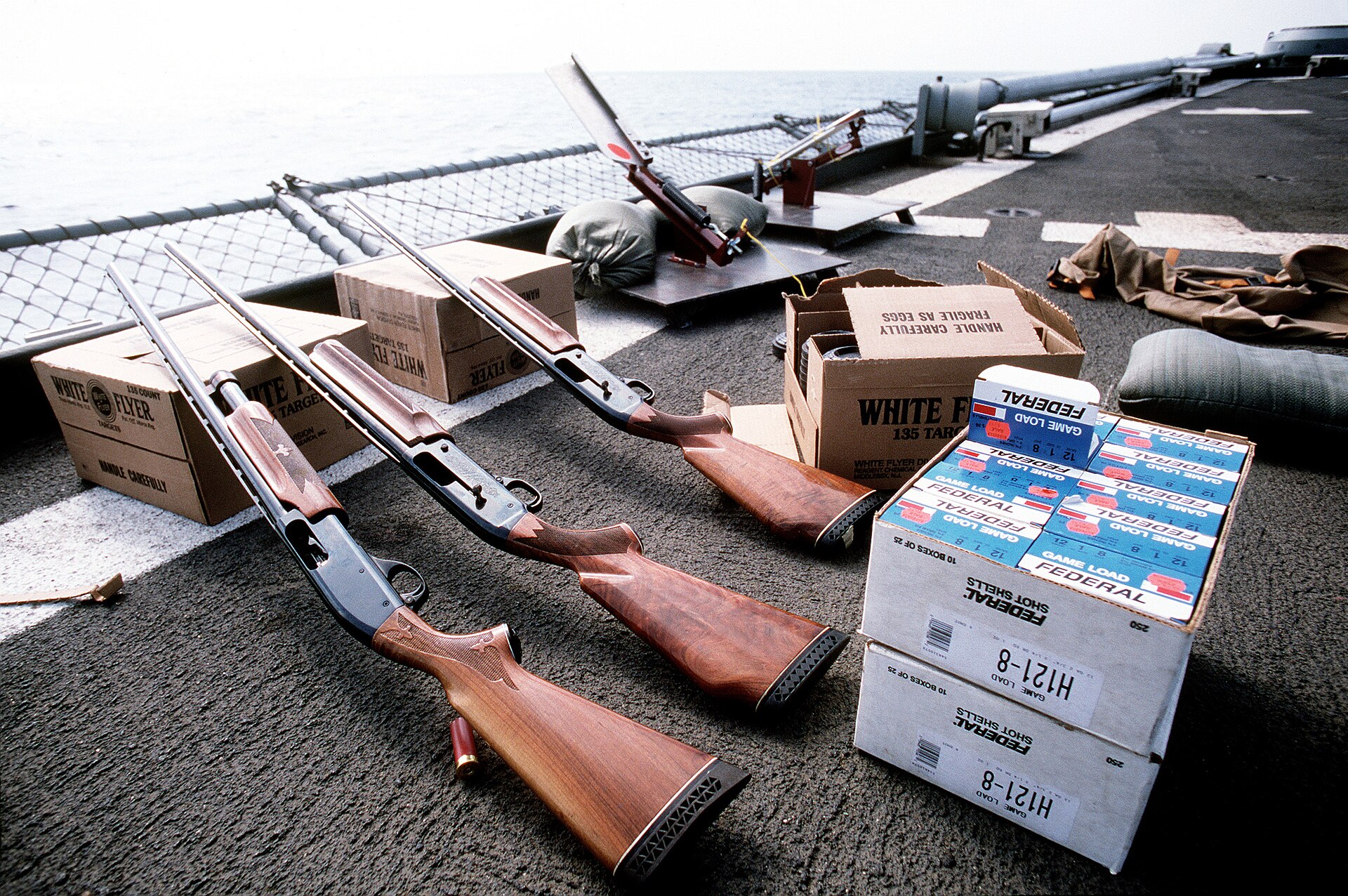
The Remington Model 870 is a 12-, 16-, 20-, 28-gauge and .410 bore pump-action shotgun introduced in 1950 and still in production. Its current maker calls it “the greatest selling pump action shotgun in the history of firearms”, and the claim is not seriously disputed.1 It has been a duck gun, a trap gun, a police car gun, a Navy boarding-party gun and a home-defence gun, often in configurations that share nothing visible except the receiver.
The shotgun documented in these volumes is one of the tactical configurations: an 870 Express Tactical with an 18½-inch barrel and XS ghost-ring sights, fitted, as documented in September 2026, with an aftermarket forend, an adjustable AR-pattern stock and a micro red dot. Its configuration, and what is planned for it, is set out in Volume 7. This volume is about the pattern: where the design came from and what its designers said they were trying to do.
1.1 What These Volumes Argue
Four claims run through the seven volumes. Each rests on a primary document, and each corrects something commonly said about the gun.
The 870’s receiver is not its pressure vessel. The bolt locks to an extension on the barrel, not to the receiver. The 1950 patent says so in plain terms, and adds that because of it “the receiver design or material specification is not particularly critical” (Volume 3). A good deal of what is said about aluminium-receiver clones and about the Express’s finish reads differently once that is understood.
The Express-versus-Police quality argument has a primary source, and it is Remington’s own. In 2005 Remington’s military and law-enforcement division published a one-page list of how its Police shotguns differed from the Express. It names the Express’s “powdered metal cast” extractor and ejector, its “bead blast blue” finish, its synthetic trigger housing and its magazine-tube lock-down (Volume 2). The quality debate can be argued from that page instead of from forum memory.
“The 870 jam” is described in the maker’s own manual, and the manual’s word is “over”, not “under”. It is a shell that has slipped past the shell latch and back over the carrier. RemArms prints the cause and the two remedies (Volume 3), and its current product pages list the “Flexi Tab” carrier as the fix.
The 870 was never part of the Walker trigger settlement. The class action that reached some seven and a half million Remington rifles named its models one by one, and the 870 is not among them. The hub’s Remington 700 dive covers that settlement; Volume 2 of this dive records only the check.
1.2 The Shotgun in One Table
Specifications for the catalogue item documented here, from the maker’s own pages. The same order number, 81198, appears on Remington’s 2012 page and as SKU R81198 on the RemArms page of 2026, which is itself a piece of evidence about what the 2020 bankruptcy did and did not change (Volume 2).23
Table 1 — The Shotgun in One Table
| Model | 870 Express Tactical with XS Ghost Ring Sights (Remington, 2009 onward); now listed by RemArms as “Model 870 Synthetic Tactical Ghost Ring” |
| Order number | 81198 (Remington, 2012); R81198 (RemArms, 2026) |
| Gauge and chamber | 12 gauge, “2 ¾” or 3"" shells |
| Operation | Manual pump action; twin action bars; tilting locking block engaging a barrel extension |
| Barrel | 18½ in, “carbon steel, hammer-forged” (2009 release), with an “extended ported Tactical Rem Choke” |
| Choke | Listed by RemArms as “Tactical Cylinder Choke” |
| Capacity | 6 in the magazine with “the factory installed 2-shot extension”, 7 in all |
| Overall length | 38½ in; “40 ½” (with choke)” on the RemArms page |
| Average weight | 7½ lb |
| Sights | XS blade front; XS ghost-ring rear on a Picatinny rail that “mounts to receiver” and “accepts optics and sight systems as well” |
| Receiver | ”milled from a solid block of billet steel”, drilled and tapped |
| Stock (factory) | Black synthetic, 14 in length of pull; replaced on the gun documented here (Volume 7) |
| Anti-jam carrier | ”Flexi Tab - Anti jam system” (RemArms page) |
⚠ The owner’s record lists the barrel as 18 inches. Remington catalogued the ghost-ring Express Tactical only with the 18½-inch barrel, and Remington’s earlier 18-inch tactical guns were a different, bead-sighted, fixed-cylinder line (see the dates below). The most likely reading is that the record rounds 18½ down. The barrel should be measured and the muzzle checked for a choke tube; Volume 7 carries this as an open question, and it matters for Volume 6’s buckshot discussion and for the federal barrel-length threshold.
1.3 Before the 870: Three Pumps and an Expensive Problem
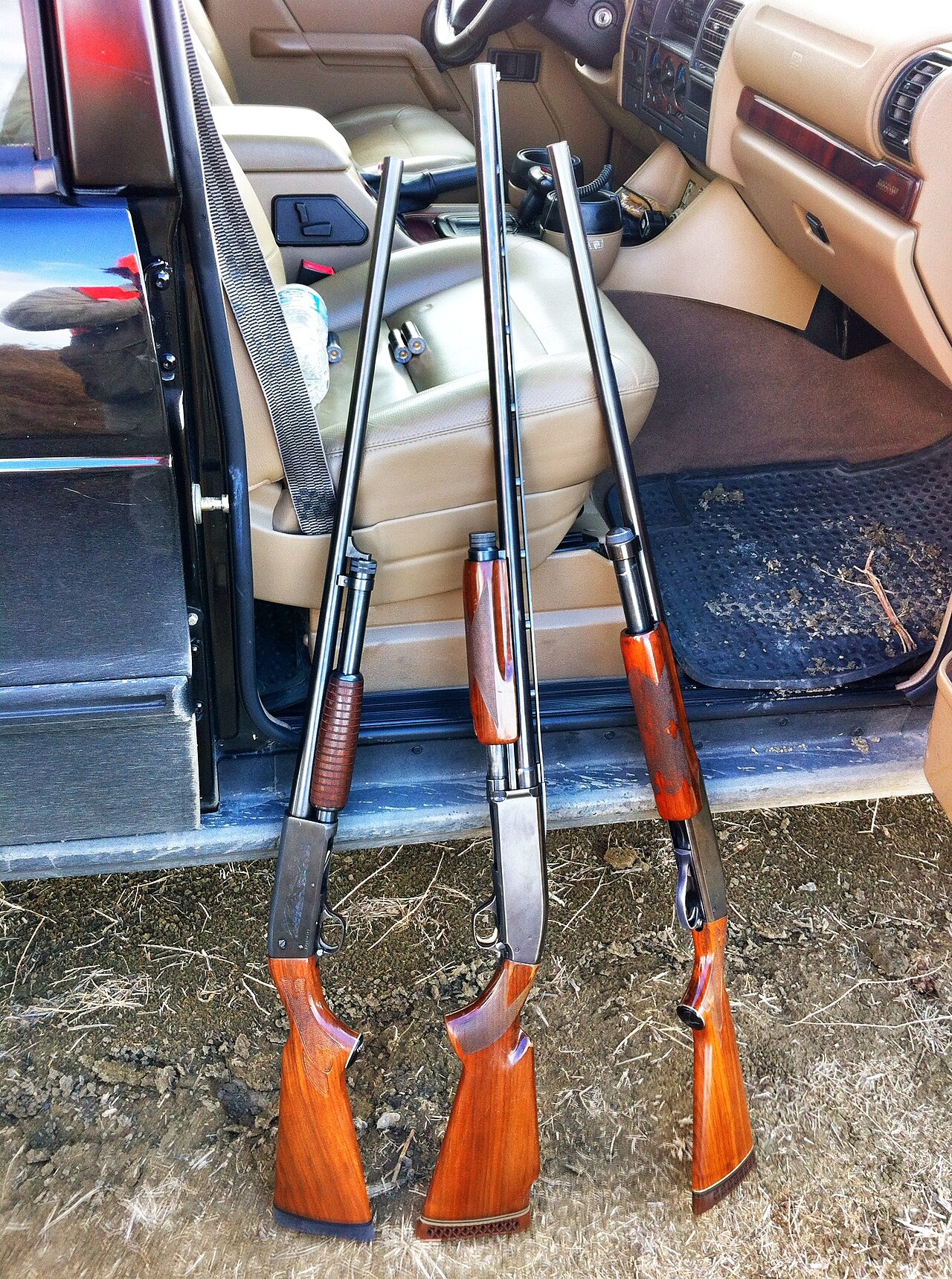
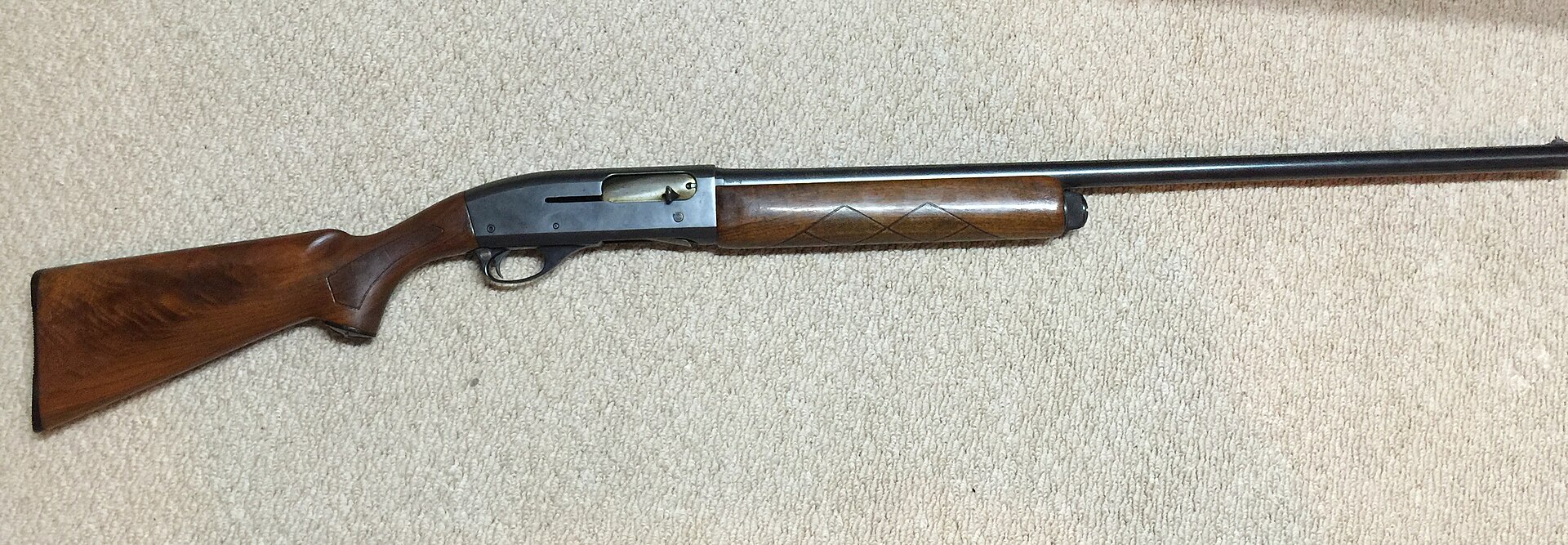
The 870 was not Remington’s first pump gun. The reference literature places it as the fourth major design in a series. John Pedersen designed the Model 10 and its successor the Model 29; John Browning designed the Model 17, which Ithaca later adapted as the Model 37; and the Model 17 was the basis of the Remington Model 31.4
The Model 31 is the problem the 870 was built to solve. The same account describes it as a well-received gun marketed as the “ball-bearing repeater”, whose “many machined and hand-fitted parts made the gun expensive to manufacture”, and which “struggled in sales compared to the Winchester Model 12”.4 Remington’s answer in 1950 was a gun that was, in that account’s words, “more modern and reliable in its construction, easy to take apart and maintain, and relatively inexpensive”.4
Field & Stream’s history of the gun gives the price that made the point: “The AP model sold for $69.95, about $15 less than a Winchester Model 12.”5 The Winchester is the benchmark throughout the early story. It was the premium pump of the period, and the 870 was designed to be cheaper to make than either it or the Model 31 without looking or shooting like a cheap gun.
These lineage statements come from secondary sources and are attributed accordingly. The primary evidence for what the 870’s designers were trying to do is their patents, which say it in their own words.
1.4 The Patent Family of 1950
RemArms credits four designers: “L.Ray Crittendon, Phillip Haskell, Ellis Hailston, and G.E. Pinckney”.1 The United States patents filed for the new gun carry the first two names. The central application was filed on 31 January 1950 and was later divided into three patents; a fire-control patent filed the following year completes the family.6789
Table 2 — The Patent Family of 1950
| Patent | Title | Inventors | Filed | Issued |
|---|---|---|---|---|
| US 2,645,873 | Slide-actuated firearm with tilting locking block | Lexie R. Crittendon, Philip R. Haskell | 31 Jan 1950 | 21 Jul 1953 |
| US 2,719,375 | Firearm with a pair of action bars (division of the above) | Crittendon, Haskell | 31 Jan 1950 (original) | 4 Oct 1955 |
| US 2,780,881 | Firearm ejector (division of the above) | Crittendon, Haskell | 31 Jan 1950 (original) | 12 Feb 1957 |
| US 2,675,638 | Fire control for firearms | Crittendon | 6 Jan 1951 | 20 Apr 1954 |
All four are assigned to Remington Arms Company, Inc., of Bridgeport, Connecticut. The inventors are given as of Ilion, New York, in the 1953 patent, and as of Wilmington, Delaware, and Fairfield, Connecticut, in the later divisions.67
No patent in Ellis Hailston’s or G. E. Pinckney’s name was located for the 870’s own mechanism in this work. Hailston appears as inventor on later Remington patents, including a 1955 filing for a “rockable breech bolt locking block” and gas-operation patents of 1956 and 1959, which fits RemArms’s credit but does not document his part in the 1950 design.10 Their roles are therefore recorded here as RemArms records them, without elaboration.
The patents themselves are drawn around a shotgun that is recognisably the 870: a takedown barrel held by a magazine cap, two action bars brazed to a sleeve under the fore-end, a slide carrying the bolt, a tilting locking block, two shell latches in grooves in the receiver walls, and a trigger plate held by two pins. Volume 3 works through the mechanism from them.
1.5 What the Designers Said They Were Building
A patent is a legal document, but its opening paragraphs state what the inventors were trying to achieve, and the 870’s are unusually direct.
“The principal object of this invention is the production of a firearm action which may be operated smoothly and with certainty that it will be free from malfunctions. It is a basic requirement that this object be achieved without in any way sacrificing existing standards of safety and fine appearance. A further object is the production of a firearm which can be manufactured with greater economy and one which utilizes to the greatest extent parts and tooling which are interchangeable throughout a series of gauges and with companion models.”6
Three things in that paragraph shaped everything that followed.
Economy was an explicit design object, alongside reliability. The Model 31’s hand-fitting is the thing being designed out. The takedown section of the same patent makes the commercial point about barrels: with most takedown guns of the time, changing barrels meant changing “the magazine tube, fore-end, and action bar assembly” as well, while on the new design a shooter who wants “a long full choke barrel and a shorter open bored barrel” buys only a barrel.6 That is still true, and it is why 870 barrels are a market of their own.
Interchangeability “with companion models” was designed in. The fire-control patent’s application history runs back through a 1949 Crittendon patent for a recoil-operated gun, US 2,570,772, and the 1953 patent says the new gun’s fire control is “in most respects, identical in parts and in operation” with it.6 The reference literature puts it the other way round: the 870’s basic fire control “was first used in the automatic 11-48”.4 A 1951 Crittendon patent for a rotating-bolt rifle states the family strategy outright: the designers had “used almost, without change, the fire control assembly” of the 1951 fire-control application, because “any single part requires the production of a sufficiently large number of units to justify the most efficient production tooling.”11
“Fine appearance” was a requirement, not an afterthought. The same patent that sets out to make the gun cheaper insists that the savings must not cost it its looks. The 870 was a blued, walnut-stocked gun for the first thirty-seven years of its life, and the Express that broke that pattern in 1987 is the subject of Volume 2’s quality argument.
1.6 to 2009: the Dates
The dates below are attributed to the source that carries them. Where sources differ, both are given.
Table 3 — 1950 to 2009: the Dates
| Date | Event | Source |
|---|---|---|
| 1950 | Introduced | RemArms (“Introduction Year: 1950”); Field & Stream (“debuted in 1950”) |
| 1951 | Production date given as “1951–present” | English Wikipedia, citing Remington’s 2009 model history page |
| 1955 | 3-inch magnum 12 gauge added | Field & Stream |
| 1960 | Magnum 20 gauge (“five years later”) | Field & Stream |
| 1969 | 28 gauge and .410 on a new scaled-down receiver | English Wikipedia |
| 1972 | 20-gauge Lightweight on the small receiver | English Wikipedia |
| 1986 | Rem Choke screw-in chokes, first in 12 gauge at 21, 26 and 28 inches | English Wikipedia, citing the 1986 Remington catalogue |
| 1987 | The Express introduced | Field & Stream |
| 2007 | ”Model 870 Tactical” line, 18- and 20-inch fixed-cylinder barrels with magazine extensions | Remington press release, 2006 |
| 2009 | Express Tactical with XS Ghost Ring Sights and a gray powder-coat Express Tactical, “New for 2009” | Remington press release, 2009 |
| 13 April 2009 | Ten-millionth 870 produced | English Wikipedia, citing Field & Stream |
The 1950 and 1951 dates are compatible: an introduction in 1950 and a first full year of production in 1951 fit both. Neither source says so, and the reconciliation is offered as a reading, not a finding.
1.7 How Many: Three Figures, Given Separately
Three kinds of number circulate for the 870’s production total, and they are not measuring the same moment.
Table 4 — How Many: Three Figures, Given Separately
| Figure | As of | Source |
|---|---|---|
| 2 million | 1973 | Wallack, “Sixty Million Guns” (1983), as cited in the reference literature; “ten times the number of Model 31 shotguns it replaced” |
| 3 million | 1983 | Same |
| Over 7 million | 1996 | Reference literature, attributing the growth to “sales of the basic ‘Express’ models” |
| 10 million | 13 April 2009 | Reference literature, citing Field & Stream |
| ”+10 million” | undated, current page | RemArms model history |
| ”over 11,000,000 made” | article dated 2026 | Field & Stream |
The RemArms page and the Field & Stream article are not in conflict so much as written at different times from different starting points. RemArms’s “+10 million” is a floor, and 11 million is the figure a writer uses a decade and more after the ten-millionth gun. No primary source for a current total was located, and none is asserted. Every figure above is attributed to whoever prints it.154
The 1996 attribution is the interesting one. If it is right, the Express, the cheap gun whose quality is argued about in Volume 2, is what carried the 870 from three million to seven.
1.8 The Family Tree the Rest of the Dive Uses
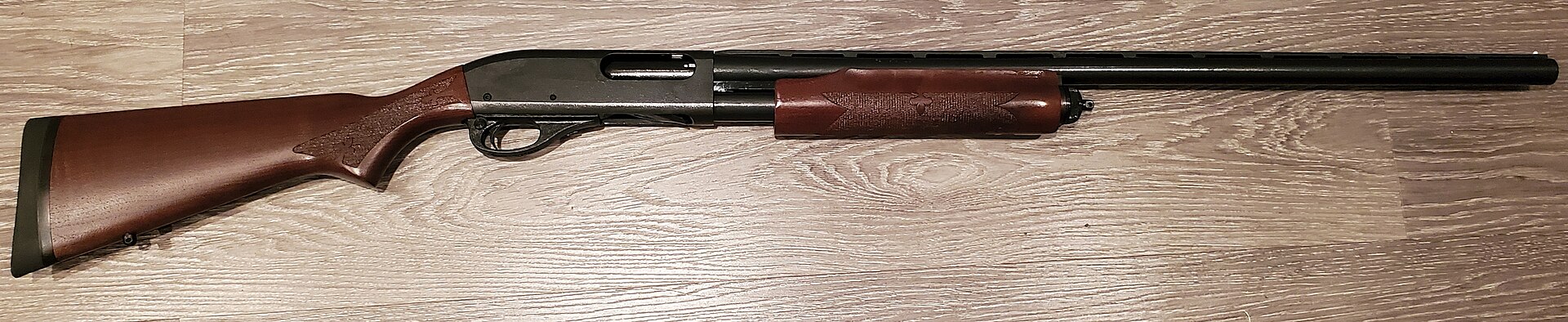
The 870 has been sold in hundreds of configurations. The dive uses four family names, defined as the makers use them.
- Wingmaster. The original line: polished blue, American walnut. RemArms still lists it.3
- Express. The lower-cost line, introduced in 1987 per Field & Stream, with “a hardwood stock in place of walnut and a lower level of polish inside and out”.5 Remington’s own 2005 account of how it differs from the Police gun is the core of Volume 2.
- Police (870P). The law-enforcement line, built in what Remington called a “special build area” at Ilion, and the source of most military 870s.12 The military designation M870 and variants such as the Modular Combat Shotgun appear in Volume 2.
- Tactical. A commercial line that Remington described in 2006 as “based on our law enforcement line”, first with fixed-cylinder barrels and later, from 2009, as the Express Tactical with the extended ported choke and optional ghost-ring sights.1314 The gun documented here is one of these.
RemArms, the company that has made the 870 since the 2020 bankruptcy, sells field guns as Fieldmaster and tactical guns as Synthetic Tactical. Volume 2 takes up whether anything but the name changed.
1.9 Reading Order
Table 5 — Reading Order
| Vol | Title | Read it for |
|---|---|---|
| 1 | Origins | the patents, the dates, and the production figures |
| 2 | Wingmaster, Express, Police — and Remington After 2020 | the Express quality argument from the maker’s own document, the bankruptcy, the trigger settlement check |
| 3 | How It Works | the twin action bars, the locking block, the shell latches, the fire control and the 870 jam |
| 4 | Keeping It Working | field strip and detail strip, maintenance, repair, and what an owner fixes |
| 5 | Forends, Stocks, Sidesaddles and Optics | the accessories on and planned for the gun documented here, and why each exists |
| 6 | Buckshot, Slugs, and the Pump Against the Semi-Auto | patterning from a cylinder barrel, slugs, and the comparison with the hub’s VR80 |
| 7 | The Gun Documented Here, and the Rules It Lives Under | the configuration as of September 2026, owed photographs, and the federal and Michigan limits |
References
Footnotes
-
RemArms, “Model 870 Historical Facts”, https://www.remarms.com/firearm-history/model-870-history, consulted 2026-09-19 — “Introduction Year: 1950”; the four designers; “Total Production: +10 million”; “The greatest selling pump action shotgun in the history of firearms”; gauges 12, 16, 20, 28 and .410. ↩ ↩2 ↩3
-
Remington Arms, “Model 870 Express Tactical” product page, remington.com, archived by the Internet Archive on 14 October 2012 — the 18½-inch barrel with “RC Tactical (ext/ported tube)”, the XS ghost-ring rail that “mounts to receiver”, “7 rounds … with the factory installed 2-shot extension”, and the specification row (7½ lb, 18½ in, 38½ in, Rem Choke, order number 81198). ↩
-
RemArms, “Model 870 Synthetic Tactical Ghost Ring”, https://www.remarms.com/shotguns/tactical/model-870-synthetic-tactical-ghost-ring, consulted 2026-09-19 — SKU R81198, capacity 6, “40 ½” (with choke), 38 ½"", 7½ lb, 18½ in, “Tactical Cylinder Choke”, 14 in length of pull, the receiver “milled from a solid billet of steel”, “Flexi Tab - Anti jam system”. The RemArms model list (Wingmaster, Fieldmaster, Synthetic Tactical) is from https://www.remarms.com/shotguns/pump-action/model-870/ on the same date. ↩ ↩2
-
“Remington Model 870”, English Wikipedia, wikitext consulted 2026-09-19 — the Model 10, 29, 17 and 31 lineage; the Model 31’s hand-fitting and its sales against the Winchester Model 12; the 1973, 1983 and 1996 totals (the first two cited to L. R. Wallack, “Sixty Million Guns”, 1983, in Gun Digest Treasury, 1994, p. 193); the ten-millionth gun on 13 April 2009; the fire control first used in the 11-48 (cited to Michalowski, The Gun Digest Book of Sporting Shotguns); the 1969 and 1972 small-receiver models; the 1986 Rem Choke; “1951–present” cited to Remington’s 2009 model history. Used as a map to other sources and attributed wherever relied on. ↩ ↩2 ↩3 ↩4 ↩5
-
Phil Bourjaily, “The Story of the Remington 870”, Field & Stream, https://www.fieldandstream.com/story/guns/history-of-the-remington-870/, page dated 23 January 2026, consulted 2026-09-19 — debut in 1950 replacing the Model 31; the $69.95 AP price against the Winchester Model 12; the 1955 3-inch magnum and the magnum 20 five years later; the 1987 Express and its hardwood and lower polish; the ten-millionth gun in 2009; “over 11,000,000 made”. The reference literature cites the same URL with a date of 27 July 2020, so the article has been revised. ↩ ↩2 ↩3
-
L. R. Crittendon and P. R. Haskell, “Slide-actuated firearm with tilting locking block”, US Patent 2,645,873, filed 31 January 1950, issued 21 July 1953, assigned to Remington Arms Company, Inc. Text and drawings via Google Patents, https://patents.google.com/patent/US2645873A/en, consulted 2026-09-19 — the objects quoted above; the takedown and barrel-interchangeability passage; the fire control “in most respects, identical” with US 2,570,772. ↩ ↩2 ↩3 ↩4 ↩5
-
L. R. Crittendon and P. R. Haskell, “Firearm with a pair of action bars”, US Patent 2,719,375, a division of application 141,532 of 31 January 1950, filed 7 January 1953, issued 4 October 1955. https://patents.google.com/patent/US2719375A/en ↩ ↩2
-
L. R. Crittendon and P. R. Haskell, “Firearm ejector”, US Patent 2,780,881, a division of application 141,532, filed 19 December 1952, issued 12 February 1957. https://patents.google.com/patent/US2780881A/en ↩
-
L. R. Crittendon, “Fire control for firearms”, US Patent 2,675,638, filed 6 January 1951, issued 20 April 1954, a continuation-in-part of application 79,368 of 3 March 1949 (US 2,570,772). https://patents.google.com/patent/US2675638A/en ↩
-
Google Patents inventor searches for Crittendon, Hailston and Haskell with assignee Remington, run 2026-09-19 — Hailston’s US 2,824,400 (“Rockable breech bolt locking block”, priority 19 January 1955), US 2,941,450 (1956) and US 3,058,400 (1959). No Pinckney patent was located. ↩
-
L. R. Crittendon et al., “Breech-loading magazine firearm”, US Patent 2,685,754, filed 12 September 1951, issued 10 August 1954 — the passage on reusing the fire control “almost, without change” and on production tooling. https://patents.google.com/patent/US2685754A/en ↩
-
Remington Arms, “Important differences between Remington 870 Police and 870 Express shotguns”, remingtonmilitary.com/articles/870ExpvsPol6-30-05.pdf (file dated 30 June 2005 by its name), archived by the Internet Archive on 16 February 2008 — the special build area at Ilion; the full list is quoted in Volume 2. ↩
-
Remington Arms, press release “Remington Model 870 Tactical Shotguns Now Available with Three Versatile Stock Designs and All-Black Platform” (for 2007), remington.com/news/2006, archived 13 February 2018 — “based on our law enforcement line”; Tac-2 and Tac-3 models with 18- and 20-inch barrels, “fixed cylinder choke”, two- and three-shot magazine extensions; the receiver “milled from solid steel” and drilled and tapped. ↩
-
Remington Arms, press release “Remington Expands Popular Model 870 Express Tactical Line”, remington.com/news/2009, archived 13 February 2018 — “New for 2009”; the XS ghost-ring model; “twin-action bars”; the two-round factory extension and seven-round capacity; the “18 1/2-inch carbon steel, hammer-forged barrel”; the “ported Extended Tactical Rem Choke tube”; receivers “milled from a solid block of billet steel”. ↩
Comments (0)