Remington 870 Express Tactical · Volume 6
Buckshot, Slugs, and the Pump Against the Semi-Auto
What an 18½-inch barrel with a cylinder tactical tube does with buckshot, what nobody has published about it, slugs through a smooth bore, and the 870 set beside the hub's VR80
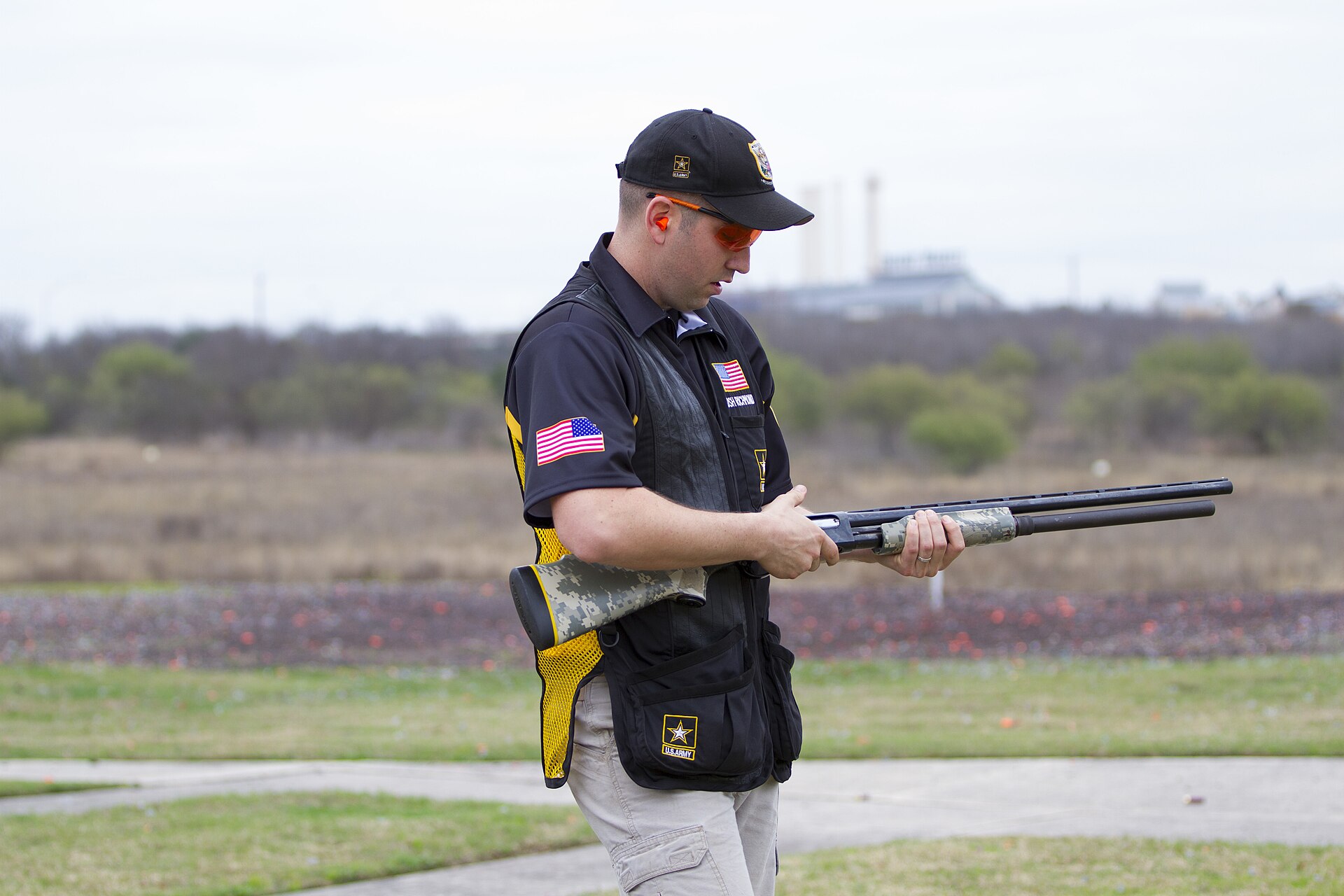
The Express Tactical documented here is a close-range gun by configuration: an 18½-inch barrel, a cylinder-constriction tactical tube, a red dot and a seven-shell capacity. This volume covers what that barrel does with buckshot and with slugs, and sets the pump action against the gas-operated semi-automatic that the hub documents in its RIA VR80 dive. Slug design, rifled chokes and sabots are that dive’s subject; this one links to it rather than repeating it.
6.1 The Barrel and the Tube
From the maker’s pages for the model (Volume 1):12
- Length: 18½ inches, “carbon steel, hammer-forged”.
- Chamber: 3 inches; “2 ¾” or 3"" shells.
- Muzzle: an “extended ported Tactical Rem Choke” tube, listed by RemArms as a “Tactical Cylinder Choke”. The overall length is given as 38½ inches without it and “40 ½” (with choke)”, so the tube projects about two inches beyond the muzzle.
Two rules from the manual govern what goes through it. “NEVER USE AMMUNITION WHICH EXCEEDS THE CHAMBER LENGTH SHOWN ON THE BARREL”, and, for any Rem Choke barrel, “NEVER fire the firearm without the choke tube installed.”3 The second matters on this gun because the tactical tube looks like a muzzle device rather than a choke, and it is the choke.
⚠ The owner’s record gives the barrel as 18 inches (Volume 1). The discussion below assumes the catalogued 18½-inch barrel and tactical cylinder tube; if the barrel turns out to be something else, the choke is the first thing to recheck.
6.2 What “Cylinder” Means, and What It Does Not Promise
A cylinder choke is no choke: the tube’s exit is the same diameter as the bore, and it neither squeezes nor opens the shot charge. That is the setting chosen for close-range buckshot and for full-bore slugs. The hub’s VR80 dive records that Rock Island’s own manual clears only its most open tube, the cylinder, for slugs, and marks its modified and full tubes “DON’T USE SLUGS!” (see VR80 Volume 4).
What a cylinder tube does not promise is a particular pattern. The pattern a load throws from a given barrel is a property of the load in that barrel. It has to be measured.
6.3 Buckshot: What Decides the Pattern
Four things decide how widely a buckshot charge spreads, and only one of them is the gun.
- The constriction, here none.
- The wad. Federal’s Personal Defense buckshot with its “FLITECONTROL” wad is sold on the claim that its “rear-braking” wad provides “the tightest, most reliable patterns possible”.4 The page does not explain the mechanism beyond the word “rear-braking”. Federal’s page for the 12-gauge 00 load, PD132 00, gives 2¾ in, 1,145 ft/s, nine copper-plated lead pellets, and says “Buffering prevents deformation”. It publishes no pattern diameter.
- The pellets. Federal lists “Copper-plated shot” and gives the purpose of the buffering as “prevents deformation”; a deformed pellet flies wider than a round one.4
- The distance. A pattern is a cone, and its width grows with range. How fast it grows is what differs between loads.
What does not appear in any maker’s statement located for this dive is a pattern figure for this barrel. A rule of thumb that buckshot spreads “an inch per yard” is widely repeated; no controlled source for it was found, and it is not used here.
6.4 The Ported Tube
Remington’s 2009 release said the Express Tactical’s barrel “delivers consistent patterns thanks to the ported Extended Tactical Rem Choke tube”.2 That is the maker’s claim, and it is the only statement about the tube’s effect on patterns that was located. No test of ported against unported tubes on this barrel was found.
What ports do in general is vent some of the powder gas sideways and upward before the shot charge leaves, which is intended to reduce muzzle rise. On an extended tube they also put blast and noise closer to the shooter’s side. Whether the ports interact with a rear-braking wad such as FliteControl, whose performance depends on how the wad leaves the muzzle, was not addressed by either Federal or Remington in anything read for this dive. It is one more reason the loads intended for this gun should be patterned through this tube, not assumed from a published photograph.
6.5 What Has Not Been Published, and the Test That Would Settle It
No maker publishes a pattern for its buckshot from an 870 Express Tactical, and none was located from an independent test that named this barrel and tube. That is a gap this dive records rather than fills with a borrowed number.
The test that would settle it for the gun documented here is simple and is set out so it can be repeated:
- Loads. Each buckshot load the gun is expected to use, from one lot each.
- Distances. 5, 10, 15 and 25 yards, measured from the muzzle.
- Targets. Plain paper at least 36 inches square, a fresh sheet for every shot, with a marked point of aim.
- Shots. Five per load per distance, from a rest, with the red dot’s centre on the point of aim.
- Measurements. The diameter of the smallest circle containing every pellet hole; the offset of that circle’s centre from the point of aim; the number of pellets that reached the paper.
- Record. A table per load, and a photograph of one representative sheet at each distance.
The red dot on the gun documented here makes the offset measurement meaningful: it tells the owner where the centre of the pattern goes relative to the dot at each distance, which with a close-range cylinder tube is the practical zero for buckshot.
6.6 Slugs Through This Barrel
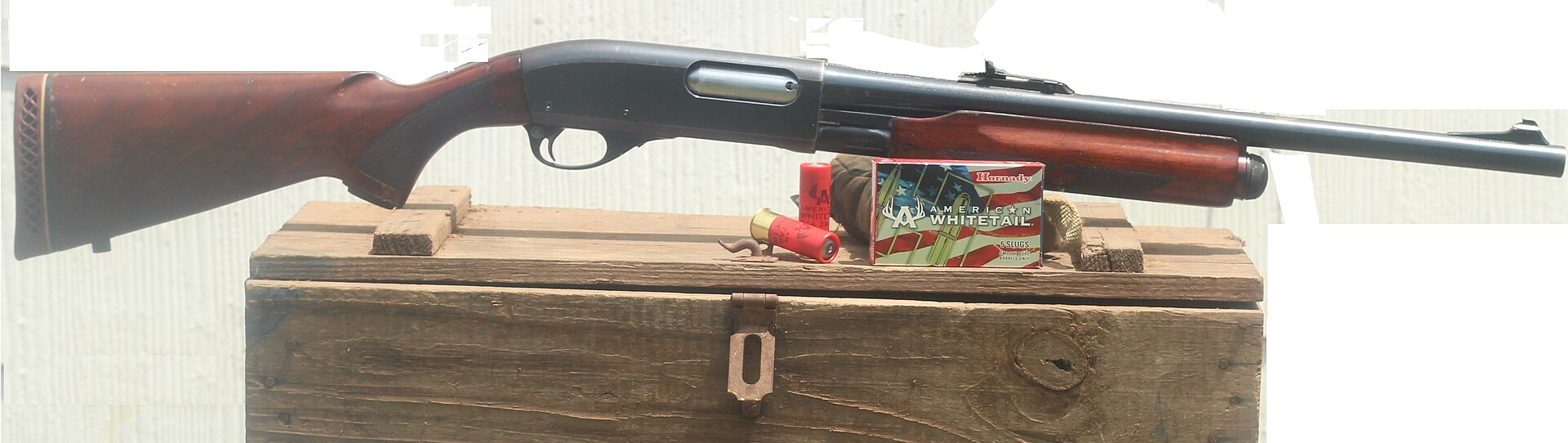
The barrel is smooth, and the tube is cylinder. The makers’ own statements settle which slugs belong in it, and the hub’s VR80 dive documents them:
- Full-bore ribbed lead slugs, sold as “rifled” slugs, are for smooth bores. Remington’s own Slugger page says “For use in smooth bore shotguns only”, and Federal’s Power-Shok page says “Designed for use in smoothbore barrels”. The word “rifled” describes the slug’s ribs, not the barrel.
- Sabot slugs are for rifled barrels. Remington’s AccuTip sabot is “Designed for rifled barrels only”.
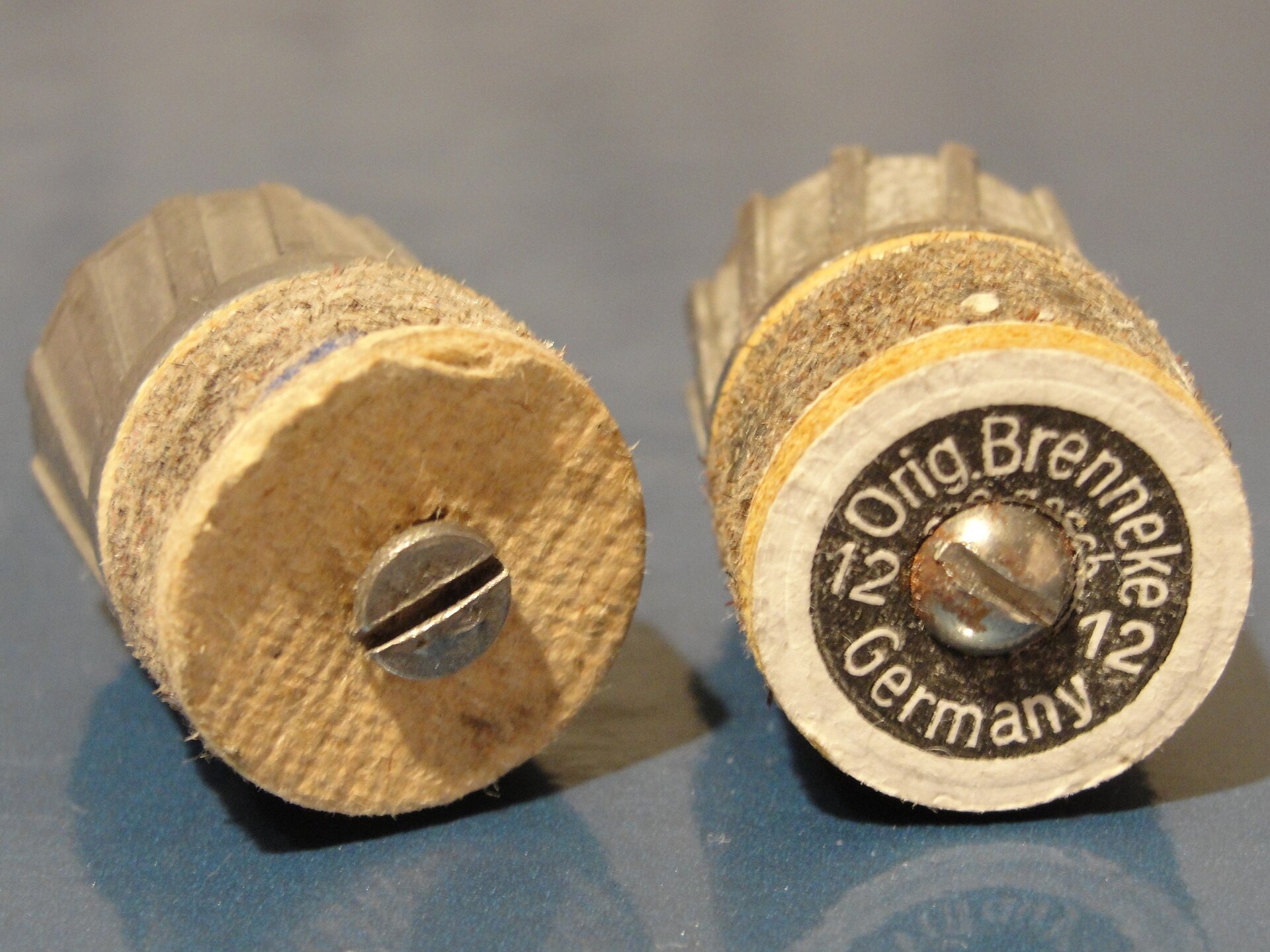
Those quotations, the 1947 Foster patent and what it actually claims, the Brenneke alternative, and what a rifled choke tube can and cannot do for a smooth bore are all in VR80 Volume 4, and the makers’ trajectory tables for the common slug loads are in VR80 Volume 5. Nothing in them is specific to the VR80’s action; the physics of a slug in a smooth barrel is the same in a pump.
What is specific to this gun. A full-bore slug through a cylinder tube is the combination both makers and Rock Island’s own choke rules point to. The XS ghost-ring sights are adjustable for windage and elevation, which a bead is not.2 The red dot gives a single aiming point with half-MOA clicks (Volume 5).5 A slug zero and a buckshot point of impact are different things and should be recorded separately. Slug accuracy from this barrel is not published anywhere located; like the buckshot patterns, it is owed as a measurement, not stated.
6.7 Switching Loads in a Tube-Fed Gun
A tube magazine delivers shells last in, first out: the last shell pushed into the tube is the first one onto the carrier. A box-fed gun such as the VR80 changes loads by changing magazines; an 870 cannot.
The manual’s own procedure for loading a single shell is the basis of the pump gun’s way round it: with the action open, “Put one shell of the correct gauge and length through the ejection port”, then close the action.3 Done with the magazine still loaded, it puts one chosen shell, for example a slug, in the chamber ahead of whatever is in the tube. The manual’s unloading procedure (Volume 4) shows how to take a chambered shell out through the ejection port without cycling the next one into the chamber.
A sidesaddle on the receiver (Volume 5) exists largely to keep the chosen shell within reach for exactly this. None of that is a published technique from RemArms beyond the single-shell loading instruction, and it is described here as a use of the manual’s procedures, not as doctrine.
6.8 Recoil
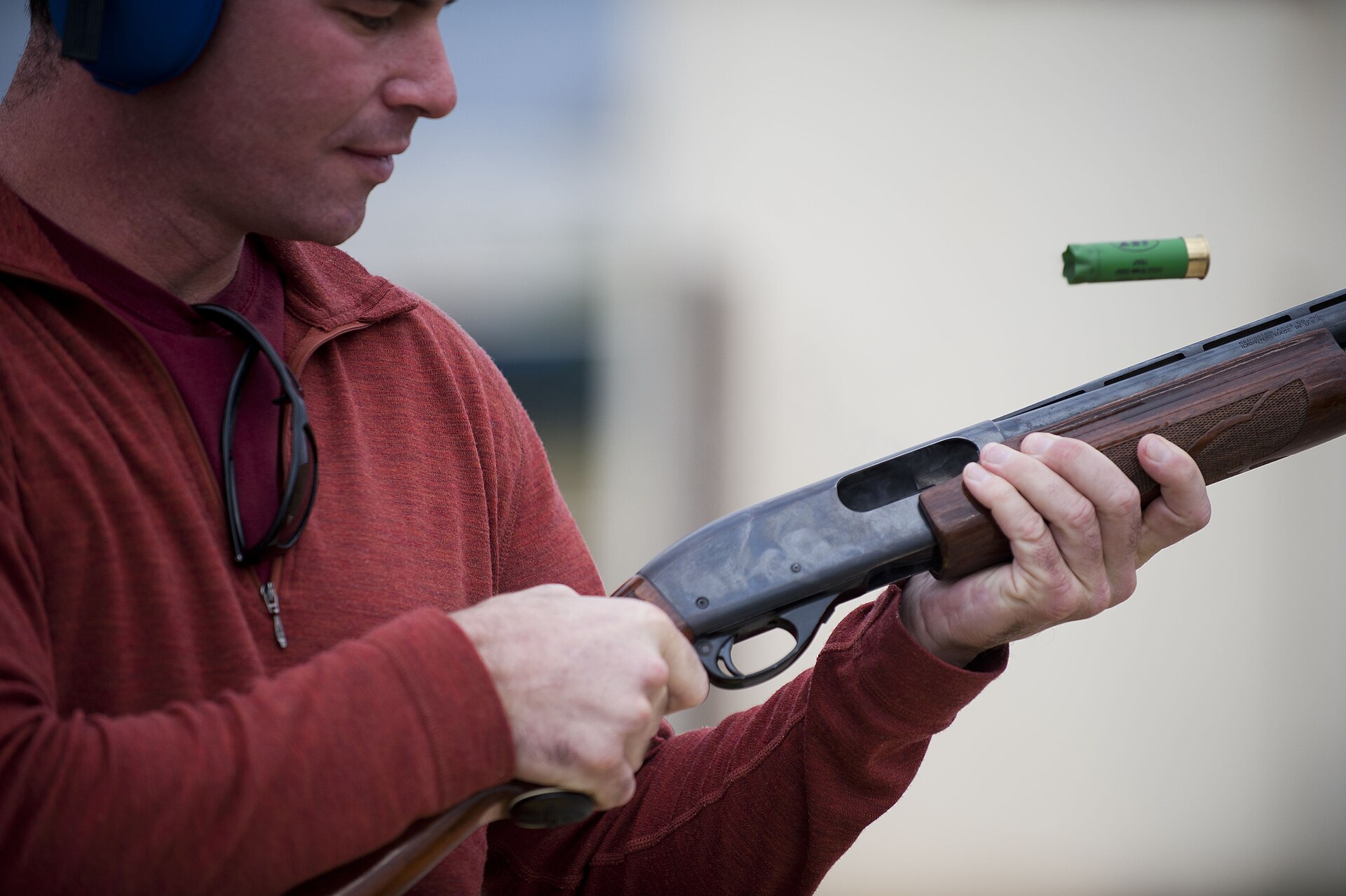
A pump gun’s action takes no energy from the shell, so the shooter’s shoulder takes the whole recoil impulse, spread only by the stock and pad. The hub’s .450 Bushmaster AR-15 dive computed the free recoil of two common 12-gauge slug loads in a rifle-weight gun at about 28 and 27 foot-pounds; the 870 documented here is lighter than that gun, so the figures are a floor for it, not a ceiling. Volume 5 covers what the ATI stock’s pad and pistol grip, and a hydraulic buffer stock, can do about it.
6.9 The Pump Against the Semi-Auto: the 870 and the VR80
The hub documents two 12-gauge guns that answer the same question in opposite ways. VR80 Volume 2 states the gas-gun side: a gas-operated shotgun “cycles only the loads that deliver enough” gas, which Rock Island sets in writing at “1,250 ft/s and 1⅛ oz”, and in return spreads its recoil over the carrier’s travel and needs no hand movement between shots; its Volume 3 documents that load floor. The pump side, from this dive’s own sources:
Table 1 — The hub documents two 12-gauge guns that answer the same question in opposite ways. [VR80 Volume 2](/actual-firearms/shotguns/ria-vr80/vol-2/) states the gas-gun side: a gas-operated shotgun "cycles only the loads that deliver enough" gas, which Rock Island sets in writing at "1,250 ft/s and 1⅛ oz", and in return spreads its recoil over the carrier's travel and needs no hand movement between shots; its [Volume 3](/actual-firearms/shotguns/ria-vr80/vol-3/) documents that load floor. The pump side, from this dive's own sources
| Remington 870 Express Tactical (this dive) | RIA VR80 (the hub’s VR80 dive) | |
|---|---|---|
| Operation | Manual pump; twin action bars (Volume 3) | Gas-operated semi-automatic |
| What it will cycle | Anything that fits the chamber, at the shooter’s stroke | Loads above the maker’s written floor |
| Feeding | Tube magazine, loaded one at a time through the bottom | Detachable box magazine |
| Factory capacity | 6 in the tube plus 1 (factory two-shot extension) | 5 in the factory magazine plus 1 |
| Changing loads | One shell through the ejection port | Change magazines |
| Recoil | All of it, through the stock | Part spread over the action’s travel |
| Characteristic malfunction | Short-stroking; the 870 jam (Volume 3) | Failure to cycle below the load floor |
| Michigan six-shell deer rule | The quoted rule names semi-automatics (below) | Factory magazine exactly at the limit |
The Michigan six-shell rule is one place the choice has a legal edge. The rule as the hub’s .450 Bushmaster dive quotes it from the current digest reads: “You cannot hunt deer with a semi-automatic shotgun or semi-automatic rifle that can hold more than six shells in the barrel and magazine combined.” Its words reach semi-automatics. The 870 is a pump, so on the rule’s text its seven-shell capacity is not limited by it. The VR80 dive’s Volume 6 works through the semi-automatic side of the same rule. Volume 7 of this dive covers the Michigan position for the 870 in full, and the note there applies: the rule is read here from the digest as that dive quotes it, and the current digest governs.
What neither gun does better in the abstract. The pump is independent of its ammunition and dependent on its shooter; the gas gun is the reverse. For an owner who has both, the useful split is the one the configurations already suggest: the VR80 set up as a slug gun with a magnified optic, the 870 as a close-range gun that will run whatever is put in it.
6.10 What Could Not Be Verified
- Any published buckshot pattern from an 870 Express Tactical barrel and tactical cylinder tube, from any maker or independent test.
- The effect of the tube’s ports on patterns, with any wad type.
- Slug accuracy from this barrel with any load.
- The source of the “inch per yard” rule, which is therefore not used.
- Federal’s payload weight for the PD132 00 load; its page gives pellet count and velocity only.
References
Footnotes
-
RemArms, “Model 870 Synthetic Tactical Ghost Ring”, https://www.remarms.com/shotguns/tactical/model-870-synthetic-tactical-ghost-ring, consulted 2026-09-19 — 18½-inch barrel; “Tactical Cylinder Choke”; overall lengths with and without the tube; “2 ¾” or 3"" shells. ↩
-
Remington Arms, press release “Remington Expands Popular Model 870 Express Tactical Line” (2009), archived 13 February 2018 — the hammer-forged barrel; “delivers consistent patterns thanks to the ported Extended Tactical Rem Choke tube”; the XS ghost-ring sights “fully adjustable for windage and elevation”. ↩ ↩2 ↩3
-
RemArms, LLC, Owner’s Manual — Model 870 & 870 Super Magnum, form RD 7058 Rev 0526, consulted 2026-09-19 — the chamber-length and choke-tube warnings; loading one shell through the ejection port; the instruction to pull the fore-end “fully rearward forcefully” to eject. ↩ ↩2
-
Federal Premium, “Personal Defense Shotshell with FLITECONTROL Wad, 12 Gauge, 00 Buck Shot, 2-3/4 in, 1145 fps”, https://www.federalpremium.com/shotshell/personal-defense/personal-defense-buckshot-with-flitecontrol/11-PD132+00.html, consulted 2026-09-19 — “rear-braking FLITECONTROL wad”; “the tightest, most reliable patterns possible”; “Copper-plated shot”; “Buffering prevents deformation”; 9 pellets, 1,145 ft/s, 2¾ in. ↩ ↩2
-
Holosun Technologies, PARALOW HS403A Red Dot Sight User’s Manual, v2.4, archived 19 March 2015 — half-MOA adjustment clicks. ↩
Comments (0)