Remington 870 Express Tactical · Volume 5
Forends, Stocks, Sidesaddles and Optics — What Goes on an 870, and Why
The parts fitted to and planned for the gun documented here, from their makers' own pages; why a hydraulic buffer stock, what a sidesaddle does to a field strip, and where a red dot sits on an 870
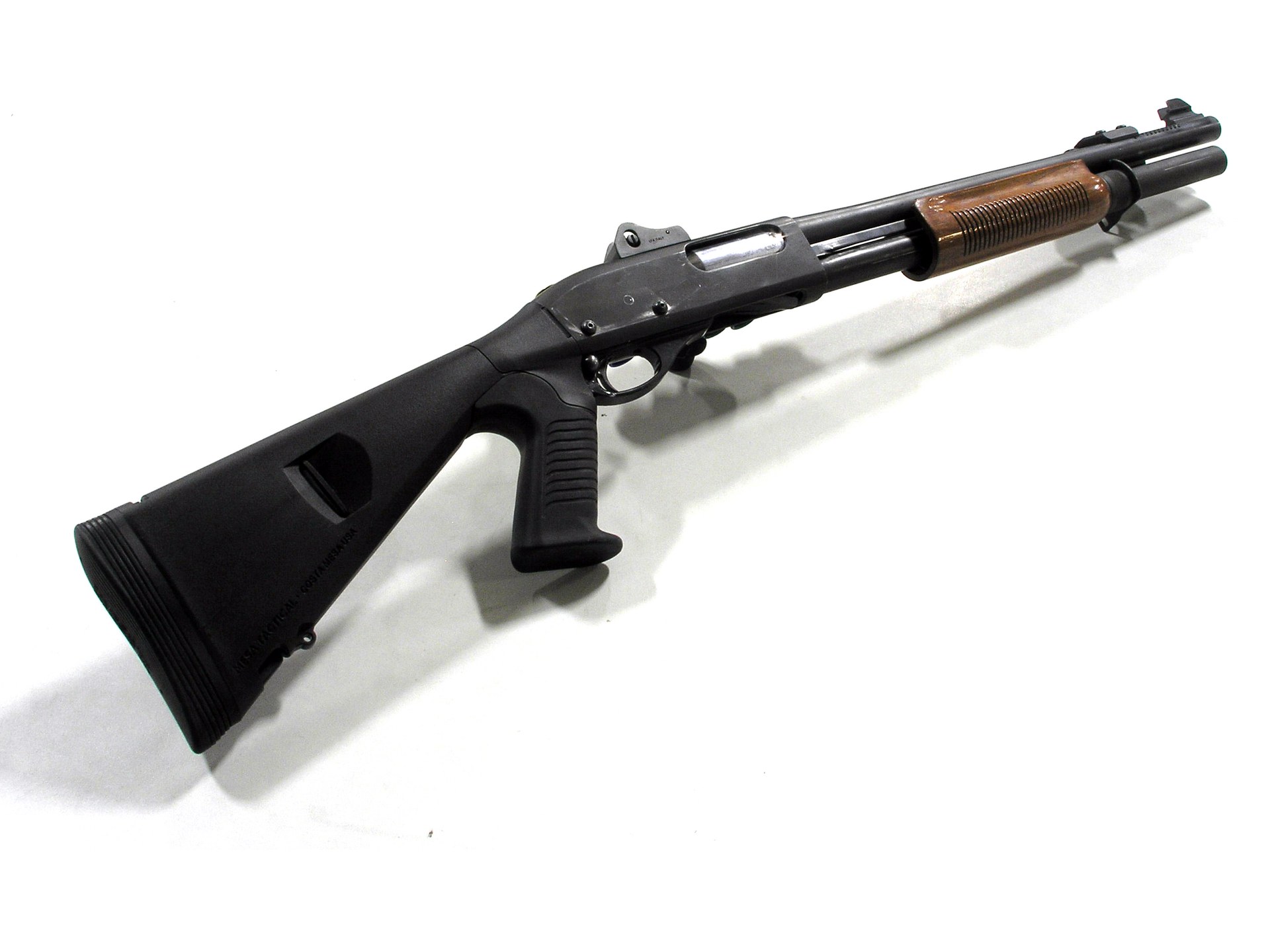
The 870 has probably had more aftermarket parts made for it than any other shotgun, and the gun documented here carries several of them. This volume identifies each part from its maker’s own documents, explains what it is for, and records exactly what was fitted and what was only planned as of September 2026. Optic theory is left to the hub’s Types of Scopes dive, which covers reflex sights; this volume covers only what is peculiar to putting one on an 870.
5.1 The Configuration, as Documented in September 2026
From the owner’s inventory record, last modified 17 September 2026. Installed means fitted to the gun; planned and on hand both mean not fitted.
Table 1 — The Configuration, as Documented in September 2026
| Part | Status |
|---|---|
| Fab Defense PR-870 forend | Installed |
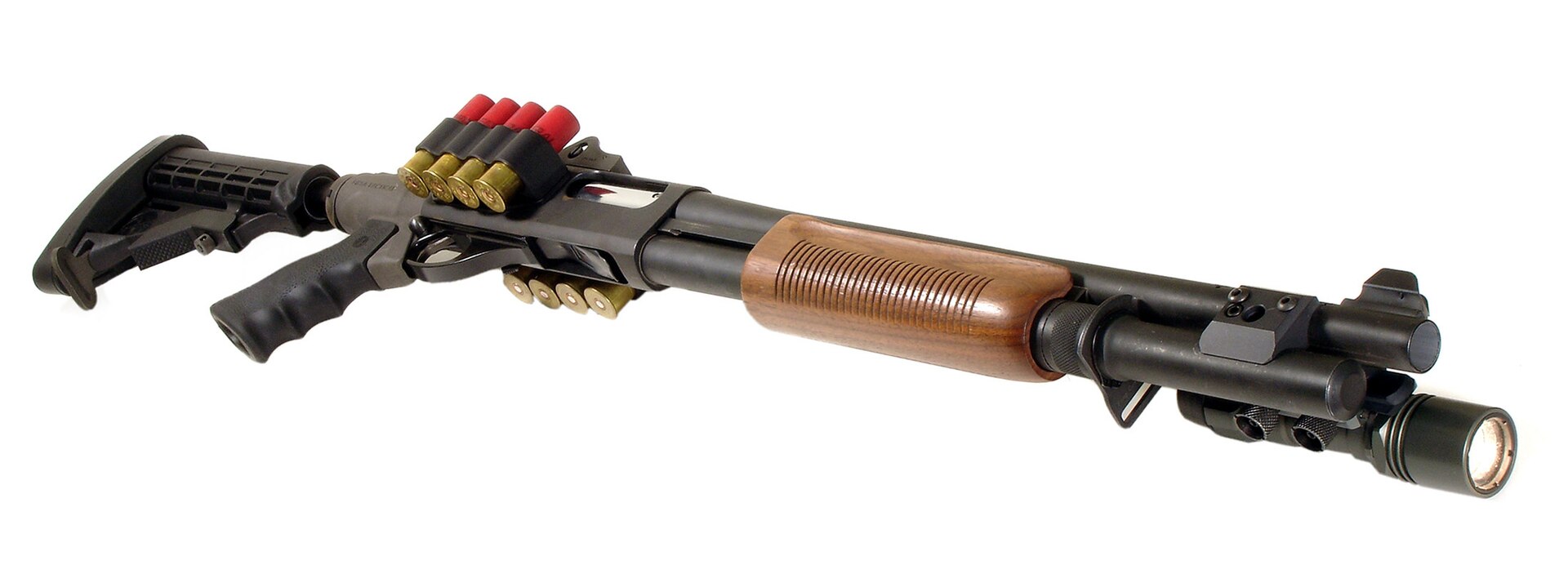
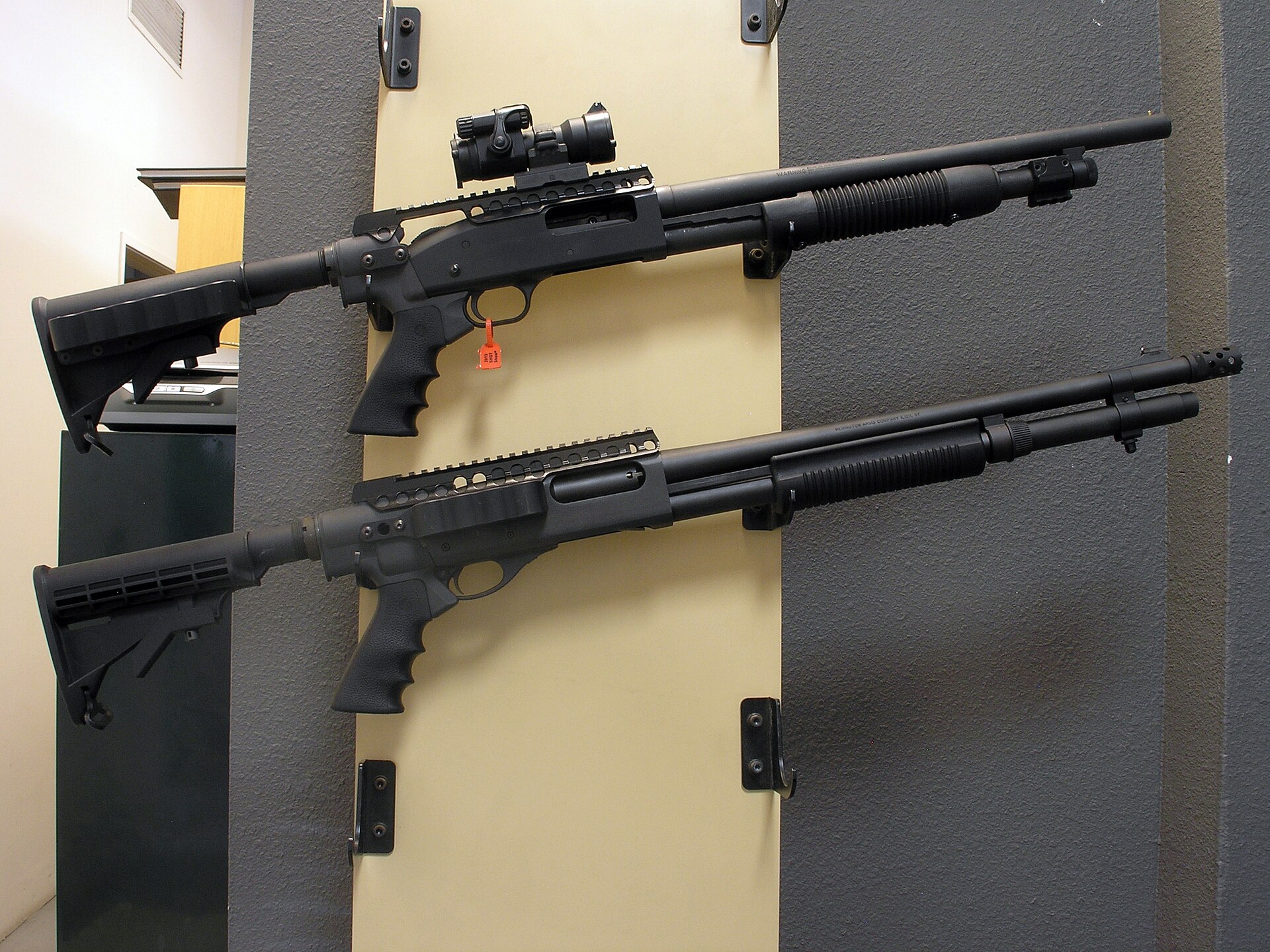
| ATI T3 six-position adjustable stock, TactLite pattern, with recoil pad and pistol grip | Installed |
| Holosun HS403A micro red dot, recorded as 2 MOA, on an AR-height riser | Installed |
| Hydraulic buffer stock (the record notes it would replace the ATI stock) | Planned — make and model not recorded |
| Vertical foregrip with LED | Planned — make and model not recorded |
| Mesa Tactical SureShell shotshell carrier | Planned — variant not recorded |
| Remington jumbo safety | On hand, not fitted |
Volume 7 carries the full configuration, the questions it leaves open, and the photographs owed.
5.2 Why the 870 Is Easy to Accessorise
Three features of the design make the 870 the easiest pump gun to change, and each comes from the 1950 patents (Volume 3).
- The fore-end is a separate part on a tube. The patent describes the fore-end “secured on a sleeve 15 between an abutment 16 and the nut 17”.1 Remove the nut and the fore-end slides off the fore-end tube; the action bars stay brazed to the tube. The RemArms parts list names the same pieces: fore-end, fore-end tube assembly, fore-end tube nut.2
- The stock is held by one bolt. The parts list shows a stock bolt with lock washer and washer, and a stock bearing plate.2 Any stock, or any stock adapter, that uses that bolt fits.
- The receiver is drilled and tapped, and the trigger-plate pins go right through it. The Express Tactical’s receiver is “drilled and tapped”, and its factory XS rail “mounts to receiver”.34 The two pins that hold the trigger plate pass through both receiver walls, which is what shell carriers and saddle rails use as mounting points.
5.3 Forends: the Fab Defense PR-870
What it is. Fab Defense, the Israeli maker, lists “PR - 870” among the rail systems on its current website, though the product page itself was unavailable when this was written. Its product datasheet, captured by the Internet Archive in 2013 and again in 2016, gives the specification:5
Table 2 — Forends: the Fab Defense PR-870
| Name | ”PR-870 Remington 870 Rail System” |
| Rails | ”Facilitates Three Picatinny Rails” |
| Material | ”Reinforced Polymer Composite” |
| Weight | 186 g |
| Dimensions | 63 mm wide, 56 mm high, 186 mm long |
| Fitting | ”Quick & Easy Installation”; “No Gunsmith Required” |
| Claimed | ”Improves Thermal Insulation” |
The datasheet does not say which three positions the rails occupy or how the forend is held; since it replaces the factory fore-end on an 870, it goes on the same fore-end tube under the same nut described above.
Why replace the factory fore-end at all. Remington’s own 2005 comparison noted that “The fore-end on the Express model is longer and not compatible with many police shotgun vehicle racks” (Volume 2).6 For a private owner the reason is the rails. A light, a vertical grip or a hand stop needs somewhere to attach, and the factory tactical fore-end on the Express Tactical offers sling studs and nothing else. The PR-870 gives Picatinny rail on a part that moves with the action.
What the owner should know. A forend that carries accessories moves them with every stroke, and a heavier forend is more mass for the shooter’s arm to throw back and forward. At 186 grams the PR-870 is light; the accessories on it are the variable. The fore-end tube nut is the part that holds the forend in place, and it should be checked for tightness after fitting and periodically afterwards.
5.4 A Vertical Foregrip on a Pump
The record plans a vertical foregrip with an integral LED light. Its make and model are not recorded, so nothing about the specific product is claimed here.
Two things follow from the mechanism. The grip becomes the pump handle. On a rifle a vertical grip is held still; on an 870 it is pulled back and pushed forward on every shot, and the shooter’s hand drives the action through it. A grip mounted on the bottom rail of the PR-870 puts the hand below the bore line, which changes the direction of the pull on the fore-end tube. Whether that matters in practice depends on the shooter; the design’s twin action bars exist to keep the slide from twisting under exactly that kind of uneven pull (Volume 3). The light moves with the action, so its switch has to be operable from the grip without letting go of the stroke, and its cable, if it has one, must allow the forend’s travel.
5.5 Stocks: the ATI T3 and the AR Pattern
What is fitted. The record calls it an “ATI T3 TactLite 6 position adj shotgun stock with recoil pad and pistol grip”. The maker, ATI Outdoors, currently sells the T3 GEN2 Shotgun Stock, SKU C.1.10.2007, at $129.99 as listed on 19 September 2026.7 Which generation the gun documented here carries is not recorded; the current product’s figures are given as the pattern.
Table 3 — Stocks: the ATI T3 and the AR Pattern
| ATI T3 GEN2, maker’s figures | |
|---|---|
| Length of pull | ”13 1/8″ to 16 5/8″“ |
| Buttstock | ”TactLite GEN2 6-Position Adjustable Mil-Spec Stock” with the “TracLOCK GEN2 system” |
| Pistol grip | ”X Series Recoil-Reducing Pistol Grip” with a “recoil-absorbing backstrap” |
| Butt-pad | ”X2 Recoil-Reducing Butt-Pad … Upgraded 1 1/4″ thick pad” |
| Cheekrest | ”Adjustable and removable”, with “1/2″ of vertical adjustment” |
| Mounting | ”Universal mount system … Mounts included for all supported models in one package” |
| Material | ”DuPont Extreme Reinforced Polymer” |
| Warranty | ”Limited Lifetime Warranty”; “Made in the USA” |
The factory Express Tactical stock has a 14-inch length of pull.4 The ATI stock’s shortest setting is almost an inch shorter, and its longest two and a half inches longer, which is the reason people fit adjustable stocks to defensive shotguns: one gun fitted to different shooters, or to one shooter in different clothing.
What the AR pattern changes. An AR-style stock rides on a tube that runs straight back from the receiver, so the comb sits in line with the bore rather than dropping away as a field stock does. The factory stock’s drop is 2½ inches at the heel and 1½ at the comb.4 With a straight-line stock the shooter’s head rides higher relative to the bore. Factory bead and ghost-ring sights were placed for a conventional stock; a raised cheek on a straight stock can put the eye above them. That is the practical reason the gun documented here carries its red dot on a riser, discussed below. On an 870 the tube carries nothing but the stock: no bolt or buffer enters it, because the 870’s bolt stays inside the receiver.
5.6 Why a Hydraulic Buffer Stock
The record plans a hydraulic buffer stock and notes that fitting one “means replacing the ATI stock”. The make is not recorded. The best documented example for the 870 is the KynSHOT system made by Kyntec Corporation of Orchard Park, New York, which is also the buffer Mesa Tactical builds into its upgraded LEO stock adapters.89
What the makers say it does. KynSHOT describes its RB5100 adjustable shotgun buffer as having three damping settings, “low, medium and heavy”, and says its technology “absorbs the recoil impulse compressing the buffer 3/4"" and “reduces felt recoil up to 90%”. Mesa’s page says its KynSHOT-equipped adapters reduce felt recoil “by 70%” with the standard-damping buffer and “up to 90%” with selectable damping.89 Neither maker states how “felt recoil” was measured.
What it can and cannot do. Recoil momentum is set by the mass and velocity of what leaves the muzzle and by the weight of the gun; nothing in the stock changes it. What a buffer changes is how quickly that momentum reaches the shoulder. By letting the stock compress on a damped cylinder, it spreads the same impulse over a longer time, which lowers the peak force the shooter feels. That is a real effect and the one a shooter notices. The makers’ 70 and 90 per cent figures are their own, for a metric they do not define, and they are attributed rather than endorsed.
How much recoil there is to buffer. The hub’s .450 Bushmaster AR-15 dive computed free recoil for two 12-gauge slug loads — a 438-grain slug at 1,610 ft/s and a 383-grain slug at 1,800 ft/s — at about 28 and 27 foot-pounds in a gun of rifle weight, and set them against the .450’s 18. Free recoil energy rises as gun weight falls, so a 7½-pound shotgun firing the same slugs recoils harder than that. Full-power slugs and buckshot are exactly the loads a buffer is for.
Why it means replacing the ATI stock. A KynSHOT buffer is the receiver-extension tube: Mesa’s page says the buffers “replace the standard receiver extension tube normally used with AR-15 style telescoping stock assemblies”, and KynSHOT says the RB5100 needs an adapter to fit an 870.98 The ATI T3 comes as a complete system with its own mounting and tube, so fitting a buffer means replacing at least the ATI’s tube and adapter with a buffer kit such as KynSHOT’s “SK5100R Tactical Shotgun Conversion Kit | Remington 870”.8
⚠ Whether the ATI buttstock and grip could be kept is a question worth asking before buying. ATI calls the TactLite buttstock “Mil-Spec”, and KynSHOT says the RB5100 takes “any Mil-Spec style collapsible stock”.78 KynSHOT lists “5 positions” of stock adjustment on its buffer against the ATI’s six. Whether the ATI buttstock fits the KynSHOT tube was not verified, and the record’s note implies the whole stock will be replaced.
KynSHOT carries one warning that is worth reading correctly: “DO NOT USE ON SHOTGUNS THAT HAVE A BOLT TRAVELING TO THE REAR OF THE FIREARM IMPACTING A BUFFER SYSTEM”.8 That excludes AR-pattern shotguns such as the VR80, for which KynSHOT sells a separate buffer. It does not affect the 870, whose bolt never leaves the receiver.
5.7 Sidesaddles: the Mesa Tactical SureShell
What is planned. A Mesa Tactical SureShell shotshell carrier; the variant is not recorded. Mesa’s current range for the 870, from its own pages on 19 September 2026:101112
Table 4 — Sidesaddles: the Mesa Tactical SureShell
| Type | Mesa part numbers | Capacity | How it mounts | Price range shown |
|---|---|---|---|---|
| Side-mount carrier | 90320 (4, aluminium, left); 90210 (6, aluminium); 94740 (6, polymer); 90420 (8, aluminium); 90600 (4, aluminium, right side, “just behind the ejection port”) | 4 to 8 | Left side of receiver | $59.95 to $99.95 |
| Carrier with saddle rail | 91630 (6, aluminium); 94830 (6, polymer); 92160 (4, aluminium, 5 in, web store only) | 4 or 6 | ”Mounts via trigger pin holes”; “Integrated Picatinny rail for optics or sights” | $119.95 to $152.95 |
| Carrier with long rail | 92130, 91980, 94800, 94840 | 6 | 20-inch rail, with or without a magazine clamp | not recorded here |
Mesa describes its carriers as aluminium, hard-anodised, with “a rubber friction retention system that holds shells firmly in place and accommodates loading from either the top or bottom”, shipped with black rubber for most shells and “harder white rubber replacements included for specialty shells”, and made in the United States with a lifetime warranty.10
What a sidesaddle is for. An 870’s magazine is loaded one shell at a time through the bottom of the receiver. A carrier on the side of the receiver keeps spare shells where the support hand can reach them, either to reload the magazine or to drop a single shell — a slug, say — straight into the ejection port.
What it does to the gun. Mesa’s saddle carriers “mount via trigger pin holes”: the carrier’s hardware takes the place of the two pins that hold the trigger plate.11 The field strip in Volume 4 then begins with the carrier’s hardware, and the trigger plate cannot come out until the carrier does. A carrier also adds weight on the left side of the receiver. Four to eight 12-gauge shells are a noticeable mass.
How it interacts with the rest of this configuration. The factory XS ghost-ring rail sits on the receiver top. A side-mount carrier leaves the top alone. A saddle carrier brings its own Picatinny rail across the top of the receiver, which would take the place of the XS rail and with it the factory rear sight and whatever the red dot is mounted on. Which kind is planned is the first question to settle (Volume 7).
5.8 The Jumbo Safety
The record lists a “Remington Jumbo Safety”, on hand and not fitted. A current RemArms product page for it was not located, and none of its dimensions is claimed here.
What can be said from the maker’s own documents is where it goes. The safety is the “cross-bolt safety” behind the trigger (Volume 3), and the parts list shows it held in the trigger plate by a detent ball, a spring and a spring retaining pin.2 Replacing it is therefore work inside the trigger-plate assembly, which the manual reserves for “the factory or a REMINGTON AUTHORIZED SERVICE CENTER”.2 That is the maker’s line; fitting a safety button is commonly treated as a simple job, and an owner deciding otherwise should know that the manual does not say so. The detent ball and spring are the parts that go missing.
Why fit one. A larger button is easier to find and push with gloves or under stress, which is why oversized safeties are sold. The same size makes it easier to push by accident. The manual’s rule applies whatever the button’s size: the red band showing means the gun will fire.
5.9 Optics on a Shotgun: the Holosun HS403A
What is fitted. A Holosun HS403A micro red dot, recorded as 2 MOA, on a riser described in the record as an “AR riser”. Holosun no longer lists the HS403A; its current site carries only the later 403-series sights. The maker’s own manual for the HS403A, captured by the Internet Archive in March 2015, gives these figures:13
Table 5 — Optics on a Shotgun: the Holosun HS403A
| Holosun HS403A, maker’s manual | |
|---|---|
| Battery | One CR2032, “housed in the base”; “up to 50,000 hours” |
| Power | ”Motion power on” with “slight vibration”; “automatically powered off after not being used for 8 hours” |
| Brightness | 12 settings; the seventh is the default at switch-on |
| Parallax | ”Parallax free optical system. Red dot parallax 1MOA. Minimum distance of 10m or 33 feet.” |
| Adjustment | One click “equivalent to 0.5MOA” |
| Sealing | ”Waterproof: IP67” |
| Mount | Integral clamp, “adaptable to any firearm with Picatinny Rail” |
| Warranty | Limited lifetime, to the original purchaser |
The manual does not state the dot size; 2 MOA is the owner’s record. It also says what to know before changing the battery: the base comes off with four screws to reach it, and “The device may need zero alignment after the battery replacement.” A 50,000-hour battery makes that rare, and it is still the reason to check zero after a battery change.
How it mounts on this 870. The factory ghost-ring rear sight on the Express Tactical sits on an XS Picatinny rail screwed to the drilled-and-tapped receiver, which Remington described as accepting “optics and sight systems as well”.34 The HS403A’s clamp fits any Picatinny rail. The riser raises the sight to the height an AR stock puts the eye at (above). Where exactly the riser sits on the gun documented here is not recorded; the two possibilities are ahead of or in place of the ghost-ring aperture on the same rail. That determines whether the ghost ring remains usable as a back-up, and it is listed as a question in Volume 7.
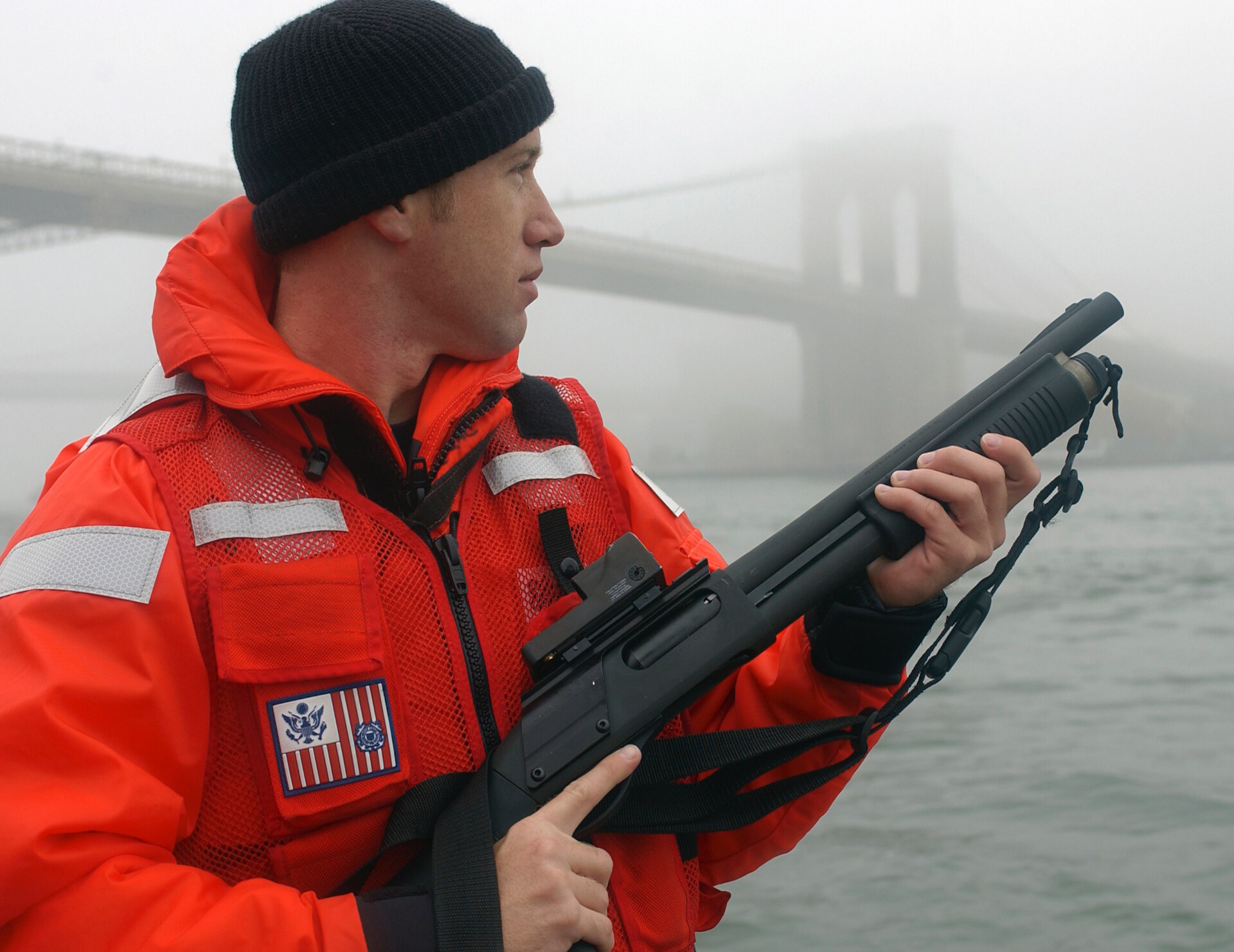
What a dot does on a shotgun. With buckshot, the dot marks where the centre of the pattern goes, and the pattern’s size at the distance fired decides what hits (Volume 6). With slugs, a dot is a single-projectile aiming point and needs a zero like any rifle sight. A dot mounted on the receiver of an 870 stays on the receiver: the barrel is held in the receiver by the magazine cap, and a barrel that is removed and refitted goes back against its locating key (Volume 3). Whether a given gun holds its slug zero across a barrel removal is something to confirm at the range, not to assume.
The Types of Scopes dive covers reflex and red-dot sights, and its Volume 8 covers mounting and zeroing.
5.10 How the Parts Interact
Taken together, the installed and planned parts make one decision depend on another:
- The stock sets the eye height, which is why the dot is on a riser, and a hydraulic buffer stock would change the stock again.
- The sight rail is shared. The XS rail carries the ghost ring and, probably, the dot’s riser. A saddle-type SureShell would replace that rail; a side-mount would not.
- The trigger-plate pins become carrier bolts once any Mesa saddle carrier is fitted, which changes the field strip.
- The forend carries whatever goes on its rails, and a vertical grip with a light becomes the part the shooter’s hand drives the action through.
5.11 What Could Not Be Verified
- The Fab Defense PR-870’s current product page. The maker lists it but the page was unavailable; the specification is from its archived datasheet.
- The ATI stock’s generation on the gun documented here.
- Whether the ATI buttstock fits a KynSHOT buffer tube.
- The make of the planned buffer stock and vertical foregrip.
- Which SureShell variant is planned.
- The Remington jumbo safety’s current catalogue listing and dimensions.
- The HS403A’s dot size from the maker; the 2 MOA figure is the owner’s record.
- Where the riser and dot sit on the receiver rail.
References
Footnotes
-
L. R. Crittendon and P. R. Haskell, US Patent 2,645,873, filed 31 January 1950, issued 21 July 1953 — the fore-end secured on its sleeve between an abutment and a nut. https://patents.google.com/patent/US2645873A/en ↩
-
RemArms, LLC, Owner’s Manual — Model 870 & 870 Super Magnum, form RD 7058 Rev 0526, consulted 2026-09-19 — the parts list (fore-end, fore-end tube and nut; stock bolt and bearing plate; safety, detent ball, spring and retaining pin); the trigger-plate adjustment rule; the safety’s red band. ↩ ↩2 ↩3 ↩4
-
Remington Arms, “Model 870 Express Tactical” product page, remington.com, archived 14 October 2012 — the XS ghost-ring rail that “mounts to receiver” and “accepts optics and sight systems as well”; the receiver drilled and tapped. ↩ ↩2
-
RemArms, “Model 870 Synthetic Tactical Ghost Ring”, https://www.remarms.com/shotguns/tactical/model-870-synthetic-tactical-ghost-ring, consulted 2026-09-19 — 14-inch length of pull; drop at heel 2½ in, at comb 1½ in; the XS ghost-ring Picatinny rail. ↩ ↩2 ↩3 ↩4
-
Fab Defense, “PR-870 Remington 870 Rail System” product datasheet, http://www.fab-defense.com/pdfnew2.php?id=114&oz=PR-870, archived by the Internet Archive on 29 December 2016 (and an earlier version at pdf.php, archived 25 January 2013), consulted 2026-09-19. The maker’s current site, https://www.fab-defense.co.il/, lists “PR - 870” under rail systems; its product URL returned 404 on that date. ↩
-
Remington Arms, “Important differences between Remington 870 Police and 870 Express shotguns” (2005), archived 16 February 2008 — the Express fore-end and vehicle racks. ↩
-
ATI Outdoors, “T3 GEN2 Shotgun Stock”, https://www.atioutdoors.com/product/t3-stock/, SKU C.1.10.2007, read through the site’s product data on 2026-09-19 — the features and price quoted. ↩ ↩2
-
KynSHOT (Kyntec Corporation), shotgun buffers page, https://www.kynshot.com/products/shotgun/, and “KynSHOT RB5100 Adjustable Shotgun Recoil Buffer”, https://www.kynshot.com/products/our-products/kynshot-rb5100-adjustable-shotgun-recoil-buffer-26/, consulted 2026-09-19 — the damping settings, the ¾-inch compression, “up to 90%”, five stock positions, Mil-Spec threads and stocks, the adapter requirement for the 870, the SK5100R and SK5103R 870 kits, and the bolt-travel warning. ↩ ↩2 ↩3 ↩4 ↩5 ↩6
-
Mesa Tactical, “LEO Gen II Telescoping Stock Adapter for Rem 870 (12-GA only)”, https://mesatactical.com/products/leo-gen-ii-telescoping-stock-adapter-for-rem-870-12-ga-only.html, consulted 2026-09-19 — KynSHOT buffers made for Mesa by Kyntec, replacing the receiver extension tube; 70 and 90 per cent claims. ↩ ↩2 ↩3
-
Mesa Tactical, “SureShell Side Mount Carrier For Remington 870/1100/11-87 (12-GA)”, https://mesatactical.com/sureshell-side-mount-carrier-for-remington-870-1100-11-87-12-ga/, consulted 2026-09-19. ↩ ↩2
-
Mesa Tactical, “SureShell Saddle Mount Carrier and Rail for Rem 870 (12-GA)”, https://mesatactical.com/sureshell-saddle-mount-carrier-and-rail-for-rem-870-12-ga/, consulted 2026-09-19 — “Mounts via trigger pin holes”. ↩ ↩2
-
Mesa Tactical, “SureShell Carrier with Long Rail for Remington 870/1100/11-87 (12-GA)”, https://mesatactical.com/sureshell-carrier-with-long-rail-for-remington-870-1100-11-87-12-ga/, consulted 2026-09-19. ↩
-
Holosun Technologies, PARALOW HS403A Red Dot Sight User’s Manual, v2.4, http://holosun.com/wp-content/uploads/2008/09/HS403A.pdf, archived by the Internet Archive on 19 March 2015, consulted 2026-09-19. The current Holosun site (https://holosun.com/, sitemap read the same day) does not list the HS403A. ↩
Comments (0)