Remington 870 Express Tactical · Volume 3
How It Works — Twin Action Bars, a Tilting Block, Two Shell Latches and the 870 Jam
The cycle of operation part by part, from the 1950 patents and the maker's manual, and why the famous jam happens
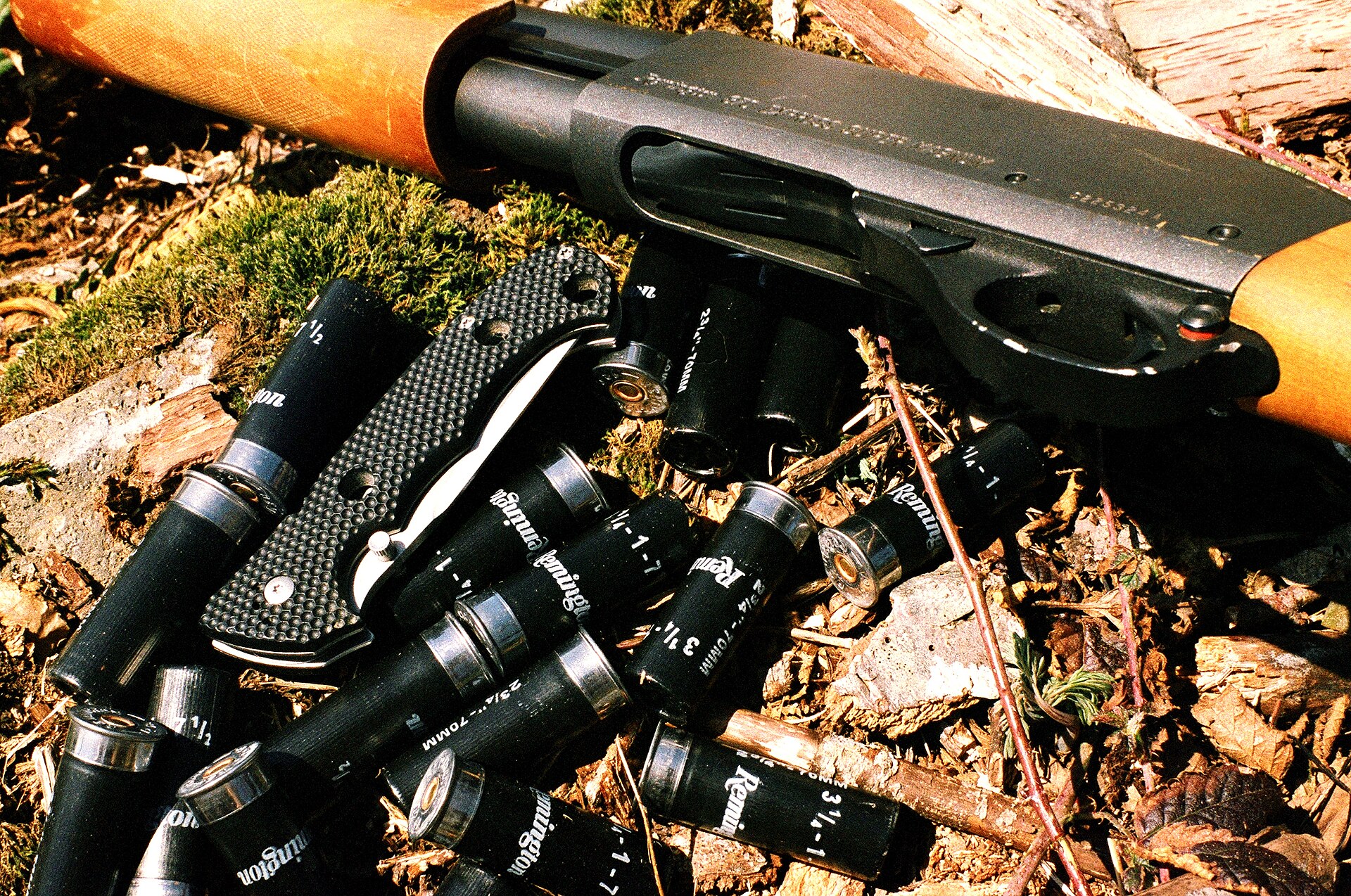
The 870’s mechanism is simple enough to strip without tools and subtle enough that its best-known malfunction is still being explained wrongly seventy years on. This volume works through it from the documents its designers wrote: the patent family filed from 31 January 1950 (Volume 1), and the owner’s manual that RemArms publishes today.
3.1 The Sources
Two primary sources carry this volume.
- The patents. US 2,645,873, “Slide-actuated firearm with tilting locking block”, describes the whole gun: locking, extraction, ejection, shell feeding, the carrier, the fire control and takedown. Its divisions, US 2,719,375 and US 2,780,881, claim the paired action bars and shell latches, and the ejector.123
- The RemArms owner’s manual, form RD 7058 revised May 2026, which names the parts, shows the trigger plate and the action bars, and describes loading, unloading, the jam and its remedies.4
A patent describes an invention as filed, not every production gun. Where a patent detail and the current parts list differ, both are given. No Remington armourer’s manual or US military technical manual for the 870 was obtained. Remington’s military website of 2010 listed its technical manuals as “Coming Soon…” behind a login, and none was located in public archives in this work.5
3.2 The Parts, in Five Groups
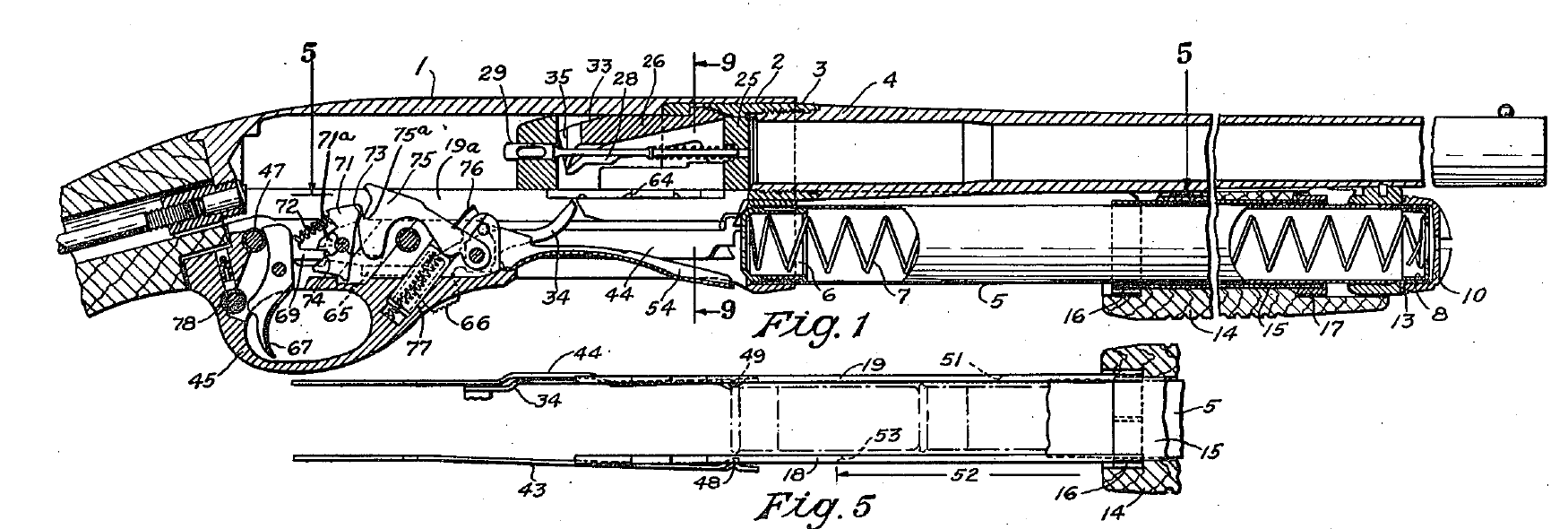
Grouping the RemArms parts list by function makes the mechanism easier to follow. Patent reference numbers are in parentheses where the patent names the part.41
Table 1 — The Parts, in Five Groups
| Group | Parts (RemArms names) | Patent |
|---|---|---|
| Barrel | Barrel assembly with its barrel extension; front sight; (on this model) extended ported choke tube | barrel (4), extension (3), locking recess (32) |
| Fore-end and action bars | Fore-end assembly; fore-end tube assembly; fore-end tube nut | sleeve (15), nut (17), action bars (18, 19) |
| Bolt group | Breech bolt; locking block assembly (and an oversize locking block); slide assembly; firing pin, firing pin retaining pin, firing pin retractor spring; extractor, extractor plunger, extractor spring | bolt (25), slide (22), slide lug (23), locking block (26), firing pin (29), extractor (36) |
| Receiver | Receiver assembly (restricted); magazine tube with follower, spring, spring retainer and cap; shell latch left and right; ejector, ejector spring and rivets | receiver (1), tube (5), shell latches (43, 44), ejector (41) |
| Trigger plate | Trigger plate; trigger; sear and sear spring; hammer, hammer plunger, hammer spring; connectors left and right; action-bar lock and spring; carrier, carrier dog and follower, carrier pivot tube; safety, detent ball and spring; front and rear trigger-plate pins | trigger plate (45), carrier (54), carrier dog (56), action-bar lock (34), disconnector (65), hammer (75), safety (78) |
⚠ The parts list printed in the current manual is for the 12-gauge Express Super Magnum. Its footnote says the parts it marks with an asterisk, which include the breech bolt, carrier, shell latches, slide, extractor and locking block, are “for use on Model 870 Super Magnum ONLY and are not interchangeable with any other Model 870”.4 The names apply to every 870; the part numbers for a standard 12-gauge gun must come from RemArms’s parts service, not from that list.
The oversize locking block in the list deserves a note. The manual does not say what it is for. Read by its name, it is a fitting part: a block with more material at its locking surfaces, which takes up clearance in a lock-up that has worn or is loose. On that reading, the factory’s remedy for a loose lock-up is a replacement part, not an adjustment, and fitting it is armourer’s work (Volume 4).
3.3 Twin Action Bars
Field & Stream describes the 870’s designers connecting the slide to the bolt “with twin action bars in place of the single bar common to many pumps”.6 RemArms’s current page describes “Silk-smooth twin action bars” that “prevent binding and twisting”; Remington’s 2010 military page said “dual, non-binding action bars”.75
The patent gives the mechanical reasons, and they are more specific than the marketing. The two bars are brazed to the rear of a sleeve that carries the fore-end, run back into guide tracks cut in the two receiver walls, and engage guide ribs on both sides of the breech-bolt slide, so that the slide is “supported for reciprocating movement along said guide tracks … by engagement between both of the action bars”.2 Pulling on the fore-end pulls the slide from both sides at once. A single bar pulls from one side, and the slide has to be guided against the resulting twist.
The second reason is feeding. Each bar controls one of the two shell latches, by cuts and cams in its lower edge, and the claim that the divisional patent was granted on is exactly that pairing: two bars, two latches, and cams “longitudinally spaced on said action bars to effect the controlled release of a single shell only for each reciprocation”.2 The twin bars are as much a feeding system as a guiding one.
3.4 The Lock-Up: a Tilting Block and a Barrel Extension
The 870’s breech is locked by a locking block that tilts up out of the bolt into a recess in the barrel extension, a sleeve on the rear of the barrel that projects into the receiver.1
The block sits in a vertical slot through the bolt. Under it, a rectangular lug on the slide projects up into the same slot, with a little fore-and-aft play. The underside of the block carries two cam surfaces: a locking cam near the front and an unlocking cam near the rear.
- Closing. The slide pushes the bolt forward. The block’s lug slides along the smooth top of the receiver and barrel extension until the bolt is fully home; then the slide, still moving, runs its lug under the locking cam, tips the front of the block up into the recess, and finishes “completely beneath the front end of the locking block”, holding it there.
- Opening. Drawing the fore-end back pulls the slide first. Its lug leaves the locking cam and strikes the unlocking cam, which rocks the block down about a fulcrum against the receiver’s roof and out of the recess. Only after the block is clear does the lug reach the rear of the bolt’s slot and carry the bolt back.
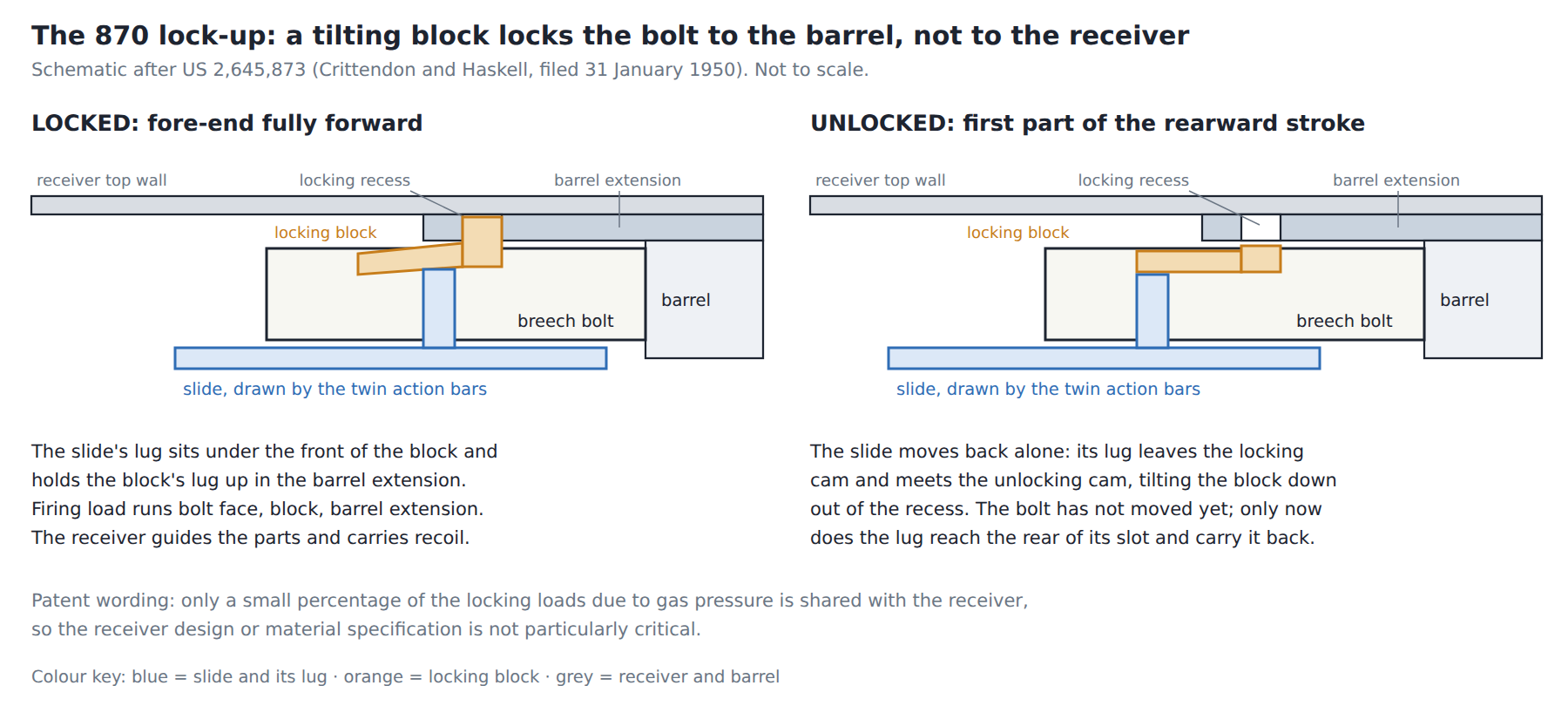
The consequence the patent states outright. Because the bolt locks to the barrel extension, “only a small percentage of the locking loads due directly to gas pressure in the barrel will be shared with the receiver. Since the receiver serves mainly to guide the parts and to transmit recoil forces to the buttstock, the receiver design or material specification is not particularly critical and a light weight action is possible without sacrificing safety or durability.”1 That is why the 870 barrel carries its own locking surface, why barrels interchange “without adjustment” across standard 12-gauge guns, and why the receiver’s finish and material are a durability question rather than a strength one.4
The firing-pin interlock. The firing pin runs through the block, which is U-shaped in section and straddles it. The head of the pin is enlarged and bears against buttresses in the block’s slot, so that the pin “cannot be caused to protrude from the face of the breech bolt unless or until the breech bolt is securely locked”. The same buttresses retract the pin positively if its spring fails, so a stuck pin cannot drag across the head of a shell during ejection.1
The patent also notes that the block is made deliberately asymmetrical “to make it impossible to assemble the gun with the locking block in reversed position”.1
3.5 The Cycle, Stroke by Stroke
From a loaded, cocked, locked gun with the safety off:
- Firing. The trigger acts through the right connector arm on the sear, which releases the hammer. The hammer strikes the firing pin, which is free to reach the primer only because the block is up in its locked position.
- Release of the action. As the hammer falls, the hammer-spring plunger strikes an arm on the disconnector, which is made integral with the action-bar lock. The lock releases the left action bar, and the action is free to open. The patent adds a refinement: the engaging faces are shaped so that a rearward pull on the fore-end at the moment of firing holds the lock engaged until the pull is relaxed, which recoil normally does involuntarily. In a hangfire, the action stays locked.1
- Unlocking. The shooter draws the fore-end back. The action bars pull the slide, the slide’s lug tips the block down (above), and the lug then carries the bolt rearward.
- Extraction. The spring-loaded extractor at the right edge of the bolt face grips the rim and draws the hull out of the chamber.1
- Ejection. The ejector, on the receiver wall opposite the ejection port, catches the hull’s head and pivots it about the extractor claw, flipping it out of the ejection port on the right. The ejector’s support carries a tongue that engages a slot in the barrel extension as a locating key, which is the “ejector cut” the manual tells the owner to align when fitting a barrel.34
- Release of the next shell. Near the end of the rearward stroke, a cam on the left action bar withdraws the left shell latch, and the rearmost shell in the magazine springs back onto the carrier. The right latch catches the shell behind it (next section).
- Cocking. The hammer is recocked during the rearward stroke; the patent’s Figure 2 shows it down just after firing and Figure 3 shows it cocked with the action open, held by the sear’s hammer hook.
- Lifting. On the forward stroke, a notch in the slide catches the carrier dog, which acts as a strut and swings the front of the carrier up, presenting the shell in line with the chamber.
- Chambering and locking. The bolt drives the shell home; the carrier dog is pried out of the notch and the carrier drops; the block tips up into the recess; the action-bar lock re-engages the left bar.
- Resetting the trigger. The trigger stays dead until it is released. If it is held back through the stroke, “the sear will retain the hammer until such time as the trigger has been released and the action bar lock engaged”.1 An 870 in good order therefore cannot fire as the action closes, whatever the trigger finger does.
3.6 Two Shell Latches: the Magazine Cut-Off Everyone Calls the Interrupter
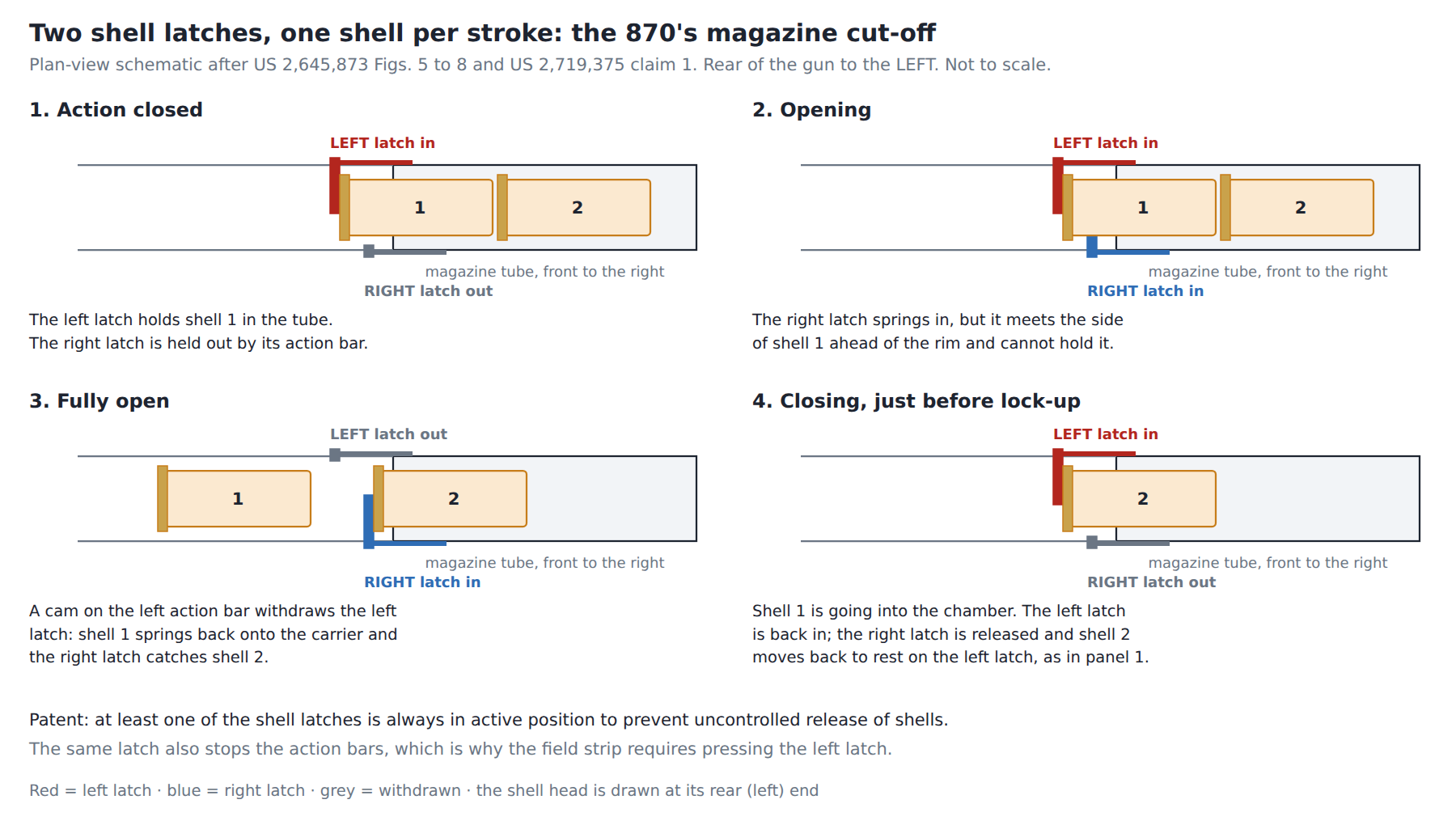
The part most owners call “the interrupter” does not appear by that name in the patent or the RemArms parts list. Both call the parts the left shell latch and the right shell latch.14 They are flat spring strips lying in grooves along the two receiver walls beside the mouth of the magazine tube, each springing inward to block the tube, and each withdrawn at the right moment by a cam on its own action bar.
The sequence, from the patent’s Figures 5 to 8:
- Action closed. The left latch is in and holds the rearmost shell. The right latch is held out by its bar.
- Opening. The right latch springs in, but it sits ahead of the rim of the shell the left latch is holding, so it only bears against the side of the shell.
- Fully open. A cam on the left bar withdraws the left latch. The rearmost shell springs back onto the carrier. “At the same time, the right hand latch catches the succeeding shell.”
- Closing. The left latch returns. Shortly before lock-up, the right bar’s cam withdraws the right latch, and the next shell moves back to rest on the left latch, where the cycle began.
“At least one of the shell latches is always in active position to prevent uncontrolled release of shells.”1
Owners and writers apply the word “interrupter” to one or both of these latches, and not always to the same one. This dive uses the maker’s names.
The latches do a second job, and it explains a step of the field strip. The divisional patent claims a “forwardly facing stop abutment” on the action bars that bears on a shell latch “to limit forward movement of the action bars … and prevent inadvertent removal of the breech mechanism when the gun has been taken down by removal of the barrel”.2 With the barrel off, the fore-end and bolt cannot simply slide out of the front of the receiver. The owner has to reach in and press the left latch, which is exactly what the manual’s disassembly step 7 says (Volume 4).
The patent also records how the latches are held: “At the rear end of the shell latches, the edges of the grooves are deformed by a staking operation to temporarily retain the latches during assembly. After assembly, they are confined in their grooves in the receiver walls by the trigger plate.”1 That staking is the origin of one of the 870’s classic repairs (Volume 4).
3.7 The Carrier and the Carrier Dog
The carrier is the lifter that brings a shell from the magazine up to the chamber. It pivots on the carrier pivot tube, through which the front trigger-plate pin passes, and the patent describes it as “generally similar to those employed in” three Browning patents.1 Behind the pivot it carries the carrier dog, which a spring and plunger in the trigger plate hold at right angles to the carrier.
- On the rearward stroke the slide rides over the dog and holds the carrier down.
- On the forward stroke a notch in the slide catches the dog’s heel; the dog becomes a strut, and the carrier’s front end rises with the shell on it.
- Near the end of the forward stroke the dog’s toe pries its heel out of the notch, and the carrier drops.
The carrier has a second use when the gun is being loaded: pushed up, its curved underside “serves as a loading ramp directing a shell into the magazine tube where it is retained by the left hand shell latch”.1 A finger on the carrier’s right edge helps keep a shell from dropping out of the ejection port when a single shell is loaded and the action worked slowly.
The carrier dog spring is one of the springs Remington upgraded for its Police guns, so that the elevated shell “will be held there until the bolt can push it into the chamber”, which Remington tied to “heavier payload rounds” (Volume 2).8
3.8 The Fire Control and the Action-Bar Lock
The whole fire control lives on the trigger plate, which drops out of the bottom of the receiver when two pins are pushed out. The patent calls its fire control “as safe as possible in that it may be positively locked, cannot fire on an open breech, cannot fire a second shot without deliberately releasing, and cannot be involuntarily opened during a hangfire.”1
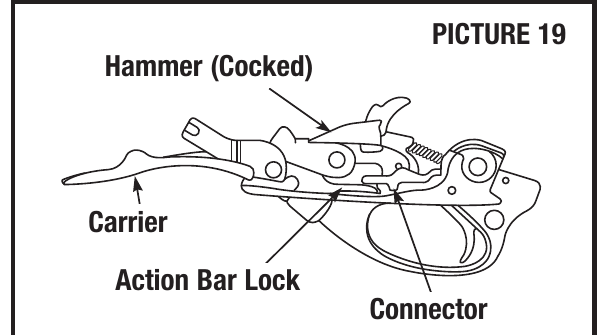
The action-bar lock is the part an owner meets every time the gun is unloaded. With the hammer cocked and the action closed, the lock holds the left action bar and the fore-end will not move. Pushing the lock’s finger piece, in front of the trigger guard, releases it. The manual’s instruction is “Push upward on the action bar lock” before opening the action.4 After a shot, as step 2 of the cycle shows, the falling hammer releases it automatically.
The same pressing of the action-bar lock also moves the disconnector, so the trigger is dead while the action is being opened by hand.1
The trigger pull is a factory setting. The manual says “All adjustments to the trigger and trigger plate assembly must be made by the factory or a REMINGTON AUTHORIZED SERVICE CENTER”.4 Remington’s 2005 page gives the Police gun’s pull as “between 5 and 8 lbs” with a heavier sear spring; no figure for the Express or the Express Tactical was located.8
3.9 The Safety
The 870’s safety is “a button located behind the trigger, commonly known as a cross-bolt safety”. Pushed so that the red band cannot be seen, it is on; pushed so that the red band shows, the gun will fire.4 The patent describes its job as to “positively block inadvertent trigger operation”, which makes it a trigger block.1 The patent’s account of drop safety with the safety off is that the trigger and sear are “centrally pivoted and thus almost perfectly balanced with respect to jolts and jars from any direction”, so that “Substantially the only condition which could cause accidental firing … would be an actual physical impact of the trigger upon some relatively fixed object.”1 That is the inventors’ claim in 1950, not a test result.
The manual is explicit that the safety is not a substitute for handling: “Even when the safety mechanism is engaged, careless handling can cause the firearm to fire.”4 Parts for left-handed shooters exist: the parts list includes trigger plates for a right-hand and a left-hand safety mechanism.4 The oversized “jumbo” safety head on hand for the gun documented here is taken up in Volume 5.
Commercial 870s of the mid-2000s could have Remington’s key-operated “ISS (Integrated Safety System)” in the safety; the Police gun did not (Volume 2).8 Whether the gun documented here has it is not recorded.
3.10 The 870 Jam
The most famous 870 malfunction is usually described as “a shell under the carrier”. The maker’s own description is more exact. In the loading instructions, after telling the owner to push each shell fully into the magazine, the manual warns:
“Be sure the rim of each shell snaps past the shell latch to prevent the shell from sliding back over the carrier.”4
What happens. A shell pushed into the tube but not far enough for its rim to pass the left latch is held only by friction and the follower spring. It comes back out of the tube, not onto a raised carrier in the normal way but back over the carrier while the action is closed, and lodges between the carrier and the slide under the closed bolt. The slide now cannot travel back past it, and the action will not open. The reference literature’s account agrees: a shell “slipping out of the magazine under the bolt in the receiver to bind the action, requiring rough treatment of the action or even disassembly”.9
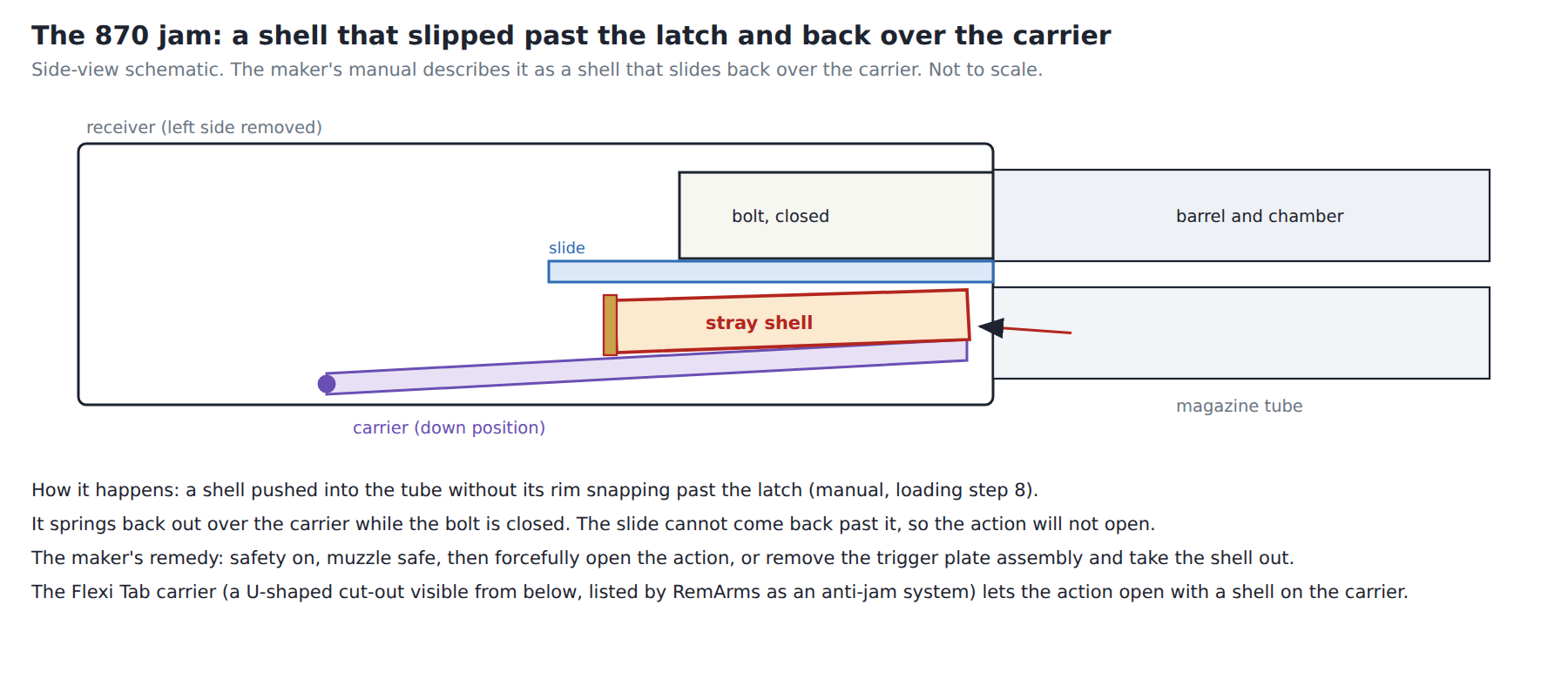
The maker’s remedy, verbatim from the manual:4
“If the shell slides back over the carrier: • Engage the safety mechanism. Make sure the RED BAND IS NOT SHOWING. • Keep the firearm pointed in a safe direction. • Forcefully OPEN the action or • REMOVE the trigger plate assembly following the instructions shown on page 13 and remove the shell.”
The design fix. Remington eventually changed the carrier. The reference literature describes the “Flexi Tab” carrier as having “the U-shaped cut-out on the carrier, visible from below the gun” which, “combined with modified machining on the underside of the slide assembly, allows the action to be opened with a shell on the carrier”, and says the problem existed “for over 30 years” before it.9 RemArms’s current page for the model documented here lists “Flexi Tab - Anti jam system” among its features.7
When the Flexi Tab arrived, and whether the gun documented here has it, could not be established from any maker’s document. It can be established by looking: the U-shaped cut-out is visible through the loading port with the gun upside down. Volume 7 lists that photograph as owed.
The practical rule needs no source beyond the manual: push each shell until the rim clicks past the latch, and feel for it. With a Flexi Tab carrier, the manual’s first remedy — forcing the action open — is the one the design is built for. Without it, the second remedy, removing the trigger plate, is sometimes the only one.
3.11 What Could Not Be Verified
- Any armourer’s manual or military technical manual. None was located in public archives. The mechanism is described from the patents and the owner’s manual.
- Which production changes the patent details went through. The patent ejector is a single leaf spring; the current parts list has an ejector, an ejector spring and two rivets. The production ejector is not described here beyond the list.
- The Flexi Tab carrier’s introduction date, and whether the gun documented here has one.
- The trigger-pull weight of the Express Tactical as shipped.
- The meaning of “interrupter” in any maker’s document. The term is vernacular; the maker’s names are used.
References
Footnotes
-
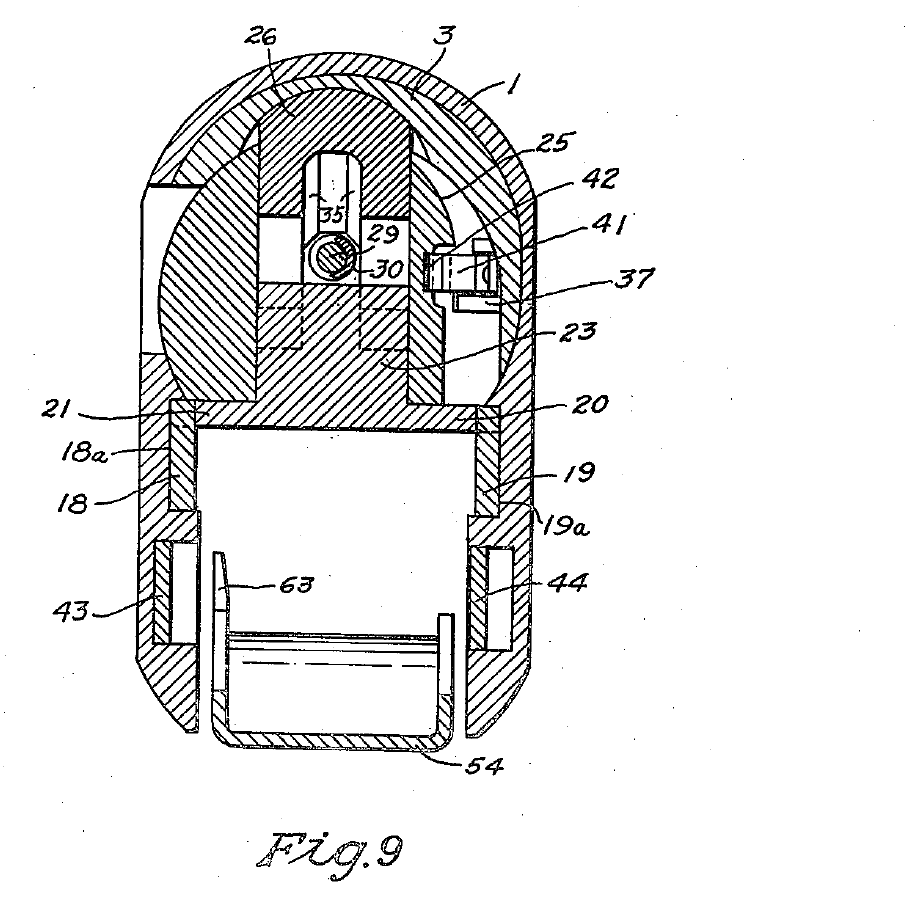
L. R. Crittendon and P. R. Haskell, “Slide-actuated firearm with tilting locking block”, US Patent 2,645,873, filed 31 January 1950, issued 21 July 1953, assigned to Remington Arms Company, Inc. Text and drawings via Google Patents, https://patents.google.com/patent/US2645873A/en, consulted 2026-09-19 — the locking block, slide lug and cams; the load path and the receiver passage quoted; the firing-pin buttresses; the asymmetric block; extraction and ejection; the shell latches, their sequence and their staking; the carrier, carrier dog and the three Browning patents; the fire control, disconnector, action-bar lock, hangfire behaviour and trigger reset; the cross-bolt safety and the drop-safety passage; takedown. Figures 1, 5 and 9 are reproduced from sheets 1 and 3 of the patent drawings (US patent drawings, public domain). ↩ ↩2 ↩3 ↩4 ↩5 ↩6 ↩7 ↩8 ↩9 ↩10 ↩11 ↩12 ↩13 ↩14 ↩15 ↩16 ↩17 ↩18
-
L. R. Crittendon and P. R. Haskell, “Firearm with a pair of action bars”, US Patent 2,719,375, issued 4 October 1955 — the slide supported by both bars; claim 1, one shell per reciprocation; claims 3 and 6, the stop abutment that prevents removal of the breech mechanism with the barrel off. https://patents.google.com/patent/US2719375A/en ↩ ↩2 ↩3 ↩4
-
L. R. Crittendon and P. R. Haskell, “Firearm ejector”, US Patent 2,780,881, issued 12 February 1957 — the ejector support’s locating tongue in the barrel-extension slot, and the leaf-spring ejector. https://patents.google.com/patent/US2780881A/en ↩ ↩2
-
RemArms, LLC, Owner’s Manual — Model 870 & 870 Super Magnum Pump Action Shotguns, form RD 7058 Rev 0526, https://www.remarms.com/sites/default/files/2026%20Revised%20OMs/870%20Manual%20RD7058%20(REV%200526).pdf, consulted 2026-09-19 — the safety; the action-bar lock; the trigger-adjustment prohibition; barrel interchangeability; the ejector cut; the loading warning and jam remedies quoted; the parts list and its Super Magnum footnote; Picture 19, reproduced here, showing the trigger plate. ↩ ↩2 ↩3 ↩4 ↩5 ↩6 ↩7 ↩8 ↩9 ↩10 ↩11 ↩12 ↩13
-
Remington Military, “870P” and “Part/Tech Manuals” pages, remingtonmilitary.com, archived 18 October 2010. ↩ ↩2
-
Phil Bourjaily, “The Story of the Remington 870”, Field & Stream, https://www.fieldandstream.com/story/guns/history-of-the-remington-870/, page dated 23 January 2026, consulted 2026-09-19. ↩
-
RemArms, “Model 870 Synthetic Tactical Ghost Ring”, https://www.remarms.com/shotguns/tactical/model-870-synthetic-tactical-ghost-ring, consulted 2026-09-19 — “Silk-smooth twin action bars prevent inding and twisting” (sic, for “binding”); “Flexi Tab - Anti jam system”. ↩ ↩2
-
Remington Arms, “Important differences between Remington 870 Police and 870 Express shotguns” (2005), archived 16 February 2008 — the carrier dog spring, the 5 to 8 lb Police trigger, the ISS. ↩ ↩2 ↩3
-
“Remington Model 870”, English Wikipedia, wikitext consulted 2026-09-19 — the shell slipping under the bolt, the “over 30 years” of the problem, and the Flexi Tab carrier’s cut-out and modified slide. Secondary, and attributed wherever relied on. ↩ ↩2
Comments (0)