Japanese Type 64 Rifle · Volume 6
Ammunition, Accessories and the Law
The reduced-charge 7.62 mm load and the primer problem it created, the bayonet whose length was settled by averaging three factions, the scope, night sights and rifle grenades, and why no Type 64 has ever reached a private owner in the United States
6.1 The reduced charge
The Type 64 fires the 7.62×51 mm NATO cartridge, chosen so that in an emergency the Self-Defense Forces could share ammunition with US forces in Japan, whose M14 used it, and with the GSDF’s own new Type 62 machine gun.1 But it was designed around a lighter load.
The Japanese Wikipedia, citing Tsunose, says the Defense Agency’s research institute at Meguro tested NATO loads at 95, 90, 80 and 45 percent of full charge and judged about 90 percent best, and that the Ground Staff Office decided in 1962 that the prototypes would use it (Vol 1). The Agency’s requirement of July 1961 had already specified a reduced 7.62 mm load.1 The usual statement of the result is that the charge is cut by about 10 percent; the Japanese Wikipedia puts it as “装薬を10%減らして反動を抑えた減装弾”, a reduced load with 10 percent less charge to hold down recoil, and Tsunose’s later 『小火器読本』 says the rifle uses a reduced load in consideration of the Japanese physique.1
The Japanese Wikipedia’s infobox gives muzzle velocities of about 800 m/s with the full charge and about 700 m/s with the reduced one; it cites no source for either.1 No Japanese specification for the reduced cartridge was found; the Ground Self-Defense Force’s published ammunition specifications include a 7.62 mm ball standard, but it covers commercial ammunition for the G28E2 sniper rifle, not the Type 64’s load.2
One English-language claim should be set aside: the English Wikipedia says that because the rifle was designed around the reduced load, it “incurs substantially accelerated wear and tear from using full-powered ammunition”, citing a defunct Japanese security-company page.3 No Japanese source read says so. What the Japanese sources do say is that the gas regulator lets the rifle fire full-charge ammunition (Vol 3), and that there was a different problem with foreign ammunition.
6.2 The primer problem
The Japanese Wikipedia, citing Tsunose:
「国産弾は規格を定める際に64式の性格を熟知した担当官によって雷管の性能を64式に合わせて鈍感にしてあったため、ドイツ製NATO弾で射撃をしたところ、全弾が遊底閉鎖と同時に発火(自爆)してしまった」
(“When the standard for Japanese ammunition was set, an official who knew the Type 64’s character well had the primers made less sensitive to suit it; so when German NATO ammunition was fired, every round went off as the bolt closed.”)1 Tsunose added, in his book, that if US-made NATO ammunition were ever supplied in an emergency, its primers should be checked first as a safety measure.1
The rifle’s heavy, free-running parts are the likely reason. A firing pin carried forward by a heavy bolt can dent a sensitive primer hard enough to fire it, which is why some rifles need hard primers; the Type 64’s hammer is a heavy rod (Vol 3). That explanation is this dive’s; the sources record only the result. Its consequence was the opposite of what the 7.62 mm NATO choice was for: the rifle could not safely take allied ammunition without checking it first. The Japanese Wikipedia notes that by the time the problem mattered, the US Army had in any case moved to the 5.56 mm M16, and ammunition commonality with US forces waited for the Type 89.1
6.3 The cartridges in service
Tsunose, as cited by the Japanese Wikipedia, lists the 7.62 mm cartridges adopted with the rifle under American-style designations: M80 普通弾 (ball), M62 曳光弾 (tracer), M82 摸擬弾 (dummy) and M63 空包 (blank).1
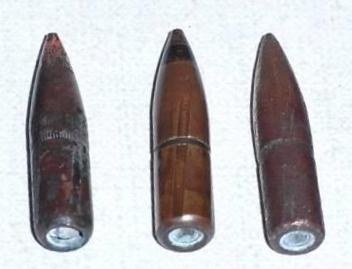
The Coast Guard’s 1999 warning fire off Noto (Vol 2) used, according to the Japanese Wikipedia citing Taoka, 500 tracer rounds among 1,050.1
6.4 The magazine
The Type 64 magazine holds 20 rounds in a double column and has a witness hole on its left side to show how many remain (Elite Forces, as cited by the Japanese Wikipedia).1 Forgotten Weapons says the magazine was “copied from the U.S. M14”,4 but no Japanese source read says so, and none says whether M14 magazines fit the rifle. That claim is not used.
6.5 The bayonet
The 64式銃剣 is about 41 cm long with a blade of about 29 cm (Tsunose, as cited by the Japanese Wikipedia).1 Its length has a story. When the rifle was being developed, a faction at the Fuji School held that a new assault rifle needed no bayonet at all; those who wanted one disagreed; and a third faction from the physical-training school, heirs to the Imperial Army’s Toyama School, wanted a long one for bayonet fighting. The three-way argument reportedly came close to a duel. A mediator settled it by taking the average: halfway between the long Type 30 bayonet and the short M1 carbine bayonet, which came out 3 cm longer than the M1 rifle’s bayonet, at a 29 cm blade.1
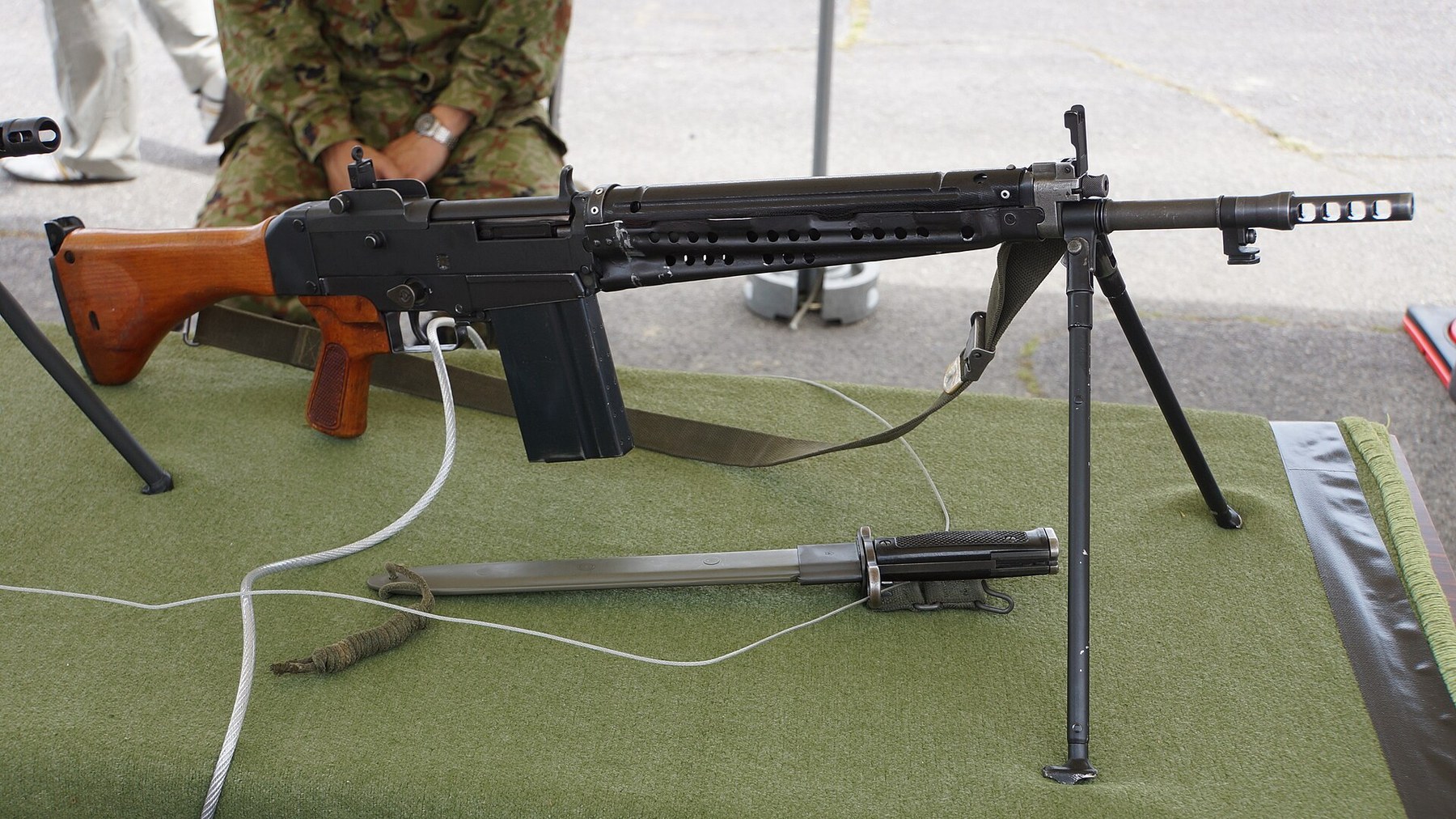
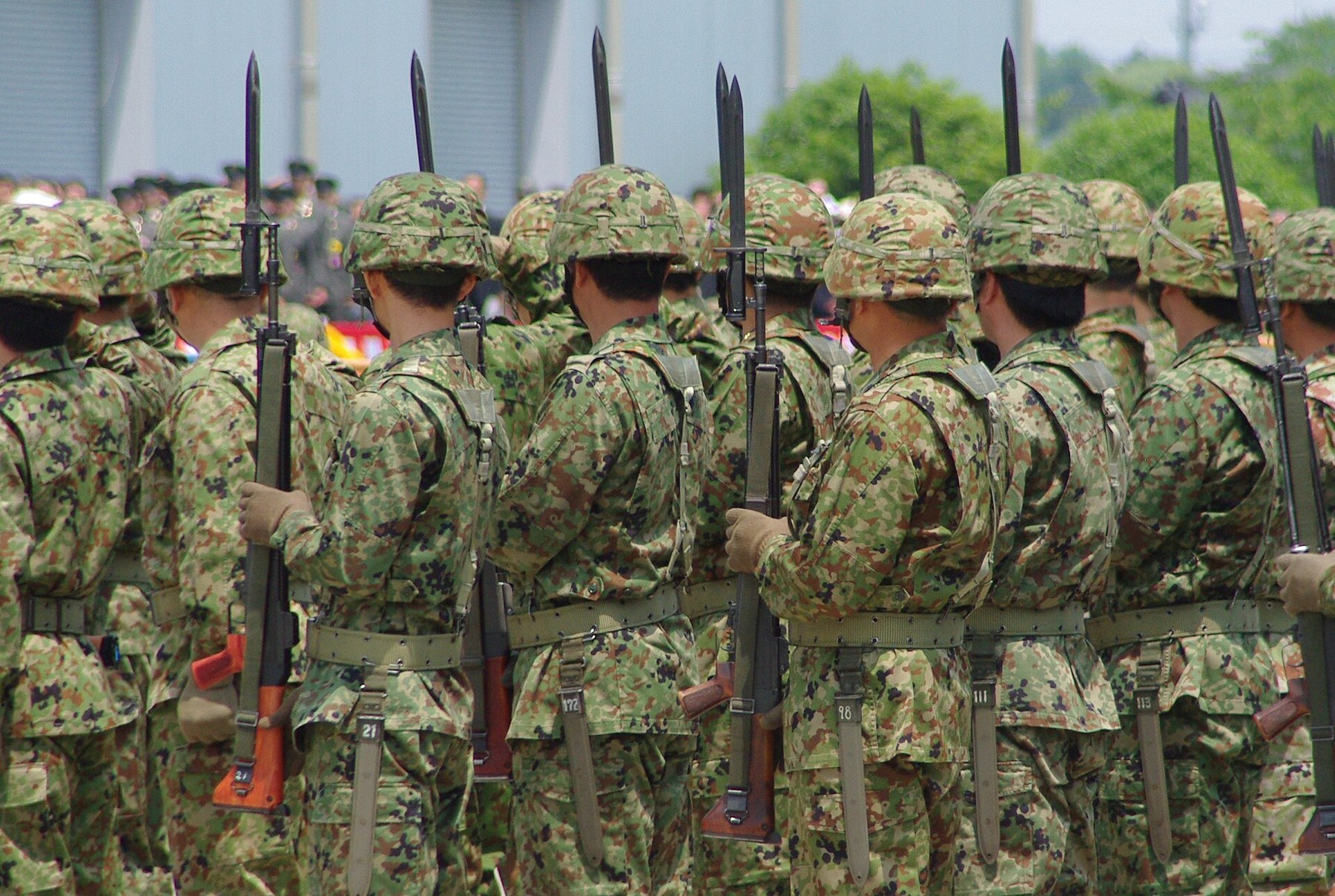
In peacetime the blade is kept unsharpened and is to be sharpened as part of preparation for combat, according to the Japanese Wikipedia; sentries at some garrison gates carry rifles with bayonets fixed.1 Fixed to the Type 64, it made a long weapon, which suited bayonet fighting.1
6.6 Scope and night sights
The Type 64 sniper scope (64式用狙撃眼鏡), by Nippon Kōgaku, 2.2×, field of view 5.2 degrees, is covered with the marksman’s configuration in Vol 2.1 Two night sights were made for the rifle, both described by 『丸』 (August 2012) as cited by the Japanese Wikipedia:1
- Type 63 sniping night-vision device I (63式狙撃用暗視装置I型). An active infrared sight, researched by the TRDI from the 1950s and adopted in 1963, developed from the American “special sighting device” supplied with the M1903A4 and made by NEC. It was designed for the new rifle, though the prototypes were tried on M1903A4s and M1C/Ds. The illuminator weighed 2 kg and the viewer 4 kg, and the firer carried a 9 kg battery on his back. It saw to 100 m at a fixed 3×; an improved B model reached beyond 100 m at 3.7×. All had been retired by 2012.
- Type 75 aiming low-light night-vision device II (75式照準用微光暗視装置II型). A passive image-intensifier successor that fitted the Type 64, the Type 62 machine gun and the 84 mm recoilless rifle, but not the Type 89, whose mount differs.
6.7 Rifle grenades
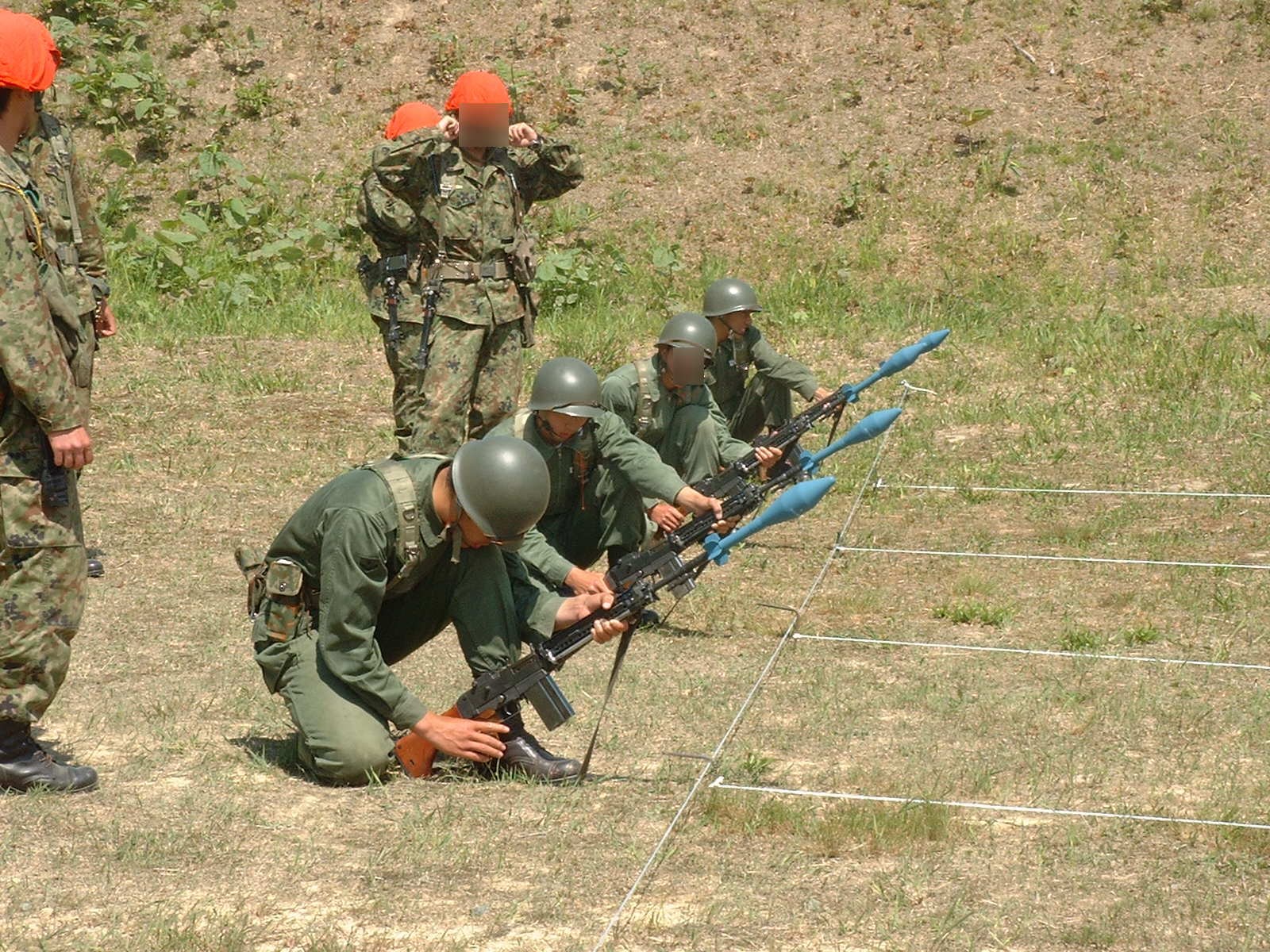
The Type 64 launches rifle grenades from its muzzle, using the regulator (Vol 3).1
- M31 HEAT. The American anti-tank rifle grenade supplied to the Self-Defense Forces, fired with a grenade-launching cartridge. Elite Forces, as cited by the Japanese Wikipedia, gives its maximum range as 185 m and its penetration as 250 mm of armour or 500 mm of concrete.1
- Type 06 rifle grenade (06式小銃てき弾). Adopted in 2006. The Ministry’s own 2005 evaluation summary of the prototype: “89式小銃または64式小銃の先端に装着して使用する” (“used fitted to the muzzle of the Type 89 or Type 64 rifle”), “小銃弾を用い、てき弾発射が可能” (“can be launched using an ordinary rifle cartridge”), smaller and lighter than the equipment it replaced, and self-destructing if it fails to function on impact.5 Fired with a ball round, it does not need the grenade blank that caused the early-sear accident described in Vol 3.
6.8 Other accessories
The Japanese Wikipedia also lists a blank-firing adaptor and a brass catcher that clamps over the rifle and screws to a hole in the handguard, with a modified version for scoped rifles that let the cases drop clear.1
6.9 Why none left Japan
Every Type 64 was made for a Japanese government agency, and Japan did not export arms while the rifle was in production. The government’s own account of the policy is in the preamble to its 2014 cabinet decision replacing it:
「政府は、これまで防衛装備の海外移転については、昭和42年の佐藤総理による国会答弁(以下「武器輸出三原則」という。)及び昭和51年の三木内閣の政府統一見解によって慎重に対処することを基本としてきた。…武器輸出三原則の対象地域以外の地域についても武器の輸出を慎むものとした結果、実質的には全ての地域に対して輸出を認めないこととなった」
(“The government has until now handled the overseas transfer of defence equipment with caution, on the basis of Prime Minister Satō’s answer in the Diet in 1967, the ‘Three Principles on Arms Exports’, and the Miki cabinet’s unified view of 1976 … Because exports were to be refrained from even to areas outside the scope of the Three Principles, in practice exports were permitted to no area at all.”)6
The whole run of GSDF contracts, from 1964 to 1985 (Vol 2), fell within that regime. The 2014 decision replaced it with the Three Principles on Transfer of Defence Equipment and Technology, which allow transfers under conditions;6 no transfer of Type 64 rifles under them was found. The English Wikipedia’s statement that the rifle “has never been exported” agrees.3
Howa’s history shows the line was drawn at military arms, not at Howa: the company exported 10,000 semi-automatic Model 300 rifles to the Thai police by 1966, and about 3,000 Golden Bear bolt-action rifles to the United States after 1967.7 It made no civilian version of the Type 64, as far as any source found records.
6.10 United States law
Nothing here is legal advice. The general law of machine guns is set out in this hub’s MP 40 dive, Volume 6, and is not repeated here; what matters is how it applies to this rifle.
- A Type 64 is a machinegun. It fires automatically more than one shot by a single function of the trigger, with the selector at レ, which puts it inside the federal definition at 26 U.S.C. § 5845(b), as quoted in the MP 40 volume.
- A transferable one would have to have been lawfully registered before 19 May 1986. That is 18 U.S.C. § 922(o).
- No Type 64 is known to have been in the United States before that date, or since. The rifles were Japanese government property made under a policy that permitted no exports (above). No record was found of any Type 64 imported, registered, sold at auction or held by a US museum, in any source searched. That is an absence of evidence, not a register search, which is not public; but the export history leaves no route by which one could have arrived.
- The post-1986 routes do not help a private owner. A machine gun made or imported after the cutoff can be held only by a government body or by a licensed dealer as a sales sample, and never becomes transferable to a private person. This hub’s FN P90 dive, Volume 4 explains what a post-1986 dealer sample is. For a Type 64 even that would need Japan to export one.
- There is no semi-automatic Type 64. Howa never made one for sale, as far as any source records, so the route that exists for some military rifles (a semi-automatic version, imported or made in the US) does not exist for this one. This dive is a reference dive and gives no build or conversion content of any kind.
The plain conclusion is the one the brief for this dive started from: no Type 64 has ever lawfully entered civilian hands in the United States, and under current law none can.
6.11 Michigan
Michigan’s machine-gun provision, MCL 750.224, and its open question for private registered owners, are covered in the MP 40 dive, Volume 6, section 6.6. For the Type 64 the question does not arise, because no transferable example exists.
6.12 Replicas in the United States
The airsoft copies described in Vol 4 (the S&T and G&G electric guns in particular) are toys under federal law, not firearms, but they are imitation firearms under 15 U.S.C. § 5001 and the marking rules that go with it, which the MP 40 volume also covers. Some states and cities add their own restrictions on carrying realistic replicas in public.
6.13 What could not be verified
- The reduced load’s specification, including bullet weight, charge and velocity; the 700 and 800 m/s figures are uncited in the Japanese Wikipedia.
- The 10 percent figure’s source. It appears in the Japanese Wikipedia without a page reference; the Meguro test range (95 to 45 percent) is from Tsunose.
- The English Wikipedia’s claim of accelerated wear from full-charge ammunition.
- Whether M14 magazines fit the Type 64.
- The bullet identifications in the 1970s photograph, which are the finder’s.
- Any Type 64 in the United States, in any status. None was found.
Footnotes
-
Japanese Wikipedia, 「64式7.62mm小銃」, wikitext read 2026-10-20, citing 津野瀬光男『幻の自動小銃 六四式小銃のすべて』 (pp. 101, 146–147, 188, 204); 津野瀬光男『小火器読本』 p. 167; 『エリートフォーセス 陸上自衛隊編』 Part 1 p. 126 and Part 2 p. 45; 『丸』 August 2012, pp. 88–91; 『月刊Gun』 May 1992. None seen for this dive. Translations this dive’s. ↩ ↩2 ↩3 ↩4 ↩5 ↩6 ↩7 ↩8 ↩9 ↩10 ↩11 ↩12 ↩13 ↩14 ↩15 ↩16 ↩17 ↩18 ↩19
-
Ground Self-Defense Force, インターネット公開仕様書目録 (弾薬), https://www.mod.go.jp/gsdf/procurement/ammunition/ , read 2026-10-20: GAM-Y701119C 「7.62mm普通弾」, “陸上自衛隊において使用する市販品の7.62mm対人狙撃銃G28E2用弾薬について規定”. ↩
-
English Wikipedia, “Howa Type 64”, wikitext read 2026-10-20. ↩ ↩2
-
Forgotten Weapons, “Howa Type 64”, https://www.forgottenweapons.com/rifles/howa-type-64/ , undated (images uploaded about November 2010), read 2026-10-20. ↩
-
Ministry of Defense, 別紙 「試作品の概要 新小銃てき弾」, policy evaluation material for fiscal 2005 (平成17年度), Internet Archive capture of 2 October 2012 of https://www.mod.go.jp/j/approach/hyouka/seisaku/results/17/jigo/sankou/jigo02_sankou.pdf , read 2026-10-20. ↩
-
National Security Council and Cabinet decision, 「防衛装備移転三原則」, 1 April 2014 (平成26年4月1日), https://www.cas.go.jp/jp/gaiyou/jimu/pdf/bouei1.pdf , read 2026-10-20. Translation this dive’s. ↩ ↩2
-
Howa Machinery, “Our History (Howa Machinery Firearms Dept.)”, https://www.howa.co.jp/en/products/firer/history.html , read 2026-10-20. ↩
Comments (0)