Japanese Type 64 Rifle · Volume 4
Identification and Markings
The production rifle against its 1963 trial rifles, the marksman's configuration and its successors; reading the receiver legend; the airsoft guns, model guns and blue dummies that outnumber real Type 64s in photographs; and the other weapons called Type 64 or Type 63
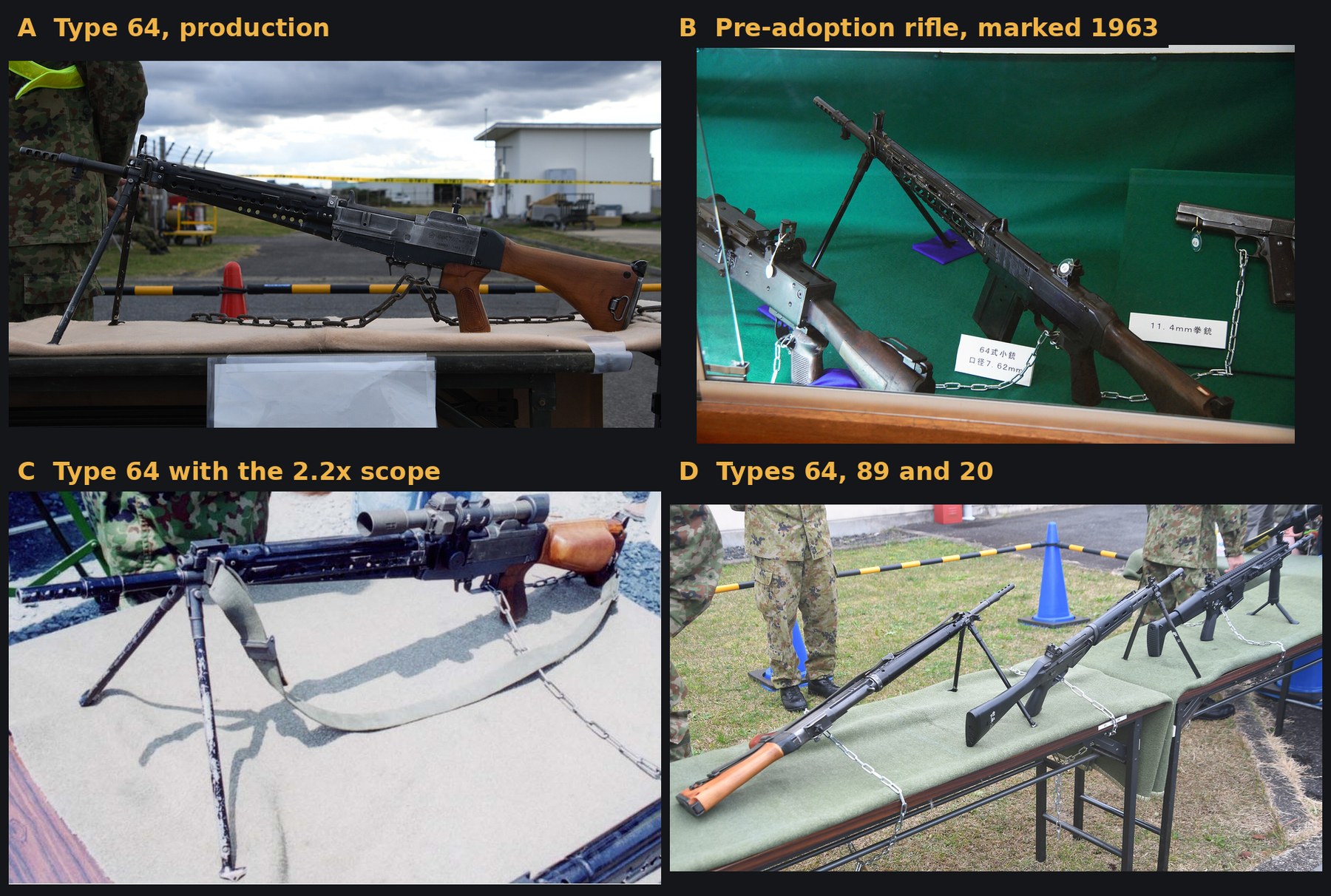
4.1 What gets confused
Only one model of the Type 64 was issued, so identifying one is less about variants than about everything around it. Five things are confused with it in photographs and in print:
- Pre-adoption trial rifles, which are displayed in Japanese military museums under the plain label 64式小銃.
- The marksman’s configuration, which is a standard rifle with a scope and cheek pad, not a separate model (Vol 2).
- Its successors, the Type 89 and the Type 20, which serve alongside it.
- Replicas. Every real Type 64 was made for a government agency and none is known in private hands (Vol 6), so most Type 64s photographed outside a garrison are airsoft guns, model guns or film props. At least one widely reused photograph labelled as a Type 64 rifle is probably one of them.
- Other weapons with the same number. China has a Type 64 submachine gun, Japan a Type 64 anti-tank missile, and China’s Type 63 rifle is sometimes confused with this one.
The identification rules here come from the sources cited in Vols 1 to 3 and from looking at every photograph used. They are recorded with each photograph in the photo credits.
4.2 The family plate
4.3 The features that identify a Type 64
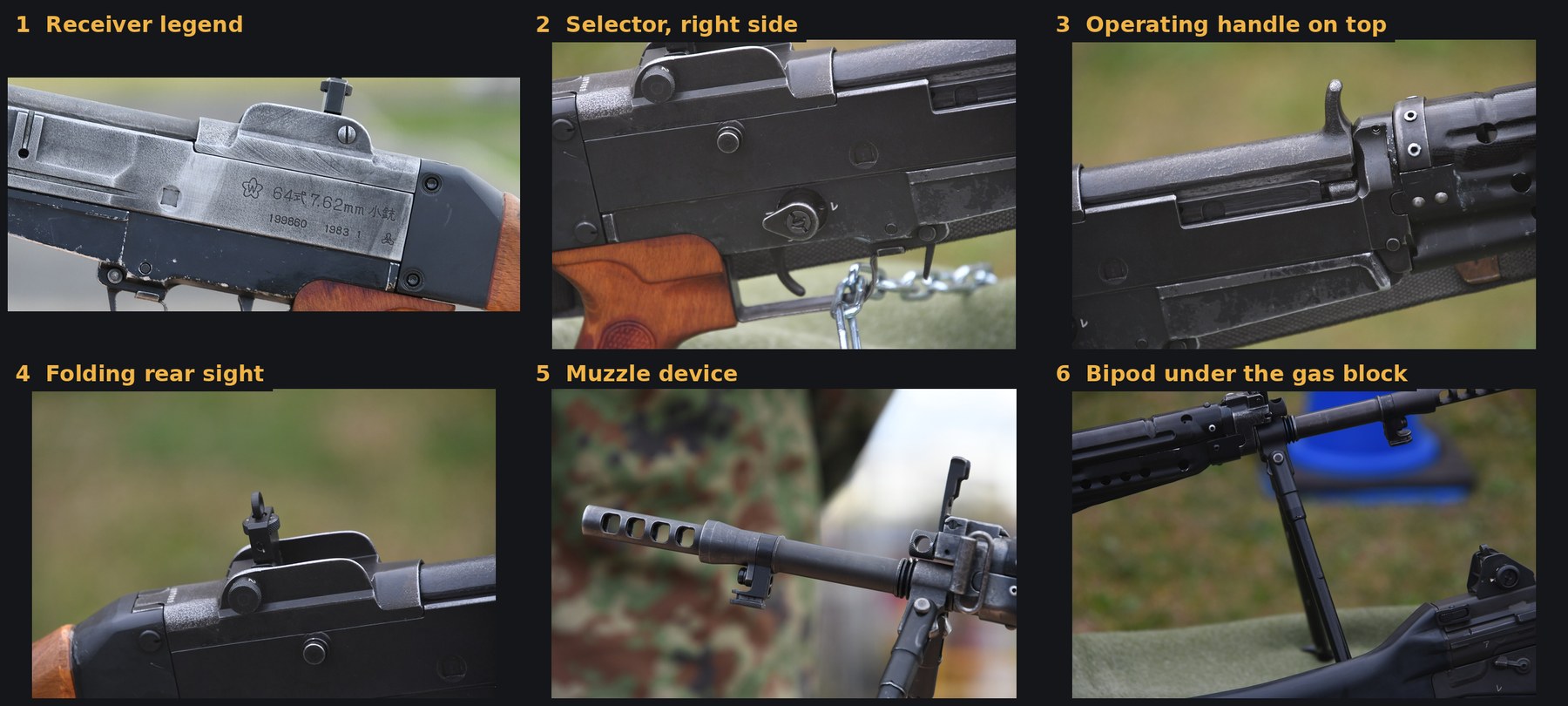
Each of these is visible in a reasonable photograph, and together they rule out every other service rifle.
- A straight-line wooden stock and a separate wooden pistol grip. Red lauan, often a reddish brown.1 No folding version exists, or can: the hammer tube runs inside the butt (Vol 3).
- A square, machined receiver with the legend on its left side (below).
- The operating handle on top of the receiver, just behind the handguard, not on the side.1
- A slotted metal handguard in upper and lower halves, with two rows of round holes along the lower half on rifles photographed for these volumes. It cannot be removed without tools.1
- A bipod hinged under the gas block, normally fitted.
- A muzzle device with rectangular ports through both sides: four a side on the rifles photographed here (Vol 3 explains the conflict with the three-port description).
- Folding front and rear sights. The rear is an aperture on a block at the back of the receiver with an adjustment knob on the right.1
- A 20-round box magazine with a witness hole on the left.1
- The selector on the right only, marked ア, タ, レ (Vol 3).
4.4 Markings
The receiver legend of a rifle displayed at Camp Yao in October 2023 reads, on the left side above the magazine well:2
Table 1 — Markings
| Line | Marking | Meaning |
|---|---|---|
| 1 | A five-lobed flower outline enclosing a “W” | Not identified by any source found. The Japanese Wikipedia, describing a replica, refers to “the Howa Industries mark on the left side of the rifle”, which matches its position, but does not describe the mark.1 |
| 1 | 64式 7.62mm 小銃 | ”Type 64 7.62 mm rifle”, the official name fixed on 6 October 1964 (Vol 1) |
| 2 | 199860 | Serial number |
| 2 | 1983 1 | Presumably the year and month of manufacture; no source explaining the marking was found |
| 2 | A small mark of three circles | Not identified; presumably an inspection or acceptance stamp |
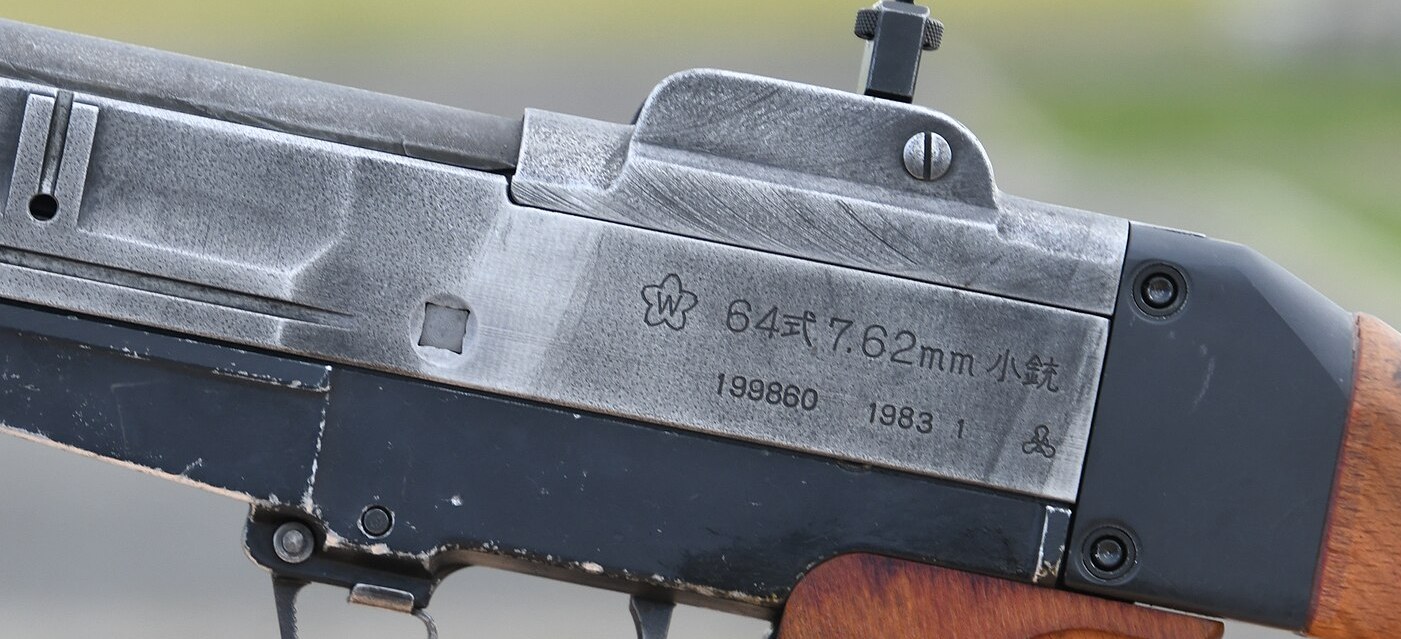
The serial number matters for one known change: rifles numbered 1 to 79054 had the hammer tube screwed into the stock and rifles from 79055 had it integral with the receiver (Vol 3).1 The change is internal. A serial number is the only external guide to which a rifle has.
Rifles in service also carry unit markings: a rifle displayed at Camp Yao bore a yellow label reading 航整-10, and another at Camp Uji had characters written on the butt in marker. These are unit and rack numbers, not factory markings.
4.5 The 1963 trial rifle
The museum at Camp Jinmachi, Higashine, displays a rifle labelled simply “64式小銃 口径7.62mm”. It is not a production rifle. Its receiver is marked with characters that read 試製口径7.62 (“trial manufacture, calibre 7.62”) and 1963, and a number that appears to be No. 012; the marking is partly hidden by a display tag and worn, and the reading is this dive’s. Its handguard has oval holes, not the production rifle’s round ones, and its front sight and handguard shapes differ. The photographer who uploaded it to Commons identified it from those features and the 試製 1963 marking as a pre-adoption prototype, perhaps an R6.3
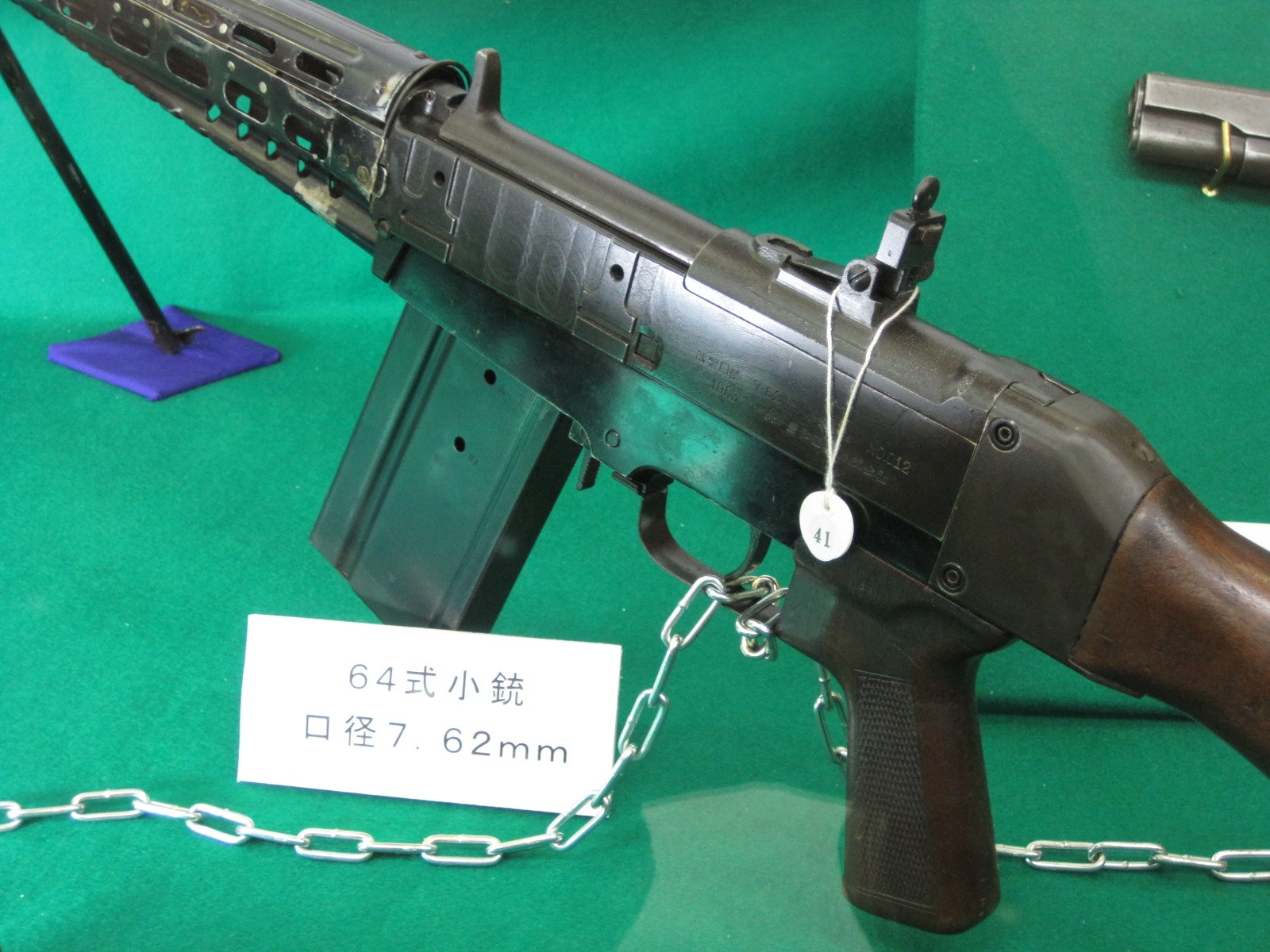
Tsunose’s chronology (Vol 1) makes a 1963 trial rifle one of the Kan II Kai or Kan III rifles built that year. One feature might settle which: the operating handle, which was on the right side before Kan III and on top from Kan III.1 The photographs of this rifle do not show the top of the receiver clearly enough to say.
The same case holds two magazines, which look like the production 20-round magazine.
4.6 Early and late production
No external difference between early and late production rifles was found in any source, apart from the serial number (above). The Japanese Wikipedia mentions informal “A”, “B” and “C” types, A for the prototypes and earliest rifles with the first sear shape, B for rifles up to serial 79054 and C for later ones, and says these names are unofficial.1 Refinishing is common: rifles returned to depots were re-parkerised (Vol 2), so finish is no guide to age.
4.7 The marksman’s configuration
The marksman’s Type 64 is an ordinary rifle with the Nippon Kōgaku 2.2× scope on a mount at the left of the receiver, and usually a leather or fabric cheek pad tied on (Vol 2). Without the scope it is indistinguishable from any other Type 64; the mount attaches with a single screw to a screw hole in the receiver, which is also used for laser engagement-system equipment.1
4.8 The Type 89 and the Type 20
The Type 89 and Type 20 serve alongside the Type 64 and appear in the same photographs.
- Type 89 (89式5.56mm小銃). Black synthetic furniture and a slimmer 5.56 mm rifle, made with fixed or folding stocks; unlike the Type 64, its selector shaft shows on the left side too.1
- Type 20 (20式5.56mm小銃). Rails on the top and handguard and an adjustable stock, as the Camp Uji photograph in the family plate shows.
In black-and-white or at a distance, the quickest tell is the stock: a wooden butt and separate wooden grip is a Type 64.
4.9 Lookalikes: airsoft guns, model guns and dummies
No real Type 64 is known in private hands, but copies are common and photograph convincingly.
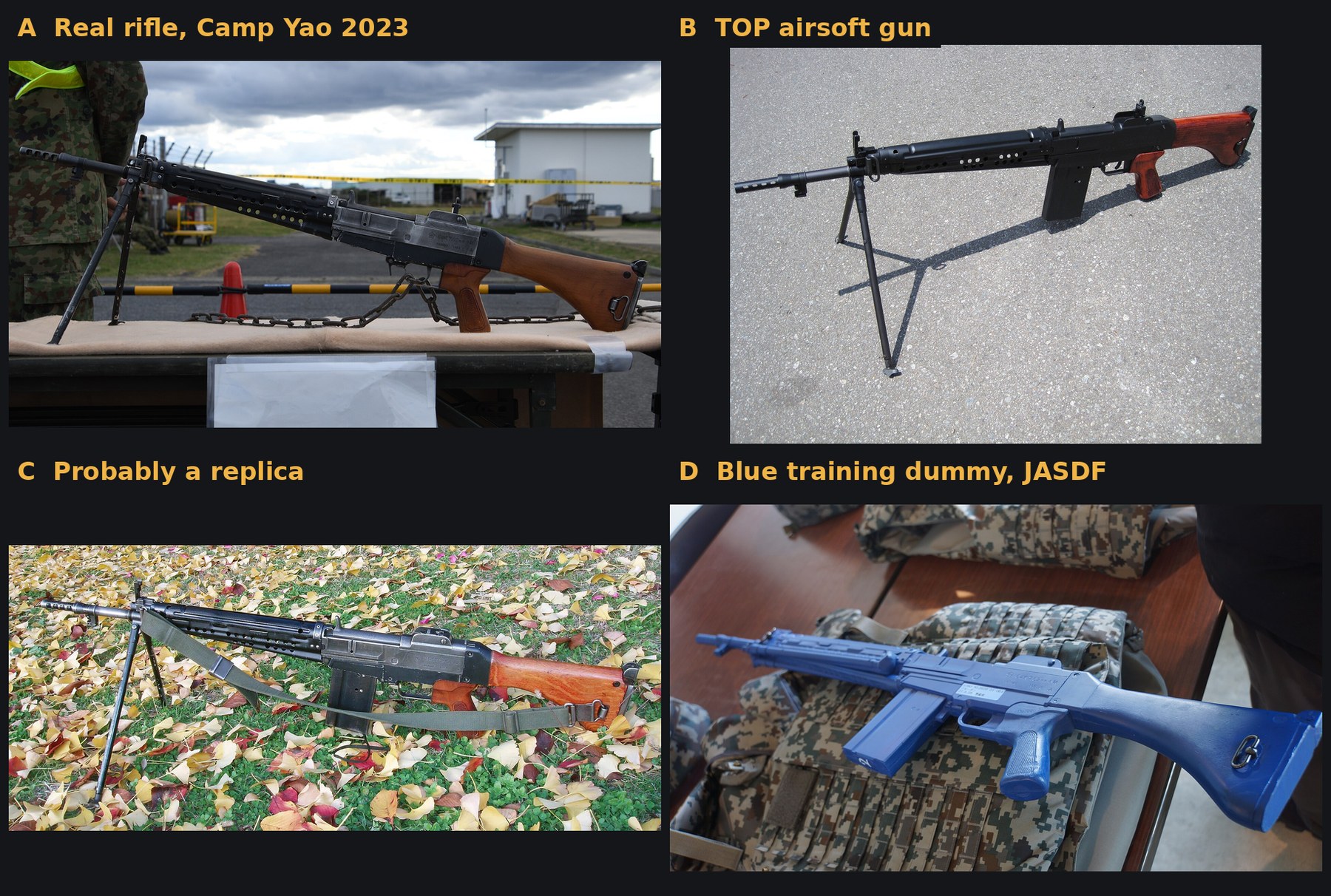
The Japanese Wikipedia lists the main copies:1
Table 2 — Lookalikes: airsoft guns, model guns and dummies
| Copy | Year | Kind | How to tell |
|---|---|---|---|
| TOP Japan 六四式小銃 | 1994 | Electric airsoft; zinc die-cast parts, aluminium receiver, steel bipod | Grip and stock thicker than real to hold battery and gears; standard version had plastic furniture, deluxe versions wood with GSDF, MSDF or ASDF markings; a sniper version came with scope and cheek pad |
| Hobby Fix 六四式小銃 | 1994 | Dummy-cartridge model gun reproducing the internal mechanism | Some parts not reproduced, among them a detail of the extractor spring; sold in small numbers |
| S&T TYPE64 | 2014 | Electric airsoft (Hong Kong), a copy of the TOP | The Howa mark on the left changed; from October 2016, an asymmetric stock and a pull-and-turn selector like the real one |
| G&G Type64 BR | 2021 | Electric airsoft with an electronic trigger | Can be set to fire three- or five-round bursts, which the real rifle cannot; stock not shaped like the real one |
| Toida Kōgyō film props | from the 1960s | Blank-firing props made for films | Used in many Japanese films |
| Rubber and blue dummies | — | Solid training replicas used by the Self-Defense Forces | One piece, no working parts |
The photograph labelled “Type 64 Rifle”. A public-domain photograph on Wikimedia Commons, captioned by its uploader “JGSDF type 64 rifle picture”, shows a complete rifle with bipod and sling lying on fallen leaves on grass.4 It has been used as the main illustration of the rifle in reference works, including the English Wikipedia’s infobox and comparison tables.5 It is probably not a real rifle. Every real Type 64 belongs to a government agency, and one would not be expected on private ground; and the receiver number, partly legible, appears to read 010000 or 030000, a round number of the kind replicas carry. This dive cannot prove it is a replica, and does not use it as a picture of the real rifle.
4.10 Other things called Type 64, or Type 63
Table 3 — Other things called Type 64, or Type 63
| Name | What it is | How it differs |
|---|---|---|
| 64式7.62mm小銃 | This rifle | — |
| 64式対戦車誘導弾 (Type 64 MAT) | A Japanese wire-guided anti-tank missile of the same year | Not a firearm. The English Wikipedia’s article on the rifle opens with a note distinguishing it.5 |
| Chinese Type 64 | A Chinese silenced submachine gun | A pistol-calibre weapon, not a rifle |
| Chinese Type 63 (63式自动步枪) | A Chinese 7.62×39 mm select-fire rifle | A different rifle in a different calibre. This hub’s Type 63 dive treats it. |
The Chinese Type 63 dive was being written at the same time as this one; its link is to that dive’s planned path and should be checked when both are published.
4.11 Tell them apart
Table 4 — Tell them apart
| Feature | Type 64 | 1963 trial rifle | Type 89 | Type 20 | Airsoft and model copies |
|---|---|---|---|---|---|
| Stock | Wood, straight, fixed | Wood, fixed | Black synthetic, fixed or folding | Black synthetic, adjustable | Wood or plastic; TOP’s grip and butt thicker |
| Handguard | Metal, two rows of round holes (lower) | Oval holes | Black synthetic | Rails | TOP: single row of holes |
| Operating handle | Top | Not seen | Not on top | Not on top | Top |
| Muzzle device | Four side ports a side | Ported | Different device | Different device | Varies |
| Bipod | Under gas block, not meant to come off | Under gas block | Detachable | Not compared | Usually fitted |
| Selector | Right side only, ア/タ/レ | Not seen | Shaft visible on the left too | Not compared | S&T from 2016: pull-and-turn |
| Receiver legend | Emblem, 64式7.62mm小銃, serial, date | 試製, 1963, No. | 89式 | 20式 | Replica legends, often round numbers |
| Calibre | 7.62×51 | 7.62×51 | 5.56×45 | 5.56×45 | 6 mm BB or dummy |
4.12 What a photograph cannot settle
- The emblem and the three-circle mark on the receiver. Their meaning was not found.
- The 1983 1 marking, presumably a date of manufacture.
- Whether a rifle has the early or late hammer tube, except by serial number.
- Whether a given Type 64 in a private-looking photograph is real. In private hands it almost certainly is not (Vol 6).
Footnotes
-
Japanese Wikipedia, 「64式7.62mm小銃」, wikitext read 2026-10-20, sections 特徴, 64式7.62mm狙撃銃 and 遊戯銃, citing 『エリートフォーセス 陸上自衛隊編』 Parts 1 and 2, 『丸』 August 2012 and 『新入隊員必携』; none seen for this dive. ↩ ↩2 ↩3 ↩4 ↩5 ↩6 ↩7 ↩8 ↩9 ↩10 ↩11 ↩12
-
Hunini, “JGSDF Type 64 rifle receiver left side view at Camp Yao October 29, 2023” and “serial number engraving and rear sight” photographs, Wikimedia Commons, CC BY-SA 4.0, read from the photographs at full size 2026-10-20. ↩
-
Crescent moon, “JGSDF Type 64 Rifle (Prototype) 20140420-01.jpg” and “JGSDF Howa Type 64 Rifle (Prototype) 20120422-01” to “-04”, Wikimedia Commons, CC BY 3.0; the 2014 file’s description: 「被筒や照星部分の形状、側面の2ヵ所開いたネジ穴、試製・1963の刻印とあるので、制式採用前の試作銃(R6型?)とみられる」, read 2026-10-20. ↩
-
ひでたけ, “Type 64 Rifle.jpg”, 3 December 2009, Wikimedia Commons, public domain, description “JGSDF type 64 rifle picture”, read 2026-10-20. ↩
-
English Wikipedia, “Howa Type 64”, wikitext read 2026-10-20. ↩ ↩2
Comments (0)