Japanese Type 64 Rifle · Volume 1
Origins: From Borrowed Rifles to the Type 64, 1950–1964
The worn-out American carbines and rebored Arisakas the new Japanese forces were handed, the Howa and Defense Agency engineers who set out to replace them, the prototypes that broke, the M14 that nearly won, and the September 1964 adoption
1.1 What the rifle is
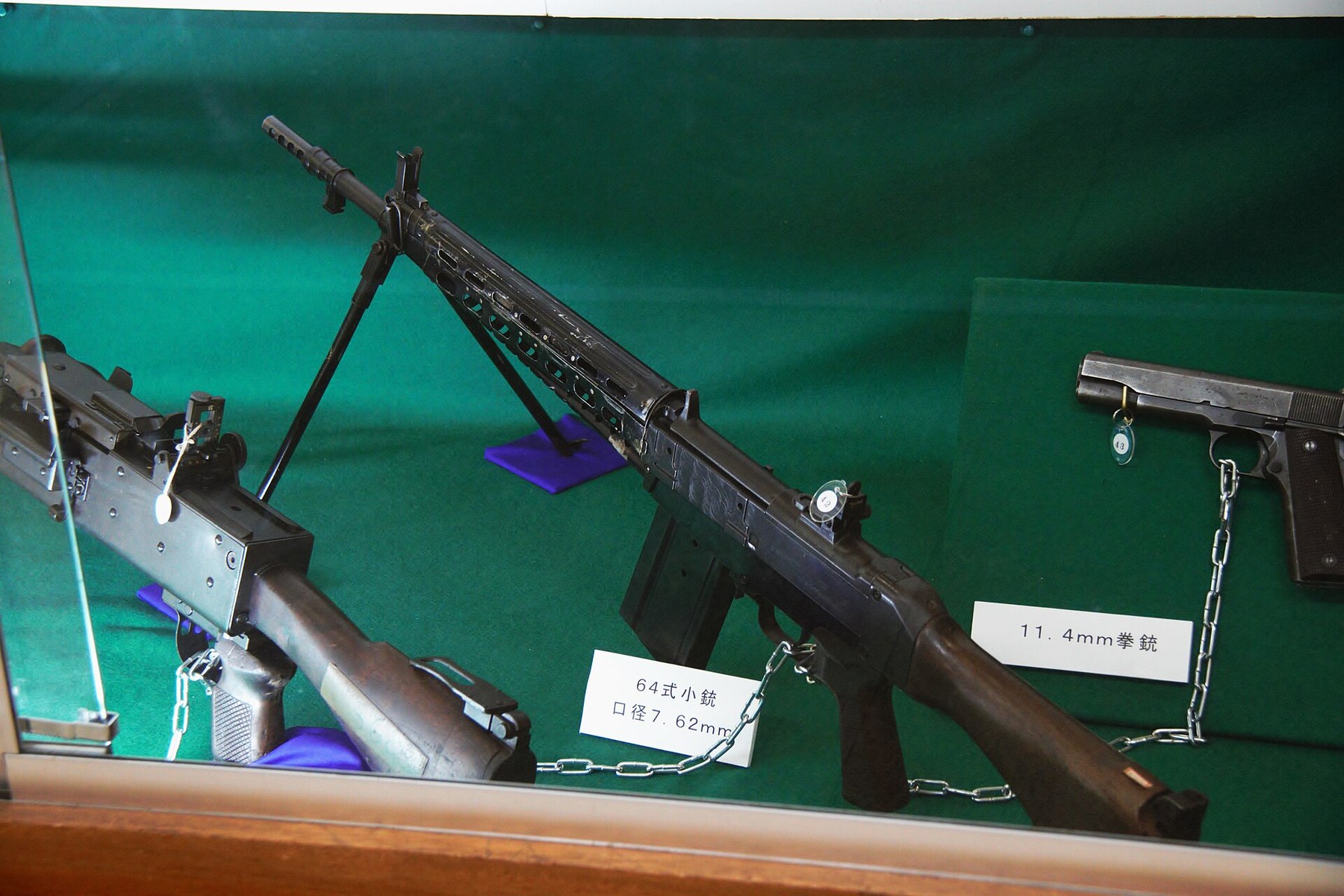
The 64式7.62mm小銃 (rokuyon-shiki 7.62-miri shōjū, “Type 64 7.62 mm rifle”) was the first rifle designed and built in Japan after the Second World War. Howa Machinery made it; the Japan Defense Agency adopted it in 1964; and it armed the Ground, Maritime and Air Self-Defense Forces and the Japan Coast Guard for the rest of the century. It is a gas-operated, tilting-bolt, selective-fire rifle in 7.62×51 mm with a 20-round box magazine, a bipod fitted as standard, and an unusual rate-of-fire mechanism in which a straight, rod-like hammer runs back into the butt-stock.
Howa’s own page states it in one sentence: “1964年に制式化された、第2次世界大戦後、初めて国内で開発された自動小銃。” (“an automatic rifle adopted in 1964, the first developed domestically after the Second World War”).1 The Ministry of Defense’s own 2011 briefing on armoured vehicles and weapons lists it, with the Type 89 that followed it, under the heading that both were “国内開発”, developed in Japan.2
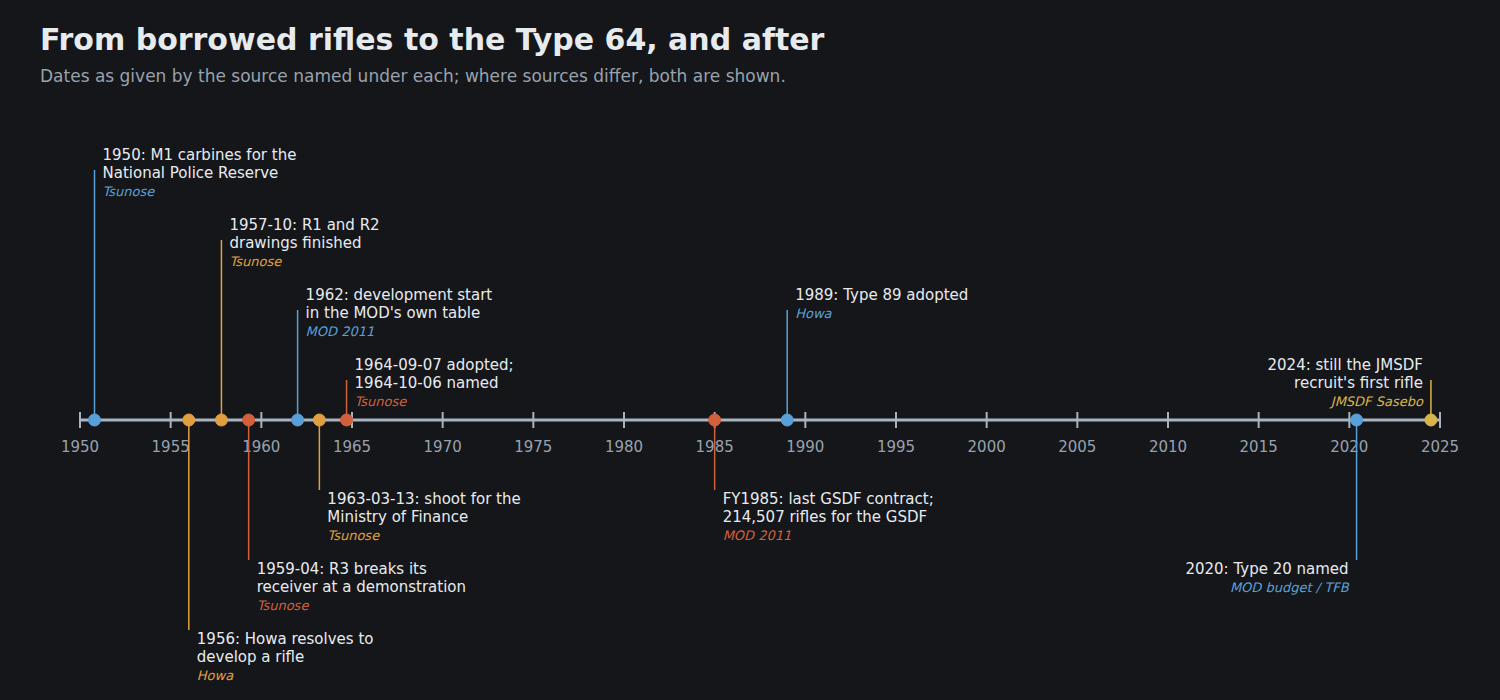
This volume covers the fourteen years from the first American rifles issued to the National Police Reserve in 1950 to the rifle’s adoption in September 1964. Vol 2 takes the story from production to retirement; Vol 3 explains how it works.
1.2 The sources, and the one that matters most
The development story rests on one book above all: 『幻の自動小銃 六四式小銃のすべて』 (“The Phantom Automatic Rifle: Everything about the Type 64 Rifle”, Kōjinsha, ISBN 4-7698-2490-4), by 津野瀬光男 (Tsunose Mitsuo). Tsunose was an engineer at the Defense Agency’s Technical Research and Development Institute (技術研究本部, TRDI) who designed several of the prototypes himself and later worked at Howa. His is an insider’s account, with the strengths and the slant that implies.
The book is not online and was not seen for this dive. Every claim below that rests on it is taken from the Japanese Wikipedia article on the rifle, which cites it page by page, and is attributed in the text as “Tsunose, as cited by the Japanese Wikipedia”.3 Where a primary document was found that confirms, refines or contradicts the book, it is quoted instead. Three were found and are used throughout:
- The Ministry of Defense’s 2011 briefing 「装甲車両・火器及び弾薬の開発・調達について」, which gives the rifle’s development and contract dates and the Ground Self-Defense Force’s total.2
- US Patent 3,236,154, filed by Kenzo Iwashita for Howa in 1964, which describes the rate-reducing hammer mechanism in the designer’s own words.4
- Howa’s own history of its firearms department.5
1.3 Rifles on loan, 1950–1961
The National Police Reserve, formed in 1950, was armed by the United States. Tsunose, as cited by the Japanese Wikipedia, gives the sequence: M1 carbines from October 1950, the force’s first rifles; M1 rifles from March 1951; and in 1952, when an expanded establishment left the force short of arms for 35,000 men, Japanese Type 99 rifles that the Americans had seized, converted to take the US .30-06 M2 ball cartridge. Some 32,500 of the converted Type 99s served as training substitutes into the late 1950s.3
Both stopgaps were poor. The carbines were second-hand, from the Second World War and Korea, and failed in a variety of ways.3 The Type 99s were worse. They came from every stage of wartime production, regular and simplified, mixed with parts from other patterns until nothing interchanged; and rechambering a light rifle for a heavier American cartridge had raised its recoil. Tsunose records reports from units that rifles fired when the trigger was pulled with the safety on and that barrels split while firing.3
The verdict on them came in 1961, while the new rifle was already being developed. Five hundred Type 99s were sent to Howa for inspection, and Iwashita Kenzo, who had worked on the Type 99 before the war, took part. Of the bolts, firing pins and safeties, none passed; of the receivers, two; of the firing-pin retaining springs, 37. Not one rifle was judged satisfactory, and when the Ground Staff Office was told, it banned the firing of Type 99s at once.3
1.4 Who designed it
The Type 64 was a team’s rifle, and the names attached to it in English-language references are unreliable.
The English Wikipedia lists the designers as “Iwashita Kenzō” and “Dōgane Giichi”, and says the rifle was produced “under the direction of General Kenzo Iwashita”.6 No source found for this dive calls Iwashita a general. The Japanese sources call him 岩下大佐, Colonel Iwashita of the former Imperial Army,3 and in 1964 his patent gave him simply as Kenzo Iwashita of Chikusa-ku, Nagoya, assigning his invention to Howa Kogyo.4 The English list also leaves out the engineer whose book is the main record.
Tsunose, as cited by the Japanese Wikipedia, names the core of the team as:3
- Howa Machinery (豊和工業), of Nagoya, which had built Type 99 rifles in the war. Howa’s history: “During the WWⅡ, Howa Heavy Industries, Ltd had been manufacturing Arisaka Rifles Type 99, parts of infantry rifles type 38, artillery, machine guns, bullets, and parts for airplanes.”5
- 岩下賢蔵 (Iwashita Kenzō) of Shin Chūō Kōgyō (新中央工業), the firm that descended from Nambu Kijirō’s Chūō Kōgyō and is now part of MinebeaMitsumi. This hub’s Minebea PM-9 dive traces that company.
- 津野瀬光男 (Tsunose Mitsuo) of the TRDI.
- 銅金義一 (Dōgane Giichi), a former Imperial Army major general who had run small-arms work at the Kokura arsenal and was by then adviser both to Japan Steel Works and to the Ground Staff Office’s weapons section.
These were men who had worked on the Imperial Army’s own self-loading rifle projects in the war.3 Two other engineers appear in the record: 伊藤眞吉 (Itō Shinkichi), who had served in the Army Technical Headquarters’ small-arms section, joined the TRDI after the war and is described as having worked on the Type 64;3 and 明地力 (Akechi Tsutomu), a Ground Self-Defense Force general who had fired the Spanish CETME rifle in Europe and held it up as the model to follow.3
Who did what matters to Vol 3. On Tsunose’s account, he drew the gas-operated prototypes from which the production rifle descends, and Iwashita drew the delayed-blowback alternative and, later, the rate-reducing mechanism that made the rifle work.3 The patent confirms the second half: the mechanism is Iwashita’s in his own filing.4
1.5 When development began: 1956, 1957 or 1962
Three dates are given, by three sources, and they are not reconciled here because each may be right about a different thing.
Table 1 — When development began: 1956, 1957 or 1962
| Source | Date | What it dates |
|---|---|---|
| Howa’s history | 1956 | ”Howa had a long-cherished desire that Japan should be defended by domestically manufactured weapons. So we determined to develop a new rifle making use of our experience of the Type 99 mass production.”5 |
| Tsunose, as cited by the Japanese Wikipedia | 1957 | The Defense Agency plans a domestic rifle and the TRDI begins research; Howa, already working with the TRDI on the 12.7 mm spotting rifle for the 106 mm recoilless gun, decides to develop a rifle of its own.3 |
| Ministry of Defense, 2011 | 1962 | 開発開始, “start of development”, in the Ministry’s own table.2 |
The Ministry’s date is the most likely to describe a formal government development programme, and a 2022 article by the defence writer Kaihōshi Hideki agrees that “正式な試作は1962年から” (“formal prototyping was from 1962”), with company research going back to the 1950s.7 The 1956 and 1957 dates describe the company’s decision and the first research and prototypes. All three are compatible with a privately started project that the government formally took over around 1962.
Before any of this, Tsunose records, the Ground Staff Office’s operations-research group studied 4,000 places across Japan suitable as battlefields in 1955, measured their lines of sight and derived from them the effective range a Self-Defense Force rifle needed.3 Trading companies, sensing a contract, flooded the Agency with brochures for imported rifles, from the ArmaLite AR-10 to the Heckler & Koch G3 and the AK-47; they were set aside as unsuited to the Japanese physique.3 For study, the Agency bought M1 rifles, M1 carbines, M14s, BARs, a Soviet SKS and Czech ZB 26 light machine guns.3
1.6 R1 and R2, and ten borrowed cartridges
What the uniformed engineers wanted, Tsunose wrote, was “a small, light, low-recoil assault rifle with a low rate of fire and good hit probability in bursts”, requirements he admitted pulled in opposite directions. The CETME, with its weaker-than-NATO cartridge and heavy bolt, was the closest thing to it.3
In October 1957 drawings were finished for two prototypes. Tsunose’s R1 was gas-operated, with a CETME-inspired trigger mechanism, a two-part bolt, a straight-line stock, a selector for automatic and semi-automatic fire and a 20-round box magazine. Iwashita’s R2 was a delayed-blowback rifle using a special cam, a design Iwashita had wanted to revive since the Imperial Army’s trials of a Pedersen-type rifle, and one that a meeting had already voted to drop.3
Both were due in March 1958, and in December 1957 there was still no 7.62 mm NATO ammunition to test them with. Official channels would be too slow, so the Ground Staff Office’s weapons section obtained ten rounds from US Marines exercising in Japan, cartridges set aside for their M14s. Those ten went to the ammunition maker Tōyō Seiki (東洋精機, now Mitsui Seiki) to start Japan’s own 7.62 mm production.3 The American rounds used ball powder, which no Japanese maker had yet handled, so the first Japanese lot was loaded with tubular powder.3
Developing a rifle and its ammunition at once cost time. When a prototype failed, nobody could tell whether the gun or the cartridge was at fault. When the ball-powder rounds arrived, the cases stuck in the chamber and would not extract. Testing traced it to the barrel wall: at an outside diameter of 34 mm the sticking stopped.3 The same 7.62 mm decision was taken at the same time for the new machine gun that Nittoku Kinzoku was developing, the future Type 62; the 34 mm finding was passed to Nittoku, which did not use it.3
The R2 never got past the sticking cases.3 The delayed-blowback line ended there, and the rifle that followed descends from Tsunose’s R1.
1.7 R3, R5 and the receiver that broke
Tsunose’s improved R3 was finished in March 1959: gas-operated, with the R1’s locking and the R2’s trigger mechanism, wooden furniture drawn so it could later be made in plastic, and a weight of 3.5 kg without the magazine, light for a 7.62 mm NATO rifle of the time.3
In April 1959 Tsunose demonstrated it himself at Tōyō Seiki’s range before senior officers from the TRDI, the Fuji School’s research department and the Ordnance School. After two or three shots the receiver broke and the rifle stopped.3 The repaired design should have been R4, but 四 (shi, four) sounds like 死 (death) and the number was skipped; it became the R5.3
The R3’s deeper problem, on Tsunose’s account, was a rate of fire so high that bursts could not be kept on target. The slide was lighter than the bolt, which made the rate hard to tame, and there was no room in the design to add anything that would slow it.3
1.8 The M14 in the budget
While the domestic rifle struggled, the case for simply buying the American M14 grew. It would ease joint operations with US forces. Tsunose records that the Second Defence Build-up Plan provided for 50,000 M14s, at a unit price of about 50,000 yen, and that US Forces Japan told the Agency the domestic rifle “lacked offensive capability”; the US Army was replacing the M14 with the M16 and had surplus M14s to place.3
Tsunose’s reply was that the M14 shared the R3’s fault: it, too, fired too fast to hold bursts on target. Howa now had to produce something demonstrably better than the M14 before the M14 money was spent.3
1.9 R6, and the rate reducer that saved it
Tsunose redesigned the rifle around the drawings of Howa’s 12.7 mm spotting rifle. The piston was carried over; the stock became a straight-line stock; the receiver went from round to square; the rifle was made easier to strip; and space was left for a rate reducer. He described these features as being of the “Czech” school, as seen in the SKS and the FN rifles. The straight stock put recoil straight into the shoulder: a stock with drop, he wrote, let the muzzle jump.3
He also added a pistol grip and a bipod, kept the muzzle brake simple, and allowed for a bayonet. At the Fuji School’s request the barrel was set at 450 mm, the CETME’s length, and the rate of fire, ideally between 350 and 450 rounds a minute, was fixed at 400, with a rate reducer to delay the hammer’s blow.3 Work on the redesign began in August 1960, and in this period Tsunose left the Defense Agency and joined Howa, which decided to build a new factory for the rifle.3
The Agency’s requirement followed in July 1961, when it settled its small-arms system. According to 『月刊Gun』 of May 1992, as cited by the Japanese Wikipedia, the domestic rifle was to fire a reduced-charge 7.62 mm cartridge, hold its automatic rate to 400 rounds a minute or less, match the BAR’s accuracy at 300 m, and be no more than 100 cm long and 4 kg in weight.3 The reduced charge came out of the Agency’s research institute at Meguro, which had tested NATO loads at 95, 90, 80 and 45 percent of full charge and judged about 90 percent best; the Ground Staff Office decided that prototypes bought from 1962 would use it (Vol 6).3
The resulting R6 series (R6 A, B, D and others; the TRDI’s test designations were 官I型, 官II型, “Government Type I and II”) had a hard start. The first, R6 A, was finished in October 1960; the Japanese Wikipedia calls it delayed-blowback, which sits oddly with a gas-operated redesign and is reported as written. R6 B-1 weighed 4.4 kg; in B-2, of March 1962, firing pins broke after a few rounds and the rate reducer was too complicated to strip. Yet in an accuracy comparison at the Fuji School in April 1962, R6 B-2’s group was a quarter of the M14’s width and a third of its height.3 In the Fuji School’s technical trials, though, the series did badly. It was said that rain would stop automatic fire; Tsunose drove back to Nagoya, drilled drain holes overnight and returned the next morning without curing it. The Defense Agency, testing Kan I (R6 B-3) and Kan II (R6 D), judged parts of the series unreliable.3
The culprit was the rate reducer. Tsunose argued it had too many parts, that a rifle too delicate for a soldier to strip and too prone to failure was useless; Iwashita held that a rate reducer was essential to hit anything in bursts. The argument became a quarrel, and both men knew that if the rifle missed its adoption date the M14 would be bought.3
Two months later Iwashita called Tsunose in and showed him a new drawing: a drastically simpler rate reducer. Tsunose, as cited by the Japanese Wikipedia, described it this way:
「発射速度こそ毎分500発と高くなるが、直動式の太い撃針が銃身軸芯上を横断し、それを逆鈎が大きな爪で抱きとめ、銃床中心に緩衝バネが備え付けられていた」
(“The rate of fire would be as high as 500 rounds a minute, but a thick, straight-moving striker ran along the axis of the barrel; the sear caught it with a large claw; and a buffer spring sat at the centre of the stock.”)3 The drawing traded the requirement’s 400 rounds a minute for 500, and Tsunose accepted the trade: he said “こいつはいける” (“this will work”). Parts drawings followed one after another, the shop worked through the night, and the new rifle was finished the evening before the Fuji School trials ended. Named from Iwashita’s initial, it was the R6 K.3
Iwashita’s Japanese patent application for the mechanism was filed on 28 June 1963, and the US patent that claims its priority describes exactly the arrangement Tsunose remembered: a hammer that moves in a straight line, is held by a sear at the rear, and is released only when the breech is locked (Vol 3).4
1.10 The demonstration for the Ministry of Finance
The R6 K, improved further, became the Kan II Kai (官II型改, R6 E) in February 1963.3 On 13 March 1963 the Ground Staff Office’s weapons section put on a firing demonstration for the Ministry of Finance, to secure the money for prototypes and adoption. Two Kan II Kai rifles fired 519 rounds between them. It went well, and the Ground Staff Office moved the money it had budgeted for M14s to the domestic rifle.3 Tsunose also records a comparison shoot against the M14 in which the domestic rifle’s accuracy was markedly better.3
1.11 Kan III and adoption
The R6 E was heavier than the requirement, and from May 1963 it was lightened by about 200 g to 4.27 kg (the R6 E Kai).3 A further modification for testing became the Kan III (官III型), and it is the rifle that was adopted. Its two visible changes from Kan II Kai were the ones that define a Type 64 today: the operating handle moved from the right side of the receiver to the top, so that it could be worked with either hand and kept the rifle balanced against sideways movement in firing; and the receiver was shortened by 10 mm.3 That 10 mm returns in Vol 5 as the cause of a feed problem.
Kan III rifles were built in two batches to take detail changes (其の1 and 其の2). Service trials ran from December 1963 to August 1964 and included cold-weather, supply, airborne and endurance tests.3
On 7 September 1964 the drawings and specification of Kan III No. 2 were approved by the Director General of the Defense Agency as the standard for the new rifle, and on 6 October 1964 its official name, 64式7.62mm小銃, was fixed.3 The first orders were 100 rifles in fiscal 1964, 6,900 in fiscal 1965 and 18,000 in fiscal 1966.3 The Ministry’s own table gives 1964 as the year of the first contract.2
For mass production, Tsunose was given the records of the Imperial Navy’s Type 4 rifle production by 横井由之助 (Yokoi Yoshinosuke), a former Army engineer at the Nagoya arsenal, and used them to lay out the line and its machine tools.3 Early quality was uneven: one story has rifles delivered provisionally for a Self-Defense Forces parade, taken back afterwards and repaired.3 Howa’s history records that in 1965 it built a firearms factory with ammunition storage and heat- and surface-treatment facilities.5
The men did not stay long with the rifle. Tsunose records that Iwashita died soon after his friend Dōgane, and that within a few years most of the men who had studied rifles since the early Shōwa era and worked on the Type 64 had died. Tsunose himself declined a part-time advisory post and left Howa in 1976.3
1.12 What the record does not settle
- The development start date (1956, 1957 or 1962) depends on what is being dated (above).
- Tsunose’s book has not been read directly. Every page-cited claim from it comes through the Japanese Wikipedia, and a reader with the book should check the quotations, especially the rate reducer passage above.
- The influence of the AR-10. A note in the Japanese Wikipedia says the prototypes took the ArmaLite AR-10 as a model, and the English Wikipedia says R1 and R2 were “based on the shape and features of the Armalite AR-10”.36 Tsunose’s own descriptions, as cited, point instead to the CETME (for R1’s trigger) and a Pedersen-type cam (for R2). No drawing of R1 or R2 was found to settle it.
- “R63E”. The English Wikipedia names an “R63E” as the basis of the Type 64.6 Tsunose’s designation is R6 E, Kan II Kai; “R63E” looks like a conflation of R6 E with the year 1963.
- The Type 62 machine gun shared the cartridge decision; it is outside this dive.
Footnotes
-
Howa Machinery, 「64式7.62mm小銃」, product page, https://www.howa.co.jp/products/firer/defense/product03.html , read 2026-10-20. Quotation translated for these volumes. ↩
-
Ministry of Defense, 資料① 「装甲車両・火器及び弾薬の開発・調達について」, February 2011 (平成23年2月), slide 4-5 「主な自走砲・小火器の生産・開発経緯」, Internet Archive capture of 12 July 2020 of https://www.mod.go.jp/j/approach/agenda/meeting/materials/seisan/sonota/pdf/03/001.pdf , read 2026-10-20. ↩ ↩2 ↩3 ↩4
-
Japanese Wikipedia, 「64式7.62mm小銃」, https://ja.wikipedia.org/wiki/64式7.62mm小銃 , wikitext read 2026-10-20. Its development section cites 津野瀬光男『幻の自動小銃 六四式小銃のすべて』 (Kōjinsha, ISBN 4-7698-2490-4) by page (pp. 3–4, 52, 78–79, 82–107, 112–114, 132–138, 148–162, 175, 186–198, 204–207); 『月刊Gun』 May 1992, pp. 53–61; and 伊藤眞吉「鉄砲の安全」, 『銃砲年鑑』 2005–06, 2006–07 and 2010–11. None of these was seen for this dive. Quotations from Tsunose are as the Japanese Wikipedia gives them; translations are this dive’s. ↩ ↩2 ↩3 ↩4 ↩5 ↩6 ↩7 ↩8 ↩9 ↩10 ↩11 ↩12 ↩13 ↩14 ↩15 ↩16 ↩17 ↩18 ↩19 ↩20 ↩21 ↩22 ↩23 ↩24 ↩25 ↩26 ↩27 ↩28 ↩29 ↩30 ↩31 ↩32 ↩33 ↩34 ↩35 ↩36 ↩37 ↩38 ↩39 ↩40 ↩41 ↩42 ↩43 ↩44 ↩45 ↩46 ↩47 ↩48 ↩49 ↩50
-
Kenzo Iwashita, assignor to Howa Kogyo Kabushiki Kaisha, “Mechanism for Reducing the Rate of Fire in Automatic Firing Arms”, US Patent 3,236,154, filed 16 April 1964, patented 22 February 1966, claiming priority from Japanese application 38/33,081 of 28 June 1963, https://patentimages.storage.googleapis.com/pdfs/US3236154.pdf , read 2026-10-20. ↩ ↩2 ↩3 ↩4
-
Howa Machinery, “Our History (Howa Machinery Firearms Dept.)”, https://www.howa.co.jp/en/products/firer/history.html , read 2026-10-20 (also the Internet Archive capture of 4 December 2017). ↩ ↩2 ↩3 ↩4
-
English Wikipedia, “Howa Type 64”, wikitext read 2026-10-20. ↩ ↩2 ↩3
-
貝方士英樹 (Kaihōshi Hideki), 「陸海空自衛隊:戦後初の国産小銃「64式7.62mm小銃」は、古くはなったが一部で現役を続ける自動小銃だ」, MotorFan, 4 June 2022, https://motor-fan.jp/article/61101/ , read 2026-10-20. ↩
Comments (0)