Japanese Type 64 Rifle · Volume 2
Production, Service and Replacement, 1964 to Today
How many were made and by when, what they cost, the sniper version, sixty years with the Ground, Maritime and Air Self-Defense Forces and the Coast Guard, the two times it was fired in earnest at sea, and the Type 89 and Type 20 that replaced it
2.1 How many
The only official total found is the Ministry of Defense’s, and it is narrower than it is usually taken to be. The Ministry’s February 2011 briefing gives, for the Type 64: first contract 1964, last contract 1985, quantity 214,507. A note under the table says the rifle quantities are 陸自分のみ, “the Ground Self-Defense Force’s only”.1
Table 1 — How many
| Source | Figure | What it covers |
|---|---|---|
| Ministry of Defense, 2011 | 214,507 | GSDF contracts, 1964 to 19851 |
| Japanese Wikipedia | 約23万丁, “about 230,000”, of which 214,507 to the GSDF | All production; the 230,000 is uncited2 |
| Japanese Wikipedia, citing Tsunose p. 3 | 約22万丁以上 delivered to the Self-Defense Forces | Deliveries2 |
| Kaihōshi Hideki, MotorFan, 2022 | 約20万挺以上, “more than 200,000” | All production3 |
The 214,507 excludes whatever the Maritime and Air Self-Defense Forces, the Coast Guard and the police bought directly. How large those purchases were, or whether the other services’ rifles were transferred from the GSDF, was not found. The commonly repeated total of about 230,000 is plausible as GSDF plus everyone else, but no document behind it was seen.
The first orders, according to Tsunose as cited by the Japanese Wikipedia, were 100 rifles in fiscal 1964, 6,900 in fiscal 1965 and 18,000 in fiscal 1966.2
One rifle on public display gives a single data point on the rate of production. A Type 64 shown at Camp Yao in October 2023 is marked with the serial number 199860 and “1983 1” (Vol 4).4 If the serials run consecutively, and if 1983 is the year of manufacture, roughly 200,000 GSDF rifles had been made by early 1983, leaving about 15,000 for the last two years of contracts. Both “ifs” are assumptions; no source explaining the marking was found.
2.2 When production ended
The Ministry gives fiscal 1985 as the last GSDF contract.1 Deliveries can run after the last contract, and the published end dates vary: the Japanese Wikipedia infobox gives “1964年–1989年(?)”, with its own question mark, and the English Wikipedia gives 1964–1988, uncited.25 Howa’s history records that its 5.56 mm successor was finished and adopted in 1989 “and deliveries started from next year”.6
The Japanese Wikipedia also says, citing Tsunose, that after the Self-Defense Forces’ establishment was filled, production continued for the reserves at “毎月3,250丁”, 3,250 rifles a month.2 That rate, held for any length of time, cannot be squared with the Ministry’s total: 214,507 rifles over contracts spanning 22 fiscal years is under 10,000 a year. Either the figure is a misprint (per year rather than per month would fit) or it applies to a short period. It is not used here.
2.3 What one cost
Table 2 — What one cost
| Source | Price | Year |
|---|---|---|
| Elite Forces, Ground Self-Defense Force Part 1 (Hobby Japan), p. 77, as cited by the Japanese Wikipedia | 約17万円, about 170,000 yen | Fiscal 19842 |
| English Wikipedia infobox | ¥188,000 | 1985, uncited5 |
For comparison, Tsunose records the M14 that the Agency nearly bought instead at about 50,000 yen a rifle in the early 1960s.2 The two prices are twenty years apart and are not comparable without an inflation series, which is not attempted here.
2.4 The Ground Self-Defense Force
The Type 64 replaced the M1 carbine, the M1 rifle and the converted Type 99 (Vol 1). It was built for the GSDF’s doctrine of the time, which was defensive: hold ground against a Soviet mechanised landing and inflict as much damage as possible on many targets, at long range and on vehicles as well as men. The Japanese Wikipedia puts the design brief in those terms, and it explains the bipod, the heavy barrel and the low rate of fire: the rifle was meant to work in part as a light machine gun from prepared positions.2 The defence writer Kaihōshi says the same: “軽機関銃のような使用法も考慮して盛り込まれ、二脚(バイポッド、展開式の脚)を標準装備とした” (“use like a light machine gun was taken into account, and a bipod was made standard”).3
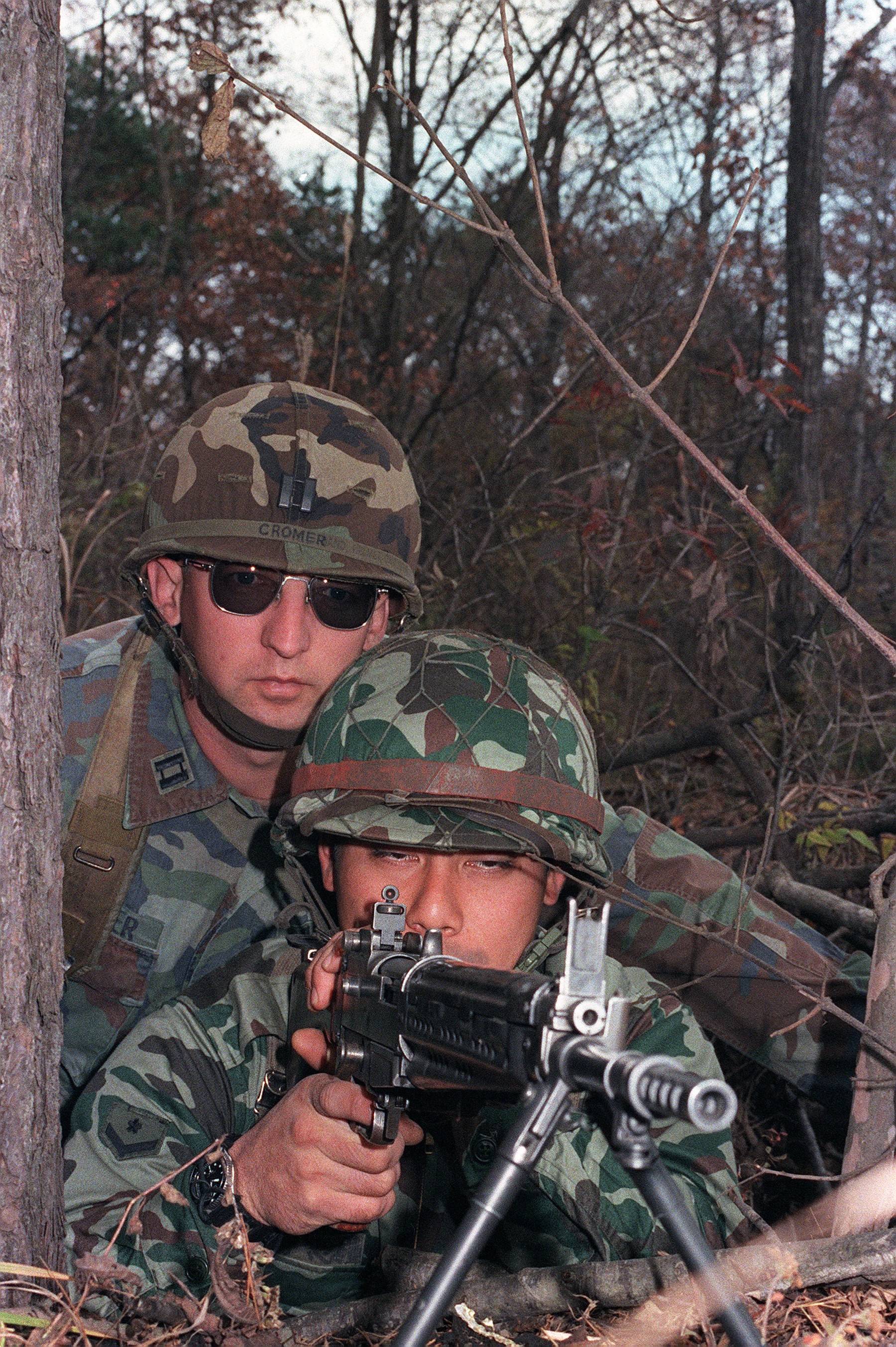
The rifle served through the whole of the Cold War. According to the Japanese Wikipedia, members of the Self-Defense Forces carried it for self-protection during the 1992 Cambodia peacekeeping deployment.2
After the Type 89 was adopted in 1989, the infantry (普通科) were re-equipped first; the Type 89 became common across the country from about 2000, according to the Japanese Wikipedia, which also says that because Type 64 barrels lasted so long, the GSDF did not replace its rifles all at once. Support arms (artillery, medical and logistic units) kept the Type 64 for years, and it went on being used for recruit training and by reservists.2 Rifles taken out of unit service were held at depots as reserve weapons; the Japanese Wikipedia says the stored rifles were either low-round-count examples re-parkerised on return, or rifles never issued at all.2 By the 2020s, on the same source, Type 89s had reached reservist training too and the Type 64 had dropped out of use there; that last statement is uncited.2
Type 64s are still shown at garrison open days. Several of the photographs in these volumes come from such displays at Camp Yao, Camp Uji and Camp Ōtsu between 2016 and 2023.
2.5 The marksman’s rifle
The GSDF’s snipers in its first years used American M1903A4 and M1C/D rifles, and the Type 64 replaced both: the M1903A4 in the late 1960s, the M1C/D in the 1970s, according to the magazine 『丸』 (Maru) in August 2012, as cited by the Japanese Wikipedia.2
The sniper’s Type 64 was not a separate model. A rifle taken from the production line and matched to the shooter was fitted with the 64式用狙撃眼鏡 (Type 64 sniper scope), made by Nippon Kōgaku (now Nikon), and a cheek pad.2 Maru gives the scope’s field of view as 5.2 degrees and its magnification as 2.2×, the same as the American M84; its elevation drum is graduated 0 to 800 m, though the Japanese Wikipedia puts the range at which a man-sized target could be hit reliably at about 500 m.2 The scope’s mount sits on the left of the receiver, over and to the left of the bore, so the iron sights cannot be used with it fitted, and it is held by a single screw. Crews packed the gap between mount and receiver with cloth or a scrap of tin to stop it shifting.2
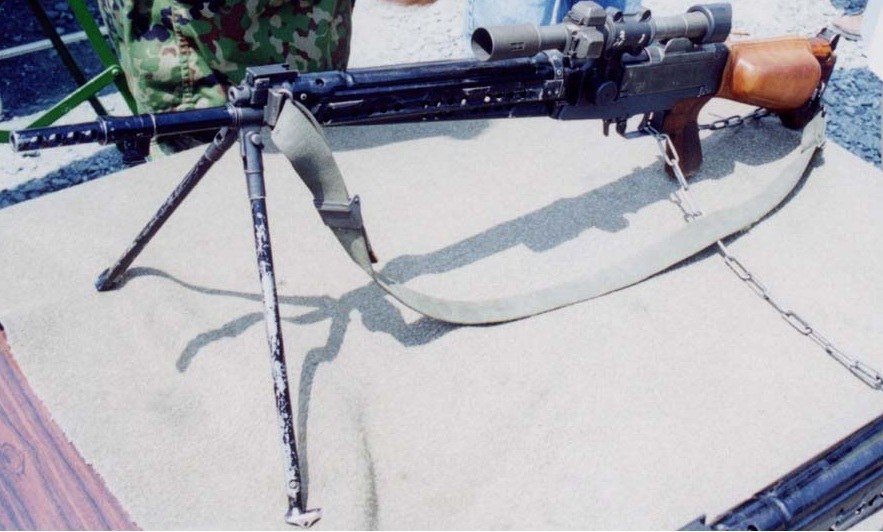
The marksman was chosen from within the squad and worked with the rifle squad, and company and platoon commanders could gather their marksmen into a temporary sniper team. The scope was usually fitted only for exercises and competitions.2 From fiscal 2002 the GSDF bought about 60 Remington M24s for evaluation, later adopted as the 対人狙撃銃 (“anti-personnel sniper rifle”), and formed dedicated sniper sections in its infantry units; the Type 64 marksman’s rifle carried on in other arms.2
2.6 The Maritime Self-Defense Force
The Maritime Self-Defense Force has kept the Type 64 longest, and here the evidence is in its own words. The JMSDF’s Sasebo Training Unit, describing a recruit class’s rifle training in July 2024:
「学生達が取扱う銃は64式小銃という銃で、海上自衛官が最初に触れる銃であり、この銃は修業後も式典や定期的に行われる実弾での射撃訓練で取扱う機会が多い銃で、学生期間中にも射撃訓練が実施されます。」
(“The rifle the students handle is the Type 64, the first rifle a member of the Maritime Self-Defense Force touches. After training, too, it is the rifle they will often handle at ceremonies and at the regular live-fire training, and they fire it during their course.”)7 The unit’s December 2023 sheet says the same, calling it “入隊して最初に触れる銃”, the first rifle they touch on joining.8 Firing is done in pairs, with an assistant (予備射手) who draws the ammunition, hands it to the firer and reports for him.7
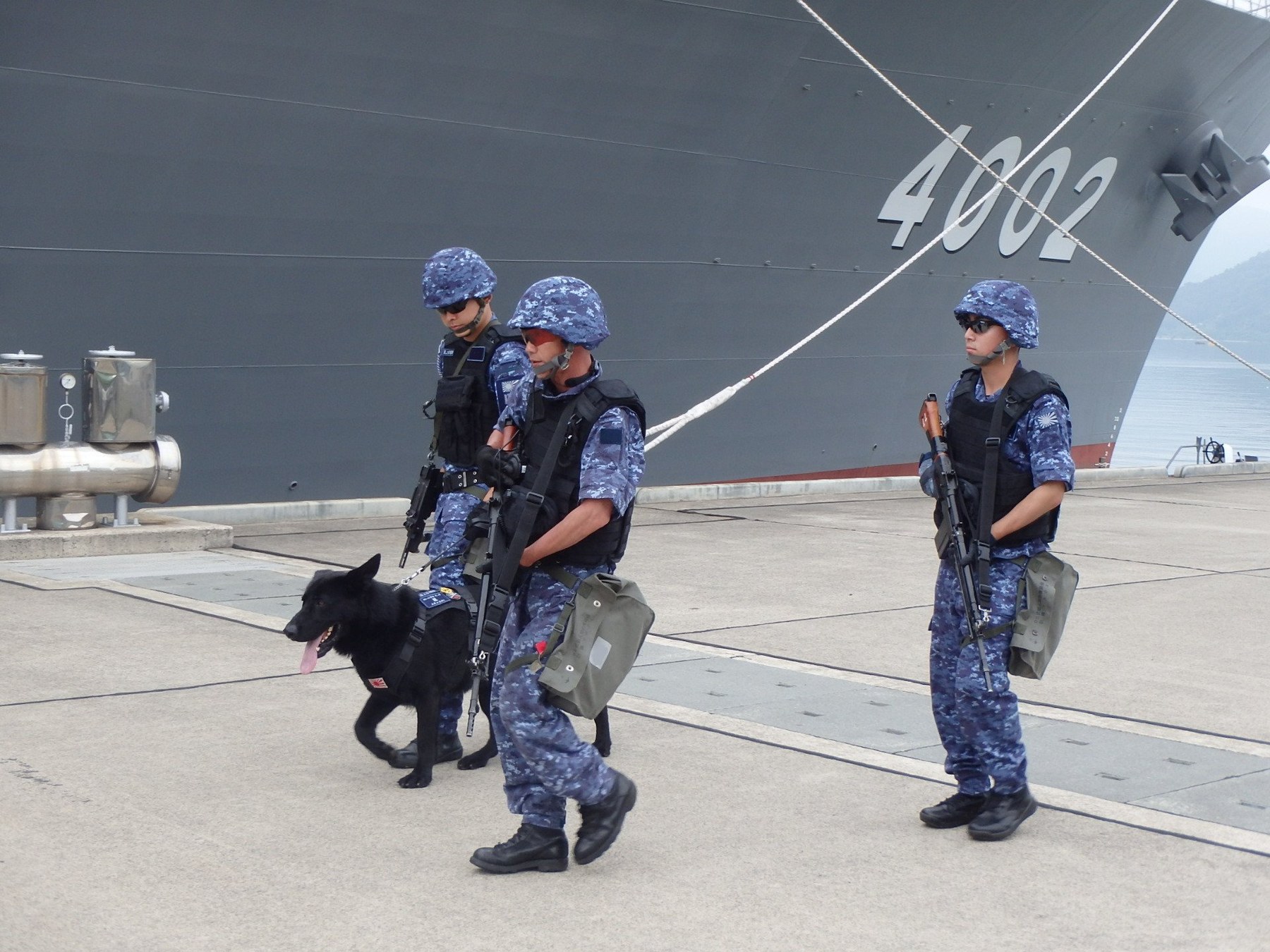
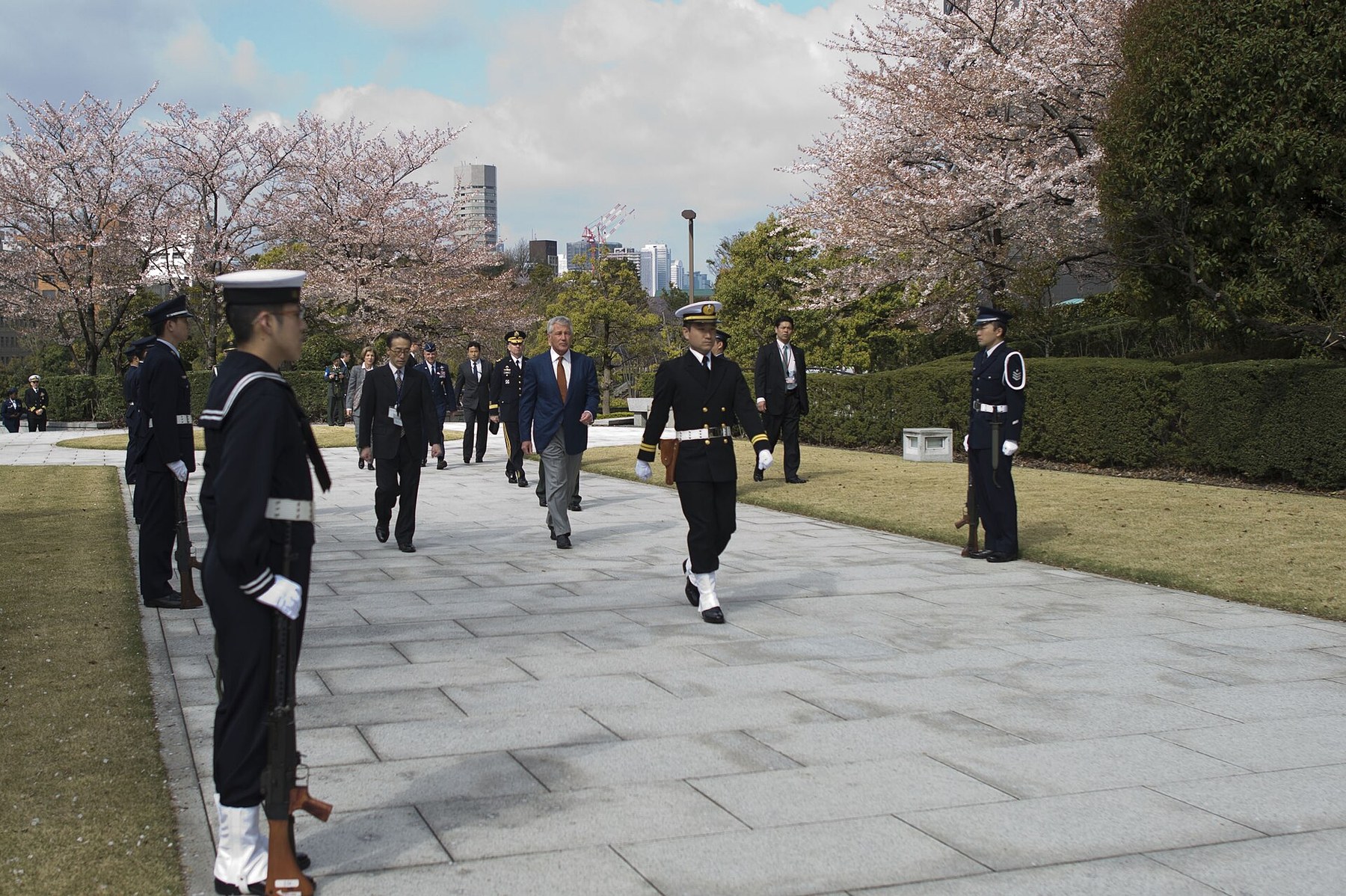
The rifle is the JMSDF’s ceremonial arm as well, carried by honour guards for visiting dignitaries, as in the photograph below of the guard that received the US Secretary of Defense in Tokyo in April 2014. A US Marine Corps photograph from December 2011 shows a sailor of Fleet Air Wing 31 requalifying with one at an indoor range; the caption says the sailors requalify every three months.9
2.7 The Air Self-Defense Force
The Air Self-Defense Force uses rifles to guard its bases, and it too kept the Type 64. The Japanese Wikipedia offers a reason: base security on open airfields favours range, which the 7.62 mm cartridge has and the 5.56 mm does not.2 Kaihōshi, writing in 2022, expected it still to be in service with base security units.3
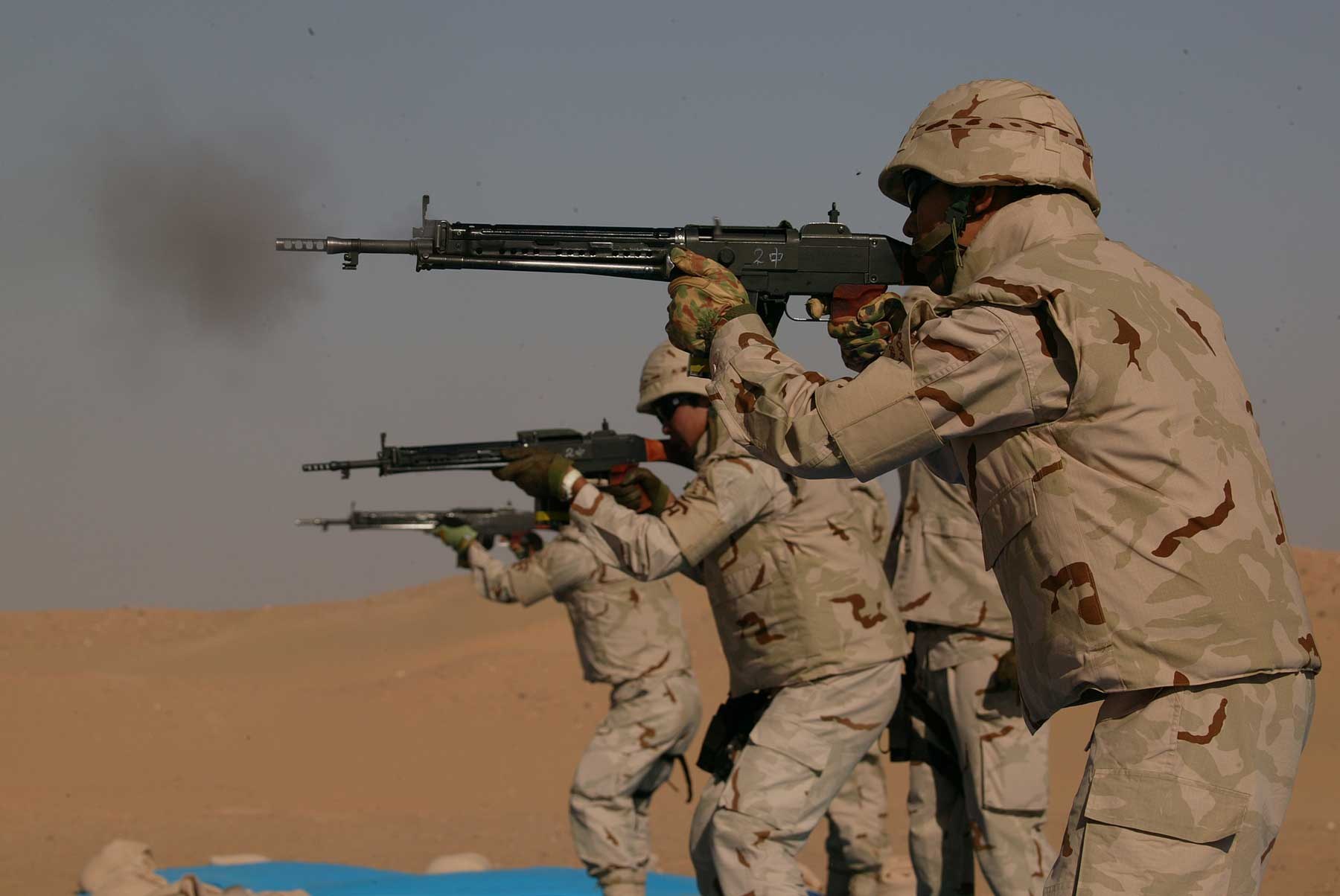
The ASDF took its Type 64s abroad. The Ministry’s own photographs from October 2008 show the airlift detachment supporting reconstruction in Iraq firing them in Kuwait and a staff sergeant of its security flight with one. A US Air Force photograph of March 2011 shows airmen of the ASDF’s then-new base defence training squadron training with them at Yokota alongside US security forces.10
2.8 The Japan Coast Guard: Noto 1999 and Amami 2001
The Coast Guard carried Type 64s on its patrol vessels, and the only occasions found on which the rifle was fired at a real adversary were both at sea.
Off the Noto Peninsula, 23 March 1999. Two suspicious vessels disguised as Japanese fishing boats ran from Coast Guard and Maritime Self-Defense Force ships. The Coast Guard’s own chronology, as reproduced in a 2000 study published by the Japan Coast Guard Association, records: “2031〜2125巡視艇「なおづき」が小銃による威嚇射撃を実施(1050発)。” (“20:31–21:25: the patrol boat Naozuki fired warning shots with rifles, 1,050 rounds.”)11 The legal basis was Article 7 of the Police Duties Execution Act.11 The chronology says “rifles” without naming the model. That they were Type 64s, that nine rifles fired, and that 500 of the 1,050 rounds were tracer, are given by the Japanese Wikipedia citing the journalist Taoka Shunji in 『世界の艦船』 of June 1999, which was not seen.2
South-west of Kyūshū, 22 December 2001. A North Korean spy ship fired on Coast Guard vessels trying to board it; the Coast Guard returned fire in self-defence and the ship blew itself up and sank. The Japanese Wikipedia says the boarding party of the patrol vessel Amami was armed with Type 64s and that rifles were among the weapons used in the exchange.2 No Coast Guard document naming the rifle was found.
2.9 The police
The English and Japanese Wikipedias both say that a small number of Type 64s went to the National Police Agency and were used as marksman’s rifles by the Special Armed Police (SAP), forerunner of the Special Assault Team.25 Neither cites a source for it, and none was found. It is recorded here as a claim.
2.10 Replacement: the Type 89 and the Type 20
Howa began a 5.56 mm rifle in 1977 and finished it in 1989, when it was adopted as the Type 89, with deliveries from 1990.6 The Ministry’s table gives its development from 1986, its first contract in 1989 and 90,473 rifles contracted for the GSDF to fiscal 2009, fewer than half the Type 64’s total after twenty years.1 That gap is the arithmetic behind the Type 64’s long tail: there were never enough Type 89s to replace it everywhere.
The Type 20 (20式5.56mm小銃) followed. Its name was announced in May 2020,12 and the Ministry’s budget overview for fiscal 2021 shows the GSDF buying 3,283 in fiscal 2020 and 3,342 in fiscal 2021.13 Kaihōshi notes that the ASDF’s base-security units, still on the Type 64, were among those the Type 20 was meant to re-equip.3
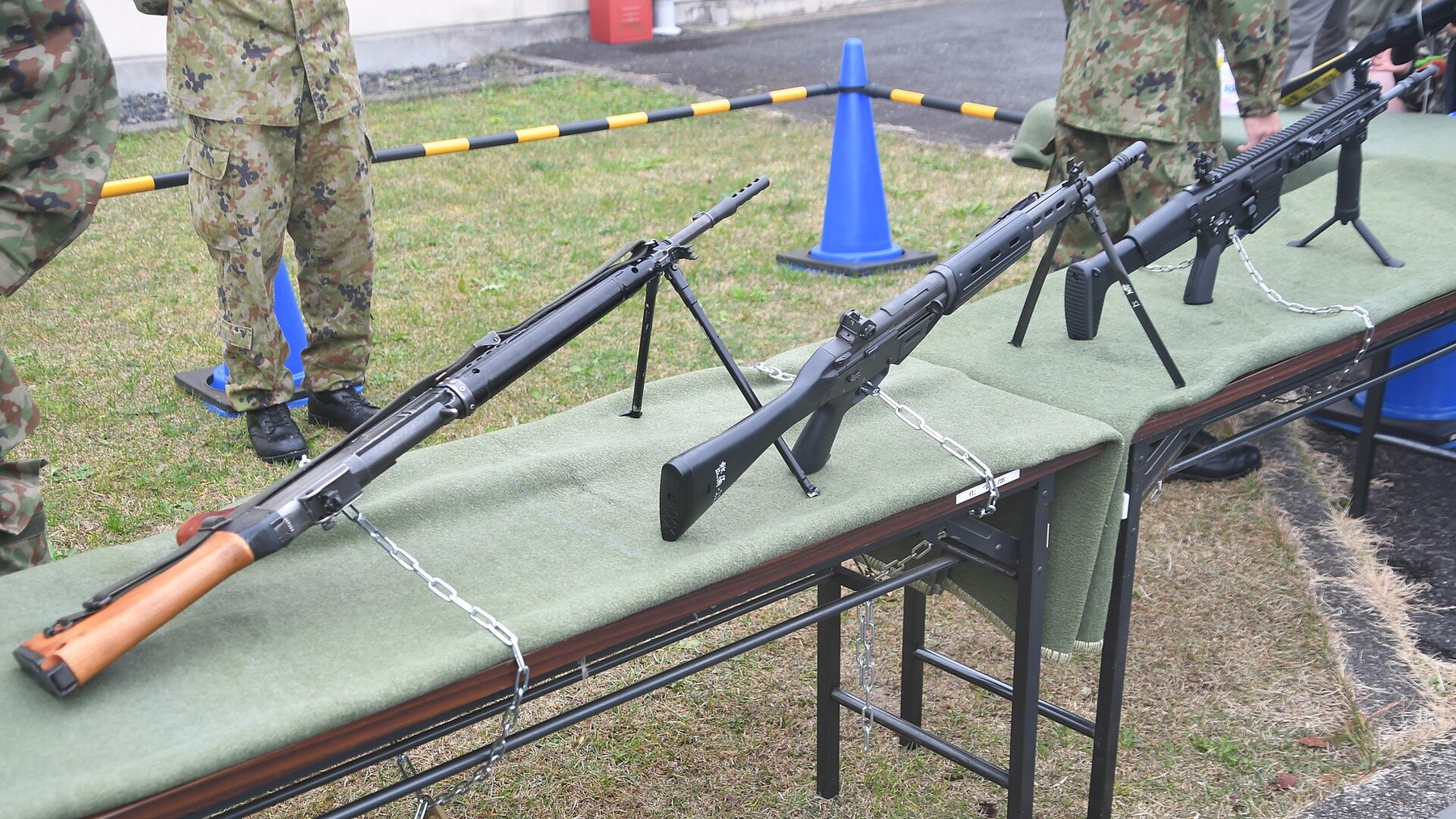
Sixty years after adoption, then, the rifle has left the GSDF’s front line but not the Self-Defense Forces: in 2024 it was still the first rifle a Maritime Self-Defense Force recruit learned.7
2.11 Claims not used
- “30 Type 64s lost at Ōita, 2007”. The English Wikipedia carries a “Scandal” section: the GSDF’s Ōita garrison “not able to account for 30 Howa Type 64s that had been lost, despite a massive search conducted by 95,000 soldiers on January 24, 2007”.5 Its source is a 2007 blog post relaying an unlinked Yahoo! News item.14 No Japanese report of the incident was found in two searches, and a search by 95,000 soldiers for rifles at one garrison is not credible as stated. It may garble a real incident; it is not used.
- A 1971 bear. The Japanese Wikipedia says that on 18 May 1971 a GSDF soldier searching for a crashed helicopter’s crew on Tsurugi-yama in Hokkaido shot a brown bear with a Type 64.2 It is uncited and is recorded here only as a claim.
- Combat use by the GSDF. None was found. The Type 64 was never fired in war.
Footnotes
-
Ministry of Defense, 資料① 「装甲車両・火器及び弾薬の開発・調達について」, February 2011, slide 4-5, Internet Archive capture of 12 July 2020 of https://www.mod.go.jp/j/approach/agenda/meeting/materials/seisan/sonota/pdf/03/001.pdf , read 2026-10-20. Table note: 「数量:2009年度まで(小銃の契約数量は陸自分のみ)」. ↩ ↩2 ↩3 ↩4
-
Japanese Wikipedia, 「64式7.62mm小銃」, wikitext read 2026-10-20, citing 津野瀬光男『幻の自動小銃 六四式小銃のすべて』; 『エリートフォーセス 陸上自衛隊編 Part 1』 p. 77; 『丸』 August 2012, pp. 88–91; 『月刊アームズ・マガジン』 December 2006, p. 29; 菊池雅之『こんなにスゴイ 最強の自衛隊』 p. 56; 田岡俊次, 『世界の艦船』 No. 553, June 1999, pp. 110–113. None seen for this dive. ↩ ↩2 ↩3 ↩4 ↩5 ↩6 ↩7 ↩8 ↩9 ↩10 ↩11 ↩12 ↩13 ↩14 ↩15 ↩16 ↩17 ↩18 ↩19 ↩20 ↩21 ↩22 ↩23
-
貝方士英樹 (Kaihōshi Hideki), MotorFan, 4 June 2022, https://motor-fan.jp/article/61101/ , read 2026-10-20. ↩ ↩2 ↩3 ↩4
-
Hunini, “JGSDF Type 64 rifle receiver left side view at Camp Yao October 29, 2023”, Wikimedia Commons, CC BY-SA 4.0, marking read from the photograph 2026-10-20. ↩
-
English Wikipedia, “Howa Type 64”, wikitext read 2026-10-20. ↩ ↩2 ↩3 ↩4
-
Howa Machinery, “Our History (Howa Machinery Firearms Dept.)”, https://www.howa.co.jp/en/products/firer/history.html , read 2026-10-20. ↩ ↩2
-
海上自衛隊佐世保教育隊 (JMSDF Sasebo Training Unit), 「小銃取扱」, diary sheet of 5 July 2024, https://www.mod.go.jp/msdf/s-tc/contents/diary/r6haru/6.7.5-22shoju.pdf , read 2026-10-20. Translation this dive’s. ↩ ↩2 ↩3
-
海上自衛隊佐世保教育隊, 「小銃取扱」, diary sheet of 4 December 2023, https://www.mod.go.jp/msdf/s-tc/contents/diary/r5aki/5.12.4-5shoju.pdf , read 2026-10-20. ↩
-
US Marine Corps photograph by Lance Cpl. Charlie Clark, 1 December 2011, “USMC-111201-M-OY184-461.jpg”, Wikimedia Commons, caption read 2026-10-20. ↩
-
US Air Force photographs by Capt. Will Powell, 4 March 2011, Wikimedia Commons (“JASDF BDDTS airmen running charge.jpg” and others), captions read 2026-10-20; Ministry of Defense / JASDF photographs of 6 and 8 October 2008, Wikimedia Commons, captions read 2026-10-20. ↩
-
廣瀬肇, 「海上警察機関による実力行使」, 『海上保安国際紛争事例の研究』 第1号 (海上保安協会, March 2000), p. 83, Nippon Foundation Library, https://nippon.zaidan.info/seikabutsu/1999/00887/contents/083.htm , read 2026-10-20. Translation this dive’s. ↩ ↩2
-
The Firearm Blog, “First Look: Japanese Army’s New Type 20 Rifle”, 18 May 2020, https://www.thefirearmblog.com/blog/2020/05/18/first-look-japanese-armys-new-type-20-rifle/ ; the Ministry’s own release was not read. ↩
-
Ministry of Defense, 「我が国の防衛と予算 令和3年度予算の概要」, https://www.mod.go.jp/j/yosan/yosan_gaiyo/2021/yosan_20210330.pdf , read 2026-10-20: “20式5.56mm小銃 3,283丁 3,342丁” (fiscal 2020, fiscal 2021). ↩
-
“Japanese Self-Defense Forces: 30 battle rifles unaccounted for…”, Japan Probe, 29 January 2007, Internet Archive capture of 10 March 2016, read 2026-10-20. ↩
Comments (0)