Japanese Type 64 Rifle · Volume 3
How It Works: Gas, Tilting Bolt and a Hammer That Runs into the Stock
The short-stroke piston and its regulator, the slide and the tilting bolt, Iwashita's straight-line hammer and why it slows the rifle down, the trigger group's three modes from the patent, the pull-and-turn selector, the muzzle device, and the barrel built to outlast the receiver
3.1 The rifle in outline
The Type 64 is a gas-operated, selective-fire rifle with a short-stroke piston, a tilting bolt and a hammer that moves in a straight line instead of pivoting. The published figures:
Table 1 — The Type 64 is a gas-operated, selective-fire rifle with a short-stroke piston, a tilting bolt and a hammer that moves in a straight line instead of pivoting. The published figures
| Figure | Source | |
|---|---|---|
| Calibre | 7.62×51 mm | Howa1 |
| Operation | ガス利用式, gas-operated | Howa1 |
| Feed | 20発入弾倉, 20-round magazine | Howa1 |
| Weight | 4.3 kg | Howa1; the Japanese Wikipedia adds “弾倉及び付属品を除く”, without magazine and accessories, and elsewhere says including the bipod2 |
| Weight, other figure | 4.4 kg | Kaihōshi 2022; English Wikipedia34 |
| Overall length | 990 mm | Howa1 |
| Barrel length | 450 mm | Howa1 |
| Rate of fire | 500発/分, 500 rounds a minute | Howa1; the Japanese Wikipedia gives “最大約500発/分(450発/分)”, a maximum of about 500, or 4502 |
| Rifling | 4 grooves, right hand, one turn in 254 mm | Japanese Wikipedia infobox, uncited2 |
| Muzzle velocity | about 800 m/s full charge, about 700 m/s reduced charge | Japanese Wikipedia infobox, uncited2 |
Howa’s own specification ends with “出典 陸上自衛隊HP”: its figures are taken from the Ground Self-Defense Force’s website.1
3.2 Gas: a short-stroke piston and a regulator
The rifle is gas-operated with a short-stroke piston: a piston, driven by gas tapped from the barrel, strikes the slide a short, sharp blow and stops, and the slide carries on rearward on its own momentum.2 Tsunose, as cited by the Japanese Wikipedia, says the piston was carried over from Howa’s 12.7 mm spotting rifle when the rifle was redesigned in the early 1960s (Vol 1).2 The maintenance table quoted in Vol 5 names the parts at the front: a gas cylinder group (ガス筒部), a piston group (ピストン部), a piston-rod seat (ピストン桿受け) and a gas regulator (規整子) held by a regulator pin.5
The regulator meters how much gas reaches the piston. The Japanese Wikipedia says that with it the rifle can fire full-charge 7.62 mm ammunition as well as its own reduced load, and launch rifle grenades.2 The English Wikipedia says the grenade setting cuts gas off from the piston, which is what a grenade setting normally does so that the action stays shut, but it cites Jane’s for it and the setting markings were not found in any Japanese source.4 The number of positions, their markings, and which position goes with which ammunition are not given in any source read for this dive. Vol 6 explains why the choice between loads mattered more on this rifle than on most.
3.3 The slide and the tilting bolt
The piston drives the slide (スライド), the part an English-language manual would call the bolt carrier. The bolt (遊底) rides in the slide. The bolt locks by tilting: the Japanese Wikipedia describes it as closing the breech by setting the rear of the bolt down into a recess in the floor of the receiver, ボルト後端をレシーバー下部の窪みにはめ込む.2 This is the same family of locking as the SKS and the FN FAL, which Tsunose cited as the “Czech” school his redesign followed (Vol 1).2
As the slide moves back, cam surfaces lift the rear of the bolt out of its recess, unlocking it, and the slide then carries the bolt back with it, extracting and ejecting the case. On the way forward the bolt strips a cartridge from the magazine and chambers it, and the last part of the slide’s travel drops the bolt’s rear into the locking recess. The exact cam geometry is not described in any source found, and the description in this paragraph is the general tilting-bolt sequence, not a reading of a Type 64 drawing.
The receiver is short. Tsunose records that shortening it by 10 mm to save weight, when Kan II Kai became Kan III (Vol 1), left the slide almost no spare travel: with the slide fully back, there was a gap of only 6 mm between the front of the bolt and the rear of the top cartridge in the magazine.2 Vol 5 follows the consequence.
The operating handle (槓桿) sits on top of the slide, not on the side, so that it could be worked with either hand and kept the rifle balanced against sideways movement in firing (Tsunose, as cited by the Japanese Wikipedia).2 Rifles before Kan III had it on the right.2
3.4 The hammer that runs into the stock
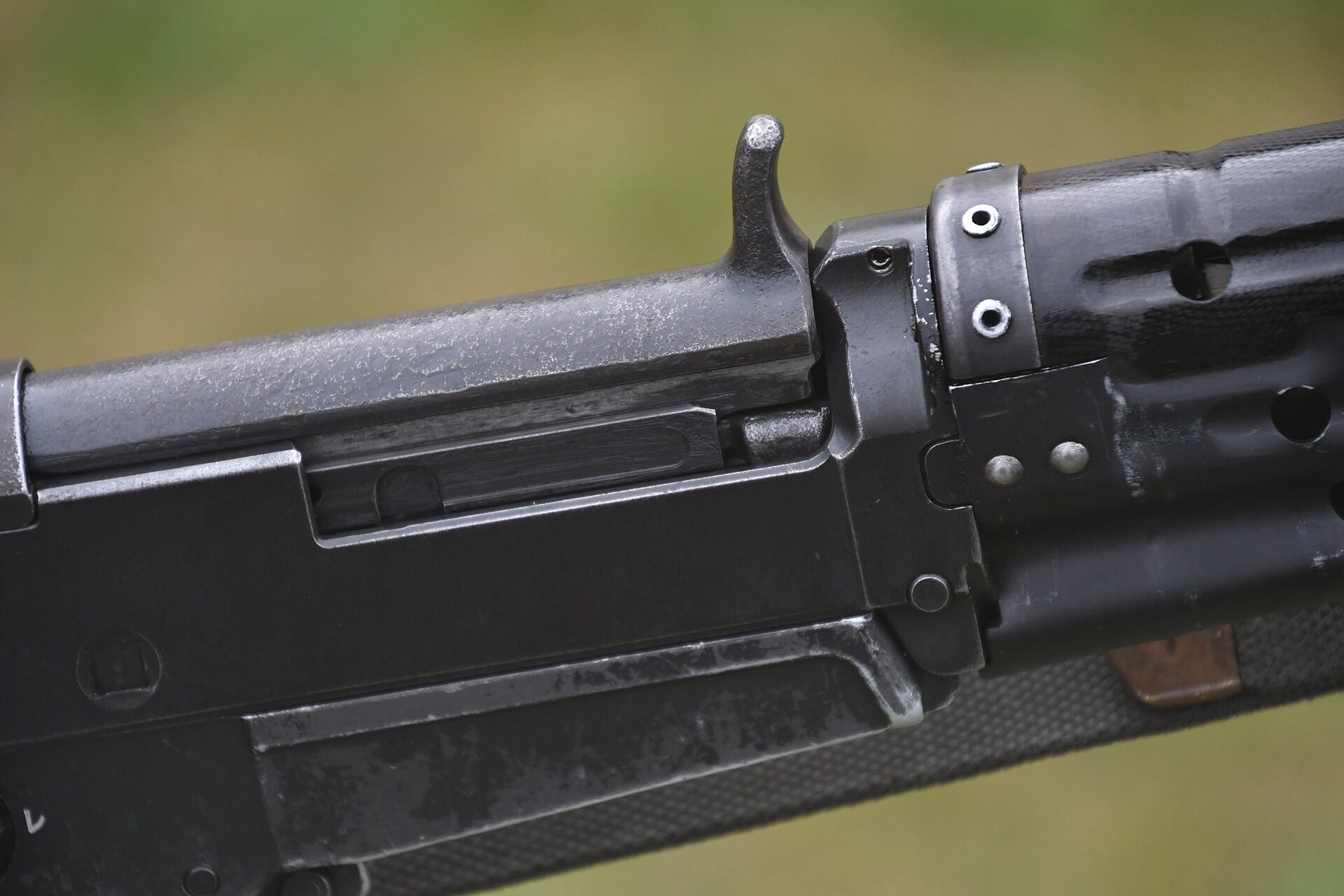
The Type 64’s most unusual feature is its hammer. In most rifles the hammer pivots on a pin in the trigger group and swings up to strike the firing pin. In the Type 64 it is a heavy rod that moves straight back and forth along the line of the bore, and when it is drawn back most of it disappears into a tube inside the butt-stock, where its spring lives.
The source for this is the inventor. Iwashita’s US patent, filed for Howa in April 1964, claims “a receiver tail containing the hammer spring, a hammer stop and being capable of having inserted therethrough substantially all of said hammer when the same is retracted”, with “the locking end of the sear being positioned at the rear portion of the receiver so as to make a substantial portion of the hammer retract into the receiver tail thereby lengthening the advancing distance of the hammer”.6 The Japanese Wikipedia describes the same thing from the rifle: “コイルばねと棒状の撃鉄を納めた撃鉄筒が床尾内に入り込む” (“the hammer tube, holding the coil spring and the rod-shaped hammer, runs into the butt”).2
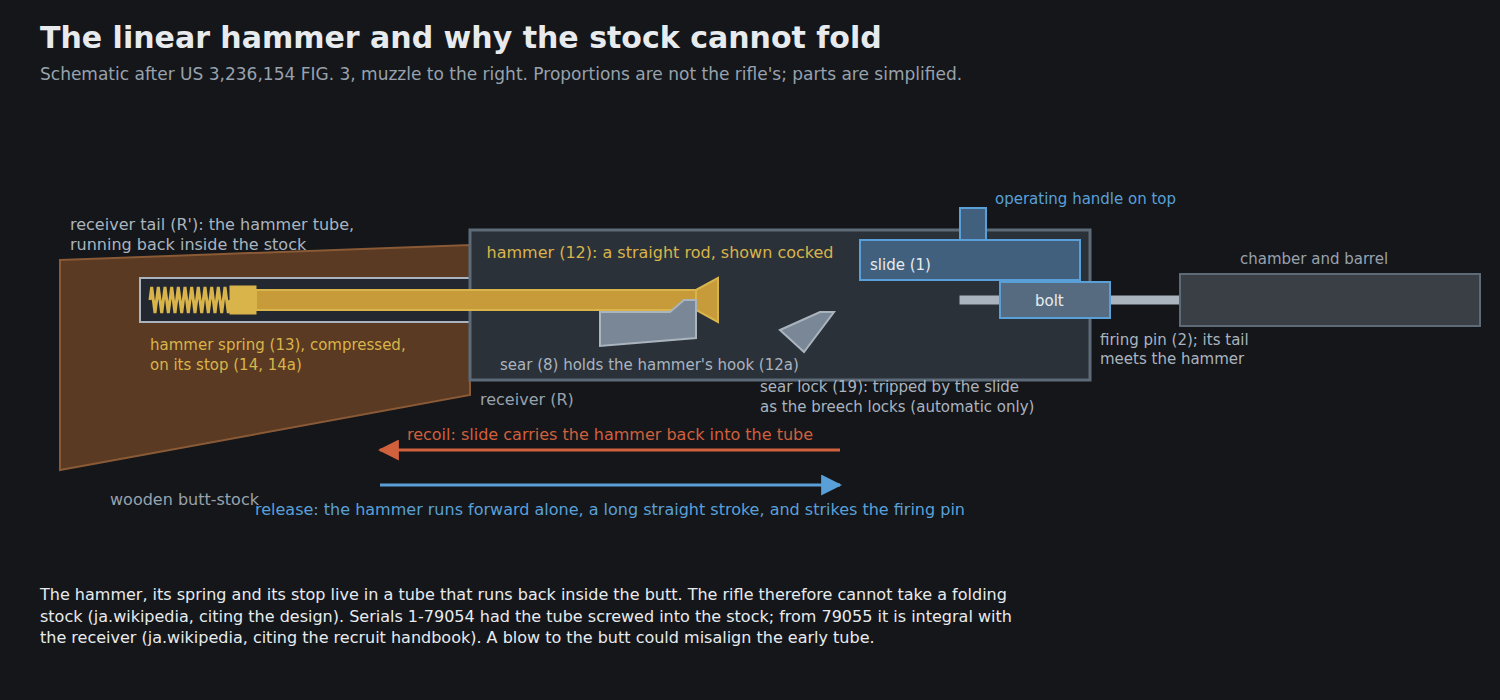
Three things follow from it.
- The stock cannot fold. Because the hammer tube runs inside the butt, a folding-stock Type 64 could not be made, as the Japanese Wikipedia points out; the Type 89 that replaced it could have one.2
- The butt must not be banged on the ground. On early rifles the hammer tube was not part of the receiver but screwed into the stock. A heavy blow to the butt could shift the tube against the receiver, catch the hammer and cause a stoppage, a failure to go back fully, or at worst an unintended discharge. The Japanese Wikipedia, citing the recruits’ handbook 『新入隊員必携』, says rifles with serial numbers 1 to 79054 were built that way and that from 79055 the tube was made integral with the receiver, and that slamming the butt down, in parachute landings or when dropping prone in an assault, was forbidden on the Type 64 and stayed forbidden after the change.2 The handbook itself was not seen.
- The lock time is long. The hammer has a long way to travel and is heavy, so the interval between pulling the trigger and the cartridge firing is longer than usual for a military rifle. The Japanese Wikipedia notes that this, with the jolt of a heavy hammer landing, made accurate single shots harder for an untrained shooter.2 The long travel is not a by-product. It is the point of the design.
3.5 Why that slows the rifle: the patent’s argument
Iwashita’s patent sets out what he wanted. In a fully automatic rifle, “having a normal rate of fire of from 700 to 800 shots or rounds per minute, it is desirable to reduce this rate as low as possible, for example to 400 to 500 shots per minute. If this reduction is possible, better firing accuracy can be attained.” Second, “the motions of a reciprocating member, such as a slide, and a firing mechanism, such as a hammer, etc., may be well balanced and smooth and … these components can reciprocate in as straight a line as possible”, so that no turning moment disturbs the barrel. Third, recoil should be reduced, by weight or by a muzzle brake.6
The usual way to slow an automatic weapon is to hold the bolt or carrier at the rear for a moment before letting it return. The patent describes that conventional arrangement and its weakness: the slide strikes an actuator, which compresses a spring and holds the slide until the actuator rebounds and releases it, but “the velocity of the slide at the time when it strikes the actuator varies substantially”, so the delay varies, “and in some cases the slide lock fails to release the slide”.6
Iwashita holds the hammer instead. The slide goes back and comes straight forward again, chambering the next round. The hammer, which the slide pushed back with it “linearly at the same speed”, is caught by the sear near the end of its travel and stays there. Only “when the forward movement of the slide caused by the recoil spring and the breech locking operation are completed” is the hammer released, and it then “is advanced … along a relatively long straight distance” before it strikes the firing pin. The added interval between shots is that journey: “increase in the firing interval should be obtained by the interval of travel 2h–3h”.6 Because the hammer’s stroke and spring force are always the same, the patent claims, “the firing intervals are very regular”.6
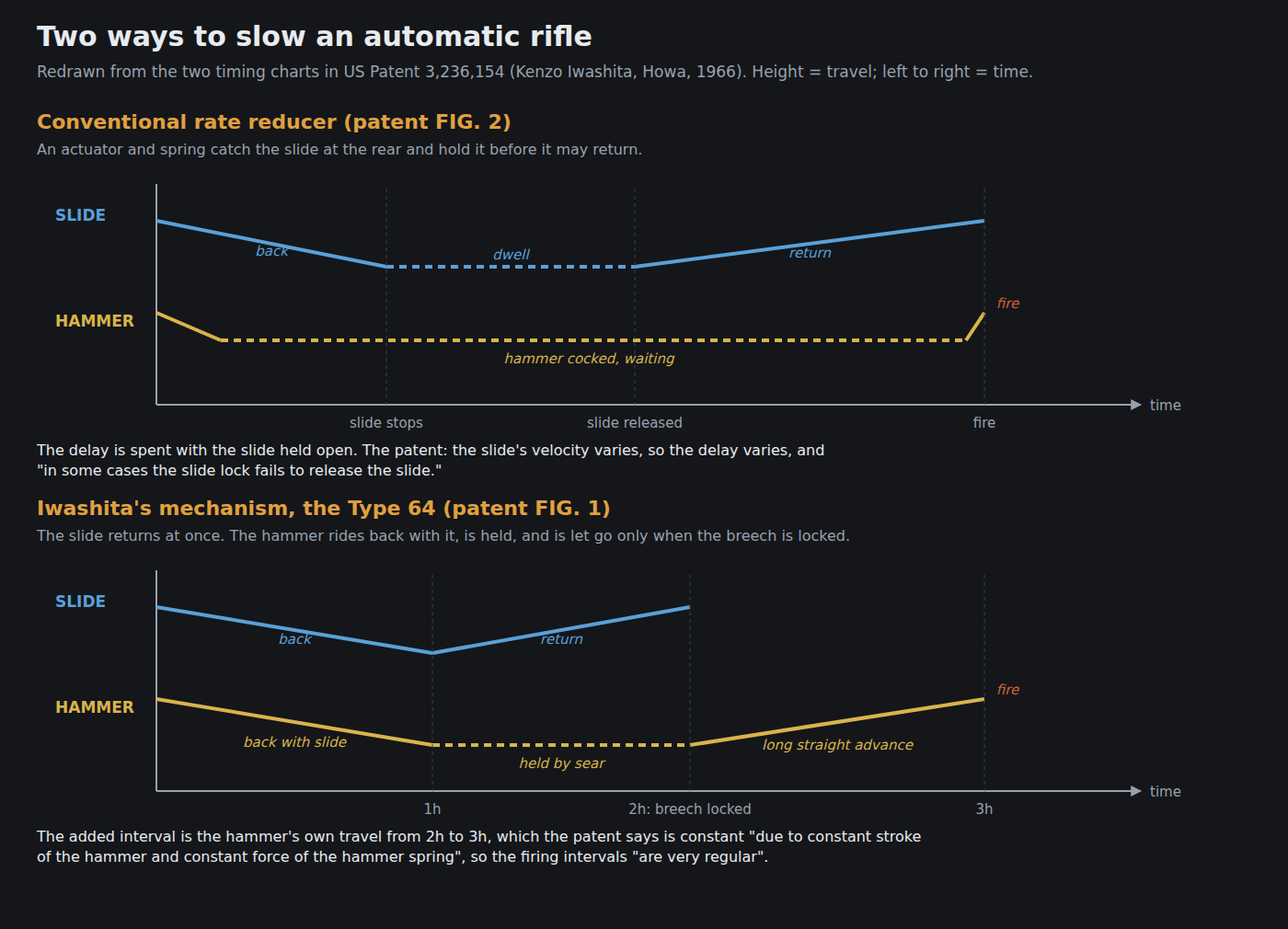
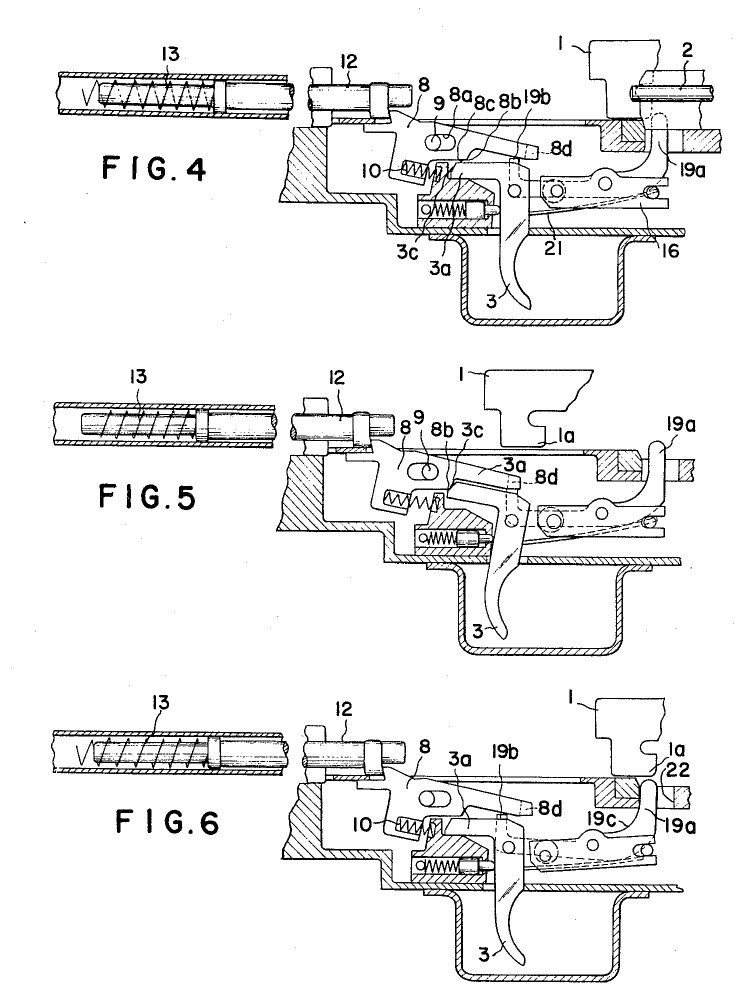
The patent’s own timing charts are reproduced below for comparison. The patent also lists the effective hammering mass as the hammer plus the hammer-spring stop and its shaft, which move together, and says that a straight-line hammer, unlike a pivoting one, does not create “a torque tending to swing the weapon”.6
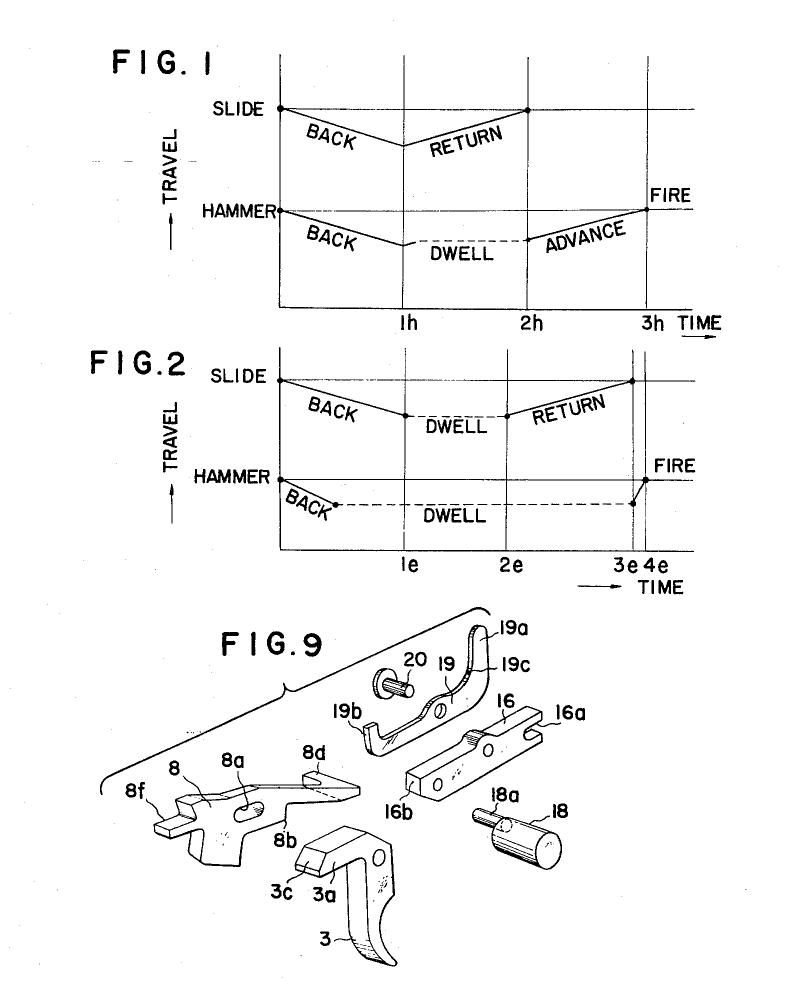
Whether the production rifle is exactly the patent’s embodiment cannot be confirmed from the patent alone: a patent describes an invention, not a service drawing. Tsunose’s memory of Iwashita’s drawing, though, matches it closely: a thick, straight-moving striker on the bore axis, caught by the sear’s large claw, with a buffer spring at the centre of the stock (Vol 1).2
3.6 The trigger group in three modes
The patent describes the trigger group in detail, and it gives the three modes with only a few parts.6 Reference numerals below are the patent’s.
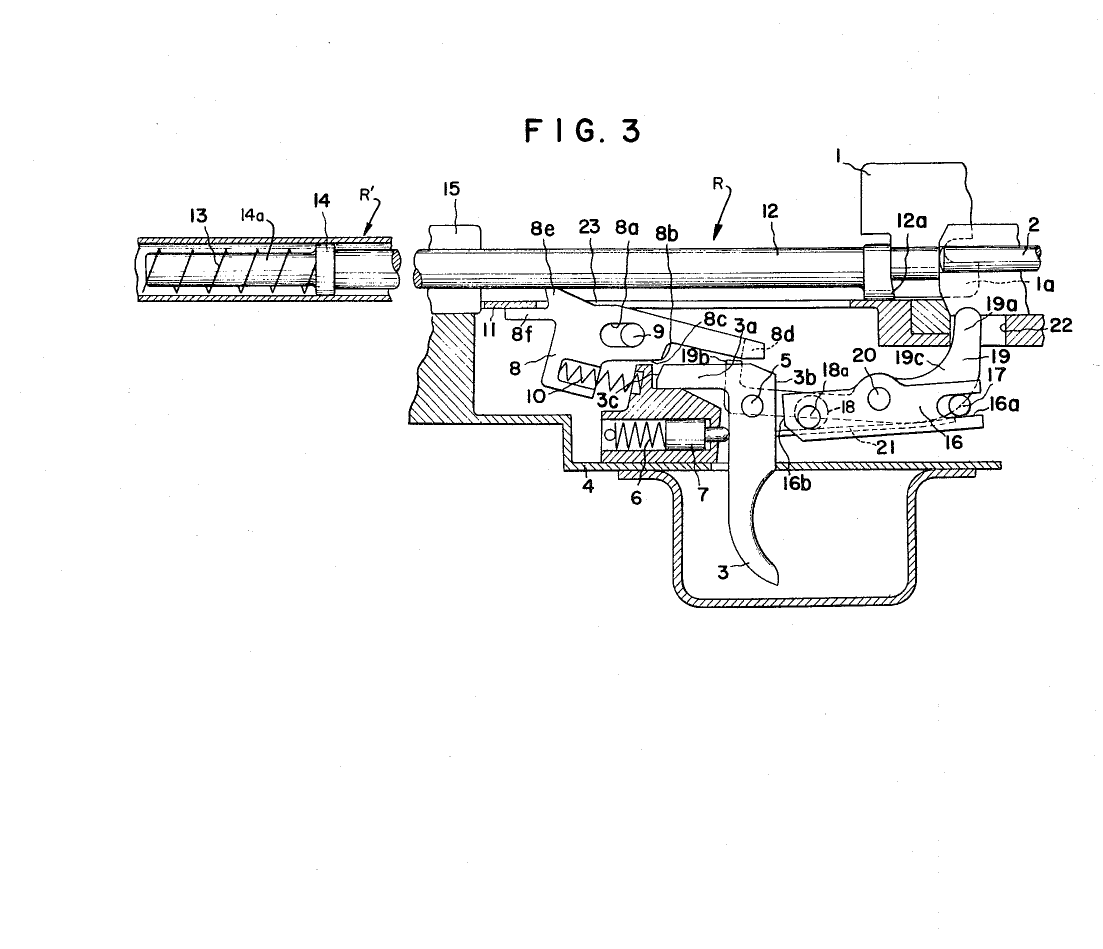
- Sear (8). It pivots on a pin (9) that runs in an elongated slot (8a), so the sear can slide fore and aft as well as rotate. Its rear hook (8c) holds the hammer’s hook (12a). The pin sits at the sear’s centre of gravity, and the hooks are slightly inclined, so that a blow to the rifle, or a drop, does not rotate the sear and release the hammer.6
- Trigger (3). Pulling it lifts the sear’s underside and rotates the sear, releasing the hammer.6
- Sear lock (19). A pivoting lever with a front projection (19a) that the slide pushes down at the very end of its return, as the breech locks, and a rear projection (19b) that then lifts the front of the sear (8d). This is the automatic release: it lets the hammer go only when the breech is closed.6
- Connector (16) and eccentric pin (18). The selector shaft carries an eccentric pin that sets the connector’s angle, and the connector sets the mode.6
Automatic. With the trigger held, the sear stays in the position where the sear lock can reach it. Each time the slide returns and locks the breech, it trips the sear lock, the sear lets the hammer go, and the rifle fires again.6
Single shot. The eccentric pin tilts the connector so that the sear lock is moved out of phase with the sear and its front projection is kept clear of the slide. The sear lock does nothing, and only the trigger can release the hammer. After a shot, the hammer, pushed back with the slide, is caught by the sear; and because the trigger is still held, the hammer spring’s force slides the sear back along its slot so that it stays locked until the trigger is released and pulled again. The patent: “only two members, namely, trigger and a sear, are utilized for this purpose”.6
Safe. The eccentric pin swings the connector so that its end face (16b) abuts the front of the trigger and blocks it.6
A failure of exactly this kind of mechanism is recorded. The Japanese Wikipedia, citing Itō Shinkichi in 『銃砲年鑑』 2005–06, says that on prototype and earliest rifles the sear and auxiliary sear were shaped differently, and that in a test of the M31 anti-tank rifle grenade, a rifle discharged its grenade-launching blank as the grenade was fitted to the muzzle. The cause was traced to the sear shape and the sear was redesigned.2 The source was not seen.
3.7 The selector: ア, タ, レ
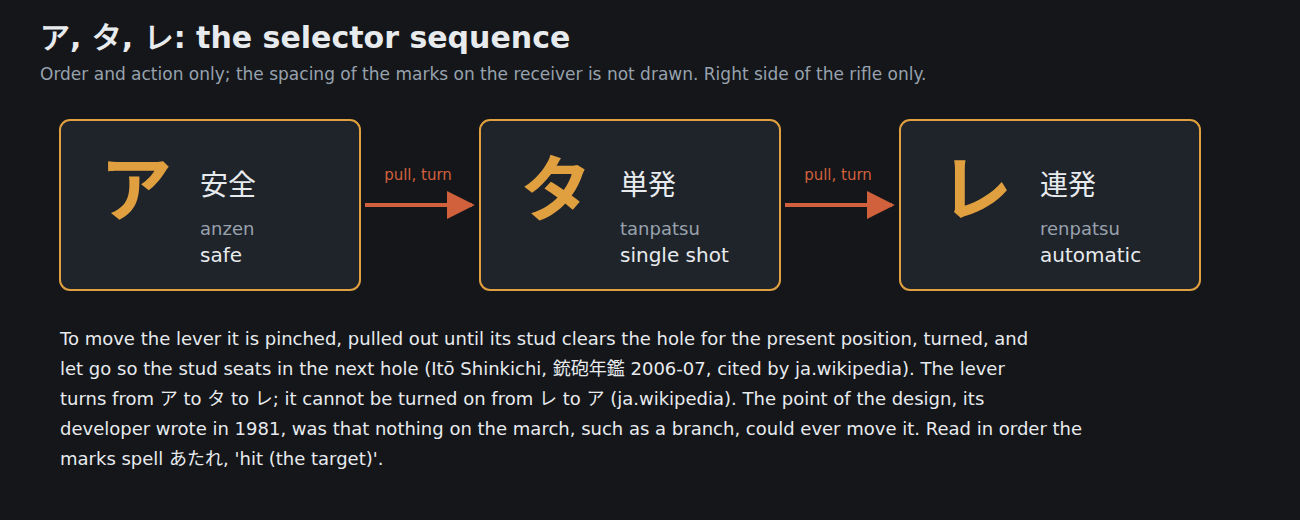
The selector is on the right of the receiver only. Its three positions are marked with three katakana: ア for 安全 (anzen, safe), タ for 単発 (tanpatsu, single shot) and レ for 連発 (renpatsu, automatic).2 Read in order they spell あたれ, atare, “hit (the target)”, which has made the selector the most quoted thing about the rifle.
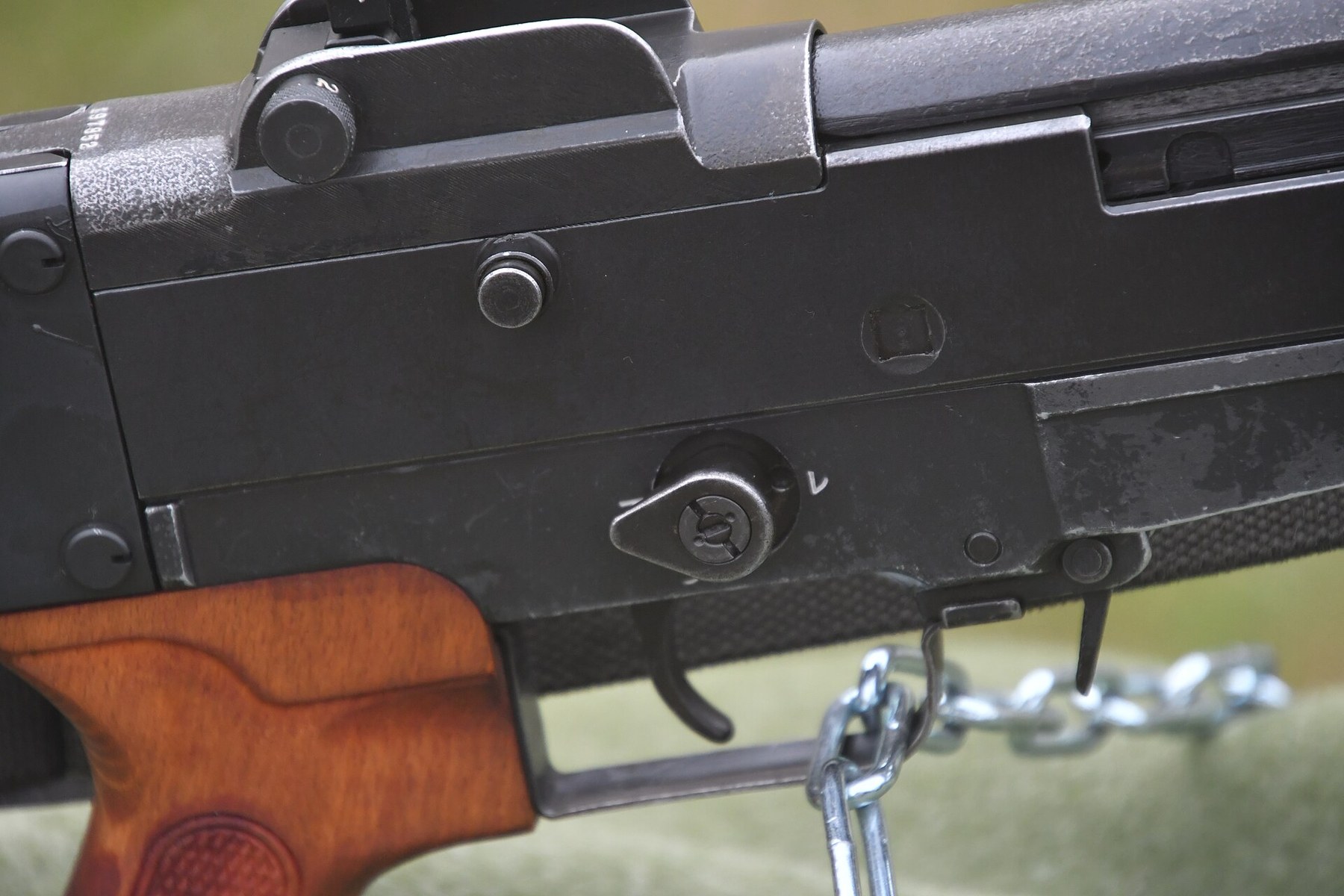
It works unlike most selectors. There is a hole at each position and a stud on the lever that drops into it; to move the lever, it is pinched from both sides, pulled out until the stud clears the hole, turned, and released. The Japanese Wikipedia, citing a 1980–81 article by Itō Shinkichi reprinted in 『銃砲年鑑』 2006–07, says the purpose was that the lever could never be moved by a branch on the march or by the firer without noticing, and that the scheme and the ア/タ/レ marking were devised by Colonel Iwashita.2 The lever turns from ア to タ to レ and cannot be turned on from レ round to ア.2 Compared with the M14 or the Type 89 it is slow to work, and the Japanese Wikipedia notes that a soldier on the left side of the rifle cannot see its position.2
The patent’s eccentric pin (18) is presumably what the selector shaft turns, but the patent does not show the external lever and no drawing linking the two was found.
3.8 One cycle, step by step
Putting the sources together, a cycle on automatic runs as follows. Steps 1 to 3 and 6 to 8 come from the patent; steps 4 and 5 are the general tilting-bolt sequence described above.
- The trigger is held; the sear lock releases the hammer as the slide locks the breech.6
- The hammer runs forward alone, a long straight stroke out of the stock tube, and strikes the firing pin.6
- The cartridge fires. Gas tapped from the barrel drives the short-stroke piston against the slide.2
- The slide moves back, lifts the rear of the bolt out of its locking recess and carries the bolt back, extracting and ejecting the case.
- On the way back the slide pushes the hammer back with it, compressing the hammer spring in the stock.6
- Near the rear of its travel the hammer is caught by the sear, and stays.6
- The recoil spring drives the slide forward; the bolt chambers a round and drops into its locking recess.6
- At the very end of the slide’s return it presses the sear lock, the sear releases the hammer, and the cycle repeats from step 2.6
The time between steps 7 and 2 of the next cycle, the hammer’s journey, is what holds the rate down to about 500 rounds a minute.
3.9 The muzzle device
The muzzle device (消炎制退器, flash suppressor and muzzle brake) is a tube with ports through both sides. Tsunose, as cited by the Japanese Wikipedia, credits it with reducing recoil by 30 percent and with spreading the flash sideways to help hide the firer.2 He also records that in development, symmetrical ports at the top, bottom and both sides balanced the gas so well that accuracy improved markedly, but downward ports raised dust from the ground and gave the position away, so the production device has ports on the sides only. Tightness of the device on the barrel affected accuracy, and a device refitted after stripping could throw the zero.2
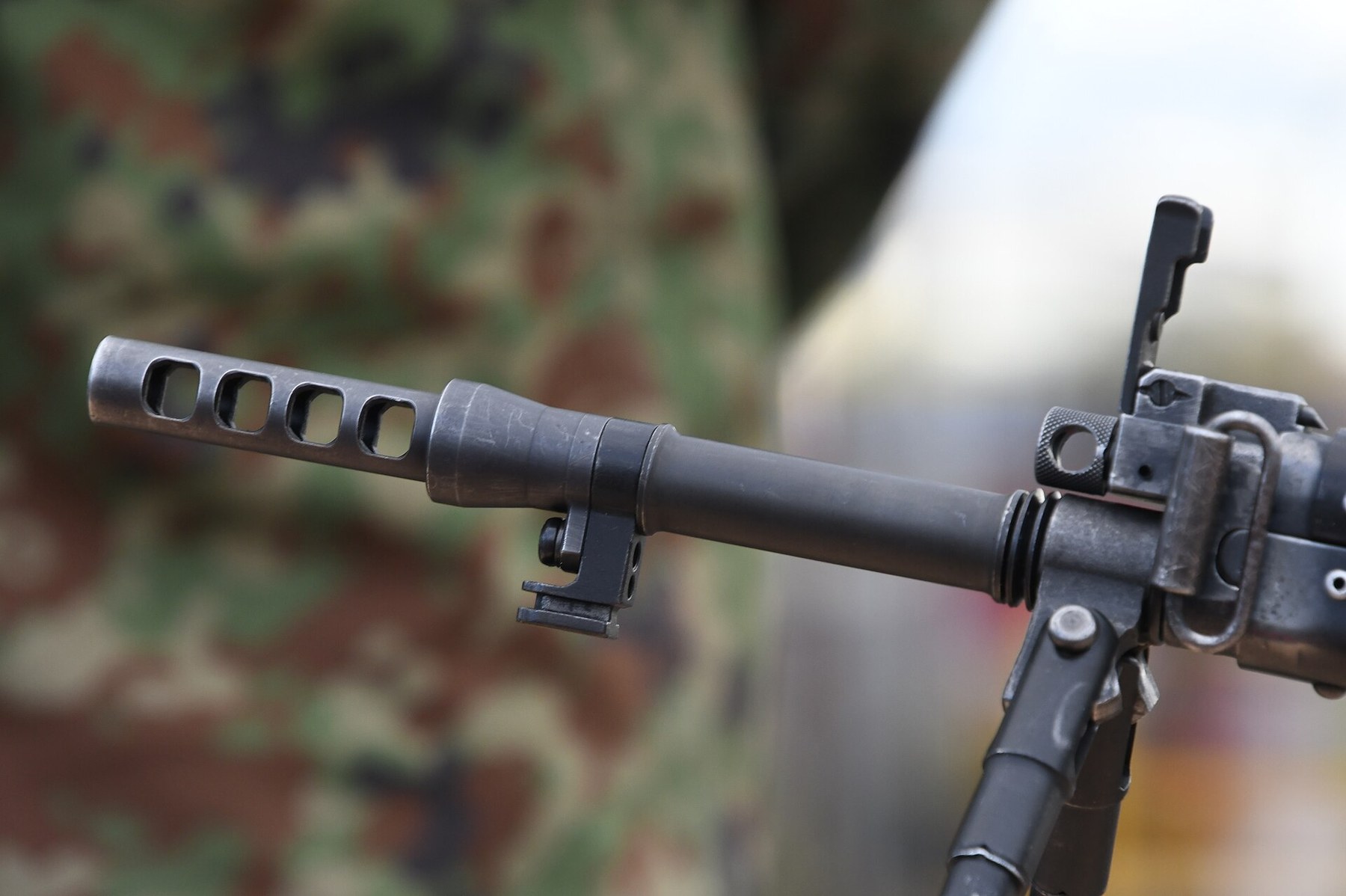
A correction. The Japanese Wikipedia says the production device has 三つ穴, “three holes”, on each side.2 The rifles photographed for these volumes at Camp Yao (2023) show four ports a side, open right through; so does a Camp Uji rifle (2022). Whether some rifles had three, or the text is simply wrong, was not settled.
3.10 Barrel and receiver life
The barrel was built to last like a machine gun’s. Its bore is chrome-plated against wear and corrosion, and Itō Shinkichi gives the chamber wall as 12.1 mm thick, 0.7 mm more than the Type 99’s.2 The Japanese Wikipedia gives the barrel’s life as over 37,000 rounds, citing Elite Forces, and the receiver’s as 24,000 rounds, citing Tsunose.2 If both figures are right, the rifle’s barrel outlasts its own receiver by half again, which is why the Japanese Wikipedia files the Type 64 under 過剰性能, “over-specification”.2 The long-lived barrel also, on the same source, slowed the replacement of the Type 64 by the Type 89: the old rifles were not worn out.2
The Ministry’s own standard for bore gauging gives the wear limit at which a Type 64 barrel must be withdrawn; it is in Vol 5.7
3.11 Sights, stock and bipod
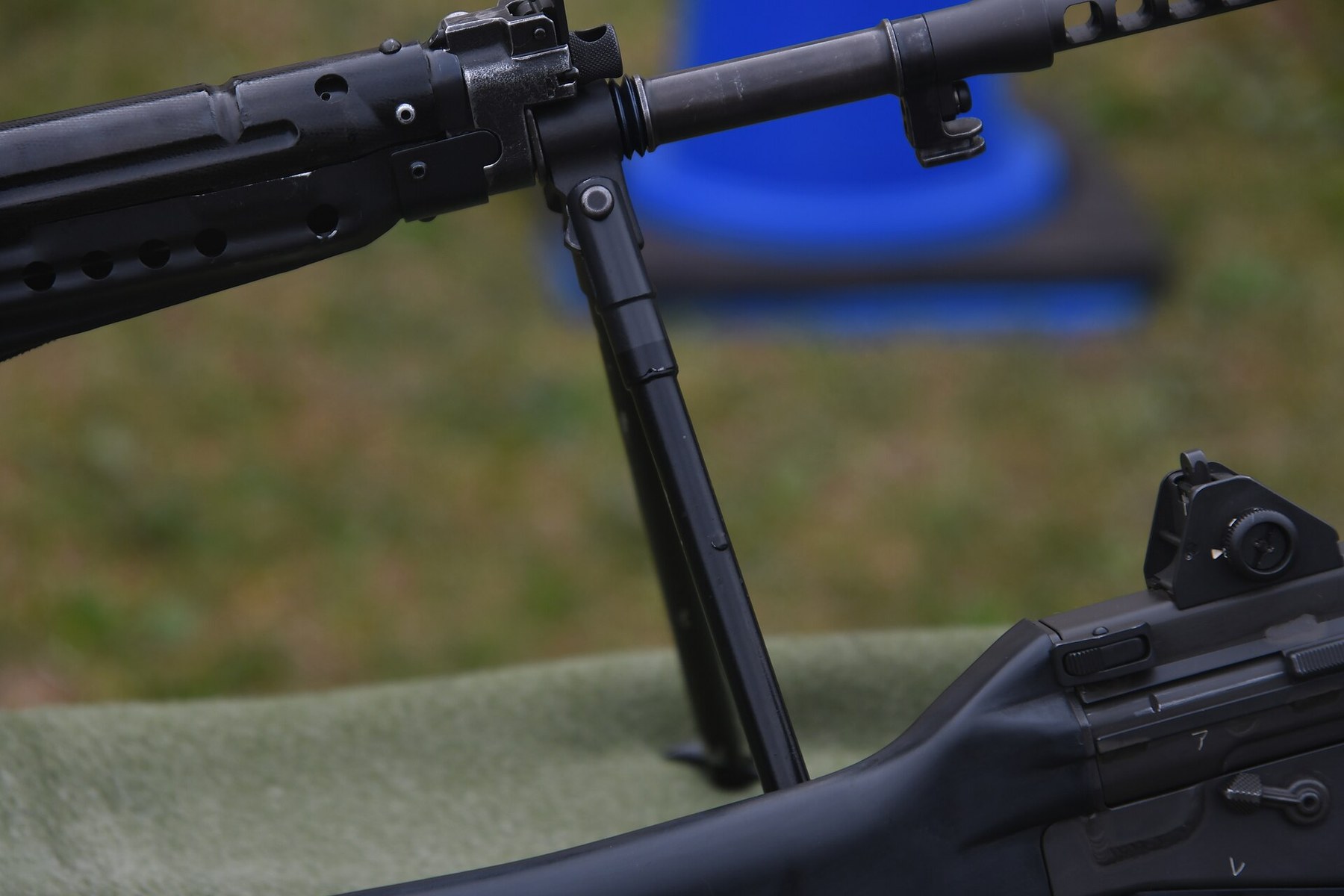
- Sights. Both fold. The front sight is a fixed post with no adjustment; the rear is an aperture with a knob on the right for windage and one beneath for elevation, neither of which locks.2 On a rifle fired prone with the Type 66 helmet pulled low, the helmet’s brim could strike the rear sight, and recoil could knock it flat; early production rifles had the rear sight fold under the rifle’s own vibration in bursts, which a drawing change only partly cured.2 In tactical drills soldiers were taught to raise the front sight before moving and raise and fold the rear for each fire position.2
- Stock. A straight-line stock of red lauan, a South-East Asian timber chosen because it was cheap and easy to work, with a metal buttplate carrying a folding shoulder rest and an accessory compartment whose kit includes the Phillips screwdriver and pin punch needed for stripping.2 Plastic stocks and grips were trialled in 1966–67 and passed for strength but were dearer than wood, and were not adopted (『月刊Gun』 May 1992, as cited by the Japanese Wikipedia).2 The upper handguard is FRP.2
- Bipod. Fitted as standard under the gas block. It folds but was not designed to come off for firing: removing it means taking off a ring at its base and drawing a pin.2
3.12 What is not documented
- The gas regulator’s positions and markings.
- The bolt’s locking and unlocking cam geometry. Described here from the general tilting-bolt principle and the Japanese Wikipedia’s one-sentence description, not from a drawing.
- A bolt hold-open. The English Wikipedia says the magazine follower holds the bolt open after the last round and the bolt runs forward when the empty magazine is removed, “much like the Yugoslavian Zastava M70”.4 It cites no source and none was found.
- Whether the production trigger group is exactly the patent’s embodiment.
- The selector lever’s link to the patent’s eccentric pin.
Footnotes
-
Howa Machinery, 「64式7.62mm小銃」, https://www.howa.co.jp/products/firer/defense/product03.html , read 2026-10-20: 口径 7.62×51mm; 作動方式 ガス利用式; 給弾 20発入弾倉; 重量 4.3kg; 全長 990mm; 銃身長 450mm; 発射速度 500発/分; 出典 陸上自衛隊HP. ↩ ↩2 ↩3 ↩4 ↩5 ↩6 ↩7 ↩8
-
Japanese Wikipedia, 「64式7.62mm小銃」, wikitext read 2026-10-20, citing 津野瀬光男『幻の自動小銃 六四式小銃のすべて』 (pp. 104–107, 152–153, 159, 174, 186, 196–198, 204–207); 伊藤眞吉「鉄砲の安全」, 『銃砲年鑑』 2005–06 p. 267, 2006–07 pp. 249–268, 2010–11 p. 117; 『エリートフォーセス 陸上自衛隊編』 Parts 1 and 2; 『月刊Gun』 May 1992, p. 61; 『月刊アームズ・マガジン』 December 2006, p. 29; 『新入隊員必携』. None seen for this dive. Translations this dive’s. ↩ ↩2 ↩3 ↩4 ↩5 ↩6 ↩7 ↩8 ↩9 ↩10 ↩11 ↩12 ↩13 ↩14 ↩15 ↩16 ↩17 ↩18 ↩19 ↩20 ↩21 ↩22 ↩23 ↩24 ↩25 ↩26 ↩27 ↩28 ↩29 ↩30 ↩31 ↩32 ↩33 ↩34 ↩35 ↩36 ↩37
-
貝方士英樹, MotorFan, 4 June 2022, https://motor-fan.jp/article/61101/ , read 2026-10-20. ↩
-
English Wikipedia, “Howa Type 64”, wikitext read 2026-10-20. ↩ ↩2 ↩3
-
防衛大学校達第19号 「防衛大学校の武器等の保管及び取扱いに関する達」, 31 August 1992, as amended to 21 October 2020, 別表第1, http://www.clearing.mod.go.jp/kunrei_data/b_fd/1992/by19920831_00019_000.pdf , read 2026-10-20. ↩
-
Kenzo Iwashita, assignor to Howa Kogyo Kabushiki Kaisha, US Patent 3,236,154, “Mechanism for Reducing the Rate of Fire in Automatic Firing Arms”, filed 16 April 1964, patented 22 February 1966, https://patentimages.storage.googleapis.com/pdfs/US3236154.pdf , read 2026-10-20. ↩ ↩2 ↩3 ↩4 ↩5 ↩6 ↩7 ↩8 ↩9 ↩10 ↩11 ↩12 ↩13 ↩14 ↩15 ↩16 ↩17 ↩18 ↩19 ↩20
-
Ministry of Defense, NDS Y 7101C 「小火器弾薬射撃試験用銃器」, established 30 May 1978, revised 15 April 2015, https://www.mod.go.jp/atla/nds/Y/Y7101C.pdf , read 2026-10-20. ↩
Comments (0)