Ruger Precision Rifle & Precision Rimfire · Volume 6
The .308 in Precision Work — Divisions, Chambering, Loading and the Suppressor
Where a .308 Precision Rifle stands under the 2026 PRS rules, what Ruger says about its chamber and its ammunition, and what the published Suppressors dive says about this rifle
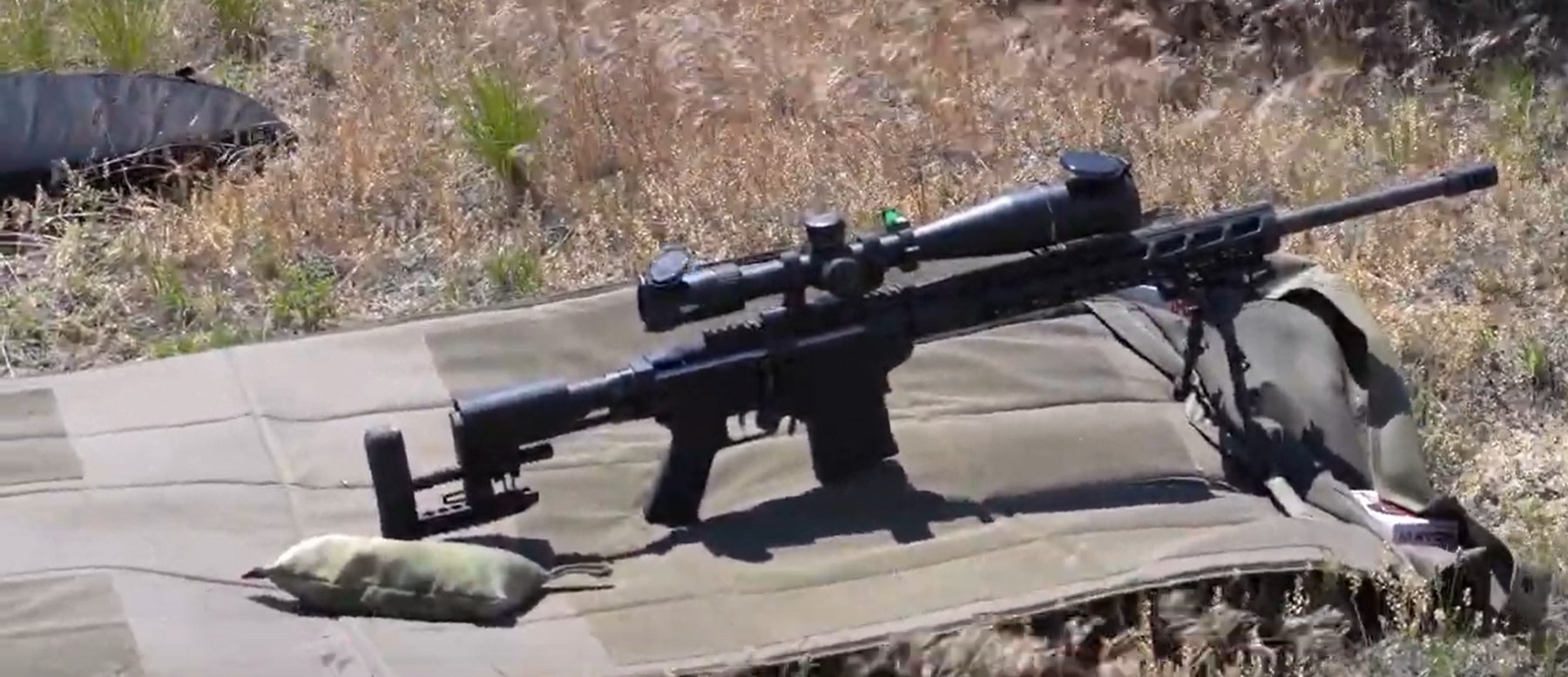
By 2026 the .308 is a minority choice in the Precision Rifle’s own catalogue. Of the ten Precision Rifles Ruger lists in September 2026, one is a .308; the rest are 6mm Creedmoor, 6mm GT, 6.5 Creedmoor, 6.5 PRC and three magnums.1 At launch it was one of three calibres, and the rifle’s first catalogue photograph was a .308.2 This volume sets out what the .308 rifle is for today, under the rules of the competition that shaped the type, and draws together what the rest of this site already says about its chambering, its ammunition and — specifically — about the .308 Precision Rifle and a suppressor.
It is deliberately short on ballistics and on handloading. The site’s Ballistics Overview, Headspace and Reloading Bench dives own those subjects, and this volume links them at the point each becomes relevant.
6.1 Where a .308 Precision Rifle Fits in the 2026 PRS Rules
The Precision Rifle Series’ 2026 rulebook, dated 13 March 2026, defines four bolt-gun and gas-gun divisions and a fifth, Sportsman.3 (The rulebook’s own introduction says “three Bolt Gun Divisions and one Gas Gun Division” and then defines Sportsman as well; the count is the rulebook’s inconsistency, not this summary’s.) For a .308 Precision Rifle:
Table 1 — The Precision Rifle Series' 2026 rulebook, dated 13 March 2026, defines four bolt-gun and gas-gun divisions and a fifth, Sportsman.[^prs2026] (The rulebook's own introduction says "three Bolt Gun Divisions and one Gas Gun Division" and then defines Sportsman as well; the count is the rulebook's inconsistency, not this summary's.) For a .308 Precision Rifle
| Division | 2026 rule | A .308 Precision Rifle |
|---|---|---|
| Open | calibre ≤ .30, muzzle velocity ≤ 3,200 fps (±32) | eligible |
| Tactical | ”.308 Winchester and 5.56 NATO/.223 Remington calibers only”; .308 bullet ≤ 178 gr, muzzle velocity ≤ 2,800 fps (±28); no wildcats; same course of fire as Open | eligible — the division the calibre was made for |
| Production | rifle ≤ $3,000 and optic ≤ $2,500 at the maker’s website; factory trigger may be tuned but not replaced; glass bedding allowed; replacement barrel must be the maker’s; handloads allowed; ≤ .30, ≤ 3,200 fps | eligible — the 18104 is $2,209; earlier models met the caps when discontinued, which the rule allows |
| Sportsman | rifle, optic, bipod, muzzle device, empty magazine and accessories ≤ 13 lb 0 oz; 6.5 Creedmoor only | not eligible — calibre |
| Gas Gun | semi-automatic | not applicable |
The Tactical division’s two caps are the ones that matter to a .308 owner who handloads. A 178-grain limit excludes the heaviest match bullets; a 2,800 fps limit, with a ±28 fps allowance, is a real ceiling for a lighter bullet from a 20-inch barrel, and match officials “may request at any point during a match that a competitor fire their rifle through chronograph.” Those are rules about the ammunition, not the rifle.
In 2016, when the Precision Rifle was new, the Production division’s caps were $2,000 for the rifle and $3,000 for rifle and scope together; the Tactical division then had no bullet or velocity cap in the membership text.4 Volume 1 sets the rifle’s launch beside those rules.
6.2 The Chamber and the Headspace
Ruger’s description of every Precision Rifle barrel is “5R Rifling at minimum bore and groove dimensions, minimum headspace and centralized chamber”.5 Ruger does not publish the chamber reamer, the throat, or whether the .308 chamber is cut to the SAAMI .308 Winchester print or to anything else; nothing in its documents mentions 7.62×51 NATO.
What “minimum headspace” means in thousandths, how it is gauged, and what GO, NO-GO and FIELD gauges are for, are the subject of Headspace, Volumes 1–4. Three points from that dive bear directly on this rifle:
- A barrel-nut rifle is one where headspace is set, not inherited. On a rifle whose barrel is held by a nut, the headspace is whatever the fitter set it to. The procedure, and the rule that the nut is never tightened with the bolt closed on a gauge, are in Headspace, Volume 5. On a Precision Rifle that has never been rebarrelled, Ruger set it; on one that has, the rebarrel set it (Volume 4 of this dive covers Ruger’s position on who may).
- Headspace belongs to the whole action, not the barrel alone — bolt face included. Headspace, Volume 9.
- Fired brass is the only witness to what the chamber does under pressure, and Ruger’s own manual tells the owner to read it: “If fired cases have bulged heads or show splits on any part of the case, stop using that ammunition.” What each mark means is in Headspace, Volume 12.6
6.3 Twist and Bullet Weight
Every recovered .308 Precision Rifle sheet gives a 1:10 right-hand twist, 5 grooves, 20-inch barrel.25 The published Suppressors by Caliber dive, Volume 5, discusses exactly this barrel: it describes 1:10 as “the modern all-round .308 standard” suited to supersonic bullets of roughly 168 to 210 grains, and concludes that heavy subsonic .308 loads are an unresolved question in 1:10 — “the only way to find out is on paper” — and a poor use of the rifle, because .300 Blackout does the subsonic job better.
That conclusion is taken as it stands. The Tactical-division cap of 178 grains sits comfortably inside the supersonic weight range that volume gives, and nothing in Ruger’s documents gives a recommended bullet weight for the rifle.
6.4 Ammunition, Handloading, and What Ruger Says About It
Ruger’s position is unambiguous and is printed in both manuals: “Use only new, factory ammunition of the correct caliber”, and “WE SPECIFICALLY DISCLAIM RESPONSIBILITY FOR ANY DAMAGE OR INJURY WHATSOEVER OCCURRING IN CONNECTION WITH, OR AS THE RESULT OF, THE USE IN RUGER FIREARMS OF FAULTY, OR NON-STANDARD, OR ‘REMANUFACTURED’ OR HAND LOADED (RELOADED) AMMUNITION”.7 It adds that the two most common causes of a bullet stuck in the bore — a squib, and a bullet pulled from its case on unloading — “occur most frequently with reloaded ammunition.”8
That is the maker’s warranty position. It sits beside a competition culture in which handloading is normal — the 2026 PRS rules allow “any and all types of factory ammunition or hand loaded ammo” in Production — and beside this site’s own Reloading Bench dive, which lists .308 Winchester first among its precision-rifle cartridges. The bench-side material for a .308 precision rifle is there and is not repeated:
- dies and neck sizing — Volume 9;
- case preparation, trimming, annealing and case life — Volumes 12 through 15;
- powder and charge weighing for extruded rifle powders — Volumes 18 and 19;
- seating depth, jump and cartridge base-to-ogive — Volume 20;
- load development as a method, and the statistics of chronograph strings and groups — Volumes 21 and 22;
- setting the shoulder bump against a specific chamber — Headspace, Volume 10.
Two rifle-specific constraints for a handloader follow from Ruger’s documents rather than from the bench dive.
- The magazine sets the upper bound on cartridge length. The rifle ships with Magpul PMAG 10 LR/SR magazines and takes AICS-pattern magazines. The overall length a load can reach and still feed is set by whichever magazine is used, not by the chamber; neither Ruger nor this dive gives that length, and it is measured on the rifle with the magazine in question.
- A Tactical-division load must stay at or under 178 grains and 2,800 fps from the rifle it will be shot in, which a chronograph string, not a load manual, confirms.
No charge weight appears in this volume.
6.5 The Suppressor — What the Published Dive Says About This Rifle
The Precision Rifle in .308 is one of two .308 rifles used as worked examples in Suppressors by Caliber, in Volumes 2, 5, 8 and 10. Its conclusions for this rifle are:
- A bolt action removes the backpressure question. “There is no gas system, so there is no overgassing” — buy for suppression and return to zero, and the low-backpressure product category is irrelevant.
- Direct-thread the can on the rifle’s 5/8-24, because the rifle lives in one configuration and direct thread is “the lightest, most concentric and most repeatable interface”; keep the brake for matches that ban suppressors.
- Length: a 20-inch barrel plus an 8-inch can is “a 28-inch barrel-equivalent object on a 9.8-pound rifle”.
- No subsonic diet: 1:10 is unresolved for heavy subsonic .308, and .300 Blackout does that job.
- One .30-calibre can serves both .308s in the example battery, and should be specified to the hardest host in it.
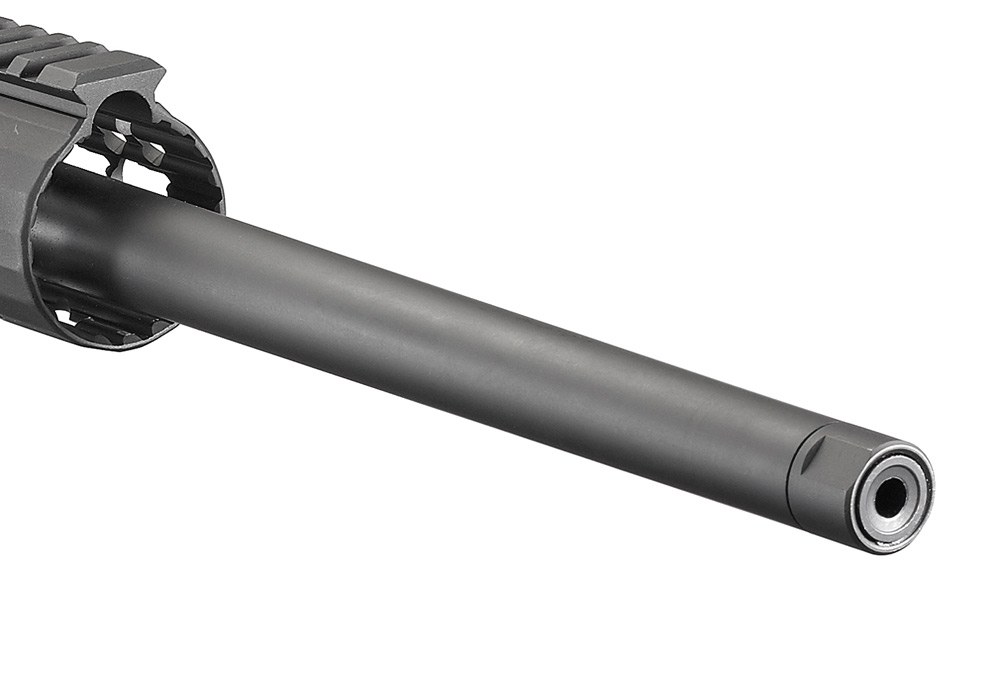
Checked against Ruger’s documents and the owner’s answers of 19 September 2026, those conclusions stand, and so do their premises for the rifle documented here: it has a 20-inch barrel and wears a muzzle brake (Volume 7). One qualification applies to the type rather than to this rifle. The dive takes its figures — 20-inch medium-contour barrel, .75 in at the muzzle, 5R, 1:10, 5/8-24, hybrid brake, 9.8 lb — from Ruger’s sheet for model 18028, which ruger.com no longer lists; the Internet Archive’s 2019 copy confirms every figure.9 The current .308, model 18104, has a heavy-contour .850-inch barrel and weighs 11.5 lb, so for a current-production rifle the “9.8-pound” figure in the length argument is 1.7 lb light.5
Ruger’s own manual adds the check every suppressor owner should run before firing, whatever can is chosen: confirm that the device “is intended for use on firearms chambered in the caliber marked on your firearm”, “utilizes the correct thread pitch”, and “is properly installed (including verification that the muzzle device is mounted concentric to the bore)”, because the alternative is “baffle strikes, unstable projectiles, and/or catastrophic failure”. If the factory brake is on, the jam nut has to come off first; Volume 4 gives both manuals’ procedures, which differ.10
The legal side — what a suppressor is under federal law, the $0 making and transfer tax on silencers since 1 January 2026, the Form 4 process, and Michigan, where ownership and suppressed hunting are both lawful with no state permit — is in the Suppressor Law dive, Volumes 3 and 7. A .308 Precision Rifle with a 16-inch or longer barrel is a rifle, not a short-barrelled rifle, and nothing about the rifle itself is regulated under the NFA.
Footnotes
-
Ruger, Ruger Precision Rifle model page. https://ruger.com/products/precisionRifle/models.html (read 2026-09-19). ↩
-
Ruger specification sheet, model 18001, captured 13 January 2016. https://web.archive.org/web/20160113233641/https://ruger.com/products/precisionRifle/specSheets/18001.html ↩ ↩2
-
Precision Rifle Series, 2026 Rules & Standard Operating Procedures, “as of 13 March 2026,” section 2.1. https://prs-website-uploads.s3.amazonaws.com/public/prs_rules.pdf (read 2026-09-19). ↩
-
Precision Rifle Series, “2016 PRS Membership” pages for the Production, Tactical and Open divisions, captured 13 November 2015. https://web.archive.org/web/20151113134905/http://www.precisionrifleseries.com:80/2016-membership/2016-prs-membership-production-division.html ↩
-
Ruger specification sheet, model 18104. https://ruger.com/products/precisionRifle/specSheets/18104.html (read 2026-09-19). ↩ ↩2 ↩3
-
Ruger, PM924, “To Clear a Malfunction,” p. 27. ↩
-
Ruger, Instruction Manual for Ruger Precision Rifle, PM924, “Ammunition” and “Ammunition (Cartridges) Notice,” pp. 15–16. https://ruger.com/dataProcess/manual/fetch.php/ms/18104/manual_18104.pdf (read 2026-09-19). PM605 carries the same notice. ↩
-
Ruger, PM924, “To Remove a Bore Obstruction,” p. 25. ↩
-
Ruger specification sheet, model 18028, captured 17 July 2019; the live page https://ruger.com/products/precisionRifle/specSheets/18028.html returned “Page Not Found” on 2026-09-19. https://web.archive.org/web/20190717012851/https://ruger.com/products/precisionRifle/specSheets/18028.html ↩
-
Ruger, PM924, “Threaded Barrel” and “Warning – Muzzle Devices,” p. 19. ↩
Comments (0)