Ruger Precision Rifle & Precision Rimfire · Volume 2
The Architecture — Receiver, Barrel Nut, Bolt, Trigger, and a Magazine Well for Two Patterns
What each part of the Precision Rifle is, why it is there, and how it changed from model 18001 to 18104
The Precision Rifle is easiest to understand as three assemblies bolted together. A steel receiver carries the barrel, the bolt, the scope rail and the trigger. An aluminium magazine well — two machined halves, which the early manuals call the “lower receiver” — hangs underneath it and carries the magazine latch, the grip and the safety selector. A stock assembly hinges off the back of the receiver. Nothing in the rifle is bedded, and nothing touches the barrel forward of the nut that holds it.
This volume goes through those assemblies part by part. Each statement of what a part is comes from one of three Ruger sources: the specification sheets (current and archived), the instruction manuals — PM605 in its 2015 and 2018 revisions, and PM924 for rifles with serial prefixes 1806 and above — and Ruger’s patents. Where a statement rests on reading a drawing rather than on Ruger’s text, it says so.
2.1 The Receiver
The receiver is the rifle. Ruger’s manuals say so in the legal sense — “Because the receiver of the RUGER PRECISION® RIFLE is a serial numbered component, it is defined as a ‘firearm’ by Federal law and is not sold as a separate component” — and the parts lists mark it with a dagger as “a serial-numbered part and is not offered for sale.”1 Everything else on the rifle can be bought as a part.
It is machined from steel. The launch sheet: “‘Upper’ receiver and one-piece bolt are precision CNC-machined from pre-hardened 4140 chrome-moly steel to minimize distortion.” The current sheet drops the alloy number and keeps the rest.23 Pre-hardened stock is machined in its final condition, so there is no heat treatment after machining to move the bore of the receiver out of line with its threads — which is the “minimize distortion” point.
Three features on the receiver matter to an owner.
- The scope rail. A 20 MOA Picatinny base “secured with four, #8-40 screws” on the launch rifle and ”# 8-40 screws” on every later sheet.2 It is a separate part (the parts list calls it “Scope Base” with four “Scope Mount Screws”) and can be replaced with another base — a flat one, or one with more cant — without touching the action. What 20 MOA buys, and what it does not, is set out in Types of Scopes, Volume 8; Volume 7 of this dive applies it to the rifle documented here.
- The gas vents. “Venting holes evident in the upper receiver and bolt ensure that excess gas (as might occur with a plugged bore or overcharged round) has the safest possible path out of the rifle. Do not fill, obstruct, or cover the vents.”4 They are easy to cover with a strip of tape or a cheek-riser when fitting accessories. The manual is explicit that they must stay open.
- The rear face. The stock hinge bolts to the back of the receiver, and the bolt comes out through the back. That is why the bolt cannot be removed with the stock open, and why the manual repeats in bold that the stock must not be folded or opened with the bolt out of battery — “Failure to fully close the bolt may result in damage to your rifle, the bolt shroud, and/or bolt.”5
2.1.1 The magazine well — the “lower”
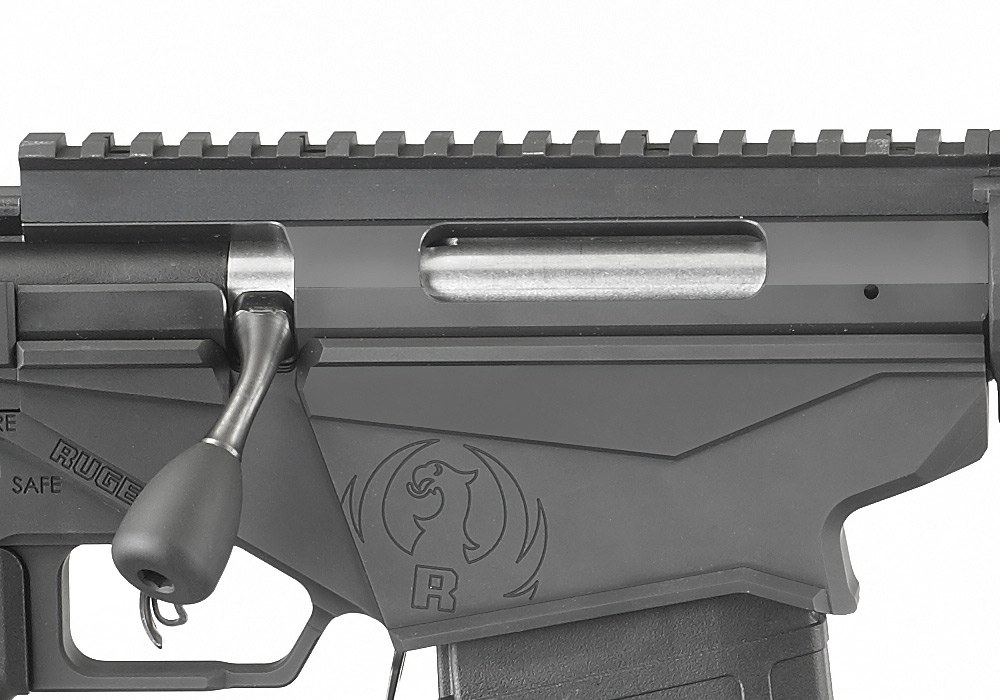
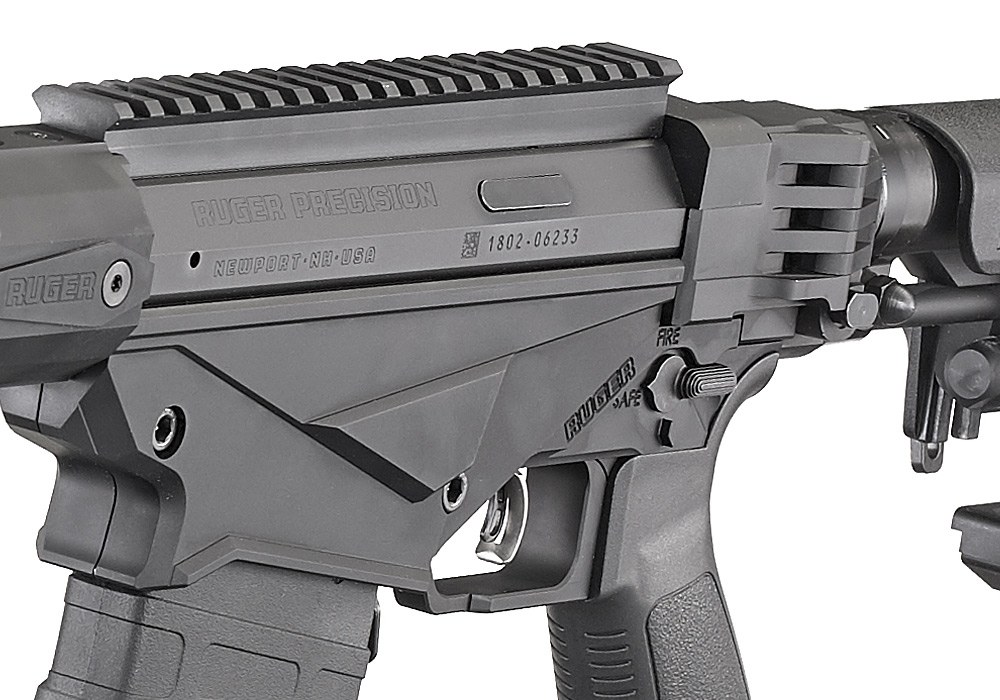
Under the receiver is a two-piece aluminium housing that holds the magazine latch, the safety selector, the pistol grip and the front of the trigger guard. The launch sheet calls these parts the “‘Lower’ magazine well halves”, “precision machined from aerospace-grade 7075-T6 aluminum” and hard-anodised; the current sheet gives them a Cerakote finish.23 The PM605 parts list names them “Short Lower, Right” and “Short Lower, Left”; PM924 renames them “Magazine Well, Right” and “Magazine Well, Left”.61 The terms “upper” and “lower” are the AR-15’s, borrowed; unlike an AR-15, the serialised part here is the upper.
The magazine well comes off the receiver with two cap screws — one at the rear of the receiver, reached with the stock folded, and one at the front of the well — and only with the safety on SAFE. The order in which the screws go back in matters. Volume 4 gives the procedure and the torque.
2.2 The Barrel, the Barrel Nut, and the Handguard That Hangs From It
2.2.1 What Ruger says about the barrel
Every Precision Rifle barrel on every recovered sheet is “cold hammer-forged … with 5R Rifling at minimum bore and groove dimensions, minimum headspace and centralized chamber”.23 5R is a five-groove form with sloped, rather than square, groove walls; the practical claims made for it are easier cleaning and less jacket deformation, and none of them is quantified in any Ruger document. “Minimum bore and groove dimensions” and “minimum headspace” say that Ruger cuts to the tight end of the SAAMI tolerances; “centralized chamber” is not defined further.
What gauges a chamber cut to minimum headspace, and why “minimum” is a manufacturing choice rather than an accuracy guarantee, is the subject of the Headspace dive. Volumes 1 and 3 of that dive own the definitions and the SAAMI figures; they are not repeated here.
2.2.2 How the barrel is held
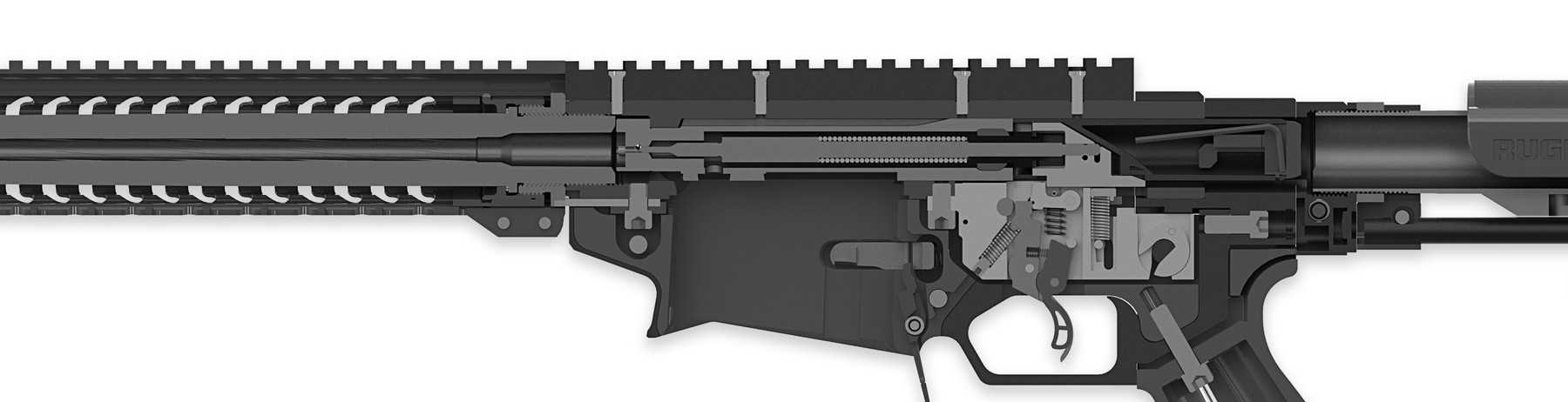
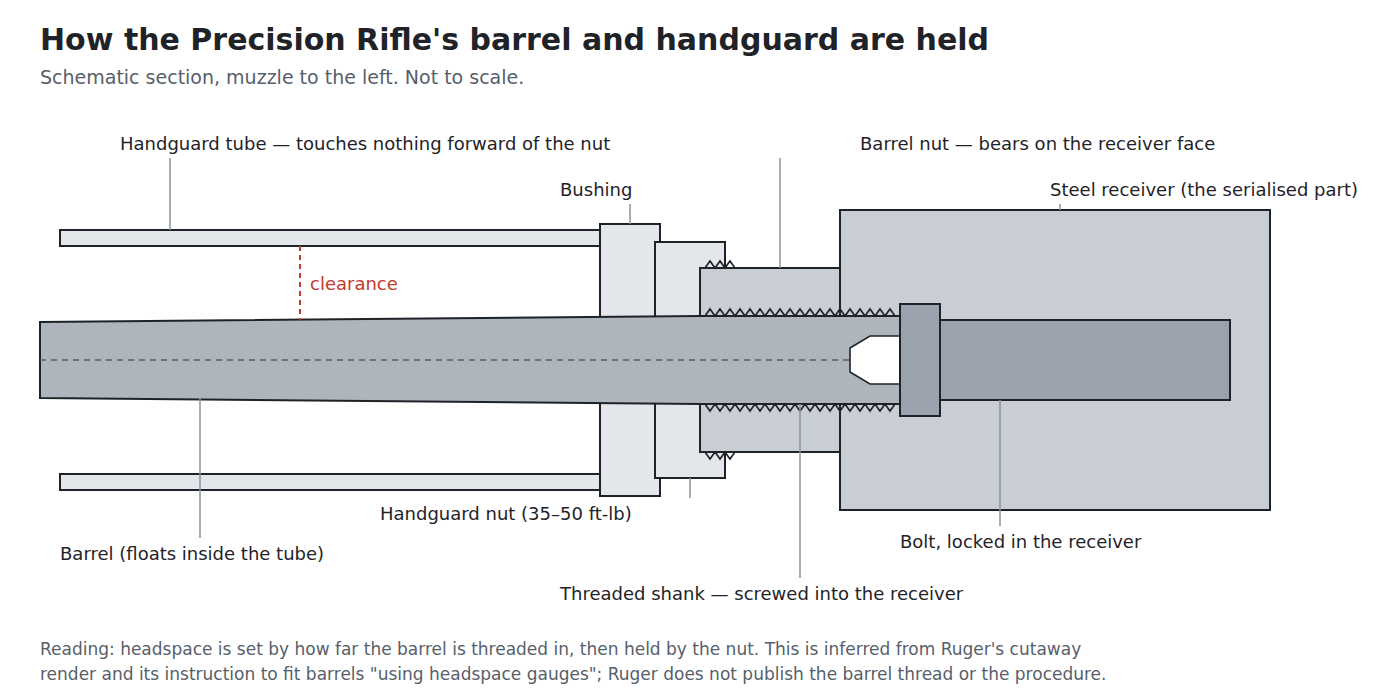
The Precision Rifle’s barrel is not shouldered against the receiver in the way a Remington 700’s is. Ruger’s parts lists carry, between the barrel and the receiver, a Barrel Nut and a Barrel Nut Lock.61 The cutaway at the top of this volume shows the arrangement: the barrel’s threaded shank runs into the front of the receiver, and a nut on the shank bears against the receiver’s front face. The handguard mounts on the outside of that nut.
Ruger does not describe in words how headspace is set on this rifle. Two things point to the answer. The launch sheet says that “Barrels can be easily replaced by a competent gunsmith using AR-style wrenches and headspace gauges”, and every later sheet keeps “using headspace gauges”.27 And the drawing shows no barrel shoulder landing on the receiver. A barrel whose headspace is fixed by a shoulder does not need headspace gauges to fit — it needs them only to check. The reading here, then, is that the barrel is threaded in until the chamber is at the correct depth against a gauge, and the nut is run up to lock it there — the barrel-nut system familiar from Savage bolt actions. It is an inference from Ruger’s instructions and its drawing, not a sentence Ruger has printed.
The general procedure for a barrel-nut fit, and the rule of thumb that makes it tractable — on an 18-thread-per-inch barrel, a sixtieth of a turn moves headspace about a thousandth — are in Headspace, Volume 5, with the warning that matters most: never tighten a barrel or barrel nut with the bolt closed on a gauge. Ruger does not publish the Precision Rifle’s barrel thread, so whether that exact rule applies to this rifle could not be confirmed.
And there is a complication that no owner should skip. Ruger’s manuals list the barrel as a part that “must be factory fit”, and say that “Barrels … must be fitted at the factory” because the company proof-tests every barrel after fitting with ammunition that “is not available to gun shops, gunsmiths or individuals.”8 Ruger’s catalogue and Ruger’s manual therefore give opposite answers to the question of who may change a Precision Rifle barrel. Volume 4 sets both out in full, with what each actually commits Ruger to.
2.2.3 The handguard
The handguard is a tube that does not touch the barrel. The manuals describe how it goes on: a bushing and a nut slide over the barrel, and the nut is turned “clockwise to engage the threads on the barrel nut” and tightened to “35 - 50 foot-lbs using a 1-3/8” wrench”; the tube then slides over the bushing and is held by six screws at 25 in-lb.9 The handguard is carried by the barrel nut, and through it by the receiver. That is what free-floating means here: a bipod clamped to the handguard loads the receiver, not the barrel. Ruger’s patent on the arrangement, “Firearm with tubular handguard mounting system” (US 9,506,712, provisional filing October 2014), names Jonathan Mather and David Kangas as inventors.10
The tube itself changed three times:
Table 1 — The tube itself changed three times
| Model | Handguard |
|---|---|
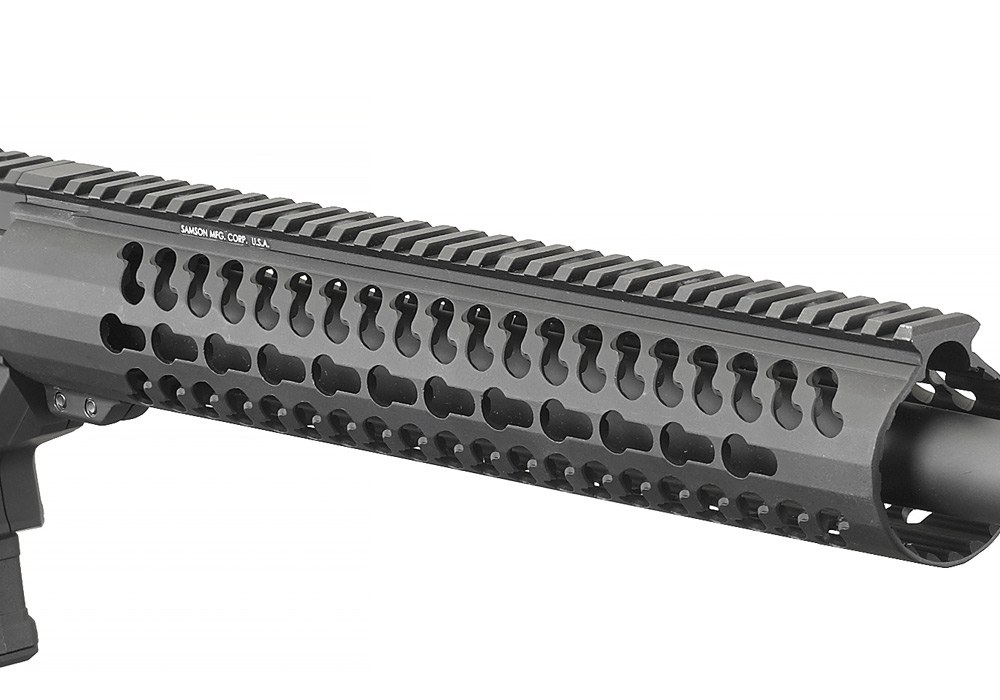
| 18001 (2015) | Samson Evolution KeyMod; “May be configured with any AR-style handguard” |
| 18004 (2016) | Ruger Precision Rifle Short-Action handguard “for improved scope clearance for long-range scopes” |
| 18028 (by 2019) onward | 15-inch aluminium free-float handguard, M-LOK slots on all four sides |
Sources: specification sheets.2117
“Scope clearance” is the practical reason for the change. A long-range scope’s objective bell sits over the front of the receiver and the rear of the handguard, and a tall handguard crowds it. The KeyMod launch tube is the easiest external identifier of a 2015 rifle.
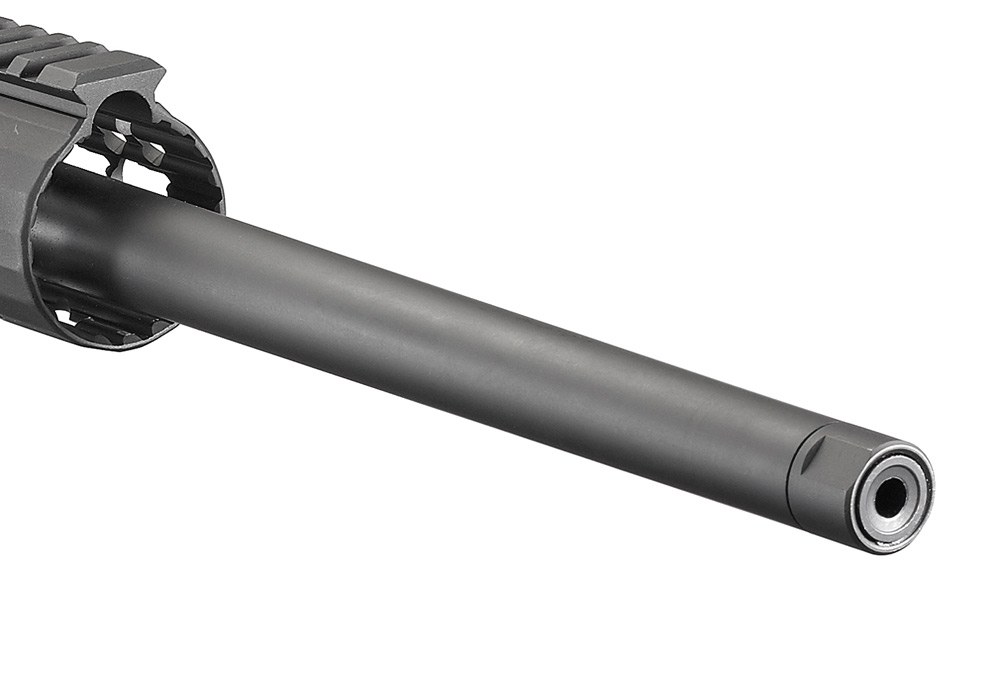
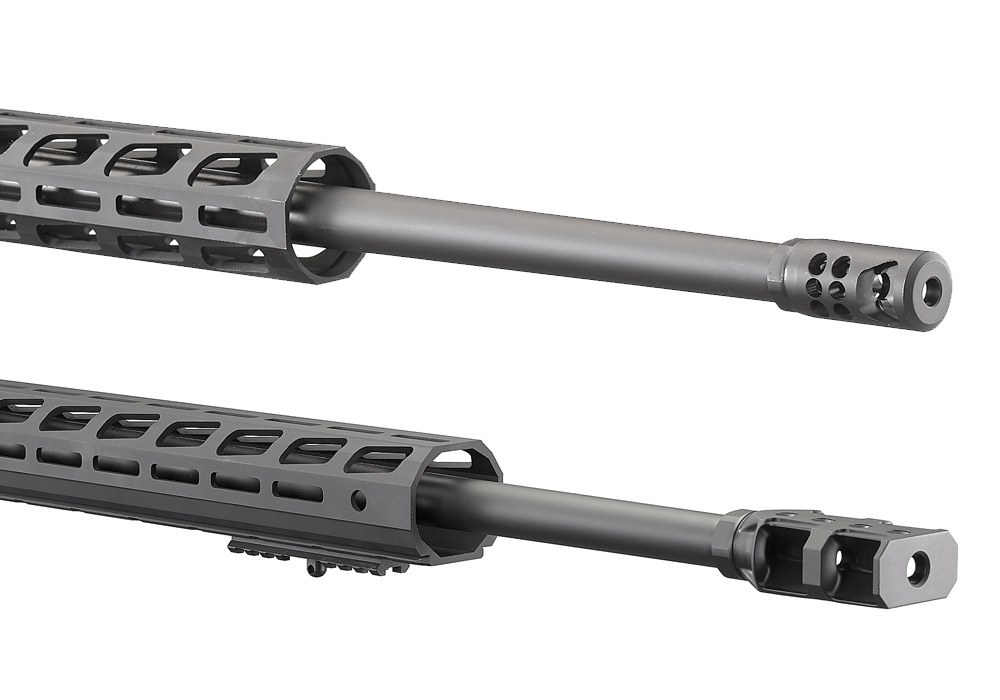
2.2.4 The muzzle
Table 2 — The muzzle
| Model | Muzzle as shipped |
|---|---|
| 18001 | 5/8-24 thread, installed thread protector, no brake |
| 18004, 18028 | Ruger Precision Rifle Hybrid Muzzle Brake (thread protector included) |
| 18104 | ”Ruger Precision Rifle muzzle brake” on a heavy-contour barrel |
Sources: specification sheets.21173
Thread sizes by calibre, from the current manual: .223/5.56 is 1/2-28; 6mm and 6.5 Creedmoor, 6.5 PRC, .308, .300 Winchester Magnum and .300 PRC are 5/8-24; .338 Lapua Magnum is 3/4-24.12 The brake is timed and held with a jam nut; the manuals give its removal and refitting, and — as Volume 4 shows — the two manual revisions do not agree on the wrench, the torque or even the direction of rotation.
2.3 The Bolt
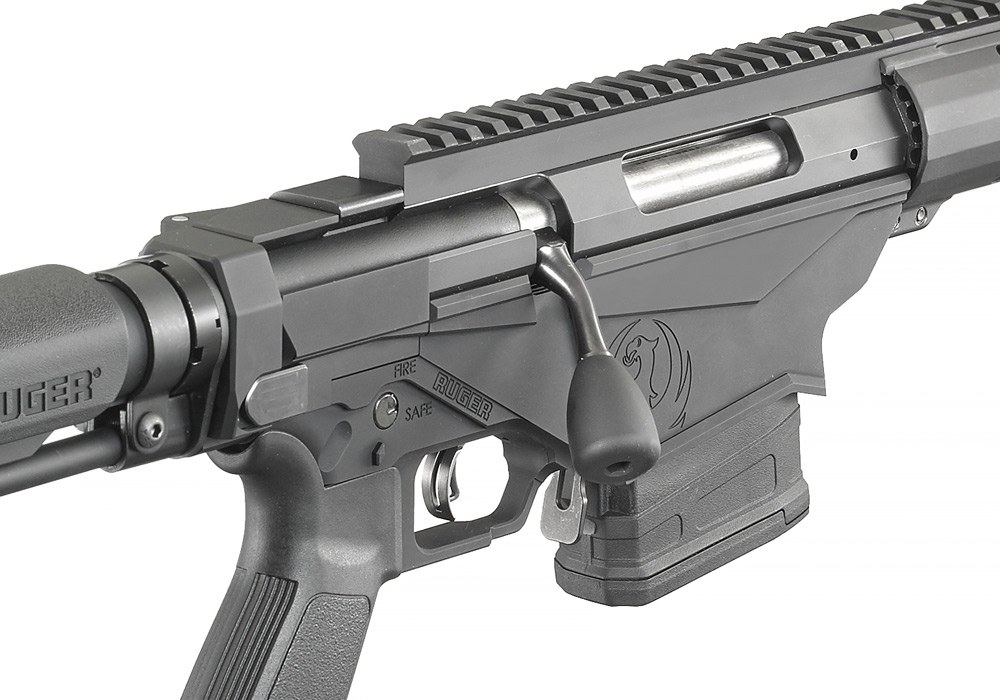
Every specification sheet describes the bolt in nearly the same words: a one-piece bolt, machined from pre-hardened chrome-moly, “Three-lug bolt with 70° throw features dual cocking cams and a smooth-running, full diameter bolt body.”2 Four features follow from that sentence, and Volume 3 shows each one working.
- Three lugs. A two-lug bolt must be lifted 90° to unlock; three lugs spaced 120° apart need less rotation. Ruger gives the lift as 70°. The practical effect is clearance between the bolt handle and an eyepiece mounted low over the receiver, and a shorter, faster stroke of the wrist.
- Dual cocking cams. The striker is cocked by the bolt lift, not by the forward stroke — “Fully raising the bolt handle cocks the firing pin” — and the cocking piece rides two cam surfaces rather than one.13 The manual’s only lubrication instruction for the bolt concerns these cams.
- Full-diameter body. The bolt body is as large in diameter as its lugs, which is the usual way of making a bolt ride on its whole length in the receiver bore rather than wobble on its lugs; Ruger’s word for the result is “smooth-running”.
- One piece. The bolt handle is not brazed on. It is a separate threaded part — “Oversized bolt handle … with a 5/16”-24 thread pattern for easy replacement” — and the knob can be changed for an aftermarket one.2
The bolt’s surface finish changed. The launch sheet does not describe one; 18028 has a “nitrided” bolt body “for corrosion resistance, smooth operation and durability”; the current rifle’s bolt body is “DLC coated” for the same stated reasons.73
At the rear, the bolt shroud holds two tools: the 5/64-inch hex key that adjusts the trigger, and a bolt disassembly tool for “easy striker channel cleaning”. From 2016 the shroud is “Billet Aluminum”.11 PM924’s parts list breaks the shroud assembly into shroud, O-ring, cap and the key; the cap turns to release the key.1
Ruger’s bolt patent, “Bolt for bolt action rifles” (US 9,885,528, filed February 2016, with two continuations to 2021), is credited to Mather alone and is listed by Ruger against both the Precision Rifle and the Ruger American Rifle.14 Its text was not fully read for this dive; nothing here is attributed to it beyond its title and dates.
2.4 The Trigger and the Safety
2.4.1 The Marksman Adjustable trigger
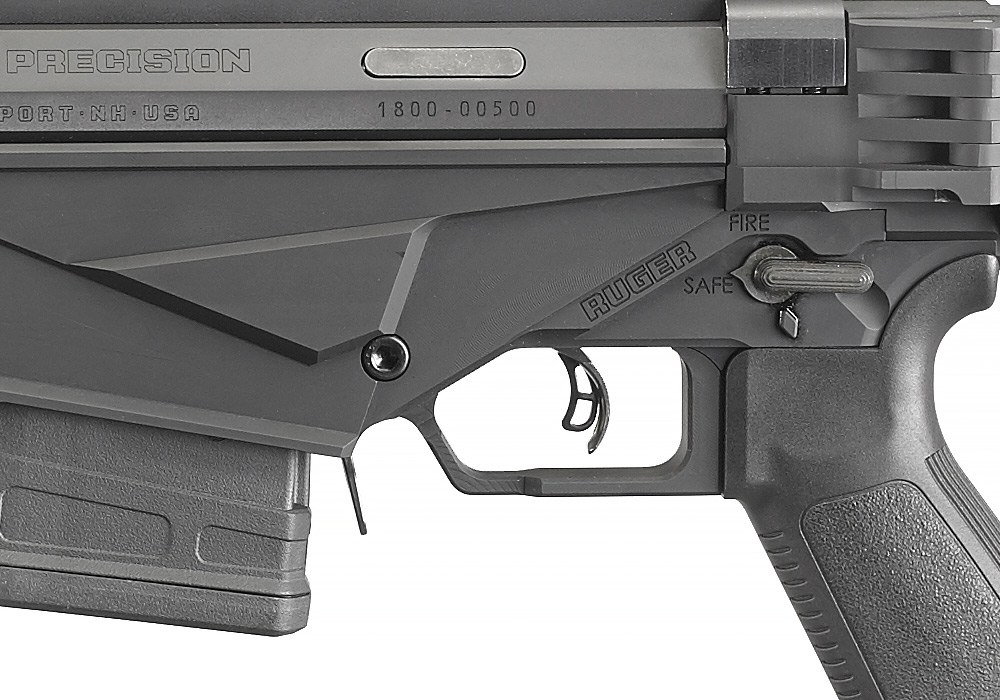
The trigger is Ruger’s Marksman Adjustable, “externally adjustable with a pull weight range of 2.25 to 5.0 lbs.”2 It is adjusted with the rifle inverted, by passing the long leg of the 5/64-inch key through a slot in the magazine latch lever and down a square passage in the magazine well to the screw; clockwise is heavier, about six full turns span the whole range, and Ruger recommends half-turn steps.15 Nothing has to come apart.
The trigger blade carries a trigger release in its centre — a second, pivoting blade that must be depressed before the trigger can move. The parts lists call it the “Trigger Release” with its own spring and pin; the function check in PM924 asks the owner to confirm that it “has fully rebounded” after each pull.116 It is the same idea as the blade safety in a Glock trigger.
The trigger group is a self-contained housing that slides into the receiver from the rear and is held by one screw at its front and by a spring-loaded guide at its rear. Ruger’s patent on the arrangement is “Trigger housing mounting system for firearm” (US 10,030,926).17 Ruger recommends cleaning the group about every thousand rounds, and treats a rise in pull weight without adjustment as the sign that it needs it (Volume 4).18
Most of its parts are on Ruger’s factory-fit list: in the 2015 manual, the sear, safety link, trigger-block pin, safety shaft, safety spring, housing, trigger release and trigger itself all carry the asterisk.6 Replacement triggers exist in the aftermarket; which ones fit and how they perform were not assessed for this dive, and none is named.
2.4.2 The safety
The safety is an AR-style rotating selector with a 45° throw, and it blocks the trigger. It can be moved to SAFE only when the striker is cocked.13 That last point catches owners: with the striker down — after dry firing, for instance — the selector will not go to SAFE until the bolt handle has been lifted.
On the launch and 2016 rifles the selector is on the left side only, and the 2015 and 2018 manuals describe “Reversing the Safety Selector Switch” — pulling it out from the indicator side with the magazine well off and refitting it from the right.19 By 2019 the sheet reads “Ambidextrous manual safety for left- or right-handed lever manipulation.”7 Ruger’s patent “Safety mechanism for firearm” (US 9,441,897) was filed with a December 2014 priority date.20
2.5 The Magazine Well That Takes Two Patterns
This is the feature Ruger patented first. The application for “Universal magazine latch mechanism for firearm” was filed on 5 May 2014 and issued as US 9,194,637 on 24 November 2015. Its abstract describes the whole idea:
“a rear catch lever pivotably mounted to a rear wall of magazine well about a first pivot axis, and a side catch lever pivotably mounted to the frame about a second pivot axis. The rear catch lever is operable to engage/disengage rear or front style latching magazines. The side catch lever is operable to engage/disengage side catch style magazines. The rear catch lever is an actuator for operating both the rear and side catch levers, thereby latching and releasing all three catch styles of magazines with a single user action.”21
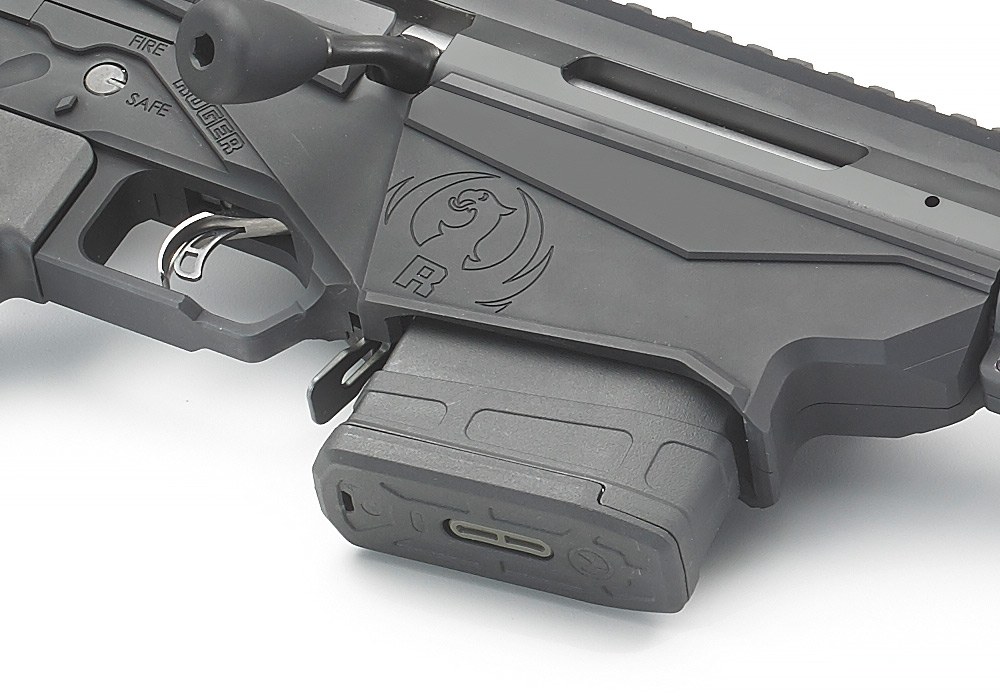
In the rifle, that becomes a paddle-shaped magazine latch lever behind the magazine, which the shooter squeezes forward. The manual describes what the hand feels: “you will feel it move through two stages; you may encounter heavier resistance releasing the second stage. (This is normal for a side-latching magazine.)”22 The two stages are the two catches.
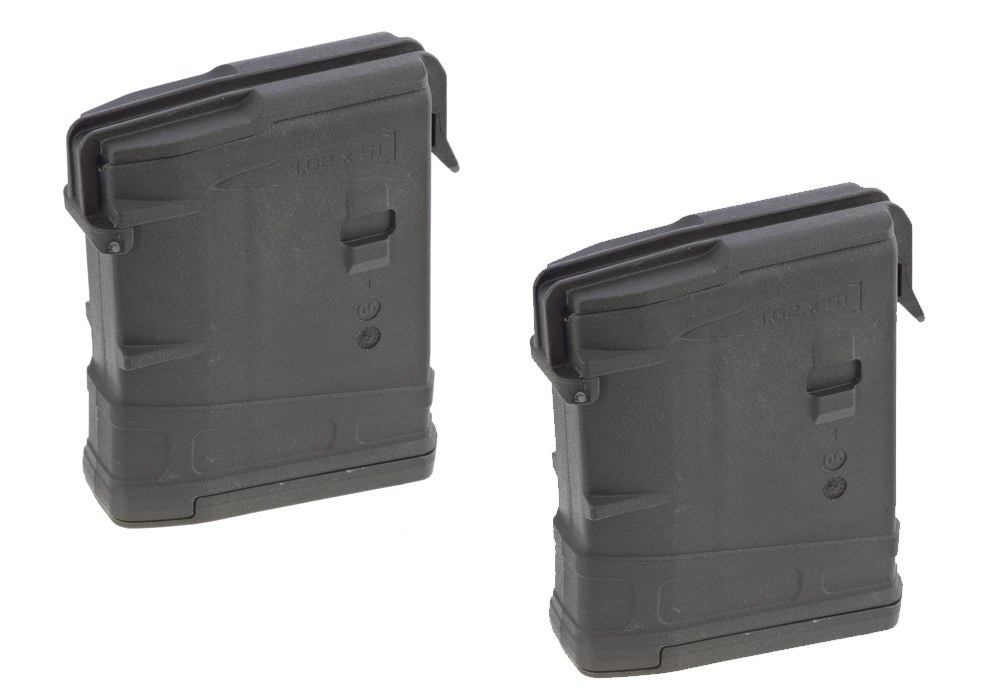
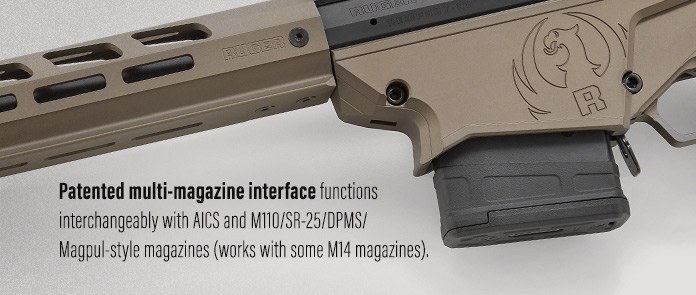
What the rifle accepts, in Ruger’s words on the sheets: “M110/SR-25/DPMS/Magpul-style magazines”, “AICS magazines”, and “(works with some M14 magazines)”.11 Two ten-round Magpul PMAG 10 LR/SR GEN M3 magazines ship with every rifle; the manual warns that although they are marked “7.62 x 51”, they must be loaded only with the calibre on the barrel.23 In practice this means a .308 owner can use the inexpensive SR-25-pattern polymer magazines or the metal AICS-pattern magazines that bolt-rifle chassis systems use, in the same rifle, without changing anything.
The front of the magazine well is shaped for use against a barricade: “Magazine well front is contoured for a positive grip for bracing against shooting supports.”2 PRS stages are built around barricades, and a well that can be pressed against a post is not incidental.
2.6 The Stock and the Recoil Path
2.6.1 “Without traditional bedding”
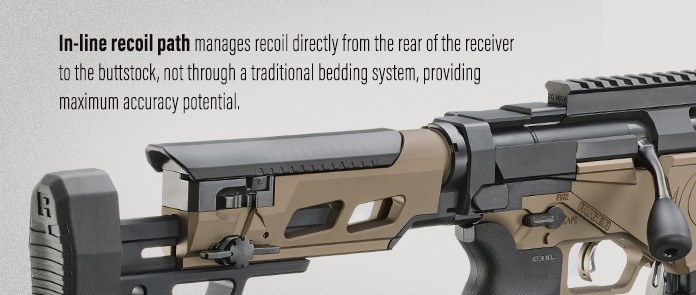
The manuals open with the design intent: the rifle “is designed to produce a direct recoil path through the upper receiver into the butt stock, without the use of traditional bedding.”24 A conventional bolt rifle drives its recoil lug into a stock, and its accuracy depends on how well that joint is bedded. Here the steel receiver’s rear face bears on the stock hinge, and the hinge on the buffer tube or stock body. The stock is not a bedding surface; it is a load path. Ruger’s own figure caption puts it in one line: recoil goes “directly from the rear of the receiver to the buttstock”.3
2.6.2 The Precision MSR stock
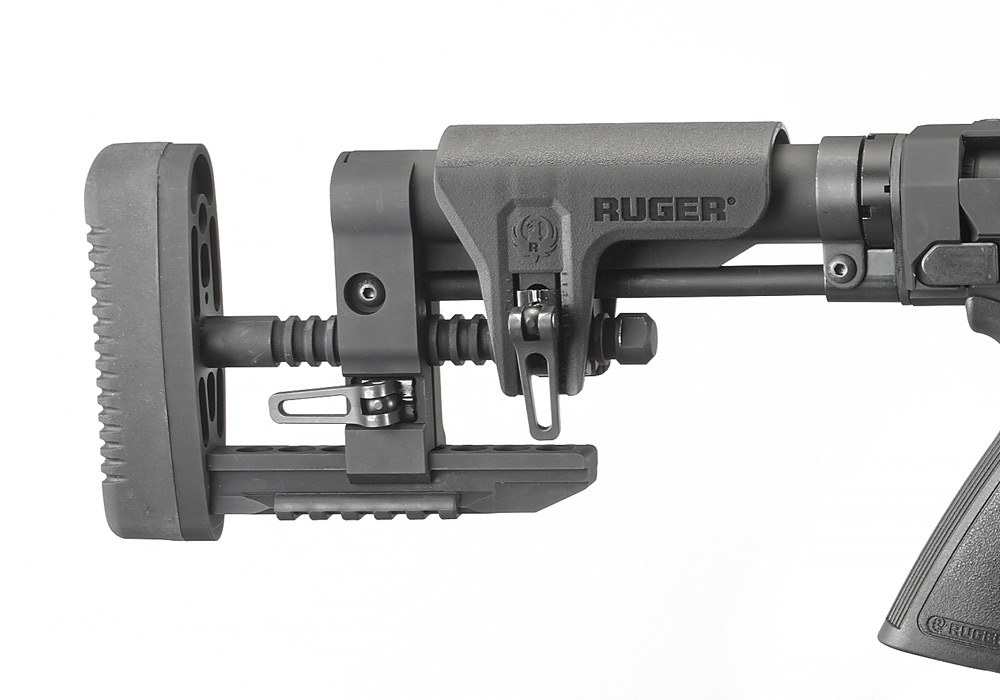
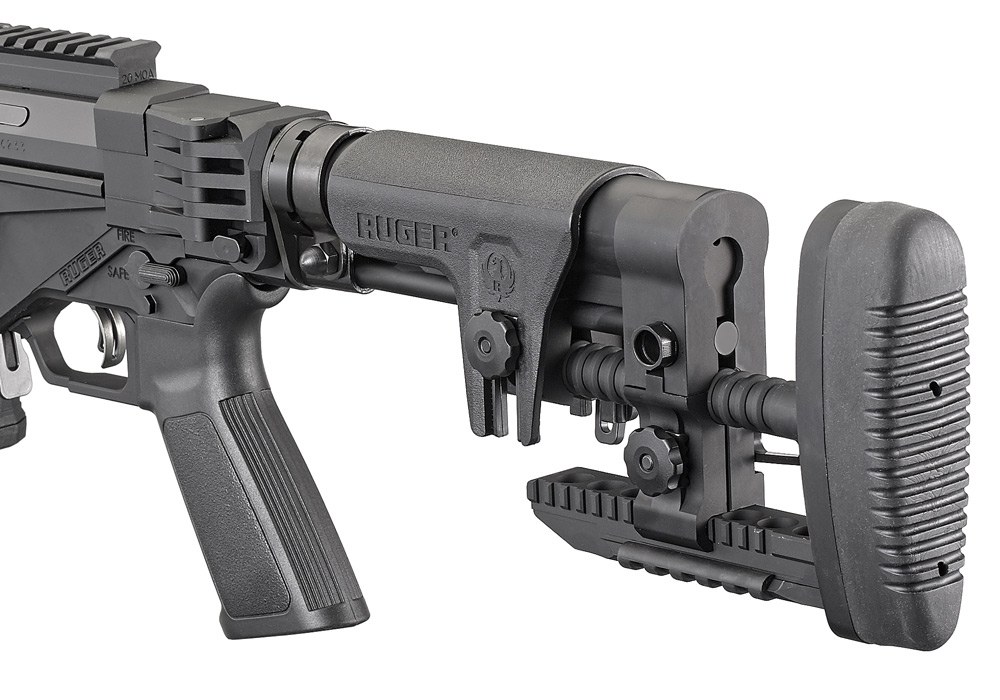
On the launch rifle and on every sheet through 18028 and its variants, the stock is the Ruger Precision MSR: “The left-folding stock hinge is attached to an AR-style buffer tube and accepts any AR-style stock.”2 PM605 describes its adjustments:
- Length of pull 12 to 15.5 in, set by releasing two cam levers — “Each increment adjusts the length of pull by ¼ of an inch”;
- Comb height by squeezing the cheek piece at the Ruger eagle and sliding it — “Each ‘click’ is 1/16 of an inch”;
- Comb position fore and aft, by rotating the cam lever 180°;
- Butt-pad cant, “either 9 degrees left or right”, by moving a screw in the butt-pad frame;
- a bottom Picatinny rail for a rear monopod, QD sling cups, and the cam levers movable to either side.25
Ruger’s patents on the folding buttstock (US 9,546,845) and the adjustable buttstock (US 9,464,863) date from October 2014 and January 2015.14
2.6.3 The current stock
The 18104’s folding stock is a different design, adjustable “for length-of-pull; cheek rest height and horizontal position; as well as buttpad height” — a thumbwheel raises the cheek piece, a button moves it fore and aft, and a separate button sets the butt pad’s height.326 It corresponds to Ruger’s later patent, “Adjustable stock for firearm” (US 10,788,287, provisional filing October 2017).14 The 18104 sheet no longer mentions an AR buffer tube or AR-stock compatibility; whether the newer hinge still accepts AR stocks was not established from Ruger’s documents.
2.7 Identifying a Rifle by Its Parts
For a used rifle, or for an owner who does not know which rifle he has, the external features are the quickest guide, and the serial prefix decides which manual applies.
Table 3 — Identifying a Rifle by Its Parts
| If the rifle has … | … it matches |
|---|---|
| a KeyMod handguard and a thread protector | the launch pattern, 18001 (2015) |
| a hybrid brake and a Ruger “Short-Action” handguard, selector on the left only | 18004 (2016) |
| a 15-inch M-LOK handguard, ambidextrous safety, Precision MSR stock | 18028 and its distributor variants |
| a heavy .850 in barrel, the newer folding stock with thumbwheel cheek piece, Magpul MOE-K2-XL grip | the current 18104 |
Parts change hands; handguards, brakes and stocks are all bolt-on, and a rifle can wear a later part than it left the factory with. The table identifies a configuration, not a birth certificate.
The manual. Ruger’s current manual, PM924, is headed “FOR USE WITH RIFLES BEARING SERIAL NUMBERS: 1806-00000 AND ABOVE”. Rifles below that range are covered by PM605, whose latest revision found is dated August 2018.2728 The two differ in ways that matter at the bench — see Volume 4.
Footnotes
-
Ruger, PM924, “Service and Parts Policy” and parts list, pp. 54–58. ↩ ↩2 ↩3 ↩4 ↩5
-
Ruger specification sheet, model 18001, captured 13 January 2016. https://web.archive.org/web/20160113233641/https://ruger.com/products/precisionRifle/specSheets/18001.html ↩ ↩2 ↩3 ↩4 ↩5 ↩6 ↩7 ↩8 ↩9 ↩10 ↩11 ↩12
-
Ruger specification sheet, model 18104. https://ruger.com/products/precisionRifle/specSheets/18104.html (read 2026-09-19). ↩ ↩2 ↩3 ↩4 ↩5 ↩6 ↩7
-
Ruger, PM924, “To Remove a Bore Obstruction,” p. 24. ↩
-
Ruger, PM924, “Warning – Folding Stock,” p. 13. ↩
-
Ruger, PM605, parts list, pp. 51–53 (2015 edition with Ruger part numbers; 2018 R3 without). ↩ ↩2 ↩3
-
Ruger specification sheet, model 18028, captured 17 July 2019 (the live page now returns “Page Not Found”). https://web.archive.org/web/20190717012851/https://ruger.com/products/precisionRifle/specSheets/18028.html ↩ ↩2 ↩3 ↩4 ↩5
-
Ruger, PM605 (2018 R3), “Ordering Parts,” p. 50; the same text appears in PM924, p. 55. ↩
-
Ruger, PM605 (2018 R3), “Handguard Installation,” pp. 35–36. ↩
-
US Patent 9,506,712, “Firearm with tubular handguard mounting system,” J. P. Mather and D. B. Kangas, filed 28 October 2015 (provisional 28 October 2014), issued 29 November 2016. https://image-ppubs.uspto.gov/dirsearch-public/print/downloadPdf/9506712 ↩
-
Ruger specification sheet, model 18004, captured 9 May 2016. https://web.archive.org/web/20160509010224/https://ruger.com/products/precisionRifle/specSheets/18004.html ↩ ↩2 ↩3 ↩4
-
Ruger, PM924, “Threaded Barrel,” thread-pattern table, p. 19. ↩
-
Sturm, Ruger & Co., virtual patent marking page. https://ruger.com/patents.html (read 2026-09-19). ↩ ↩2 ↩3
-
Ruger, PM924, “Trigger Pull Weight Adjustment,” pp. 34–35. ↩
-
Ruger, PM924, “Check Your Rifle’s Function,” pp. 49–50. ↩
-
US Patent 10,030,926, “Trigger housing mounting system for firearm,” Mather et al., filed 21 January 2016, issued 24 July 2018. https://image-ppubs.uspto.gov/dirsearch-public/print/downloadPdf/10030926 ↩
-
Ruger, PM605 (2018 R3), “Trigger Group,” p. 43. ↩
-
Ruger, PM605 (2018 R3), “Reversing the Safety Selector Switch,” p. 42. ↩
-
US Patent 9,441,897, “Safety mechanism for firearm,” J. P. Mather and B. K. Parker, filed 28 December 2015 (provisional 26 December 2014), issued 13 September 2016. https://image-ppubs.uspto.gov/dirsearch-public/print/downloadPdf/9441897 ↩
-
US Patent 9,194,637, “Universal magazine latch mechanism for firearm,” J. P. Mather, filed 5 May 2014, issued 24 November 2015; abstract quoted. https://image-ppubs.uspto.gov/dirsearch-public/print/downloadPdf/9194637 ↩
-
Ruger, PM924, “Removing the Magazine,” p. 17. ↩
-
Ruger, PM924, “Magazines,” p. 16. ↩
-
Ruger, Instruction Manual for Ruger Precision Rifle, PM605, © 2015 (PDF created 9 June 2015), p. 10. Archived copy: https://web.archive.org/web/20150906142211/https://ruger-docs.s3.amazonaws.com/_manuals/RugerPrecisionRifle-Bp2dZ95h4Rs7.pdf ↩
-
Ruger, PM605, © 2018 revision (“TAC 8/18 R3”), “Stock Adjustment,” pp. 24–29. https://ruger-docs.s3.amazonaws.com/_manuals/RugerPrecisionRifle-Bp2dZ95h4Rs7.pdf (the file at this address has been replaced in place since 2015; read 2026-09-19). ↩
-
Ruger, PM924, “Stock Adjustment,” pp. 28–33. ↩
-
Ruger, Instruction Manual for Ruger Precision Rifle, PM924, cover. https://ruger.com/dataProcess/manual/fetch.php/ms/18104/manual_18104.pdf (read 2026-09-19). ↩
-
The 2018 revision is marked ”© 2018” and “TAC 8/18 R3” on its cover. ↩
Comments (0)