Ruger Precision Rifle & Precision Rimfire · Volume 5
The Precision Rimfire — a Trainer Built to the Big Rifle's Controls
What the rimfire copies from the centerfire rifle, what it cannot copy, and what NRL22 and PRS Rimfire ask of it
A trainer earns the name only if what it teaches carries over. The Precision Rimfire’s case, as Ruger made it, is that the hands and eyes can be trained on a cartridge that costs a fraction of a centerfire round, is quiet enough for a small range, and falls and drifts enough at short distance to make the same problems a centerfire rifle presents far away. This volume tests that case against the rifle’s specification, against the rules of the two rimfire leagues that grew up alongside it, and against the published ballistics of the .22 Long Rifle.
What the .22 LR itself does — its velocity classes, its trajectory, the transonic argument, the match ammunition and the lot-testing method — is owned by the .22 Rimfire dive and is linked here, not repeated.
5.1 What the Rimfire Copies, and What It Does Not
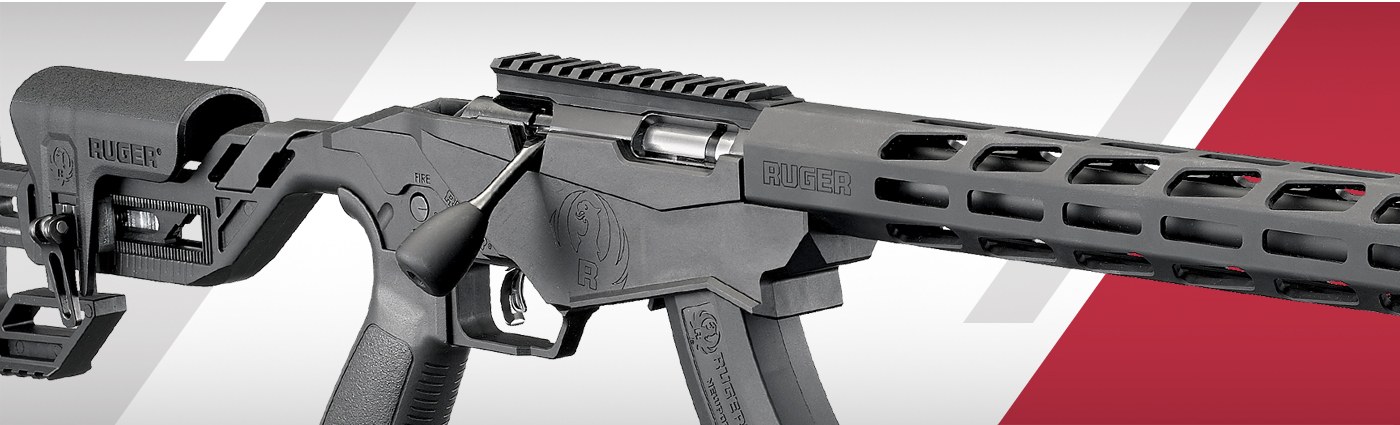
Ruger’s sheet lists the features in one run. Set against the centerfire rifle, they fall into three groups.1
Copied exactly, or nearly.
- The trigger. The Marksman Adjustable, 2.25 to 5 lb, adjusted with the same 5/64-inch key by the same method — a key stored in the rifle, reached from underneath (Volume 4).
- The bolt handle. “Oversized bolt handle for positive bolt manipulation (same as the Ruger Precision Rifle).”
- The grip and safety. “Ruger’s own AR-Pattern pistol grip and safety selector … 45 degree, reversible safety selector.” The thumb works the same lever in the same arc.
- The bolt stroke — if the clip is removed. 3 in, “a short-action centerfire 3” bolt throw”. This is the one feature that exists only to make the rimfire behave like the other rifle.
- The handguard. A 15-inch M-LOK tube, as on the centerfire rifle from model 18028 onward, so a bipod, a barricade stop or a rail section moves from one rifle to the other.
Copied in principle, different in detail.
- The stock. Adjustable for length of pull, comb height and pad height, with a flat Picatinny bag rider underneath and a QD sling pocket — the same controls as the Precision MSR stock — but moulded in one piece with the chassis from “glass-filled nylon”, and adjusted in 1/16-inch increments rather than the MSR stock’s 1/4 in.12
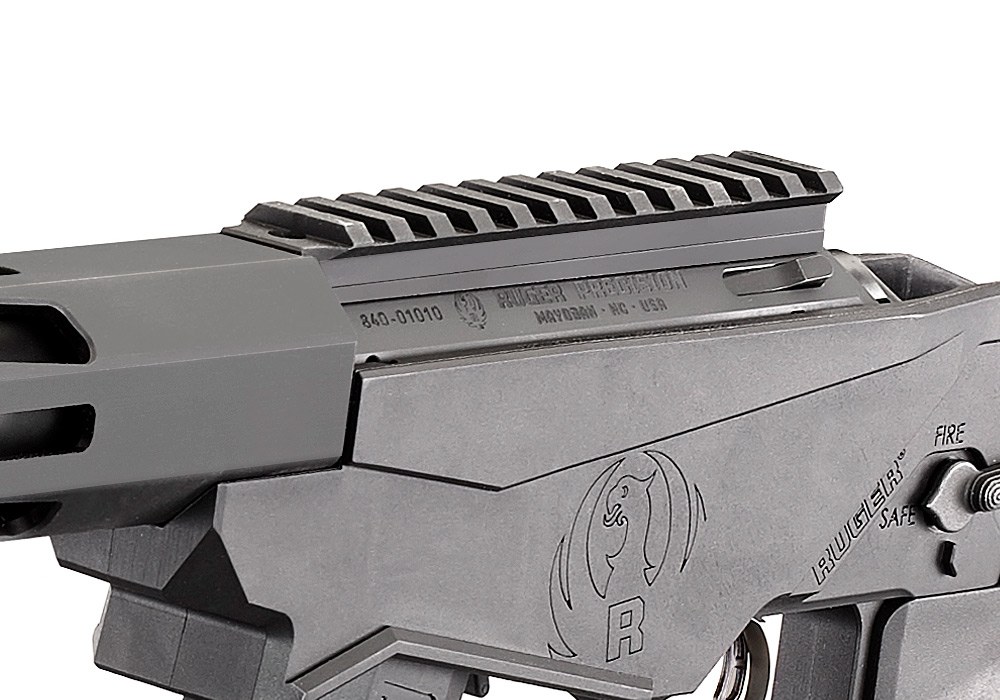
- The scope rail. Picatinny, but canted 30 MOA against the centerfire rifle’s 20. A .22 LR falls about 21 MOA by 200 yards, and the extra cant supplies part of that before a turret is turned (see below).
- The magazine. Detachable and released by a lever behind the magazine, but a 10/22 rotary or BX-pattern box, not an SR-25 or AICS magazine.
Not copied.
- Weight and balance. 6.8 lb bare against 9.7 to 11.5 lb for the centerfire rifle.134 Positional shooting off a barricade feels different with a rifle that weighs two-thirds as much, and no clip changes that.
- Recoil. The whole reason the rimfire is cheap and quiet is also the reason it cannot train recoil management or the recovery of the sight picture after the shot.
- The bedding. The rimfire’s barreled action is held in its chassis by two bedding screws at 35 in-lb, and Ruger forbids altering the chassis bedding (Volume 4). The centerfire rifle has no bedding at all.
5.2 Magazines, and the 10/22 Connection
The rifle “Accepts all 10/22® magazines” and ships with one 15-round BX-15.1 Ruger’s manual lists the three it approves for .22 LR — the 10-round rotary BX-1, the 15-round BX-15 and the 25-round BX-25 — and warns that the .22 WMR and .17 HMR magazines (JMX-1 and BX-15 Magnum) look similar but are “dimensionally different” and must never hold .22 LR.5
For the owner of a 10/22, the practical consequence is that the magazines are already on the shelf. Why the rotary magazine feeds as reliably as it does, and how its rotor and feed lips present each round, is in the Ruger 10/22 dive, which also covers aftermarket magazines in its aftermarket volume and magazine care in its upkeep volume. A bolt action does not ask a magazine to do anything a semi-automatic 10/22 does not; the difference is only that the rimfire bolt’s stroke strips each round deliberately rather than at blowback speed.
Two match-rule points bear on magazine choice. NRL22’s rules have strongly encouraged removable magazines since its first season, and PRS Rimfire’s 2026 rules say the same: “rifles with removable magazines are recommended and encouraged”.67 Neither caps capacity. A stage that calls for more rounds than one magazine holds is the case for the 25-round BX-25 — or for practising the reload.
5.3 The Bolt Throw: When the Clip Should Come Off
Ruger ships the rifle with the clip in, giving the 1½-inch rimfire throw, and describes the 3-inch setting as “reducing the chance of short-stroking your bolt in competition”.18 The two settings answer different questions.
- Clip out (3 in) — for an owner who also shoots a short-action centerfire rifle in matches, and wants the rimfire to train the stroke that rifle needs. On a Precision Rifle in .308 the bolt must travel far enough to clear a 2.8-inch cartridge; a hand that has learnt the rimfire’s 1½ inches will stop short. That is the short-stroke Ruger’s sheet refers to.
- Clip in (1½ in) — for rimfire matches shot for their own sake. The shorter stroke is faster, and a rimfire-only shooter has nothing to transfer.
Nothing in Ruger’s documents suggests the long throw affects feeding, extraction or accuracy, and the clip goes back on in a minute (Volume 4). What the rifle documented in Volume 7 has fitted is not recorded.
5.4 The Leagues
5.4.1 NRL22
The Precision Rimfire arrived three months into NRL22’s first national season. The league was set up by the National Rifle League “to provide a way for shooters that are looking to get into the sport of precision rifle shooting the opportunity to do so without having to invest a lot of money in gear and travel”, on the premise, in its first rules, that “most localities are not fortunate enough to have a 1000 yard range. However, nearly all localities have access to 100 yard ranges and most shooters own a 22 rifle.”96
Its format, from the 2017/2018 rules:6
- a monthly national course of fire, released a week ahead, “a total of 5 stages, 100 yards or less and different every month”, shot by clubs across the country and scored nationally;
- two prone stages, a barricade stage, a positional stage and one of any kind, one of them on paper; steel at 10 points a hit;
- a standard target package of AR500 circles from 1/4 inch to 6 inches, and a standard barricade list anyone can assemble — a six-foot ladder, buckets, cinder blocks, a folding chair and a used pickup-truck tyre;
- stages started “with magazine in and bolt to the rear”, and movement only with the action open;
- .22 LR only: “At these ranges it also most closly mimics centerfire cartridges at Precision Rifle. 17 HMR, 22 Magnum and like rimfires cartridges are not allowed.”
The equipment classes are where the Precision Rimfire’s position changed.
Table 1 — NRL22
| Rules | Base class limit | Precision Rimfire (.22 LR) |
|---|---|---|
| 2017/2018 | rifle MSRP $350 or less; scope MSRP $700 or less; no aftermarket barrel or trigger, “No modification of any kind may be made to the factory trigger or action” | $529 MSRP (March 2018) — over the cap: Open class |
| ”NRL22 Rules 2024” | rifle and scope, combined MSRP $1,300 or less on the maker’s website; aftermarket triggers, bolt releases, magazines, bipods and suppressors treated as accessories and excluded; rifle must stay in its factory stock | $629 MSRP (2026) — leaves $671 for the scope |
Sources: NRL22 rules as captured by the Internet Archive.610
The first season’s approved Base list named the 10/22 but no bolt-action rifle priced like the Precision Rimfire. By the rules published for 2024 the cap had become a combined rifle-and-scope figure that a Precision Rimfire with a mid-priced scope sits well inside. The current season’s rulebook could not be read — NRL22’s site refused connections when this dive was researched — so the 2024 rules are the latest given here.
5.4.2 PRS Rimfire
The Precision Rifle Series runs its own rimfire series under a separate rulebook. The 2026 edition, dated 19 December 2025, sets:7
- Divisions: Open, Production, Semi-Auto and Airgun.
- Open: .22 LR only, and — a rule that directly shapes ammunition choice — “Commercially available standard velocity .22LR ammunition only.”
- Production: rifle and optic “together shall not exceed a combined MSRP of $1820 USD”, set at the manufacturer’s MSRP on 1 September of the preceding year. (The 2025 figure was $1,632, on a schedule of 2% annual rises from $1,600 in 2024; the committee replaced the schedule with the new figure by a vote of 38 to 5.)
- Distances, new for 2026: “The minimum distance is 25 yards, and the maximum distance is 250 yards. Targets over 200 yards should be no smaller than 3 MOA”; qualifiers, regional finales and nationals are capped at 225 yards. The 2025 rule had been “no minimum or maximum target distances or sizes”.
A Precision Rimfire at $629 with a scope at any price up to $1,191 falls inside the 2026 Production limit. The standard-velocity rule is worth noting separately, because it removes the whole high-velocity class of .22 LR from Open-division competition regardless of how a given lot shoots.
5.5 .22 LR at Distance, in Angular Terms
The .22 Rimfire dive’s external-ballistics volume gives the numbers; what matters here is how they compare with the centerfire rifle the rimfire is meant to prepare for. Putting both into minutes of angle, from figures already published on this site:
Table 2 — The [.22 Rimfire](/ammo-and-ballistics/22-rimfire/vol-5/) dive's external-ballistics volume gives the numbers; what matters here is how they compare with the centerfire rifle the rimfire is meant to prepare for. Putting both into minutes of angle, from figures already published on this site
| Distance | 10 mph full-value drift | In MOA | |
|---|---|---|---|
| .22 LR (aggregate table) | 100 yd | 5.4 in | ≈ 5.2 |
| .22 LR (aggregate table) | 200 yd | 18.9 in | ≈ 9.0 |
| .22 LR (aggregate table) | 300 yd | 39.2 in | ≈ 12.5 |
| .308, 175 gr | 300 yd | 7.3 in | ≈ 2.3 |
| .308, 175 gr | 500 yd | 21.3 in | ≈ 4.1 |
| .308, 175 gr | 1,000 yd | ≈ 100 in | ≈ 9.5 |
Drift figures from the .22 Rimfire dive, Volume 5, and the Ballistics Overview dive, Volume 7; conversion at 1.047 in per MOA per 100 yd. Both sources describe their figures as approximate and load-dependent, and they come from different published tables.
Read as angles, a .22 LR at 200 yards needs roughly the same wind hold as a .308 at 1,000, and at 100 yards more than a .308 needs at 500. That is the strongest version of the trainer argument, and it is the one NRL22’s founders made in words when they wrote that at 100 yards the .22 LR “most closly mimics centerfire cartridges at Precision Rifle”. The drop is similar in kind: a high-velocity .22 LR falls 44 in, about 21 MOA, at 200 yards from a 50-yard zero — the elevation a .308 needs somewhere well past 600.11
Two limits keep the argument honest.
- The wind is not the same wind. A 1,000-yard .308 shot crosses a kilometre of terrain with changing wind along it; a 200-yard .22 shot crosses a short stretch. The rimfire trains the reading of a value and the holding of a correction; it does not train reading a wind that changes along the bullet’s path.
- The .22 disperses more. Ammunition matters far more at the rimfire’s distances than rifle features do, which is the argument of the .22 Rimfire dive’s match-ammunition volume: the lot number is the product, and the Precision Rimfire is the rifle in this collection best able to show the difference between lots. Whether transonic behaviour is part of why subsonic match ammunition outshoots high-velocity ammunition at 100 yards is presented, and deliberately left open, in that dive’s Volume 5.
5.5.1 Why the 30 MOA base
A scope’s elevation travel is finite. The 1:16 barrel and a standard-velocity load mean a large angle between the bore and the line of sight at 200 yards, and a 30 MOA base tilts the scope to supply part of that angle before any turret is turned. Ruger’s own phrase is that it provides “increased long-range capabilities out of the box”.1 Volume 7 works the arithmetic for the particular scope the owner’s record lists.
5.6 The Suppressor
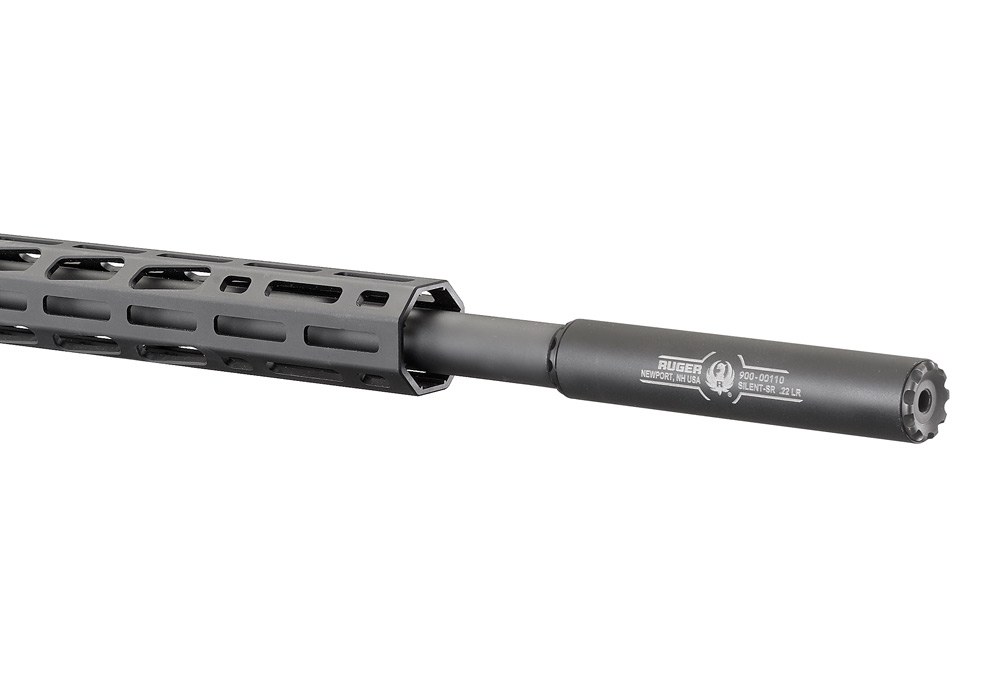
The barrel is threaded 1/2-28 and ships with a protector that covers “both the threads and crown”; Ruger’s 2018 sheet named its own Silent-SR suppressor as an example of what it takes.12 What a suppressor does to a .22 LR — its noise, its fouling, the case for standard-velocity and subsonic ammunition behind it, and the point-of-impact shift — is covered in the .22 Rimfire dive’s suppressor volume and in Suppressors by Caliber, Volume 3, which uses a Mack Brothers Lima moving between several .22s as its worked example. That volume’s suggestion that the Precision Rimfire is one of the two rifles in such a battery most deserving of a can that stays on it, with a zero that therefore stays fixed, applies to the rifle documented here.
5.7 An Assessment
On Ruger’s own terms — “the big-gun experience” — the rifle delivers most of what a rimfire can. The controls a shooter touches under time pressure are the centerfire rifle’s controls: the bolt knob, the trigger, the selector, the handguard, the cheek piece and, with one clip removed, the stroke. The distances at which a .22 LR demands centerfire-like corrections are the distances the leagues shoot. And it does this at a price that, by 2024, fitted both leagues’ budget divisions with a scope.
What it cannot deliver is weight, recoil and a real long-range wind. An owner who treats it as a way to build the procedures of precision shooting — positions, dope, holds, reloads, stage planning — and treats the centerfire rifle as the place to learn recoil and distance, is using it as it was designed.
Footnotes
-
Ruger specification sheet, model 8400. https://ruger.com/products/precisionRimfire/specSheets/8400.html (read 2026-09-19). ↩ ↩2 ↩3 ↩4 ↩5 ↩6
-
Ruger, PM697, “Stock Adjustment,” pp. 25–29. ↩
-
Ruger specification sheet, model 18001, captured 13 January 2016. https://web.archive.org/web/20160113233641/https://ruger.com/products/precisionRifle/specSheets/18001.html ↩
-
Ruger specification sheet, model 18104. https://ruger.com/products/precisionRifle/specSheets/18104.html (read 2026-09-19). ↩
-
Ruger, Instruction Manual for Ruger Precision Rimfire, PM697 (“PRR 4/2026 R10”), “Magazines,” p. 15. https://ruger.com/dataProcess/manual/fetch.php/ms/8400/manual_8400.pdf ↩
-
NRL22, “2017 / 2018 National Rifle League’s Rules and Regulations,” captured 1 September 2017. https://web.archive.org/web/20170901115958/http://nrl22.org:80/about/rules/ ↩ ↩2 ↩3 ↩4
-
Precision Rifle Series, PRS Rimfire Rules, 2026 edition with changes “as of 19 December 2025,” rules 2.1–2.2.1 and 5.2.6. https://prs-website-uploads.s3.amazonaws.com/public/prs_rules_rimfire.pdf (read 2026-09-19). ↩ ↩2
-
Ruger, PM697, “To Adjust Bolt Throw,” p. 32. ↩
-
NRL22, “About,” captured 20 July 2017. https://web.archive.org/web/20170720043447/http://nrl22.org:80/about/ ↩
-
NRL22, “NRL22 Rules 2024,” captured 19 April 2023. https://web.archive.org/web/20230419163355/https://nrl22.org/about/nrl22-rules-2024/ (nrl22.org refused connections on 2026-09-19). ↩
-
.22 Rimfire, Volume 5, “Trajectory” (CCI Mini-Mag 36 gr at 1,260 fps, −44.1 in at 200 yd from a 50-yd zero), on this site. ↩
-
Ruger specification sheet, model 8400, captured 5 March 2018. https://web.archive.org/web/20180305005438/https://ruger.com/products/precisionRimfire/specSheets/8400.html ↩
Comments (0)