Ruger Precision Rifle & Precision Rimfire · Volume 1
Origins — a $1,399 Rifle, a Points Series, and the Market Between Them
The Ruger Precision Rifle from its 2014 patent filings to the current model, and the rimfire trainer that followed it
The Ruger Precision Rifle is a factory bolt-action rifle built around the parts vocabulary of the AR-15: an AR-pattern pistol grip, an AR-style buffer tube carrying the stock, AR-pattern handguard interfaces and a barrel held by a nut. It went on sale in July 2015 at a manufacturer’s suggested retail price of $1,399, in a market where a rifle with its feature list — an adjustable folding stock, a canted rail, a free-floated barrel, an externally adjustable trigger and a detachable box magazine that takes two different magazine families — was ordinarily a chassis build costing a good deal more. Its maker described the competitive position in one sentence on an investor call three weeks after the first rifles shipped: “they have no comparable product.”1
The Ruger Precision Rimfire followed at the end of 2017. It is not a scaled-down Precision Rifle. It is a separate rimfire bolt action made in a different factory, dressed in the same controls — the same bolt handle, the same trigger family, an AR-style grip and selector — and given a bolt whose throw can be lengthened to match a short-action centerfire’s. Its purpose, in Ruger’s own phrase, is “bringing the big-gun experience to the rimfire world.”2
These seven volumes document both rifles. They are written about the pattern — what the rifles are, how they changed, how they work and how they are kept working — and, in the last volume, about two particular rifles owned by the collection this site documents: one Precision Rifle in .308 Winchester and one Precision Rimfire in .22 LR. Where the owner’s record of those two rifles is blank, the volumes say so and do not fill the gap.
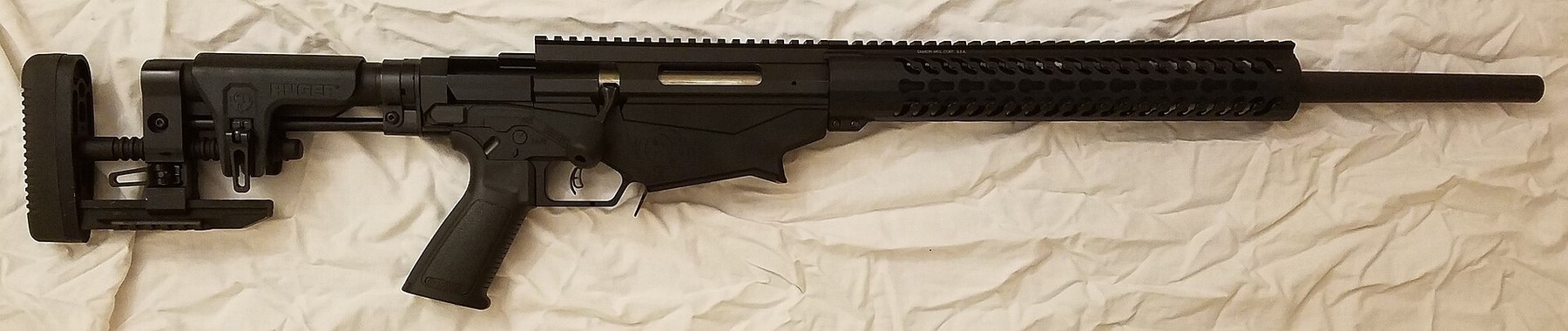
1.1 What It Is, in One Table
Figures are Ruger’s, from its specification sheets. The .308 row gives the launch model and the current model because they differ materially; Volume 2 walks the generations between them.
Table 1 — What It Is, in One Table
| Precision Rifle, .308 (launch, model 18001) | Precision Rifle, .308 (current, model 18104) | Precision Rimfire, .22 LR (model 8400) | |
|---|---|---|---|
| Introduced | July 2015 (first shipments)3 | on sale 2026 | December 20174 |
| Made in | Newport, New Hampshire5 | — | North Carolina4 |
| Action | Bolt action, three-lug bolt, 70° throw | same | Bolt action, rimfire; throw adjustable 1½ in or 3 in |
| Barrel | 20 in, cold hammer-forged 4140, 5R, 1:10 RH, medium contour (.75 in at muzzle) | 20 in, cold hammer-forged, 5R, 1:10 RH, heavy contour (.850 in at muzzle) | 18 in, cold hammer-forged 1137, 1:16 RH, 6 grooves |
| Muzzle | 5/8-24 thread, thread protector | 5/8-24, Ruger Precision Rifle muzzle brake | 1/2-28, thread protector over threads and crown |
| Trigger | Ruger Marksman Adjustable, 2.25–5.0 lb | same | same family, 2.25–5 lb |
| Magazine | Two 10-round Magpul PMAGs; AICS-pattern also accepted | same | One BX-15; “Accepts all 10/22 magazines” |
| Stock | Ruger Precision MSR, left-folding on a buffer tube | folding, adjustable LOP, cheek height and position, buttpad height | one-piece glass-filled nylon chassis and stock, adjustable |
| Rail | 20 MOA Picatinny | 20 MOA Picatinny | 30 MOA Picatinny |
| Weight | 9.7 lb | 11.5 lb | 6.8 lb |
| Suggested retail | $1,399 | $2,209 | $529 (2018); $629 (2026) |
Sources: Ruger specification sheets 18001 (archived January 2016), 18104 and 8400 (current, read 19 September 2026), 8400 (archived March 2018).678
1.2 A Rifle Filed Before It Was Announced
The Precision Rifle’s design work shows up in the patent record more than a year before the rifle did. Ruger’s own patent-marking page lists fifteen United States patents against the rifle, twelve of them utility patents.9 Their front pages give a timeline that no press release does:
Table 2 — The Precision Rifle's design work shows up in the patent record more than a year before the rifle did. Ruger's own patent-marking page lists fifteen United States patents against the rifle, twelve of them utility patents.[^patents] Their front pages give a timeline that no press release does
| Filed | Patent | Subject |
|---|---|---|
| 5 May 2014 | US 9,194,637 | ”Universal magazine latch mechanism for firearm” |
| 28 Oct 2014 (provisional) | US 9,506,712 | ”Firearm with tubular handguard mounting system” |
| 28 Oct 2014 (provisional) | US 9,546,845 | ”Firearm with folding buttstock” |
| 26 Dec 2014 (provisional) | US 9,441,897 | ”Safety mechanism for firearm” |
| 13 Jan 2015 (provisional) | US 9,464,863 | ”Adjustable buttstock for firearm” |
| 21 Jan 2015 (provisional) | US 10,030,926 | ”Trigger housing mounting system for firearm” |
| 25 Feb 2016 | US 9,885,528 | ”Bolt for bolt action rifles” (continued as 10,458,731 and 11,105,570) |
| 27 Oct 2017 (provisional) | US 10,788,287 | ”Adjustable stock for firearm” — the later stock |
One name runs through almost all of them. Jonathan Philip Mather of Grafton, New Hampshire, is the sole or a joint inventor on every one of the utility patents except a magazine patent credited to James B. Higley; Ruger’s 2016 web page for the rifle quoted him as “Lead Engineer on the Ruger Precision Rifle.”10 The magazine-latch application, filed in May 2014, is the earliest. That fits what the rifle is: before anything else, a way of accepting the two magazine families that precision shooters already owned.
The bolt patent is also listed by Ruger against the Ruger American Rifle, and the Scout Rifle shares the magazine patent. The Precision Rifle was not a clean sheet in every part, and the patent page is the plainest evidence of where it borrowed.
1.3 July 2015
Ruger’s second-quarter results release of 28 July 2015 carried the first public mention of sales: “The recently introduced Ruger Precision Rifle did not begin to ship until July, and therefore did not impact the second quarter’s results.”3 By the third-quarter call, the company was calling it “our major new product launch in the third quarter”, and its chief executive told analysts it was made in Newport, New Hampshire, and vertically integrated — “the vast majority of the parts are made in house and not outsourced to vendors.”5
The first catalogue listed three calibres — .308 Winchester, 6.5 Creedmoor and .243 Winchester — all at $1,399.106 The .308 rifle, model 18001, was a leaner thing than the rifle sold today:
- a 20-inch medium-contour barrel, .75 in at the muzzle, “cold hammer-forged 4140 chrome-moly steel … with 5R Rifling at minimum bore and groove dimensions, minimum headspace and centralized chamber”;
- no muzzle brake — “an installed thread protector with 5/8”-24 threads”;
- a Samson Evolution KeyMod handguard, with the note that the rifle “may be configured with any AR-style handguard”;
- the Ruger Precision MSR stock, whose “left-folding stock hinge is attached to an AR-style buffer tube and accepts any AR-style stock”;
- a 20 MOA Picatinny rail held by four 8-40 screws, the Marksman Adjustable trigger at 2.25 to 5.0 lb, and two ten-round Magpul PMAGs;
- 9.7 lb without optic.6
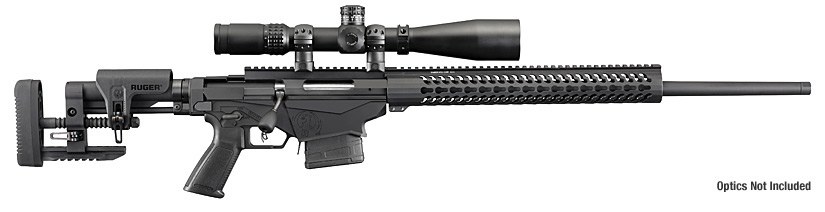
The sheet also carries a small internal inconsistency worth recording because it has been copied since: it lists “5R Rifling” and, two lines away, “Grooves 6”. 5R rifling is a five-groove form by definition. Every later .308 sheet says five.
1.4 What $1,399 Bought
The argument the rifle made was not that it was the most accurate rifle available. It was that the feature set of a competition rifle could be had from a factory, at a price close to that of a good hunting rifle, in a form that took the parts the buyer already understood.
Three things carried that argument.
The interfaces were the AR’s. A Precision Rifle owner could change the grip, the stock and, at launch, the handguard, using the enormous AR-15 parts market — the stock hinge sat on an AR buffer tube, the grip was an AR grip, the selector was AR-pattern. Ruger’s chief executive made the point himself on the July 2015 call: the rifle “can accept so many mill spec standard AR or M4 type products whether it is a butt stock, a grip, heat shield, whatever”.1 For a first-time precision shooter this lowered the cost of fitting the rifle to the body; for an experienced one it meant the stock and grip could be changed without a gunsmith.
The recoil path did not depend on bedding. Ruger’s description, repeated in every manual since 2015, is that the rifle is “designed to produce a direct recoil path through the upper receiver into the butt stock, without the use of traditional bedding.”11 A conventional stocked bolt rifle’s accuracy depends on how its action sits in its stock; the Precision Rifle’s steel receiver bears straight back into its stock hardware, and the barrel floats inside an aluminium tube carried by the barrel nut. Volume 2 takes the architecture apart.
The barrel could be changed. Ruger’s launch sheet said that “Barrels can be easily replaced by a competent gunsmith using AR-style wrenches and headspace gauges.”6 That was an unusual thing for a maker to print about a factory bolt rifle. It is also, as Volume 4 shows, contradicted by Ruger’s own manual — the sharpest disagreement in the rifle’s documentation, and one this dive quotes on both sides rather than resolving.
What the rifle was praised for in its first year is on the record largely through Ruger’s own selection of it. The company’s 2016 overview page quoted reviewers, among them a field editor who asked, “What other $1,200 factory rifle can be counted on to shoot half-MOA five-shot groups?”10 The $1,200 is a street price, not the $1,399 suggested retail; and the half-minute claim is the reviewer’s, reproduced by the maker, not a guarantee. Ruger itself printed no accuracy guarantee for the rifle in any document found.
Demand outran supply. On the 2017 year-end call the company’s chief executive, asked about products on allocation, answered with “some frustration out there like we saw with the Ruger Precision Rifle, that people are chasing that and trying to find available product.”4 In 2016 Ruger also ran a public “Ruger Precision Rifle Challenge”, with leaderboards from a three-shot group at 100 yards out to a first-round hit at 1,600 yards, under a letter from the chief executive that opened “1,600 yards. Enough said.”12
1.5 The Market It Met
The rifle arrived four years into the life of the competition that gave “precision rifle” its current meaning. The Precision Rifle Series describes itself as launched in 2011; its 2012 site ran a points race counting a shooter’s best three events toward a season finale.1314 (The sibling Types of Scopes dive dates PRS to 2012, the first season; PRS’s own page says 2011.)
What matters here is not the founding date but the equipment divisions. PRS membership pages captured in November 2015 — during the Precision Rifle’s first months on sale — show three divisions for the 2016 season:15
- Open: calibre up to .30 and velocity up to 3,200 fps;
- Tactical: “.308 Winchester and 5.56 NATO/.223 Remington calibers only”;
- Production: “meant to provide anyone an opportunity to shoot in a PRS event that wishes to do so that would otherwise not compete due to lack of equipment … rifles are not permitted to be altered or improved in any way from the original factory configuration … combined rifle and scope MSRP as listed on the company’s website shall not exceed $3,000 USD, the rifle shall not exceed $2,000 USD and the optic not exceed $2,000 USD.”
A $1,399 factory rifle, or a $1,599 one after the 2016 changes, sat comfortably inside a $2,000 rifle cap and left $1,400 to $1,600 of the combined cap for an optic. No document found says Ruger designed the rifle to that rule, and the patent filings predate the division pages. What can be said is that the rifle and the division arrived together, and that the .308 rifle also qualified for Tactical by calibre alone. Whether the Precision Rifle appeared on the Production Division’s approved-rifle appendix (Appendix A-4 of the 2016 rules) was not checked; the appendix was not obtained.
Volume 6 carries the divisions forward to the 2026 rulebook, where the caps and the calibre rules have both moved.
1.6 How the Rifle Changed
Owners speak of Gen 1, Gen 2 and Gen 3 rifles. Those are community labels. None of Ruger’s specification sheets uses them, and no Ruger document found defines them. The only generation label on Ruger’s side is incidental: the feature images on the current product page are named g4-barrel.jpg, g4-trigger.jpg and so on.16 This dive therefore describes the rifle’s history by what Ruger’s specification sheets say, sheet by sheet, and dates each sheet by the Internet Archive capture it was read from.
Table 3 — How the Rifle Changed
| Model (.308) | Sheet read from | What the sheet adds or changes | MSRP | Weight |
|---|---|---|---|---|
| 18001 | capture 13 Jan 2016 | Launch: KeyMod handguard, thread protector, Precision MSR stock, left-side selector | $1,399 | 9.7 lb |
| 18004 | capture 9 May 2016 | Hybrid muzzle brake (thread protector included); Ruger Precision Rifle Short-Action handguard “for improved scope clearance”; billet aluminium bolt shroud | $1,599 | 9.8 lb |
| 18028 | capture 17 Jul 2019 | 15-inch free-float handguard, M-LOK on all four sides; ambidextrous manual safety; nitrided bolt body; the magazine interface now “Patented” | $1,599 | 9.8 lb |
| 18024 / 18045 | capture 17 Jul 2019 | Distributor-finish variants of 18028 (camouflage; Barrett Brown Cerakote) | — | 9.8 lb |
| 18104 | current, 19 Sep 2026 | Heavy-contour barrel, .850 in; new folding buttstock adjustable for pull, cheek height and position and buttpad height; Magpul MOE-K2-XL grip; DLC-coated bolt body; Smoked Bronze Cerakote | $2,209 | 11.5 lb |
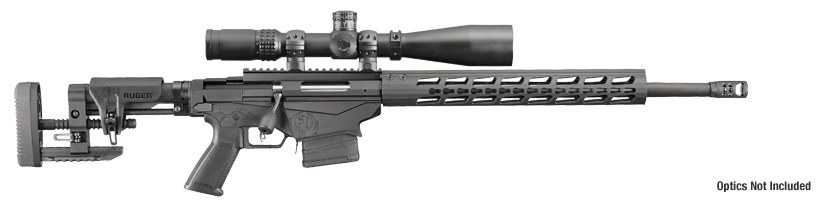
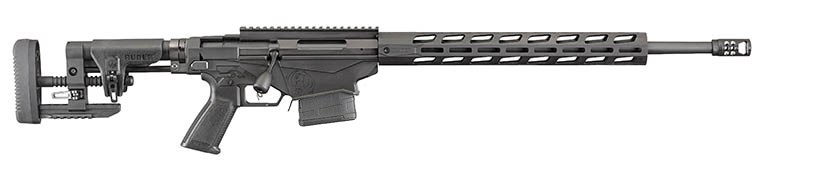
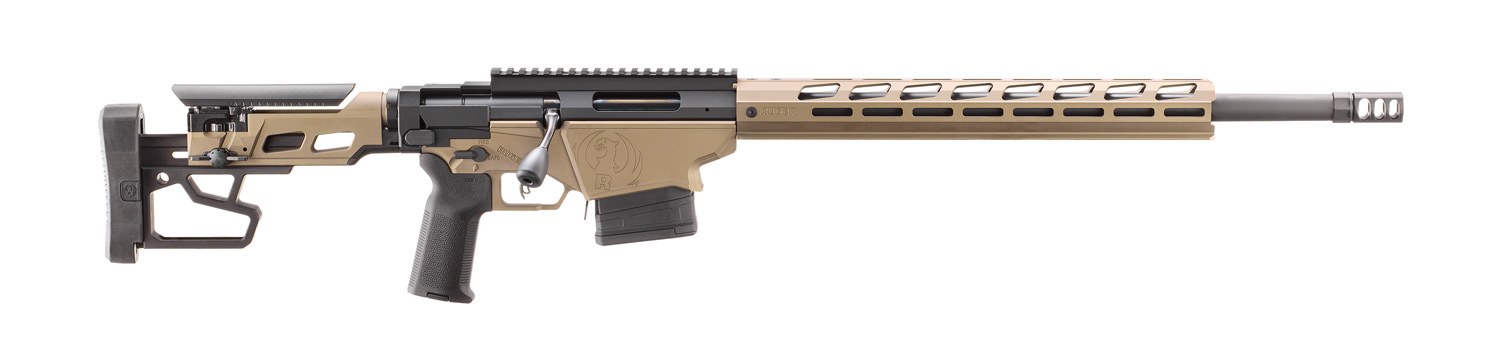
Three trends run through the table. The rifle got heavier, 9.7 lb to 11.5, most of it in the heavier barrel and stock. It got dearer, $1,399 to $2,209 — by 2026 above the old $2,000 Production cap, though inside the current one (Volume 6). And it grew a muzzle brake as standard after the first year, which matters to anyone reading an older rifle’s history: a launch-pattern .308 left the factory with a thread protector, not a brake.
The calibre list grew alongside. The recovered sheets show .243 Winchester (26 in, 1:7.7) and 6.5 Creedmoor (24 in, 1:8) at launch; 6mm Creedmoor by late 2016; 5.56 NATO/.223 Remington (20 in, 1:7) by 2017; 6.5 PRC (26 in, 1:8) by 2019; the magnum long-action rifles — .338 Lapua Magnum, .300 Winchester Magnum and .300 PRC, at 15.2 lb and $2,099 — introduced in 2018; and, in the current catalogue, 6mm GT, with four of the 26-inch 6mm and 6.5 Creedmoor rifles fitted with a TriggerTech two-stage trigger in place of the Marksman.1718 Of the ten rifles Ruger lists in September 2026, one is a .308.
Every recovered .308 sheet gives the barrel as 20 inches. No .308 Precision Rifle with any other barrel length appears in any Ruger document found; The owner’s inventory sheet first recorded the rifle documented here as 19 inches; the owner has since confirmed it is 20 (Volume 7).
1.7 December 2017: the Precision Rimfire
Ruger’s year-end 2017 call listed it among the products “introduced” in December 2017 — “the pistol caliber carbine, the Security-9 pistol, the EC9s pistol and the Rimfire Precision Rifle” — and placed its manufacture in the company’s North Carolina plant, where it is built alongside the American Rimfire.4 The first specification sheet the Internet Archive holds, captured in March 2018, prices the .22 LR model 8400 at $529.19 It is $629 today.8
(The common shorthand that the Precision Rimfire “came out in 2018” is close but not what the maker says. It was introduced at the end of 2017 and reached most buyers in 2018.)
The rifle’s case, as Ruger put it on the sheet, is that of a trainer:
- a bolt throw adjustable from a rimfire 1½ in to “a short-action centerfire 3” bolt throw, reducing the chance of short-stroking your bolt in competition”;
- the Ruger Marksman Adjustable trigger, 2.25 to 5 lb;
- an oversized bolt handle “(same as the Ruger Precision Rifle)”;
- an AR-pattern grip and 45° reversible selector;
- a 15-inch M-LOK handguard and a 30 MOA Picatinny base;
- and — the feature that makes it cheap to feed — “Accepts all 10/22 magazines.”19
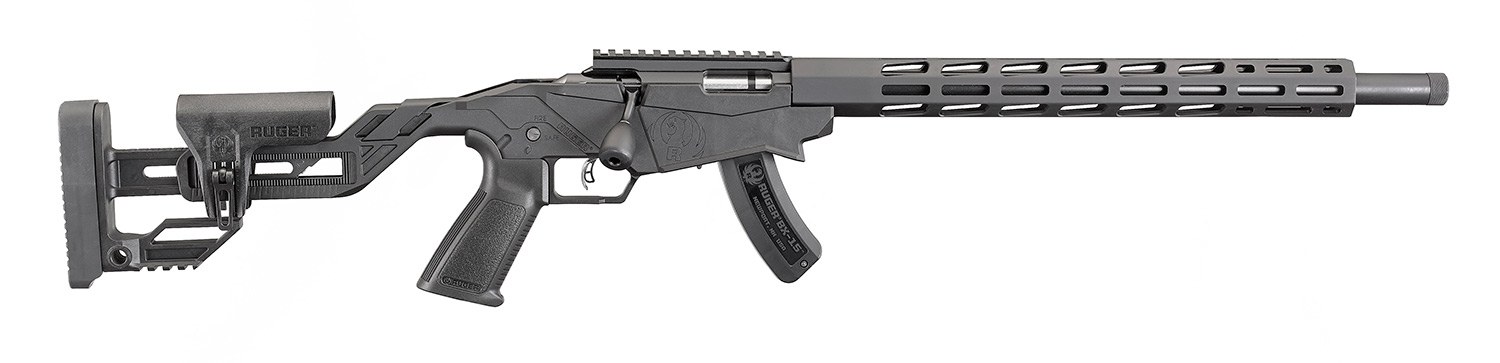
In 2018 Ruger added the rifle in .17 HMR and .22 WMR, with their own magazines, and distributors have since sold coloured Cerakote versions; two archived distributor sheets, 8419 and 8420, even list a 16.10-inch barrel.1820 The standard .22 LR rifles, 8400 (15-round) and 8401 (10-round), remain 18 inches.
Its competitive timing mirrors the centerfire rifle’s. The NRL22 league — a division of the National Rifle League, created “to provide a way for shooters that are looking to get into the sport of precision rifle shooting the opportunity to do so without having to invest a lot of money in gear and travel” — ran its first national season from September 2017, three months before the Precision Rimfire was introduced.2122 Its first Base class capped the rifle at $350 MSRP, which put a $529 Precision Rimfire in the Open class. Later caps moved. Volume 5 takes up the rimfire’s match history and what it asks of the rifle.
1.8 How These Volumes Are Organised
- Volume 2 — the Precision Rifle’s architecture: what each part is and why it is there, generation by generation.
- Volume 3 — how both actions work, with drawings: the bolt, the cocking cams, the trigger and safety, the magazine latch, the Rimfire’s bolt-throw clip.
- Volume 4 — keeping them working: field strip and detail strip from Ruger’s manuals, maintenance, the common failures, the barrel swap, and what an owner fixes against what goes to Ruger.
- Volume 5 — the Precision Rimfire as a trainer: magazines, the 10/22 connection, NRL22 and PRS Rimfire, and .22 LR at distance.
- Volume 6 — the .308 in precision work: the PRS divisions now, what the chambering asks of a loader, and the suppressor question.
- Volume 7 — the two rifles documented here: what the owner’s record says and what it does not, and an honest assessment of a Vortex Crossfire at 4–12× on each.
Footnotes
-
Sturm, Ruger & Co., Form 8-K, Exhibit 99.1, transcript of the second-quarter 2015 conference call, filed 30 July 2015. https://www.sec.gov/Archives/edgar/data/95029/000117494715001287/ex99-1.htm ↩ ↩2
-
Ruger, Ruger Precision Rimfire model page. https://ruger.com/products/precisionRimfire/models.html (read 2026-09-19). ↩
-
Sturm, Ruger & Co., Form 8-K, Exhibit 99.1, second-quarter 2015 results release, 28 July 2015. https://www.sec.gov/Archives/edgar/data/95029/000117494715001264/ex99_1.htm ↩ ↩2
-
Sturm, Ruger & Co., Form 8-K, Exhibit 99.1, fourth-quarter and full-year 2017 call, filed 23 February 2018. https://www.sec.gov/Archives/edgar/data/95029/000117494718000251/ex99-1.htm ↩ ↩2 ↩3 ↩4
-
Sturm, Ruger & Co., Form 8-K, Exhibit 99.1, transcript of the third-quarter 2015 conference call, filed 6 November 2015. https://www.sec.gov/Archives/edgar/data/95029/000117494715001623/ex99-1.htm ↩ ↩2
-
Ruger specification sheet, model 18001, captured 13 January 2016. https://web.archive.org/web/20160113233641/https://ruger.com/products/precisionRifle/specSheets/18001.html ↩ ↩2 ↩3 ↩4
-
Ruger specification sheet, model 18104. https://ruger.com/products/precisionRifle/specSheets/18104.html (read 2026-09-19). ↩
-
Ruger specification sheet, model 8400. https://ruger.com/products/precisionRimfire/specSheets/8400.html (read 2026-09-19). ↩ ↩2
-
Sturm, Ruger & Co., virtual patent marking page. https://ruger.com/patents.html (read 2026-09-19). Front pages of the utility patents read from the USPTO’s PDF service, e.g. https://image-ppubs.uspto.gov/dirsearch-public/print/downloadPdf/9194637 ↩
-
Ruger, “Ruger Precision Rifle — Overview,” captured by the Internet Archive 23 January 2016. https://web.archive.org/web/20160123040710/http://www.ruger.com:80/products/precisionRifle/overview.html ↩ ↩2 ↩3
-
Ruger, Instruction Manual for Ruger Precision Rifle, PM605, © 2015, “General Information and Mechanical Characteristics,” p. 10. The same sentence appears in the 2018 revision and, reworded, in the current manual PM924, p. 11. ↩
-
Ruger, “Ruger Precision Rifle Challenge,” captured 30 August 2016. https://web.archive.org/web/20160830082153/http://www.ruger.com:80/products/precisionRifle/challenge.html ↩
-
Precision Rifle Series, “About the Series” and “Rules,” captured 10 March 2012. https://web.archive.org/web/20120310073435/http://precisionrifleseries.com:80/about ↩
-
Precision Rifle Series, “About the Precision Rifle Series,” captured 16 September 2018: “the growth of the discipline has been exponential since the PRS was launched in 2011”. https://web.archive.org/web/20180916161403/https://www.precisionrifleseries.com/about-the-precision-rifle-series/ ↩
-
Precision Rifle Series, “2016 PRS Membership — Production Division,” ”— Tactical Division” and ”— Open Division,” captured 13 November 2015. https://web.archive.org/web/20151113134905/http://www.precisionrifleseries.com:80/2016-membership/2016-prs-membership-production-division.html ↩
-
Ruger, Ruger Precision Rifle model page. https://ruger.com/products/precisionRifle/models.html (read 2026-09-19). ↩
-
Ruger specification sheets 18004, 18005, 18008, 18010, 18016, 18019, 18024, 18025, 18028, 18029, 18032, 18042, 18044, 18045, 18080, 18081, 18083, 18084 and 18085, as captured by the Internet Archive 2016–2022, located through the Wayback CDX index. Capture URLs are recorded in the dive’s research notes. ↩
-
Sturm, Ruger & Co., Form 8-K, Exhibit 99.1, fourth-quarter and full-year 2018 call, filed 22 February 2019: “new products launched in 2018 included the Ruger Precision Rifle in the Magnum calibers, the Ruger Precision Rimfire in Magnum calibers of 17 HMR and 22 mag.” https://www.sec.gov/Archives/edgar/data/95029/000117494719000249/ex99-1.htm ↩ ↩2
-
Ruger specification sheet, model 8400, captured 5 March 2018. https://web.archive.org/web/20180305005438/https://ruger.com/products/precisionRimfire/specSheets/8400.html ↩ ↩2
-
Ruger specification sheets 8419 and 8420, captured 20 July 2019. https://web.archive.org/web/20190720015419/https://ruger.com/products/precisionRimfire/specSheets/8419.html ↩
-
NRL22, “About,” captured 20 July 2017. https://web.archive.org/web/20170720043447/http://nrl22.org:80/about/ ↩
-
NRL22, “2017 / 2018 National Rifle League’s Rules and Regulations,” captured 1 September 2017. https://web.archive.org/web/20170901115958/http://nrl22.org:80/about/rules/ ↩
Comments (0)