Ruger 10/22 · Volume 6
Accuracy Work — Bedding, Barrel Fit and the V-Block
Where a 10/22's accuracy is lost, what the published record says about getting it back, and a bench method for finding out on a given rifle
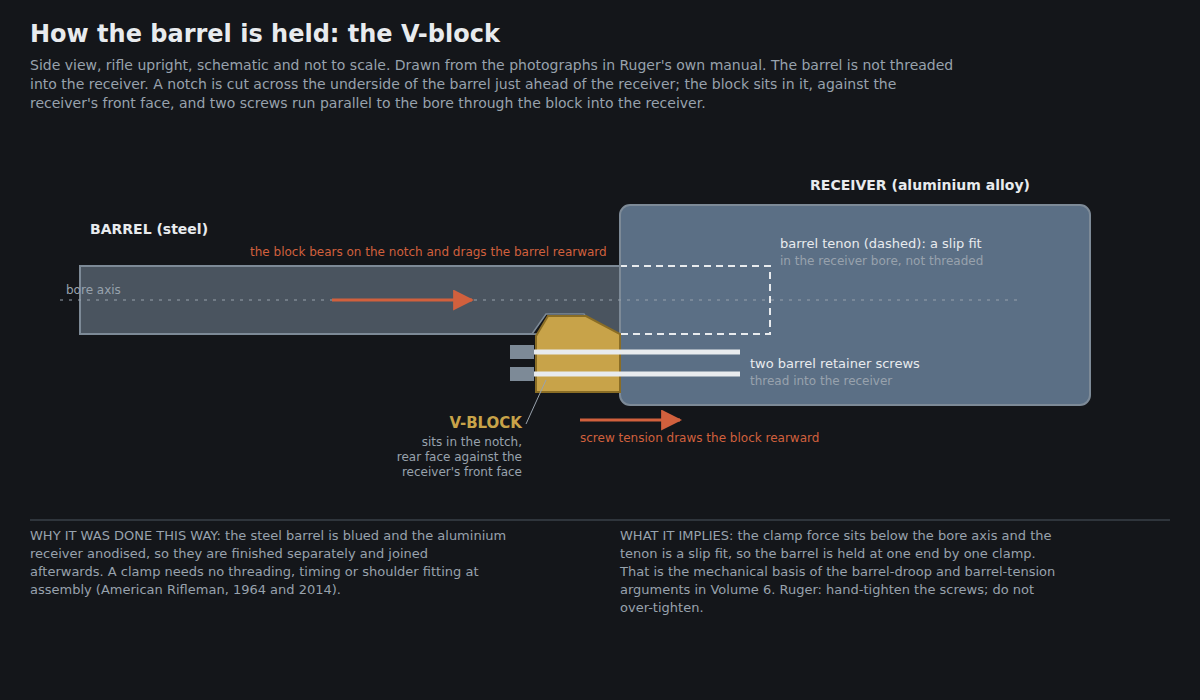
Most 10/22 accuracy advice is a list of parts to buy. This volume is organised the other way round: it starts from the mechanism in Volume 2, identifies where that mechanism can lose repeatability, and then says what the published record actually supports about each. The honest conclusion, stated at the start, is that almost nothing in the 10/22 accuracy literature is a controlled measurement. The makers publish guarantees for their own barrels; nobody publishes a comparison of the same rifle bedded and not bedded, or with the V-block screws at two torques. Section 6.8 sets out how to produce that evidence on a single rifle.
6.1 What the Factory Promised
In 1964 Ruger’s stated accuracy standard, quoted by the NRA’s testers, was “a 10-shot grouping capability not exceeding 4” extreme spread at 100 yds.” — roughly 4 MOA for ten shots.1 Ruger publishes no accuracy standard for current rifles on the specification sheets consulted.
For comparison with an aftermarket barrel: KIDD guarantees its sleeved barrel at “½” at 50 yards (5-shot group).”2 The two are not the same test — ten shots at 100 yards against five at 50 — and should not be converted into each other. They mark the range: a sporting rifle built to a price, and a match barrel built to a guarantee.
6.2 Where Accuracy Goes
On a 10/22 there are five places for dispersion to come from, and they are listed in the order in which they are cheapest to test, not the order in which they are most discussed:
- The ammunition and the lot. Owned by the .22 Rimfire dive; on most rifles it is the largest single variable, and it costs a box of each candidate to find out.
- The optic mount. Loose screws and rings behave like a bad barrel. Ruger’s torque figure for its own scope base screws is 12–15 in-lb, without thread locker (Volume 4 §4.9).3
- The stock contact — the takedown screw, the barrel band on a carbine, and where the stock touches the barrel and receiver (Section 6.4).
- The barrel-to-receiver joint — tenon fit and V-block (Section 6.3).
- The barrel and chamber themselves — the only item on the list that requires buying a part.
Items 1–4 can be investigated with the rifle as it is. That ordering is the basis of Section 6.8.
6.3 The Barrel-to-Receiver Joint
Volume 2 §2.9 described the joint: a slip-fit tenon in the receiver bore, and a V-block drawn rearward against the receiver’s front face by two screws running parallel to the bore, below it. Three facts about that arrangement matter for accuracy.
The alignment is the tenon fit. Nothing else keeps the barrel concentric with the bolt’s path and square to the receiver. KIDD, which makes both barrels and receivers, puts the consequence plainly: “Barrel droop is caused by an insecure or inconsistent tenon/shoulder fit.”2 A loose tenon lets the barrel sit at a slightly different angle each time it is clamped — or each time it is heated.
The clamp acts on one side of the bore. Both screws are below the axis. Tightening them draws the barrel back and, because the force is below the axis, also tends to tip it about the tenon. How much depends on the fit: in a tight tenon, nothing measurable; in a loose one, the screw torque becomes part of the barrel’s pointing angle. This is a mechanical inference from the geometry in Ruger’s manual photographs, not a measured result, and no source was found that measured it.
The screw torque has no factory figure. Ruger says to “hand tighten them until they are securely in place” and warns against over-tightening; it publishes no number.4 KIDD gives one for its own barrels in a properly fitted receiver: “When properly fitted, v-block screws only need to be snug (~10 in-lb).”2 The practical point for accuracy work is not which figure is right but that the same figure is used every time, applied with an inch-pound driver and written down, so that the joint is a controlled variable rather than a random one.
What a gunsmith can do about a loose tenon. The options are to fit a barrel whose tenon matches the receiver bore (aftermarket barrels are sold for exactly this) or a receiver whose bore matches the barrel. KIDD’s receivers and barrels are sold as a system, and KIDD’s receiver instructions warn that a receiver from “another brand” should have “paint/build-up” cleaned from its mortise before a barrel is fitted.2 Shimming, sleeving or epoxy-bedding a loose tenon into its bore are shop methods that circulate widely; none was found described by Ruger or by a maker consulted, and none is recommended here as tested.
6.4 The Stock Contact: Bedding, Free-Floating and Pressure
The 1964 NRA report described how Ruger bedded the rifle: “Receiver is bedded full-length in the stock. There is no recoil lug, but rear face of receiver abuts the stock mortise.”1 On the carbine, the barrel band then clamps the barrel to the forend near the muzzle. Ruger’s disassembly instructions confirm the arrangement: the band comes off first, then the takedown screw is loosened, and the action lifts out.3
That gives a carbine three points of contact that affect the barrel: the receiver’s bed, the takedown screw’s clamp, and the band. A sporter-pattern rifle — the Deluxe Sporter among them — has no band.3 Every one of those points can change with humidity (in wood), temperature (in any material) and how hard the screw is turned.
The three standard approaches, described as what each does to the mechanism rather than as recommendations:
Table 1 — The three standard approaches, described as what each does to the mechanism rather than as recommendations
| Approach | What it does | What it assumes |
|---|---|---|
| Keep the factory contact, make it repeatable | Same takedown-screw torque every time; band tension the same | That the factory contact is consistent enough; costs nothing |
| Free-float the barrel | Remove all forend contact so the barrel is supported only at the receiver | That the tenon joint is stiff enough to carry the barrel alone — which, per Section 6.3, is the joint’s weak point |
| Pressure point or preload | Deliberately press the forend up against the barrel at one place | That a known, constant preload is better than none; Magpul’s takedown stock builds this in (Section 6.6) |
Free-floating is the default in centrefire accuracy work, but the 10/22’s barrel is supported at its rear by a slip fit and a clamp, not a threaded shoulder. That is exactly why the heavy and sleeved barrels in Section 6.5 exist: they are stiff enough to be free-floated from that joint. A pencil-profile sporter barrel free-floated from a loose tenon may be worse off than one held by a forend. No published comparison either way was found; it is a question for the bench.
Bedding the receiver — epoxy-bedding the receiver and the barrel’s first inches into the stock — is a common shop practice for 10/22s. None of the makers or manuals consulted describes it, and no controlled result was found. It is irreversible in a wooden stock, which is a reason to do it last, not first.
6.5 Tensioned and Sleeved Barrels
The aftermarket’s answer to the clamped cantilever is not to make the joint better but to make the barrel stiffer, and in some designs to pre-load it.
- Sleeved barrels. KIDD’s lightweight barrel is a stainless core in a fluted aluminium sleeve, .920 in at the breech end for the first 2 inches.2 The outside diameter of a bull barrel without the weight of solid steel.
- Tensioned barrels. Volquartsen’s carbon-fibre barrel is a stainless barrel inside a woven carbon-fibre tube with an air gap; “the rigidity of the carbon fiber tube allows us to put the barrel in tension, minimizing barrel vibrations typically found on smaller barrel diameters.”5 The idea is that a thin barrel held in tension between the breech and a muzzle fitting inside a stiff outer tube behaves more like a stiff barrel.
- Ruger has adopted the idea. Its 2026 Takedown SBR, model 33001, has a “cold hammer-forged barrel tensioned in aluminum alloy barrel sleeve.”6
The makers’ claims are claims about vibration and stiffness. KIDD guarantees a group figure; Volquartsen publishes none on the page consulted. What they share is a design goal the V-block explains: moving the stiffness from the joint to the barrel.
6.6 The Takedown’s Two Extra Variables
A Takedown adds a second joint and, with the Magpul stock, an adjustable forend.
The barrel joint. Ruger’s claim is a secure, repeatable lock-up that “returns the firearm to zero, even when receiver mounted optics are used.”3 The adjustment knob sets the joint’s preload, and Ruger’s instruction is to set it once and leave it (Volume 3 §3.5). Two details in Ruger’s procedure are accuracy instructions, not assembly ones: the knob should give “some resistance … but it should not be difficult,” and after each assembly the action should be dry-cycled two or three times, slingshotting the bolt, which “will properly ‘seat’ the barrel assembly” for “best fired shot accuracy.”3 Omitting the dry-cycle is an uncontrolled variable.
How well a given rifle actually returns to zero is not published by Ruger or anyone else. The .22 Rimfire dive’s Volume 11 sets out a five-reassembly group test for measuring it; that test is the right one and is not repeated here.
The forend shim. Magpul’s Hunter X-22 Takedown stock has an “adjustable barrel tensioning shim in forend” that “allows barrel preload tension setting or free float if desired.”7 On the Takedown, the forend travels with the barrel (Volume 3 §3.4), so this is a preload applied within the barrel half. It is a controlled version of the third approach in Section 6.4. It is also a variable, and its setting belongs in the rifle’s record alongside the knob position and the screw torques. The standard Hunter X-22 for non-takedown receivers has no such shim listed.8
6.7 The Things That Are Not the Rifle
Ammunition. On a rimfire, the lot is often the largest variable, and the procedure for finding the lot a rifle likes is the .22 Rimfire dive’s subject, not this one’s. It belongs first in any test sequence for the plain reason that the other variables cannot be judged with ammunition that is itself the limit.
The chamber. Factory 10/22s have sporting chambers; aftermarket barrels may be cut to the Bentz pattern or a maker’s own reamer. The accuracy benefit of a tighter chamber is contested in the very sources that document the dimensions, as the .22 Rimfire dive’s Volume 4 sets out. A factory-barrelled rifle — which both rifles in Volume 8 are — keeps its sporting chamber regardless of what bolt or trigger is fitted.
The trigger. A lighter, cleaner trigger does not tighten the rifle’s mechanical dispersion; it reduces what the shooter adds. KIDD’s two-stage argument (Volume 4 §4.7) is about exactly that. It is a real improvement in groups shot from a rest by a person, and no improvement at all in groups shot from a machine rest.
The optic. A second-focal-plane BDC scope at the wrong magnification is a holdover error, not a dispersion error, and the fix for the Nikon BDC150 fitted to both rifles in Volume 8 is worked through in the .22 Rimfire dive’s Volume 11 §11.3.
6.8 A Bench Method
The method follows from Sections 6.2–6.7: change one thing at a time, in the order of cost, and record everything that could be a variable. It is a method, not a claim about any result.
Record the rifle first. Before any change, write down: V-block screw torque (measured by backing off and re-tightening to a set figure), takedown screw torque, band tension (carbine), scope base and ring torques, and on a Takedown the knob position and Magpul shim setting. Most “accuracy upgrades” that later appear not to work were never compared against a known starting point.
Then, in order:
- Ammunition. Several candidate loads, one lot each, same day, same rest, 50 yards, five-shot groups in multiples. Keep the best lot for every later step.
- Mount. Re-torque base and rings to the recorded values; shoot the best lot again. A change here means the mount was the problem.
- Takedown screw. Shoot at two different recorded torques. A difference means stock contact is a variable on this rifle.
- Forend contact. On a Takedown with the Magpul stock, the shim at its two extremes. On a fixed-barrel rifle, the band on and off (carbine), or a temporary free-float by relieving the barrel channel with a shim under the receiver — reversible, and only then decide about permanent changes.
- V-block torque. Two recorded torques within the range the barrel maker allows.
- Only then, barrel, chamber or bedding.
Record the result as data. Group sizes with the ammunition lot, the distance, the temperature and every setting above. The resulting table — one rifle, one variable at a time — is a better answer to “does free-floating help a 10/22” than anything in the published record, because nothing in the published record is that.
6.9 Bibliography
Footnotes
-
NRA Technical Staff, “Ruger Model 10/22 Carbine,” The American Rifleman, September 1964, reprinted 23 October 2014. https://www.americanrifleman.org/articles/2014/10/23/throwback-thursday-ruger-model-1022-carbine-sept-1964-the-american-rifleman/ (accessed 2026-09-19). ↩ ↩2
-
KIDD Innovative Design, KIDD .22LR Lightweight Fluted Aluminum Sleeved Barrel. https://www.kiddinnovativedesign.com/KIDD-22LR-Lightweight-Fluted-Aluminum-Sleeved-Barrel_p_137.html (accessed 2026-09-19). ↩ ↩2 ↩3 ↩4 ↩5
-
Sturm, Ruger & Co., Instruction Manual for Ruger 10/22 Autoloading Rifles, PM058, B 4/2025 R40: model descriptions p. 13; Takedown barrel assembly pp. 16–17; Disassembly p. 28; scope base adapter p. 36. ↩ ↩2 ↩3 ↩4 ↩5
-
Sturm, Ruger & Co., Instruction Manual for Ruger 10/22 Autoloading Rifle, PM1269, 10/22 6/2026 R1, “To Reinstall the Barrel,” p. 34. https://ruger-docs.s3.amazonaws.com/_manuals/Ruger_1022.pdf (accessed 2026-09-19). ↩
-
Volquartsen Firearms, Lightweight Carbon Fiber Barrel for 10/22 Rifles. https://volquartsen.com/inventory_configurations/3785 (accessed 2026-09-19). ↩
-
Sturm, Ruger & Co., 10/22 SBR specification sheet, model 33001. https://ruger.com/products/1022sbr/specSheets/33001.html (accessed 2026-09-19). ↩
-
Magpul Industries, Hunter X-22 Takedown Stock – Ruger 10/22 Takedown, MAG760. https://magpul.com/hunterx-22takedownstock-ruger10-22takedown.html (accessed 2026-09-19). ↩
-
Magpul Industries, Hunter X-22 Stock – Ruger 10/22, MAG548. https://magpul.com/hunterx-22stock-ruger10-22.html (accessed 2026-09-19). ↩
Comments (0)