Ruger 10/22 · Volume 3
The Variants — Carbine, Deluxe Sporter, International, Target, Takedown and the Rest
What Ruger's own manuals say distinguishes each model, and how the Takedown returns to zero
3.1 One Action, Many Rifles
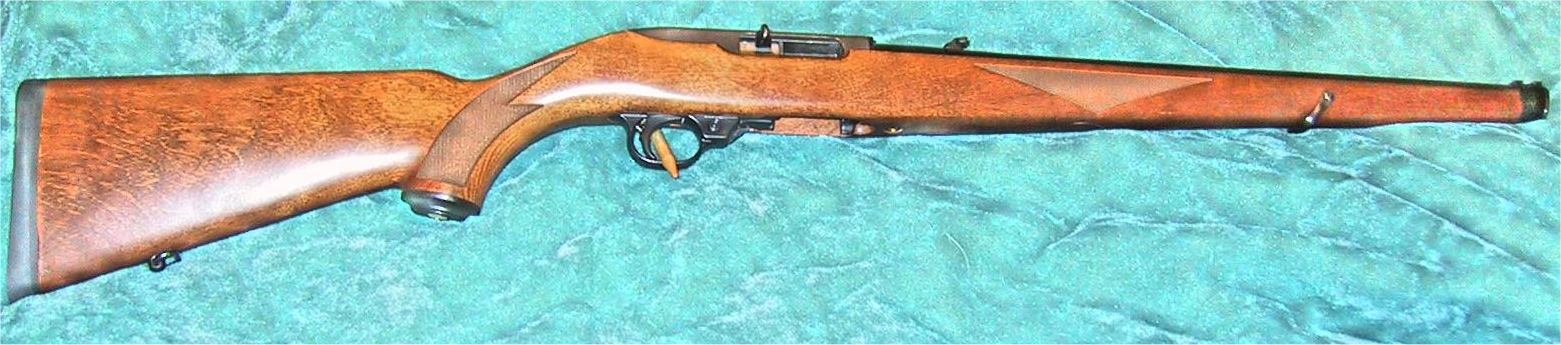
Ruger has sold the 10/22 in dozens of catalogue numbers and a great many distributor exclusives, and the temptation is to treat them as different rifles. Mechanically they almost all are not. Every .22 LR model described in this volume uses the same receiver pattern, the same bolt and trigger-housing layout, the same V-block barrel attachment and the same rotary magazine. What changes is:
- the stock — birch, walnut, laminate, synthetic, Magpul polymer, full-length Mannlicher, or a takedown two-piece;
- the barrel — length, contour (pencil, heavy, sleeved, fluted), finish (blued, stainless), and threading;
- the sights and mounting — open sights, peep sights, scope base adapter, integral rail;
- the trigger — the original, a target trigger, or the BX-Trigger;
- the bolt lock — the original press-to-release, or the 2025 “match-type” (Volume 2 §2.8).
The two exceptions are the Takedown, whose barrel joint is genuinely different (Sections 3.4–3.5), and the magnum-calibre rifles, which are a different rifle under the name (Section 3.6).
3.2 The Classic Line, in Ruger’s Words
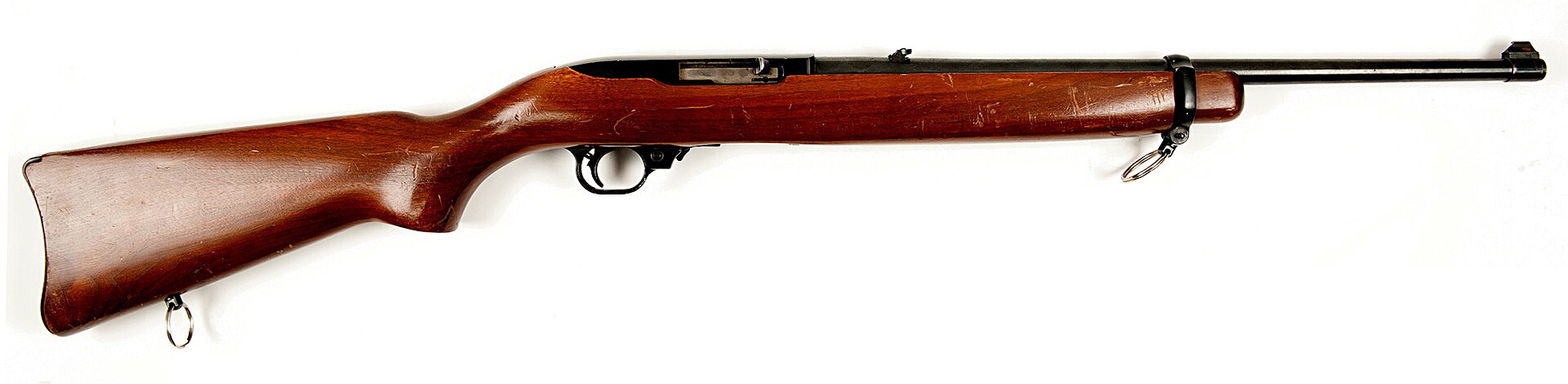
Ruger’s manual for pre-32000 rifles defines the classic models by what the owner can see, and it is the most authoritative short description of each:1
Table 1 — 3.2 The Classic Line, in Ruger's Words
| Model | Ruger’s description |
|---|---|
| Carbine | ”identified by its curved carbine-style butt plate and barrel band” |
| Deluxe Sporter | ”a flat recoil pad, cut checkered stock, and no barrel band” |
| Target | ”a heavyweight, hammer forged barrel, laminated target style stock, and a special target trigger” |
| All-Weather | ”a carbine style stock with barrel band and is checkered on the forearm, pistol grip and butt plate. The black composite stock is made of a thermoplastic polyester resin, reinforced with fiberglass” |
| Rifle | ”a slimmer, hardwood stock, longer barrel, flat rifle butt plate, ramp front sight, and no barrel band” |
| Compact | ”a shorter barrel, shorter rifle-style, hardwood stock and forend, flat buttplate, and fiber optic front and rear sights” |
| Tactical | ”a Mini-14-style flash suppressor … a black synthetic stock, and a precision-rifled, cold hammer-forged 16-1/8” alloy steel barrel with black matte finish” |
| Takedown | ”easy takedown for quick separation of the barrel from the action” (Section 3.4) |
The International does not appear in that list but is in Ruger’s 2003 manual and parts list, which name a “Stock, Mannlicher, Birch” and a “Stock, Mannlicher, Laminated,” with a muzzle cap, muzzle-cap screw and escutcheon, and a pistol-grip cap with medallion.2 The 2003 parts list also records something the brochures do not: the barrel part number for “Standard, Deluxe Sporter, International & All-Weather — Blued Models” is a single part, 0B8001.2 The furniture varied; the barrel under it was the same part.
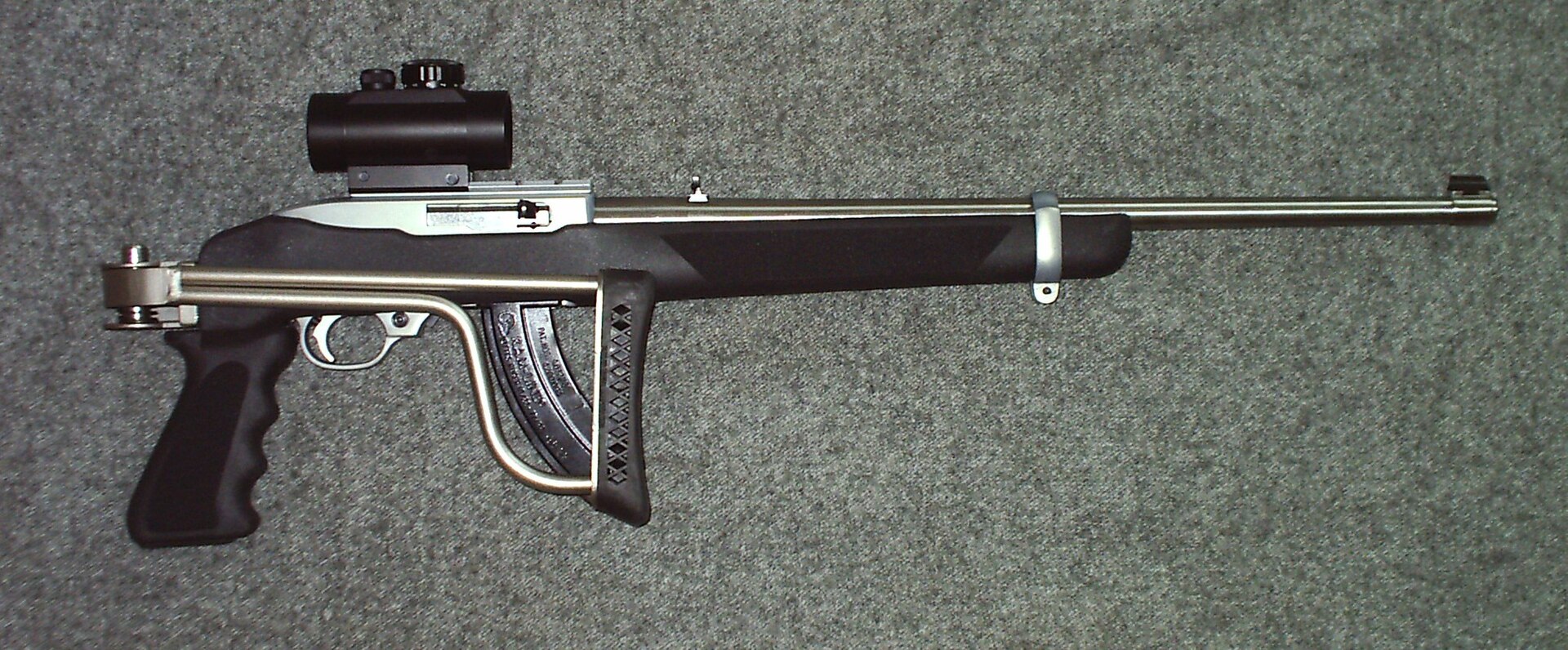
Stainless models pair a stainless barrel with a receiver and trigger housing that are aluminium alloy with a clear coat, not stainless steel. Ruger’s manual is specific: “Do NOT use abrasives on the clear coating of the aluminum alloy receiver and trigger housing.”1 It is an easy mistake to take a scouring pad to a “stainless” receiver that is in fact coated aluminium.
3.3 The Deluxe Sporter
The owner’s inventory records one of the two rifles in Volume 8 as a “10/22 DSP,” blued. Ruger’s manuals do not print the abbreviation; they name the model the Deluxe Sporter, and the 2003 parts list pins down what that meant in parts:21
- Stock: “Stock Assembly, Complete — Walnut,” part B09201, Deluxe Sporter only; a recoil pad (D06304) rather than a buttplate; sling swivels front and rear (MS07601).
- Bolt: “Bolt Assembly, Complete, Color Buffed,” part B-10C, listed for the “Deluxe Sporter & Target” — against the “Standard Finish” bolt B-10A of the carbine and All-Weather.
- Barrel: the same 0B8001 blued barrel as the carbine.
- No barrel band.
“DSP” is therefore the Deluxe Sporter as the model is commonly abbreviated; this reading rests on the name and on the owner’s sheet, since no Ruger document consulted prints the three letters. ⚠ Whether the rifle in Volume 8 still wears its walnut Deluxe Sporter stock is not recorded; the sheet lists a Magpul Hunter X-22 stock as on order for it.
3.4 The Takedown
Ruger announced the 10/22 Takedown on 28 March 2012.3 The announcement specified 4.67 lb, 37 in assembled, subassemblies “each less than 20¼ inches,” one ten-round magazine, and a “ballistic nylon backpack-style carrying case” with internal sleeves and MOLLE pockets. It described the operation in one sentence: “The barrel and forend are easily separated from the action and buttstock by pushing a recessed lever, twisting the subassemblies, and pulling them apart.”3
The Takedown is a different receiver and a different barrel at the joint. Its supplemental parts list, in Ruger’s order, names the parts the ordinary 10/22 does not have: insert (factory-fit only in Ruger’s current list4), detent spring, safety detent plunger, adjusting knob, spacer, spacer pin, clamp, two barrel retainer screws, takedown screw, locking plunger with its detent and spring, two mounting screws, locking lever, block, a separate forend, and a black plastic barrel band with its screw and retaining nut.1
The manual’s text does not say which half of the rifle each of these parts lives on, and the exploded view was not legible enough in the copy read to settle it, so no layout is asserted here. Two things are clear from the procedure and the announcement: the forend travels with the barrel, so each half is complete in itself, and the locking lever sits where it can be “aligned with the magazine well” when the joint is closed.34 The presence of a clamp and two barrel retainer screws in the list suggests the barrel is retained in its half of the joint by a clamp of the familiar kind, but that is an inference from part names, not something the manual states.
Stocks must be takedown-specific. Magpul, for example, sells the Hunter X-22 for “all factory Ruger® 10/22® .22 LR receivers” and a separate Hunter X-22 Takedown for “Factory Ruger® 10/22 Takedown® .22 LR receivers”; the takedown version adds “an adjustable barrel tensioning shim in forend.”5 Volume 4 covers both.
⚠ The spec page for Ruger’s stainless 18.5-inch Takedown model 11100, which the .22 Rimfire dive’s Volume 11 cites, returned “page not found” on ruger.com on 19 September 2026, and no archived copy was available. Its figures are cited there and are not re-derived here.
3.5 How the Takedown Returns to Zero
Ruger’s claim, in the manual and the 2012 announcement alike, is that “simple reassembly allows for a secure connection of the barrel and action and returns the firearm to zero, even when receiver mounted optics are used.”13 The announcement adds the key design word: “The friction fit lockup of the assembly joint is simple to adjust, but will rarely need re-adjustment after the first assembly.”3
The mechanism, as the procedure reveals it: the barrel half enters the receiver and is rotated to lock, like a bayonet joint, until the locking lever snaps into line with the magazine well. The adjusting knob works on a spacer, and the procedure shows what the setting does: loosened fully, the joint closes freely; tightened, the barrel half must be turned against resistance, and over-tightened it becomes “difficult to remove and/or install.”4 The knob therefore sets the preload in the joint. Too loose and the joint has play; too tight and it will not turn. The point of adjustment is a joint with no play and a repeatable preload, which is what a repeatable zero requires.
Ruger’s procedure, from the manual for pre-32000 rifles, with nothing added:1
- Remove the magazine, lock the bolt open and visually check the chamber.
- Loosen the adjustment knob by turning it clockwise as far as possible with finger pressure.
- Insert the barrel assembly into the receiver and rotate it clockwise until it locks.
- Tighten the adjustment knob counterclockwise as far as possible with finger pressure.
- To remove: lock the bolt back, push the locking lever toward the muzzle, rotate the barrel assembly counterclockwise, and pull it out of the receiver.
- Tighten the adjustment knob counterclockwise “one or two (1 - 2) more clicks.”
- Reinstall. “You should feel some resistance when turning the barrel assembly, but it should not be difficult.” If not, remove and tighten or loosen accordingly.
After the first adjustment, Ruger says, installation is steps 1 and 3 only and removal steps 1 and 5 only — the knob is left where it is. And after every installation Ruger recommends dry-cycling the action two or three times, letting the handle “slingshot” forward with the magazine out and the chamber empty, which “will properly ‘seat’ the barrel assembly” for “best fired shot accuracy.”1 Ruger’s newer manual warns: “Overtightening the adjustment knob may make it difficult to remove and/or install your barrel.”4
⚠ A discrepancy with a published dive. The .22 Rimfire dive’s Volume 11 gives this procedure with “two or three additional clicks” at step 6, attributed to magazine reviews. Ruger’s own manuals, both PM058 and PM1269, say one or two.14 The maker’s figure is the one to use.
What neither Ruger nor any source consulted provides is a number for how well the zero returns. The .22 Rimfire dive’s Volume 11 declines to invent one and sets out a five-reassembly group test for measuring it on a given rifle; that test is not repeated here. The owner’s own result for the rifle in Volume 8 is an owed figure.
3.6 The Relatives
- 10/22 Magnum (.22 WMR). Produced 1998 to 2006 by one secondary account, which also states that the magnum rifle’s receiver was steel rather than aluminium alloy.6 The magnum cartridge’s higher pressure is the obvious reason, but no Ruger source was consulted for it; treat both points as secondary. The magnum rifle uses its own magazine, and Ruger’s current manual warns that “certain models are designed for use with magnum rimfire calibers only. Never attempt to use an incorrect magazine in your 10/22 rifle.”4
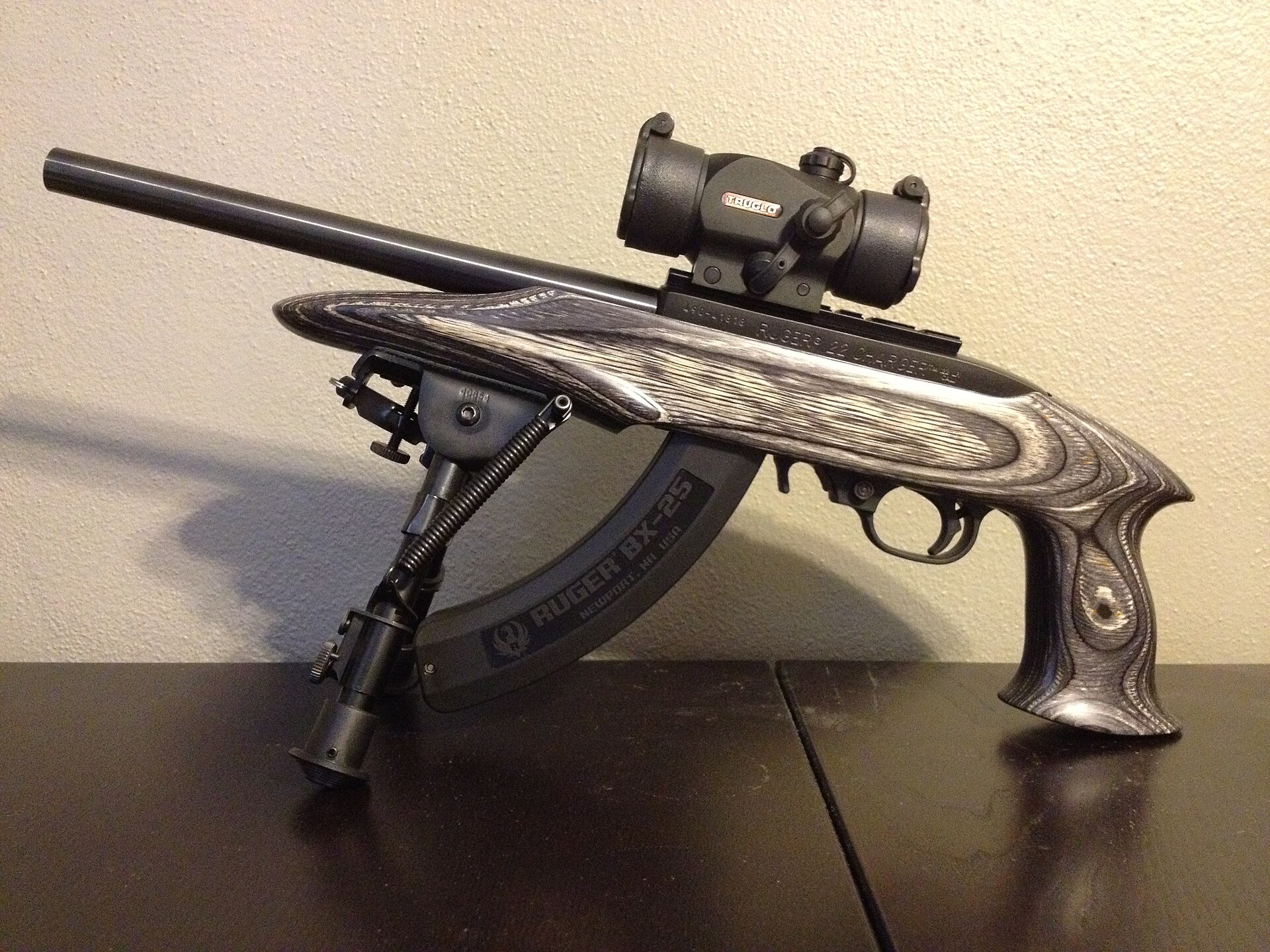
- 22 Charger. A 10/22 action as a pistol, first introduced, per the same secondary account, in late 2007.6 It is a pistol, not a short-barrelled rifle, because it was made as a pistol with no shoulder stock; converting a rifle into one is a different legal act entirely, and nothing in these volumes suggests it.
- 10/22 Competition. Ruger’s in-house answer to the aftermarket: “Hard-coat anodized, CNC-machined receiver made from heat treated and stress relieved aluminum,” with a 16.12 in barrel and a laminate stock.7 It is the one current Ruger 10/22 with a machined rather than cast receiver.
- 10/22 SBR (2026). Models 33000 (8 in) and 33001 (10 in Takedown, with the barrel “tensioned in aluminum alloy barrel sleeve”), announced 19 January 2026, registered NFA items (Volume 1 §1.9).8
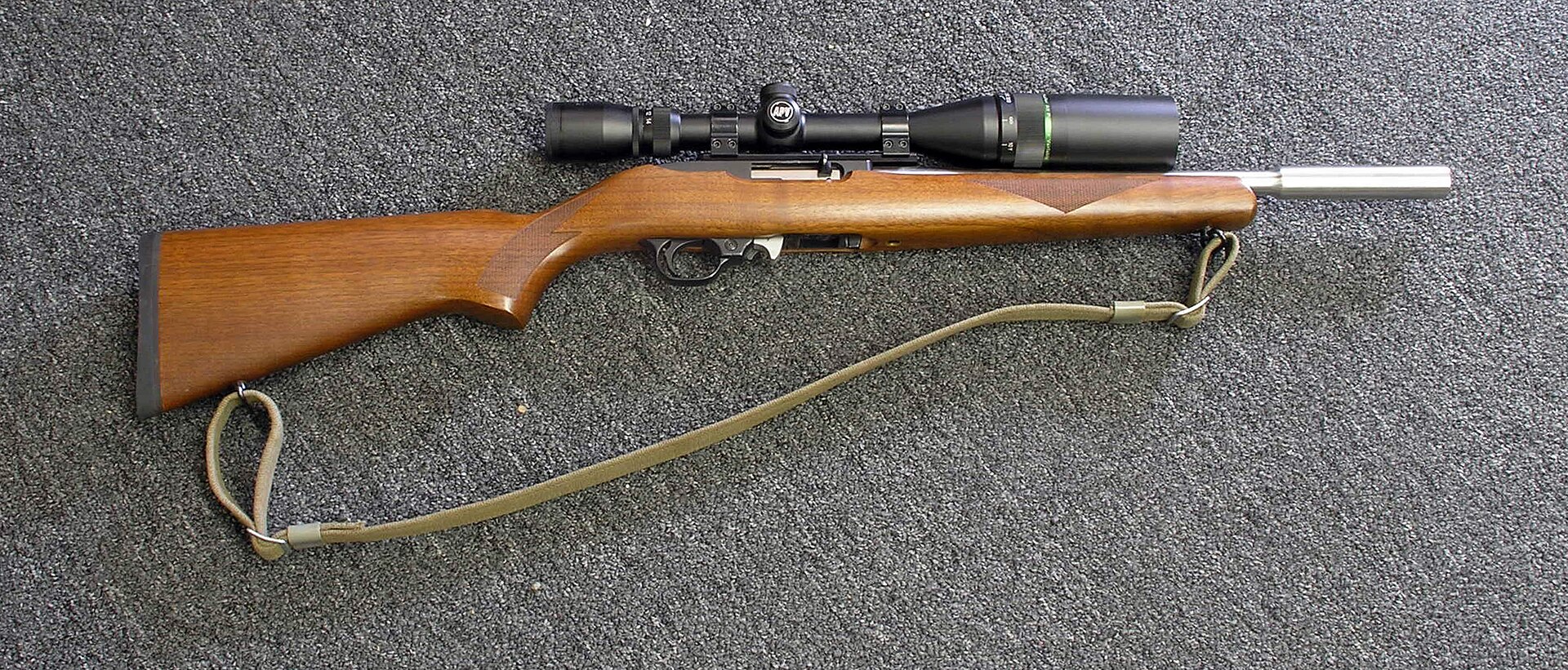
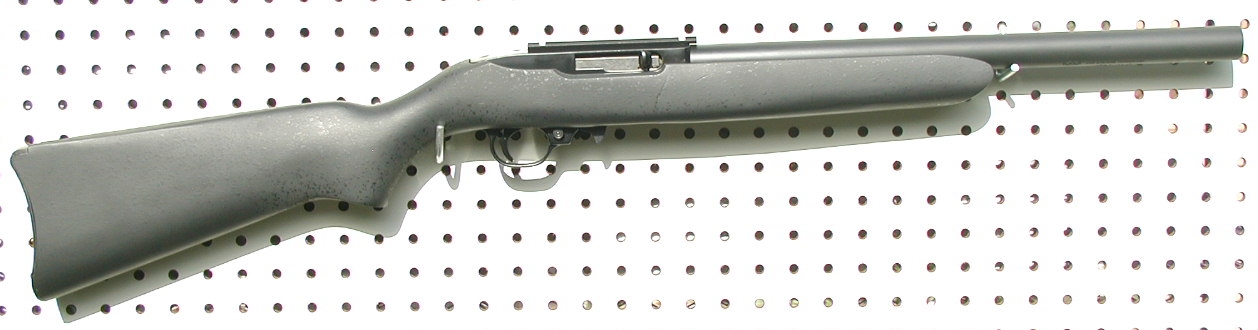
- AWC Ultra II and other integrally suppressed 10/22s. Not Ruger products: third-party builds on a 10/22 action with a suppressor surrounding the barrel. The one below is described by its uploader as 16.5 in, 34.5 in overall and 6.0 lb, and “qualifies as a Class III weapon” — a registered suppressor, integral to the barrel.
3.7 The Current Catalogue
The late-2025 update (Volume 1 §1.9) reorganised the line around a Standard model series numbered from 32000, with the BX-Trigger, the match-type bolt lock and a receiver with a rear cleaning port as standard.9 Ruger’s specification pages on 19 September 2026 list, among others:10
Table 2 — 3.7 The Current Catalogue
| Model | Stock | Barrel | Weight |
|---|---|---|---|
| 32000 / 32002 | Black polymer | 16.40 in / 18.50 in, satin black | 4.0 / 4.2 lb |
| 32004 / 32006 | Black polymer | 16.40 in / 18.50 in, satin stainless | 4.0 / 4.2 lb |
| 32009 | Birch | 18.50 in, satin black | 4.9 lb |
| 32015 | Walnut | 18.50 in, satin black | 4.9 lb |
| 32013, 32016, 32017, 32020, 32029 | Magpul Hunter X-22 Backpacker (various colours) | 16.40 in | 4.4 lb |
| 32021 / 32023 | Magpul MOE X-22 | 18.50 in, black / stainless | 4.2 lb |
| 31110, 31120, 31127, 31147 | Laminate (Competition) | 16.12 in | 5.5–6 lb |
| 33000 / 33001 | Folding (SBR) | 8 in / 10 in | 3.6 / 4.8 lb |
No Takedown model appeared among the specification pages retrieved that day. Whether the Takedown remains in the catalogue under a 32000-series number was not established.
3.8 Identifying a Rifle
Three things establish what a given 10/22 is.
The model number. Ruger’s manuals are now split by it: PM1269 “applies only to 10/22 rifles with model numbers 32000 and higher,” and directs owners to Ruger’s serial-history service to confirm the model.4 Everything older is covered by PM058.1 The difference is not cosmetic. It decides which bolt lock the rifle has, whether it has a rear cleaning port, and which disassembly instructions apply.
The serial table. Ruger publishes the approximate first serial shipped each year from 1964 to 2017.11 It is a dating aid, not a production record: “Ruger does not necessarily produce firearms in serial number order.”11 Volume 8 uses it to date the two rifles documented there, without printing either serial.
The furniture and barrel against the manual’s descriptions (Section 3.2) — with the caution that a 10/22 is the most re-stocked rifle in America, and the stock on a rifle is evidence of what it is now, not of what it left the factory as.
3.9 Bibliography
Footnotes
-
Sturm, Ruger & Co., Instruction Manual for Ruger 10/22 Autoloading Rifles, PM058, B 4/2025 R40. Model descriptions p. 13; Takedown barrel assembly pp. 16–17; stainless maintenance p. 35; Takedown supplemental parts list p. 49. ↩ ↩2 ↩3 ↩4 ↩5 ↩6 ↩7 ↩8 ↩9
-
Sturm, Ruger & Co., Instruction Manual for Blued & Stainless Steel Ruger Model 10/22 Carbine — Standard, Deluxe Sporter, International, Target and All-Weather Models, B 2/03 R11, parts list pp. 30–34. Mirror: http://pdf.textfiles.com/manuals/FIREARMS/ruger_1022.pdf (accessed 2026-09-19). ↩ ↩2 ↩3
-
Sturm, Ruger & Co., news release announcing the 10/22 Takedown, 28 March 2012. https://ruger.com/news/2012-03-28.html (accessed 2026-09-19). ↩ ↩2 ↩3 ↩4 ↩5
-
Sturm, Ruger & Co., Instruction Manual for Ruger 10/22 Autoloading Rifle, PM1269, 10/22 6/2026 R1. Takedown pp. 16–17; magazine caution p. 20; Takedown supplemental parts list p. 53. https://ruger-docs.s3.amazonaws.com/_manuals/Ruger_1022.pdf (accessed 2026-09-19). ↩ ↩2 ↩3 ↩4 ↩5 ↩6 ↩7
-
Magpul Industries, Hunter X-22 Stock (MAG548) and Hunter X-22 Takedown Stock (MAG760) product pages. https://magpul.com/hunterx-22stock-ruger10-22.html ; https://magpul.com/hunterx-22takedownstock-ruger10-22takedown.html (accessed 2026-09-19). ↩
-
“Ruger 10/22,” Wikipedia (secondary; used only for the 10/22 Magnum production dates and receiver material and the Charger’s introduction). https://en.wikipedia.org/wiki/Ruger_10/22 (accessed 2026-09-19). ↩ ↩2
-
Sturm, Ruger & Co., 10/22 Competition specification sheet, model 31110. https://ruger.com/products/1022Competition/specSheets/31110.html (accessed 2026-09-19). ↩
-
Sturm, Ruger & Co., news release, 19 January 2026, https://ruger.com/news/2026-01-19.html ; specification sheets 33000 and 33001 (accessed 2026-09-19). ↩
-
Jeremiah Knupp, “Updating A Legend: Ruger Makes 10/22 Upgrades Standard,” American Rifleman, 30 December 2025. https://www.americanrifleman.org/content/updating-a-legend-ruger-makes-10-22-upgrades-standard/ (accessed 2026-09-19). ↩
-
Sturm, Ruger & Co., 10/22 specification sheets, models 32000–32036, 31110–31147, 33000–33001. https://ruger.com/products/1022Standard/specSheets/32000.html and sibling pages (accessed 2026-09-19). ↩
-
Sturm, Ruger & Co., “10/22 Serial Number History.” https://ruger.com/service/productHistory/RI-10-22.html (accessed 2026-09-19). ↩ ↩2
Comments (0)