Ruger 10/22 · Volume 4
The Aftermarket — What KIDD, Volquartsen and Magpul Parts Actually Change
Bolt releases, buffers, extractors, bolts, handles, triggers and stocks, each against the factory part it replaces
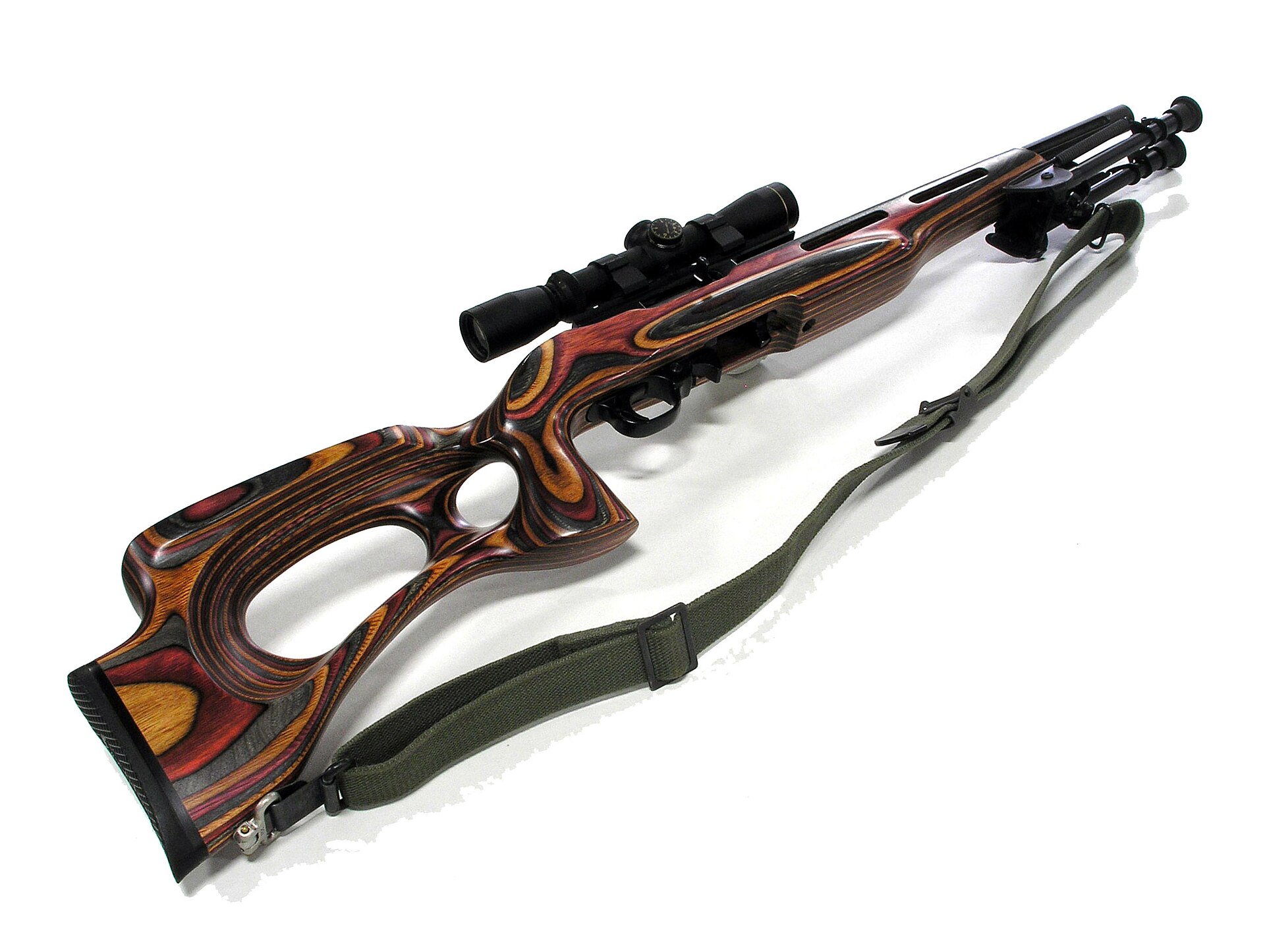
4.1 Why This Rifle Has an Aftermarket
Volume 1 explained four 1964 decisions — a cast receiver, a clamped barrel, a pinned trigger housing and a separate cocking-handle assembly — taken to hit a price. Each became an interface. The barrel comes off with a hex key, so barrels became a product. The trigger housing comes out with a punch, so complete trigger units became a product. The bolt lifts out once one pin is drifted, so bolts, firing pins and extractors became products. And the receiver drops out of the stock on one screw, so stocks became a product.
Every part in this volume changes one of the mechanisms in Volume 2, and it is worth reading it in those terms: which mechanism does this part change, and what does its maker actually claim? Prices and part numbers throughout are from each maker’s own page on 19 September 2026. Makers’ claims are attributed as claims.
4.2 The Bolt Release
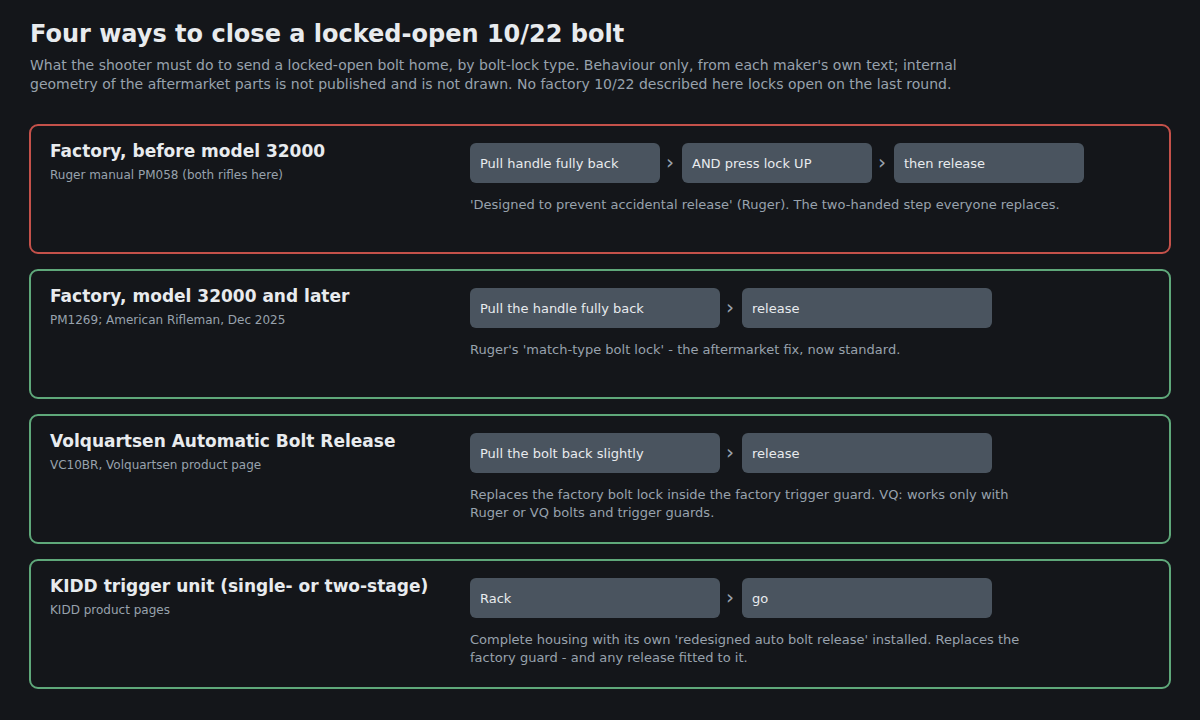
Volume 2 §2.8 set out the factory bolt lock on every 10/22 before model 32000: to release a locked-open bolt, the handle is drawn back and the upper section of a small lever inside the trigger guard is pressed up at the same time. Ruger designed it that way “to prevent accidental release of the bolt from its open position.”1
Volquartsen’s Automatic Bolt Release is the best-known fix. Volquartsen’s page describes it in two sentences: it “enables the shooter to simply pull the bolt back slightly to release it. This eliminates the need to push up on the bolt lock mechanism to release the bolt.”2 It is a replacement bolt lock, fitted inside the factory trigger guard with a 3/32 in punch, in black (VC10BR-B-10) or silver (VC10BR-S-10), at $13.75.2 Volquartsen does not publish how its geometry differs from Ruger’s lever, and it is not drawn in this dive.
Its compatibility statement matters more than its price: “our bolt release is only compatible with Volquartsen and Ruger factory bolts and trigger guards, including the BX-Trigger. It is not compatible with other manufacturers’ parts.”2 (Its installation page softens that to “It may not work correctly with other manufacturers’ parts.”3)
The trap in combining parts. Three consequences follow for any owner building up a rifle a part at a time, and all three apply to the rifles in Volume 8:
- A complete aftermarket trigger unit retires the release. The Volquartsen release lives in the factory trigger guard. A complete KIDD or Volquartsen trigger unit replaces that guard entirely, and brings its own release: KIDD’s single-stage unit “includes redesigned auto bolt release for simple, no-fiddle bolt drops,” installed at the factory; Volquartsen’s own TG2000 “includes Automatic Bolt Release.”45 Once a complete unit is fitted, the separate release comes out with the old guard and has nothing left to do.
- A non-Ruger bolt in a factory guard with the Volquartsen release is outside Volquartsen’s stated compatibility. A KIDD bolt fitted before a KIDD trigger unit — or instead of one — would put the Volquartsen release against another maker’s bolt. Volquartsen says it is not compatible.
- The order of installation therefore matters. Fitting the complete trigger unit first, or both together, avoids the intermediate state in point 2.
Ruger’s own answer. Rifles from model 32000 on have a factory “match-type bolt lock”: “Retract the bolt handle to its extreme rearward position and fully release it … Retracting the bolt will disengage the bolt lock.”6 The 2026 SBRs are described the same way: “Match bolt release allows you to easily advance the bolt with a quick pull and release to the rear.”7 It is the aftermarket part’s function, now standard.
⚠ One caution that applies to every version. Ruger’s warning about the lock is independent of how it is released: “The bolt stop is NOT a safety device … A slight jar to the butt end of the rifle CAN cause the bolt stop to disengage and feed a cartridge into the chamber. The bolt stop should only be relied upon to hold the bolt in its rearward position when the chamber is empty and an empty magazine is in place.”6 A lock designed to release easily is not more trustworthy as a hold-open with a loaded magazine in the rifle.
4.3 The Bolt Buffer — and What Sefried’s Patent Says About It
Both rifles documented in Volume 8 have a KIDD bolt buffer fitted. It is a ten-dollar part, and it is where the maker’s claims and the rifle’s designer’s claims point in opposite directions.
What the buffers are. Each replaces the factory bolt stop pin, the transverse pin at the rear of the receiver.
- KIDD Bolt Buffer (KIDD-22BOLTBUF, $10.22): a “steel-core dowel with a padded tubing cover to absorb impact”; the package is “rubber tubing / steel dowel pin”; installation is tubing first, from the inside of the receiver outward, then the steel pin pushed through it. KIDD’s claims: it “eliminates bolt battering against the rear of the receiver,” “reduces vibration for smoother cycling” and “lowers perceived recoil noise.” Its engineering note: “A standard 10/22 steel bolt stop allows the bolt to slam rearward with every cycle. Over time that repeated impact can leave marks and increase vibration.” Not recommended for magnum receivers.8
- Volquartsen Recoil Buffer (VC10RB, $13.75): a “drop-in polyurethane bolt stop pin,” “1/4” diameter,” which “eliminates the metal to metal contact between bolt and receiver and eliminates vibration caused by this” and “provides a remarkable difference in cycling noise.”9
What the designer said. Volume 2 §2.4 quoted Harry Sefried’s patent for the 10/22’s decelerator. The factory bolt stop pin is not merely a stop. It is the fixed half of a cam: the bolt’s curved tail rides over it and is thrust downward, turning rearward motion into transverse motion. The patent claims, in so many words, that this produces “no tendency for the breechblock to bounce forward … as there would be if the breechblock were stopped by a resilient buffer or by striking against a fixed stop member,” so that the bolt “move[s] forward under the influence of the return spring only,” starting slowly, which “gives the magazine more time.”10
The two positions, set side by side:
Table 1 — The two positions, set side by side
| Sefried’s patent (1964) | Buffer makers (2026) | |
|---|---|---|
| What the factory pin does | Cams the bolt down and stops it without bounce | Lets the bolt “slam rearward” and batter the receiver |
| What a resilient stop does | Causes bounce, so a faster return | Absorbs impact, reduces vibration and noise |
| Evidence offered | The design argument in the patent | None published beyond the claim |
What can be established, and what cannot.
- It is established that a buffer does not delete the cam. It replaces the pin the cam rides on with one whose surface yields. Volquartsen’s buffer is specified at ¼ in; the patent’s example pin is “0.250 inch,” so the nominal geometry is at least the same size.910 KIDD does not publish the outside diameter of its tubing-covered pin, so whether it changes the cam geometry could not be determined.
- It is not established, by any source consulted, that a buffer measurably increases bolt bounce, speeds the return stroke, or harms feeding; nor that the factory pin measurably damages receivers. No source was found that measured bolt velocity, cyclic rate or receiver wear with and without a buffer. Both sides are, on the published record, design arguments and marketing claims.
- It is plausible on the patent’s own reasoning that the effect of a buffer interacts with spring rate and ammunition. The .22 Rimfire dive’s Volume 9 records the common advice that a lighter recoil spring for subsonic ammunition is safe with a buffer fitted; that advice, too, rests on widely repeated guidance rather than a measurement.
The honest position for an owner is therefore empirical: a buffer is cheap, reversible with a punch, and its effect on a given rifle can be checked — feeding from a full magazine, with the ammunition actually used, with the buffer in and with the factory pin back in. Anyone who has both rifles in Volume 8 apart on the bench is in a position to run that comparison and publish the only real number in this section.
4.4 Extractors and Firing Pins
The extractor and firing pin are the two small parts in the bolt that decide whether a rimfire extracts and ignites every time, and both are sold as drop-in improvements.
Extractors. Ruger’s factory extractor (part B-14 in the 2003 list) is held by a spring and plunger in the bolt.11
- Volquartsen Exact Edge (VC10EE, $14.25): EDM-machined A2 tool steel, “hardened to a Rc 58-60,” “tolerances to +/-.0001”.” Its geometric claim: “The hook is .005” closer to the rim of the cartridge to allow for the most positive extraction available.” It adds a chamfer on the bottom edge “improving feeding and reliability. It will eliminate any issues with the bottom edge of the extractor catching on the next round as it feeds up from the magazine” — and warns that “at first glance, it may look like a defect.” Volquartsen contrasts it with “extractors made from stamped steel or titanium that will have their edges roll over.”12
- KIDD Extractor (KIDD-22EXTR, $14.85): “A2 tool steel,” “Hardened to 60c,” “Machined on wire EDM to .0002” tolerances,” with “optimized geometry for tight match chambers.” KIDD’s summary: “Extraction is only as strong as the hook geometry and surface finish.”13
Firing pins.
- Volquartsen SureStrike (VC10SSFP, $37): EDM-machined A2, “Hardened to a Rc 56–58,” “designed to minimize and/or eliminate light hits”; “.004” wider than the factory firing pin to help eliminate side to side movement in the factory bolt.” .22 LR model only.14
- KIDD Firing Pin (KIDD-22FP, $40): “precision-ground and wire EDM cut,” “0.0001” machining tolerance,” supplied with “a directional spring” — “the larger end faces the bolt face, the conical small end faces the rear.” KIDD’s claim about the part it replaces, “Factory firing pins are often stamped, leaving uneven surfaces and inconsistent geometry,” is KIDD’s and was not independently checked.15
The point to take from both: firing-pin protrusion and fit are what these parts change, and neither maker publishes a protrusion figure. A light strike on a rimfire can be ammunition, a worn pin, a pin binding in its channel, or fouling in the channel. Volume 7 lists them in diagnostic order.
4.5 Complete Bolts
The KIDD Bolt is sold complete: “CNC-machined billet steel,” “fully hardened,” with “correct headspacing and firing pin protrusion right out of the box,” a “‘pinned’ firing pin design for ultra-consistent rim strikes,” “radiused, polished surfaces to improve reliability and feeding,” and KIDD’s firing pin and extractor installed. It weighs 6.5 oz. Prices on 19 September 2026: $164 (silver matte, KIDD-22BOLT-MAT-S, and engraved silver), $174 (silver scalloped), $204 (black matte), $214 (black scalloped).16 It fits “10/22-style receivers, including all KIDD .22LR receivers,” and is installed “after the charging assembly is installed” — the cocking handle and guide rod are not part of it.16
Two things about a replacement bolt deserve a machinist’s attention rather than a buyer’s:
- Bolt mass is a blowback tuning variable (Volume 2 §2.1). KIDD publishes its bolt’s weight. Ruger does not publish the factory bolt’s, and no reliable figure was found, so whether the KIDD bolt is heavier or lighter than the one it replaces could not be established. It should be weighed on the bench, factory bolt against replacement, before either is assumed.
- Headspace in a 10/22 is set by the bolt face against the barrel’s breech face, and “correct headspacing … out of the box” is a claim about a bolt made to nominal dimensions in a receiver and barrel made to nominal dimensions. KIDD publishes no headspace or protrusion figure. The prudent check after fitting any replacement bolt is Ruger’s own: look at fired cases. “If they have bulged heads or frequently show splits on any part of the case, the firearm should be returned to the factory for inspection” — or, for a rifle no longer entirely factory, to a gunsmith.6
4.6 Bolt Handles and Guide Rods
KIDD Bolt Handle, “Black with Black Viton” (KIDD-22HDL-BV) or “Silver with Black Viton,” $43 each. KIDD’s specification: “1 3/4” length — a full 1/4” longer than factory,” “lightweight 0.4 oz anodized aluminum,” “cushioned grip,” “noticeably better knuckle clearance during charging.”17
Two corrections to how this part is usually described:
- The Viton is the grip, not a buffer. KIDD’s page describes the material as “anodized aluminum with cushioned grip”; the word “Viton” appears only in the product name.17 It does nothing in the mechanism.
- The handle is not a stand-alone swap. KIDD’s fit note: “Ruger 10/22 bolt handle assemblies (use with KIDD guide rod & spring kit),” and “Do not attempt to separate the factory bolt handle — it is permanently affixed.”17 Ruger sells the handle, guide rod and recoil spring as one assembly (part B-48A in 2003, “Cocking Handle, Guide Rod & Recoil Spring Assembly”).11 A KIDD handle therefore goes onto a KIDD Guide Rod & Spring Kit (KIDD-22GRSK, $25): a “precision-ground hardened tool steel guide rod,” “nitride-treated,” with three springs — white standard, red “10% increase,” green “10% decrease.”18
That last point is the useful one. Fitting a KIDD handle means fitting a KIDD guide rod, which puts a choice of three recoil springs in the owner’s hands — exactly the variable the .22 Rimfire dive’s Volume 9 discusses for running subsonic ammunition. Which spring is fitted to the rifle in Volume 8 that has the KIDD handle is not recorded.
4.7 Trigger Units
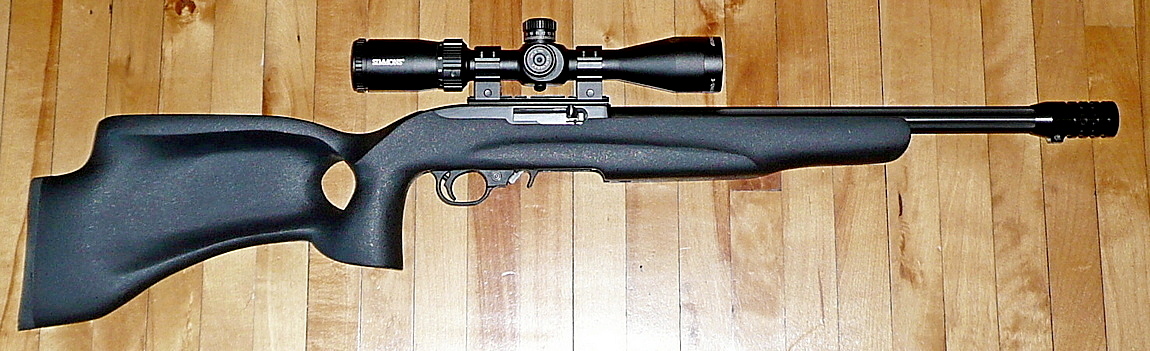
Ruger lists the sear, hammer and trigger as factory-fit parts, fitted “on an exchange basis only.”6 That is why the 10/22 trigger aftermarket is dominated by complete drop-in units — a new housing with every part already fitted — rather than individual springs and sears. A complete unit replaces everything the factory marks as factory-fit, at once, without anyone stoning a sear.
Table 2 — 4.7 Trigger Units
| Unit | Maker’s key specification | Price, 19 Sept 2026 |
|---|---|---|
| KIDD Single Stage Trigger Unit (KIDD-TG1-B, black; also silver and two-tone) | CNC-machined billet aluminium guard; “wire-EDM cut hammer, sear, and disconnect”; “adjustable pull weight from 1.5 lbs to 5 lbs” by one external screw; auto bolt release and stainless magazine-latch plunger installed; three interchangeable magazine-release levers; “true drop-in for nearly all Ruger 10/22 rifles”4 | $320 |
| KIDD Two Stage Trigger Unit | ”fully adjustable pull weight from 6 oz to 2.5 lbs”; “a predictable wall with a .001” engagement for the break — yet a massive .040” of total hammer/sear engagement when cocked”; 6061-T6 billet housing; auto bolt release19 | $405 |
| Volquartsen TG2000 (VCTP-1-B-10) | billet 6061 housing; “crisp, clean 2.25 lb trigger pull”; “adjustable for pretravel and overtravel but not pull weight”; automatic bolt release and extended magazine release included; right-handed rifles only5 | $310 |
| Ruger BX-Trigger | 2.5–3 lb, polymer housing; now standard on model 32000 and later20 | — |
KIDD’s own account of why it makes a two-stage unit is worth reading as engineering rather than marketing: a single-stage semi-automatic trigger has to choose between a light, short sear engagement and a safe one, and splitting the pull into two stages lets the break happen on “.001” engagement” while “.040” of total hammer/sear engagement” holds the hammer when cocked — “something impossible to achieve in an autoloader with a single-stage design,” in KIDD’s words.19 That is a claim about KIDD’s own product; it does explain why KIDD’s single-stage unit’s lowest setting (1.5 lb) is well above the two-stage’s (6 oz).
⚠ The owner’s inventory lists a KIDD single-stage trigger at $199, undated; KIDD’s price on 19 September 2026 was $320. The sheet’s figure is not used in these volumes.
4.8 Stocks and the Bipod Mount
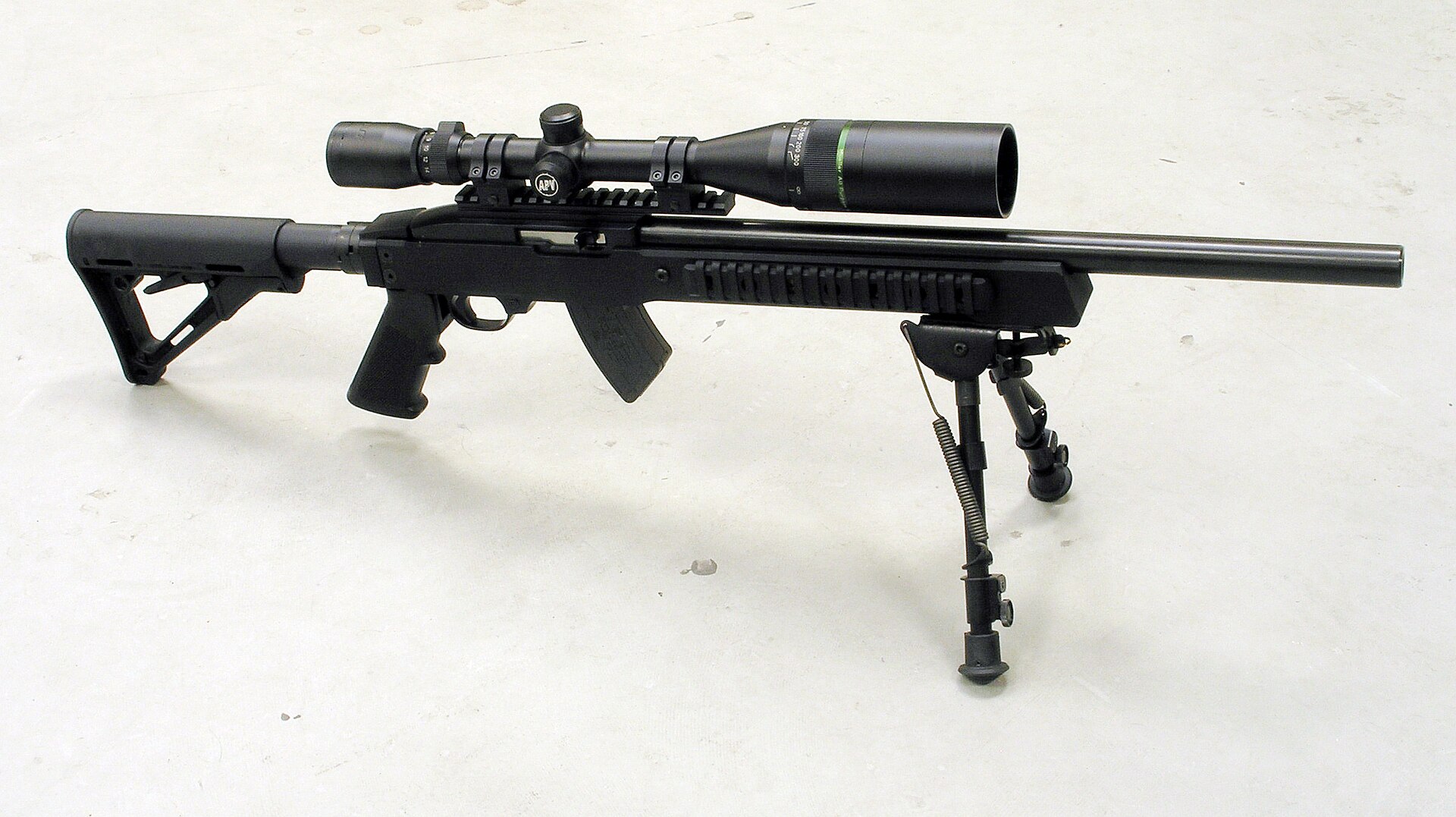
Magpul Hunter X-22 (MAG548, $144.95) — “a fully-featured drop-in stock for Ruger 10/22s … offers adjustments for LOP and comb height,” “compatible with all factory Ruger 10/22 .22 LR receivers.” A reversible barrel tray takes “factory pencil profile barrels and bull barrels up to 0.92” diameter”; spacers adjust length of pull from 12.5 to 14.5 in in 0.50 in steps; M-LOK slots in the forend; weight 2.45 lb.21
Magpul Hunter X-22 Takedown (MAG760, $149.95) — the same stock for “Factory Ruger 10/22 Takedown .22 LR receivers” only, with one mechanical addition: an “adjustable barrel tensioning shim in forend allows barrel preload tension setting or free float if desired.” Weight 2.37 lb.22 The two are not interchangeable; a takedown receiver needs the takedown stock (Volume 3 §3.4). Volume 6 takes up the tensioning shim, because it is a bedding adjustment.
Cheek risers. Both Hunter X-22 stocks ship with the no-rise cheek piece (MAG679): “The Hunter/SGA No-Rise Cheek Piece comes standard with the Magpul Hunter X-22, Hunter X-22 Takedown.”23 Risers are sold in two kits: the Low Cheek Riser Kit (MAG463, $24.95), “one (1) 0.25” cheek riser and one (1) 0.50” cheek riser,” and the High Cheek Riser Kit (MAG461, $24.95), “one (1) 0.50” … and one (1) 0.75”.”24 ⚠ Magpul sells no “medium” riser for this stock. The owner’s inventory records “medium cheek riser” for both rifles; the 0.50 in piece, which comes in both kits, is the likely meaning, but that is an inference and is listed as a question for the owner.
Magpul M-LOK Bipod Mount (MAG609, $22.95): an aluminium M-LOK attachment that “deliver[s] a sling stud that’s compatible with Magpul MOE and Sling Stud QD Bipods, along with most Harris-style bipods.”25 On a Hunter X-22 it is how a Harris bipod goes on the forend.
4.9 Scope Mounting
Ruger’s own rules come first, because they are specific and they are routinely ignored.1
- The receiver has four filler screws in the top. Remove them only when a base is going on, with a correctly sized screwdriver: “Never use a screwdriver to remove the filler screws that exceeds the width of the filler screw slot.”
- Ruger’s scope base adapter screws go to “a maximum torque setting of 12-15 inch/lb,” tightened a little at a time in rotation.
- “Do not deepen or alter the screw holes.” If a screw binds the bolt, it is too long: “If it is necessary to shorten a screw, be certain to chamfer its top.”
- “Do not place any thread locker (such as LOCTITE) into the screw holes in the receiver, as the thread locker can drip into the bolt or receiver and cause potentially dangerous malfunctions.”
That last instruction is worth taking seriously for a rifle whose bolt runs a few thousandths below the underside of the receiver top. Aftermarket rails such as the UTG low-profile rail listed for both rifles in Volume 8, and rings from UTG and TPS, mount to the same four holes. Their makers’ specifications could not be retrieved for this dive and are not quoted; ring height and optic theory belong to the Scopes dive.
4.10 KIDD
The owner of both rifles in Volume 8 rates KIDD highly, and the company’s own account of itself explains the reputation. KIDD Innovative Design is in McQueeney, Texas. Its owner, Tony Kidd, lists on the company’s page a career as a gunsmith and pistolsmith including Chief Pistolsmith at the U.S. Army Marksmanship Unit, Fort Benning (1994–98), and later head of the AMU’s research and development department (2004–08), and induction into the Army Marksmanship Hall of Fame for Support in 2012.26 The two-stage trigger’s origin, in the maker’s own words: in 1996 an AMU rifle gunsmith’s tuned 10/22 was grouping with Anschutz barrelled actions, but “that $150 rifle shot great but that $10 trigger needed some serious help”; a shooter took the prototype trigger to the Smallbore Silhouette Nationals and won, which “had never been done with an autoloader much less a 10/22.”26 That is KIDD’s account of KIDD and is presented as such.
KIDD sells complete receivers and rifles through a second site, because, it explains, “PayPal has many restrictions regarding the purchase of firearms” (Volume 5).27
4.11 A Parts Table
Every figure from the maker’s own page, 19 September 2026. Prices change; these are dated, not current.
Table 3 — 4.11 A Parts Table
| Part | Maker, SKU | Price | Replaces |
|---|---|---|---|
| Automatic bolt release | Volquartsen VC10BR-B-10 / -S-10 | $13.75 | Factory bolt lock |
| Bolt buffer | KIDD KIDD-22BOLTBUF | $10.22 | Bolt stop pin |
| Recoil buffer | Volquartsen VC10RB | $13.75 | Bolt stop pin |
| Extractor | Volquartsen VC10EE | $14.25 | Extractor |
| Extractor | KIDD KIDD-22EXTR | $14.85 | Extractor |
| Firing pin | Volquartsen VC10SSFP | $37 | Firing pin |
| Firing pin | KIDD KIDD-22FP | $40 | Firing pin |
| Complete bolt | KIDD KIDD-22BOLT-MAT-S | $164 (to $214) | Bolt assembly |
| Bolt handle | KIDD KIDD-22HDL-BV | $43 | Handle (needs guide rod kit) |
| Guide rod and springs | KIDD KIDD-22GRSK | $25 | Handle/guide rod/spring assembly |
| Single-stage trigger unit | KIDD KIDD-TG1-B | $320 | Trigger housing |
| Two-stage trigger unit | KIDD | $405 | Trigger housing |
| TG2000 trigger unit | Volquartsen VCTP-1-B-10 | $310 | Trigger housing |
| Hunter X-22 stock | Magpul MAG548 | $144.95 | Stock (standard receiver) |
| Hunter X-22 Takedown stock | Magpul MAG760 | $149.95 | Stock (Takedown receiver) |
| Riser kits | Magpul MAG463 / MAG461 | $24.95 each | Cheek piece |
| M-LOK bipod mount | Magpul MAG609 | $22.95 | — |
4.12 Bibliography
Footnotes
-
Sturm, Ruger & Co., Instruction Manual for Ruger 10/22 Autoloading Rifles, PM058, B 4/2025 R40: The Bolt Lock p. 15; Attaching Scope Base Adapter p. 36. ↩ ↩2
-
Volquartsen Firearms, Automatic Bolt Release. https://volquartsen.com/products/158-automatic-bolt-release (accessed 2026-09-19). ↩ ↩2 ↩3
-
Volquartsen Firearms, installation guide, 10/22 automatic bolt release. https://volquartsen.com/howto/install_1022_auto_bolt_release (accessed 2026-09-19). ↩
-
KIDD Innovative Design, KIDD Single Stage Black Trigger Unit. https://www.kiddinnovativedesign.com/KIDD-Single-Stage-Black-Trigger-Unit_p_45.html (accessed 2026-09-19). ↩ ↩2
-
Volquartsen Firearms, TG2000 Trigger Group, Black, 10/22. https://volquartsen.com/inventory_configurations/17 (accessed 2026-09-19; shown as backorder that day). ↩ ↩2
-
Sturm, Ruger & Co., Instruction Manual for Ruger 10/22 Autoloading Rifle, PM1269, 10/22 6/2026 R1: The Bolt Lock pp. 14–15; Minimize Malfunctions p. 26; Ordering Parts and Parts List pp. 49–50. https://ruger-docs.s3.amazonaws.com/_manuals/Ruger_1022.pdf (accessed 2026-09-19). ↩ ↩2 ↩3 ↩4
-
Sturm, Ruger & Co., 10/22 SBR specification sheets 33000 and 33001. https://ruger.com/products/1022sbr/specSheets/33000.html (accessed 2026-09-19). ↩
-
KIDD Innovative Design, KIDD Bolt Buffer. https://www.kiddinnovativedesign.com/KIDD-Bolt-Buffer_p_12.html (accessed 2026-09-19). ↩
-
Volquartsen Firearms, Recoil Buffer for 10/22 and 10/22 Magnum. https://volquartsen.com/departments/internal-parts-for-1022-and-magnum/inventory_configurations/814 (accessed 2026-09-19). ↩ ↩2
-
H. H. Sefried II, “Self-Loading Guns,” US Patent 3,240,121, filed 31 August 1964, granted 15 March 1966. https://patentimages.storage.googleapis.com/pdfs/US3240121.pdf (accessed 2026-09-19). ↩ ↩2
-
Sturm, Ruger & Co., Instruction Manual … Model 10/22 Carbine, B 2/03 R11, parts list pp. 30–34. Mirror: http://pdf.textfiles.com/manuals/FIREARMS/ruger_1022.pdf (accessed 2026-09-19). ↩ ↩2
-
Volquartsen Firearms, Exact Edge Extractor. https://volquartsen.com/departments/internal-parts-for-1022-and-magnum/inventory_configurations/811 (accessed 2026-09-19). ↩
-
KIDD Innovative Design, KIDD Extractor. https://www.kiddinnovativedesign.com/KIDD-Extractor_p_13.html (accessed 2026-09-19). ↩
-
Volquartsen Firearms, SureStrike Firing Pin for Ruger 10/22. https://volquartsen.com/departments/internal-parts-for-1022-and-magnum/inventory_configurations/770 (accessed 2026-09-19). ↩
-
KIDD Innovative Design, KIDD Firing Pin. https://www.kiddinnovativedesign.com/KIDD-Firing-Pin_p_48.html (accessed 2026-09-19). ↩
-
KIDD Innovative Design, KIDD Bolt — Silver Matte, and Complete Bolts category. https://www.kiddinnovativedesign.com/KIDD-Bolt-Silver-Matte_p_31.html ; https://www.kiddinnovativedesign.com/Complete-Bolts_c_36.html (accessed 2026-09-19). ↩ ↩2
-
KIDD Innovative Design, KIDD Bolt Handle — Black with Black Viton. https://www.kiddinnovativedesign.com/KIDD-Bolt-Handle-Black-with-Black-Viton_p_56.html (accessed 2026-09-19). ↩ ↩2 ↩3
-
KIDD Innovative Design, KIDD Guide Rod & Spring Kit. https://www.kiddinnovativedesign.com/KIDD-Guide-Rod-Spring-Kit_p_46.html (accessed 2026-09-19). ↩
-
KIDD Innovative Design, KIDD Two Stage Trigger Unit for the .22. https://www.kiddinnovativedesign.com/KIDD-Two-Stage-Trigger-Unit-for-the-22-_p_11.html (accessed 2026-09-19). ↩ ↩2
-
Jeremiah Knupp, “Updating A Legend: Ruger Makes 10/22 Upgrades Standard,” American Rifleman, 30 December 2025. https://www.americanrifleman.org/content/updating-a-legend-ruger-makes-10-22-upgrades-standard/ (accessed 2026-09-19). ↩
-
Magpul Industries, Hunter X-22 Stock – Ruger 10/22, MAG548. https://magpul.com/hunterx-22stock-ruger10-22.html (accessed 2026-09-19). ↩
-
Magpul Industries, Hunter X-22 Takedown Stock – Ruger 10/22 Takedown, MAG760. https://magpul.com/hunterx-22takedownstock-ruger10-22takedown.html (accessed 2026-09-19). ↩
-
Magpul Industries, Hunter/SGA Cheek Riser – Standard, MAG679. https://magpul.com/sga-huntercheekriser-standard.html (accessed 2026-09-19). ↩
-
Magpul Industries, Hunter/SGA Low Cheek Riser Kit MAG463 and High Cheek Riser Kit MAG461. https://magpul.com/sga-low-cheek-riser-kit.html ; https://magpul.com/sga-high-cheek-riser-kit.html (accessed 2026-09-19). ↩
-
Magpul Industries, M-LOK Bipod Mount, MAG609. https://magpul.com/m-lok-bipod-mount.html (accessed 2026-09-19). ↩
-
KIDD Innovative Design, About Us. https://www.kiddinnovativedesign.com/About-Us_ep_7.html (accessed 2026-09-19). ↩ ↩2
-
KIDD Innovative Design, Receivers & Rifles. https://www.kiddinnovativedesign.com/Receivers-Rifles-link_c_8.html (accessed 2026-09-19). ↩
Comments (0)