Ruger 10/22 · Volume 1
Origins — Bill Ruger, Harry Sefried and a $54.50 Rifle
1964, the .44 Magnum Carbine, three patents, and why a cast rifle with a clamped barrel became the most customised rifle in America
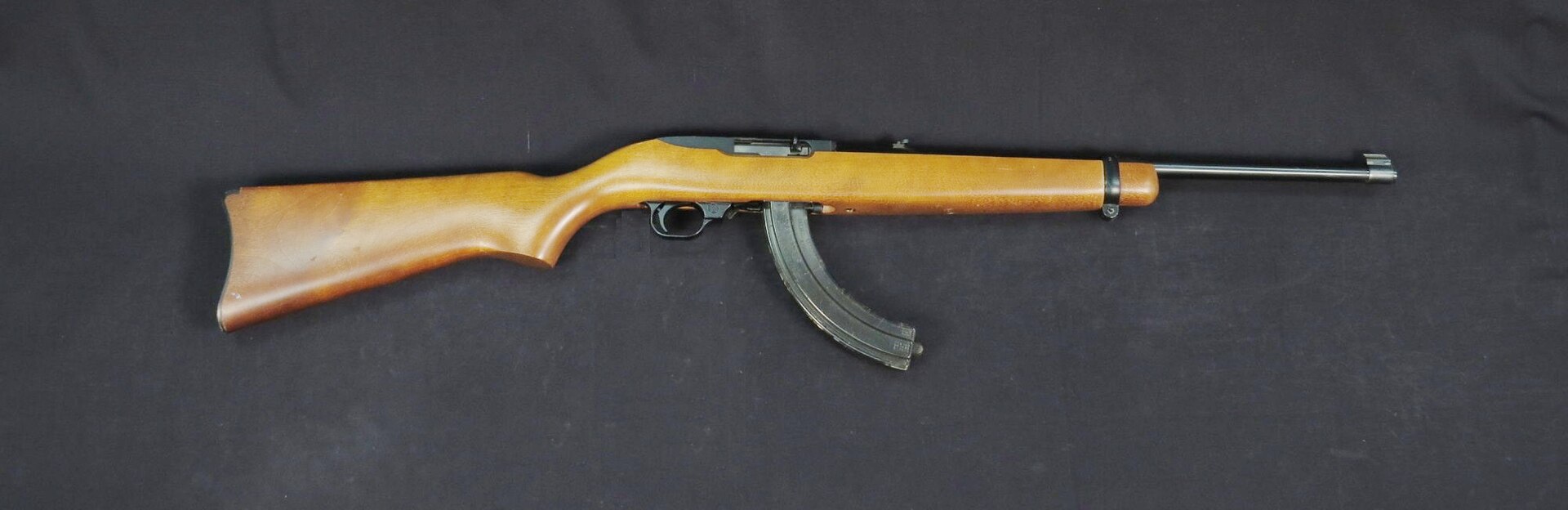
The Ruger 10/22 is the rifle that a great many American shooters fired first, and the one that a great many of them never stopped modifying. It is a straight-blowback .22 Long Rifle autoloader with a cast aluminium-alloy receiver, a barrel held on by a clamp rather than a thread, a trigger housing held in by two cross pins, and a ten-round rotary magazine that sits flush with the stock. Every one of those four facts was a manufacturing decision taken in 1963 and 1964 to hit a retail price, and every one of them turned out, decades later, to be the reason an entire industry could build replacement parts for it.
1.1 What These Volumes Cover
Eight volumes, on the rifle rather than the cartridge.
Table 1 — 1.1 What These Volumes Cover
| Vol | Title |
|---|---|
| 1 | Origins — Bill Ruger, Harry Sefried and a $54.50 Rifle |
| 2 | How It Works — Blowback, the V-Block, the Rotary Magazine and the Decelerator |
| 3 | The Variants — Carbine, Deluxe Sporter, International, Target, Takedown and the Rest |
| 4 | The Aftermarket — What KIDD, Volquartsen and Magpul Parts Actually Change |
| 5 | Building One From Parts — The Receiver Is the Firearm |
| 6 | Accuracy Work — Bedding, Barrel Fit and the V-Block |
| 7 | Keeping It Working — Field Strip, Detail Strip, Maintenance and Repair |
| 8 | The Two Rifles Documented Here — a Deluxe Sporter, a Takedown, and the Suppressor Question |
The ammunition is not covered here. The .22 Rimfire dive owns the cartridge, its chambers (sporting, Bentz and match), its ballistics, the choice of load for a given job, the suppressed .22, and a full working-through of a suppressed 10/22 Takedown as a backpacking rifle in its Volume 11. Suppressor mechanics and suppressor law have their own dives, How Suppressors Work and Suppressor Law. Where this dive touches any of those subjects it links rather than repeats.
Three findings run through what follows, and each is argued from a primary document rather than asserted.
The most popular aftermarket part for this rifle is the one its designer’s patent argues against. Harry Sefried’s patent for the 10/22’s bolt decelerator explains that the bolt stops without bouncing precisely because it is not stopped by “a resilient buffer.” The polyurethane or rubber-sleeved “bolt buffer” that replaces the factory bolt stop pin is fitted to both rifles documented in these volumes. Volume 4 sets the patent’s claim against the buffer makers’ claims and says what each can and cannot be shown to do.
The first modification everyone makes is one Ruger has now made itself. For sixty years the factory bolt lock required a deliberate two-handed press to release, and the manual said this was “designed to prevent accidental release.” The aftermarket automatic bolt release existed to defeat that design. Ruger’s rifles from model number 32000 onward ship with a “match-type bolt lock” that releases with a pull on the handle. Both rifles documented here predate that change.
The barrel-block patent number in circulation is wrong. It belongs to a steam-cooled nuclear reactor. Section 1.5.
1.2 The Rifle in One Table
Table 2 — 1.2 The Rifle in One Table
| 1964, as tested by the NRA | Current catalogue (model 32000 series) | |
|---|---|---|
| Operation | Blowback, semi-automatic | Same |
| Cartridge | .22 Long Rifle | Same |
| Barrel | 18½ in, six grooves, right-hand twist | 16.4 in threaded ½-28, or 18.5 in |
| Barrel attachment | Tenon not threaded; clamped by a V-block and two screws | Same |
| Receiver | Alloy casting, anodised matte black | ”Alloy receiver”, with a rear cleaning port |
| Magazine | 10-round rotary, flush | 10-round rotary (BX-1); 15- and 25-round BX magazines available |
| Trigger | ”About 7 lbs., but let-off is crisp after initial slack” | BX-Trigger, 2.5–3 lb |
| Bolt lock | Manual, press to release | ”Match-type”, pull and release |
| Weight | 5 lb | 4–4.9 lb depending on stock and barrel |
| Length | 36⅞ in | varies with barrel |
| Price | $54.50 (extra magazines $4) | $299–$399 MSRP, standard models |
Extended magazines came from the factory only in April 2011, when Ruger announced the BX-25 with stainless feed lips, a “constant force” spring and the pointed line from its chief executive: “We designed them. We didn’t license and rebrand someone else’s magazines.”1
Sources for the table: the September 1964 American Rifleman test report;2 American Rifleman’s report of the late-2025 update;3 Ruger’s current specification sheets.4
1.3 The .44 Magnum Carbine and the “Same-Sized Companion”
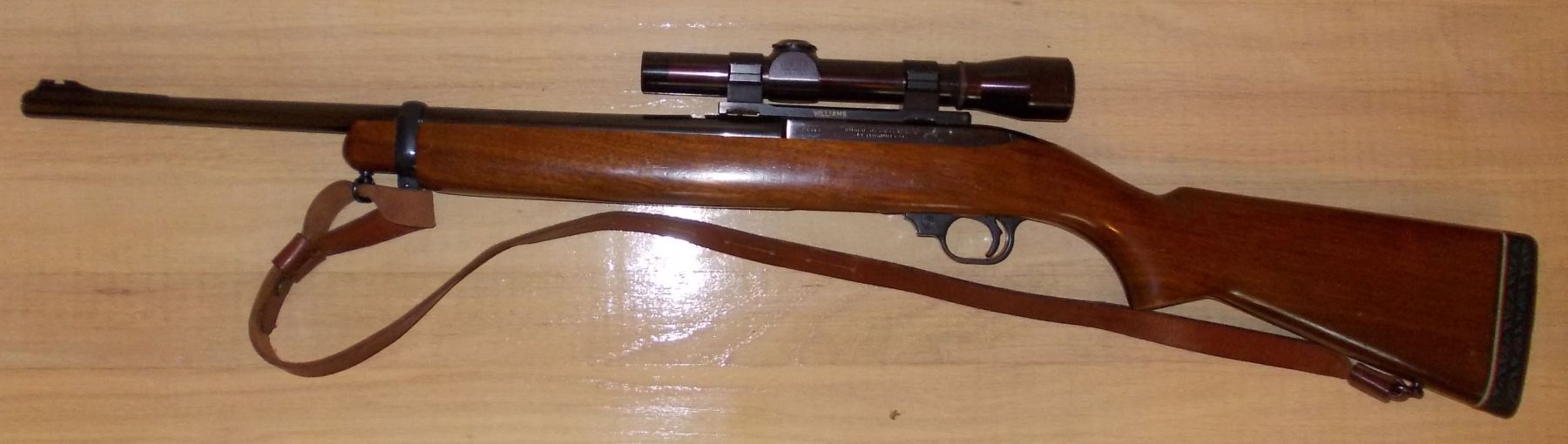
The 10/22 was not conceived as a standalone .22. Ruger had introduced a semi-automatic .44 Magnum carbine a few years earlier, and the rimfire was positioned as its understudy. Walt Kuleck’s history, excerpted by American Rifleman, quotes Ruger’s own positioning of the two as “ideal hunting companions … identical in size, balance and style, and nearly the same in weight,” and states flatly that “the stock of the .22 was externally identical to that of the .44.”5 The 1964 NRA test said the same from the outside: “Externally the Ruger Model 10/22 carbine resembles the Ruger semi-automatic cal. .44 Magnum carbine … However, their operating mechanisms differ greatly.”2
The date of the .44 carbine’s introduction is given differently by two respectable sources and neither is corrected here: the 1964 NRA report says 1961,2 and Shooting Illustrated says 1960.6
What the 10/22 inherited from the .44 was shape and layout, and in one place architecture. The .44, like the M1 Carbine, was held in its stock by a barrel band at the front and a recoil block at the rear. The .22 did not need the recoil block — “because of the minimal recoil of the .22 rimfire cartridge” — and replaced it with a single vertical screw into the bottom of the receiver, which is the takedown screw every 10/22 owner knows.5 The trigger mechanism came across more directly: Kuleck traces it through the .44’s lockwork to the Winchester Model 1905, “albeit with two transverse pins retaining the trigger assembly to the receiver rather than the single pin of the M1 and .44.”5 Those two pins are why the entire fire-control group of a 10/22 comes out as one unit with a punch, and why it can be replaced as one unit (Volume 4).
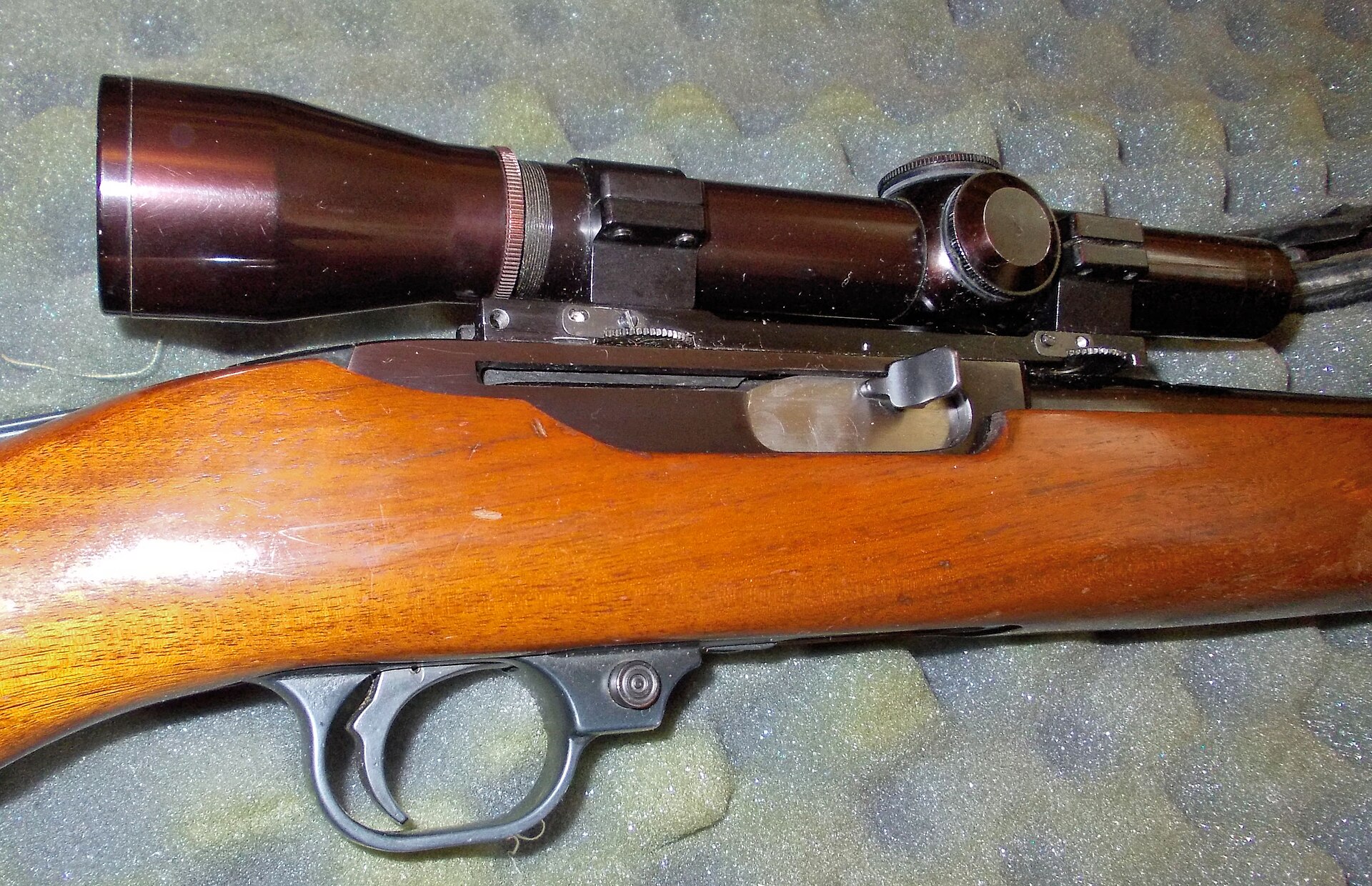
The .44 carbine went out of production in 1985. By then, in Kuleck’s phrase, “the 10/22 emerged as a phenomenon all its own.”5
1.4 Three Inventions and Three Patents
Kuleck organises the rifle’s origin around “three creative innovations: the barrel block, the rotary magazine and the anti-bounce bolt.”5 Two of the three patents were obtained and read for this dive. Their front pages correct the popular account in two small ways and confirm it in a large one.
The rotary magazine — US 3,239,959, “Removable Magazine for Repeating Gun.” The inventors are Harry H. Sefried II and Douglas S. McClenahan, both of Southport, Connecticut, assignors to Sturm, Ruger and Company. It was filed on 24 March 1964 and granted on 15 March 1966.7 Most accounts credit the magazine to Sefried alone;5 the patent names McClenahan as co-inventor. (McClenahan later founded Charter Arms.5) The filing date is worth noticing: Shooting Illustrated dates Ruger’s release of catalogue proofs to the gun press to the same day, 24 March 1964.6
The patent explains what the magazine was for, and it is more specific than “reliable.” A rimmed cartridge in a conventional box magazine sits with its rim behind or in front of its neighbour’s rim, and a rim caught behind the rim below it is the classic .22 double-feed. Sefried and McClenahan’s rotor holds each cartridge in its own “skew pocket,” with the pocket axes inclined “such an amount with respect to the rotor axis that the rim of one cartridge lies ahead of the rim of the next cartridge in the direction of feeding,” so that the cartridges sit “between parallel transverse planes and are not progressively advanced as in a helix.”7 Every round is presented to the bolt at the same angle, and no rim can hook another. Volume 2 follows a round through the magazine.
The bolt decelerator — US 3,240,121, “Self-Loading Guns.” Inventor Harry H. Sefried II, filed 31 August 1964, granted 15 March 1966, assigned to Sturm, Ruger.8 That filing date falls about four months after Ruger’s own letter said production shipments would begin, “early in May.”9 The patent addresses a problem specific to a blowback rifle feeding from a lightly sprung rotary magazine: a bolt that returns too fast outruns the magazine. Its answer is a cam on the rear of the bolt that meets a transverse pin at the back of the receiver and drives the bolt’s tail downward at the end of its travel, converting rearward motion into transverse motion so the bolt stops “smoothly and completely,” with “no tendency for the breechblock to bounce forward.”8 That transverse pin is the part every 10/22 owner knows as the bolt stop pin. Volume 2 explains the mechanism; Volume 4 explains why it matters to the most commonly fitted aftermarket part.
The barrel block. Credited by Kuleck to Bill Ruger himself: “a dovetail arrangement with a barrel clamping block.”5 Section 1.5 is about its patent number.
1.5 A Patent Number That Is a Nuclear Reactor
American Rifleman’s 2020 publication of Kuleck’s history gives the barrel block its own heading: “Patent 3183167: The Barrel Block.”5
United States Patent 3,183,167, granted 11 May 1965, is titled “Steam Cooled Nuclear Reactor.” Its inventor is Norman Bradley of Culcheth, Warrington, England, and its assignee is the United Kingdom Atomic Energy Authority. It describes baffles for draining condensate from the fuel channels of a heavy-water-moderated reactor.10 It has nothing to do with Ruger or with rifles.
The number is therefore wrong, and it is wrong in a place where it will be copied. The correct patent number for the barrel-clamping block was not located for this dive and none is offered in its place. Kuleck places the three patents “in the order of their patent numbers,” with the barrel block first,5 which suggests a number below 3,239,959 — but that is an inference from his ordering, and his ordering was built on the wrong number.
⚠ One further note: Kuleck says the same patent that contained the barrel mounting also described the vertical-screw stock attachment. That too could not be checked.
1.6 The Cost Logic
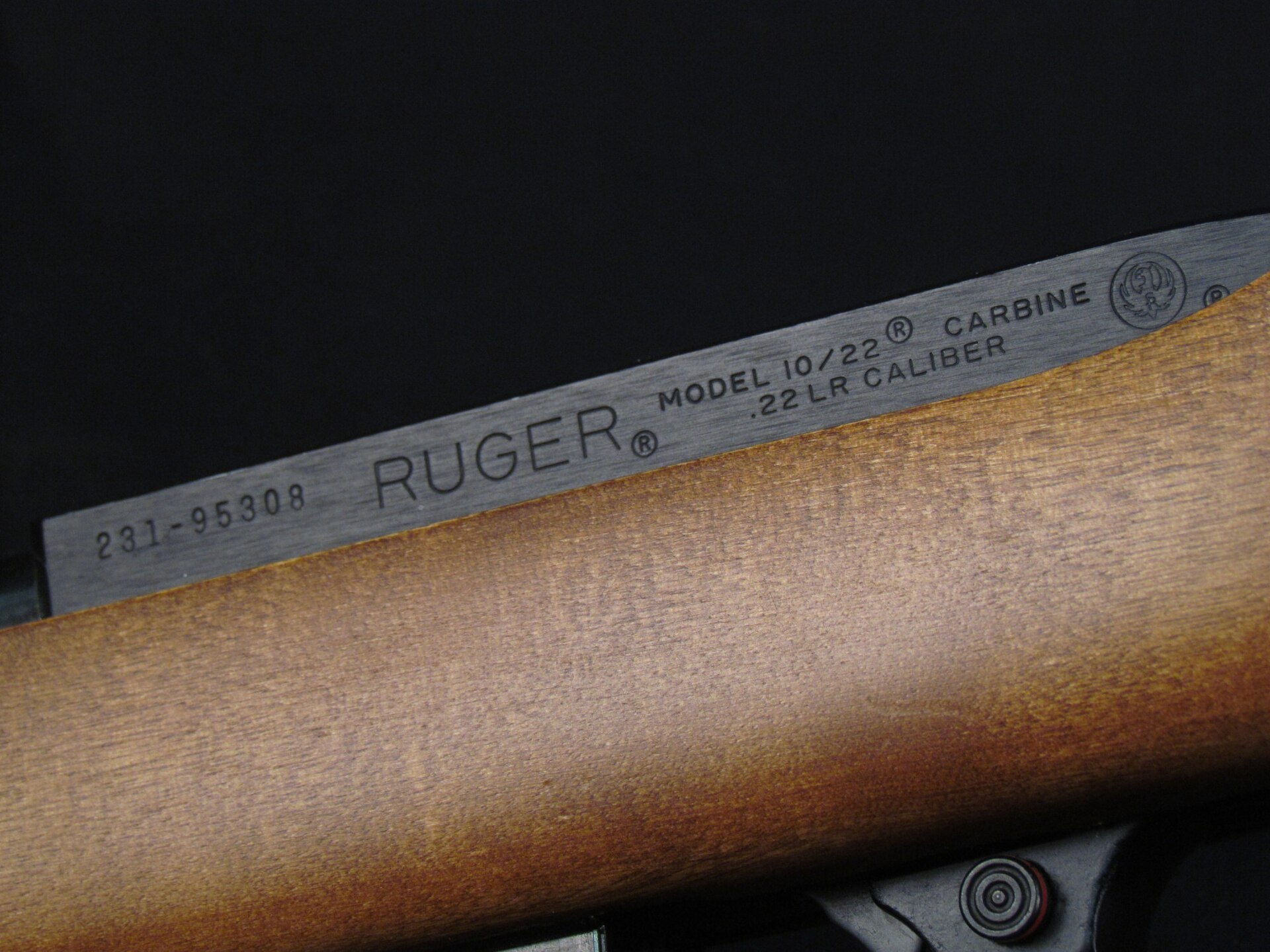
Kuleck’s reading, which his text labels as inference (“must have influenced”), is that the machined-from-billet receiver of the .44 carbine persuaded Ruger to “do the next rifle more simply and less expensively, using investment casting instead of from billet.”5 The stated goal, in the 2014 American Rifleman retrospective, was to “manufacture it with economical processes so that it is available to people of ordinary means.”9
Four decisions carry that logic, and it is worth seeing how each one set up the aftermarket that followed.
A cast alloy receiver. Light, cheap, and needing little machining. ⚠ The sources disagree about the casting process: the 1964 NRA test calls the receiver and trigger guard “lightweight alloy die castings,”2 while Kuleck (2020) and Mark Keefe (2020) both say investment-cast.511 The contemporaneous report and the later histories cannot both be right for the same period, and no source was found that dates a change. The specific alloy is not published by Ruger or by any source consulted, and none is stated here. Ruger’s own manual confirms only “the aluminum alloy receiver and trigger housing.”12
A barrel that is clamped, not threaded. This is the decision with the largest downstream consequences, and its reason was finishing, not convenience of removal. The steel barrel is blued; the aluminium receiver is anodised. Those are incompatible processes, so “you have to finish the barrel and receiver separately before joining them.”5 A threaded joint would then have to be made up after finishing, with the timing, shoulder fitting and action-wrench work that entails. The clamp needed none of it: “No timing or shoulder trimming were required and no vice blocks or action wrenches were necessary.”9 Kuleck is emphatic that “the reason is not ease of barrel removal; the reason is ease of barrel installation.”5 An interference fit between tenon and receiver was tried and “proved to be impractical … and unnecessary.”5 The consequence nobody planned for is that anyone with a hex key can change the barrel, which is the foundation of the entire aftermarket barrel business (Volumes 4, 5 and 6).
A self-contained, pinned trigger housing. “A self-contained housing held into the receiver with stout crosspins,” as the 2014 retrospective has it: “Such modular assemblies made cleaning, maintenance and, later, customization much easier.”9 It is the reason a complete KIDD or Volquartsen trigger unit drops in without fitting.
Castings elsewhere. The 1964 report notes that the magazine’s plastic body carries a “magazine throat [that] is a steel investment casting,”2 and early barrel bands were aluminium castings.9 Which small parts of later rifles are metal-injection moulded is widely asserted and was not confirmed in any Ruger or reputable source; no part is identified as MIM in these volumes.
1.7 The Launch, and the 1964 Test
The 2014 retrospective quotes a letter from Bill Ruger to Jack O’Connor dated 25 March 1964: “I have just received this proof of our new catalogue page and rush it to you herewith … the new 10/22 is one of the best things we have done. We are planning to show the gun at the N.R.A. Show, but will not announce it in our advertising until June … at the moment have only three pilot guns which we are still tuning. Production guns are very near at hand, we should begin shipments early in May.”9 Shooting Illustrated dates the proofs to 24 March;6 the two dates are recorded as given. Ruger’s archive holds 10/22 serial numbers 1, 2 and 3.5
The American Rifleman’s technical staff tested a production carbine for the September 1964 issue, and the report is the best contemporaneous description of the rifle as first sold.2 Price $54.50, extra magazines $4. Weight 5 lb; barrel 18½ in with six-groove right-hand rifling (no twist rate stated); overall 36⅞ in; gold-bead front sight and folding-leaf rear; receiver, trigger guard and barrel band anodised matte black; barrel blued. The trigger pull was “about 7 lbs., but let-off is crisp after initial slack.” Ruger’s own accuracy standard, quoted in the report, was “a 10-shot grouping capability not exceeding 4” extreme spread at 100 yds.”
The testers fired 1,200 rounds of fifteen brands from six makers, and: “There were no malfunctions … neither the gun nor its magazine were cleaned or lubricated during test.”2
For context, the 2014 retrospective lists the competition in 1964: a Browning Auto Grade I at $74.50, a Marlin 99 Deluxe at $53.95, a Remington Nylon 66 at $54.95 and a Winchester 77 at $47.95.9 The 10/22 did not undercut the field. It sat in the middle of it on price and above it on how the rifle felt — a carbine styled like a centrefire deer rifle, with a flush magazine and a centrefire rifle’s barrel band.
Two details of the first rifles recur in collector discussion and are recorded with the disagreement intact: the 1964 report describes a “curved, rifle-style steel buttplate,” while the 2014 retrospective says early guns had “a curved black-anodized aluminum buttplate.”29
1.8 How Many
Three published figures, from three dates, and they are not reconciled here.
Table 3 — 1.8 How Many
| Figure | Source | Date |
|---|---|---|
| ”more than 6 million sold since production began in 1964” | Shooting Illustrated6 | June 2017 |
| ”about 8 million guns … the total production number the folks at Ruger seem comfortable with” | Mark Keefe, American Rifleman11 | October 2020 |
| ”more than 10 million have been produced over the last 60 years” | Jeremiah Knupp, American Rifleman3 | December 2025 |
Ruger’s own product page says only “millions sold over a span of more than half a century.”13
Ruger does publish a serial-number table giving the approximate first serial shipped in each year from 1964 to 2017, and it is how the two rifles in Volume 8 are dated.14 The maker warns explicitly that the table is not a production count: “Ruger does not necessarily produce firearms in serial number order … within a model family the same serial number prefix may be used to produce a variety of different models.”14
1.9 Sixty Years On: What Ruger Changed in 2025 and 2026
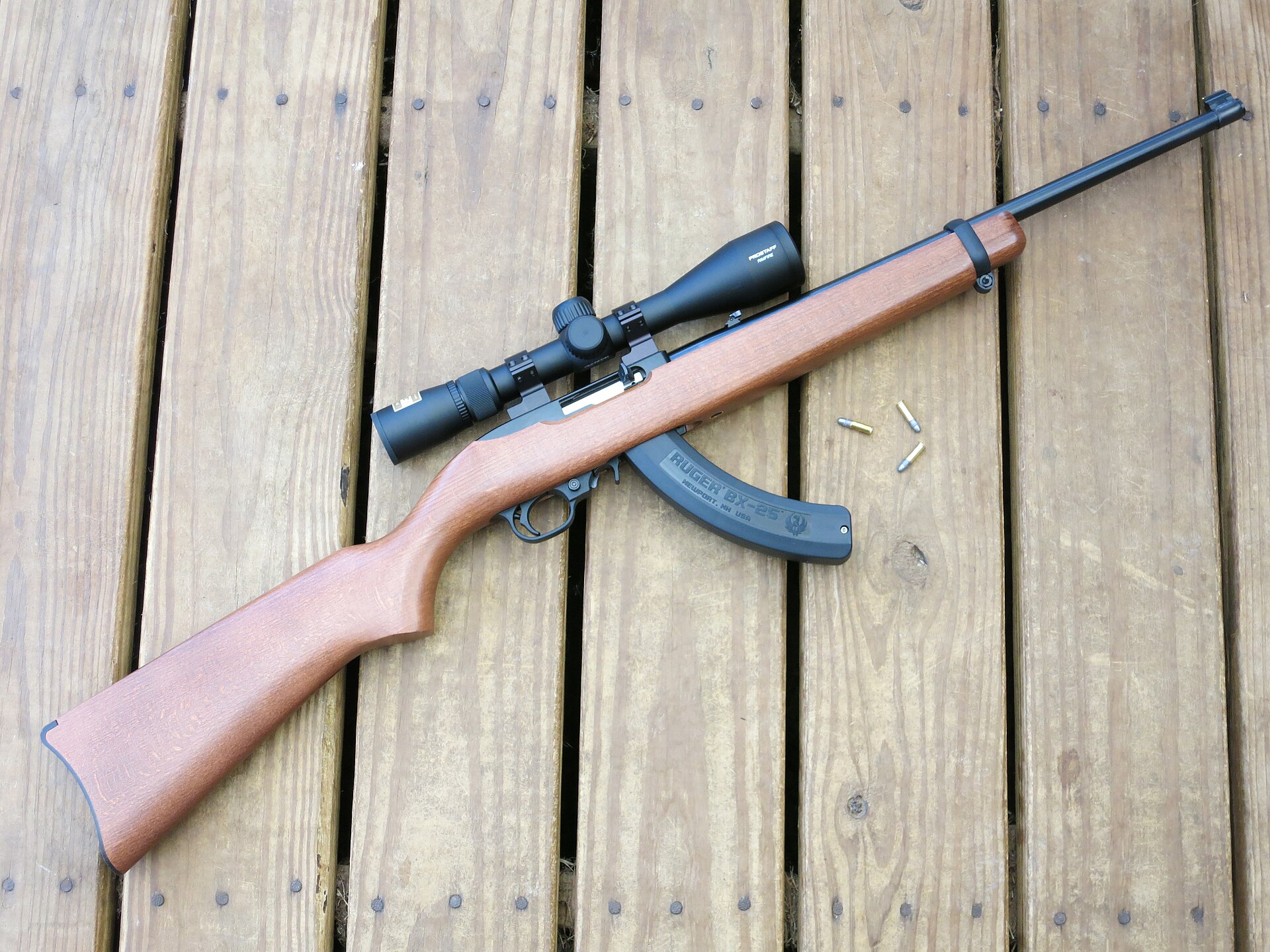
Two recent changes bear directly on the rifles documented in these volumes, because both rifles predate them.
The 2025 standard-line update. In December 2025 American Rifleman reported that Ruger had made three features standard across the 10/22 line that had previously been reserved for special models or sold as aftermarket parts: the BX-Trigger (“a pull weight between 2.5 and 3 lbs.”), a “match-type bolt lock” that “allows a bolt that has been manually locked to the rear to be released with a simple pull-and-release of the charging handle,” and a cleaning port in the rear of the receiver, so the bore can finally be cleaned from the breech.3 Ruger’s new manual, which applies “only to 10/22 rifles with model numbers 32000 and higher,” says it plainly: “Retracting the bolt will disengage the bolt lock.”15 The manual for earlier rifles says the opposite, and says why: “Simply retracting the bolt will not disengage the lock … This is designed to prevent accidental release of the bolt from its open position.”16
That reversal is the clearest single piece of evidence of how far the aftermarket shaped this rifle. The first part almost every owner of an older 10/22 buys — including the owner of both rifles in Volume 8 — is a part that turns the old lock into the new one. Volume 2 explains the old lock; Volume 4 the fixes.
The 2026 short-barrelled rifles. On 19 January 2026 Ruger announced 10/22 SBRs: model 33000, with an 8-inch barrel, and model 33001, a Takedown with a 10-inch barrel “tensioned in aluminum alloy barrel sleeve.”17 Both have the BX-Trigger, the match bolt release and ½-28 threaded cold-hammer-forged barrels; MSRPs are $649 and $799.18 Ruger’s announcement does not mention the tax, but the timing is not a coincidence that needs arguing: Public Law 119-21 set the National Firearms Act making and transfer tax on short-barrelled rifles and suppressors to $0 for applications from 1 January 2026, and the SBRs were announced nineteen days later. The Suppressor Law dive sets out exactly what that law changed and what it did not — registration, approval and the wait all remain. Volume 8 returns to it for the suppressor planned for one of the rifles documented here.
1.10 Bibliography
Footnotes
-
Sturm, Ruger & Co., “Ruger Introduces 25-Round Magazine for Ruger 10/22,” news release, 29 April 2011. https://ruger.com/news/2011-04-29b.html (accessed 2026-09-19). ↩
-
NRA Technical Staff, “Ruger Model 10/22 Carbine,” The American Rifleman, September 1964, reprinted as “Throwback Thursday,” American Rifleman, 23 October 2014. https://www.americanrifleman.org/articles/2014/10/23/throwback-thursday-ruger-model-1022-carbine-sept-1964-the-american-rifleman/ (accessed 2026-09-19). Price, specification, trigger pull, accuracy standard, die-cast receiver, 1,200-round test, .44 carbine date of 1961, steel buttplate. ↩ ↩2 ↩3 ↩4 ↩5 ↩6 ↩7 ↩8
-
Jeremiah Knupp, “Updating A Legend: Ruger Makes 10/22 Upgrades Standard,” American Rifleman, 30 December 2025. https://www.americanrifleman.org/content/updating-a-legend-ruger-makes-10-22-upgrades-standard/ (accessed 2026-09-19). BX-Trigger, match-type bolt lock, rear cleaning port, “more than 10 million,” MSRPs $299–$399. ↩ ↩2 ↩3
-
Sturm, Ruger & Co., 10/22 Standard specification sheets, models 32000–32036. https://ruger.com/products/1022Standard/specSheets/32000.html (accessed 2026-09-19). ↩
-
Walt Kuleck, excerpt from The Ruger 10/22 Complete Owner’s and Assembly Guide, published as “The Ruger 10/22: History & Design,” American Rifleman, 22 October 2020. https://www.americanrifleman.org/content/the-ruger-10-22-history-design/ (accessed 2026-09-19). Source of the “Patent 3183167” heading corrected in §1.5. ↩ ↩2 ↩3 ↩4 ↩5 ↩6 ↩7 ↩8 ↩9 ↩10 ↩11 ↩12 ↩13 ↩14 ↩15 ↩16
-
“The Ruger 10/22: A Classic Rimfire Rifle,” Shooting Illustrated, 15 June 2017. https://www.shootingillustrated.com/articles/2017/6/15/the-ruger-1022-a-classic-rimfire-rifle (accessed 2026-09-19). 24 March 1964 catalogue proofs; .44 carbine date of 1960; “more than 6 million.” ↩ ↩2 ↩3 ↩4
-
H. H. Sefried II and D. S. McClenahan, “Removable Magazine for Repeating Gun,” US Patent 3,239,959, filed 24 March 1964, granted 15 March 1966, assigned to Sturm, Ruger and Company. Read from the patent document, https://patentimages.storage.googleapis.com/pdfs/US3239959.pdf (accessed 2026-09-19). ↩ ↩2
-
H. H. Sefried II, “Self-Loading Guns,” US Patent 3,240,121, filed 31 August 1964, granted 15 March 1966, assigned to Sturm, Ruger and Company. https://patentimages.storage.googleapis.com/pdfs/US3240121.pdf (accessed 2026-09-19). ↩ ↩2
-
“Ruger’s 10/22: ‘One of the Best Things’ For 50 Years,” American Rifleman, 22 October 2014. https://www.americanrifleman.org/articles/2014/10/22/rugers-1022-one-of-the-best-things-for-50-years (accessed 2026-09-19). Quotes the Ruger–O’Connor letter of 25 March 1964; 1964 competitor prices; aluminium buttplate. ↩ ↩2 ↩3 ↩4 ↩5 ↩6 ↩7 ↩8
-
N. Bradley, “Steam Cooled Nuclear Reactor,” US Patent 3,183,167, filed 18 November 1960, granted 11 May 1965, assigned to the United Kingdom Atomic Energy Authority. https://patentimages.storage.googleapis.com/pdfs/US3183167.pdf (accessed 2026-09-19). ↩
-
Mark Keefe, “The Keefe Report: The Ubiquitous Ruger 10/22,” American Rifleman, 22 October 2020. https://www.americanrifleman.org/content/the-keefe-report-the-ubiquitous-ruger-10-22/ (accessed 2026-09-19). ↩ ↩2
-
Sturm, Ruger & Co., Instruction Manual for Ruger 10/22 Autoloading Rifles, PM058, B 4/2025 R40, “Maintenance of Stainless Steel Rifles,” p. 35. ↩
-
Sturm, Ruger & Co., 10/22 overview. https://ruger.com/products/1022/overview.html (accessed 2026-09-19). ↩
-
Sturm, Ruger & Co., “10/22 Serial Number History.” https://ruger.com/service/productHistory/RI-10-22.html (accessed 2026-09-19). ↩ ↩2
-
Sturm, Ruger & Co., Instruction Manual for Ruger 10/22 Autoloading Rifle, PM1269, 10/22 6/2026 R1, “The Bolt Lock,” pp. 14–15. https://ruger-docs.s3.amazonaws.com/_manuals/Ruger_1022.pdf (accessed 2026-09-19). ↩
-
Ruger PM058 (note 11), “The Bolt Lock,” p. 15. ↩
-
Sturm, Ruger & Co., news release, 19 January 2026. https://ruger.com/news/2026-01-19.html (accessed 2026-09-19). ↩
-
Sturm, Ruger & Co., specification sheets for models 33000 and 33001. https://ruger.com/products/1022sbr/specSheets/33000.html ; https://ruger.com/products/1022sbr/specSheets/33001.html (accessed 2026-09-19; MSRPs as displayed that day). ↩
Comments (0)