Ruger 10/22 · Volume 5
Building One From Parts — The Receiver Is the Firearm
Buying a receiver, assembling a complete rifle from aftermarket parts, and what a lab-made receiver has to get right
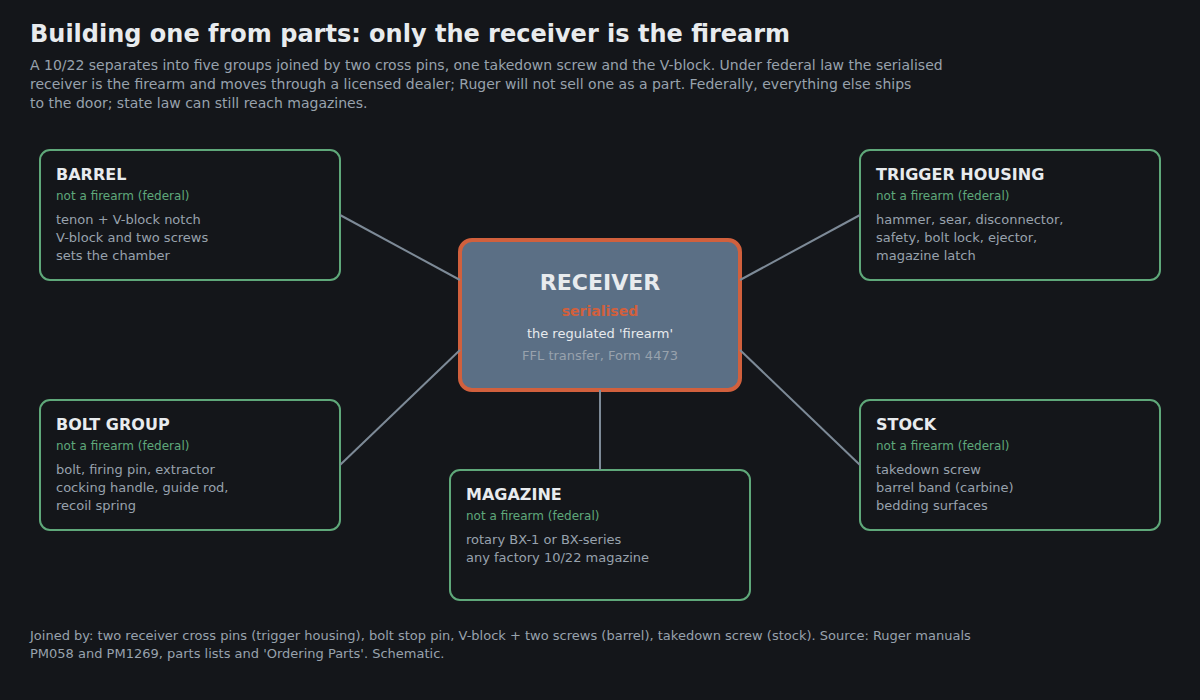
Volume 4 treated aftermarket parts one at a time, as upgrades to a factory rifle. This volume treats them as a kit. A 10/22 can be built with no Ruger part in it at all, and the only step that involves the law is acquiring the receiver. For a shop with CNC mills, the receiver itself is within reach too, and Section 5.6 sets out what it must get right.
5.1 The Part That Is the Firearm
Federal regulation defines the regulated part of a rifle by function. Under 27 CFR § 478.12(a)(2), the receiver of a rifle is “the part of a rifle … that provides housing or a structure for the primary component designed to block or seal the breech prior to initiation of the firing sequence (i.e., bolt, breechblock, or equivalent).”1 On a 10/22 that is unambiguous: the bolt rides in the receiver, and the receiver is the only part that houses it. The trigger housing, which holds the hammer and sear, is a separate assembly and is not the receiver.
Ruger says the same thing in its parts policy: “Because the receiver is a serial numbered component, it is defined as a ‘firearm’ by Federal law and is not sold as a separate component.” Every Ruger parts list carries the same line: “The receiver is a serial-numbered part and is not offered for sale.”23
Three consequences shape a build:
- Everything except the receiver ships to the door, federally. Barrels, bolts, trigger units and stocks are parts. (State law can reach some parts — magazine capacity in particular; Ruger’s own store lists states to which it will not ship its 25-round magazine.4)
- The receiver moves through a licensed dealer, with a Form 4473 and a background check, like any firearm.
- An unfinished receiver is not automatically outside the definition. The same section reaches “a partially complete, disassembled, or nonfunctional frame or receiver … that is designed to or may readily be completed … to function as a frame or receiver.”1 Where that line falls is worked through, with the regulation’s own wording, in the AR-15 5.56 dive’s Volume 2; the rule survived a facial challenge in the Supreme Court in Bondi v. VanDerStok (26 March 2025), as the P320 dive’s Volume 2 records.
5.2 Buying a Receiver
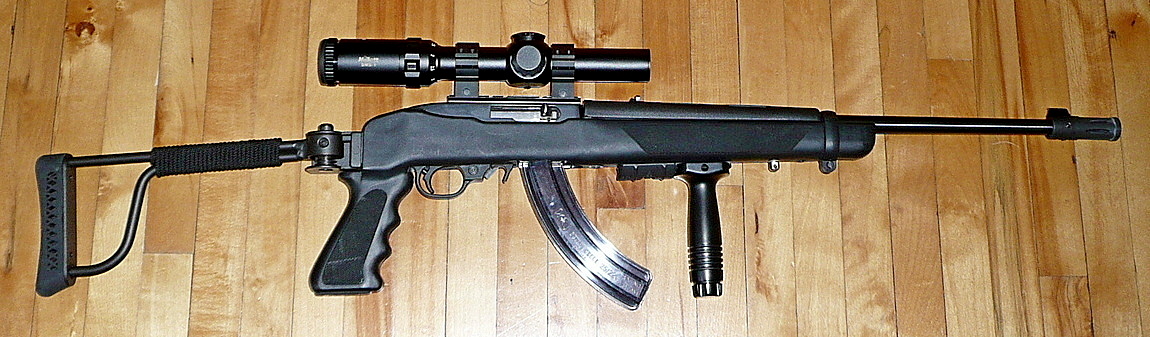
Two makers’ receivers, by their own specifications on 19 September 2026.
KIDD Classic II (“KIDD Aftermarket Silver .22LR Receiver Classic II Slip Fit Model,” KIDD-22RECVR-CLS-S; black also listed; $353).5
- “Billet 6061-T6 aluminum”; “slip-fit 10/22-style receiver with industry-standard dimensions.”
- “Built-in rear cleaning hole” — the feature Ruger added to its own standard line in 2025.
- “V-Block Included.”
- An “interchangeable low-profile scope base system (Zero MOA installed; optional 20, 30, 40 or 50 MOA available)” — KIDD’s own base, not specified on the page as a Picatinny rail.
- A “Quick Locking Handle upgrade for fast bolt hold open,” using KIDD’s Quick Lock handle, which works “only … on KIDD receivers with serial numbers 026-1280 and above.”6
- “Drops into any 10/22-inletted stock with no modification.”
- Options: rear tang, takedown screw, bolt buffer, threaded receiver pins.
- Transfer: “This receiver must ship to your local FFL dealer”; KIDD verifies the dealer’s licence with ATF; “you must visit your FFL in person to complete Form 4473”; “Federal law requires buyers to be 21 or older.” That age is the one federal law sets for a licensed dealer’s sale of a firearm that is not a rifle or shotgun; a bare receiver is not yet either.
KIDD sells its receivers and complete rifles through a second website, coolguyguns.com, and explains why: “PayPal has many restrictions regarding the purchase of firearms.”7
Volquartsen Replacement Receiver — “a drop-in replacement for the factory 10/22 receiver. It comes complete with take-down action screw, V-locking block with retaining screws, recoil buffer, and trigger guard cross pins.”8
- Superlite anodised aluminium, black (VCFT-AB), $336, approximately 9 oz.
- Stainless steel (VCFT-SS) or stainless matte black (VCFT-SSB), $449, approximately 1 lb 5 oz.
- Versions with a universal red-dot mount (VCFT-0001, -0002, -0003).
- “Removable Picatinny Rail, 0 MOA.”
Neither maker publishes the tenon bore diameter or any other receiver dimension on the product page. KIDD’s phrase “industry-standard dimensions” is a claim of interchangeability with the factory pattern, not a published standard.
A stainless receiver weighs more than twice an aluminium one (Volquartsen’s own figures), and on a blowback rifle the receiver’s mass is not part of the reciprocating system, so the choice is about stiffness, finish and balance rather than function.
5.3 The Parts List for a Complete Rifle
Every group from the diagram above, with a source for each option in Volume 4.
Table 1 — 5.3 The Parts List for a Complete Rifle
| Group | Parts | Notes |
|---|---|---|
| Receiver | Receiver; V-block and two screws (included by both makers above); takedown screw; two receiver cross pins; bolt stop pin or buffer | Via a dealer |
| Barrel | Barrel with 10/22-pattern tenon and V-block notch | Chamber choice is the .22 Rimfire dive’s Volume 4: sporting, Bentz, or a maker’s own reamer |
| Bolt | Complete bolt with firing pin and extractor, e.g. KIDD at 6.5 oz; or a factory bolt with aftermarket pin and extractor | Protrusion and headspace are the bolt maker’s claim until checked (Section 5.5) |
| Charging assembly | Cocking handle, guide rod and recoil spring — e.g. a KIDD handle on a KIDD guide rod kit, with three springs | The handle and rod are one assembly (Volume 4 §4.6) |
| Trigger | Complete unit: KIDD single- or two-stage, Volquartsen TG2000, or Ruger BX-Trigger | A complete unit brings its own bolt release and ejector |
| Stock | Any stock inletted to the factory pattern — takedown receivers need takedown stocks | Bedding in Volume 6 |
| Magazine | Ruger BX-1, BX-15 or BX-25 | ”Compatible with all capacities of factory Ruger 10/22 magazines,” says Magpul of its stock |
Barrels. Two examples of what the aftermarket sells, by the makers’ pages:
- KIDD .22LR Lightweight Fluted Aluminum Sleeved Barrel, $435 (+$60 threaded ½-28): “Bored & rifled by Lothar Walther (Germany), finished and hand-machined by Tony Kidd with a proprietary chamber reamer”; a stainless core in a fluted aluminium sleeve, .920 in for the first 2 inches, then .876 in; 1:16 twist; “11° crown + double ring”; 18 in at 2 lb; a “precision convex extractor slot”; a guarantee of “½” at 50 yards (5-shot group).”9
- Volquartsen Lightweight Carbon Fiber Barrel, $394: “A stainless steel barrel fitted with a woven carbon fiber tube … The rigidity of the carbon fiber tube allows us to put the barrel in tension, minimizing barrel vibrations typically found on smaller barrel diameters”; laser-hardened breech.10
Ruger’s own SBR Takedown uses the same idea — a barrel “tensioned in aluminum alloy barrel sleeve.”11 Volume 6 explains why tensioned and sleeved barrels exist at all.
5.4 Assembly, in Order
Ruger publishes a reassembly sequence for its own rifle, and a build from parts follows it. The steps below are Ruger’s (PM058 and PM1269), with the build-specific points from the parts makers added and attributed. Nothing is added from memory.23
1. Barrel into receiver. Clean the receiver bore first. KIDD: “If using another brand of receiver clean paint/build-up from the receiver mortise before installing.”9 Then, per Ruger: “Insert the barrel into the receiver. Place the barrel retainer v-block into the notch in the bottom of the barrel. Insert the two barrel retainer screws through the holes in the barrel retainer v-block and into the receiver, then hand tighten them until they are securely in place. CAUTION: Do not over tighten.”3 KIDD gives a figure for its own barrels: “When properly fitted, v-block screws only need to be snug (~10 in-lb).”9 Ruger gives none.
2. Charging assembly. Receiver bottom up. Ruger: “position the rear end (cone pointed) of the recoil spring guide rod in the mating recess near the rear right side of the receiver. The recoil spring must be flat against the side and ‘bottom’ of the receiver.” Hold the handle rearward and compress the spring — Ruger’s older manual uses “the flat side of the screwdriver blade.”2
3. Bolt. With the spring held compressed, “lay the recessed section of the top of the bolt on the section of the cocking handle that mates with it. Press down on the bolt until a ‘click’ is heard,” then let the handle carry the bolt forward slowly. “Cycle the cocking handle a few times to be certain the components are correctly assembled.”2 KIDD’s bolt is installed “after the charging assembly is installed.”12
4. Bolt stop pin or buffer. Ruger: “Install the bolt stop pin.” For KIDD’s buffer, the maker’s order differs: “Install the cocking handle and bolt before inserting the bolt buffer,” tubing first from the inside of the receiver outward, then the steel pin through the tubing.13
5. Trigger unit. “Lay the trigger guard in place and install the two receiver pins. NOTE: Be sure the ejector is held in the ejector slot as you set the trigger guard in place.”2 This is the step that most often goes wrong: an ejector out of its slot means a rifle that does not eject.
6. Stock. Centre the safety — “an equal amount of the button exposed on each side,” or the stock will be damaged — lower the action in, and hand-tighten the takedown screw. PM1269: “Do not over tighten the takedown screw.”3 Watch that the cross pins and bolt stop pin do not walk out while the action is out of the stock; the stock is what holds them in.
7. Optic base. Ruger’s rules in Volume 4 §4.9 apply to any receiver with the factory hole pattern: correct screwdriver, 12–15 in-lb, no thread locker.
5.5 The First Function Check and the First Rounds
Ruger’s function check, from the manual, is the minimum for any build, done with the rifle empty and pointed in a safe direction:2
- Bolt. “Pull the bolt fully to the rear and release it. The bolt should operate smoothly and travel freely within the receiver without binding.” Three times.
- Safety. Cock; safety on; pull the trigger — “the trigger should not move and the hammer should not fall.” Safety off; pull — the hammer falls. Three times. The safety must click in both positions.
- Bolt lock. Lock the bolt open and release it, per whichever release the build uses.
Then the first rounds. Three checks are specific to a rifle assembled from parts from several makers:
- Fired cases. Ruger’s own inspection rule: “If they have bulged heads or frequently show splits on any part of the case, the firearm should be returned to the factory for inspection.”3 On a mixed-maker build there is no factory to return it to; bulged heads mean excess headspace between that bolt and that barrel, and the rifle should not be fired again until it is resolved.
- Firing-pin indent. A rim struck lightly or off-centre points at pin protrusion or a pin binding. Neither KIDD nor Volquartsen publishes a protrusion figure (Volume 4 §4.4), so the fired rim is the only check without a gauge.
- Feeding from a full magazine. Blowback timing is bolt mass against spring force (Volume 2 §2.1). A new bolt, a new spring and a buffer together change all three variables at once. Feed a full magazine of the ammunition the rifle will actually use.
5.6 Making the Receiver in the Lab
The law first. Federal regulation defines a privately made firearm as “a firearm, including a frame or receiver, completed, assembled, or otherwise produced by a person other than a licensed manufacturer, and without a serial number placed by a licensed manufacturer at the time the firearm was produced.”14 The definition presupposes that such firearms exist lawfully; a licence is required to be engaged in the business of manufacturing firearms, not to make one for personal use. The federal position on personal-use builds, and what changes when making for sale, is set out with its sources in the FP-45 Liberator replica dive’s Volume 4 and is not repeated here. A semi-automatic .22 rifle with a barrel of 16 inches or more is not an NFA item.
⚠ Michigan’s treatment of privately made firearms was not verified from statute for this dive. It must be checked against current Michigan law before a receiver is made, and the answer should be recorded in the dive when it is.
What the part must do. No dimensioned drawing of the 10/22 receiver was found from Ruger or from any aftermarket maker, and none is invented here. What can be stated is what the receiver has to provide, from the mechanism in Volume 2 and the parts it must accept — the functional requirements a drawing would have to satisfy.
Table 2 — 5.6 Making the Receiver in the Lab
| Feature | What it must do | Source of the requirement |
|---|---|---|
| Barrel bore | Accept the tenon in a slip fit, concentric and square to the bolt’s path; this fit is the barrel alignment | V-block design; KIDD on droop and “tenon/shoulder fit”9 |
| Front face and V-block screw holes | Two tapped holes below the bore, parallel to it, and a front face square to the bore for the block to seat against | Ruger’s manual photographs; Volume 2 §2.9 |
| Bolt rails and roof | Guide the bolt; the patent has the bolt’s forward part bear on “support surfaces” and its rear part on lower ones | US 3,240,12115 |
| Decelerator clearance | A transverse hole for the bolt stop pin at the rear, and a recess below the rails into which the tail of the bolt is thrust | US 3,240,121 |
| Guide-rod pocket | A mating recess near the rear right for the cone-pointed end of the guide rod | Ruger PM0582 |
| Ejection port | On the right, clear of the ejector’s arc | — |
| Magazine well | A transverse opening, open below; a close-fitting bore in the forward wall for the magazine’s pin; the latch engages the rear | US 3,239,95916 |
| Trigger housing | Two cross-pin holes, and a slot for the ejector | Ruger parts list |
| Stock | Tapped hole for the takedown screw; rear face to bear on the stock mortise | 1964 test report17 |
| Optic | Four tapped holes (factory pattern) or an integral rail | Ruger PM058 |
Material. Both makers in Section 5.2 use 6061-T6 or stainless billet for their machined receivers; Ruger’s own machined Competition receiver is aluminium, “heat treated and stress relieved.”18 A billet receiver needs no casting and no heat treatment of the alloy beyond buying T6 stock.
How to get the dimensions. In the absence of a published drawing, the practical route for a lab is to measure a factory receiver — and an aftermarket barrel’s tenon — with the barrel and bolt as the gauges: the receiver’s job is to hold the barrel concentric to the bolt’s path and to present the magazine to the bolt at the right height. The magazine’s pin bore and the bolt-rail height relative to the bore are the two dimensions where a small error becomes a feeding failure.
5.7 Which Other Parts a Lab Should Make
Not every part in a 10/22 is a sensible thing to make even in a well-equipped shop.
- Receivers, V-blocks, stocks and scope bases are straightforward machined parts in non-heat-treated alloy, and the obvious candidates.
- Barrels can be made, but the chamber is the accuracy. The makers in Section 5.3 buy bored and rifled blanks and cut the chamber with their own reamers. A lab building one should do the same — a blank, a chamber reamer of a known pattern, and a gauge.
- Bolts, extractors, firing pins, hammers and sears are hardened small parts whose makers publish tolerances of a few ten-thousandths and hardnesses of Rc 56–60 (Volume 4). Both KIDD and Volquartsen cut them by wire EDM. Ruger does not let even its own customers fit a hammer, sear or trigger: they are “factory fit … on an exchange basis only.”3 A hardened fire-control part made without the means to cut, harden and inspect it properly is the one part of this rifle that can make it unsafe rather than merely inaccurate. Buy these.
5.8 Bibliography
Footnotes
-
27 CFR § 478.12, “Definition of frame or receiver,” paragraphs (a)(2) and (c). https://www.law.cornell.edu/cfr/text/27/478.12 (accessed 2026-09-19). ↩ ↩2
-
Sturm, Ruger & Co., Instruction Manual for Ruger 10/22 Autoloading Rifles, PM058, B 4/2025 R40: Reassembly p. 29; function check pp. 31–32; Ordering Parts and Parts List pp. 43–45. ↩ ↩2 ↩3 ↩4 ↩5 ↩6 ↩7
-
Sturm, Ruger & Co., Instruction Manual for Ruger 10/22 Autoloading Rifle, PM1269, 10/22 6/2026 R1: Minimize Malfunctions p. 26; Reassembly pp. 32–35; Ordering Parts and Parts List pp. 49–50. https://ruger-docs.s3.amazonaws.com/_manuals/Ruger_1022.pdf (accessed 2026-09-19). ↩ ↩2 ↩3 ↩4 ↩5 ↩6
-
ShopRuger, BX-25 Magazine, item 90361, shipping restrictions as listed. https://shopruger.com/BX-25-Magazine/productinfo/90361/ (accessed 2026-09-19). ↩
-
KIDD Innovative Design, “KIDD Aftermarket Silver .22LR Receiver Classic II Slip Fit Model.” https://www.coolguyguns.com/KIDD-Aftermarket-Silver-22LR-Receiver-Classic-II-Slip-Fit-Model_p_251.html ; receivers category https://www.coolguyguns.com/KIDD-Receivers_c_78.html (accessed 2026-09-19). ↩
-
KIDD Innovative Design, KIDD Quick Lock Bolt Handle. https://www.kiddinnovativedesign.com/KIDD-Quick-Lock-Bolt-Handle-Silver_p_554.html (accessed 2026-09-19). ↩
-
KIDD Innovative Design, Receivers & Rifles. https://www.kiddinnovativedesign.com/Receivers-Rifles-link_c_8.html (accessed 2026-09-19). ↩
-
Volquartsen Firearms, Replacement Receiver. https://volquartsen.com/products/887-replacement-receiver (accessed 2026-09-19). ↩
-
KIDD Innovative Design, KIDD .22LR Lightweight Fluted Aluminum Sleeved Barrel. https://www.kiddinnovativedesign.com/KIDD-22LR-Lightweight-Fluted-Aluminum-Sleeved-Barrel_p_137.html (accessed 2026-09-19). ↩ ↩2 ↩3 ↩4
-
Volquartsen Firearms, Lightweight Carbon Fiber Barrel for 10/22 Rifles. https://volquartsen.com/inventory_configurations/3785 (accessed 2026-09-19; backorder that day). ↩
-
Sturm, Ruger & Co., 10/22 SBR specification sheet, model 33001. https://ruger.com/products/1022sbr/specSheets/33001.html (accessed 2026-09-19). ↩
-
KIDD Innovative Design, KIDD Bolt — Silver Matte. https://www.kiddinnovativedesign.com/KIDD-Bolt-Silver-Matte_p_31.html (accessed 2026-09-19). ↩
-
KIDD Innovative Design, KIDD Bolt Buffer. https://www.kiddinnovativedesign.com/KIDD-Bolt-Buffer_p_12.html (accessed 2026-09-19). ↩
-
27 CFR § 478.11, definition of “Privately made firearm (PMF).” https://www.law.cornell.edu/cfr/text/27/478.11 (accessed 2026-09-19). ↩
-
H. H. Sefried II, “Self-Loading Guns,” US Patent 3,240,121 (1966). https://patentimages.storage.googleapis.com/pdfs/US3240121.pdf (accessed 2026-09-19). ↩
-
H. H. Sefried II and D. S. McClenahan, “Removable Magazine for Repeating Gun,” US Patent 3,239,959 (1966). https://patentimages.storage.googleapis.com/pdfs/US3239959.pdf (accessed 2026-09-19). ↩
-
NRA Technical Staff, “Ruger Model 10/22 Carbine,” The American Rifleman, September 1964, reprinted 23 October 2014. https://www.americanrifleman.org/articles/2014/10/23/throwback-thursday-ruger-model-1022-carbine-sept-1964-the-american-rifleman/ (accessed 2026-09-19). ↩
-
Sturm, Ruger & Co., 10/22 Competition specification sheet, model 31110. https://ruger.com/products/1022Competition/specSheets/31110.html (accessed 2026-09-19). ↩
Comments (0)