M40A1 — the Marine Sniper Rifle, and a Clone · Volume 3
M40A3, M40A5, M40A6 — and the End of the Line
An adjustable McMillan A-4, a 30 MOA rail, a variable scope in combat, a threaded muzzle, a folding chassis — and a .300 Win Mag successor
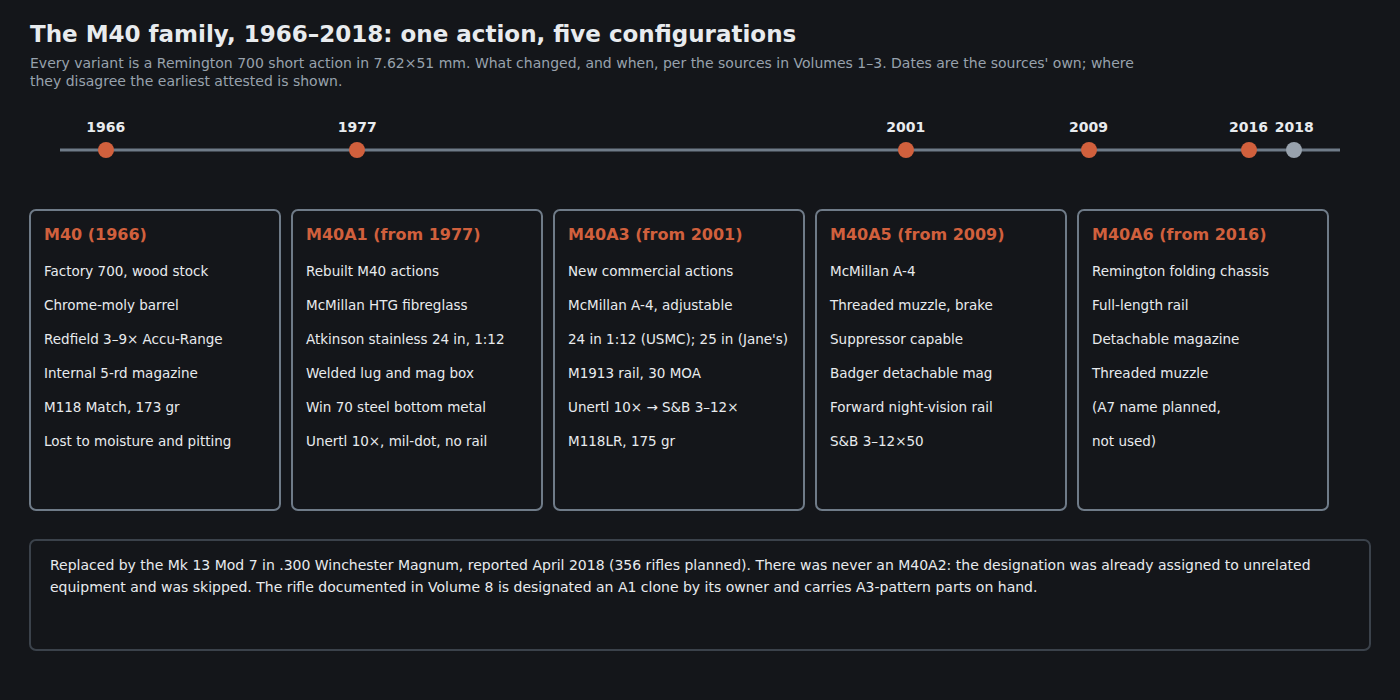
After the A1 the M40 changed faster. In roughly fifteen years the Corps went from a fixed-scope, internal-magazine, bare-muzzled rifle to one with an adjustable stock, a variable scope, a rail, a detachable magazine, a threaded barrel and, finally, a folding chassis — and then replaced the whole family with a rifle in a different cartridge.
This volume covers those changes in order, with dates from the Corps’s own pages and from the makers where they exist. It closes by checking a spec list that circulates among clone builders against those sources, because several of its items are right, one is contradicted by the Corps, and one could not be found at all.
Every rifle in this volume is A3-pattern or later. The rifle documented in Volume 8 is designated an A1 clone by its owner, and several parts on hand for it are A3-pattern — which is exactly why the two patterns need to be kept apart.
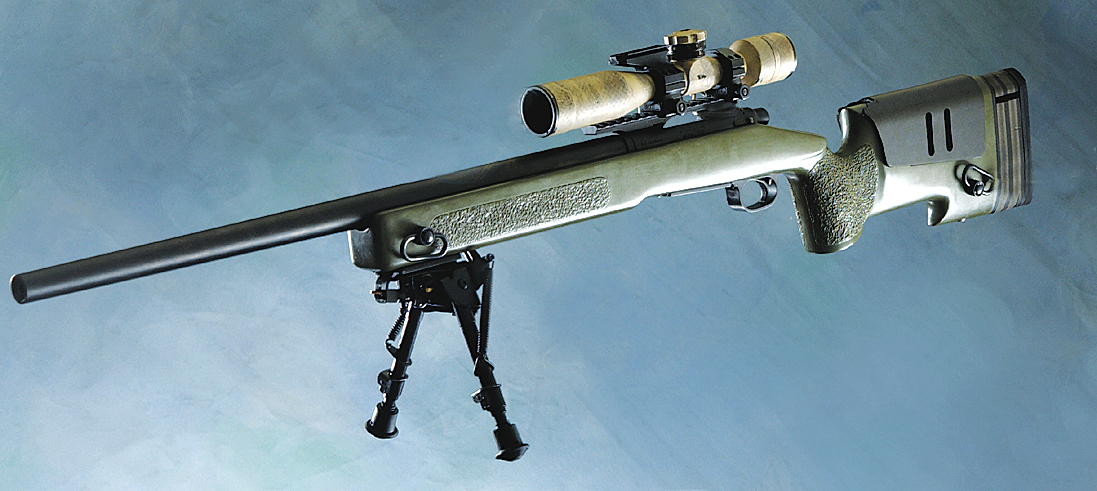
3.1 The Family at a Glance
Table 1 — The Family at a Glance
| M40A1 | M40A3 | M40A5 | M40A6 | |
|---|---|---|---|---|
| In service | from the 1970s (Vol 2) | design from 1996; production from 2001 | superseded the A3 from 2009 | fielding from June 2016 |
| Stock | McMillan HTG, fixed | McMillan A-4, adjustable cheek and length of pull | McMillan A-4 | Remington folding modular chassis |
| Magazine | internal, 5 rds, floorplate | internal, 5 rds; Badger detachable-magazine guard from 2007 | Badger detachable box | detachable box |
| Muzzle | bare, recessed crown | recessed crown (see §“The Threaded-Muzzle Question”) | threaded — muzzle brake, suppressor | threaded |
| Scope mount | Unertl/U.S.O. base, no rail | M1913 rail — 30 MOA per the maker of the replacement part | as A3, plus forward rail for night vision | full-length rail |
| Day scope | Unertl 10× fixed | Unertl 10×, then Schmidt & Bender 3–12×50 | Schmidt & Bender 3–12×50 | Schmidt & Bender 3–12×50 (not confirmed here) |
| Ammunition | M118 Match, 173 gr | M118LR, 175 gr | M118LR | M118LR |
Sources for each cell are in the sections that follow.
3.2 The M40A3 — Designed from 1996
When. The USMC Scout/Sniper Association: “In 1996 the USMC started on the design for the replacement of the M40A1, the result was the M40A3.”1 American Rifleman, writing in February 2001, recorded “30 prototype M40A3 rifles” built in 1999, “600 or so” planned, and production due by June 2001 at the Precision Weapons Facility, Quantico, under its officer in charge, Ken M. Davis; “advanced CNC equipment will yield a new M40A3 rifle every two days”.2
How it replaced the A1. Not by a fleet-wide swap: “As the M40A1’s rotate in for service and repair, they are replaced by M40A3’s. All M40A3s are built by USMC Armorers at Quantico Virginia.”1 The two patterns therefore coexisted in service for years.
The Corps’s own description. The Weapons Training Battalion armory at Camp Lejeune, on its page for the rifle:3
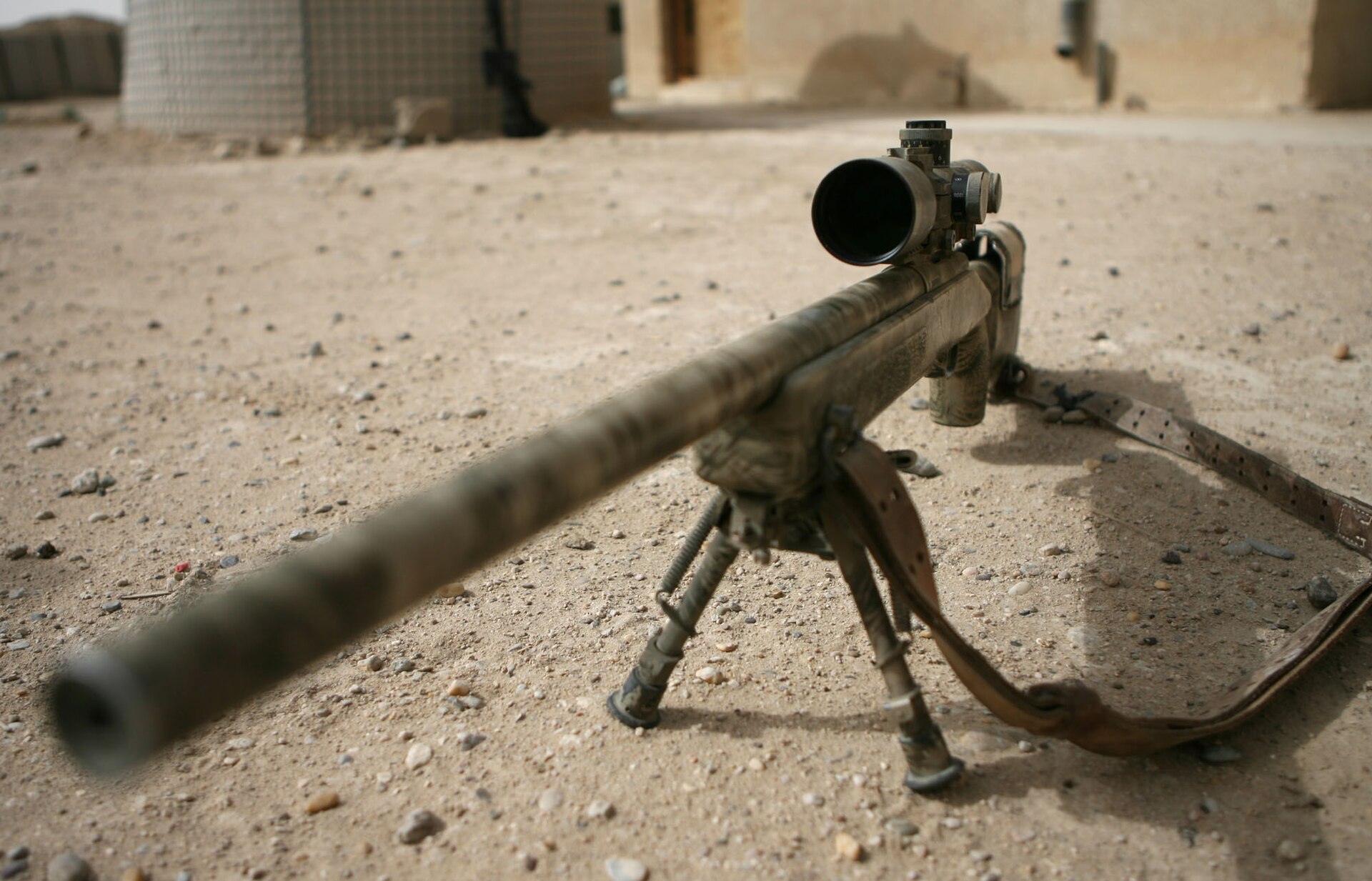
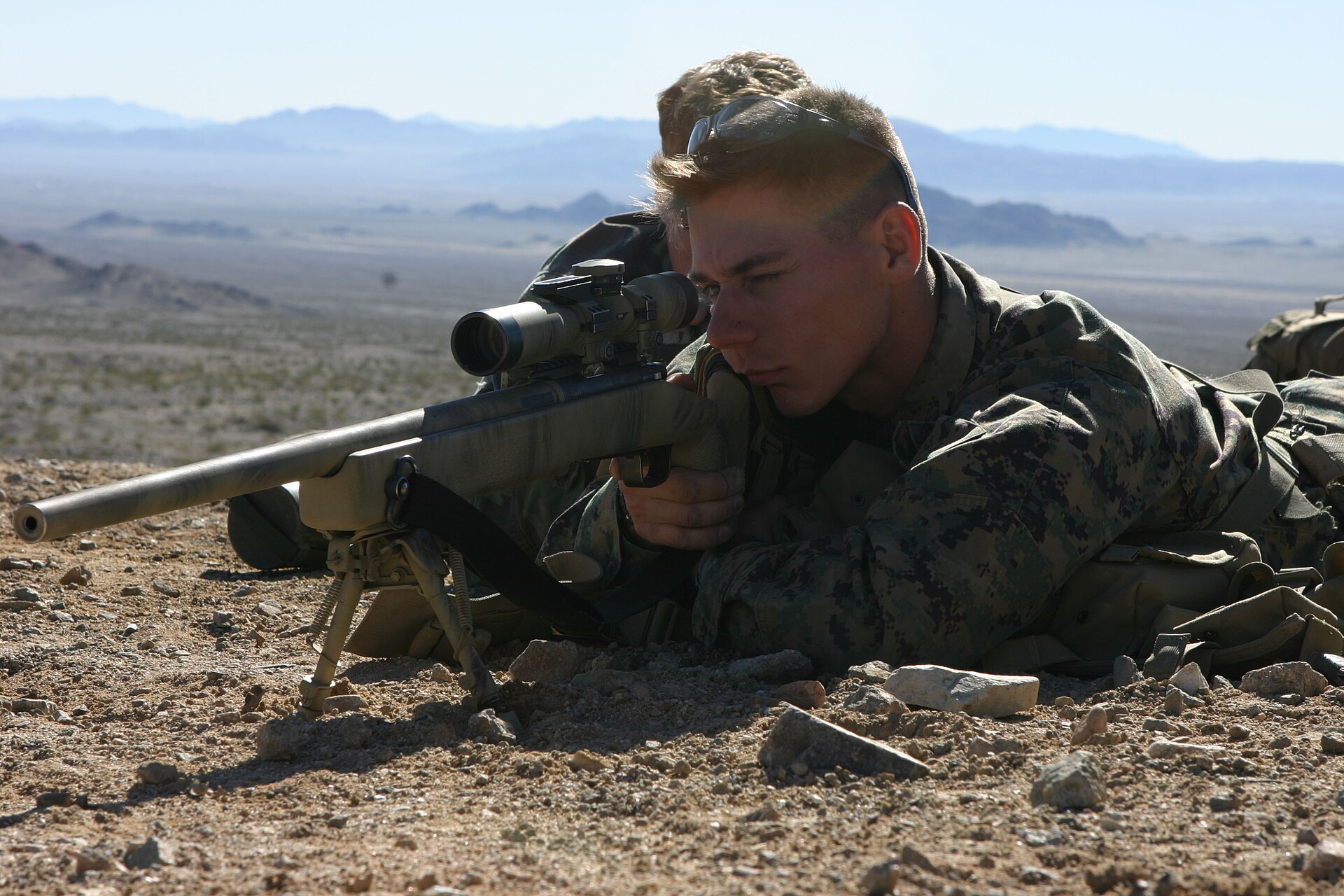
Designed to deliver precise, accurate fire at ranges up to and beyond 1,000 yards with M118LR special ball 7.62mm ammunition. The M40A3 is equipped with a fixed ten power scope or an ANPVS-10 attached to a modular M1913 MIL-SPEC rail; a fiberglass stock adjustable for length of pull and ambidextrous, adjustable cheek piece; a 24 inch 1/12 twist stainless steel barrel with 5 lands and grooves; and a steel floor plate and trigger guard assembly. The magazine box holds five rounds. Additional enhancements include six quick detach sling swivel mounts and a removable, swivel bipod. The M40A3 is hand crafted by precision weapons repairmen assigned to WTBN Quantico, “Built by Marines For Marines”.
Leatherneck (April 2009) gives the A3 as 16.5 lb and 44.3 in, “capable of one minute of angle accuracy”, built by the “Precision Weapons Section, MCB Quantico”.4 American Rifleman’s 2001 figure of 18 lb was “including sound suppressor” — a pre-production description, discussed below.2
3.2.1 The action
“Commercial Remington Model 700 short-action”, per American Rifleman,2 and a “Remington 700 short action” per the Scout/Sniper Association.1 Unlike the A1, the A3 was a new rifle on new commercial actions, not a rebuild of the originals.
3.2.2 The stock — the McMillan A-4
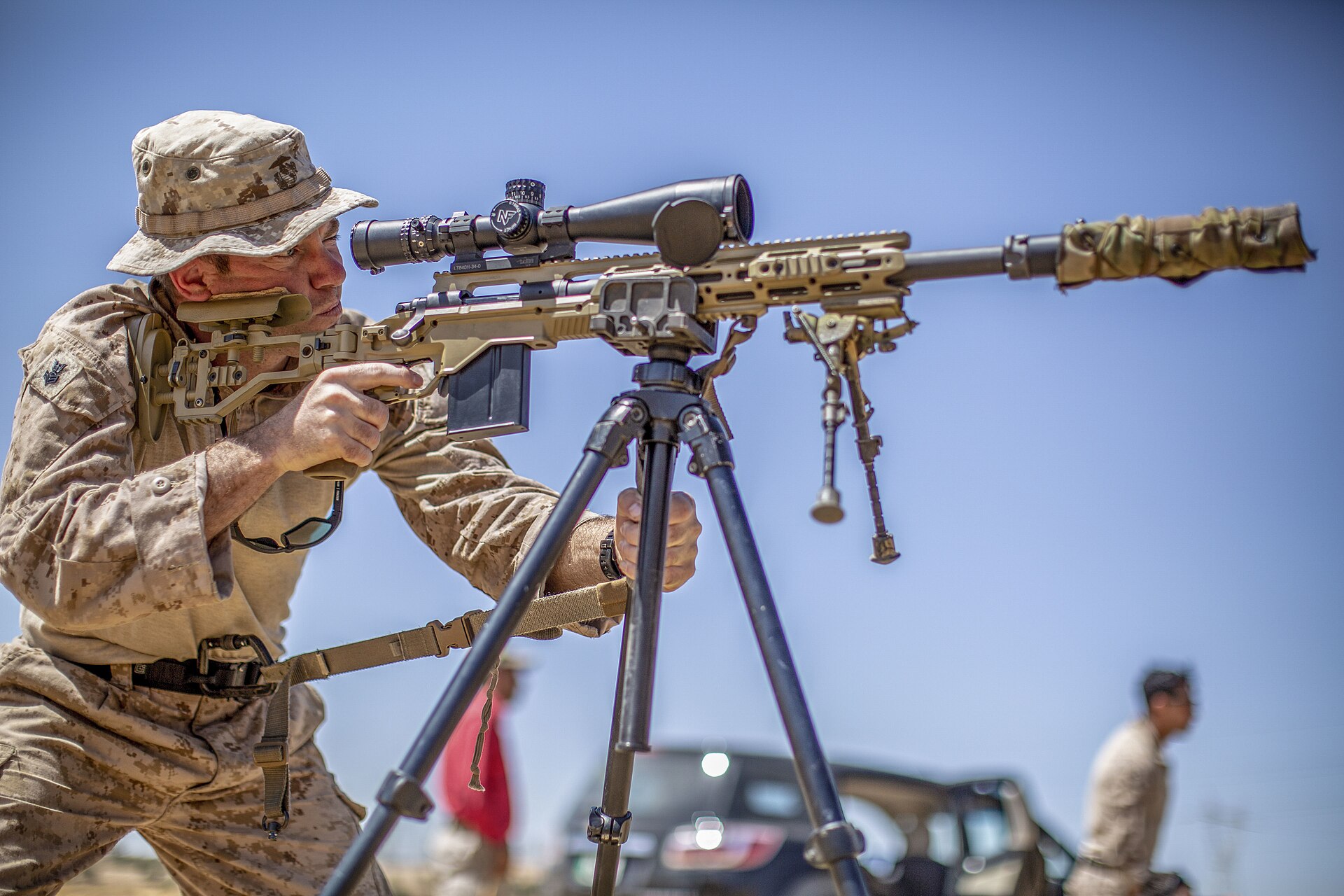
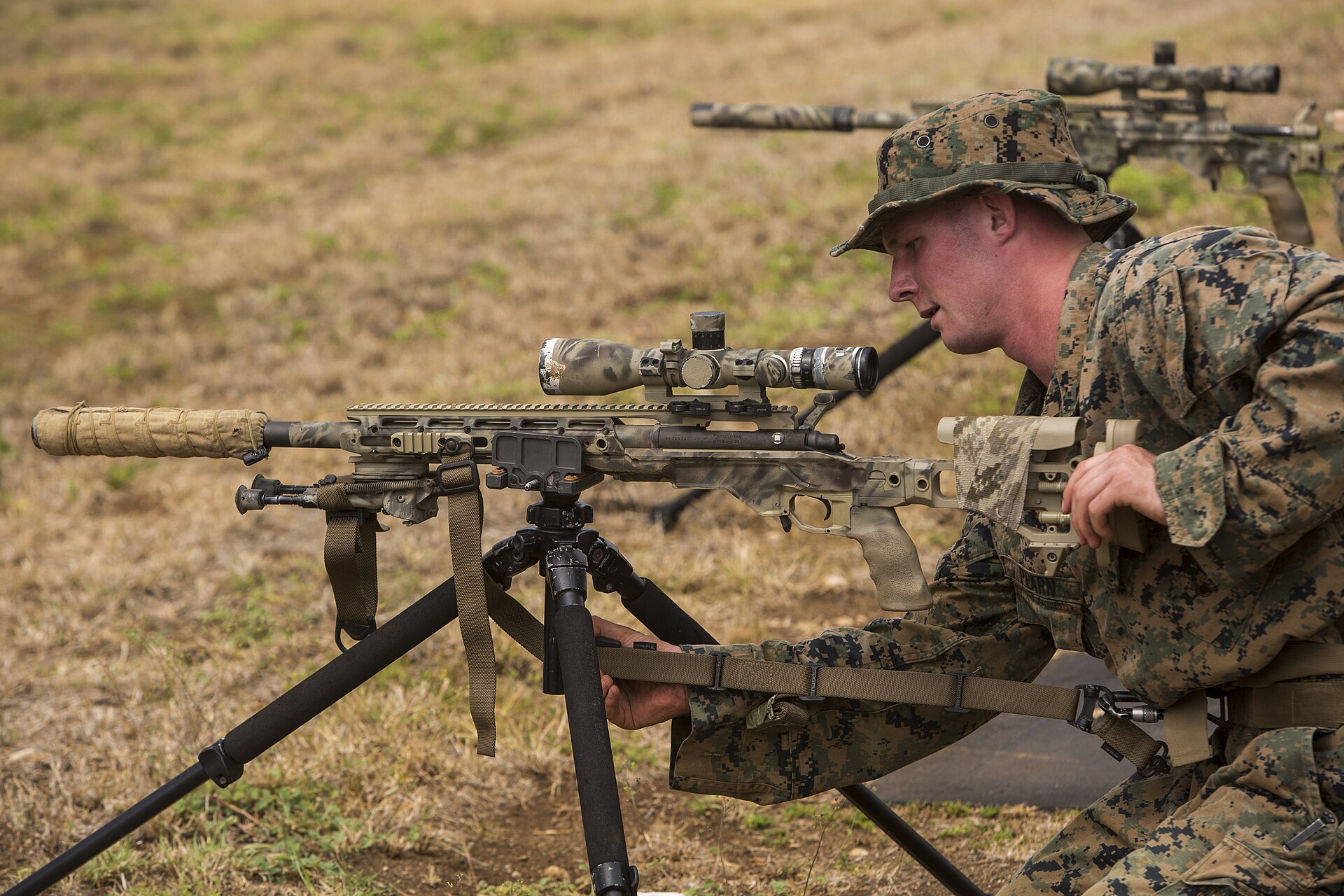
“The stock is a new McMillan A4, with adjustable cheek and length of pull.”1 American Rifleman lists an adjustable cheekpiece, a butt hook and quick-detach sling sockets.2 The Wikipedia summary adds OD green moulding, aluminium pillars with glass bedding, a free-floated barrel, a buttstock spacer system for length of pull, and “a Marine manufactured adjustable saddle-type cheekpiece”.5
McMillan’s own account adds the detail a builder needs to tell A-4s apart:6
The original A-4 stock that we designed by the Marines had a large butt hook that was about two inches forward of the recoil pad and was pretty deep. We made about 100-150 of them before they decided it really wasn’t designed right so they had us make it smaller and move it toward the grip so that is in-line with the rear screw on the cheek piece.
McMillan calls these “Mod 1” and “Mod 2”. The identification: “the Mod 1 is tapered from the butt hook to the front of the pistol grip in a straight line. The Mod 2 is angled from the hook to the rear of the pistol grip and has a pronounced grip cap.” The Mod 2 is what McMillan sells as the “USMC M40A3”. And the company’s own advice to shooters is to buy its current A-4 instead of either, because “the cheek piece elevator is much better” and the two-screw Marine cheekpiece “will continually come loose while you are shooting”.6
That matters to Volume 8: a McMillan A-4 is an A3/A5 stock, not an A1 stock. Fitting one to an A1-designated clone is a clone decision in McMillan’s own sense — it trades pattern fidelity for a stock the maker considers better to shoot.
3.2.3 The barrel — and a disagreement worth knowing
Here the sources split, and the split runs straight through the spec lists clone builders pass around.
- The Corps’s armory page: “a 24 inch 1/12 twist stainless steel barrel with 5 lands and grooves”.3
- Jane’s Infantry Weapons, as cited by the Wikipedia article (the Jane’s page itself is a dead link): “Schneider 635; 25-inch, 6-groove, 1:12” match-grade heavy barrel.5
The twist agrees; the length and groove count do not. The armory page is a primary Marine Corps source describing the rifle its own repairmen built; Jane’s is a respected secondary reference whose original could not be consulted. The Corps’s figure — 24 inches, five grooves — is preferred here, and the Jane’s figure is given so that a reader meeting “Schneider, 25 inches” knows where it comes from. It is possible both describe real rifles at different dates; no source says so.
American Rifleman’s 2001 description adds “Blackened stainless steel, heavy contour, recessed crown” and says the barrel was “optimized for new ammunition”.2
3.2.4 The bottom metal — D.D. Ross, then Badger
“A steel floorplate assembly and trigger guard built by D.D. Ross.”1 The Wikipedia summary adds that some A3s used Badger Ordnance guards and that “In 2007, the Marine Corps began replacing the DD Ross trigger guard assemblies with the M5 detachable magazine trigger guard manufactured by Badger Ordnance.”5 The 2007 date is secondary. What is primary is that the Corps’s 2009 programme statement for the A3 lists a “detachable box magazine” among the planned upgrades.4 An A3 can therefore have either an internal magazine with a floorplate or a detachable magazine, depending on when it last went through Quantico.
3.2.5 The rail — 30 MOA, with a clip slot
The Scout/Sniper Association: “The Unertl rings and bases have been replaced with D.D. Ross base and BADGER ORDNANCE Machine rings. The rifles also come with a Harris bipod and an accessory rail, built by G&G Machine.”1 The Corps’s armory page calls it “a modular M1913 MIL-SPEC rail”.3
How much cant that base carried is not stated in either. Two independent sources say 30 MOA:
- The Wikipedia summary: “The scope and rings are mounted on a DD Ross 30-minute-of-angle lugged Picatinny rail.”5
- Badger Ordnance, which sells the replacement part today under the name “USMC Short Action Scope Rail, #8-40 Screws, Clip Slot, 30 MOA Cant, Steel” (part 306-06-A3, $195.00 as listed on 19 September 2026), “designed specifically for USMC M40A3/A5 Scout Sniper Rifles”, with the “USMC Clip Slot recoil lug pattern” and “30 MOA bias (8.72 mils)”; installation “Gunsmith required”.7
Three details follow for a builder. The A3 rail uses #8-40 screws, not the Model 700’s factory #6-48 — the receiver is drilled and tapped oversize. It keeps the A1’s stripper-clip slot in the rail’s lug pattern. And it is 30 MOA, not 20: a 20 MOA rail on a Model 700 is a sensible modern choice, but it is neither the A1 pattern (no rail) nor the A3 pattern (30 MOA). Volume 7 discusses the choice; the underlying theory of canted rails is in the Types of Scopes dive.
3.2.6 The bipod
A Harris bipod from the start.12 The Wikipedia summary gives it precisely: “a 6–9” Harris notched swivel type bipod, model S-BRM, with a KMW Pod-Loc, which is a push button ratcheting bipod swivel locking mechanism”.5 The model code could not be checked on Harris’s own site during this work. The combination matters in Volume 8: the bipod and Pod-Loc fitted to the rifle documented there match this A3 description, and are shared between rifles.
3.2.7 The scope — Unertl first, then Schmidt & Bender, and earlier than usually said
The A3 entered service with the Unertl 10× retained from the A1.2 It then received the M8541 Scout Sniper Day Scope, which the Wikipedia summary describes as a Schmidt & Bender Police Marksman II LP 3–12×50 modified by Premier Reticles, bought under Marine Corps Systems Command contract M67854-05-D-1043 of 5 August 2005, mounted in Badger rings (a standard rear ring and a wider “MAX-50” front), with a dovetail on the front ring cap for a clip-on night sight. The same summary says it replaced the Unertl “Starting in 2007”.5
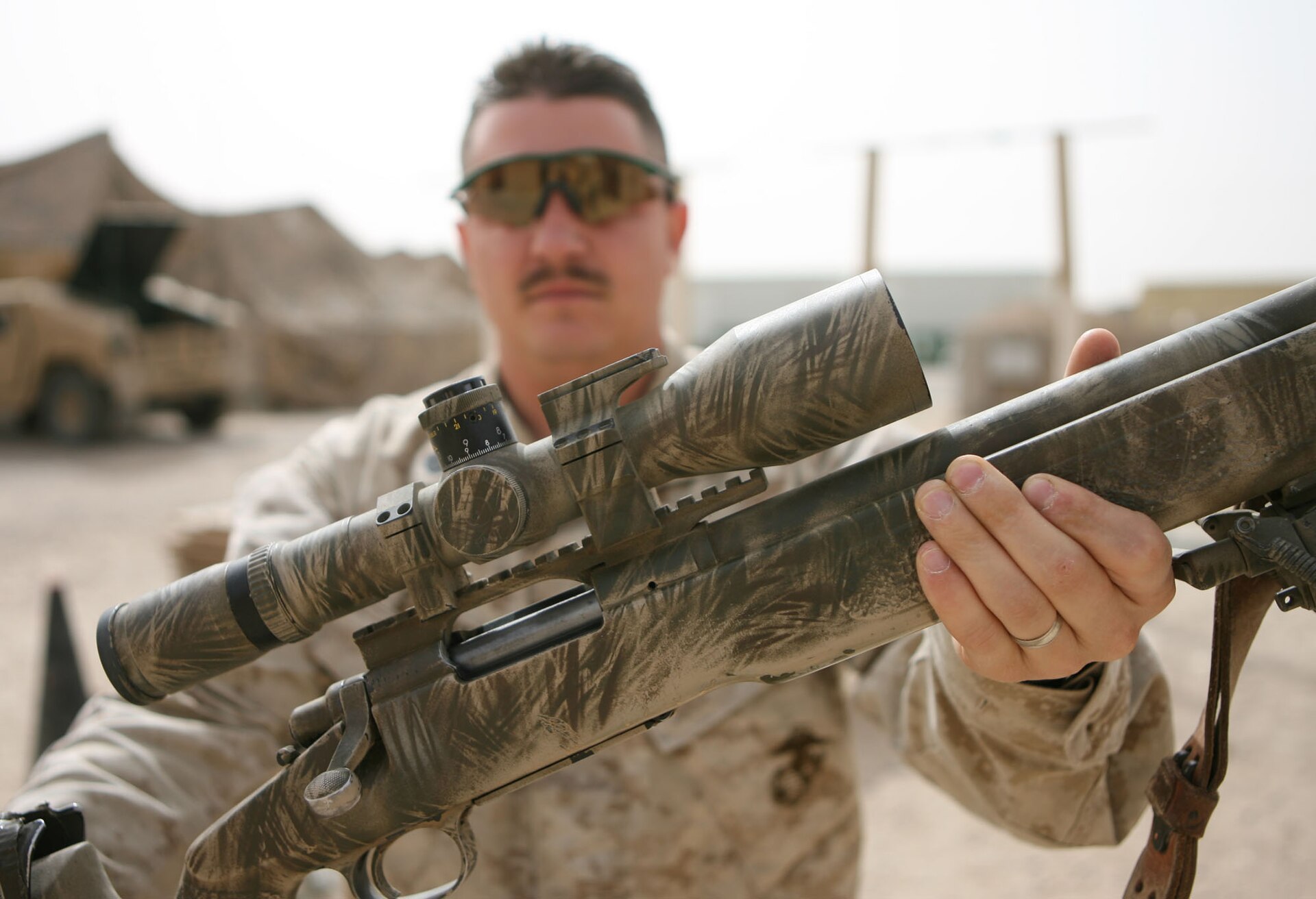
The Corps’s own photographs put it in combat more than a year earlier. A Marine Corps photograph dated 9 March 2006 at Camp Mercury, Iraq, shows the platoon sergeant of 3rd Battalion, 5th Marines’ scout-sniper platoon holding “the new 3 x 12 variable-power Schmidt & Bender … Scout Sniper Day Scope, mounted on the M-40A3”, and records that he “is credited with the first combat kill with the new scope” after the battalion arrived near Fallujah in January 2006; a companion photograph says the Corps “adopted the new scope recently”.8 Fielding therefore began no later than January 2006, with 2007 more plausibly the date of fleet-wide replacement. The caption renders the scope’s designation as “M-854155 DS”, which appears to be a typographical corruption of M8541; that could not be resolved.
3.2.8 The ammunition — M118LR
The A3 was built around a new load. American Rifleman (2001): a new Lake City “AA11” load, the 175-grain Sierra MatchKing “at up to 2680 fps”.2 The Corps’s armory page names it M118LR “special ball”.3 Leatherneck in 2009 describes the M39 marksman rifle as firing the “AA11 long-range round”, which ties the two designations together.4 The Scout/Sniper Association: “Combined with the new M118LR ammo, it makes a system that is ranked with the best in the world.”1
The change from the A1’s 173-grain M118 is modest in weight and significant in bullet: a match hollow-point in place of a full-metal-jacket match bullet. Handloading a 175-grain .308 load for a rifle of this class is covered in The Reloading Bench and is not re-derived here.
3.2.9 Accuracy acceptance
American Rifleman reports the Precision Weapons Facility’s check: “rifles fire three five-round groups at 300 yds. to ensure one m.o.a. accuracy”, with “several five-shot, sub-m.o.a. groups fired at 1,000 yds.” in testing.2 A tester at the section in 2009 put it in field terms: “when the rifles pass out of here, we are confident they can hit something 6 inches wide by 6 inches long at 600 yards with one shot.”4
3.3 The Threaded-Muzzle Question
The one real contradiction in the A3 record concerns the muzzle. American Rifleman in February 2001, describing rifles not yet in production, gave the A3 a “threaded muzzle” and a weight of 18 lb “including sound suppressor”.2 Every later source describes a recessed target crown on the A3 and places the thread on the A5:
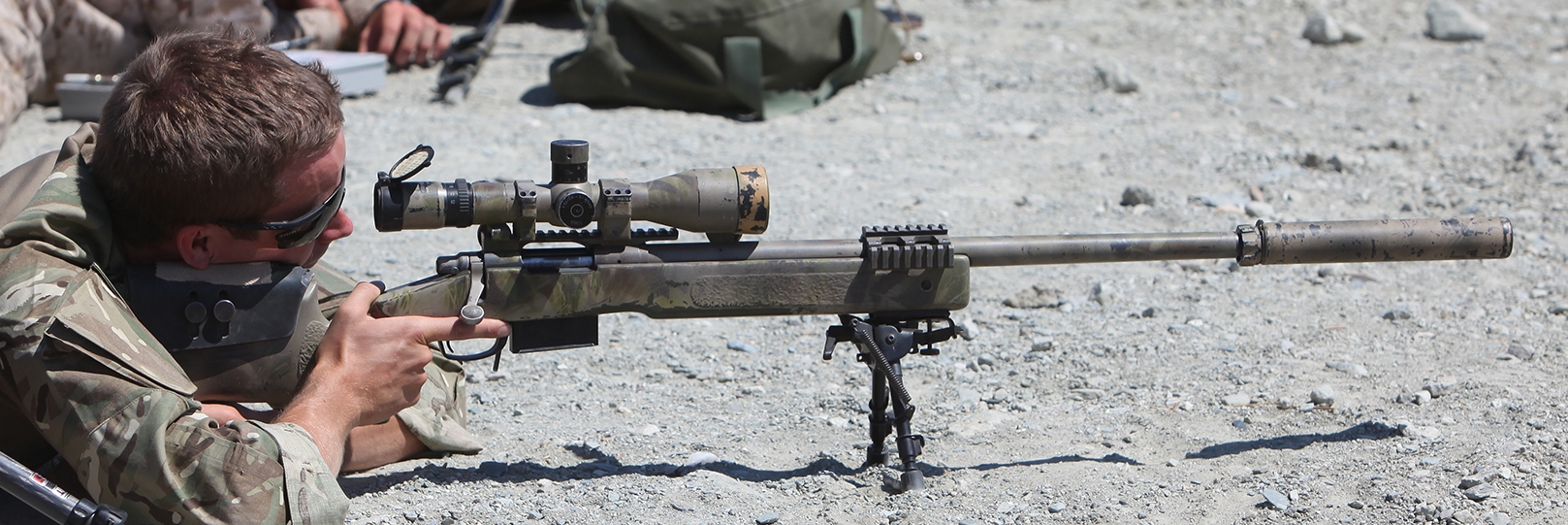
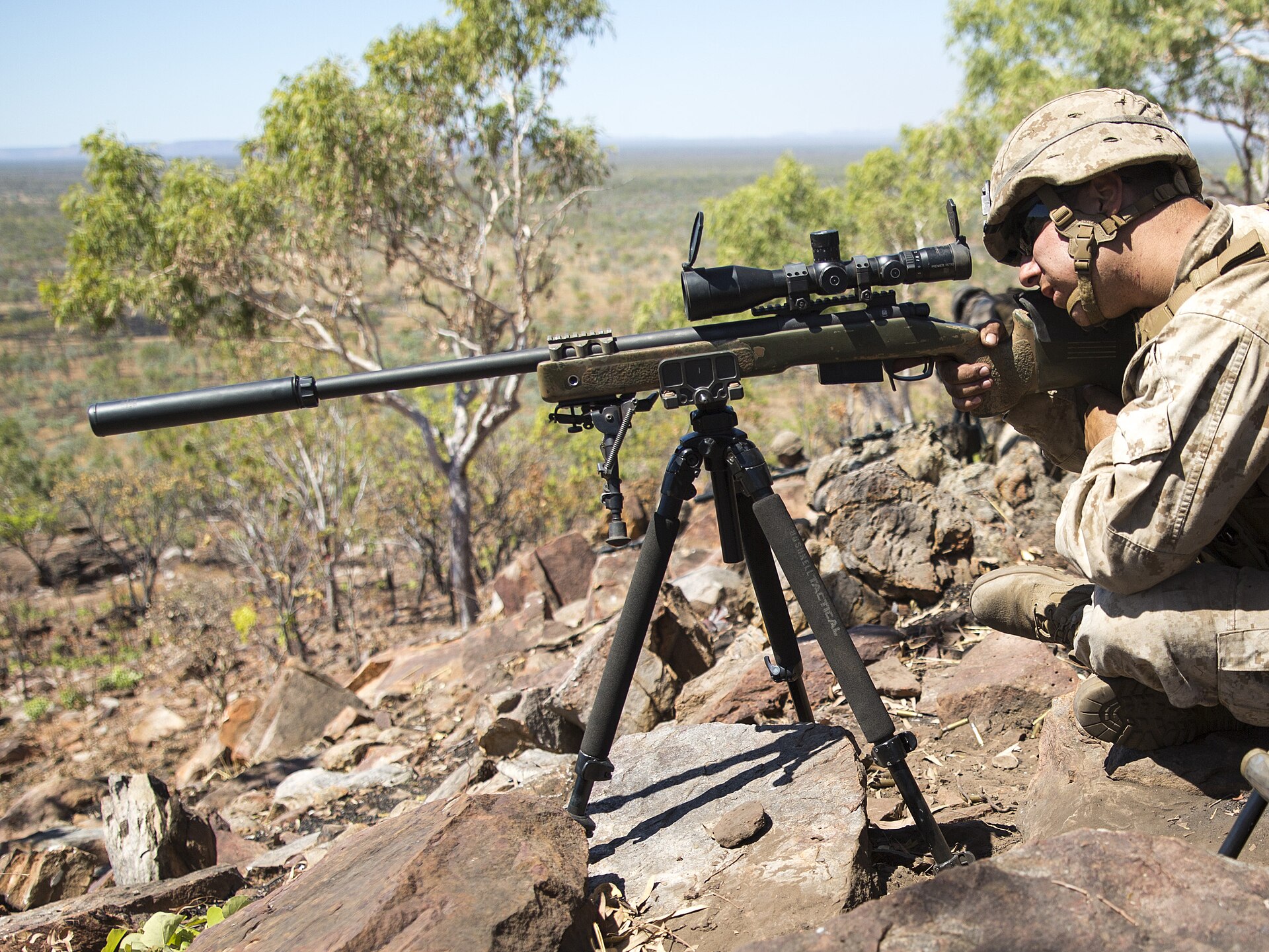
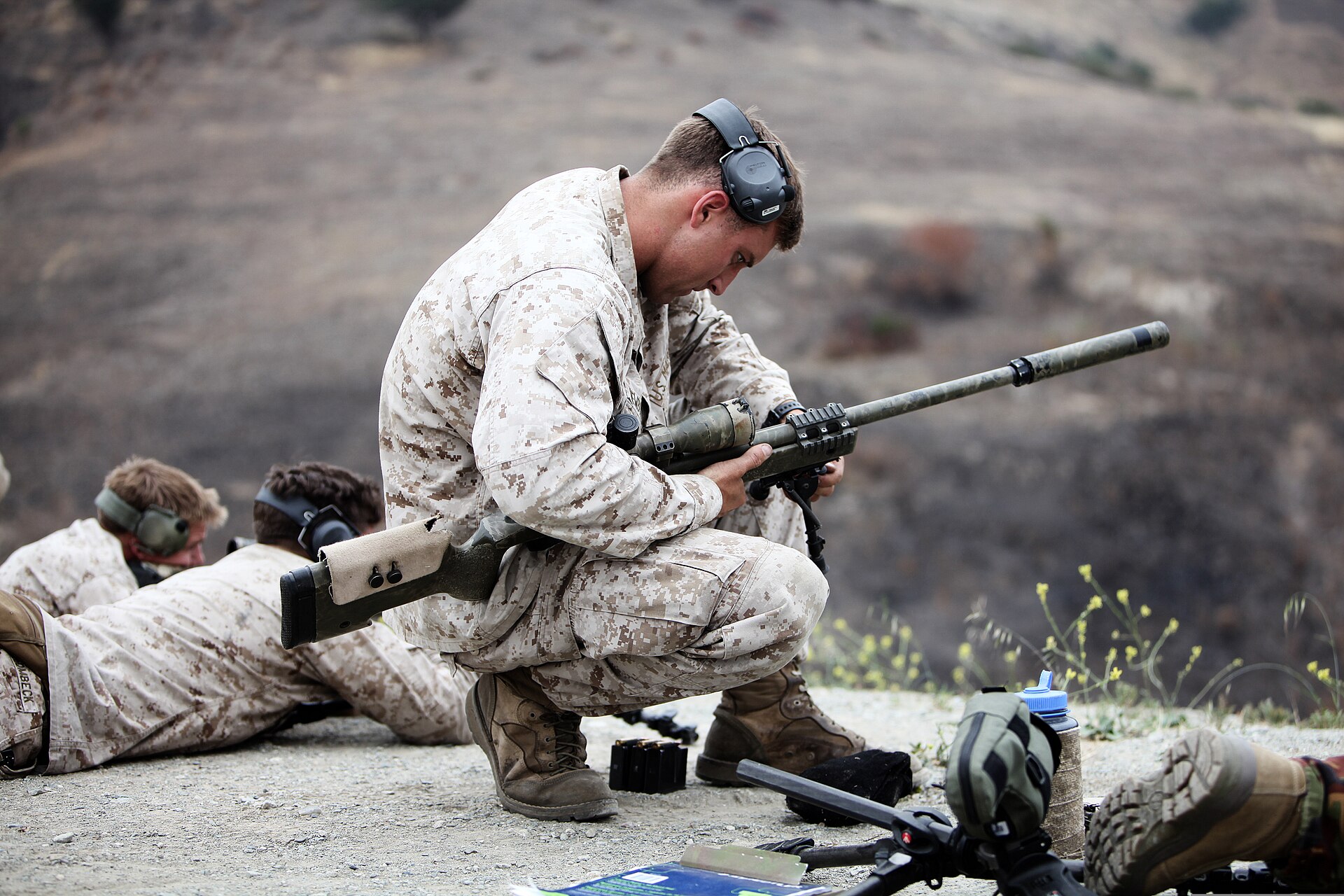
- The Corps’s warrant officer at the Precision Weapons Section in 2009: “The M40A5 is the next version [to] which we are slowly transitioning … The M40A5 has the tip of the barrel threaded for a muzzle brake that gives the shooter the capability of adding a [sound] suppressor at his or her discretion, based on the mission as it dictates.”4
- The Wikipedia summary: “The A3’s target crown has been replaced with a threaded muzzle and straight tapered barrel” on the A5.5
The weight of the evidence is that the fielded A3 had a bare, recessed crown, and that the 2001 description anticipated a feature that arrived later. That is the reading used here. It matters to a clone builder only as a reminder that a threaded muzzle is an A5 feature — not A1, and probably not A3.
3.4 The M40A5 — the Suppressor Rifle
The A5 superseded the A3 in 2009, “though the evolution between the two systems occurred gradually over a longer period”.5 Its defining change is the one the Corps’s own people gave a reason for. The warrant officer quoted above described situations in Iraq “where a car would pull up and three or four guys would start to set up an IED … The sniper may be back only 300 yards. He takes one shot, and the sound of the rifle gives his cover away. He can only get one person. The M40A5 will have the capability to suppress its sound.”4
The A5 therefore brought:
- A threaded muzzle carrying a muzzle brake, onto which a suppressor mounts.4 A 2009 Marine Corps procurement notice named the SureFire muzzle brake and SureFire suppressor among the rifle’s certified components.9
- A detachable box magazine — “All M40A5s are fitted with a Badger Ordnance detachable magazine system”.5
- A forward rail for the AN/PVS-22 night sight, since the A3’s rail left too little room ahead of the day scope.54
Leatherneck’s programme table gives the A5, like the A3, at 16.5 lb and 44.3 in with one-MOA capability.4
The same 2009 procurement notice is revealing in two ways. It stated that “The M40A5 was developed, tested and certified using specific parts from specific manufacturers” and listed 89 Remington brand-name parts — firing pin assemblies, bolt bodies, extractors, trigger assemblies, receivers — which is the plainest possible statement that the Marine rifle remained a Remington 700 at its core. And it sought an improved barrel with a “length of less than 24 inches” — the Corps, in 2009, wanted its sniper barrel shorter, not longer.9
3.5 The M40A6 — a Folding Chassis
The A6 changed the stock and nothing else of substance. The Wikipedia summary records a Marine Corps solicitation of 25 July 2013 for an “M40 Modular Stock Program”: a folding stock compatible with existing actions and barrels, to make the rifle compact in vehicles, and a full-length rail because the A5 had “only a few inches of rail space beyond the scope for a night vision optic”; 1,100 stocks were to upgrade the entire A5 inventory.5 Remington won the contract in November 2014 — The Firearm Blog reported “up to 2,000 modular stocks, spares, and magazines”, replacing the McMillan A-4.10
Soldier Systems Daily, previewing the prototype in March 2015, described “a modified version of the Remington Arms Chassis System which has already been adopted in other forms by the US Army and SOCOM”, noted that “the barrel remains the sticking point, and a final decision on length and twist rate has still not been made”, and reported that the working designation M40A6 was expected to become M40A7 on fielding.11 Its editor added in comments that Cadex had helped Remington develop the chassis.11 In the event the rifle was fielded as the A6, beginning in June 2016 according to the Wikipedia summary; the A7 name does not appear in the Marine Corps photographs of the rifle consulted here.5
3.6 The End of the Line
The Corps looked for a replacement for a long time. The Wikipedia summary dates the search to 2004, with requirements drafted in 2009 alongside Special Operations Command and a decision after 2013 to keep upgrading the M40 in 7.62 NATO, partly on cost.5 In April 2018 Marine Corps Times reported the decision to field the Mk 13 Mod 7 in .300 Winchester Magnum: “The Corps plans to purchase 356 rifles.” The report contrasts the M40’s “nearly 1,000-yard range” with a rifle whose range “pushes beyond 1,000 yards”.12
So the line ran 1966 to 2018: fifty-two years, five configurations, and one commercial action throughout. What replaced it was a different cartridge, which is the one thing the Corps had declined to change for half a century.
3.7 The Clone-Builder’s Spec List, Checked
A list of M40A3 components circulates among clone builders and appears, unsourced, on the owner’s own inventory sheet for the rifle in Volume 8. Checked item by item against the sources in this volume:
Table 2 — A list of M40A3 components circulates among clone builders and appears, unsourced, on the owner's own inventory sheet for the rifle in [Volume 8](/actual-firearms/rifles/remington-700-m40a1/vol-8/). Checked item by item against the sources in this volume
| Claim on the list | Verdict | Basis |
|---|---|---|
| Schneider barrel, 1:12 | Twist confirmed; maker secondary | 1:12 is the Corps’s figure; “Schneider” is Jane’s, via Wikipedia |
| Barrel finished at 25 in | Contradicted by the Corps | WTBN armory page: 24 in, five lands and grooves; Jane’s says 25 in, six grooves |
| D.D. Ross bottom metal, then Badger | Supported | D.D. Ross from the Scout/Sniper Association; the 2007 Badger M5 changeover is secondary |
| Unertl 10×, later Schmidt & Bender PM II 3–12×50 | Supported, with a date correction | In combat on an A3 by January 2006 per Marine Corps photographs; “2007” is the secondary date |
| Badger rings | Supported | Scout/Sniper Association |
| PGW night-vision mount | Not found | The only source consulted to name the night-vision interface gives a SPA-Defense dovetail on the front ring cap for a Simrad KN200 (secondary); no source naming PGW was located |
The lesson is the one this hub keeps relearning: a list that is mostly right is the hardest kind to catch. Four items check out, one is contradicted by the Corps’s own armory, and one could not be found.
3.8 What Could Not Be Verified
- A3 barrel maker, length and groove count — the Corps (24 in, five grooves) against Jane’s (Schneider, 25 in, six grooves).
- The base’s MOA cant on the service A3 is from a secondary source and a maker’s replacement-part name, not from a Marine Corps document.
- The 2007 dates for the Badger M5 guard and for the Schmidt & Bender scope — both secondary, and the scope date contradicted by Marine Corps photographs.
- The Harris model code S-BRM — not checked on the maker’s site.
- The M40A6’s barrel length and twist as fielded, which the 2015 preview said was undecided.
- A PGW night-vision mount on any M40.
3.9 Bibliography
Footnotes
-
United States Marine Corps Scout/Sniper Association, “The M40A3”, archived 22 June 2009 — design start 1996; Remington 700 short action; D.D. Ross floorplate and guard; D.D. Ross base with Badger Ordnance rings replacing Unertl’s; Harris bipod and G&G accessory rail; McMillan A4 with adjustable cheek and length of pull; replacement as A1s rotated in; built at Quantico; M118LR. https://web.archive.org/web/20090622131913/http://www.usmcscoutsniper.org/hogsden/the-m40a3.htm (consulted 2026-09-19). ↩ ↩2 ↩3 ↩4 ↩5 ↩6 ↩7 ↩8
-
Brian C. Sheetz and Doug Wicklund, “Long-Range Warriors: The USMC M40 Rifles”, American Rifleman, February 2001 (web 12 April 2019) — the A3 prototypes, planned quantity and production date; Ken M. Davis; CNC production; 18 lb including suppressor; blackened stainless heavy barrel with recessed crown and threaded muzzle; McMillan A-4; Unertl 10× retained; the AA11 load, 175-grain Sierra MatchKing at up to 2,680 ft/s; one-piece steel guard; Harris bipod; the 300-yard acceptance test. https://www.americanrifleman.org/content/long-range-warriors-the-usmc-m40-rifles/ (consulted 2026-09-19). ↩ ↩2 ↩3 ↩4 ↩5 ↩6 ↩7 ↩8 ↩9 ↩10
-
Weapons Training Battalion, Marine Corps Base Camp Lejeune, armory page “M40A3 Sniper Rifle”, archived 17 September 2008 — quoted in full above. https://web.archive.org/web/20080917175809/http://www.lejeune.usmc.mil/wtbn/wtbn_mcb_clnc_m40a3_sniper_rifle.htm (consulted 2026-09-19). ↩ ↩2 ↩3 ↩4
-
Leatherneck, April 2009, p. 36 — programme tables for the M40A3 and M40A5 (Precision Weapons Section; 16.5 lb; 44.3 in; one MOA; planned upgrades including forward rail, detachable box magazine, flash hider and/or suppressor); the M39’s “AA11 long-range round”; a tester’s 600-yard standard; CWO-5 Justus on the A5’s threaded muzzle and the IED example. Archived at https://web.archive.org/web/20110713194328/http://www.leatherneckmagazine-digital.com/leatherneckmagazine/200904/?pg=36 (consulted 2026-09-19). ↩ ↩2 ↩3 ↩4 ↩5 ↩6 ↩7 ↩8 ↩9
-
“M40 rifle”, English Wikipedia, wikitext consulted 2026-09-19 — A-4 details (OD green, pillars, spacers, Marine-made cheekpiece); the Jane’s barrel description; the Badger M5 changeover in 2007; the Harris S-BRM with KMW Pod-Loc; the M8541 day scope and contract M67854-05-D-1043; Badger rings; the D.D. Ross 30 MOA rail; the A5’s threaded muzzle, Badger magazine and forward rail; the Modular Stock Program solicitation of 25 July 2013; fielding of the A6 from June 2016; the replacement search from 2004. ↩ ↩2 ↩3 ↩4 ↩5 ↩6 ↩7 ↩8 ↩9 ↩10 ↩11 ↩12 ↩13
-
McMillan, “M40a1 and M40a3/5 Specific Stocks”, company blog, 10 August 2017 — the A-4 “Mod 1” and “Mod 2” and how to tell them apart; the current A-4 recommended for shooting. Archived at https://web.archive.org/web/2020id_/https://mcmillanusa.com/m40a1-m40a35-specific-stocks/ (consulted 2026-09-19). ↩ ↩2
-
Badger Ordnance, product page “USMC Short Action Scope Rail, #8-40 Screws, Clip Slot, 30 MOA Cant, Steel”, part 306-06-A3, $195.00 as listed 2026-09-19. https://www.badgerordnance.com/usmc-short-action-scope-rail-clip-slot-30-moa-cant-306-06-a3.html ↩
-
U.S. Marine Corps photographs, Camp Mercury, Iraq, 9 March 2006, Wikimedia Commons File:USMC-14924.jpg and File:USMC-060309-M-9218S-.jpg, public domain — captions recording the new Schmidt & Bender Scout Sniper Day Scope on the M40A3 and the first combat kill with it at the end of January 2006. ↩
-
Scott R. Gourley, “Marine Corps Seeks M40A5 Sniper Rifle Support”, Defense Media Network, 21 July 2009 — the solicitation’s statement on certified parts; the 89 Remington brand-name items; the SureFire muzzle brake and suppressor; the “length of less than 24 inches” barrel attribute. https://www.defensemedianetwork.com/stories/marine-corps-seeks-m40a5-sniper-rifle-support/ (consulted 2026-09-19). ↩ ↩2
-
“Remington Awarded Contract for Marines M40 Sniper Rifle Program”, The Firearm Blog, 7 November 2014 — up to 2,000 modular stocks, spares and magazines, replacing the McMillan A4. https://www.thefirearmblog.com/blog/2014/11/07/remington-awarded-contract-marines-m40-sniper-rifle-program/ (consulted 2026-09-19). ↩
-
“Sneak Peek – USMC M40A6 Prototype”, Soldier Systems Daily, 16 March 2015 — the Remington Arms Chassis System; the undecided barrel; the expected M40A7 designation; Cadex’s role (editor’s comment). https://soldiersystems.net/2015/03/16/sneak-peek-usmc-m40a6-prototype/ (consulted 2026-09-19). ↩ ↩2
-
Shawn Snow, “Marine snipers are getting new Mk 13 rifles”, Marine Corps Times, 2 April 2018 — the Mk 13 Mod 7 in .300 Winchester Magnum; 356 rifles; the range comparison. https://www.marinecorpstimes.com/news/your-marine-corps/2018/04/02/marine-snipers-are-getting-new-mk-13-rifles/ (consulted 2026-09-19). ↩
Comments (0)