M40A1 — the Marine Sniper Rifle, and a Clone · Volume 2
The M40A1 — the Rifle Quantico Built
A fibreglass stock, a stainless barrel, a welded lug, a Winchester floorplate and a fixed 10× Unertl — and the twist rate the Corps's own manual settles
The M40A1 is the rifle the M40 name really refers to. It is the one that served from the late 1970s through the Gulf War and into the 2000s, the one that established the look of a Marine sniper rifle — a green-and-brown fibreglass stock, a heavy stainless barrel with no muzzle device, and a long fixed-power steel scope — and the one that clone builders most often mean when they say “M40”. It is also the configuration the rifle in Volume 8 is designated after, by its owner’s decision.
Its specification is better documented than its reputation suggests, because the Corps published it. This volume builds the A1 from four primary documents — the Headquarters Marine Corps fact file, the Corps’s sniping manual, and two statements by McMillan, the stockmaker that worked on the rifle from 1975 — and uses the secondary literature only where it adds something, and then says so.
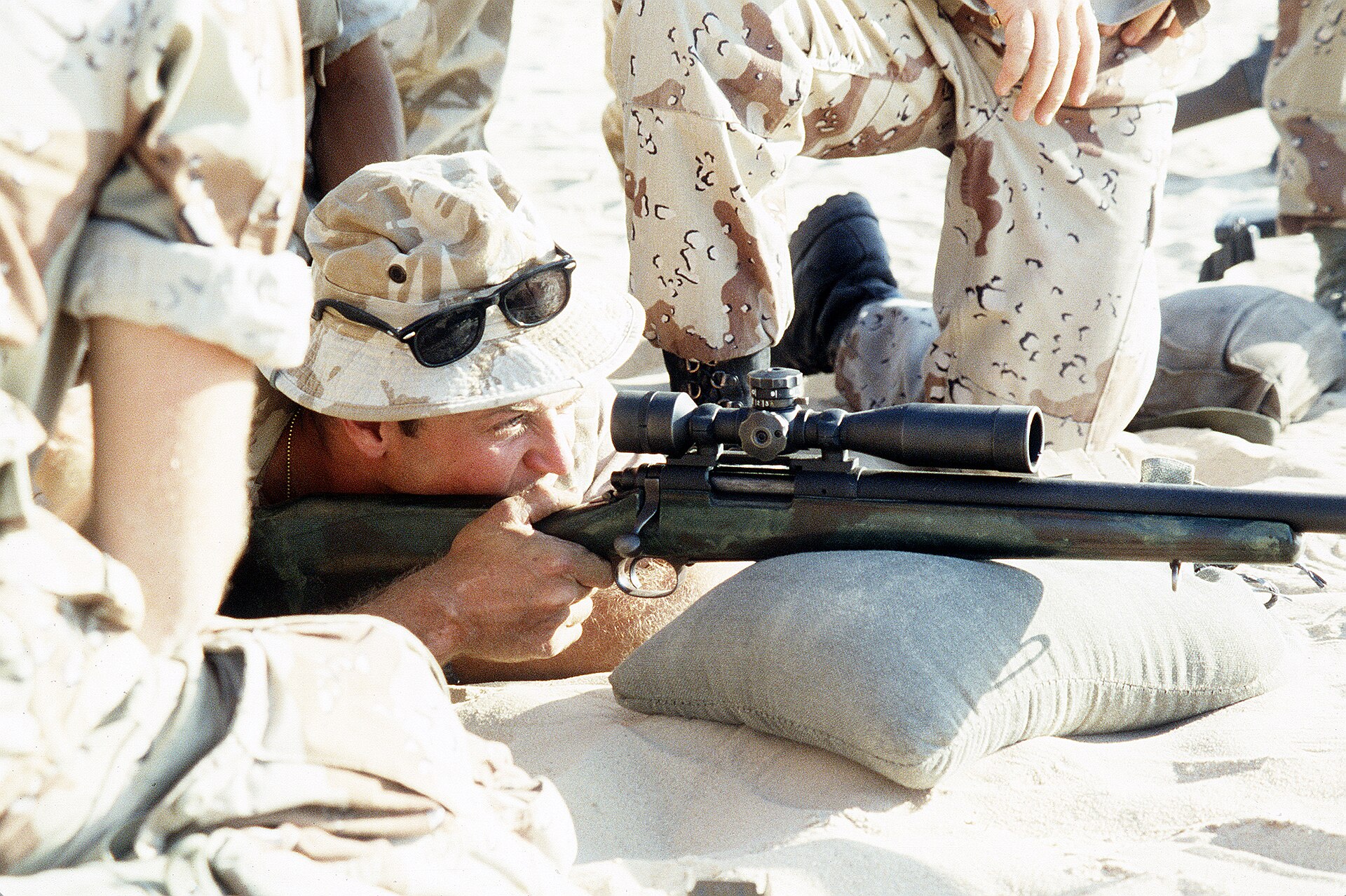
2.1 The M40A1 in One Table
Every figure here is from the Corps itself: the HQMC fact file (last modified December 1995) and FMFM 1-3B, Sniping (1981).
Table 1 — The M40A1 in One Table
| HQMC fact file1 | FMFM 1-3B2 | |
|---|---|---|
| Built by | ”Specially trained armorers at Quantico, Virginia" | "a Marine Corps designed and produced bolt action” |
| Calibre | 7.62 mm | 7.62 mm NATO |
| Overall length | 44 in | 44 in |
| Barrel length | 24 in | 24 in |
| Lands and grooves | — | 6 |
| Twist | — | 1 turn in 12 inches, right hand |
| Weight | 14.5 lb with scope | 14 lb |
| Trigger | ”modified and lightened” | 3 to 5 lb |
| Guard-screw torque | — | 65 inch-pounds |
| Magazine | 5 rounds, built-in | 5 rounds |
| Muzzle velocity | 2,550 ft/s | (M118: 2,550 ft/s) |
| Chamber pressure | 50,000 psi | — |
| Maximum effective range | 1,000 yd (914 m) | 1,000 yd |
| Accuracy standard | ”all weapons must shoot less than one minute of angle” | — |
| Unit replacement cost | $2,105 | — |
| Scope | ”special 10 power Unertl sniper scope” | Unertl 10×, mil-dot reticle, M118 elevation cam |
2.2 The Twist Rate Is Not Contested
The single most useful line in that table for a clone builder is the twist. Published clone literature — including one of this hub’s own dives — has treated the A1’s twist as a disagreement between 1:12 in the general references and 1:11 in the clone-building community, and advised measuring the barrel.
The Corps’s own manual settles the pattern: one turn in 12 inches, right-hand, six lands and grooves, on a 24-inch barrel.2 That is the service M40A1. The 1:11 figure circulating among clone builders may describe barrels that were made later for clones, or a single maker’s offering; it is not the service specification, and no primary source for it was found.
What remains a question is not the pattern but any particular rifle. A clone’s twist is whatever blank went into it, and Volume 8 explains why the rifle documented there may have 1:12 or 1:10 depending on its year of manufacture, not on anything to do with the A1.
2.3 Who Built It, and When
Where. Every source places the work at Quantico. The fact file says “Specially trained armorers at Quantico” and, in its background note, “the Marine Corps Marksmanship Training Unit (MTU)”.1 The sniping manual names the trade: field repair “is the responsibility of the rifle team equipment (RTE) repairman”, whose military occupational specialty is 2112.2 McMillan, describing its own commemorative replicas, reproduces the “RTE-P” proof mark of “the dedicated USMC creators of the original M40A1” on the barrel.3 The later organisation, the Precision Weapons Section, built the A3 and A5 (Volume 3).
When. The dates in the sources do not agree exactly, and they are given separately:
- American Rifleman dates the modernisation programme to 1977.4
- The fact file says only that the rifle “was put into service in the 1970s”.1
- The Wikipedia summary of Senich says the Quantico armorers began rebuilding M40s into A1s “sometime in the early 1970s”.5
- McMillan says its founder Gale McMillan “worked with the Marine Corps in 1975 to develop the M40A1”, and that the company “has manufactured stocks for the Marine Corps since 1975”.36
These fit together if development began around 1975 and the programme of rebuilding the fleet dates from 1977. They should not be averaged into a single year.
How. The A1 was not a new rifle. It was the original M40 actions, rebarrelled and restocked.4 That matters to anyone reading serial numbers or collecting: an A1 is, typically, an M40 that went through Quantico.
2.4 The Stock — McMillan, and Why It Is Called the HTG
The fibreglass stock was the answer to the wooden stock that moved with the Vietnamese weather. American Rifleman describes McMillan fibreglass stocks in “green and earthtone red camouflage”.4 The fact file lists “McMillan fiberglass stock and butt pad” among the rifle’s “unique characteristics”, and says each stock is epoxy bedded.1
The model name. The reference literature is inconsistent here: the Wikipedia article calls it a “McMillan A1” stock in its text and a “McMillan HTG” in its own comparison table.5 McMillan itself names it the HTG — its commemorative replica of 2010 uses “a McMillan plain HTG with molded-in forest camo, like the original, no stippling or checkering”.3 That is the maker’s word and it is used here. The stock the Marines used was also the parent of McMillan’s early “General Purpose Hunting Stocks”, made from the same moulds.6
The camouflage, and the “smear pattern”. McMillan’s own account of the early A1 stocks is unusually candid. They “were the first stocks in which we used colored gelcoat to effect a camouflage pattern”. Three colours went into the mould, the forest green laid over the other two, and rubbing it in “tended to smear the two colors placed in the mould before it”; it “took about three years to figure out how to make the stocks so that the gelcoat didn’t smear”. The company will not reproduce the pattern, partly because it would devalue the originals and partly because, in its words, “I refuse to repeat my mistakes”.6 The practical consequence for a collector is that no two early A1 stocks look alike, and a very even pattern is a hint of a later stock, not proof.
Surface. The Marine stocks “were smooth surfaced and had no texturing in the pistol grip or forend.”6
Fittings. Wichita sling swivels anchored on internal moulded-in steel inserts, and a Pachmayr recoil pad.35 The two McMillan descriptions of the pad differ — the 2010 release gives a “1/2” brown Pachmayr basket weave recoil pad … for the 13 1/2” LOP”; the 2017 blog asks replica builders to supply “the Red Pachmayr ½ pad, with the leather texture”.36 Both are the maker’s; which was used when could not be resolved here.
Bedding. McMillan’s replica specification — built, it says, after interviewing Marine armorers at Quantico on “specifications and gunsmithing procedures” — has “the action … hand bedded along with the 1 1/2” of barrel cylinder forward of the recoil lug. The remainder of the barrel is free-floated.”3 That detail is worth a builder’s attention. It is not a fully floated barrel with only the receiver bedded, which is the modern default; it supports a short length of the barrel shank ahead of the lug. Volume 7 discusses it.
2.5 The Barrel — Atkinson, Stainless, 24 Inches
American Rifleman: “Atkinson stainless barrels (24” length) with black oxide coating”.4 The Wikipedia text adds that the barrel was made by Bill Atkinson from 416 stainless, “bead blasted and blued with black oxide” — while the same article’s infobox says Hart.5 The primary-adjacent account (Land, via American Rifleman) is Atkinson, and the infobox contradicts its own article; Atkinson is used here, with the note that the rifle was rebarrelled over a long service life and more than one barrel maker is plausible across two decades. That is an inference, not a finding.
Length. The Corps says 24 inches, twice.12 McMillan’s commemorative replica has a 25-inch barrel “with a 1 in 12” twist and … a M40A1 spec barrel contour”.3 The difference is not explained in the release. For a clone, 24 inches is the service figure.
Crown. The replica is “finished off with a deep recessed target crown matching the rifle given to Gale McMillan.”3 A Precision Weapons Section tester, speaking in 2009 of the later rifles, gave the reason: the crown is where “a weak link” sits, “That’s why that barrel has a recess cut into it—so the crown is less prone to getting hit.”7 The A1’s muzzle was bare — no thread and no device. That is the one feature most often lost on a working clone, and Volume 8 records how it stands on the rifle documented there.
Contour. Published clone specifications describe the A1 contour as a straight taper to about .940 in at the muzzle. No primary source for that dimension was found, and McMillan’s release says only “M40A1 spec barrel contour”.3 It is left as a lead.
2.6 The Action Work
The A1’s action work is documented at two levels of confidence.
From the service record. American Rifleman states that the modernisation welded the magazine box and the recoil lug to the receiver.4 That is a significant, and irreversible, modification: a welded recoil lug can no longer shift or be fitted on a barrel change, and a welded magazine box stops moving under the floorplate. The fact file adds a “modified and lightened trigger”.1
From McMillan’s replica, which claims to follow the originals. The commemorative rifle is “a blue-printed Remington 700 short action that includes surface ground recoil lug; trued receiver face, threads, receiver lug shoulders and bolt head, and finally lapped bolt lugs.” Its receiver “is machined with the correct stripper clip slots along with the ejection port modification and is marked ‘U.S.’ above the serial number to match the original issue M40A1.” And, “Like the originals, the BDL magazine box is welded to the receiver.”3
Two things follow for a clone. First, the stripper-clip slot — cut across the front of the receiver bridge so the rifle can be charged from 7.62 mm clips — is an A1 feature that almost no commercial 700 has, and it persists into the A3’s rail design (Badger’s USMC rail is sold with a “USMC Clip Slot recoil lug pattern”, Volume 3). Second, the blueprinting list is a good description of what an action-truing job on any 700 involves, and Volume 7 takes it step by step.
2.7 The Bottom Metal — a Winchester Floorplate on a Remington
The A1 replaced the Model 700’s aluminium trigger guard with steel. The fact file names “modified Winchester Model 70 floorplate and trigger guard” among the rifle’s unique characteristics; American Rifleman says the steel Winchester parts replaced aluminium.14 The Wikipedia text says the Winchester assembly “was cut about one inch to fit the Remington 700 action”.5 McMillan’s replica has “steel Winchester Model 70 style two-piece” bottom metal “modified for the M40A1”, held with “Socket cap bolts, not factory slotted guard screws”.3
The Corps torqued those screws to 65 inch-pounds and forbade the sniper to touch them: “NEVER REMOVE THE TORQUE SCREWS. THIS IS DONE BY A QUALIFIED RIFLE TEAM EQUIPMENT REPAIRMAN (MOS 2112).”2 The reason is the bedding: a rifle whose action is epoxy-bedded is only as consistent as the clamp on it.
The A1’s bottom metal was a hinged-floorplate, internal-magazine design. Detachable magazines came to the family only with the A3’s later rifles and the A5 (Volume 3).
2.8 The Scope — a Fixed 10× Unertl
Around 1980 the Redfield variable gave way to a fixed 10× Unertl with a steel tube, a mil-dot reticle — its first military adoption, according to American Rifleman — and Unertl rings and mount.4 The sniping manual gives it in detail:2
Table 2 — The Scope — a Fixed 10× Unertl
| Magnification | 10× |
| Construction | Steel tube, dull black chrome finish |
| Weight | 2 lb 3 oz |
| Eye relief | 12½ in (as read from the scanned manual) |
| Elevation | Ballistic cam (“comeups”) for M118 Lake City Match, built in; ±3 minutes fine adjustment for differences in zero, temperature and lot |
| Windage | 60 minutes main adjustment; ±4 minutes with stops “to allow shooter to run windage on and off in the dark” |
| Reticle | ”Mil dot duplex for range estimation and calculating leads on moving targets” |
| Coating | HELR — “gathers in over 90 percent of available light” |
| Claim | ”allows shooter to shoot point of aim/point of impact back to 1,000 yards” |
The design logic is the reverse of the Redfield’s. Instead of a variable erector with a ranging mechanism, the A1 had a fixed-power erector — fewer moving parts to shift zero — and a reticle whose mil spacing the shooter used for arithmetic. The elevation was cut for one load, M118, so dialling a range put the bullet on it. The mil-dot reticle’s history, and its later role in the mil/mil convention of modern precision shooting, is told in the Types of Scopes dive.
McMillan names the scope the MST-100 and adds that “US Optics picked up the scope contract after it ran out with Unertl and performed all upgrades and refurbishing, as well as supplying new optics”.3 So a late A1 may carry a US Optics-made scope in the Unertl pattern.
The mount. The manual describes “a top-mounted telescope base, to which the sniper scope can be readily attached without special tools”.2 McMillan’s replica has “one-piece period correct U.S.O. base and rings”, “hand fitted to the receiver just as the originals were”.3 The USMC Scout/Sniper Association, describing the A3, confirms that “The Unertl rings and bases have been replaced” on the later rifle.8 The A1 had no Picatinny rail and no canted base. Its elevation budget came from the scope’s own cam. The 20 MOA rail on a modern clone is therefore not an A1 feature at all — Volume 7 explains why a builder fits one anyway.
2.9 Weight, and the Accuracy Standard
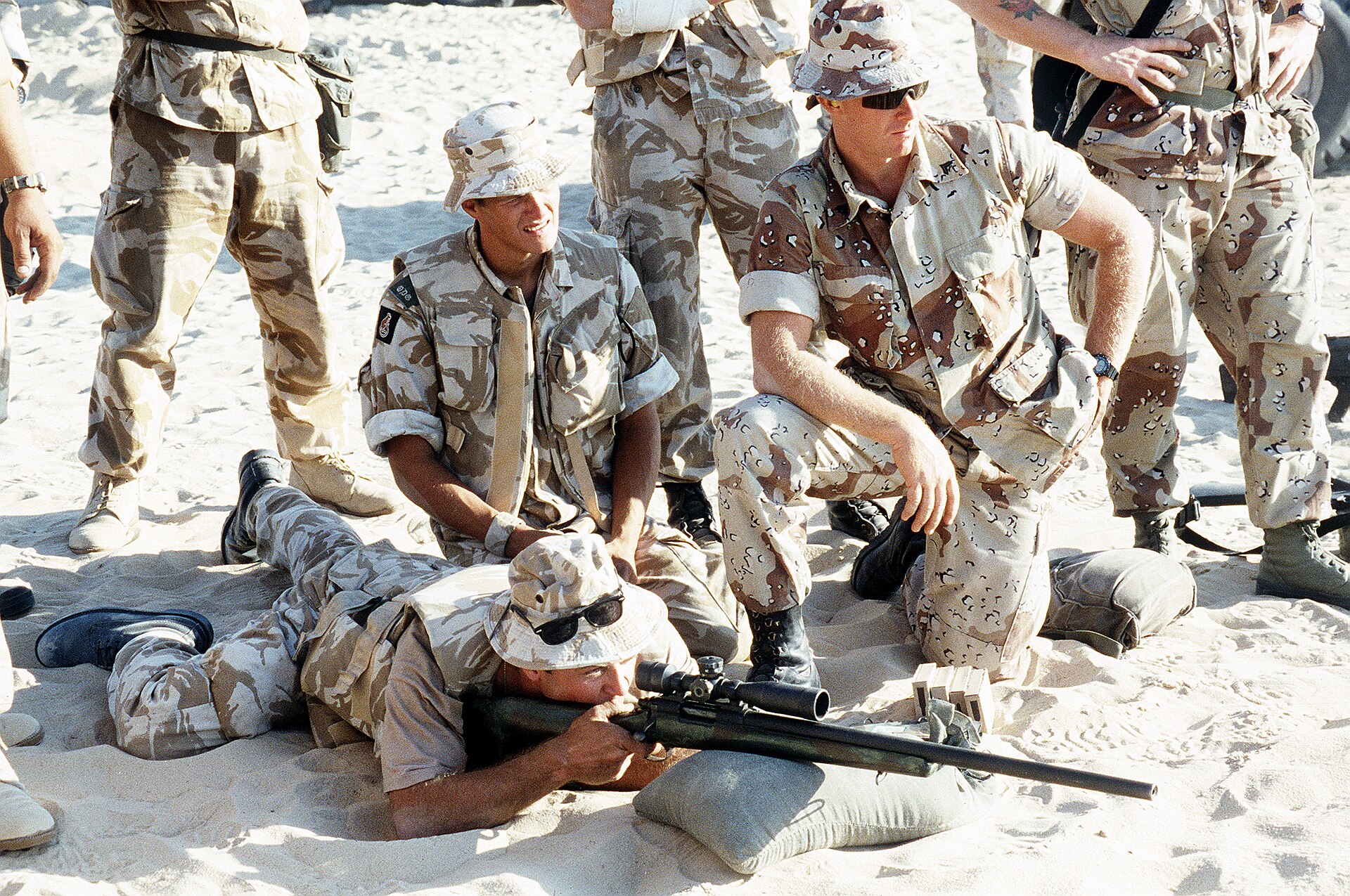
The A1 put weight on as it went. American Rifleman gives “12 lbs.—nearly 3 lbs. more than its ancestor” at first and “at 14.5 lbs., became a true heavyweight” later; the fact file gives 14.5 lb with scope; the 1981 manual gives 14 lb.412 The steel bottom metal, the stainless heavy barrel and the steel-tubed Unertl account for it.
The accuracy standard was stated as an absolute: “all weapons must shoot less than one minute of angle (MOA).”1 The group size and distance at which that was tested are not given in the fact file. (For the A3, American Rifleman reports “three five-round groups at 300 yds.” — Volume 3.)
2.10 The M40A2 That Never Existed
There is no M40A2 rifle. American Rifleman: “An M40A2 designation was skipped because it already was assigned to an unrelated piece of military equipment.”4 (The M40 designation itself is shared with a recoilless rifle and a field protective mask, which is why searches for it return so much that is not a sniper rifle.) A photograph captioned “M40A2” is a mistake for another variant — Volume 3 shows one on Wikimedia Commons whose own description says M40A5.
2.11 Replica or Clone
The stockmaker that built the A1’s stocks draws a distinction that is the right frame for any A1 build, and it is quoted in full because it is the maker’s:6
REPLICA – This term is used to indicate that you intend to build a rifle as close to the original M40a1 as is possible, using all materials and techniques still available. This rifle more than likely will be shot for accuracy one or twice and then reside in the display case or the gun safe for most of its life.
CLONE – This term indicates you intend to build a rifle to the basic specs as the M40a1 but plan to use it as you would any rifle in your safe. Having an identical rifle isn’t really the point so when challenged with some of the more difficult choices you should opt for ‘easy’.
On a replica McMillan recommends the steel inserts and Wichita swivels and the original recoil pad; on a clone, ordinary studs, because “Taking the sling off and on when shooting from the bench will be much, much easier”.6 The same logic applies to every decision in Volume 7: a welded lug, a clip slot, a Winchester floorplate and a bare muzzle are replica decisions; a modern trigger, a detachable magazine and a canted rail are clone decisions. The rifle in Volume 8 is, by its owner’s description and its parts list, a clone in this sense.
2.12 What Could Not Be Verified
- The A1 barrel contour (commonly quoted as a straight taper to about .940 in at the muzzle). No primary source.
- Atkinson or Hart as the barrel maker at any given period; Atkinson is the better-attested.
- The length and twist of barrels made as replacements later in service. The 24-in, 1:12, six-groove figure is the 1981 manual’s.
- The exact year the A1 programme began — 1975 (McMillan’s involvement), 1977 (American Rifleman), “early 1970s” (the summary of Senich) and “the 1970s” (the fact file) are all given.
- Which Pachmayr pad — the maker’s two descriptions differ.
- The test protocol behind the fact file’s sub-MOA requirement.
2.13 Bibliography
Footnotes
-
Headquarters, U.S. Marine Corps, Fact File, “M40A1 Sniper Rifle”, last modified 15 December 1995 — manufacturer, dimensions, weight, muzzle velocity, chamber pressure, unit replacement cost, the “unique characteristics” list (commercial competition-grade heavy barrel; McMillan fibreglass stock and butt pad; modified Winchester Model 70 floorplate and trigger guard; modified and lightened trigger; epoxy bedding; less than one MOA), and the MTU background note. Archived at https://web.archive.org/web/20070225004953/http://www.hqmc.usmc.mil/factfile.nsf/7e931335d515626a8525628100676e0c/03ae5c82962bc0f48525627b006d3126?OpenDocument (consulted 2026-09-19). ↩ ↩2 ↩3 ↩4 ↩5 ↩6 ↩7 ↩8 ↩9
-
Headquarters, U.S. Marine Corps, FMFM 1-3B, Sniping, 28 January 1981, reissued as MCWP 3-15.3 (erratum of 27 May 2004) — §201 and the tabulated data for the M40A1 (44 in, 14 lb, 24-in barrel, six lands and grooves, one turn in 12 inches right hand, 3–5 lb trigger, 65 in-lb torque, five rounds, 1,000 yd); §202 and the tabulated data for the Unertl scope; the maintenance section, including “NEVER REMOVE THE TORQUE SCREWS” and the RTE repairman, MOS 2112. Internet Archive item
mcwp-3-15.3-sniping-2004(consulted 2026-09-19). ↩ ↩2 ↩3 ↩4 ↩5 ↩6 ↩7 ↩8 -
McMillan, press release, “McMillan Announces the Limited Edition of the M40A1 Commemorative Marine Corps Sniper Rifle Package”, Phoenix, 5 November 2010 — Gale McMillan’s 1975 work with the Corps; the interviews with Quantico armorers; the replica’s specification (25-in barrel, 1:12, M40A1-spec contour, deep recessed crown; blueprinted short action with surface-ground lug, trued face, threads, lug shoulders and bolt head, lapped lugs; stripper-clip slots; ejection-port modification; “U.S.” marking; plain HTG stock with moulded-in forest camouflage; Wichita swivels on moulded-in steel inserts; brown Pachmayr basket-weave pad; action and 1½ in of barrel bedded; Winchester Model 70-style two-piece bottom metal with socket-cap screws; welded BDL magazine box; “RTE-P”; MST-100 10× and the US Optics contract; U.S.O. base and rings hand-fitted; Remington trigger at 3 lb). Archived at https://web.archive.org/web/2015id_/http://mcmillanusa.com/documents/Final%20McMillan%20M40A1%20Release.pdf (consulted 2026-09-19). ↩ ↩2 ↩3 ↩4 ↩5 ↩6 ↩7 ↩8 ↩9 ↩10 ↩11 ↩12 ↩13
-
Brian C. Sheetz and Doug Wicklund, “Long-Range Warriors: The USMC M40 Rifles”, American Rifleman, February 2001 (web 12 April 2019) — the 1977 modernisation; welded magazine box and recoil lug; Winchester Model 70 steel trigger guard and floorplate replacing aluminium; Atkinson 24-in stainless barrels with black oxide; McMillan fibreglass stocks in green and earthtone red camouflage; the weights; the Unertl 10× with mil-dot reticle around 1980; the skipped M40A2 designation. https://www.americanrifleman.org/content/long-range-warriors-the-usmc-m40-rifles/ (consulted 2026-09-19). ↩ ↩2 ↩3 ↩4 ↩5 ↩6 ↩7 ↩8 ↩9
-
“M40 rifle”, English Wikipedia, wikitext consulted 2026-09-19 — “McMillan A1” in the text against “McMillan HTG” in the comparison table; Atkinson in the text against Hart in the infobox; 416 stainless, bead blasted, black oxide; the Winchester guard “cut about one inch”; Wichita swivels and Pachmayr pad; the “early 1970s” rebuild date, cited there to Senich (1988). ↩ ↩2 ↩3 ↩4 ↩5
-
McMillan, “M40a1 and M40a3/5 Specific Stocks”, company blog, 10 August 2017 — stocks for the Corps since 1975; the “smear pattern”; smooth, untextured Marine stocks; the General Purpose Hunting Stock from the same moulds; the replica and clone definitions; the red Pachmayr pad. Archived at https://web.archive.org/web/2020id_/https://mcmillanusa.com/m40a1-m40a35-specific-stocks/ (consulted 2026-09-19). ↩ ↩2 ↩3 ↩4 ↩5 ↩6 ↩7
-
Leatherneck, April 2009, p. 36 — a Precision Weapons Section tester on the recessed crown. Archived at https://web.archive.org/web/20110713194328/http://www.leatherneckmagazine-digital.com/leatherneckmagazine/200904/?pg=36 (consulted 2026-09-19). ↩
-
United States Marine Corps Scout/Sniper Association, “The M40A3”, archived 22 June 2009 — “The Unertl rings and bases have been replaced with D.D. Ross base and BADGER ORDNANCE Machine rings.” https://web.archive.org/web/20090622131913/http://www.usmcscoutsniper.org/hogsden/the-m40a3.htm (consulted 2026-09-19). ↩
Comments (0)