M40A1 — the Marine Sniper Rifle, and a Clone · Volume 1
The M40 — a Commercial Rifle Goes to Vietnam, 1966
Seven hundred Remingtons, a variable scope with a rangefinder, a wooden stock, and what four years of monsoon did to them
The M40 family is the longest-lived sniper rifle line in American service. From the first contract in 1966 to the adoption of its successor in 2018 the Marine Corps fielded five configurations under the one designation — the M40, M40A1, M40A3, M40A5 and M40A6 — and every one of them was built on the same commercial foundation: a Remington Model 700 short action, bought from the maker and turned into a sniper rifle by Marine armorers at Quantico.
These eight volumes separate two things that are easily confused. Volumes 1 to 3 cover the pattern: what each M40 actually was, taken from the Corps’s own fact files, its sniping manual, and the makers who supplied it. Volumes 4 to 6 cover the Remington 700 action that all of them share — how it works, how it is stripped and maintained, and how it fails. Volume 7 covers building a clone. Volume 8 covers the unit: one rifle, a Remington 700 SPS Varmint being built by its owner as an M40A1 clone, described as it stood in September 2026 and no further.
This volume covers the first rifle: the one bought in 1966, what it was, and why it had to be rebuilt within a decade.
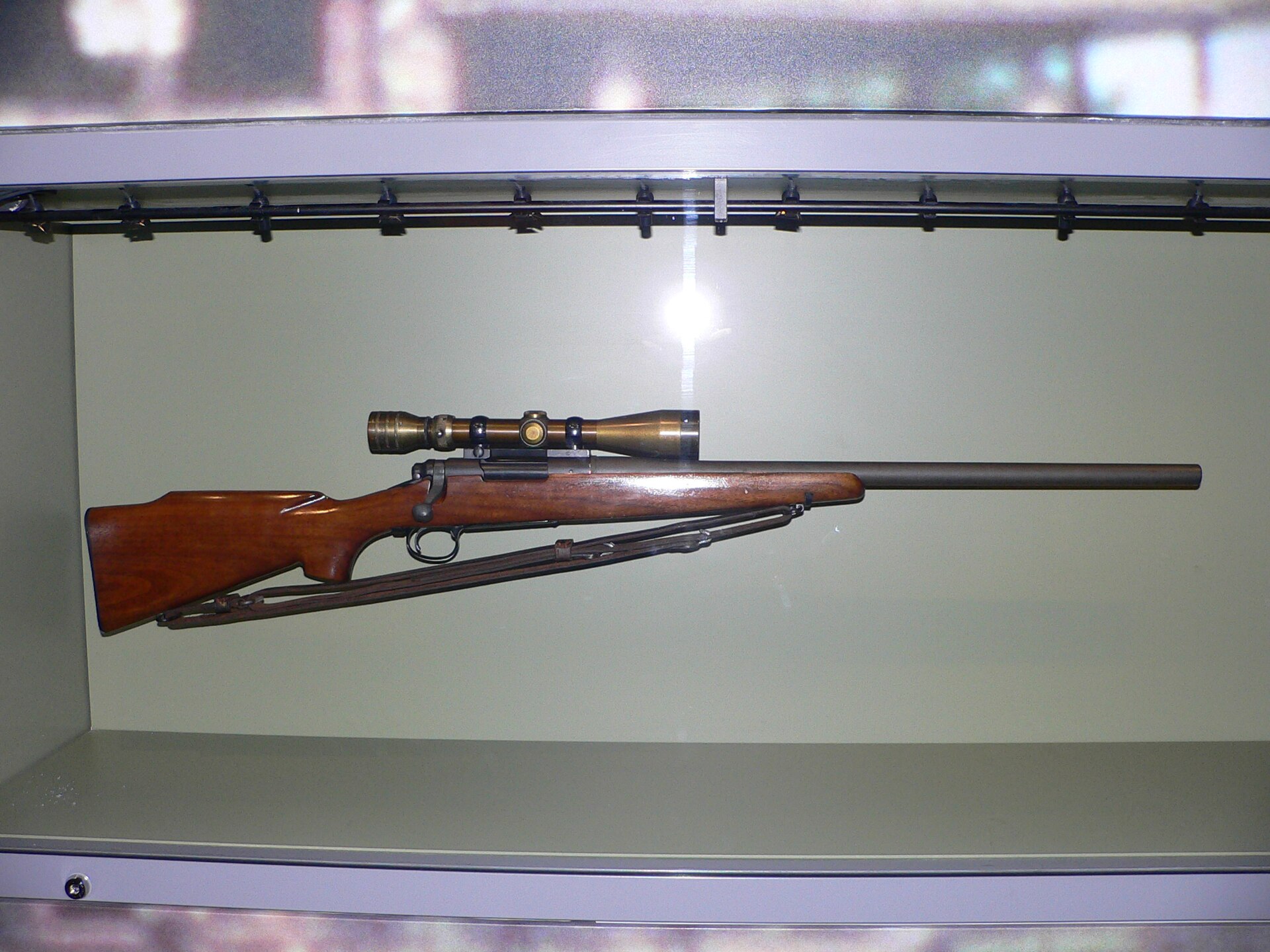
1.1 The Rifle in One Table
Table 1 — The Rifle in One Table
| Designation | Rifle, 7.62 mm, Sniper, M40 |
| Adopted | 7 April 19661 |
| First contract | 700 rifles, deliveries beginning 19661 |
| Total bought | 995 rifles between 1966 and 1977, per the Wikipedia summary of Senich2 — not confirmed from a primary source |
| Action | Remington Model 700, short action, 7.62×51 mm |
| Barrel | Free-floating, medium-weight, chrome-moly steel1 |
| Stock | One-piece wood, uncheckered1 |
| Finish | Matte Parkerized1 |
| Scope | Redfield Accu-Range 3–9×, green anodised, ranging to 600 yards, on a tapered Redfield mount1 |
| Magazine | Five rounds, internal |
| Successor | M40A1, from 19771 |
1.2 Why a Commercial Rifle
The Marine Corps entered the Vietnam War without a standardised sniper rifle. What it had in the hands of its early scout-snipers was a mixture, of which the best known is the Winchester Model 70 in .30-06 with a Unertl target scope — the rifle most associated with the Corps’s most famous sniper, discussed below.3 The Unertl lineage itself runs back to the Second World War, when an 8× Unertl target scope was paired with modified M1903 rifles; the Types of Scopes dive covers that history and is not repeated here.
The decision in 1966 was to stop improvising and buy a standard rifle. Two choices shaped everything that followed.
The first was the cartridge. The M40 was a 7.62×51 mm rifle from the start, which put it on the same round as the M14 and the machine guns, and — more importantly for a sniper — on the same round as a match-grade load that Lake City could produce. The .30-06 Model 70s were an evolutionary dead end the moment the cartridge changed.
The second was to buy a commercial action rather than design one. The Remington Model 700 had been on the market since 1962. It was a mass-production design built for tight tolerances, and it was available. Every later M40 inherits this decision: the Corps never owned the design of its own sniper rifle’s action. It bought Remington’s, and did its own work on top.
1.3 What Was Bought — a Model 700, and the “40X” Question
The sources disagree on a small point that matters to anyone building a clone, so both versions are given.
The reference most often repeated online states that the Corps “ordered seven hundred Remington Model 40x rifles (target/varmint version of the Remington Model 700 bolt-action rifle), and gave them the M40 designation”, citing Peter Senich’s Complete Book of U.S. Sniping (1988).2 American Rifleman, drawing on Edward J. Land Jr. — a Marine from 1953 to 1977 who was instrumental in building the Corps’s sniper programme — describes the M40 simply as a Model 700 with a medium-weight free-floating barrel.1
The two are not as far apart as they look. The Remington 40X was Remington’s target rifle, built on a 700-family receiver; the difference in practice is the grade of the barrel and the degree of hand work, not the basic action. But “Model 40X” as an ordering designation could not be confirmed from a primary document in this work, and the rifles are described by the Corps’s own later fact file simply as “based on the Remington model 700”.4 This dive treats the M40 as a Model 700 short action, which is what every source agrees on, and flags the 40X wording as unconfirmed.
The design credit is also secondary: the Wikipedia article, again citing Senich, names Jack Cuddy and Gunner (later Captain, CWO4) Neil Warren Goddard as the rifle’s originators.2 No primary document naming them was located.
1.4 The Rifle as Issued
The configuration is well attested and simple.1
- Action. A factory Remington Model 700 short action in 7.62×51 mm, with a five-round internal magazine.
- Barrel. Medium-weight chrome-moly steel, free-floated in the stock. It was not stainless — that came with the A1 rebuild.
- Stock. One-piece wood, uncheckered. It was a sporter-derived stock, and it was the weakness of the rifle.
- Finish. Matte Parkerized.
- Sights. No iron sights of consequence; the rifle existed to carry its scope.
What is striking, set beside the later rifles, is how little was done to it. The M40 was a type-classified commercial rifle, factory-made, with a match-quality barrel and a good scope. The hand-built, epoxy-bedded, blueprinted rifle that the M40 name now evokes is the A1, a decade later. The M40 of 1966 is closer to a good factory varmint rifle than to anything that followed.
1.5 The Redfield Accu-Range
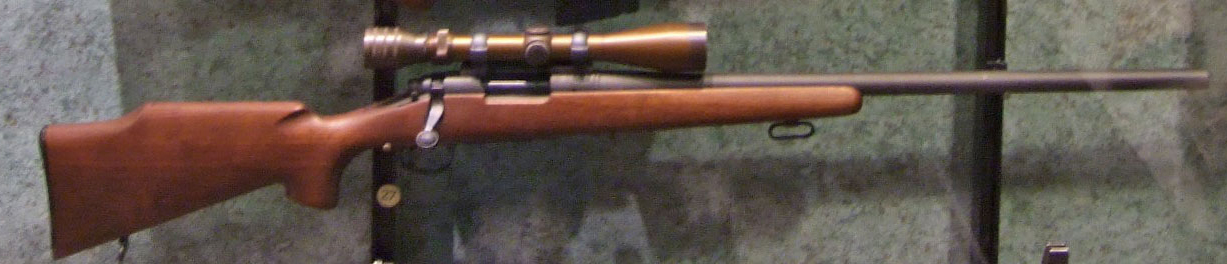
The scope was a Redfield Accu-Range 3–9× variable, finished in green anodising, mounted on a tapered Redfield mount, with a ranging feature good to 600 yards.1
The ranging feature is the important part. A Marine sniper in 1966 had no laser rangefinder, and range estimation was the largest single source of error at distance. The Accu-Range put a ranging aid inside the scope, working — as such reticles generally do — by bracketing a target of assumed size and reading a range from the result. Its limits are the limits of every such device: it assumes the target’s size, and it relies on a variable-power erector of the period holding zero across its range. The exact reticle and scale of the M40’s Accu-Range were not documented from a primary source in this work.
The Corps’s later choices say what it concluded. The A1 went to a fixed 10× Unertl with a mil-dot reticle — ranging done by the shooter’s arithmetic on a fixed reticle rather than by a mechanism — and ballistic cams matched to one load.5 That design choice is covered in Volume 2.
One field failure of the Redfield is recorded specifically: the rangefinder scale was melted by light exposure.1 The same hazard appears in the Corps’s own sniping manual fifteen years later, applied to the Unertl — sunlight through the objective “may melt the mil dots and damage the telescope internally”, and the scope is to be kept covered.5 Sunlight focused by a lens onto an internal scale is a failure mode of every scope, not a defect of one maker.
1.6 The Ammunition
The M40 was a system with its cartridge. The Corps’s sniping manual specifies 7.62 mm M118 Match from Lake City: a 173-grain boat-tail bullet at 2,550 feet per second, headstamped “MATCH” with the year and the arsenal’s initials.5 It also gives the standard M80 ball, 147 grains at 2,750 feet per second, and draws the practical consequence: because match ammunition is heavier and slower, “all other types of ammunition will strike higher on the target.”5
The manual’s instruction is unambiguous — “LAKE CITY M118 MATCH GRADE AMMUNITION WILL BE ISSUED TO THE SNIPER AND SHOULD BE FIRED AT ALL TIMES, WHEN AVAILABLE” — and it adds a piece of lot discipline that any handloader will recognise: among different lots, “an especially accurate lot can be identified through use, and it should be used as long as it is available.”5
The 2,550 ft/s figure recurs. It is the muzzle velocity the Corps’s M40A1 fact file gives for the rifle,4 and it is close to the figure the owner of the clone in Volume 8 records for 175-grain ammunition. Loading for this class of rifle is covered in The Reloading Bench, which this dive links rather than repeats.
1.7 What Vietnam Did to It
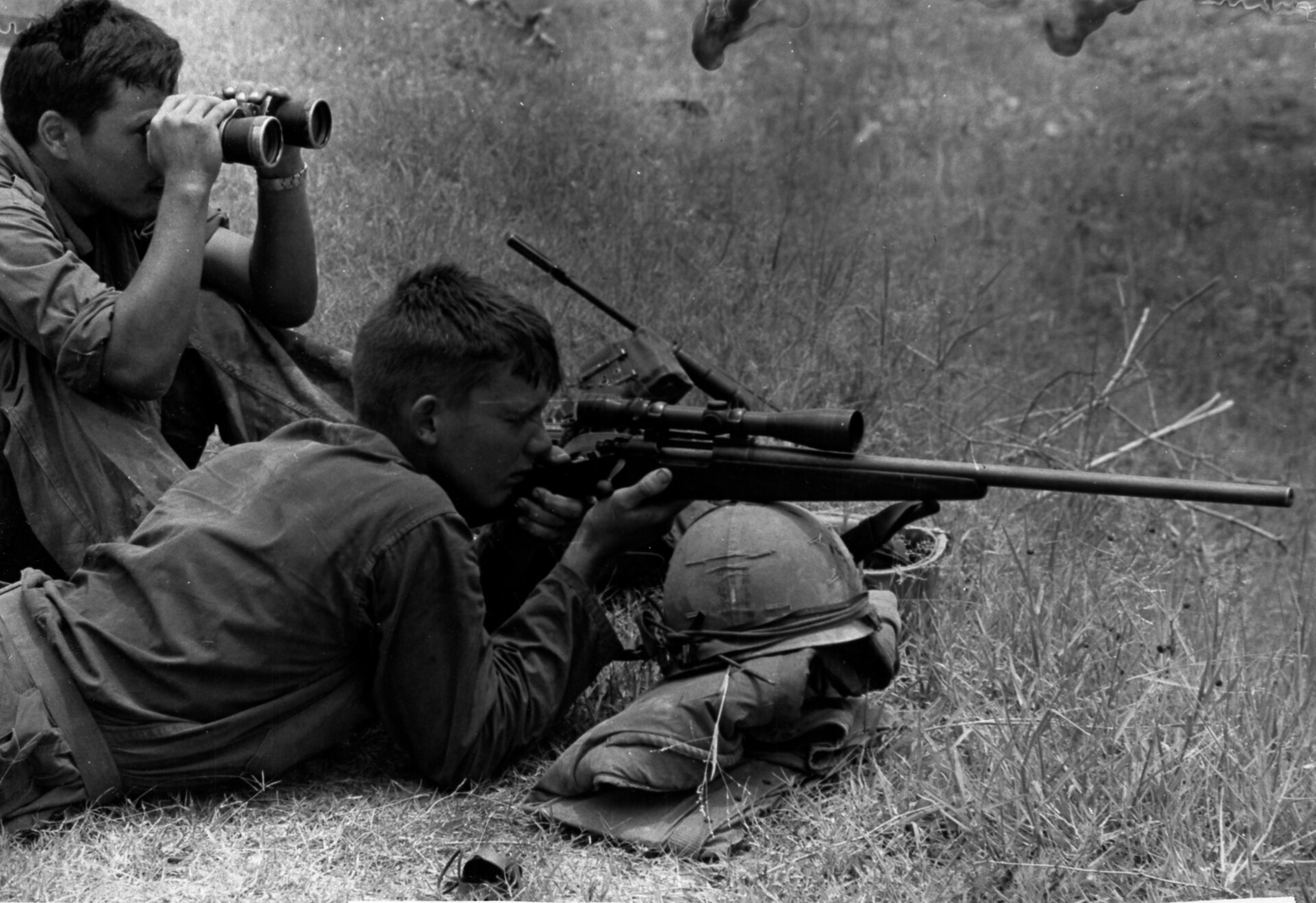
The M40’s service record is short and the attrition numbers are the reason. American Rifleman gives two figures, both attributed to the Corps’s own reporting through Land:1
- June 1969: of 82 rifles allocated to the 1st Marine Division’s scout-sniper teams, “only 45 remained in the field with another 22 sidelined.”
- 1973: “the number of available M40 rifles had dwindled to 425.”
Set against a 700-rifle first contract, the second figure means that within seven years well under two-thirds of the rifles were available at all.
The causes are recorded in the same account: moisture in the wooden stocks, pitted barrels, and the scope’s rangefinder scale damaged by light.1 The Wikipedia summary of Senich reduces it to “primarily warping of the all-wood stock”.2
The stock is the one that matters for understanding everything after. A precision rifle’s accuracy depends on the barrelled action sitting in the stock the same way for every shot. A wooden stock in a monsoon climate takes up water and moves. On a free-floated barrel, a stock that swells can close the float gap and begin touching the barrel; one that shifts at the action changes the bedding. The rifle’s zero wanders, and it wanders in a way that looks like a shooter problem until the rifle is taken apart. The pitted barrels were the other half — a chrome-moly barrel in the tropics, cleaned under field conditions, corrodes.
Both have the same answer, and it is the answer the A1 rebuild adopted: a fibreglass stock that does not take up water, and a stainless barrel that does not pit.1 The M40’s service life is the case for the A1.
1.8 The Army’s Different Answer
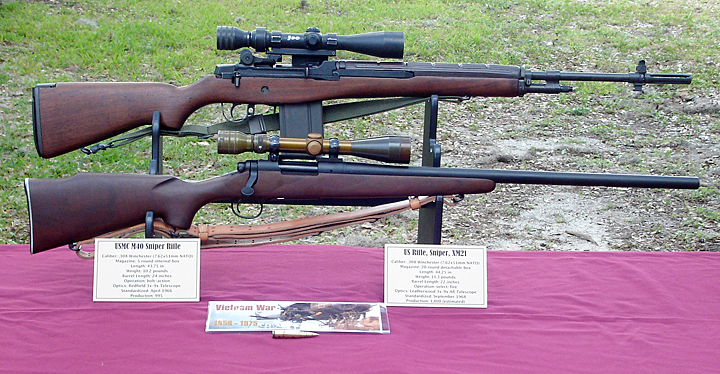
The comparison with the Army is worth one paragraph, because the two services reached opposite conclusions from the same war. The Army’s Vietnam sniper rifle was the XM21, an accurised M14: a semi-automatic, 20-round, magazine-fed rifle. The Marine M40 was a bolt action with a five-round internal magazine.6
The Army returned to the bolt action itself with the M24 Sniper Weapon System, adopted in 1986 according to the Remington 700 reference summary — also a Remington 700, but on the long action, so that it could be rechambered for longer cartridges; the Marine rifles always used the short action.2 The two services therefore ended up on the same maker’s receiver in different lengths, and the shared parentage is why the Army’s M24 literature is sometimes useful to an M40 builder. (Volume 5 explains why its operator’s manual is nonetheless not reproduced in this dive.)
1.9 Hathcock, and What the Record Supports
No account of Marine sniping escapes Carlos Hathcock, and a clone builder will meet his name attached to the M40 constantly. What the sources used here actually support is narrower than the association suggests.
- His Vietnam record is associated mostly with other rifles. The biographical summaries built on Charles Henderson’s Marine Sniper and Sasser’s account state that Hathcock “generally used the standard sniper rifle: the Winchester Model 70 chambered for .30-06 … with the standard 8-power Unertl scope”, and that he also used the M40 with the Redfield 3–9×.3 His longest recorded shot, at 2,500 yards in 1967, was made with an M2 Browning machine gun fitted with an 8× Unertl, not with a bolt-action rifle.3
- His link to the A1 era is institutional. A 2003 National Defense Magazine article, as quoted in the same summary, records that the Quantico sniper school was “Founded in 1977” and that its “first staff NCOIC was the famed sniper, Gunnery Sgt. Carlos Hathcock II”.3 That puts him at Quantico at exactly the moment the M40A1 was being built there — which is a real connection, and a different one from the popular image of him with an M40 in Vietnam.
- The kill count. The widely quoted figure of 93 confirmed kills is, as of September 2026, tagged as disputed in the reference literature.3 It is not relied on here.
One line that circulates as a Hathcock quotation — that the M40 was the “best sniping rifle available” — appears in the American Rifleman history in a passage built on Land’s account of the Corps’s view, not attributed to Hathcock in the text consulted.1 It should not be quoted as his.
1.10 What the M40 Left for the A1
The M40 established four things that every later rifle kept:
- A Remington 700 short action in 7.62×51. Never changed across five configurations.
- Match ammunition as part of the system. M118 then, M118LR later (Volume 3).
- A free-floated barrel. Refined, never abandoned.
- Marine hands on a commercial rifle. The M40 was the least worked of the family; every successor was more so.
And it left the two failures that defined the rebuild: a stock that moved with the weather and a barrel that pitted. Volume 2 is the answer to both.
1.11 What Could Not Be Verified
- The total of 995 rifles bought 1966–1977. Given by the Wikipedia summary of Senich; no primary procurement record was located.
- Whether the order was placed as “Model 40X”. American Rifleman and the Corps’s fact file describe a Model 700.
- The design credit to Jack Cuddy and Neil Warren Goddard, again only via the summary of Senich.
- Hathcock’s 93 confirmed kills, which the reference literature currently tags as disputed.
1.12 Bibliography
Footnotes
-
Brian C. Sheetz and Doug Wicklund, “Long-Range Warriors: The USMC M40 Rifles”, American Rifleman, first published February 2001, web edition 12 April 2019 — adoption 7 April 1966; the 700-rifle contract; the M40’s configuration (medium-weight free-floating chrome-moly barrel, uncheckered wood stock, Redfield Accu-Range 3–9× green anodised with ranging to 600 yards on a tapered Redfield mount, matte Parkerized); the June 1969 and 1973 availability figures; the causes of attrition; Edward J. Land Jr. as the principal informant. https://www.americanrifleman.org/content/long-range-warriors-the-usmc-m40-rifles/ (consulted 2026-09-19). ↩ ↩2 ↩3 ↩4 ↩5 ↩6 ↩7 ↩8 ↩9 ↩10 ↩11 ↩12 ↩13 ↩14 ↩15
-
“M40 rifle”, English Wikipedia, wikitext consulted 2026-09-19 — the order of “seven hundred Remington Model 40x rifles”, the 995-rifle total, the Cuddy and Goddard design credit, and the warping of the wood stock, each cited there to Peter R. Senich, Complete Book of U.S. Sniping (Paladin Press, 1988); the short-action (M40) versus long-action (M24) distinction. ↩ ↩2 ↩3 ↩4 ↩5
-
“Carlos Hathcock”, English Wikipedia, wikitext consulted 2026-09-19 — the Winchester Model 70 with 8× Unertl and the M40 with Redfield 3–9× (cited there to Sasser, 1990); the 2,500-yard shot with an M2 Browning (Henderson, 2003, p. 181); the National Defense Magazine article of March 2003 on the Quantico school founded in 1977 with Hathcock as first staff NCOIC; the “disputed” tag on the kill count dated April 2026. ↩ ↩2 ↩3 ↩4 ↩5
-
Headquarters, U.S. Marine Corps, Fact File, “M40A1 Sniper Rifle”, last modified 15 December 1995 — “based on the Remington model 700”; muzzle velocity 2,550 ft/s. Archived at https://web.archive.org/web/20070225004953/http://www.hqmc.usmc.mil/factfile.nsf/7e931335d515626a8525628100676e0c/03ae5c82962bc0f48525627b006d3126?OpenDocument (consulted 2026-09-19). ↩ ↩2
-
Headquarters, U.S. Marine Corps, FMFM 1-3B, Sniping, 28 January 1981 (superseding the edition of 7 April 1976), reissued as MCWP 3-15.3 by erratum of 27 May 2004 — §202 on the Unertl scope and the warning that sunlight may melt the mil dots; §203 on M118 Match (173-grain boat-tail, 2,550 ft/s) and M80 ball (147-grain, 2,750 ft/s), lot selection, and the instruction that M118 be fired at all times when available. Internet Archive item
mcwp-3-15.3-sniping-2004(consulted 2026-09-19). ↩ ↩2 ↩3 ↩4 ↩5 -
Wikimedia Commons, File:Sniper Rifles M40 XM21.jpg, by Curiosandrelics, CC BY-SA 3.0 — the display description identifying the XM21 as a modified M14 with a 20-round magazine and the M40 as a Remington 700 with a five-round internal magazine, and stating that both examples are reproductions fitted with original optics. ↩
Comments (0)