MP 40 · Volume 5
In Service — Issue, Range, and an Honest Comparison
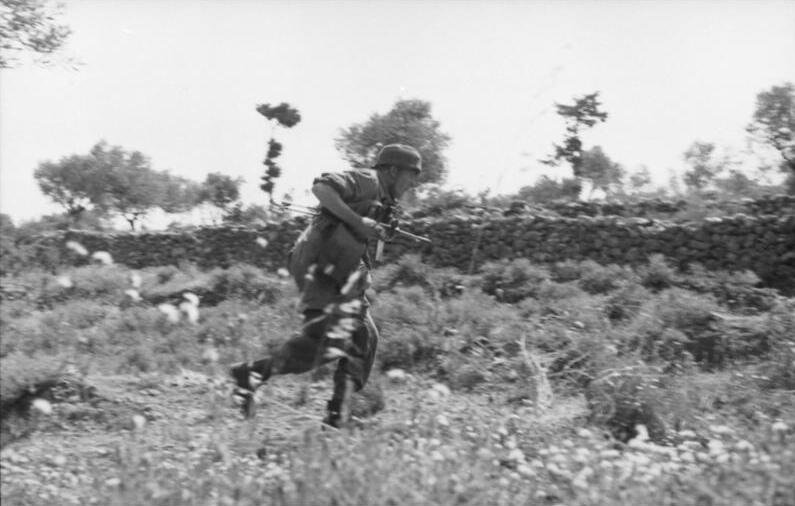
The MP 40 has a reputation problem in both directions. It is treated as the standard German infantry weapon, which it was not. It is shown being fired from the hip in long bursts at distant targets, which it could not usefully do. And it is then over-corrected into a mediocrity by people reacting against the first two claims, which is also wrong — it was a good weapon, and at least one museum thinks the Allies preferred it to their own.
This volume works through who actually carried it, what it could actually do, and how it compares with the three weapons it is always set against.
5.1 Who Actually Got One
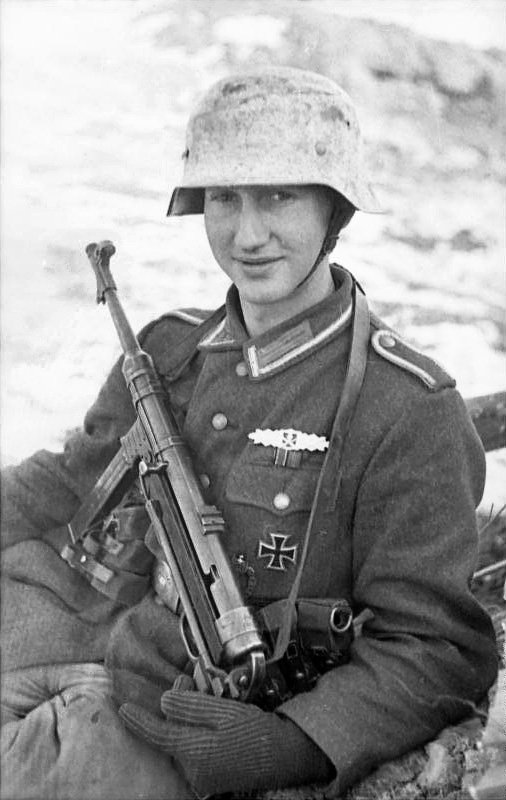
The MP 40 was never the standard German infantry weapon. The standard German infantry weapon was a bolt-action rifle, and it remained one until the end.
The arithmetic settles this on its own, without needing an establishment table. Volume 1 gave the production totals: somewhere between 1,047,100 and 1,200,000 MP 40s of all variants across the entire war, depending on which source is taken.12 That is a large number in absolute terms and a small one relative to the number of men Germany put in uniform between 1939 and 1945. A weapon produced in that quantity cannot have been issued to the rifle squad as a whole; it can only have been issued to particular people within it.
The wartime US assessment identifies the original constituency directly. The MP 38 is described as “an earlier model designed for issue to parachute troops and still used,” with the MP 40 developed from it.3 The same source names the pair’s distinctive features as “the folding stock and all metal and plastic construction.”3
The folding stock is the whole explanation for the issue pattern. A weapon that goes from 833 mm to 630 mm, with no wood to swell or split, is a weapon for people who are inside something or attached to something:
- Parachute troops, the original users, who had to jump with it.
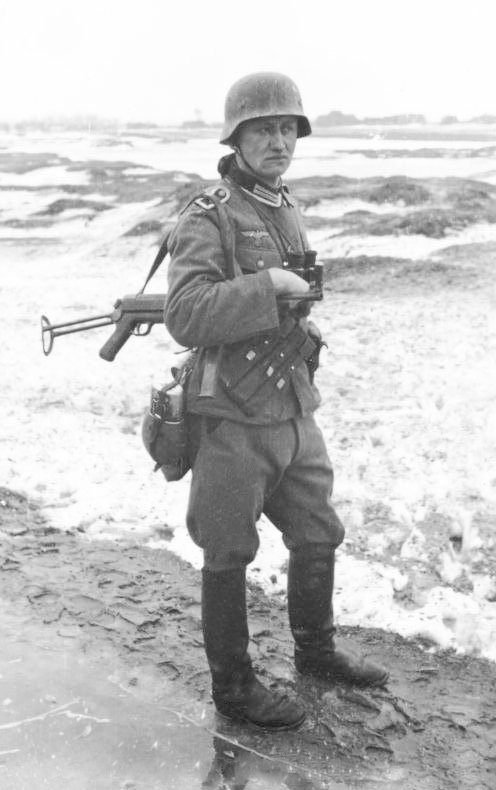
- Vehicle and gun crews, for whom a full-length rifle inside an armoured hull or a gun position is an obstacle.
- Squad and platoon leaders, who needed volume of fire at close range rather than reach.
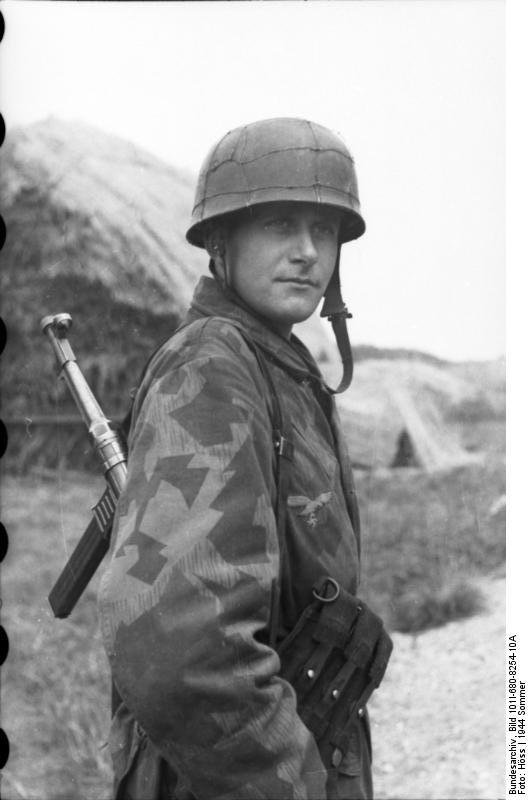
The resting bar under the barrel, described in Volume 3, is the detail that gives the game away. It is a hook designed to steady the weapon over the lip of a vehicle firing port or a hatch edge. It is an inherited feature from the EMP 36, and it is not a feature anyone puts on a rifleman’s weapon.4
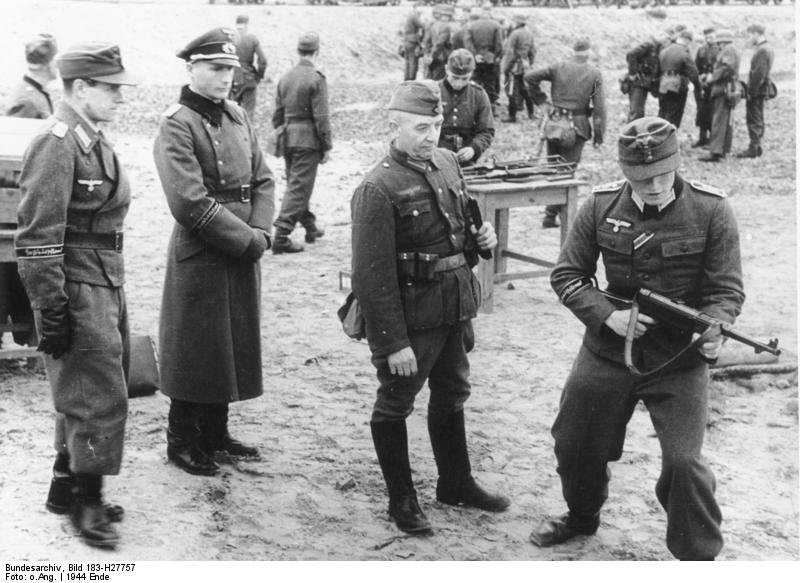
By the end, issue widened for the worst of reasons. The weapon appears in the hands of Volkssturm formations being trained in 1944 and 1945, where its virtue was that it existed and could be taught quickly.
5.2 Range, Against the Mythology
Volume 4 gave the sights: a hooded front blade, a 100-metre fixed rear notch and a 200-metre folding leaf, with no windage and no graduation in between.3 The published effective range is 100 to 200 metres, with a maximum of 250.1
Those numbers are not a limitation the Germans failed to overcome. They are a specification. A weapon with exactly two range settings, the further of which requires flipping a leaf, is a weapon nobody expected to be used past a couple of hundred metres.
Three claims commonly made about the weapon do not survive its own sights and its own mechanism.
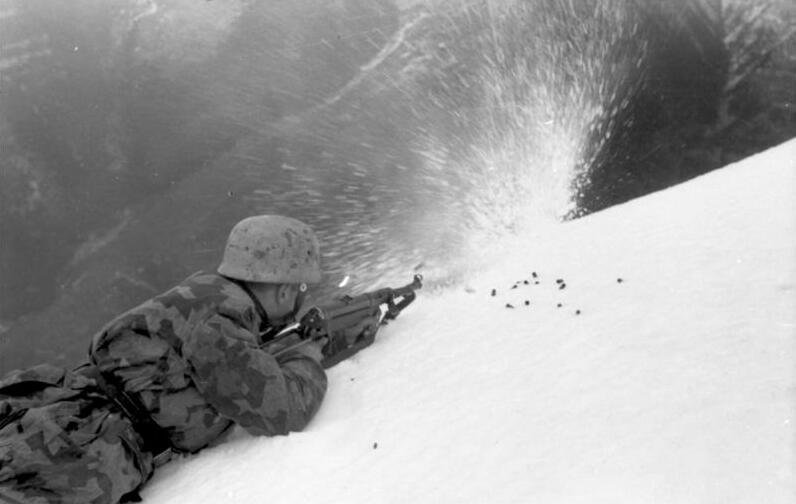
The hip-fired sweeping burst. The weapon fires from an open bolt, which Volume 4 explained means a substantial mass lurches forward every time the trigger is pressed, moving the muzzle before anything leaves the barrel. Add a 32-round magazine and a rate of 500 rounds per minute — under four seconds to empty — and the cinematic long burst is both mechanically inaccurate and logistically absurd. The US assessment’s practical rate of 180 rounds per minute against a cyclic rate of 500 is the documentary trace of how it was really fired: short bursts and singles.3
The long-range submachine gun. The general reference literature makes the wider point for the class: the German army sought an intermediate-cartridge weapon precisely to place accurate shots “beyond that of the 100–200 yd (91–183 m) range of the typical submachine gun.”5 That programme produced the StG 44 — Schmeisser’s weapon, as Volume 2 noted. The existence of the assault rifle is itself the German army’s verdict on the submachine gun’s reach.
The claim that it was uncontrollable. This one is wrong in the other direction. At 500 rpm the MP 40 was among the most controllable submachine guns of the war, as § 5.4 sets out.
5.3 The Eastern Front and the PPSh-41 Problem
The MP 40’s worst comparison is the one Germany actually had to fight.
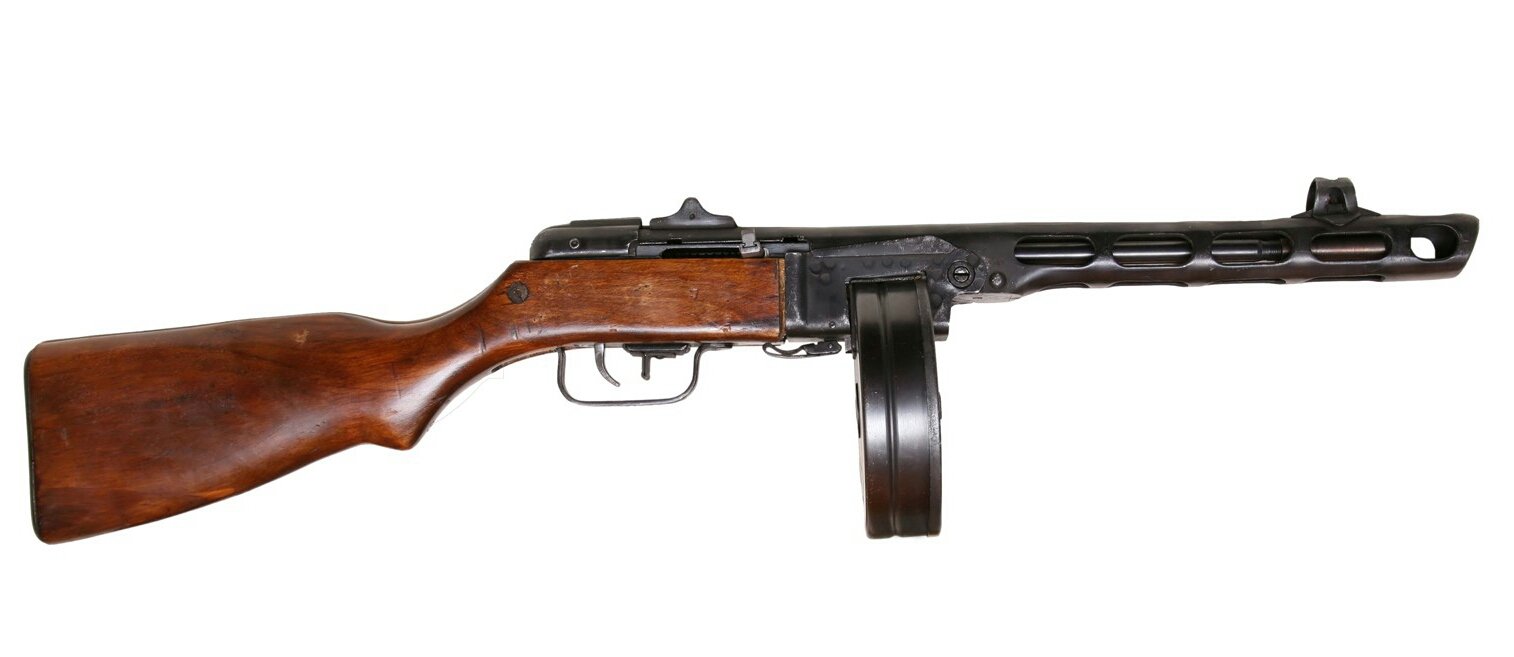
Table 1 — 5.3 The Eastern Front and the PPSh-41 Problem
| MP 40 | PPSh-41 | |
|---|---|---|
| Cartridge | 9×19mm Parabellum1 | 7.62×25mm Tokarev6 |
| Mass | 3.97 kg1 | 3.63 kg without magazine6 |
| Length | 833 / 630 mm1 | 843 mm6 |
| Barrel | 251 mm1 | 269 mm6 |
| Cyclic rate | 500–550 rpm1 | 1,250 rpm6 |
| Muzzle velocity | about 400 m/s1 | 488 m/s6 |
| Effective range | 100–200 m1 | 150–200 m6 |
| Magazine | 32-round box1 | 71-round drum or 35-round box6 |
| Production | 1,047,100–1,200,00012 | about 6,000,0006 |
The decisive row is the last one. The Soviet Union built roughly six times as many submachine guns as Germany, and issued them far more widely — entire companies were armed with them. The reference literature records the ramp: a few hundred in November 1941, another 155,000 over the next five months, and by spring 1942 the factories were producing roughly 3,069 units a day.6
The second most decisive row is the magazine. A 71-round drum against a 32-round box, at a moment when both sides were fighting at ranges where volume mattered more than precision. Volume 1 and Volume 4 covered the German answer — the dual-magazine MP 40/I, which tried to reach 64 rounds and creased its own receiver doing it.7
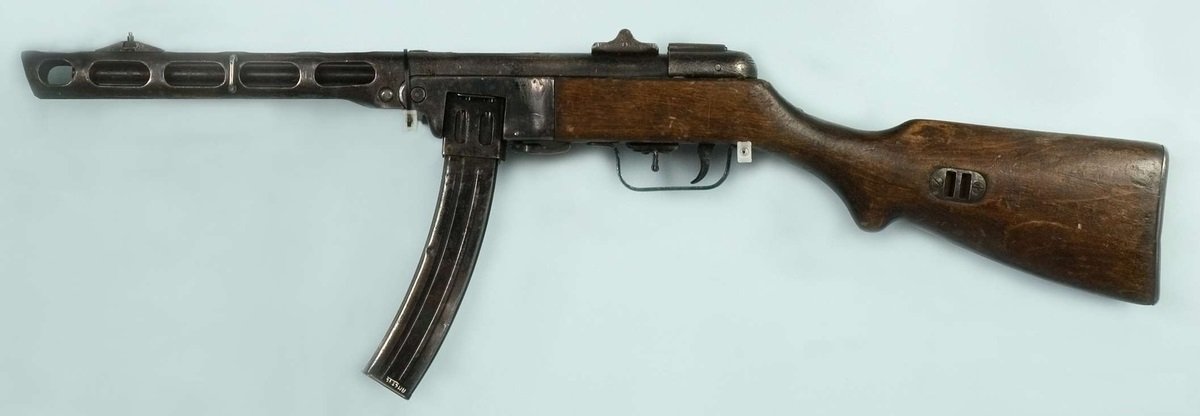
One correction in the Soviet weapon’s favour is due, and one against it. In its favour: the PPSh is a stamped-steel weapon, which makes the German claim to manufacturing sophistication a good deal less distinctive than it sounds.6 Against it: the drum does not actually hold 71 usable rounds — “misfeeding is likely to occur with more than about 65.”6 The capacity advantage was real but smaller than the number stamped on it.
And the Germans voted with their hands. The reference literature records the PPSh-41 as having been chambered in 9×19mm Parabellum in conversions, and fed from a 32-round box in German conversions.6 Germany captured Soviet submachine guns in quantity and put them into German service on German ammunition and German magazines. An army does not do that to a weapon it considers inferior to the one it is already issuing.
5.4 The STEN, Honestly
The STEN is this hub’s other treatment of the same 1940 problem, approached from the opposite end, and the comparison is more interesting than the usual “crude British stopgap versus refined German engineering” framing.
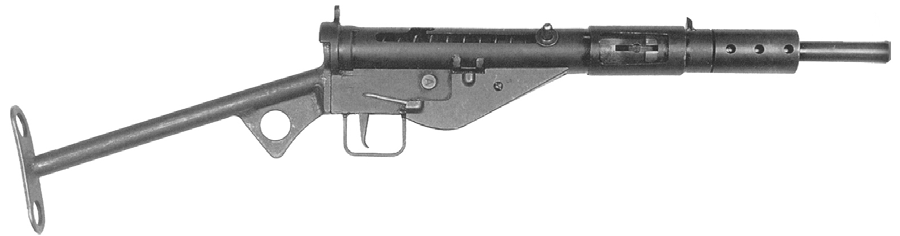
Table 2 — 5.4 The STEN, Honestly
| MP 40 | STEN Mk II | |
|---|---|---|
| Cartridge | 9×19mm1 | 9×19mm8 |
| Mass | 3.97 kg1 | 3.2 kg8 |
| Length | 833 / 630 mm1 | 762 mm8 |
| Barrel | 251 mm1 | 196 mm8 |
| Cyclic rate | 500–550 rpm1 | about 500–600 rpm8 |
| Muzzle velocity | about 400 m/s1 | 365 m/s8 |
| Effective range | 100–200 m1 | 60 m8 |
| Magazine | 32-round box1 | 32-round box8 |
| Unit cost | not verified — see Volume 3 | £2 6s in 19428 |
| Production | 1,047,100–1,200,00012 | 3.7–4.6 million8 |
A caution before anyone reads the effective-range row as a knockout. 60 metres against 100–200 metres is a startling gap, and it is almost certainly not a like-for-like measurement. These are published figures from different sources using different conventions, not the results of a common trial. The barrel-length difference — 196 mm against 251 mm — and the velocity difference are real and point the same way, but they do not account for a three-fold ratio. The honest statement is that the MP 40 has the longer barrel, the higher velocity and the better sights, and the STEN’s published effective range is markedly shorter, but the two figures should not be subtracted from one another.
Where the STEN plainly wins is the last two rows. It cost £2 6s and Britain built between 3.7 and 4.6 million of them.8 Volume 3 recorded that no verifiable unit cost for the MP 40 could be found, but nothing in its construction suggests it approached that. The STEN was the more successful industrial object by a wide margin, and it put a submachine gun into the hands of resistance movements across occupied Europe, which the MP 40 never had to do.
Where the MP 40 wins is everything about being a weapon rather than a product. Better sights, longer barrel, higher velocity, a folding stock, non-warping furniture, and a magazine problem that — while real, as Volume 4 set out — is at least a problem of hand pressure rather than of the wearing catch and dirt-prone feed taper the STEN’s reference entry documents.8
And there is a museum prepared to say so.
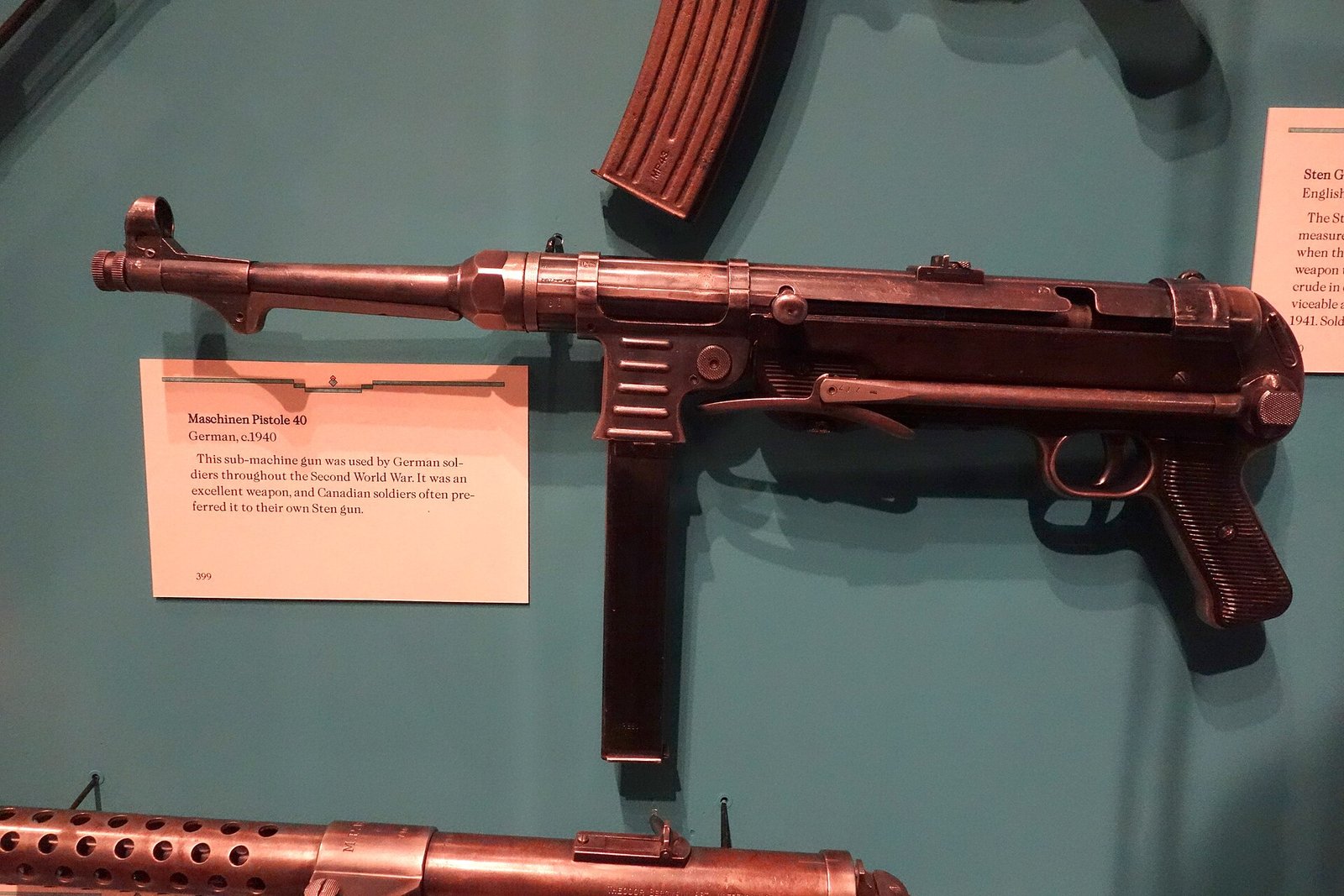
That label is a museum’s claim and should be weighed as one — it is not a study, it cites nothing, and institutions write confident sentences on small cards. But it is a Canadian institution volunteering, in a permanent display, that its own soldiers preferred the enemy’s weapon, and preference in a soldier’s hands is a legitimate kind of evidence even when it is not a measurement.
5.5 The Thompson
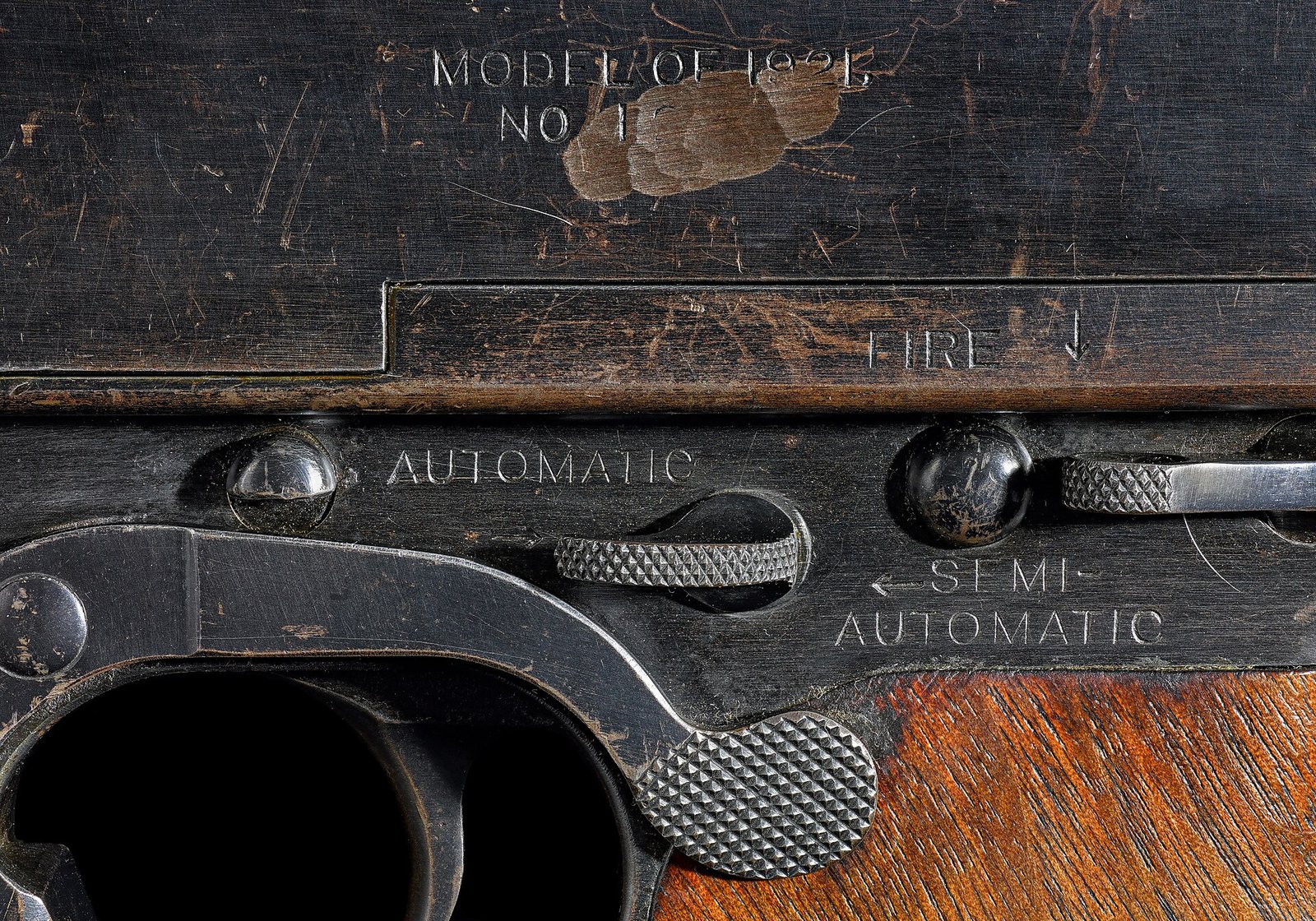
Table 3 — 5.5 The Thompson
| MP 40 | Thompson M1928A1 | Thompson M1A1 | |
|---|---|---|---|
| Cartridge | 9×19mm1 | .45 ACP9 | .45 ACP9 |
| Mass | 3.97 kg (8.75 lb)1 | 4.9 kg (10.8 lb)9 | 4.5 kg (10 lb)9 |
| Length | 833 / 630 mm1 | 860 mm9 | 810 mm9 |
| Cyclic rate | 500–550 rpm1 | 600–725 rpm9 | 700–800 rpm9 |
| Muzzle velocity | about 400 m/s1 | 285 m/s9 | 285 m/s9 |
| Effective range | 100–200 m1 | 150 m9 | 150 m9 |
| Magazine | 32-round box1 | 20/30 box, 50/100 drum9 | 20/30 box only9 |
| Unit cost | not verified | $225 (1928), $70 (spring 1942)9 | $45 (Feb 1944)9 |
The MP 40 is nearly two pounds lighter than an M1928A1, folds to three-quarters of its length, and drives its bullet at roughly 400 m/s against the Thompson’s 285. The Thompson throws a much heavier bullet, has a selector the MP 40 lacks, and — in its early forms — could take a 50-round drum.
The most striking row is the cost. The Thompson fell from $225 a gun in 1928 to $45 by February 1944.9 That is the same transformation the MP 40 represents relative to the MP 38, executed by a different industry on a different weapon, and it is a useful reminder that design-for-production was not a German insight but a general one that every major combatant reached.
5.6 The Scoreboard
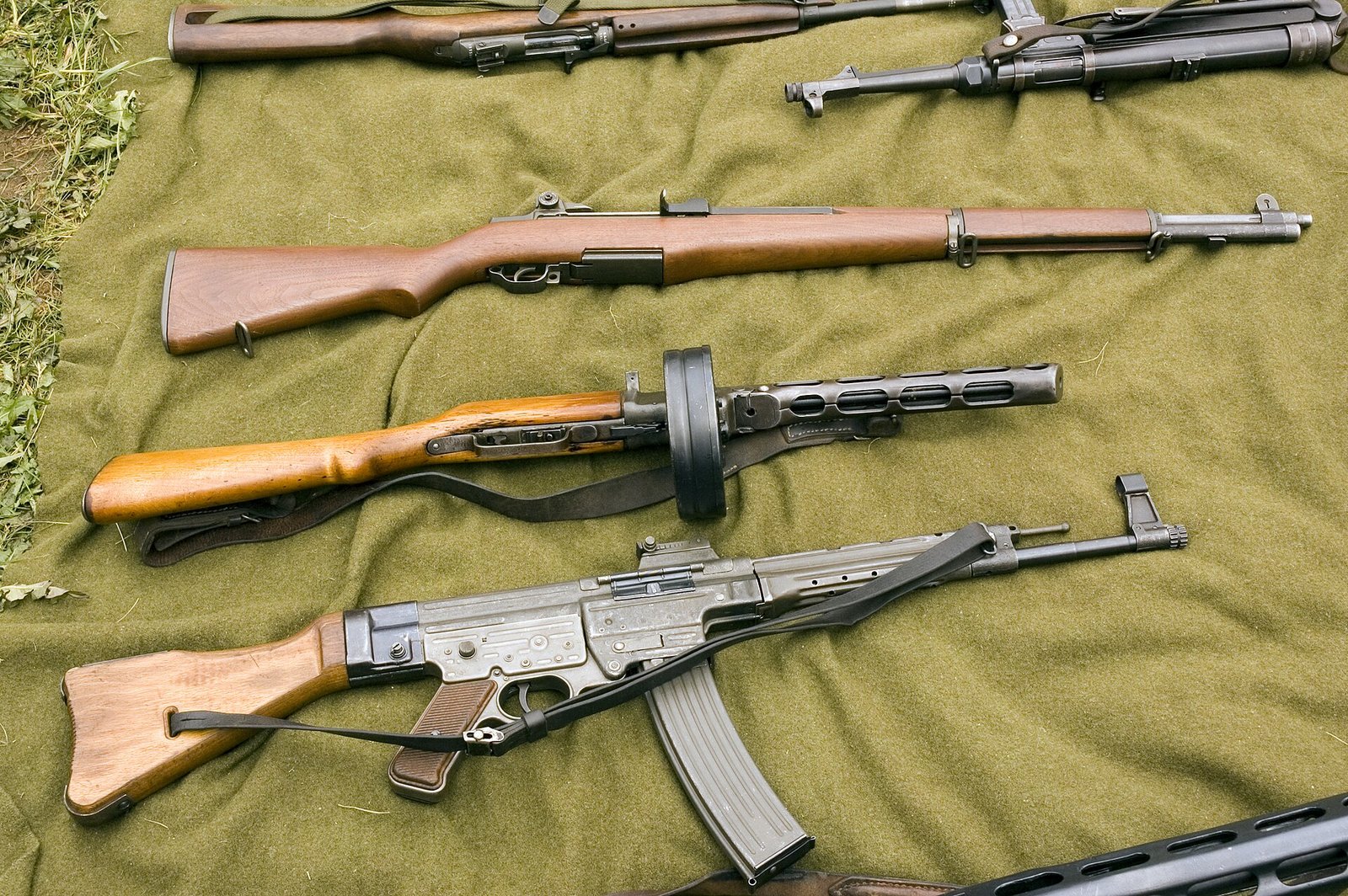
Stated plainly, and without preferring the famous weapon because it is famous:
- Best weapon in the hand of the four compared here: arguably the MP 40. Lightest of the group bar the STEN, the most controllable by rate, folding, weatherproof furniture, the best sights of the group, and higher velocity than either the STEN or the Thompson.
- Best industrial object: the STEN, decisively. Cheaper, simpler, made in far greater numbers relative to the industrial base that made it, and distributable by parachute to people with no armourer.
- Most militarily consequential: the PPSh-41, by six million to one. The weapon that actually shaped how the war’s largest infantry battles were fought.
- Least good value: the Thompson, which was superb and cost a fortune until the Americans redesigned it into something that did not.
And the MP 40’s real limitation was not the weapon. It was that Germany issued about a million submachine guns to an army whose standard arm remained a bolt-action rifle, while the Soviet Union issued six million and armed whole units with them. The MP 40 lost an argument about doctrine, not an argument about engineering.
5.7 Capture, and Afterwards
The weapon outlived the state that made it. The reference literature records that upwards of 200,000 were captured or surrendered to the Allies after the war.1
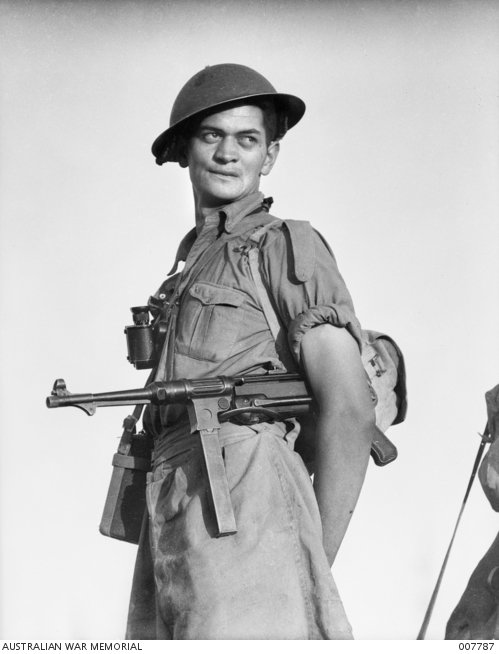
Two hundred thousand serviceable weapons in 9×19 do not get destroyed in 1945; they get distributed. Surviving MP 40s appear in post-war service across a range of countries, and museum collections documenting that service exist in several of them. This dive did not attempt a survey of post-war users and does not offer one — but the scale of the captured stock is the reason the weapon kept appearing in conflicts for decades after the army that designed it ceased to exist, and it is also the reason so many specimens survive in collections today, which Volume 6 takes up.
5.8 Bibliography
Footnotes
-
“MP 40”, English Wikipedia, consulted 2026-09-17 — specifications including mass, lengths, barrel, cyclic rate, muzzle velocity, effective and maximum ranges and magazine capacity; the 1,100,000 production estimate; the MP 40/I; and the figure of upwards of 200,000 captured or surrendered to the Allies after the war. ↩ ↩2 ↩3 ↩4 ↩5 ↩6 ↩7 ↩8 ↩9 ↩10 ↩11 ↩12 ↩13 ↩14 ↩15 ↩16 ↩17 ↩18 ↩19 ↩20 ↩21 ↩22 ↩23 ↩24 ↩25 ↩26 ↩27 ↩28
-
“MP 40”, German Wikipedia, and “Heinrich Vollmer”, German Wikipedia, consulted 2026-09-17 — the 1,047,100 total across all manufacturers for 1940–1944, and the 1.2 million figure attributed to Vollmer’s designs. ↩ ↩2 ↩3
-
US War Department, Handbook on German Military Forces, TM-E 30-451, chapter on weapons, consulted via the HyperWar transcription — the MP 38 as “an earlier model designed for issue to parachute troops and still used”, the MP 40 as developed from it, the folding stock and all metal and plastic construction as the distinctive features of both, the 100-metre fixed and 200-metre folding rear sights, and the cyclic rate of 500 rounds per minute against a practical rate of 180. ↩ ↩2 ↩3 ↩4
-
Forgotten Weapons, “Erma EMP36: External Form Factor of the MP40”, https://www.forgottenweapons.com/erma-emp36-external-form-factor-of-the-mp40/ — the pistol grip, underfolding stock and muzzle rest system as features carried from the EMP 36 into the MP 38 and MP 40. ↩
-
“Submachine gun”, English Wikipedia, consulted 2026-09-17 — the German pursuit of an intermediate cartridge enabling accurate shots beyond the 100–200 yard range of the typical submachine gun. ↩
-
“PPSh-41”, English Wikipedia, consulted 2026-09-17 — specifications including the 7.62×25mm Tokarev cartridge, 3.63 kg mass, 843 mm length, 269 mm barrel, 1,250 rpm cyclic rate, 488 m/s muzzle velocity, 150–200 m effective range, and the 35-round box and 71-round drum magazines; the approximately 6,000,000 produced and the production ramp figures; the largely stamped-steel construction; the note that misfeeding is likely with more than about 65 rounds in the drum; and the 9×19mm Parabellum conversions and 32-round box magazines used in German conversions. ↩ ↩2 ↩3 ↩4 ↩5 ↩6 ↩7 ↩8 ↩9 ↩10 ↩11 ↩12 ↩13
-
Forgotten Weapons, “MP-40/I: The Dual-Magazine Experimental MP-40”, https://www.forgottenweapons.com/mp-40i-the-dual-magazine-experimental-mp-40/ — development in response to Soviet submachine gun fire superiority and larger magazine capacity, and the creasing of the receiver caused by the added weight. ↩
-
“Sten”, English Wikipedia, consulted 2026-09-17 — Mk II specifications including 3.2 kg mass, 762 mm length, 196 mm barrel, approximately 500–600 rpm, 365 m/s muzzle velocity, 60 m effective range and 32-round magazine; the unit cost of £2 6s in 1942; total production of 3.7–4.6 million; and the magazine’s double-column single-feed design, dirt-prone merging taper, 8-degree feed-lip requirement and the wear to the magazine catch caused by using the magazine as a handhold. ↩ ↩2 ↩3 ↩4 ↩5 ↩6 ↩7 ↩8 ↩9 ↩10 ↩11 ↩12
-
“Thompson submachine gun”, English Wikipedia, consulted 2026-09-17 — M1928A1 and M1A1 specifications including mass, length, cyclic rate, muzzle velocity, effective range and magazine options, and the unit costs of $225 in 1928, $70 in spring 1942 and $45 for the M1A1 in February 1944. ↩ ↩2 ↩3 ↩4 ↩5 ↩6 ↩7 ↩8 ↩9 ↩10 ↩11 ↩12 ↩13 ↩14 ↩15 ↩16 ↩17
Comments (0)