MP 40 · Volume 1
Origins — Erma, Vollmer, and the Weapon the Wehrmacht Asked For
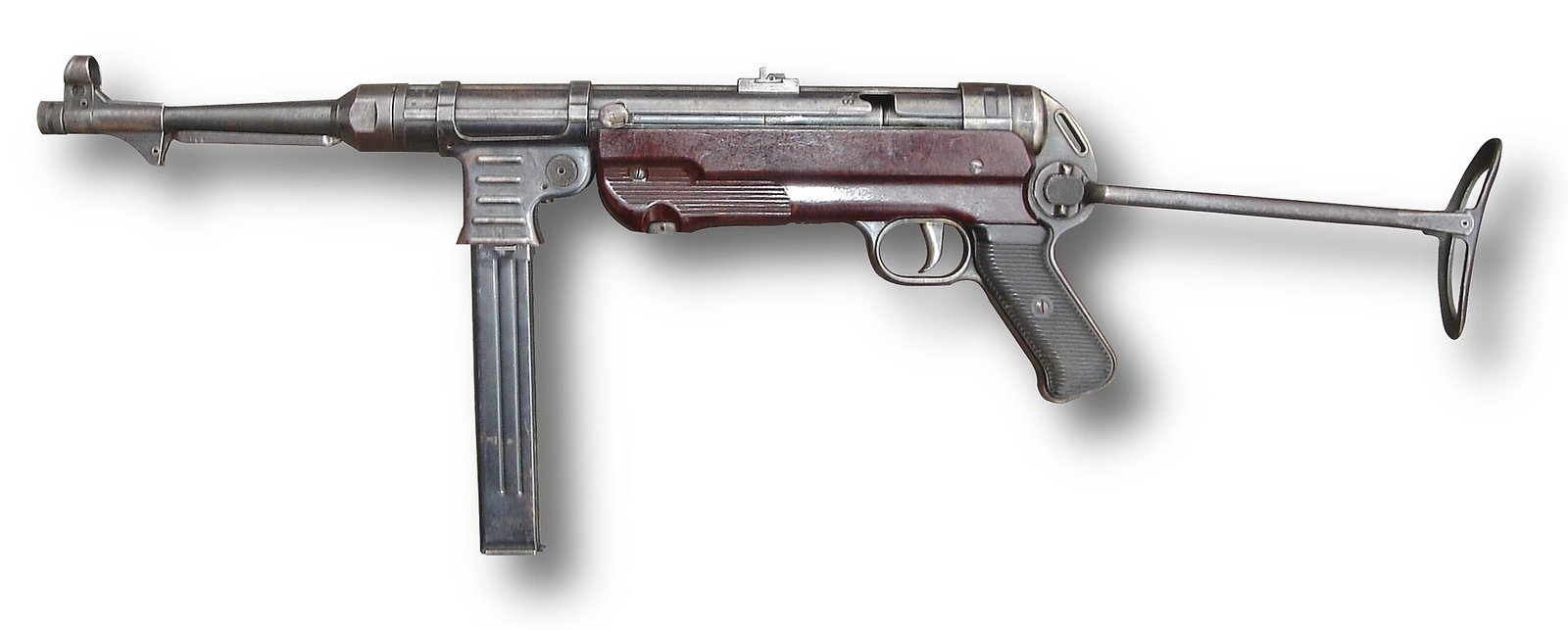
The MP 40 is the most recognisable German weapon of the Second World War and one of the most consistently misdescribed. It is called a Schmeisser by people who have no idea who Hugo Schmeisser was. It is shown in films being fired from the hip in long bursts by men who hit things, which it will not do. It is credited with a production run that varies by two hundred thousand units depending on which book is open. And it is routinely described as a mass-produced stamped weapon that Germany built because stamping was cheap — which is true of the MP 40 and emphatically not true of the MP 38 that preceded it and looks almost identical.
This volume establishes the ancestry: the weapon Germany actually invented in 1918, the man who built the machine that became the MP 38, the trials that produced a hybrid, and the production sequence from MP 38 through MP 38/40 and MP 40 to the dual-magazine MP 40/I. Volume 2 then takes up the attribution question in full, because it is the single largest piece of received wisdom attached to this weapon and it does not survive contact with the evidence.
1.1 The Weapon in One Table
Figures are as published in the reference literature, with the wartime US intelligence assessment given alongside where it differs, because the difference is itself informative.12
Table 1 — 1.1 The Weapon in One Table
| MP 38 | MP 40 | |
|---|---|---|
| Adopted | 1938 | 1940 |
| Cartridge | 9×19mm Parabellum | 9×19mm Parabellum |
| Operation | Straight blowback, open bolt, automatic only | Straight blowback, open bolt, automatic only |
| Mass | about 4.2 kg | 3.97 kg (8.75 lb) |
| Length, stock extended | 833 mm (32.8 in) | 833 mm (32.8 in) |
| Length, stock folded | 630 mm (24.8 in) | 630 mm (24.8 in) |
| Barrel | 251 mm (9.9 in) | 251 mm (9.9 in) |
| Cyclic rate | 500–550 rounds/min | 500–550 rounds/min |
| Practical rate | — | 180 rounds/min (US assessment) |
| Muzzle velocity | about 400 m/s (1,312 ft/s) | about 400 m/s (1,312 ft/s) |
| Effective range | 100–200 m | 100–200 m |
| Maximum range | 250 m | 250 m |
| Sights | Hooded front blade; 100 m fixed rear, 200 m folding leaf | Hooded front blade; 100 m fixed rear, 200 m folding leaf |
| Magazine | 32-round detachable box | 32-round detachable box |
| Receiver | machined from bar, longitudinally fluted | rolled and welded sheet steel, smooth |
| Furniture | phenolic resin | phenolic resin |
The two weapons are mechanically the same gun. Every meaningful difference between them is a manufacturing difference, and Volume 3 is built around that fact.
Two entries in this table deserve immediate comment, because both are routinely misquoted.
“Automatic only” is not a simplification. There is no selector on an MP 38 or an MP 40. The weapon has one fire mode. The reference literature notes that the low cyclic rate “permits single shots with controlled trigger pulls,” and the US War Department’s own handbook gives a practical rate of 180 rounds per minute against a cyclic rate of 500 — a ratio that only makes sense if trained users were firing very short bursts and singles.12 A soldier could get one round at a time out of an MP 40, but by technique, not by a switch.
The sights are the honest answer to the range question. A 100-metre fixed notch with a 200-metre folding leaf is a statement of intent by the people who issued the weapon. Volume 5 takes up what it could actually do against what it is shown doing.
1.2 What Germany Had Already Invented
The submachine gun is a German idea, and Germany got there first by a wide margin.
In 1917 Hugo Schmeisser, working at Theodor Bergmann’s Bergmann Waffenfabrik as part of a team, designed the MP 18.3 It was the first mass-produced submachine gun in the world: a blowback weapon in 9×19mm with a wooden rifle stock, a perforated barrel jacket, and a magazine fed horizontally into the left side of the receiver.
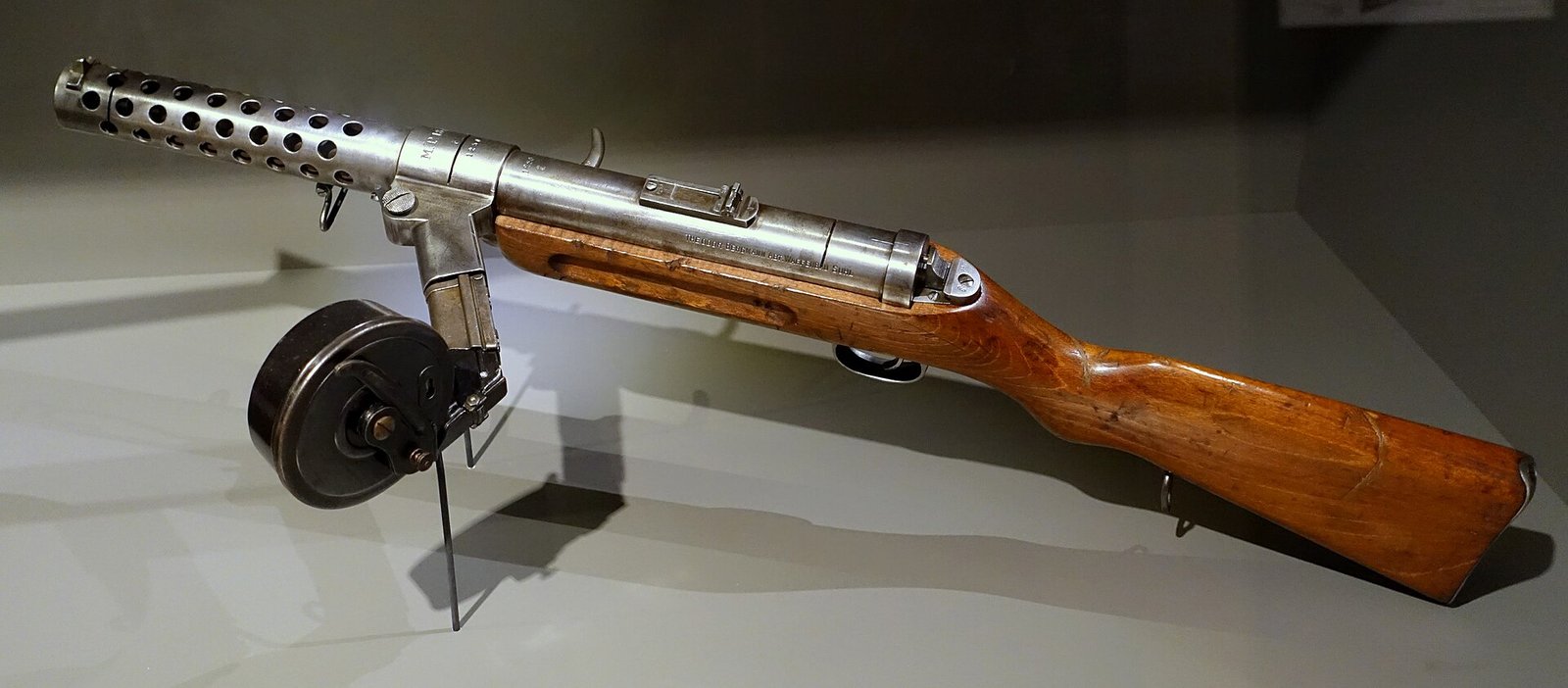
The magazine was the awkward part. The MP 18 was issued with the TM 08 snail drum, a 32-round helical magazine adapted from the artillery model Luger pistol, which was heavy, slow to load and needed a separate loading tool. After 1920 the design was modified to accept straight box magazines “similar to those later employed in the MP 40.”3 That sentence is the hinge on which the whole Schmeisser attribution turns, and Volume 2 pulls it apart.
Production of the MP 18/I ran to roughly 37,000 units.3 Schmeisser then developed the MP 28,II in the 1920s, of which about 80,000 were made, widely used by German police and exported broadly.3
A correction worth making early, because it is repeated constantly. The Treaty of Versailles is usually described as having banned German submachine gun manufacture outright. It did not. The treaty “restricted Germany to 1,134 submachine guns but did not ban their manufacture outright, contrary to common belief.”3 The German submachine gun line was never actually broken; it was capped, and it continued through the police market and the export market throughout the 1920s and 1930s. By the time the Heereswaffenamt wrote a requirement in the late 1930s, Germany had two decades of continuous institutional experience with the weapon class.
1.3 Vollmer, Geipel and Erma
The company that built the MP 38 was founded in 1922 in Erfurt, Thuringia, by Berthold Geipel, as the Erfurter Maschinen- und Werkzeugfabrik GmbH. It entered the firearms business at the beginning of the 1930s by acquiring licences to produce Mauser carbines including the Karabiner 98k, and in 1934 was renamed the Erfurter Maschinenfabrik B. Geipel GmbH — abbreviated ERMA.4
The designer was Heinrich Vollmer (26 July 1885 – 1 July 1961), an engineer from Württemberg who had founded Vollmer Werke GmbH at Biberach an der Riß in 1909.5 Vollmer developed a series of submachine gun prototypes through the 1920s, listed among his known constructions as the Vollmer machine pistol of 1927 and an associated machine gun design.5
The sources do not agree on exactly how Vollmer and Erma came together, and the difference is not trivial. The German account has Vollmer working as chief engineer at Erma in Erfurt from 1928.5 The English account has Geipel acquiring Vollmer’s designs in the early 1930s, with the resulting EMP series produced from 1932 to 1938.4 These are different relationships — an employed designer and a licensed design — and the distinction matters when the question becomes who owned what. This volume records both readings rather than choosing between them; the point on which they agree is that the EMP was Vollmer’s work and Erma’s product.
The EMP was exported to Spain, Mexico, China and Yugoslavia, and saw service in the Spanish Civil War.4 It is commercially important because it put Vollmer’s mechanism into production and into the field for six years before any German army requirement existed. The MP 38 did not emerge from a blank sheet; it emerged from a product line.
1.4 The 1938 Trials — Two Prototypes, One Hybrid
In the mid-1930s, with a German army requirement forming, two firms put forward prototypes. Both survive, both have been examined and photographed in detail, and together they settle a question that the one-line summaries get wrong in both directions.
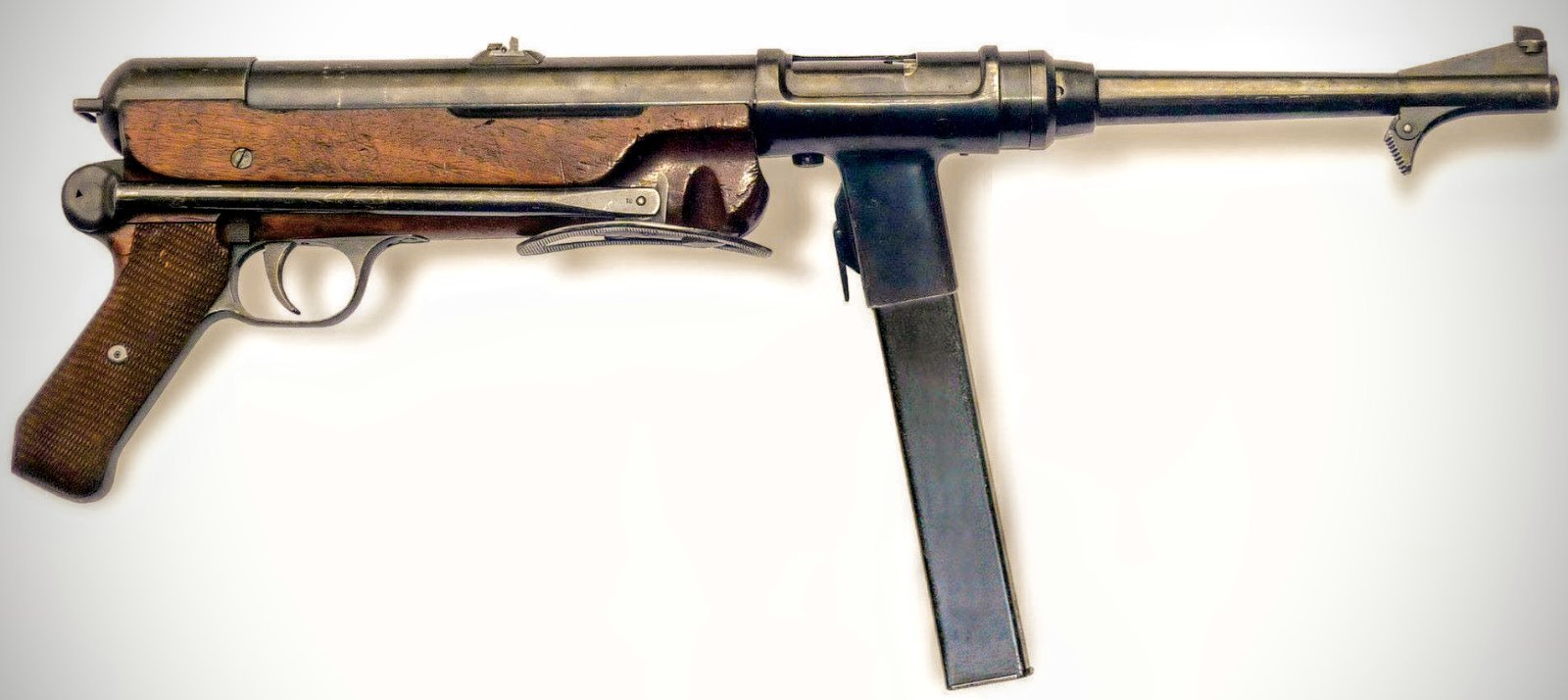
Erma’s entry was the EMP 36, sometimes written MP 36, designed by Vollmer. Only two examples are known; one is held at the Military History Institute in Prague, and surviving examples are marked “ERMA ERFURT” and “EMP 36.”67 It already had the shape: the pistol grip, the underfolding stock, the muzzle resting bar. It differed from the MP 38 in ways that matter — it had a button allowing selection between semi-automatic and automatic fire, its magazines were not interchangeable with what followed, and its shoulder stock was held by friction rather than by a spring or a positive lock.7 It was also, in the assessment of those who have handled it, “massively more complicated than such a simple design has any right to be,” with tiny set screws and a detachable bolt face that were unsuitable for military production.6
Haenel’s entry was the Schmeisser MK 36,II, designed by Hugo Schmeisser, who had been Haenel’s chief designer since around 1920.89 It was a simple blowback weapon with a full wooden stock, chambered in 9×19mm; two prototypes are held by the Royal Armouries, one in 9×19 and one in 9×25 for Hungarian trials, and it carried a magazine safety whose purpose has not been satisfactorily explained.8
What the trials produced was not a winner but a combination. The assessment of the surviving prototypes is explicit: “the result of testing of the Erma and Schmeisser prototypes was a combination of their features into a hybrid design. The Erma provided the external form factor, and the Schmeisser contributed the internal mechanics for the MP38 and in turn MP40.”6 Stated from the Haenel side: “the Schmeisser gun was simple and effective mechanically (except for that weird safety), and it ultimately contributed its magazine, bolt, and fire control system to the MP38 and MP40 design.”8
That is a materially different claim from the standard encyclopaedia line that Schmeisser “did not have anything to do with the design or development of the MP 40, although he held a patent on the magazine.”1 Both statements are in circulation, both come from sources that are ordinarily reliable, and they cannot both be complete. Volume 2 is devoted to reconciling them, because doing it properly requires laying out what each source actually asserts, what physical evidence exists, and which parts of the popular story turn out to rest on a magazine marking.
1.5 The MP 38
The development contract was issued in January 1938 and the weapon was complete by August of that year, entering service as the Maschinenpistole 38.7 Vollmer submitted the prototype in answer to a Heereswaffenamt request for a new submachine gun.1
What the army got was, by the standards of 1938, a strikingly modern object and a strikingly expensive one.
It had no wood on it at all. The grip frame and forearm were moulded phenolic resin — the material generally called bakelite — in place of the walnut that every previous German submachine gun had carried. The reference literature is direct about the reason: the material was cheap and quick to produce.7 Volume 3 takes up what that substitution actually bought and what it cost.
It had a folding stock, described in the reference literature as the first collapsible metal shoulder stock fitted to any submachine gun.7 The claim to primacy should be treated with some caution — priority claims of this kind are difficult to verify and easy to repeat — but the significance of the stock itself is not in doubt. It made a shoulder-fired weapon that a man could carry in an armoured vehicle, a glider or a parachute harness.
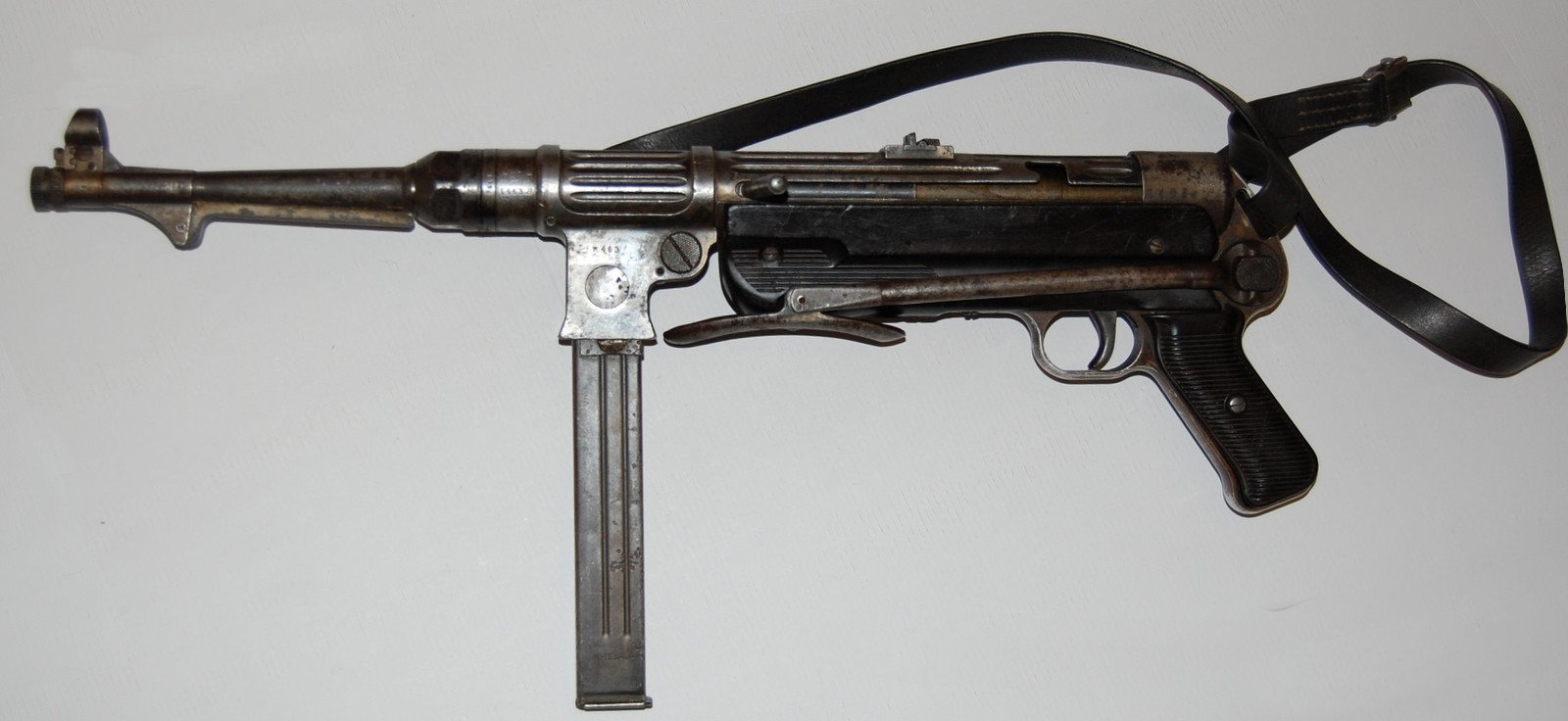
And it was machined from solid. The MP 38’s receiver was cut from bar stock, with deep longitudinal flutes machined along its length, and its magazine housing was left smooth. This is the single most reliable way to tell an MP 38 from an MP 40 in a photograph.
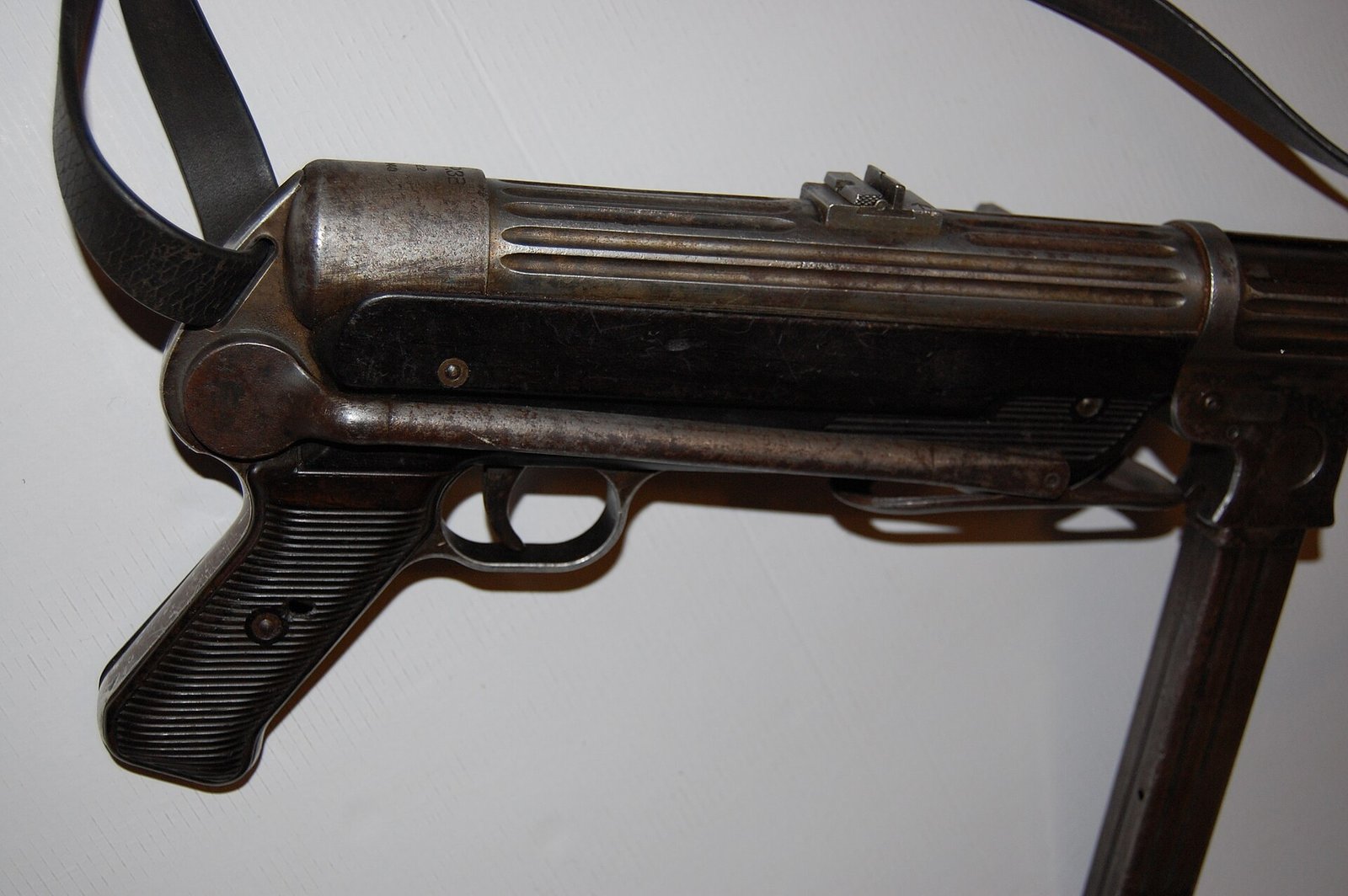
The flutes were not decoration. They were the weight that a machinist could remove from a bar-stock receiver without compromising it, and their presence advertises exactly how the part was made. Producing a receiver this way consumed machine time and skilled labour, the two things a wartime economy runs out of first.
1.6 The Accidental Discharge, and the MP 38/40
The MP 38 entered service with a defect that killed people.
An open-bolt weapon holds its bolt to the rear under spring tension when cocked and fires by releasing it; the bolt strips a round from the magazine, chambers it, and fires it on the same forward stroke. The early MP 38 had no means of locking the bolt in any position. A weapon carried with the bolt forward and a loaded magazine fitted could, if dropped or knocked hard enough, have its bolt driven rearward far enough to pick up a cartridge — which it would then chamber and fire on the return, with nobody touching the trigger.17
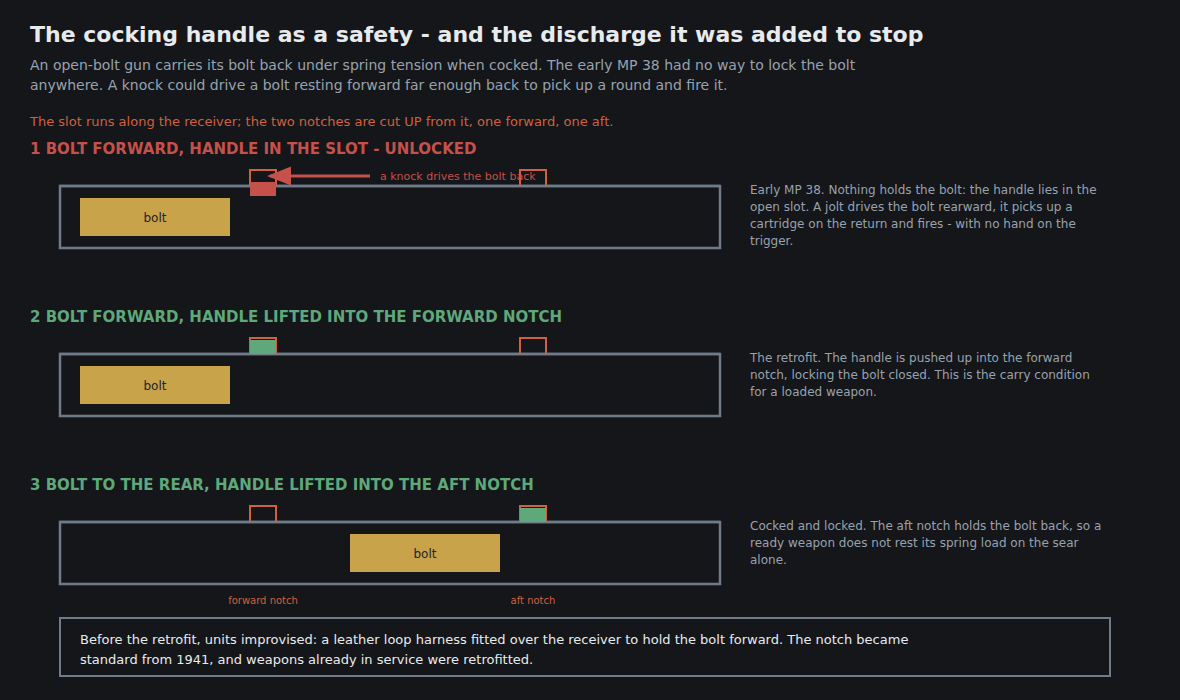
Units improvised before the factories caught up. The documented field expedient was “leather harnesses with a small loop that were used to hold the bolt in the forward position.”1 A leather strap is the sort of fix that appears when a hazard is real, common and not yet solved at the source.
The engineered answer was a locking notch cut in the cocking-handle slot, so that the handle could be pulled back and pushed upward into a notch, locking the bolt in either the forward or the cocked position.17 The US War Department’s handbook describes the resulting drill plainly for its own readers: pull the cocking handle back and push it upward into the safety notch.2 The modification was introduced as standard equipment from 1941, and weapons already in service were retrofitted.7
Between the MP 38 and the MP 40 sits a designation that is frequently mistaken for a collector’s invention: the MP 38/40. These are MP 38 receivers completed or reworked with MP 40 production methods and fittings, including the safety modification. A weapon marked this way is neither cleanly one model nor the other, and the marking is genuine.
1.7 The MP 40
The MP 40 entered production in early 1940 and is, in one sentence, the MP 38 redesigned so that presses could make it instead of machinists.
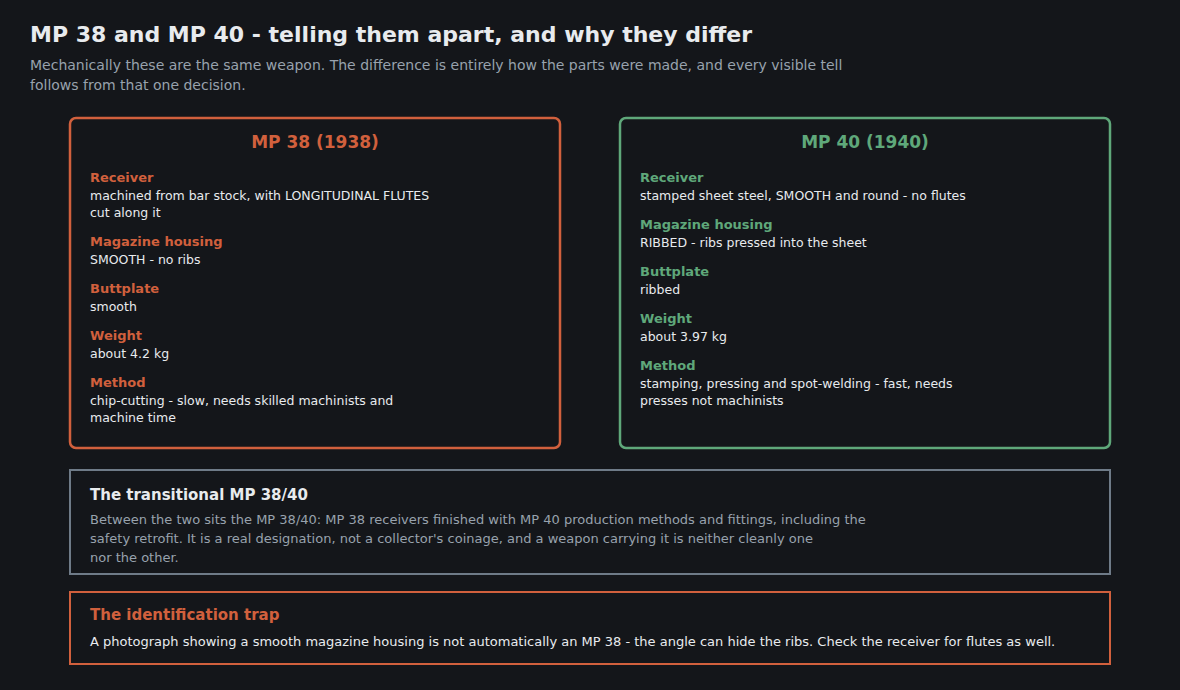
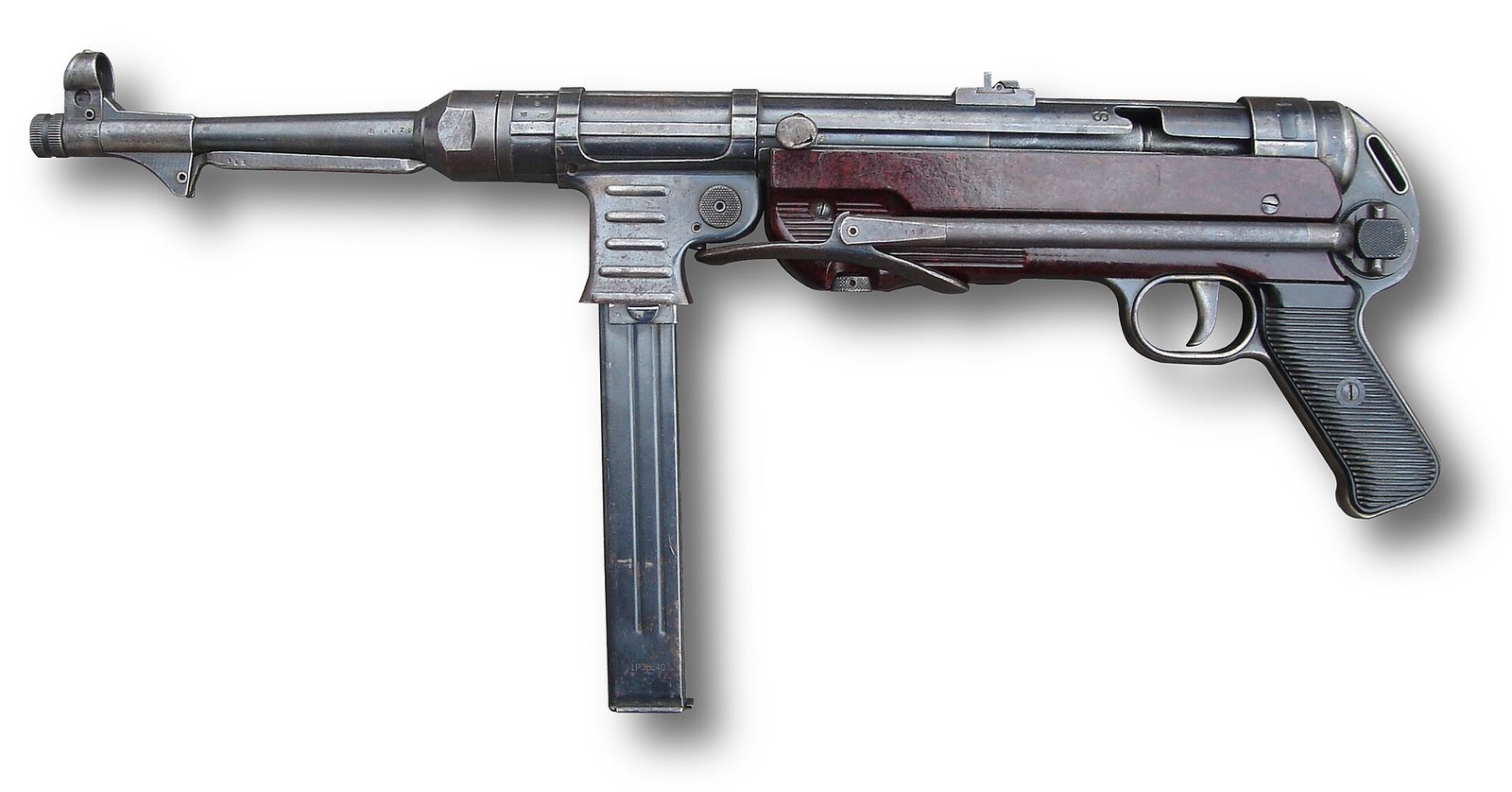
The reference literature describes the lineage as a sequence of simplifications: “The MP 38 was a simplification of the MP 36, and the MP 40 was a further simplification of the MP 38, with certain cost-saving alterations, most notably in the more extensive use of stamped steel rather machined parts.”1 The German account is more specific about method — sheet metal stamping and spot welding in place of chip-removing machining — and about the visible consequences: the magazine housing gained ribs pressed into the sheet, the buttplate gained ribbing, and the weight fell from about 4.2 kg to 3.97 kg.7
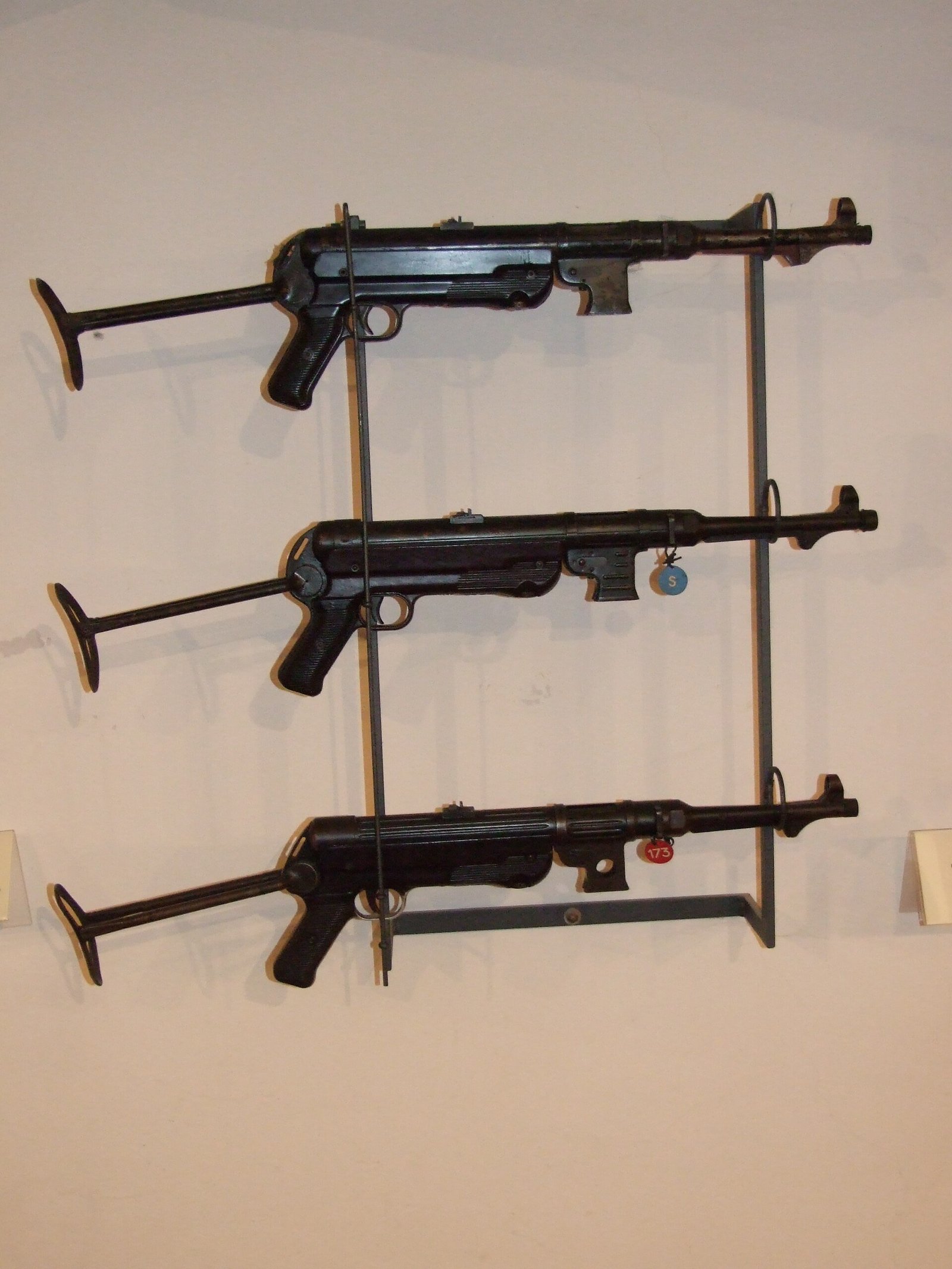
The count of ribs on the magazine housing is given in the reference literature as four transverse ribs.7 The specimens photographed for this dive show a stack of horizontal ribs pressed into the housing sides, and an exact count could not be established reliably from the available photographs; the figure is therefore reported here as sourced rather than as confirmed by inspection.
1.8 The MP 40/I — and Why It Is Not the MP 40/II
Late in 1942, in response to complaints about Soviet fire superiority — the Red Army fielded both more submachine guns and larger magazines, the PPSh-41’s 71-round drum against the MP 40’s 32-round box — a modification was developed to double the ammunition a soldier had immediately on hand.10
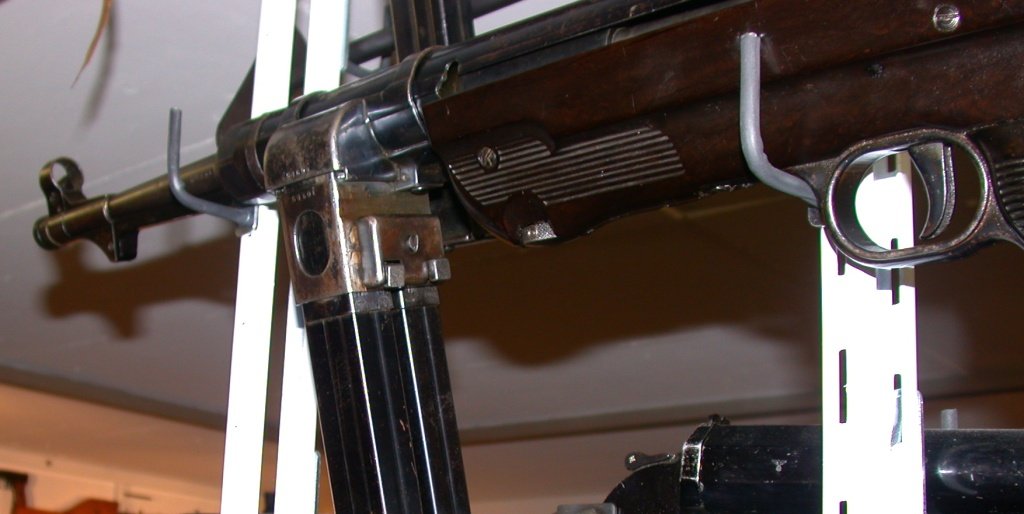
The conversion replaced the standard magazine housing with a wider one containing a sliding block that held two standard magazines side by side, giving 64 rounds on the weapon. The work also involved “slightly shortening the ejector and reshaping the bottom of the buttplate so that it would clear the new magazine release catches,” and the guns were made by retrofitting existing weapons rather than building new ones, with the dual housing originally serial-matched to the base gun.10
It did not work. The added weight spoiled the balance when both magazines were loaded, the sliding mechanism admitted dirt, and — the detail that condemns it structurally — “the extra weight on the relatively thin receiver tube often contributed to creases or other damage to the magazine well and ejection port areas.”10 The MP 40’s receiver is rolled sheet; it was never intended to carry a cantilevered mass of that kind. Only a small number were made, around the middle of 1943, and very few survive.10
The designation is the MP 40/I. It is widely rendered “MP 40/II,” including in otherwise careful sources, and the reference literature explicitly flags that form as incorrect.1 Every primary examination of surviving examples consulted for this dive uses MP 40/I.10
1.9 Who Built Them, and How Many
Three firms manufactured the weapon: Erma, C.G. Haenel and Steyr.1 The German account records Steyr as the largest producer by volume, and as the last to stop, ceasing manufacture in October 1944.7
On the production total, the sources do not agree, and the spread is about fifteen per cent. Each figure is given here with the source that carries it, rather than averaged into a false precision:
Table 2 — On the production total, the sources do not agree, and the spread is about fifteen per cent. Each figure is given here with the source that carries it, rather than averaged into a false precision
| Figure | Scope | Source |
|---|---|---|
| 1,100,000 (estimated) | all variants, by the end of the war in 1945 | English-language reference literature1 |
| 1,047,100 | total across all manufacturers, production 1940–1944 | German-language reference literature7 |
| 1,200,000 | attributed to Vollmer’s designs | biographical account of Heinrich Vollmer5 |
The 1,047,100 figure is the only one of the three stated to a precision that implies a documentary source rather than an estimate, and it is bounded by an explicit production window that closes in 1944. The 1,100,000 figure is expressly flagged as an estimate and extends to 1945. The 1,200,000 figure appears in a biography rather than an arms reference and is the least constrained of the three. None of this establishes which is right; it does establish that any single number quoted without a source is quoting one of three.
Separately, the reference literature records that upwards of 200,000 were captured or surrendered to the Allies after the war.1
Markings and maker codes. German wartime production carried three-letter manufacturer codes in place of company names. The codes associated with this weapon are ayf for Erma, bnz for Steyr and fxo for Haenel. The evidence for that mapping available to this dive is photographic rather than documentary: a specimen photographed in detail is identified by its documenting photographer as Erma manufacture of 1943 and is catalogued under the code ayf, and a collector’s schematic of receiver markings reproduces “MP 40 / bnz. 41”, “MP 40 / bnz. 40” and “MP 40 / fxo. 41”, identifying bnz with Steyr and fxo with Haenel in its accompanying text.1112 No authoritative published code table was located during this work, and the mapping is therefore recorded here as well attested but not verified against a primary reference. Volume 3 returns to markings in detail, including a finding from that schematic that has real consequences for anyone identifying a specimen: the serial number alone does not identify an MP 40.
1.10 What the Rest of This Series Argues
Seven volumes, and three claims run through them.
The gun is not named after the man who designed it, and the correction is more interesting than the error. The popular name is wrong, but so is the flat denial that usually replaces it. Volume 2 shows that Schmeisser’s contribution was real, specific and internal, that Vollmer and Erma supplied the form and the programme, and that the name attached itself for a reason that has nothing to do with either — a marking on a magazine.
The MP 40 is a manufacturing story wearing a weapon’s clothes. Nothing about how it shoots was improved over the MP 38. Everything about how it was made was changed. Volume 3 treats the stamping, the phenolic furniture and the three-firm production system as the actual subject, because they are.
Almost every popular claim about its performance is a claim about films. The hip-fired burst, the hundreds-of-metres engagement, the magazine held as a foregrip: Volumes 4 and 5 take these in turn against the sights the weapon actually carried, the rate it actually fired at, and the training its users were actually given — which, in the case of the magazine, was explicitly not to do the thing everyone has seen done on screen.
Table 3 — 1.10 What the Rest of This Series Argues
| Vol | Title |
|---|---|
| 1 | Origins — Erma, Vollmer, and the Weapon the Wehrmacht Asked For |
| 2 | The Schmeisser Question — Who Designed It, and Where the Name Came From |
| 3 | How It Is Made — Stamping, Phenolic Resin, and Three Factories |
| 4 | How It Works — Open Bolt, Telescoping Spring, and the Safety That Was Added Late |
| 5 | In Service — Issue, Range, and an Honest Comparison |
| 6 | Owning One Today in the United States |
| 7 | Handling and Upkeep |
The closest relative of this weapon already documented in this hub is the STEN, the British answer to the same problem arrived at from the opposite direction — and the comparison between them, which Volume 5 makes in full, is less flattering to the MP 40 than its reputation suggests.
1.11 Bibliography
Footnotes
-
“MP 40”, English Wikipedia, consulted 2026-09-17 — specifications, the 1,100,000 production estimate, the manufacturers, the Schmeisser attribution and magazine patent, the cocking-handle safety and the leather-harness expedient, the magazine-as-handhold problem, and the MP 40/I including the note that “MP 40/II” is an incorrect designation. ↩ ↩2 ↩3 ↩4 ↩5 ↩6 ↩7 ↩8 ↩9 ↩10 ↩11 ↩12
-
US War Department, Handbook on German Military Forces, TM-E 30-451, chapter on weapons, consulted via the HyperWar transcription — the MP 40 as developed from the MP 38, the folding stock and all-metal-and-plastic construction, 9mm calibre, 33½ inches, 9 pounds without magazine, 32-round magazine, 500 rounds per minute cyclic and 180 practical, the 100-metre fixed and 200-metre folding rear sights, and the safety drill of pulling the cocking handle back and pushing it up into the safety notch. ↩ ↩2 ↩3
-
“MP 18”, English Wikipedia, consulted 2026-09-17 — Schmeisser’s authorship within a Bergmann team in 1917, the TM 08 snail drum and its Luger artillery-pistol origin, the post-1920 conversion to straight box magazines, production figures for the MP 18/I and MP 28,II, and the Treaty of Versailles limit of 1,134 submachine guns rather than an outright ban. ↩ ↩2 ↩3 ↩4 ↩5
-
“Erma Werke”, English Wikipedia, consulted 2026-09-17 — the 1922 founding by Berthold Geipel in Erfurt, the 1934 renaming to Erfurter Maschinenfabrik B. Geipel GmbH, the acquisition of Vollmer’s designs in the early 1930s, EMP production 1932–1938 and its export markets. ↩ ↩2 ↩3
-
“Heinrich Vollmer”, German Wikipedia, consulted 2026-09-17 — dates of birth and death, Vollmer Werke at Biberach an der Riß from 1909, the account of his position at Erma from 1928, the listed 1927 machine pistol, and the 1.2 million production figure attributed to his designs. ↩ ↩2 ↩3 ↩4
-
Forgotten Weapons, “Erma EMP36: External Form Factor of the MP40”, https://www.forgottenweapons.com/erma-emp36-external-form-factor-of-the-mp40/ — Vollmer’s authorship of the EMP 36, the surviving example at the Military History Institute in Prague, the assessment of its production unsuitability, and the statement that the trials produced a hybrid in which Erma supplied the external form and Schmeisser the internal mechanics. ↩ ↩2 ↩3
-
“MP 40” and “MP 38”, German Wikipedia, consulted 2026-09-17 — the 1,047,100 total across all manufacturers for 1940–1944, Steyr as largest producer ceasing in October 1944, the January 1938 development contract and August 1938 completion, the MP 36’s two surviving examples and their markings, the machined-versus-stamped construction difference, the ribbed magazine housing and buttplate, the 4.2 kg to 3.97 kg weight change, the phenolic furniture, and the 1941 introduction and retrofit of the safety notch. ↩ ↩2 ↩3 ↩4 ↩5 ↩6 ↩7 ↩8 ↩9 ↩10 ↩11 ↩12
-
Forgotten Weapons, “Schmeisser MK-36,II – The Mechanics of the MP40”, https://www.forgottenweapons.com/schmeisser-mk-36ii-the-mechanics-of-the-mp40/ — the MK 36,II as Schmeisser’s Haenel prototype, the Royal Armouries examples in 9×19 and 9×25, and the statement that it contributed its magazine, bolt and fire control system to the MP 38 and MP 40. ↩ ↩2 ↩3
-
“Hugo Schmeisser”, English Wikipedia, consulted 2026-09-17 — his dates, his father Louis Schmeisser, the C.G. Haenel association from around 1920, and the weapons he is credited with designing. ↩
-
Forgotten Weapons, “MP-40/I: The Dual-Magazine Experimental MP-40”, https://www.forgottenweapons.com/mp-40i-the-dual-magazine-experimental-mp-40/ and “The WW2 Double-Magazine MP40/I”, https://www.forgottenweapons.com/the-ww2-double-magazine-mp40-i/ — Erma’s presumed authorship in late 1942, production around mid-1943 in small numbers, the sliding two-magazine block, the shortened ejector and reshaped buttplate, the serial-matching of the housing to the base gun, and the receiver creasing caused by the added weight. ↩ ↩2 ↩3 ↩4 ↩5
-
Wikimedia Commons, File:MP 40 AYF 2.JPG and File:MP 40 AYF 3.JPG, photographs by Quickload, CC BY-SA 3.0 — a specimen documented by its photographer as “MP40 — Erma, 1943 manufacturing” and catalogued under the code ayf. ↩
-
Wikimedia Commons, File:Loghi MP40 (It).jpg by Lory Tek, CC BY-SA 4.0 — a schematic of MP 40 receiver markings reproducing “MP 40 / bnz. 41”, “MP 40 / bnz. 40” and “MP 40 / fxo. 41”, with accompanying text identifying bnz with Steyr and fxo with Haenel and explaining the duplication of serial numbers across makers and years. ↩
Comments (0)