MP 40 · Volume 4
How It Works — Open Bolt, Telescoping Spring, and the Safety That Was Added Late
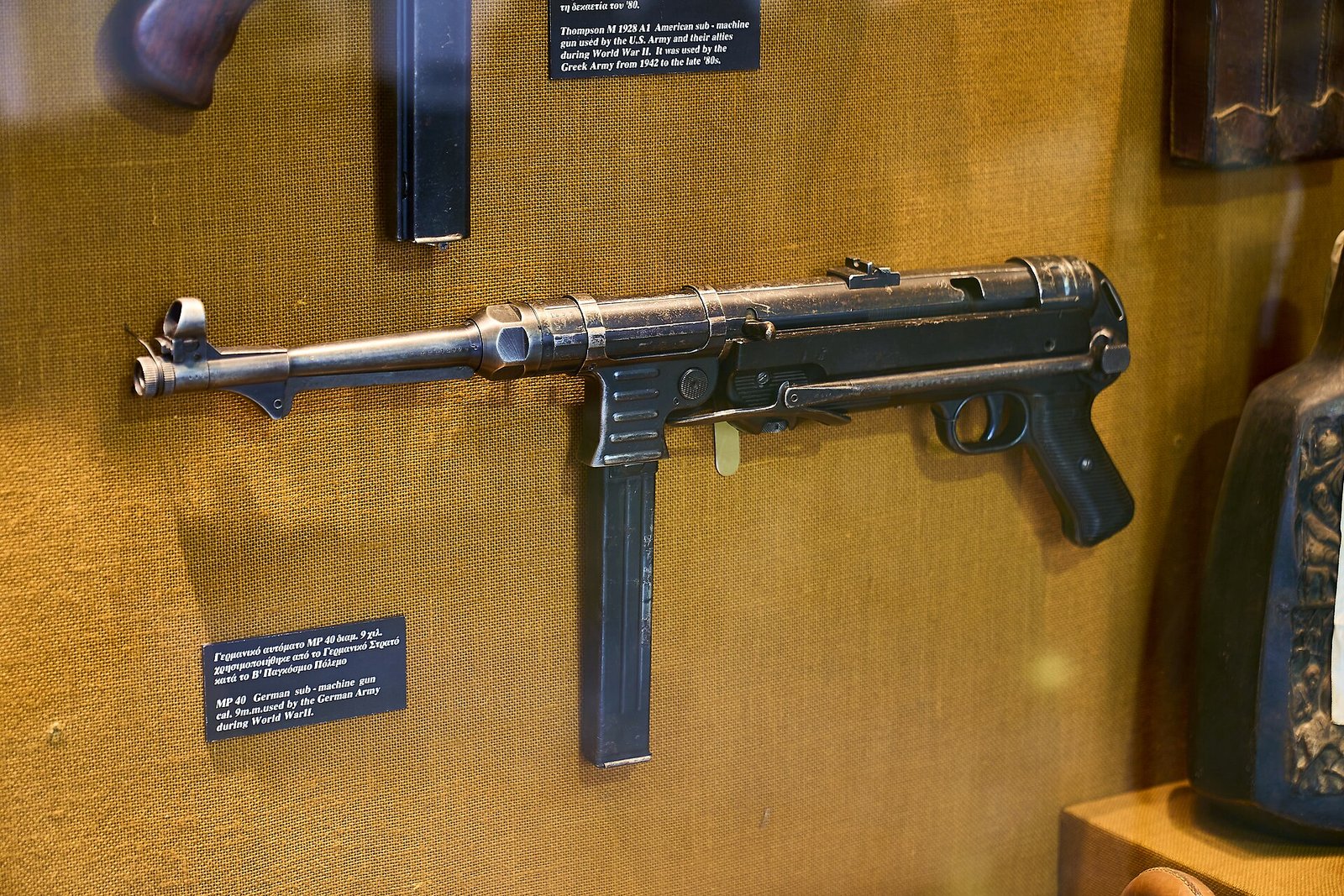
The MP 40 is a simple weapon and its simplicity is the point. It has no locked breech, because it does not need one. It has no gas system, because it does not need one. It has no fire selector, because somebody decided it did not need one — and that decision, which sounds like a defect, is the most interesting engineering judgement in the design.
This volume works through the mechanism, the rate of fire and why it is what it is, the magazine and the two ways it fails, and the safety that had to be added after the weapon was already in service and killing the people carrying it.
4.1 Straight Blowback, Open Bolt
The MP 40 is a straight blowback, open-bolt weapon firing 9×19mm Parabellum.1
Blowback means the breech is never locked. The bolt is held against the chamber by nothing but its own mass and the recoil spring behind it. When the cartridge fires, the case pushes back against the bolt face, and the bolt begins to move — but because the bolt is heavy and the spring is resisting it, it moves slowly enough that the bullet has left the barrel and pressure has dropped before the case is clear of the chamber. The whole system is a calculation in inertia. Nothing holds the breech shut; the breech is merely slow to open.
This works for 9×19 and would not work for a rifle cartridge. Pistol cartridges operate at pressures and energies where a bolt of a few hundred grams and a modest spring can do the job. It is the reason submachine guns are simple and self-loading rifles are not.
Open bolt means the weapon rests, when cocked, with the bolt held to the rear and the chamber empty. Pressing the trigger releases the bolt; the recoil spring drives it forward; it strips a cartridge from the magazine, chambers it, and fires it — all on one continuous forward stroke. There is no separate hammer, and the firing pin is carried in the bolt face.
The consequences of firing from an open bolt are worth stating plainly, because they explain most of the weapon’s behaviour:
- It cools well. Between bursts the chamber stands open to the air, which matters on a weapon with no quick-change barrel.
- It cannot cook off. A round is never left sitting in a hot chamber.
- It is less accurate than a closed-bolt weapon. Pressing the trigger sets a substantial mass in motion forward before anything fires, and that lurch moves the muzzle. This is the mechanical reason behind Volume 5’s treatment of what the weapon could actually hit.
- It is vulnerable to exactly the accident described in § 4.5. A bolt held back by a spring, with nothing positively locking it, is stored energy.
4.2 The Telescoping Recoil-Spring Assembly — and a Correction
Behind the bolt sits the feature most often misdescribed on this weapon.
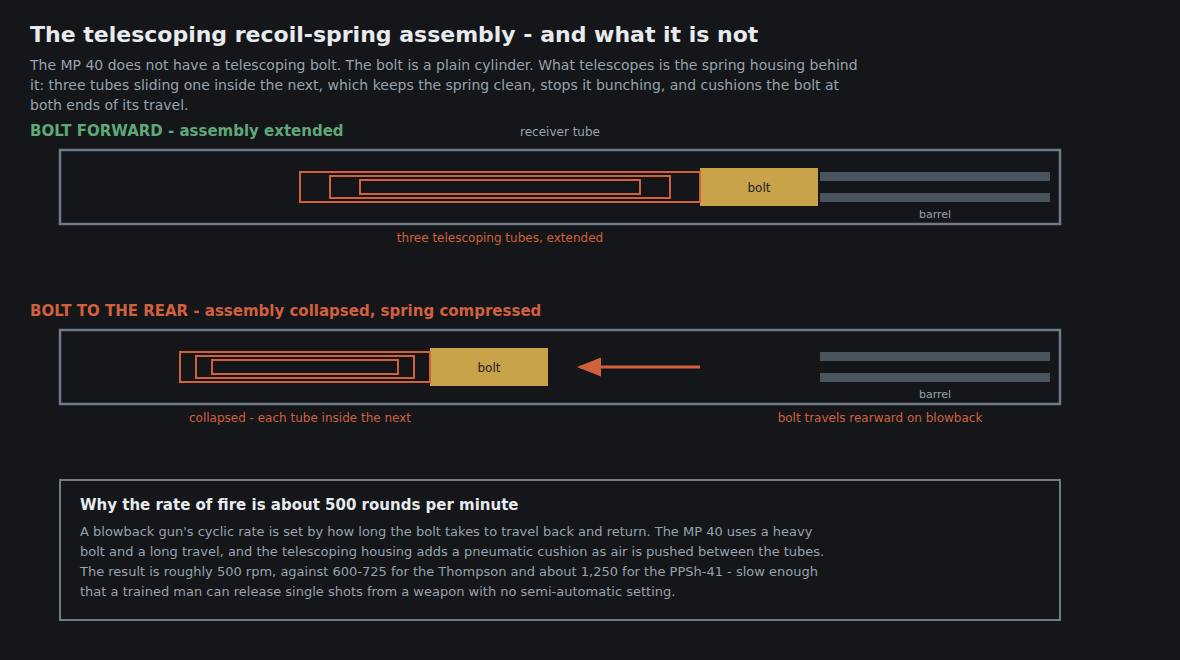
The MP 40’s recoil spring is carried inside a telescoping housing — a nest of tubes that slide one inside the next as the bolt travels back, and extend again as it returns. The arrangement does three things at once. It keeps the spring enclosed and therefore clean, which matters enormously on a weapon issued to men in mud and snow. It stops a long spring from buckling or bunching under compression. And it forms an air cushion, because compressing a nest of close-fitting tubes means pushing air out through the gaps between them, which damps the bolt at both ends of its travel.
The correction. The MP 40 is frequently described, including in diagrams in wide circulation, as a telescoping-bolt design, illustrated alongside the Uzi with the bolt drawn wrapping forward around the barrel. That characterisation is wrong, and the photographs in these volumes disprove it directly.
A telescoping bolt — the Uzi’s defining feature — is one that wraps around the rear of the barrel, so that the barrel extends back inside the bolt and the receiver can be shorter than the sum of its parts. For that to be possible, the barrel must project rearward into the receiver body.
On an MP 40 it does not. The barrel projects entirely forward of the receiver; the receiver ends where the barrel and its collar begin, and the magazine feeds vertically into the chamber at that junction. Any photograph in this dive shows it — the weapon’s whole forward section is exposed barrel, with the receiver tube stopping behind it.
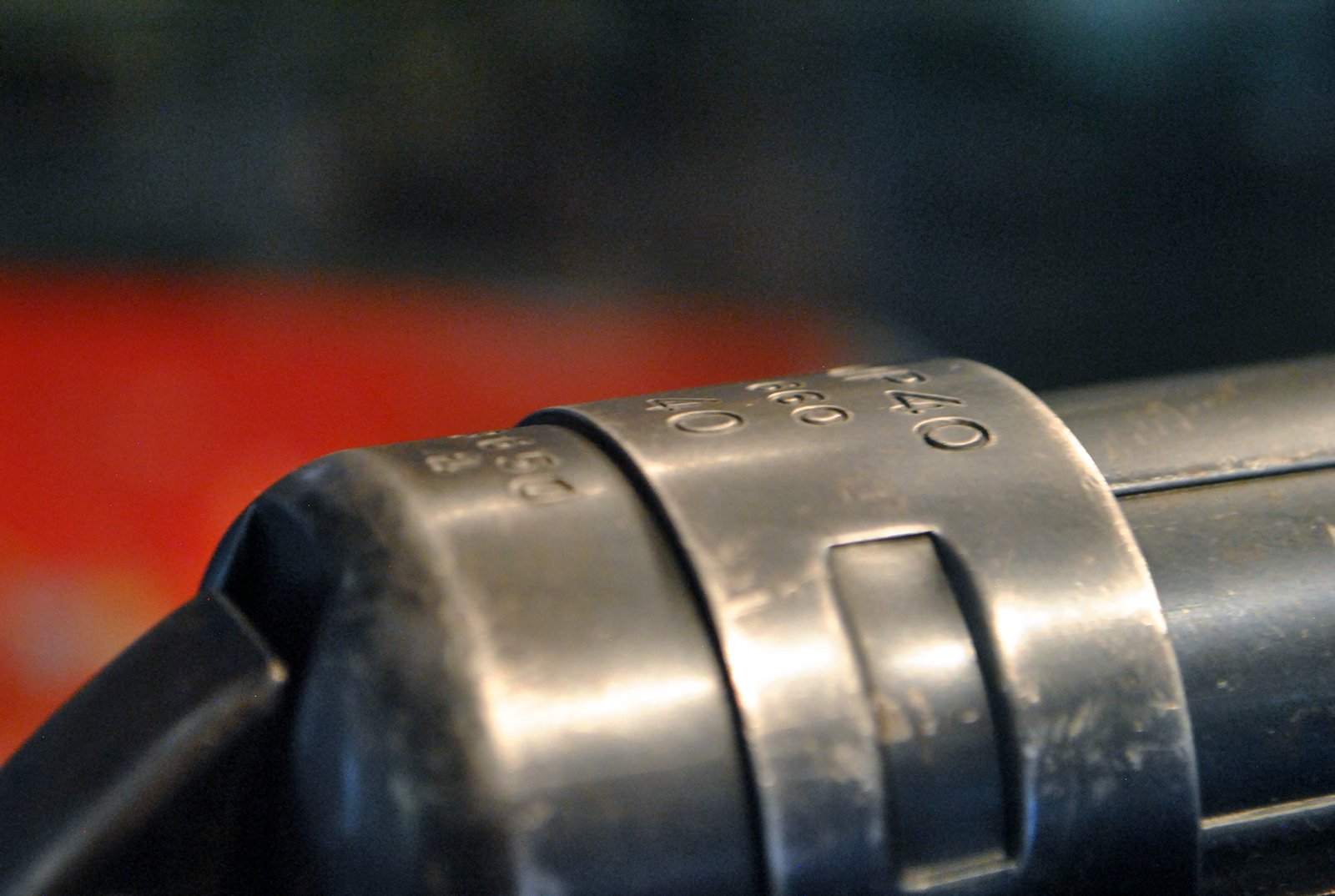
The MP 40’s bolt is a plain cylindrical blowback bolt travelling in a straight tube. What telescopes is the spring housing behind it, which is a different component doing a different job. This dive rejected the circulating diagrams on that basis and drew its own, and readers should be aware that this particular correction rests on the weapon’s visible construction and this dive’s reasoning rather than on a cited authority — no source consulted addressed the point in terms. The evidence is, however, in plain sight in every photograph of the weapon.
The housing’s internal construction is commonly described as a three-part telescoping tube assembly. That part-count is repeated widely; a citable source for it was not located in this work, and it is given here as the common description rather than as verified.
4.3 Why About 500 Rounds a Minute
The MP 40’s cyclic rate is 500 to 550 rounds per minute.1 The US War Department’s wartime handbook gives 500 cyclic and 180 rounds per minute practical.2
For a blowback weapon, cyclic rate is a function of how long the bolt takes to complete its round trip, and that is set by bolt mass, spring rate and travel distance. The MP 40 uses a heavy bolt over a long travel, and the German account attributes the low rate directly to the heavy spring-loaded bolt mass.3 The telescoping housing’s air damping contributes at both ends.
What that number buys is the design’s central compromise, and it is a good one. Set against its contemporaries:
Table 1 — What that number buys is the design's central compromise, and it is a good one. Set against its contemporaries
| Weapon | Cyclic rate |
|---|---|
| MP 40 | 500–550 rpm1 |
| Sten Mk II | about 500–600 rpm4 |
| Thompson M1928A1 | 600–725 rpm5 |
| Thompson M1A1 | 700–800 rpm5 |
| PPSh-41 | 1,250 rpm6 |
A weapon firing at 1,250 rounds per minute empties a 71-round drum in under four seconds and is extremely difficult to hold on a target while doing so. A weapon firing at 500 puts roughly eight rounds per second into the air, which a trained man braced against a folded stock can keep more or less where he is pointing for a short burst.
And it makes the missing selector survivable. The MP 40 has no semi-automatic setting; its only mode is automatic.1 But the reference literature notes that “the relatively low rate of fire permits single shots with controlled trigger pulls.”1 The gap between 500 cyclic and 180 practical in the US assessment is the measure of how well that worked in the field: soldiers were getting singles and very short bursts out of a weapon with no mechanism for either.2
This is a genuine design insight and it deserves to be named as one. Rather than adding a selector — a part, a spring, a detent, a hole in the receiver, an assembly step, a thing to break — the designers made the weapon slow enough that the operator’s finger could do the selector’s job. Volume 3’s whole argument is about removing manufacturing operations; this is the same argument applied to the fire-control group.
4.4 The Magazine, and the Two Ways It Fails
The MP 40 feeds from a 32-round detachable box magazine inserted vertically into a housing beneath the receiver.1
The magazine is the weakest part of the weapon, and it is the weakest part of most submachine guns of the period for the same reason. The lineage runs from the MP 18’s post-1920 straight box, through Schmeisser’s patent, into the MP 38 and MP 40 — and, by a separate route through the Lanchester, into the STEN.7
The feed geometry. MP 40 magazines are commonly described as double-column, single-feed — cartridges stacked in two columns that must merge into one at the top to present a single round to the bolt. The STEN’s magazine is documented as exactly that arrangement, with the reference literature noting that the taper where the columns merge was prone to malfunction from dirt and that the feed lips required a precise 8-degree angle.4 A source directly documenting the MP 40 magazine’s internal feed geometry was not located for this dive, and the description is therefore given as the common account, supported by the shared design ancestry with the STEN’s magazine rather than by a direct citation.
What is directly documented is how the magazine fails in the hand.
4.4.1 The magazine as a foregrip

The reference literature is unambiguous:
“Another problem was that the magazine was also sometimes misused as a handhold. This could cause the weapon to malfunction when hand pressure on the magazine body caused the magazine lips to move out of the line of feed, since the magazine well did not keep the magazine firmly locked.”1
And on the training that answered it:
“German soldiers were trained to grasp either the handguard on the underside of the weapon or the magazine housing with the supporting hand to avoid feed malfunctions.”1
Two things follow, and both are worth separating from the folklore.
First, the failure mechanism is specific. It is not that the magazine breaks or that the catch wears through; it is that side load on the magazine body tilts the magazine in a well that does not hold it rigidly, and the feed lips consequently stop presenting the round in line with the bolt’s path. The root cause is named in the source itself — the magazine well did not keep the magazine firmly locked.1 It is a tolerance problem in the housing, expressed as a feeding problem at the lips.
Second, the correct hold was doctrine, not folk wisdom. There were two of them: the forearm underneath the receiver, or the magazine housing — the fixed sheet-metal shroud — as distinct from the magazine itself. The distinction between gripping the housing and gripping the magazine is the entire difference between a correct hold and a malfunction, and it is invisible in most photographs and in essentially all film.
The comparison with the STEN is instructive because the failure mode is different. On a STEN, gripping the magazine “tended to wear the magazine catch, altering the angle of feed and causing a failure to feed.”4 That is cumulative damage to a component. On the MP 40 the effect is immediate and mechanical — pressure now, misfeed now, no lasting damage required. The two weapons punish the same mistake by different routes.
4.5 The Safety, and the Discharge It Was Added to Stop
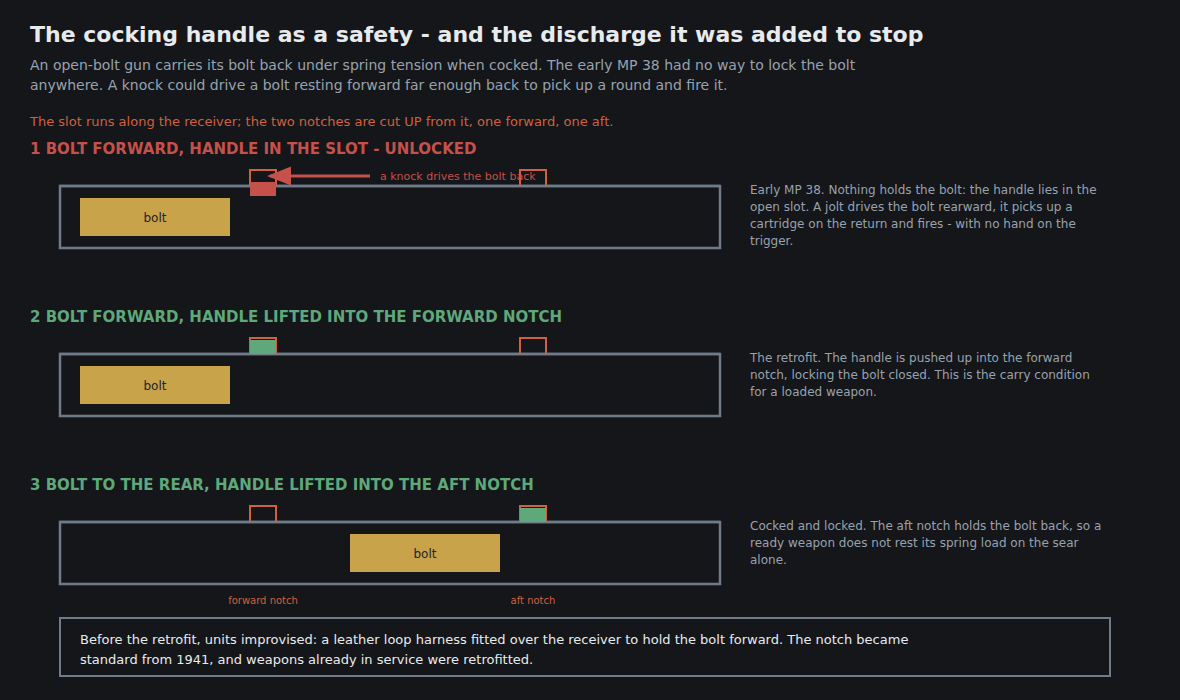
Volume 1 introduced this; here is the mechanism in full, because it is the most consequential change made to the weapon in its service life.
An open-bolt weapon at rest with the bolt forward has its bolt held there by nothing — the recoil spring is extended, the sear is not engaged, and the bolt is simply sitting against the chamber. A weapon in that condition with a loaded magazine fitted is dangerous in a specific way: a hard enough knock can drive the bolt rearward far enough to pass over the top cartridge in the magazine, whereupon the spring returns it, it strips that cartridge, chambers it and fires it. Nobody has touched the trigger. The reference literature and the German account both describe the hazard directly.13
The interim answer came from the units, not the factories: “leather harnesses with a small loop that were used to hold the bolt in the forward position.”1 A strap is what appears when a hazard is real, frequent and unsolved at source.
The engineered answer was a notch — in fact two. A notch cut upward from the cocking-handle slot allows the handle “to be pushed into one of two separate notches above the main opening; this action locks the bolt in either the cocked (rear) or uncocked (forward) position.”1 The drill, as the US handbook set it out for its own troops, is to pull the cocking handle back and push it upward into the safety notch.2
The modification became standard equipment from 1941, and weapons already in service were retrofitted.3
Two points that get lost. First, this gives the weapon two safe conditions, not one: bolt forward and locked, which is the carry condition for a loaded weapon, and bolt back and locked, which lets a ready weapon rest its spring load on the notch rather than on the sear alone. Second, the absence of the feature on early MP 38s is a real identification and safety point for anyone handling a specimen today. Volume 7 treats it as an inspection item.
4.6 Sights, and What They Say
The sights are a hooded front blade with a 100-metre fixed rear notch and a 200-metre folding leaf.2
That is the complete sighting arrangement, and it is a statement by the people who issued the weapon about what they expected it to be used for. There is no adjustment, no windage, and no graduation between or beyond those two settings. The published effective range is 100 to 200 metres with a maximum of 250.1
Volume 5 takes up the gap between that and the weapon’s screen reputation.
4.7 The MP 40/I: Solving the Wrong Problem
The dual-magazine MP 40/I, covered in Volume 1, belongs here as a mechanical footnote because of what it reveals about where the design’s limits actually were.
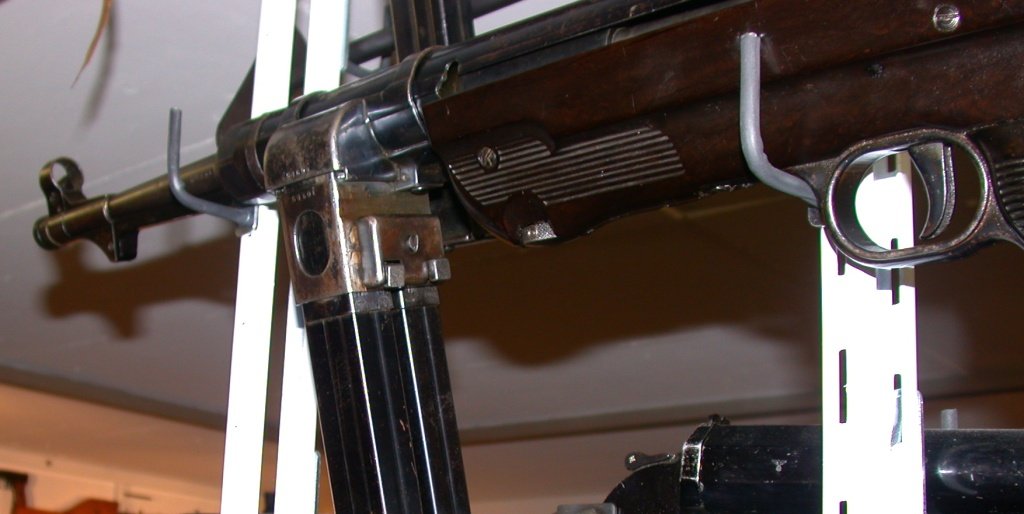
It was developed in response to Soviet fire superiority — more submachine guns, and much larger magazines.8 The answer offered was to double the ammunition on the weapon to 64 rounds.
It failed for reasons that are all consequences of the design it was bolted to. The weight unbalanced a weapon whose whole layout assumes a light forward end; the sliding mechanism admitted dirt into the one area of the weapon least tolerant of it; and the cantilevered mass creased a receiver made of rolled sheet.8 Only a small number were made, around mid-1943.8
The instructive part is the diagnosis. The problem the Red Army posed was not really magazine capacity; it was volume of fire per squad, which the Soviets solved by issuing far more submachine guns. Doubling one weapon’s on-board ammunition addressed the symptom that was easiest to see. It is a good example of a mechanical answer to a doctrinal question, and the receiver creasing is the design telling its authors so.
4.8 What Could Not Be Verified
Recorded plainly, rather than smoothed over:
- The three-part construction of the telescoping spring housing. Widely repeated; no citable source located.
- The MP 40 magazine’s internal feed geometry. Described here as double-column single-feed on the strength of the shared design ancestry with the STEN’s documented arrangement; no direct source for the MP 40 itself was located.
- The rejection of the telescoping-bolt characterisation rests on the weapon’s visible construction and this dive’s reasoning, not on a source that addresses the claim directly.
- No figure for MP 40 bolt mass, spring rate or bolt travel was located, so the account of why the cyclic rate is about 500 rpm is qualitative rather than calculated.
4.9 Bibliography
Footnotes
-
“MP 40”, English Wikipedia, consulted 2026-09-17 — straight blowback open-bolt operation, the 9×19mm chambering, the 500–550 rpm cyclic rate, the 32-round detachable box magazine, the note that automatic is the only fire mode but that the low rate permits single shots with controlled trigger pulls, the quoted passages on the magazine misused as a handhold and on the training to grasp the handguard or magazine housing instead, the cocking handle locking the bolt in either the cocked or uncocked position via two notches, the leather-harness field expedient on early MP 38s, and the 100–200 m effective and 250 m maximum ranges. ↩ ↩2 ↩3 ↩4 ↩5 ↩6 ↩7 ↩8 ↩9 ↩10 ↩11 ↩12 ↩13
-
US War Department, Handbook on German Military Forces, TM-E 30-451, chapter on weapons, consulted via the HyperWar transcription — the 500 rounds per minute cyclic and 180 rounds per minute practical rates, the 100-metre fixed and 200-metre folding rear sights, and the safety drill of pulling the cocking handle back and pushing it upward into the safety notch. ↩ ↩2 ↩3 ↩4
-
“MP 40”, German Wikipedia, consulted 2026-09-17 — the attribution of the approximately 500 rpm cyclic rate to the heavy spring-loaded bolt mass, the description of the accidental-discharge hazard, and the introduction of the locking device as standard equipment from 1941 with retrofitting of older weapons. ↩ ↩2 ↩3
-
“Sten”, English Wikipedia, consulted 2026-09-17 — the Mk II’s approximately 500–600 rpm rate, the double-column single-feed magazine and the merging taper’s susceptibility to dirt, the 8-degree feed-lip angle, and the observation that grasping the magazine as a handhold wore the magazine catch and altered the angle of feed. ↩ ↩2 ↩3
-
“Thompson submachine gun”, English Wikipedia, consulted 2026-09-17 — cyclic rates of 600–725 rpm for the M1928A1 and 700–800 rpm for the M1A1. ↩ ↩2
-
“PPSh-41”, English Wikipedia, consulted 2026-09-17 — the 1,250 rpm cyclic rate and the 71-round drum and 35-round box magazines. ↩
-
“MP 18”, English Wikipedia, consulted 2026-09-17 — the post-1920 conversion to straight box magazines similar to those later used in the MP 40. ↩
-
Forgotten Weapons, “MP-40/I: The Dual-Magazine Experimental MP-40”, https://www.forgottenweapons.com/mp-40i-the-dual-magazine-experimental-mp-40/ and “The WW2 Double-Magazine MP40/I”, https://www.forgottenweapons.com/the-ww2-double-magazine-mp40-i/ — development in late 1942 in response to Soviet submachine gun fire superiority and larger magazine capacity, the sliding two-magazine block, production in small numbers around mid-1943, and the failure modes of weight and balance, dirt ingress and creasing of the receiver tube. ↩ ↩2 ↩3
Comments (0)