FN P90 & PS90 · Volume 6
Modifications and Accessories — Optics, Triggers, Magazines and Cans
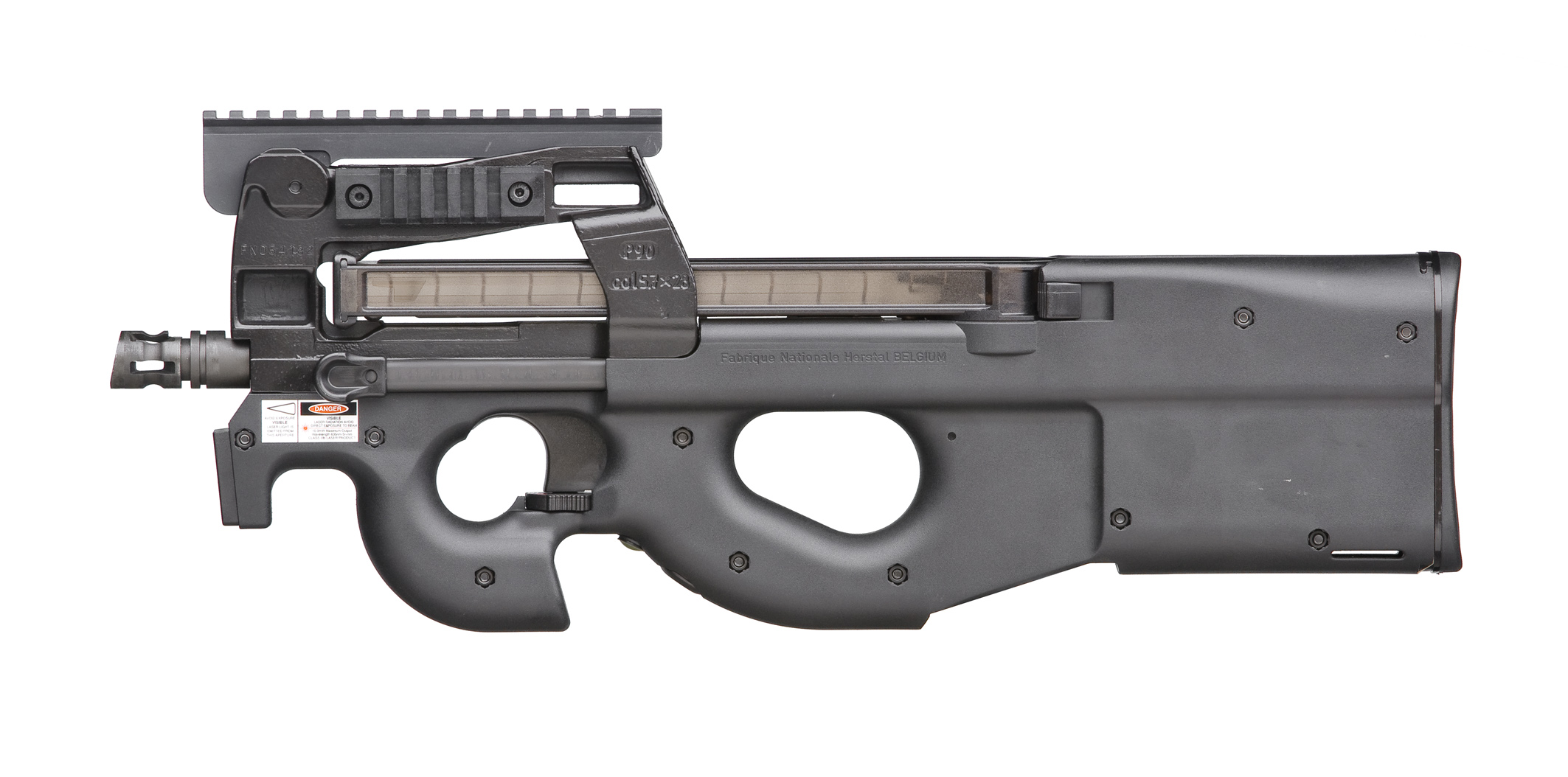
The PS90 is a closed design in a way most modern rifles are not. It has no barrel nut, no free-float tube, no standard grip interface, no buffer tube and no drop-in trigger ecosystem. The aftermarket is correspondingly narrow, and it is dominated by two questions: how to mount an optic, and what to do about the trigger.
This volume is deliberately conservative about products. Firearms dives in this workspace have previously shipped invented model numbers and non-existent products, so the rule applied here is that a product is named only if it was verified from the manufacturer’s own material during this work. Where an accessory category exists but could not be catalogued to that standard, the category is described and the gap is declared.
6.1 Optics and Rails
The generation question comes first. A Standard or USG-pattern weapon carries a moulded optical housing with FN’s own reflex sight in it, and there is nothing to mount anything to. A TR-pattern weapon carries a MIL-STD-1913 Picatinny rail, and accepts anything.
A current PS90 Standard ships with a MIL-STD-1913 accessory rail and back-up iron sight as standard equipment.1 This is the configuration that resolves the problem: the weapon leaves the factory ready for the owner’s optic, with irons as a fallback.
FN’s own documentation for the two relevant parts is published, which is a useful signal that both are factory items rather than aftermarket claims:
- FN PS90 M1913 Rail Instructions, FN document 06-236-FNH_M1913_Rail_Inst_v2.2
- FN PS90 RD Sight Instructions.2
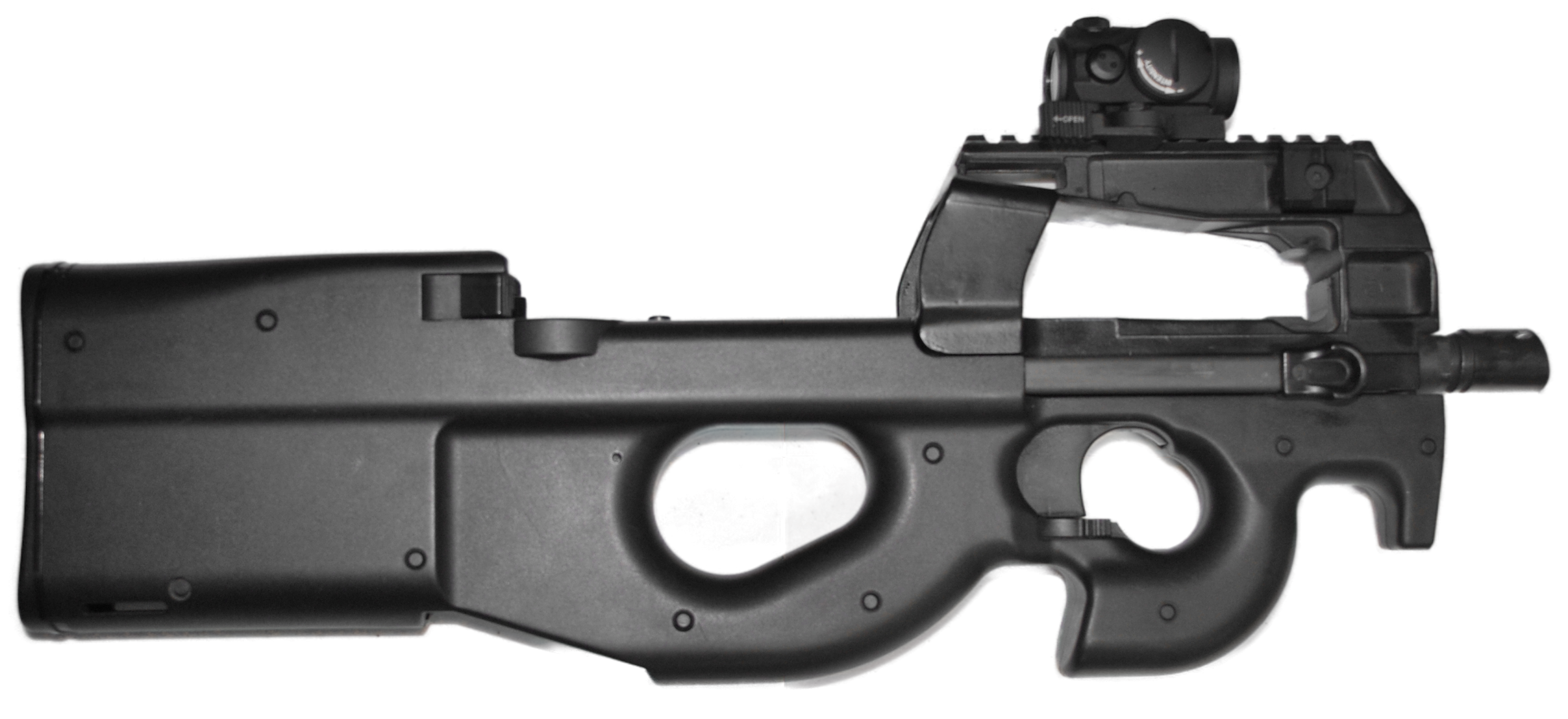
What to put on it. The weapon’s characteristics point clearly at a particular answer. It is a 200-metre carbine with a heavy trigger, very low recoil and fast handling, used mostly inside 100 yards. That is a red dot’s natural habitat, and it is what the factory reflex sight was already trying to be. A low-power variable optic is defensible if the intent is to work the weapon to the edge of its range; magnification above about 4× is buying precision the trigger and the cartridge will not deliver.
Height matters more than usual. The rail sits above the magazine, which itself sits on top of the receiver, so the optic ends up high over the bore. This is inherent to the layout and cannot be designed out. The practical consequences are a larger mechanical offset at close range than a shooter may be used to, and a comb height that the shell’s fixed cheek line has already decided.
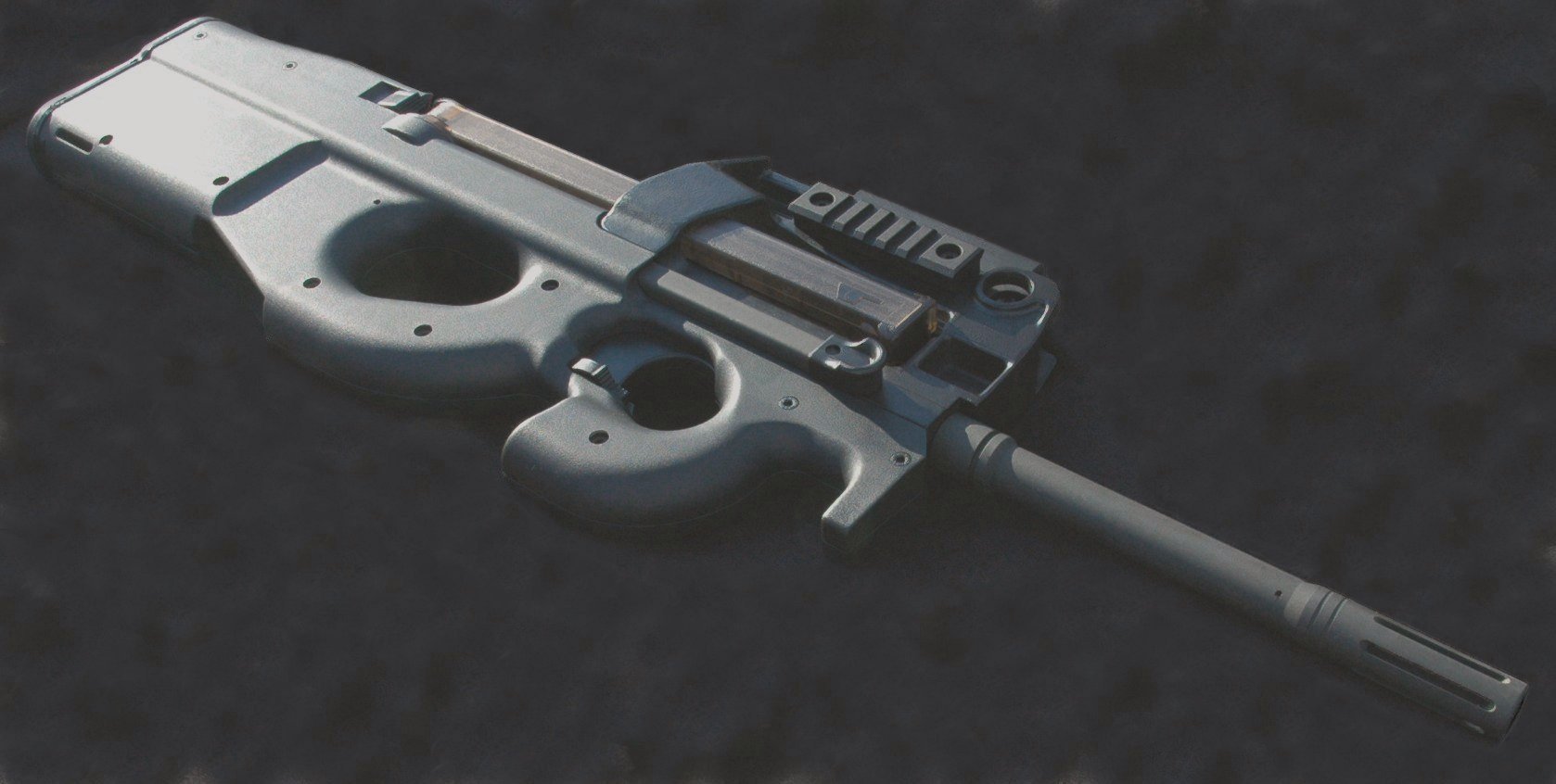
Retrofitting an older weapon is the question that decides a used purchase. A Standard or USG-pattern PS90 has a moulded optical housing where a rail would go, so fitting a modern optic is not a matter of buying a mount — it is a matter of changing the part of the weapon that carries the sighting system. FN publishes M1913 rail instructions as a document in its own right, which indicates the rail is a fitted item rather than a factory-only configuration.2 Whether a specific discontinued PS90 USG can be brought to current rail configuration, and what that costs, could not be established from FN’s published material during this work, and a buyer considering a discontinued variant specifically to modify it should resolve that question before purchase rather than after.
Iron sights. The back-up irons on the rail generations, and the tritium irons on the P90 TR, exist for the case where the optic fails. On a weapon whose sighting system has historically been integral, a back-up that does not depend on a battery is more valuable than it sounds.
6.2 The Trigger
Volume 5 set out the problem: FN specifies 6 to 11 pounds, and the cause is the long linkage inherent to the bullpup layout.3
What the physics allows. Trigger work on a bullpup addresses friction and lost motion in the linkage, not just sear geometry. Polishing bearing surfaces, removing burrs, and reducing slop in the connecting rod all make a measurable difference to feel, and none of them change where the sear breaks. This is the category of work that a competent gunsmith can do on almost any bullpup.
What could not be verified. No specific aftermarket trigger component, trigger job service, or spring kit for the PS90 was verified from a manufacturer’s own material during this work. Several likely vendors were checked and either could not be reached or did not list such a product; one domain that formerly appeared to serve this niche now resolves to unrelated content entirely. This volume therefore names no trigger products. The absence of a verified product list here is a gap in this dive, not evidence that no such products exist.
What can be said without a product list. A shooter unhappy with the trigger has three routes that do not depend on buying a named part: have the existing mechanism cleaned up by a gunsmith familiar with bullpups; accept it and train with it, which is reasonable given the ranges involved; or conclude that a precision trigger matters more than the layout does, which is an argument for a different weapon rather than for modifying this one.
6.3 Barrels and Configuration
The factory barrel is 16.04 inches, cold hammer-forged and chrome-lined, with a ported muzzle brake.1 Chrome lining and hammer forging are both durability features, and FN quotes a 20,000-round barrel service life for the platform.4
Shortening it is the Form 1 route set out in Volume 4, and the three constraints there apply in full: ATF approval before any work, the 27 CFR 478.39 imported-parts question, and — for a Michigan owner — the MCL 750.224b(4) cross-reference that catches a weapon under 26 inches overall. The velocity cost is set out in Volume 2 and is real but modest.
Threading and muzzle devices. The factory muzzle device is a ported brake. The PS90’s muzzle thread specification could not be verified from FN’s own published material during this work: the owner’s manual does not state a thread pitch, and no FN document giving one was located. Anyone planning to fit a muzzle device or a suppressor should measure or have the muzzle measured rather than rely on a figure from a forum, and this dive declines to publish one.
Stocks and furniture. There are none in the conventional sense. The PS90’s shell is the stock, the receiver housing and the forend simultaneously, and the length of pull is fixed. This is the single largest ergonomic limitation of the design and there is no modification path around it. A shooter for whom the fixed length of pull does not work is not going to be able to fix it.
6.4 Magazines
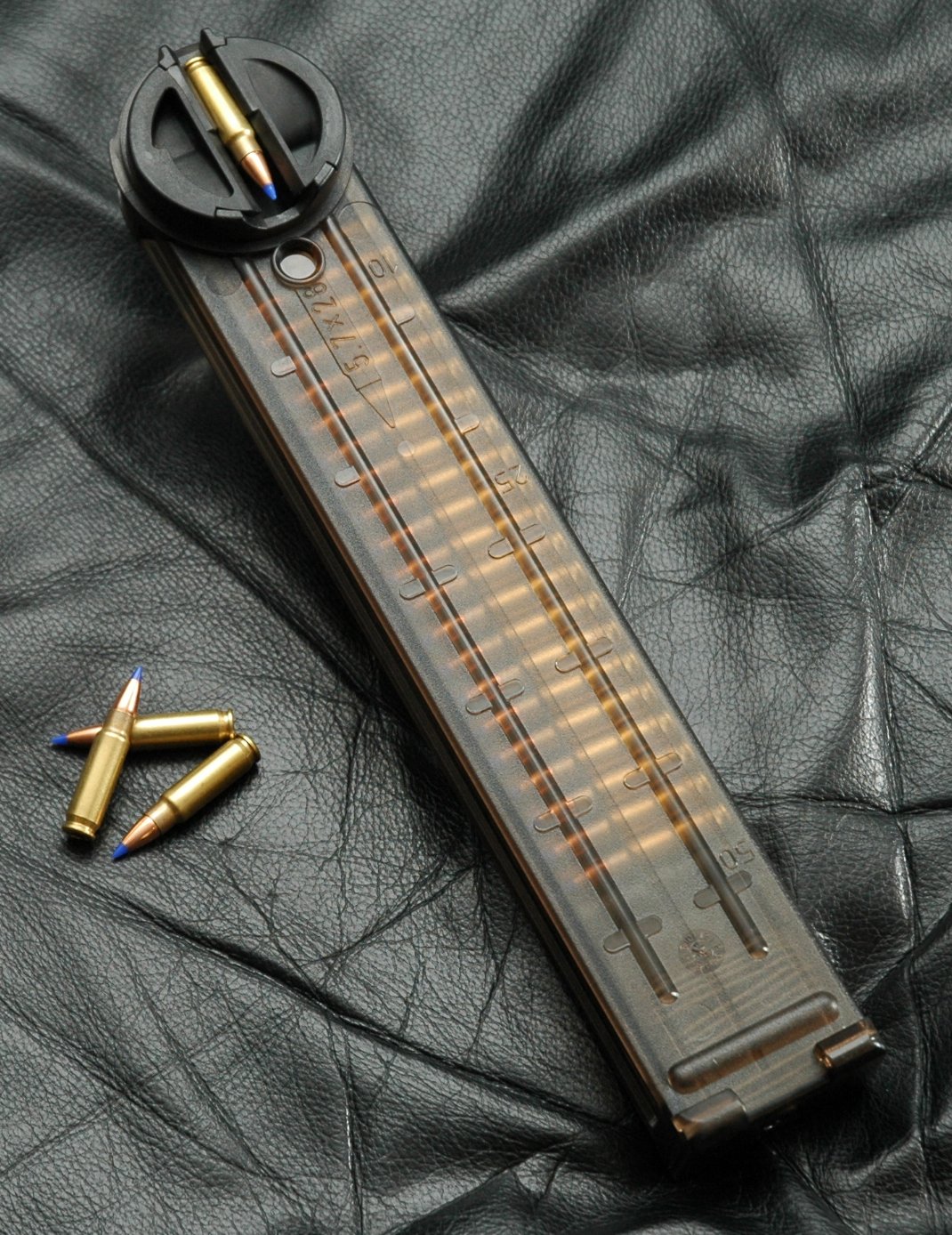
The magazine is the same 50-round rotating-feed unit described in Volume 5 across both weapons. FN lists capacities of 10, 30 and 50 rounds, with the manual noting that some states limit capacity to 10.3
Current FN America PS90 Standard listings show both 30-round and 10-round black configurations and 50-round and 10-round FDE configurations, by model number.1
What could not be verified. A magazine generation change is frequently referred to in secondary discussion of this platform — the suggestion being that FN revised the magazine at some point and that the revisions are not interchangeable across all weapons. No FN source establishing such a change, its date, or any compatibility limitation was located during this work. It is recorded here as an unresolved question specifically so that a reader buying used magazines knows to verify fit against their own weapon rather than assuming universal interchange.
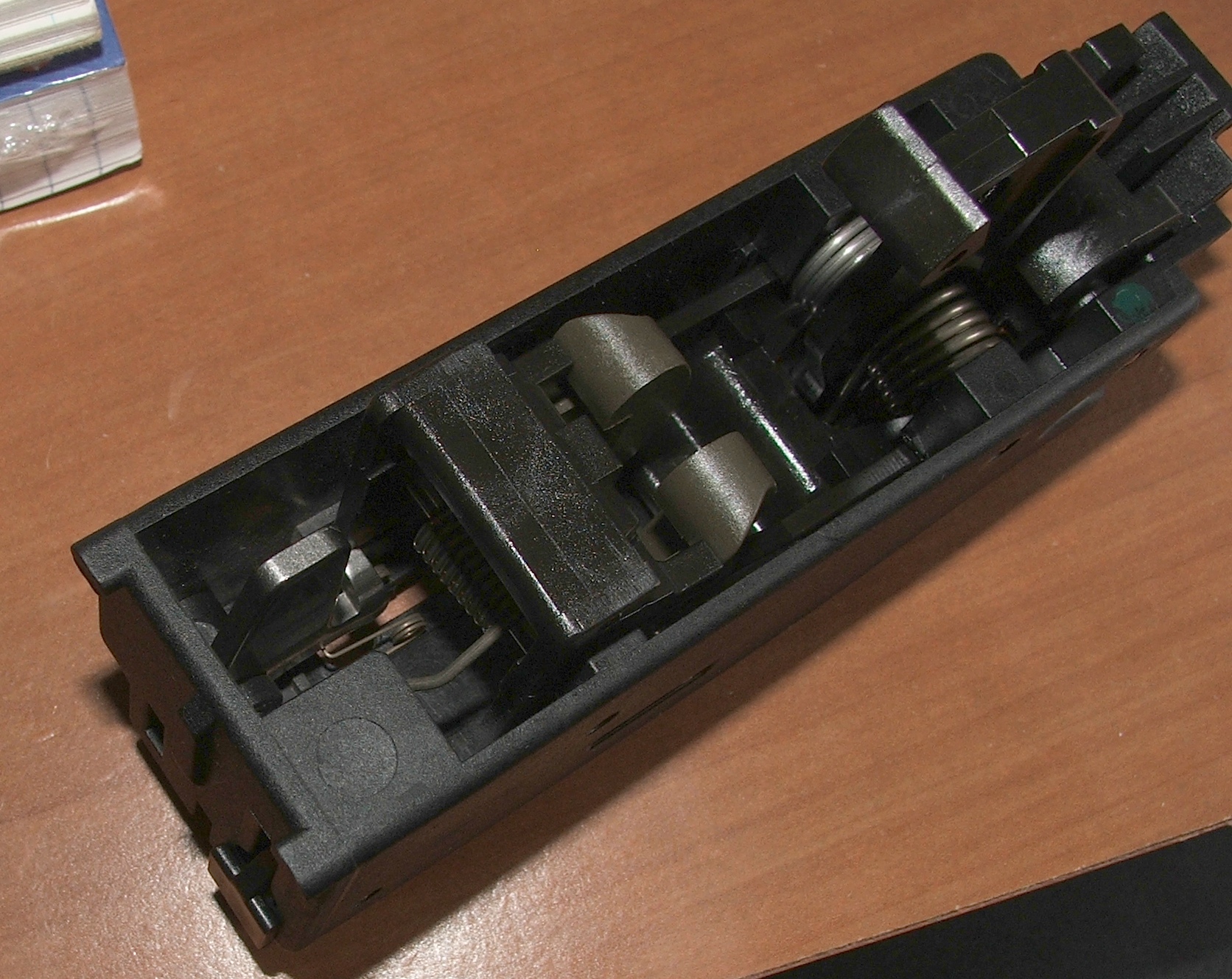
Practical magazine advice that does not depend on that question. The magazine is a mechanism with a follower assembly and two rollers (Volume 7 covers stripping it). It should be cleaned. Loading fifty rounds by hand is tedious. The translucent body makes a visual round count trivial and also makes a dirty magazine obvious.
6.5 Suppressor Host Considerations
The PS90 is a good suppressor host in principle: low recoil, a closed-bolt action, and a cartridge whose subsonic loading exists. Three things decide whether it is a good one in practice, and two of them are settled elsewhere in this hub rather than re-derived here.
The caliber rating is the one that matters, and it is already answered. The Suppressors by Caliber dive files 5.7×28 in its rimfire-can tier alongside .22 LR, .22 WMR and .17 HMR, and states the operative warning directly: the 5.7×28 “is a centerfire cartridge in a rimfire-sized package and needs an explicit” rating, and a can rated only for .22 LR should not see it. That dive also identifies specific current cans carrying an explicit 5.7×28 rating. That treatment is the reference; it is not restated here, and nothing in this volume should be read as adding to or qualifying it.
The legal framing is likewise already covered. The Suppressor Law dive is the hub’s reference for the NFA framework around silencers. The one point worth carrying forward from Volume 4 is current and consequential: under Public Law 119-21 of 4 July 2025, the making and transfer taxes at 26 U.S.C. §§ 5821 and 5811 are now $0 for any NFA firearm that is not a machinegun or destructive device — which includes suppressors. The registration and approval requirements are unchanged; the $200 is not.
For the mechanism itself — how a can actually works, and the servicing regime a dirty cartridge imposes — the How Suppressors Work dive is the reference.
The host-specific points, which are this volume’s to make.
- Thread specification is unverified, as § 6.3 states. Measure before ordering.
- Subsonic ammunition exists but is restricted. The SB193 subsonic loading (3.6 g at 305 m/s) is on FN’s restricted list and is not a commercial purchase.4 A civilian suppressing a PS90 is, in practice, suppressing supersonic ammunition, which caps how quiet the result can be no matter what the can does.
- A documented factory-adjacent suppressor exists for the military weapon: the Gemtech SP90, 184 mm long, 35 mm diameter, 680 g, with a reported 33 dB reduction using subsonic ammunition.4 Both halves of that figure matter — it is a manufacturer-class claim, and it is measured with ammunition a civilian cannot buy.
- Downward ejection interacts with a suppressor better than most layouts. Gas that a conventional semi-automatic would blow back through the ejection port toward the shooter’s face has, on this weapon, a downward path away from it.
6.6 The AR-15 Route, and the Replica Route
Two adjacent paths are worth recording because both are genuinely verified and both change the economics.
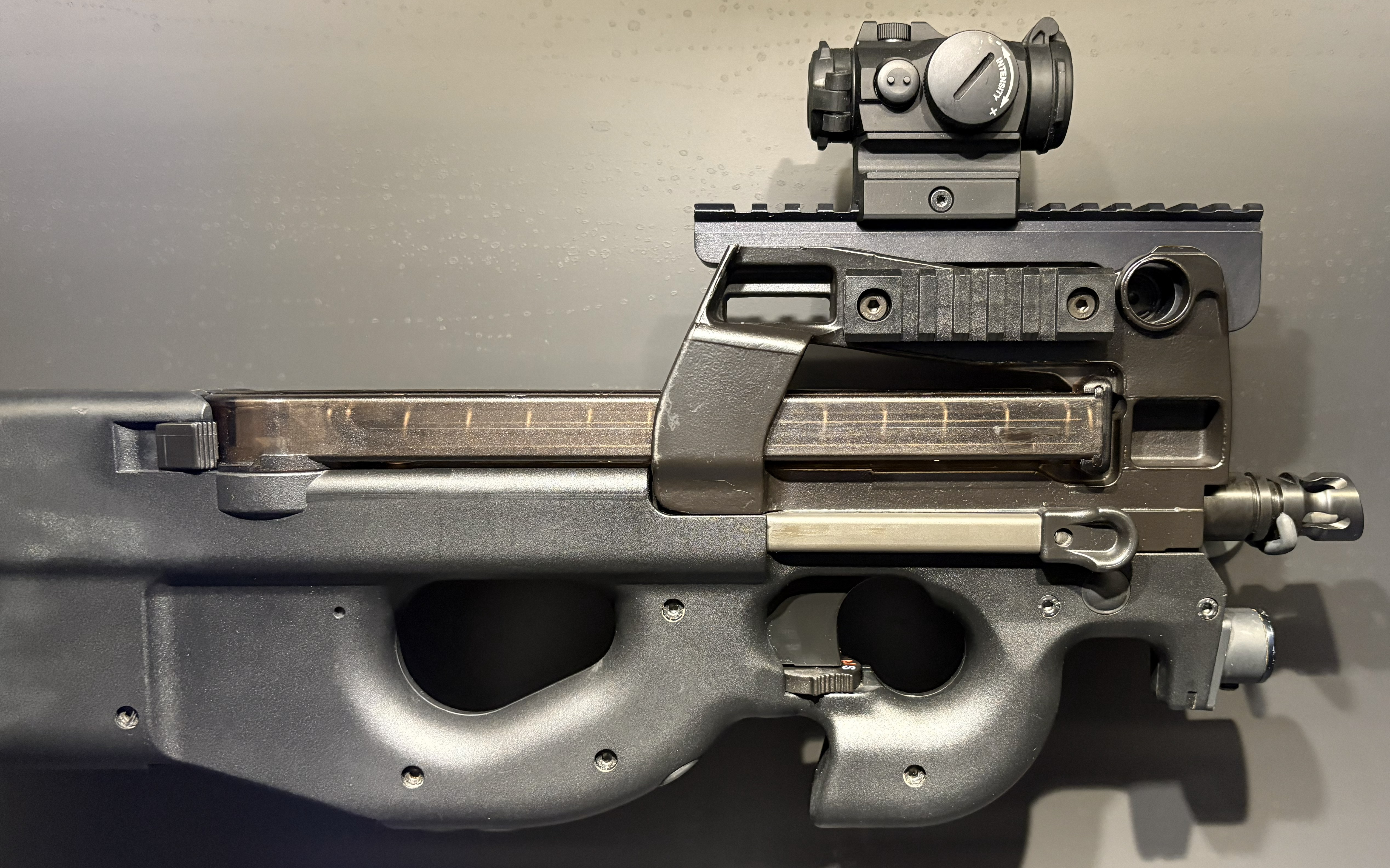
The AR57 upper receiver is a monolithic AR-15 upper chambered in 5.7×28 that feeds from standard FN P90 50-round magazines mounted horizontally on top of the handguard, and ejects spent cases down through the magazine well. It was originally designed by Rhineland Arms and produced by AR57 LLC, with a PDW variant using a 16-inch barrel, and operates by straight blowback rather than the AR’s usual gas system.5
The significance is that it decouples the magazine from the weapon. An owner with P90 magazines can run them on an AR-15 lower with a conventional AR trigger and conventional AR ergonomics — which is, in effect, an answer to this volume’s two main complaints (the trigger and the fixed length of pull) at the cost of the bullpup layout that made the weapon interesting.
The replica route. The P90 is a long-established airsoft platform, and this hub’s Gas dive covers the relevant engineering detail: the P90 is one of the offset-nozzle platforms — alongside the M14, Thompson and Tavor families — whose gearbox geometry will not accept a centred HPA engine, which is why Wolverine produce the HYDRA specifically for them. For anyone wanting the P90 form factor for training, filming or costume use rather than for shooting, that dive is the reference.
6.7 Lights, Lasers and Brass Management
Three accessory categories are worth treating separately because they interact with this weapon’s specific geometry rather than being generic.
Weapon lights. A rail-equipped PS90 mounts a light conventionally, and the military LV and IR variants demonstrate that FN expected forward-mounted illumination and aiming devices from the mid-1990s onward.4 The geometry to watch is the same one that governs optics: the top rail sits high, and the forward rails on a tri-rail pattern sit close to the muzzle on a weapon that has very little barrel forward of the hand. A light mounted far forward on a short-barrelled configuration can end up close enough to the muzzle to collect blast residue on its lens.
Lasers. The P90 LV and IR carried Laserex modules — 8 mW visible and 4.5 mW infrared respectively, 131 g, with battery life quoted at 250 hours in training use or 50 hours in combat use.4 These are integrated factory configurations rather than accessories, and they are listed here to establish that the platform has a documented history of laser fitment, not as a product recommendation.
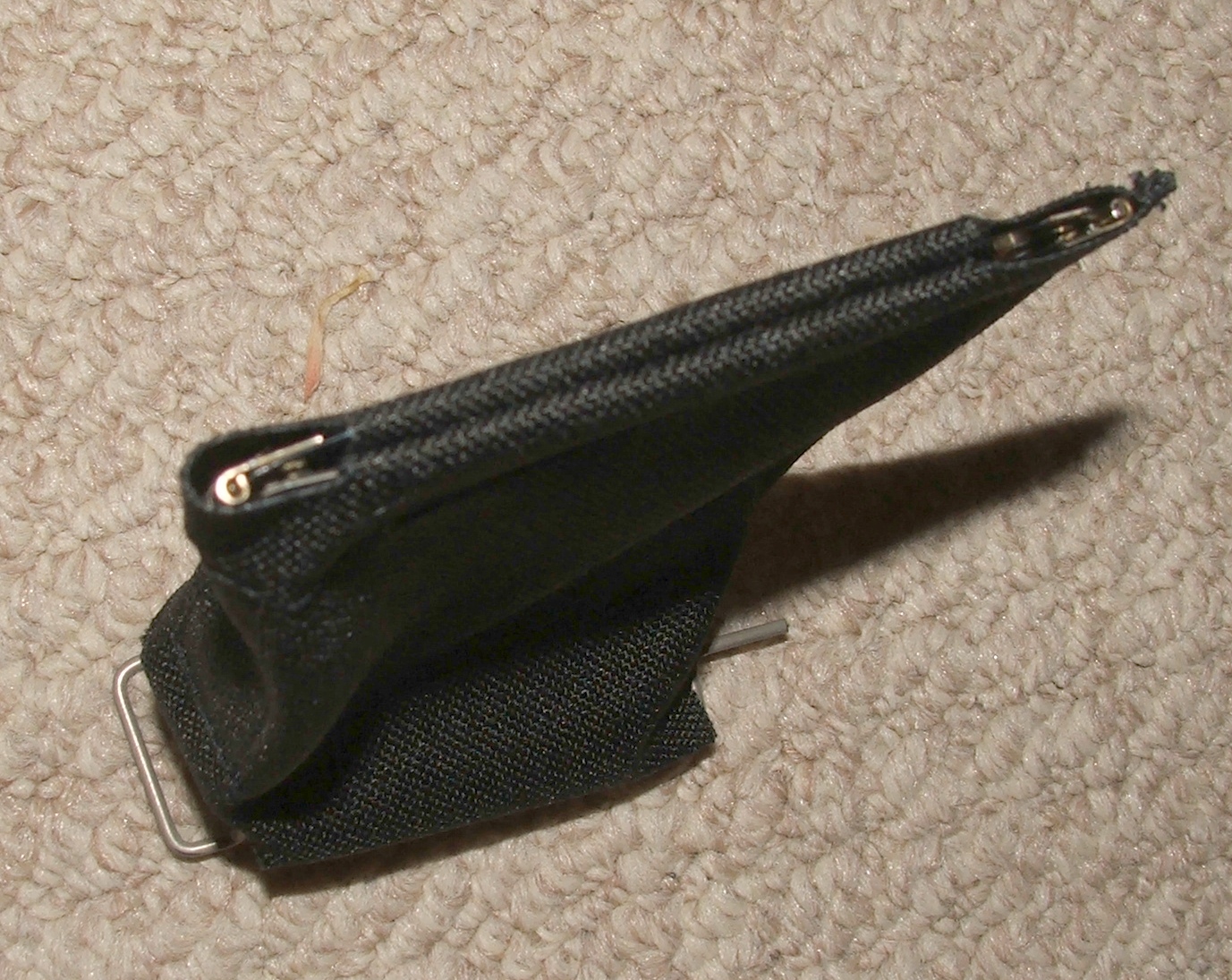
Brass management is a modification category on this weapon in a way it is not on others. Because ejection is downward, cases fall directly beneath the weapon: into a vehicle footwell, onto a shooting bench’s supports, onto the shooter’s feet when prone. FN’s own accessory list includes case collector pouches holding up to 100 cartridges.4 For an owner who reloads, the downward path is an advantage — the brass lands in one place instead of being scattered to the right. For an owner shooting from a vehicle or a confined position, a collector is closer to a requirement than an accessory.
6.8 What Not to Do
A short list, each item with its reason, because the constrained aftermarket means most of the damage done to these weapons is done by improvisation.
Do not shorten the barrel before the Form 1 is approved. Volume 4 states the sequence and it is not negotiable: approval, then metal. The reverse order is the manufacture of an unregistered NFA firearm.
Do not fit a suppressor or muzzle device on an assumed thread pitch. Section 6.3 declines to publish one because none could be verified from FN. Cross-threading a muzzle is an expensive way to learn this.
Do not assume a can rated for .22 LR will take 5.7×28. The Suppressors by Caliber dive is explicit that this is a centrefire cartridge in a rimfire-sized package requiring an explicit rating.
Do not use non-factory or uncoated ammunition. FN’s manual states directly that “the use of any non-factory loaded and coated ammunition can result in pressures leading to personal injury as well as to damage to the firearm.”3 Volume 7 returns to this.
Do not expect modification to fix the length of pull. The shell is the stock. There is no adjustment and no aftermarket path to one.
Understand that modification affects the warranty. FN’s manual excludes weapons that have had metal removed from the barrel or the firing mechanism modified, with restoration payable by the owner.3 Both of the most-wanted modifications to this weapon fall inside that sentence.
6.9 What This Volume Could Not Catalogue
Stated plainly, because a modifications volume with gaps is more useful than one with inventions:
- No aftermarket trigger product was verified and none is named.
- No muzzle thread specification was verified from FN material.
- No magazine generation or compatibility change was verified, in either direction.
- No aftermarket rail, mount, stock or barrel product beyond FN’s own documented M1913 rail and RD sight was verified from a manufacturer’s own material. Several specialist vendors were checked; one could not be reached, and one domain formerly associated with this niche now serves unrelated content.
Anyone extending this dive should treat that list as the work queue, and should verify each product against the maker’s own catalogue rather than against a retailer listing or a forum post.
Sources
Footnotes
-
FN America, “FN PS90 Standard”, https://fnamerica.com/products/rifles/fn-ps90-standard/ — MIL-STD-1913 accessory rail and back-up iron sight, 16.04-inch cold hammer-forged barrel, integrated muzzle brake, and the 30/10/50-round model number listings. ↩ ↩2 ↩3
-
FN America published documentation: FN PS90 M1913 Rail Instructions (06-236-FNH_M1913_Rail_Inst_v2) and FN PS90 RD Sight Instructions, listed among FN’s owner’s manuals at https://fnamerica.com/support/manuals/. ↩ ↩2 ↩3
-
FN Herstal / FN America, FN PS90 Owner’s Manual, 1605_PS90_Owners_Manual_v3 — § 11 trigger pull 6 to 11 lb; magazine capacity 10, 30 or 50 cartridges, with the note that some states limit capacity to 10. ↩ ↩2 ↩3 ↩4
-
“FN P90”, English Wikipedia, consulted 2026-09-17, for the 20,000-round barrel service life, the SB193 subsonic loading and its restricted status, and the Gemtech SP90 suppressor dimensions and 33 dB figure with subsonic ammunition. ↩ ↩2 ↩3 ↩4 ↩5 ↩6
-
“AR-57”, English Wikipedia, consulted 2026-09-17 — monolithic AR-15 upper in 5.7×28mm feeding from standard FN P90 50-round magazines, ejecting through the magazine well, originally designed by Rhineland Arms and produced by AR57 LLC, straight blowback operation, 16-inch barrel on the PDW variant. ↩
Comments (0)