FN P90 & PS90 · Volume 4
The Civilian PS90 — What Differs, and the Law That Made It
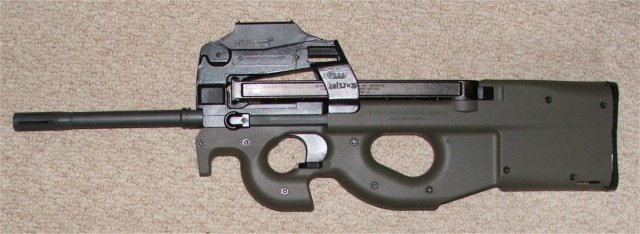
This volume exists to answer one question precisely, because it is the question that decides the purchase and because the internet answers it badly.
There is no transferable select-fire P90 available to an ordinary civilian buyer in the United States, at any price. Not rare, not expensive, not difficult — unavailable, as a matter of arithmetic between two dates. The PS90 is not a budget alternative to a gun that a wealthier buyer could obtain. It is the only version of this weapon that exists in the civilian market.
The rest of this volume sets out why that is true, exactly what FN changed to make the PS90 lawful, what the Form 1 route to a short-barrelled PS90 involves, the imported-parts rule that complicates it, and Michigan’s specific position.
4.1 The Arithmetic, Stated Once and Plainly
Three facts, each individually verifiable, produce the conclusion.
One: the registry closed on 19 May 1986. The Firearm Owners Protection Act was signed on that date, and its section 922(o) provides:
“(1) Except as provided in paragraph (2), it shall be unlawful for any person to transfer or possess a machinegun. (2) This subsection does not apply with respect to— (A) a transfer to or by, or possession by or under the authority of, the United States or any department or agency thereof or a State, or a department, agency, or political subdivision thereof; or (B) any lawful transfer or lawful possession of a machinegun that was lawfully possessed before the date this subsection takes effect.”1
The effect is that the pool of machine guns a private citizen may acquire was frozen at whatever was already lawfully registered on that date. Nothing manufactured afterwards can enter it.
Two: a P90 is a machinegun within the statutory definition. Under 26 U.S.C. § 5845(b) a machinegun is “any weapon which shoots, is designed to shoot, or can be readily restored to shoot, automatically more than one shot, without manual reloading, by a single function of the trigger.”2 A P90 on its “A” setting does exactly that.
Three: the P90 entered production in 1990.3
1990 is after 19 May 1986. No P90 was, or could have been, lawfully possessed by a private citizen before the cutoff, so none can be in the transferable pool, so none can ever be transferred to one. This is not a question of price or scarcity. The set is empty.
What does exist, and why it is not an exception. Select-fire P90s are lawfully held in the United States by government agencies under § 922(o)(2)(A), and by federal firearms licensees with the appropriate Special Occupational Tax status as post-1986 dealer samples. A dealer sample is not transferable to a private individual; it is inventory that belongs to a licensed business and must be disposed of accordingly. A private buyer cannot acquire one by becoming wealthy, patient or persistent — only by becoming a licensed dealer with an SOT, which is a business undertaking rather than a purchase.
The practical consequence. For a buyer who wants the P90 layout, the PS90 is the only lawful route. Comparisons that treat the two as alternatives on a spectrum of cost are comparing a product with a legal impossibility.
4.2 What FN Actually Changed
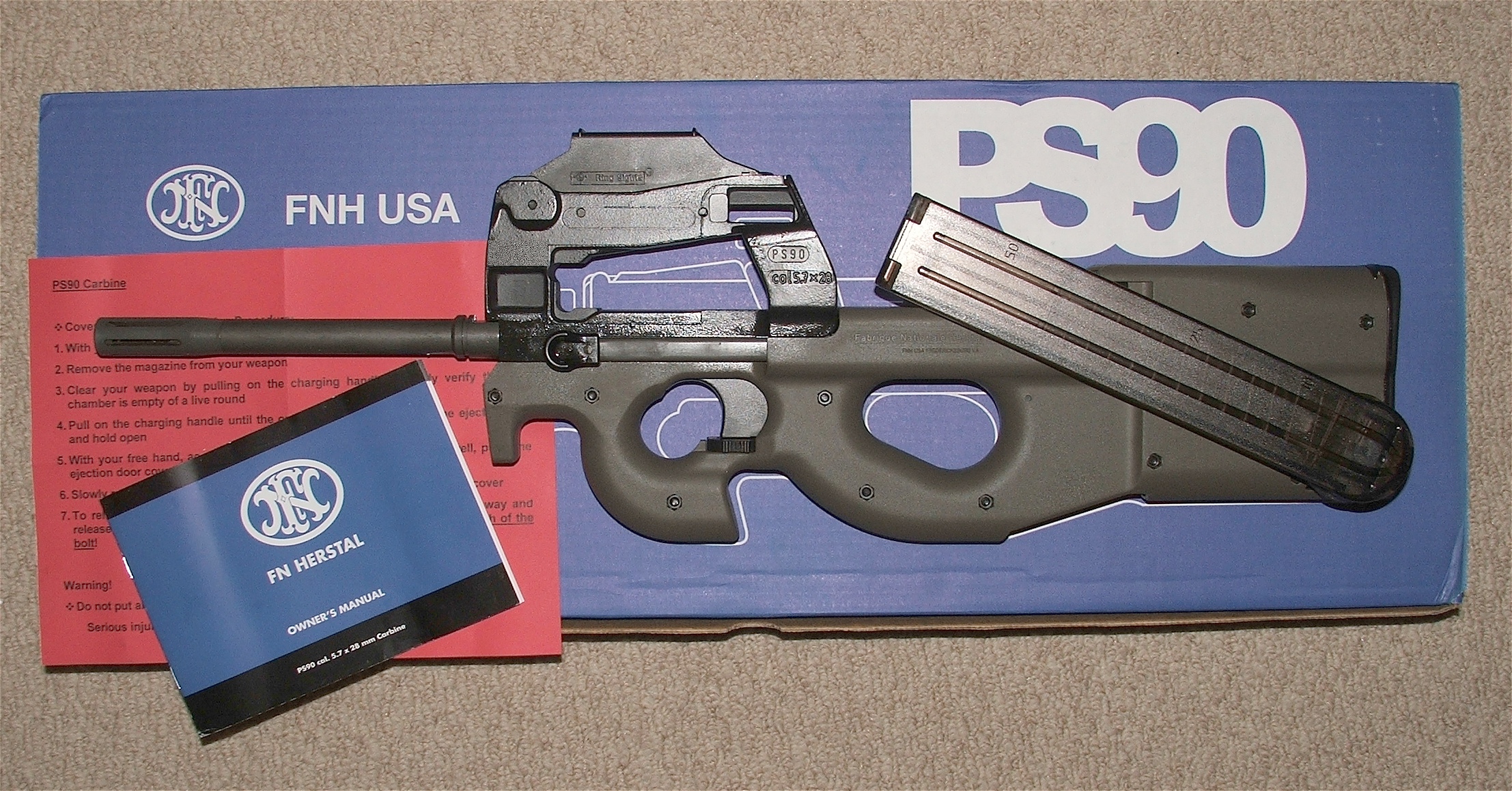
The PS90 was introduced in 2005.3 Two changes make it lawful, and both are aimed at specific statutory thresholds.
The barrel went from 263 mm to 408 mm. Under 18 U.S.C. § 921 a “short-barreled rifle” is “a rifle having one or more barrels less than sixteen inches in length and any weapon made from a rifle … if such weapon, as modified, has an overall length of less than twenty-six inches.”4 FN’s published barrel length is 16.04 inches and overall length 26.23 inches — both figures sitting just above their respective thresholds, which is not a coincidence but a design specification.5 The owner’s manual gives the barrel as 16.1 inches with a rifled length of 14.8 inches, 8 grooves, right-hand 1:9 twist.6
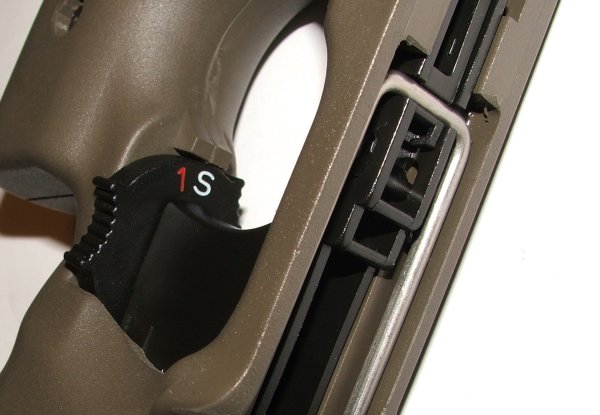
The fire-control group fires once per trigger pull. The rotary selector carries S and 1 only. There is no A position, and the two-stage trigger behaviour described in Volume 3 does not exist on this weapon.
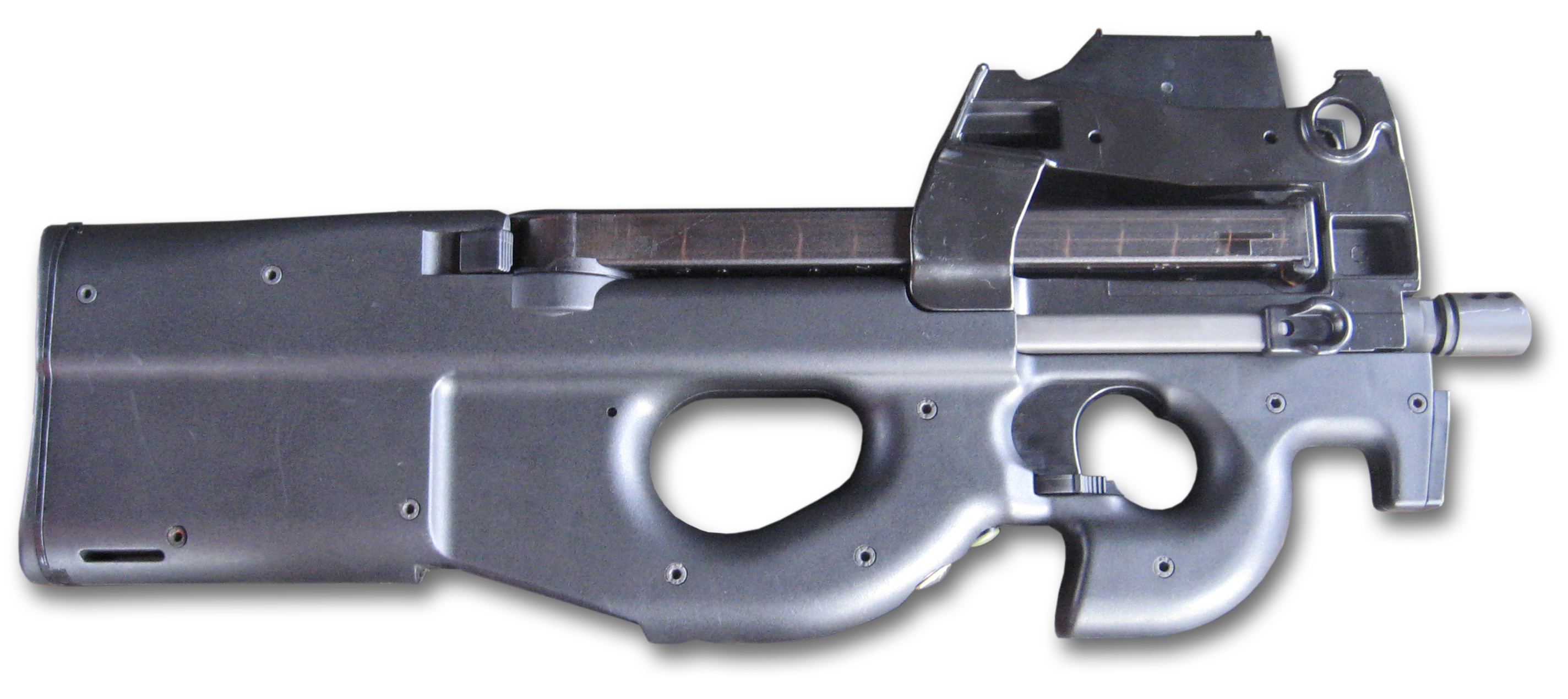
Everything else is the weapon from Volume 3: the same blowback closed-bolt action, the same top-mounted 50-round magazine rotating cartridges through ninety degrees, the same downward ejection, the same ambidextrous controls, the same polymer shell.
4.3 The PS90 Variants and What They Cost
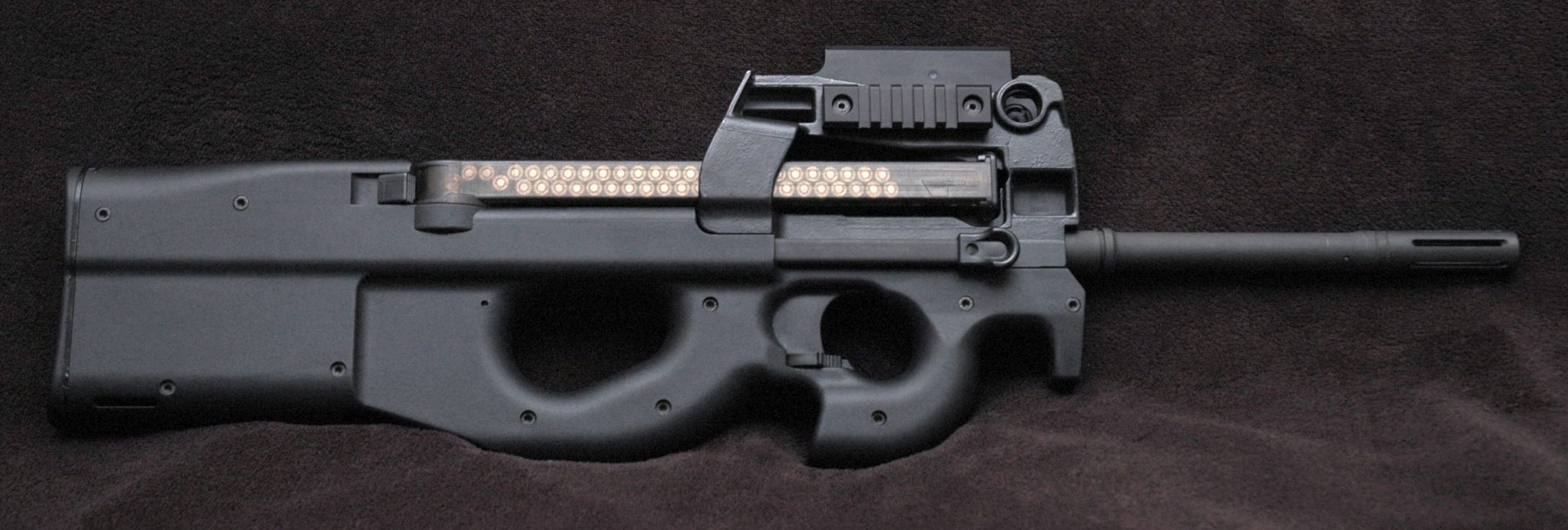
FN America’s current listing for the PS90 Standard gives the following, with model numbers as published:5
Table 1 — 4.3 The PS90 Variants and What They Cost
| Model number | Configuration |
|---|---|
| 3848950460 | PS90 Standard, black, 30-round |
| 3848950440 | PS90 Standard, black, 10-round |
| 3848950501 | PS90 Standard, FDE, 50-round |
| 3848950511 | PS90 Standard, FDE, 10-round |
| 3848950463 | PS90 Standard, black, 1×50, law enforcement |
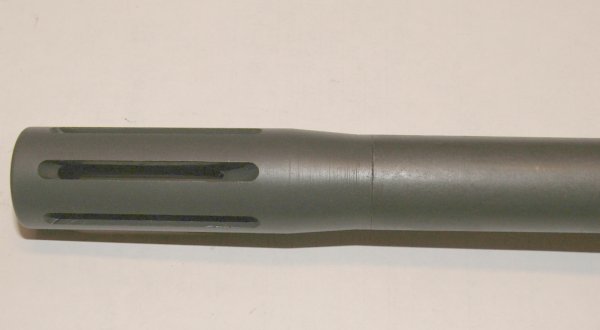
Specifications: 5.7×28mm, 16.04-inch cold hammer-forged barrel, 26.23 inches overall, 6.28 lb, closed-bolt blowback, MIL-STD-1913 accessory rail with back-up iron sight, integrated muzzle brake, ambidextrous controls. MSRP $2,330.00.5
FN America separately lists an FN PS90 50rd configuration as available for law enforcement, with pricing on request.7
Two historical variants mirror the military generations and are recorded as discontinued:3
- PS90 TR, with the triple Picatinny rail system of the P90 TR — discontinued as of 2013.
- PS90 USG, with the aluminium reflex sight housing and revised reticle of the P90 USG — discontinued as of 2011.
A variant claim that should be treated with caution. The reference literature lists a “PS90 SBR” said to retain a “standard 10.5-inch barrel” and to require registration as a Title II weapon.3 The figure does not match the P90’s published 10.4-inch barrel, no FN America catalogue entry for such a product was located during this work, and the claim could not be verified. It is recorded here as unverified rather than repeated as fact. The route an individual actually takes to a short-barrelled PS90 is the one in the next section.
4.4 The Form 1 Route to a Short PS90
A PS90 owner who wants the original P90 proportions is making a short-barrelled rifle, and that is a lawful thing to do with advance approval.
The mechanism. The owner files an ATF Form 1 — an application to make and register a firearm — identifying themselves as the maker, and waits for approval before any work is done. Shortening the barrel first and applying afterwards is the manufacture of an unregistered NFA firearm, which is a felony. The sequence is not negotiable.
The tax is now zero, and this is recent. Both the making tax at 26 U.S.C. § 5821 and the transfer tax at § 5811 were amended by Public Law 119-21, enacted 4 July 2025, to read:
“a tax at the rate of— (1) $200 for each firearm [made/transferred] in the case of a machinegun or a destructive device, and (2) $0 for any firearm [made/transferred] which is not described in paragraph (1).”8
The amendment applies to calendar quarters beginning more than 90 days after enactment. A short-barrelled rifle is not a machinegun or a destructive device, so the making tax on a Form 1 SBR is $0. The registration requirement, the approval wait and the criminal exposure for getting the sequence wrong are all unchanged; only the $200 is gone. The same change applies to suppressors, which is directly relevant to Volume 6.
The trap specific to this weapon: 27 CFR 478.39. The PS90 is an imported firearm, and federal regulation prohibits assembling a semiautomatic rifle from more than 10 imported parts drawn from a specified list where the resulting configuration could not itself be imported on sporting-purposes grounds. The enumerated parts include frames and receivers, barrels, barrel extensions, bolts, bolt carriers, trigger housings, triggers, hammers, sears, disconnectors, buttstocks, pistol grips, forearms and handguards, and magazine bodies, followers and floorplates.9
A PS90 reconfigured with a short barrel is precisely the case the regulation contemplates: an imported semi-automatic rifle placed in a configuration that could not be imported. The compliance route builders use is to substitute US-made parts until the imported count drops to 10 or fewer. This volume does not attempt to publish a parts count for a specific PS90 configuration, because the count depends on the exact parts fitted, US-made replacement availability changes, and an incorrect count published as guidance is worse than none. Anyone going down this road should get the count confirmed against the specific parts in hand.
The same point is made at greater length in this hub’s STEN treatment of the 20-parts rule, which remains the hub’s canonical worked example of imported-parts compliance.
4.5 Michigan
Michigan’s position is unusually clean, and it is set out here from the statute rather than from summaries.
4.5.1 Short-barrelled rifles: lawful if federally lawful, with two conditions
MCL 750.224b provides at subsection (1) that “a person shall not make, manufacture, transfer, or possess a short-barreled shotgun or a short-barreled rifle,” a felony under subsection (2) punishable by up to 5 years or a $2,500 fine. Subsection (3) then supplies the exception that matters:
“(3) Subsection (1) does not apply to a short-barreled shotgun or short-barreled rifle that is lawfully made, manufactured, transferred, or possessed under federal law.”10
Two further subsections impose Michigan-specific duties, and both are easy to miss:
“(4) A person, excluding a manufacturer, lawfully making, transferring, or possessing a short-barreled shotgun or short-barreled rifle that is 26 inches or less in length under this section shall comply with section 2 or 2a of 1927 PA 372, MCL 28.422 and 28.422a.”
“(5) A person who possesses a short-barreled shotgun or short-barreled rifle that is greater than 26 inches in length under this section shall possess a copy of the federal registration of that short-barreled shotgun or short-barreled rifle while transporting or using [it] and shall present that federal registration to a peace officer upon request.”10
A violation of subsection (5) is a state civil infraction with a fine of up to $100, and the weapon is subject to immediate seizure, with 45 days to produce the federal registration before forfeiture proceedings follow.10
Why the 26-inch line matters specifically here. A PS90 shortened to P90 proportions would be in the region of 20 inches overall — the P90 is 500 mm, about 19.7 inches. That is 26 inches or less, which places it under subsection (4) and its reference to MCL 28.422 / 28.422a, Michigan’s licence-to-purchase and pistol-registration machinery, rather than under the simpler carry-the-paperwork duty of subsection (5). A PS90 left at its factory 26.23 inches is over the line and falls under subsection (5) if it is an SBR at all — which, at a 16.04-inch barrel, it is not.
The statute’s history is: added by 1978 PA 564, amended by 2008 PA 196 effective 7 January 2009, and amended by 2014 PA 63, immediately effective 27 March 2014.10
4.5.2 Suppressors: lawful through the federal-licensee exception
MCL 750.224(1)(b) makes it a felony to “manufacture, sell, offer for sale, or possess” a “muffler or silencer,” defined broadly at subsection (4) to include not only a complete device but “a combination of parts, designed or redesigned, and intended for use in assembling or fabricating a muffler or silencer” and any part “designed or redesigned, and intended only for” that purpose.11
The exception at subsection (3)(c) is the operative provision:
“(3) Subsection (1) does not apply to any of the following: … (c) A person licensed by the secretary of the treasury of the United States or the secretary’s delegate to manufacture, sell, or possess a machine gun, or a device, weapon, cartridge, container, or contrivance described in subsection (1).”11
This is the statutory basis on which suppressors are lawfully held in Michigan: possession authorised under the federal scheme falls outside the state prohibition. Note the drafting — it is framed around federal licensing rather than around a simple “if federally legal” clause of the kind used for short-barrelled rifles in 750.224b(3). The statute’s most recent amendment in this chain was 2006 PA 401, effective 28 December 2006.11
Michigan’s machine-gun prohibition sits in the same section at 750.224(1)(a), with the same federal-licensee exception — which is consistent with, and adds nothing to, the federal position in § 4.1: a Michigan resident cannot obtain a transferable P90 because no such thing exists, not because of anything in Michigan law.
For the general NFA framing rather than the PS90-specific case, this hub’s Suppressor Law dive is the reference and is not restated here.
4.6 The Verdict for a Civilian Buyer
For a buyer who wants the P90 layout, the PS90 is the only lawful route. The select-fire weapon is not expensive, it is unobtainable.
For a buyer who wants P90 proportions, the route is a Form 1 on a PS90 — approval first, work second, $0 making tax since Public Law 119-21, and a real 27 CFR 478.39 parts-count question to resolve honestly before any metal is cut. In Michigan the resulting weapon lands under MCL 750.224b(4) and its cross-reference to MCL 28.422, because it will be under 26 inches overall.
For a buyer who simply wants to shoot 5.7×28 from a carbine, the standard PS90 needs no paperwork beyond an ordinary rifle purchase, and its 16-inch barrel is the version of this weapon with the best ballistics, as Volume 2 sets out. The unmodified PS90 is the only configuration in this entire dive that requires nothing from anybody.
4.7 What “Transferable” Means, and Why There Is No Way Around It
The word “transferable” does a great deal of work in machine-gun discussions and is worth defining precisely, because most of the folk workarounds fail on the definition rather than on the price.
A transferable machine gun is one that was lawfully registered and possessed before 19 May 1986 and may therefore still be transferred between private citizens, subject to ATF approval and the transfer tax.1 The pool is finite, it is closed, and attrition only shrinks it — a destroyed or surrendered weapon is not replaced. That scarcity is why prices in this category bear no relation to manufacturing cost; the reference literature notes most such weapons cost in excess of $10,000, and that observation long predates the current market.12
A post-1986 dealer sample is a machine gun manufactured after the cutoff, held by a federal firearms licensee with the appropriate Special Occupational Tax status, for purposes the licence contemplates — demonstration to agencies, sales samples, and similar. It belongs to the licensed business. It does not become transferable to a private citizen by the licensee’s retirement, death or sale, and it cannot be “bought out” of that status.
Why the workarounds fail. Importing one is barred, both by § 922(o) itself and by the import restrictions on machine guns generally; manufacturing one is barred by the same subsection; a trust or corporation does not change the analysis, because § 922(o) speaks of “any person” and the registry’s closure is a matter of date, not of entity form. Registering a newly made select-fire P90 is not a slow or expensive process — it is not a process at all, because ATF has no lawful basis to approve it.
The conclusion is therefore not a caution about difficulty. For a private buyer, the select-fire P90 does not exist as a purchasable object, and any listing, forum claim or price rumour suggesting otherwise is describing a dealer sample, a government weapon, a misidentified PS90, or a fraud.
4.8 A Note on Magazines and State Law
FN’s own owner’s manual carries the observation that “some states limit the magazine capacity to 10 rounds,” and FN accordingly sells the PS90 in 10-round configurations as well as 30 and 50.65
This is worth flagging in a legal volume for one reason specific to this weapon: the 50-round magazine is not an accessory here, it is the design. The entire argument for the top-mounted horizontal magazine, set out in Volume 1, is that it carries fifty rounds without protruding below the weapon. A jurisdiction that caps capacity at ten does not merely reduce the PS90’s ammunition supply — it removes the reason the magazine is shaped the way it is, while leaving the owner with all of the layout’s costs.
Michigan imposes no such capacity limit, so this is a travel and residency consideration rather than a local one. It is raised here because a buyer moving between states, or buying magazines across state lines, is dealing with a weapon whose defining feature is the thing most commonly restricted.
4.9 What Could Not Be Verified
- The “PS90 SBR” factory variant and its “10.5-inch barrel” figure, as discussed in § 4.3.
- A current parts count for any specific PS90 configuration under 27 CFR 478.39. Deliberately not published.
- Current ATF Form 1 processing times. These move constantly and no figure is given rather than a stale one.
- Whether Michigan’s MCL 28.422 licence-to-purchase machinery is applied in practice to a sub-26-inch SBR in the same way as to a pistol. The statute’s cross-reference is quoted above; how a given county applies it was not researched and is a question for a Michigan firearms attorney rather than for this dive.
Sources
Footnotes
-
18 U.S.C. § 922(o), quoted from the Legal Information Institute text; Firearm Owners Protection Act signed 19 May 1986, which is the date the subsection takes effect. ↩ ↩2
-
26 U.S.C. § 5845(b), definition of “machinegun.” ↩
-
“FN P90”, English Wikipedia, consulted 2026-09-17, for the 1990 start of production, the 2005 introduction of the PS90, the PS90 TR (discontinued 2013) and PS90 USG (discontinued 2011) variants, and the unverified “PS90 SBR” entry discussed in § 4.3. ↩ ↩2 ↩3 ↩4
-
18 U.S.C. § 921, definition of “short-barreled rifle.” ↩
-
FN America, “FN PS90 Standard”, https://fnamerica.com/products/rifles/fn-ps90-standard/ — model numbers, 16.04-inch barrel, 26.23-inch overall length, 6.28 lb, MIL-STD-1913 rail with back-up iron sight, integrated muzzle brake, MSRP $2,330.00. ↩ ↩2 ↩3 ↩4
-
FN Herstal / FN America, FN PS90 Owner’s Manual, 1605_PS90_Owners_Manual_v3, § 11 — barrel 16.1 in, rifled length 14.8 in, 8 grooves, 1:9 in right-hand twist, trigger pull 6 to 11 lb, semi-automatic firing mode, magazine capacity 10/30/50. ↩ ↩2
-
FN America, “FN PS90 50rd” — listed as available for law enforcement, pricing on request. ↩
-
26 U.S.C. §§ 5821 and 5811 as amended by Public Law 119-21 (4 July 2025), applicable to calendar quarters beginning more than 90 days after enactment. ↩
-
27 CFR § 478.39, assembly of semiautomatic rifles or shotguns from imported parts, including the enumerated parts list at paragraph (c). ↩
-
MCL 750.224b, The Michigan Penal Code (Act 328 of 1931), quoted from the Michigan Legislature’s published text, current through PA 91 of 2026. History: added 1978 PA 564; amended 2008 PA 196, effective 7 January 2009; amended 2014 PA 63, immediately effective 27 March 2014. ↩ ↩2 ↩3 ↩4
-
MCL 750.224, The Michigan Penal Code (Act 328 of 1931), quoted from the Michigan Legislature’s published text, current through PA 91 of 2026. Most recent amendment in this chain: 2006 PA 401, effective 28 December 2006. ↩ ↩2 ↩3
-
Firearm Owners Protection Act, English Wikipedia, consulted 2026-09-17, for the observation that the limited civilian supply of pre-1986 machine guns has driven prices, with most costing in excess of $10,000. The figure is reported as a general market observation, not as current pricing. ↩
Comments (0)