FN P90 & PS90 · Volume 1
The PDW Problem — What NATO Asked For and What FN Built
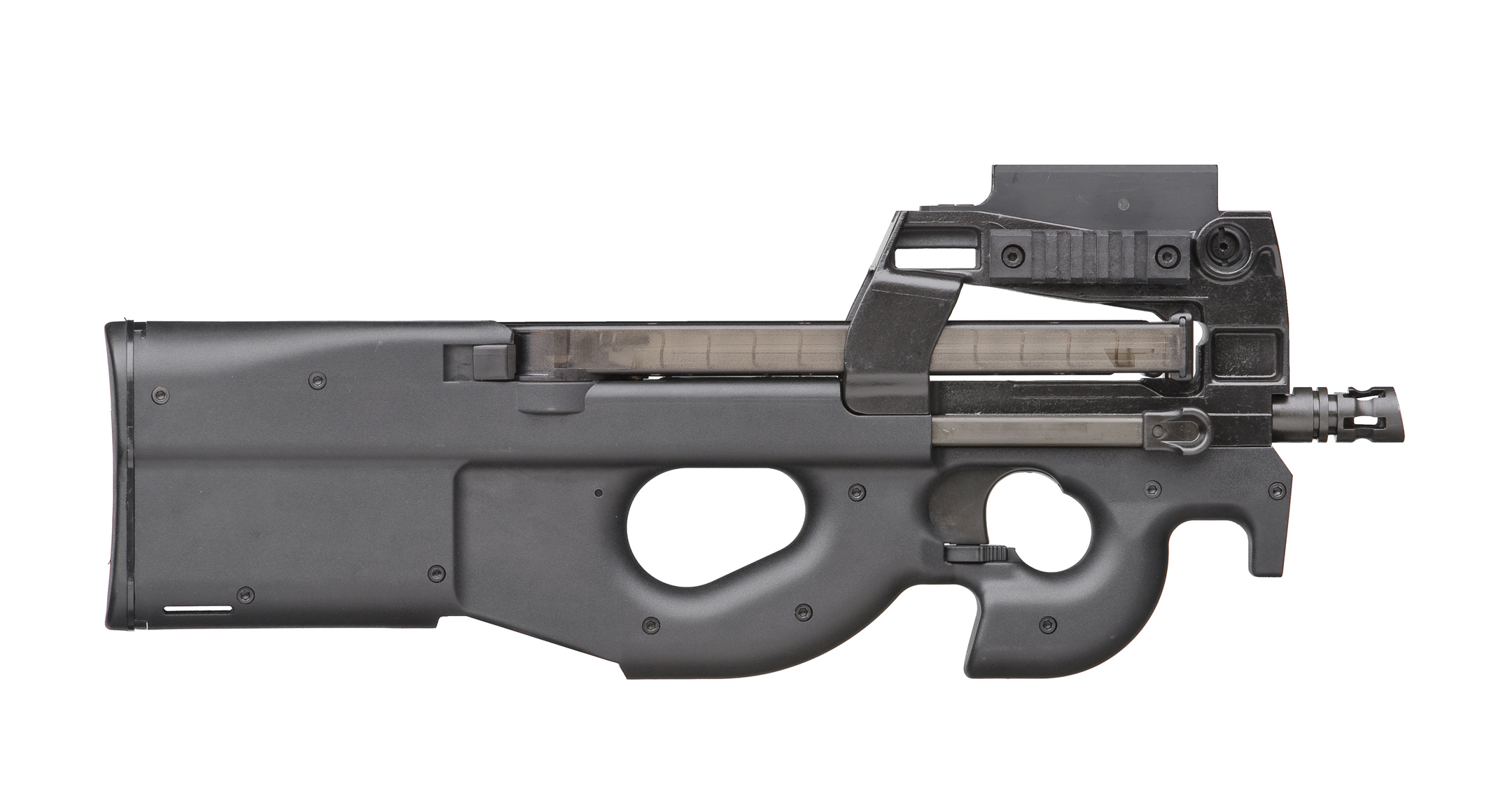
The FN P90 is the most recognisable weapon almost nobody has handled. It has been on screen for thirty years, it is the default “future gun” in a generation of video games, and its silhouette is legible to people who could not name a single other firearm. That fame has almost nothing to do with why it exists, and it has actively obscured what the thing is for.
What it is for is a specific problem that NATO wrote down in 1989 and then never solved.
1.1 The Argument These Volumes Make
Seven volumes, and three claims run through all of them.
The P90 answers a real question that turned out not to matter as much as the question-askers thought. The personal defence weapon requirement was aimed at a genuine gap: the enormous population of soldiers who are not riflemen — drivers, gun crews, signallers, medics, aircrew — armed with pistols or submachine guns that could not defeat the body armour that was becoming ordinary on the battlefield. FN’s answer was excellent engineering against that brief. The brief itself was then overtaken by cheap short-barrelled rifles in 5.56×45, which did most of the same job with ammunition every unit already carried. The P90 is not a failed design. It is a successful design for a procurement category that never grew to the size anyone forecast.
The cartridge is the whole argument, and it is discussed almost entirely in bad faith by both sides. The 5.7×28mm attracts extraordinary confidence from people who have not read the test data. One camp holds that it is a laser that defeats body armour and makes the 9×19 obsolete; the other that it is a hopped-up .22 that will not stop anything. Volume 2 separates what has actually been measured from what has been asserted, and the answer is genuinely more interesting than either position — the load matters far more than the cartridge does, and the loads that penetrate armour are the ones an ordinary buyer cannot get.
For a civilian, the two weapons in the title are not two versions of one thing. They are one purchasable object and one that cannot be bought. This is the single most decision-relevant fact in the dive and it is covered properly in Volume 4: the machine-gun registry closed on 19 May 1986, the P90 entered production in 1990, and the arithmetic of those two dates admits no exception. There is no transferable select-fire P90 at any price. The PS90 is not a compromise version of a gun a determined buyer could otherwise obtain; it is the only version that legally exists outside a government or a licensed dealer’s inventory.
1.2 What Each Is, in One Table
Figures for the P90 are FN Herstal’s and as reported in the reference literature; figures for the PS90 are taken directly from FN America’s own product listing and the FN PS90 owner’s manual.123
Table 1 — 1.2 What Each Is, in One Table
| P90 (select-fire) | PS90 (semi-automatic) | |
|---|---|---|
| Type | Personal defence weapon, select-fire | Civilian carbine, semi-automatic only |
| Cartridge | 5.7×28mm | 5.7×28mm |
| Operation | Straight blowback, closed bolt | Straight blowback, closed bolt |
| Barrel | 263 mm (10.4 in) | 408 mm (16.04 in); 376 mm (14.8 in) rifled |
| Rifling | 8 grooves, right-hand, 1:231 mm (1:9.1 in) | 8 grooves, right-hand, 1:9 in |
| Overall length | 500 mm (19.7 in) | 667 mm (26.23 in) |
| Height / width | 210 mm / 55 mm | 197 mm (7.8 in) / 59 mm (2.3 in) |
| Weight | 2.6 kg (5.8 lb) empty | 3.1 kg (6.74 lb) with empty 30-round magazine |
| Fire control | Rotary selector: S — 1 — A | Rotary selector: S — 1 only |
| Cyclic rate | 850–1,100 rounds/min | not applicable |
| Trigger pull | not published by FN | 6 to 11 lb (FN specification) |
| Magazine | 50-round, top-mounted, horizontal | 10, 30 or 50-round, same design |
| Effective range | 200 m | 200 m |
| Ejection | Downward, through a chute behind the grip | Downward, through a chute behind the grip |
| First production | 1990 | 2005 |
The two columns differ in exactly three consequential places — barrel length, fire control, and the resulting legal status. Everything else is the same weapon, and that is why Volume 4 can be as short and as blunt as it is.
1.3 The Requirement
NATO published document D/296 in 1989. It described a category rather than a weapon: a personal defence weapon offering greater range, accuracy and terminal performance than the 9×19mm cartridge, with the ability to defeat body armour, in a package a non-infantryman would actually carry. The shoulder-fired version was to weigh under 3 kg and feed from a magazine of at least 20 rounds.1
The gap it named was real and it was large. In any mechanised army the majority of uniformed personnel are not riflemen. They crew vehicles, guns and radios, they fly and fix aircraft, they drive trucks and treat casualties, and their personal weapon is a compromise nobody thinks about until the line moves. Through the Cold War that compromise was a pistol or a submachine gun, both of them firing pistol ammunition, and both of them increasingly unable to do anything useful against a soldier in a modern vest.
The armour is the hinge. A 9×19 round from a submachine gun is a serious weapon against an unprotected man at close range and very nearly a nuisance against a protected one. As soft armour and ceramic plates spread through the Warsaw Pact and then everywhere else, the entire pistol-calibre category quietly lost its reason to exist in a military context.
There were two obvious answers and NATO’s requirement effectively asked for the third. The first answer is a rifle: issue everybody a 5.56×45 carbine and accept the bulk. The second is to give up: accept that support troops are not going to win firefights and arm them for self-defence at conversational range. The third — the one D/296 described — is a new small-calibre, high-velocity cartridge, physically closer to a pistol round than a rifle round, driven fast enough to punch armour at a few hundred metres, in a weapon small enough to sling out of the way.
FN went at the third answer from the cartridge end, which is the correct end, and which is why the cartridge gets its own volume before the weapons do.
1.4 Project 9.0, and Where the Name Comes From
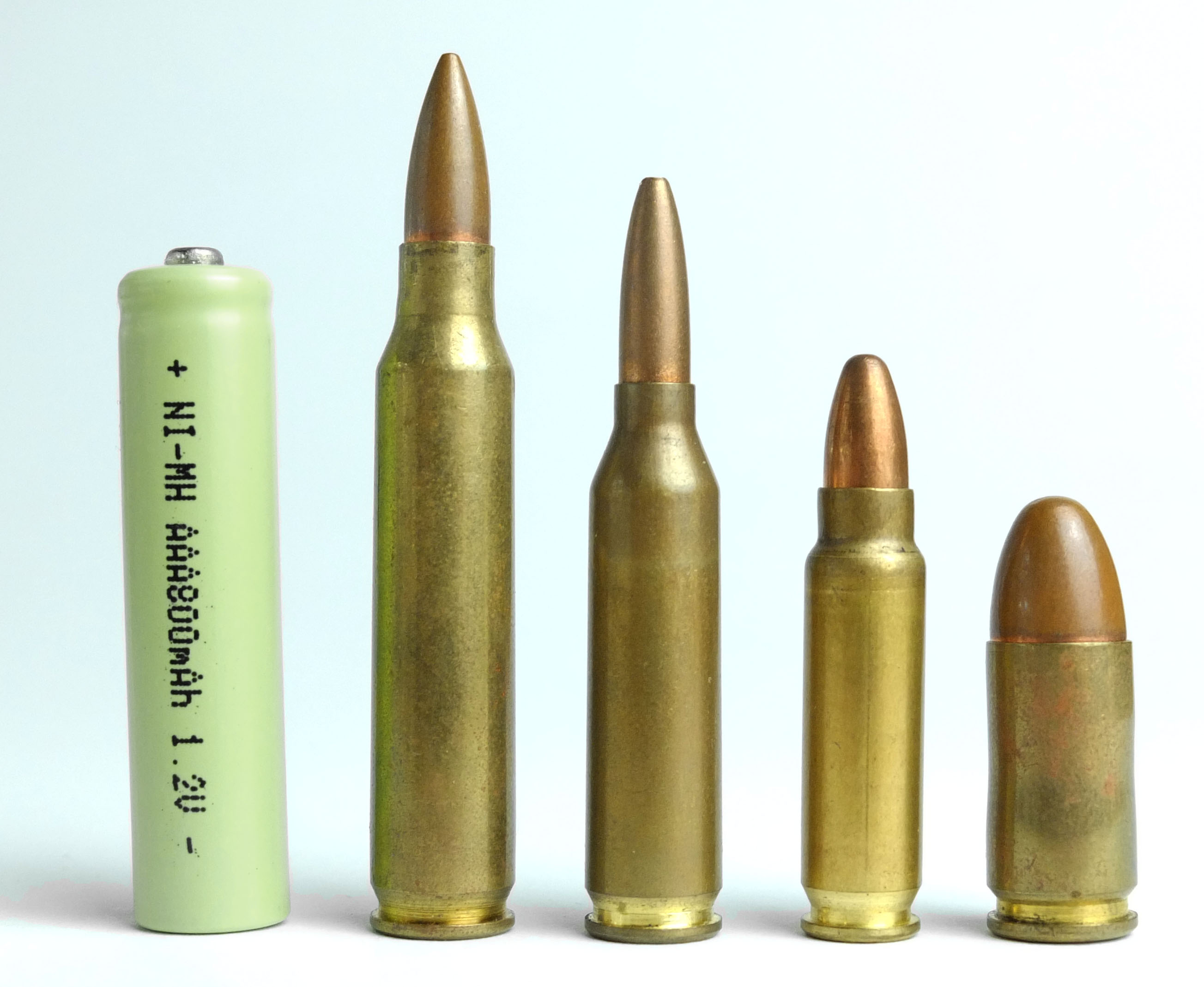
Development ran from roughly 1986 to 1990 under the internal designation Project 9.0, which is where the “90” in P90 comes from — not, as is often repeated, the year 1990, although production did begin that year. The design of record is credited to René Predazzer at FN Herstal.1
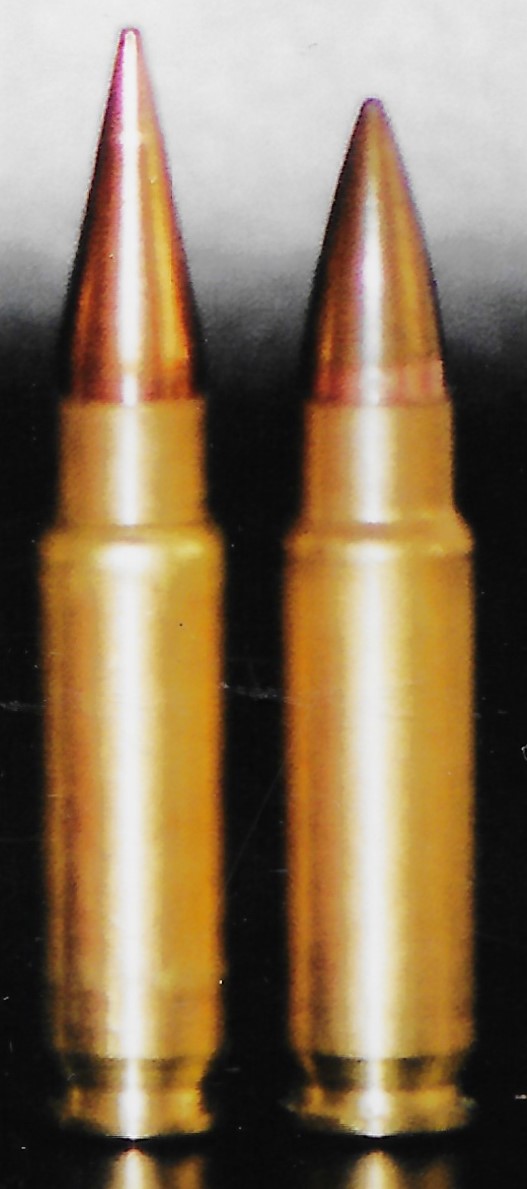
The first production ammunition was the SS90: a 1.5 g (23-grain) projectile leaving the 263 mm barrel at roughly 850 m/s (2,800 ft/s). It did not last. FN replaced it with the SS190, prototyped in 1992 and finalised in 1993, which is 2.7 mm shorter, heavier at 2.0 g (31 grains), slower at about 716 m/s, and built around a conventional two-part core of aluminium and steel. The weapon was modified to suit the shorter cartridge, which is why an early P90 and a post-1993 P90 are not quite the same object.1
That substitution is worth pausing on, because it sets the pattern for everything in Volume 2. The original cartridge was the fast, light, exotic one. The one that went to war was heavier, slower and more conventional — and better, because terminal performance and penetration are not simply functions of velocity. The 5.7×28’s own maker reached that conclusion within three years of production and the internet has been relitigating it ever since.
1.5 The Layout, and Why Each Odd Decision Is Not Arbitrary
Nothing on the P90 looks like a conventional firearm, and almost every part of it is a direct consequence of the requirement rather than styling.
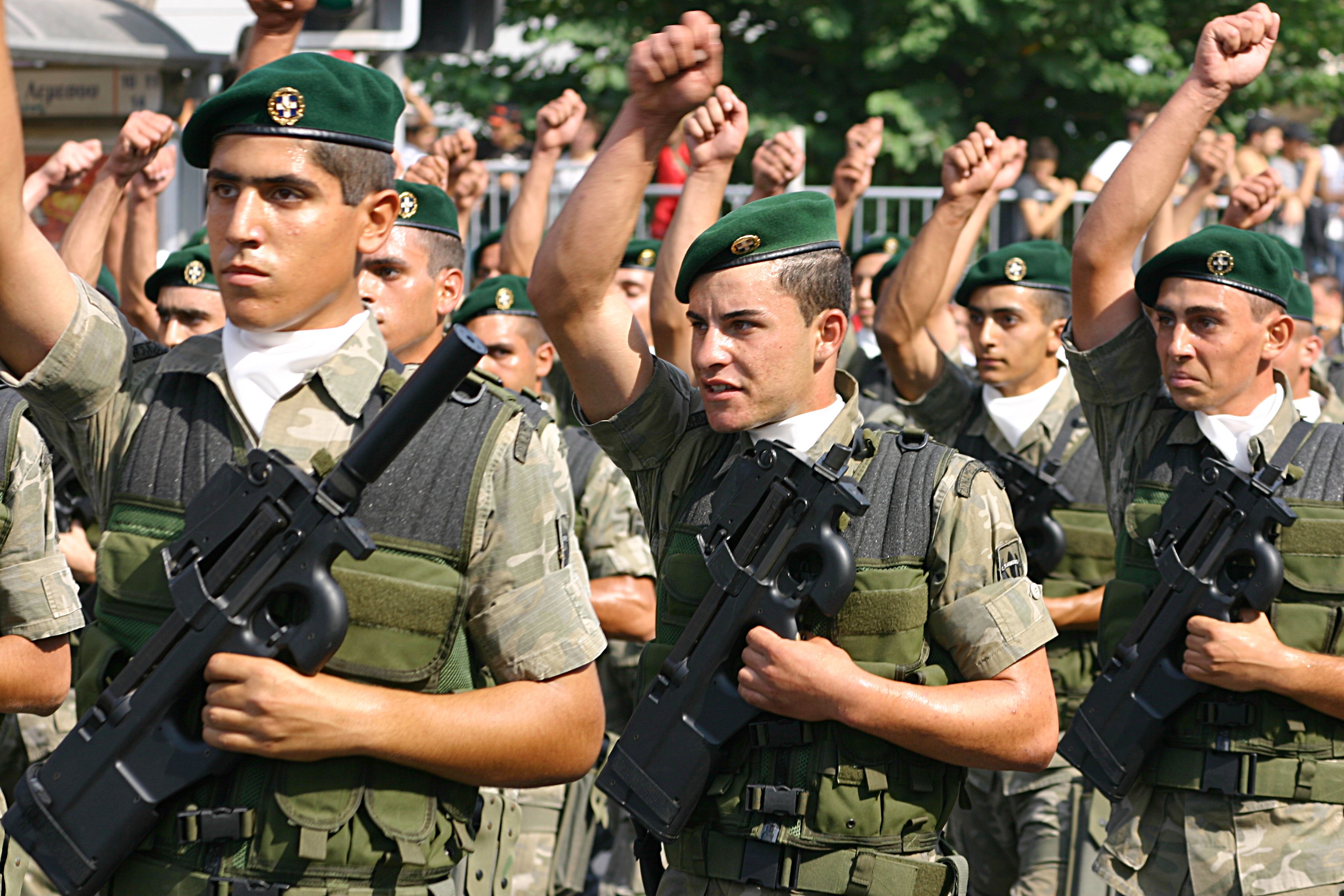
Bullpup. Putting the action behind the trigger buys barrel length inside a short overall package. The P90 is 500 mm long overall — shorter than most submachine guns with folded stocks — while retaining a 263 mm barrel. For a weapon whose entire justification is that a truck driver will still have it on him, length is the governing constraint and the bullpup is the direct answer to it. The cost is the trigger, discussed at length in Volume 5.
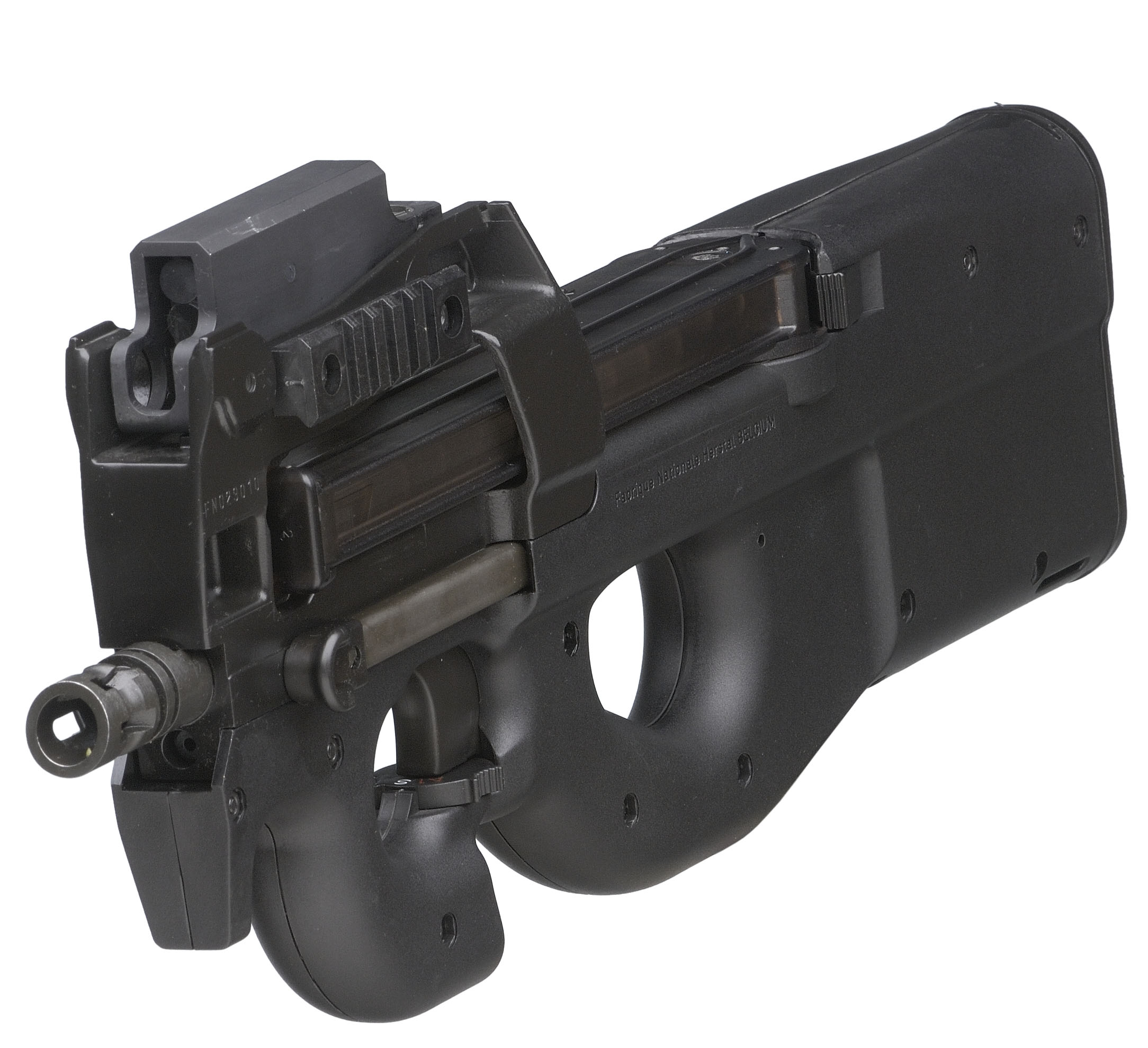
A magazine lying flat along the top. This is the single most distinctive feature and the one most often assumed to be styling. It is not. A conventional box magazine of 50 rounds would hang far enough below the weapon to defeat the whole point; laid horizontally over the receiver, fifty rounds add nothing to the silhouette below the shooter’s hand. The cost is a mechanism that has to rotate each cartridge through ninety degrees on its way to the chamber, covered in Volume 5, and protected by a US patent (4,905,394).1
Downward ejection. Spent cases drop through a chute that exits behind the pistol grip. On a conventional bullpup, ejection is the defect that makes the design hostile to left-handed shooters — the case comes out beside the cheek. Ejecting down removes the problem completely, and it is the reason the P90 is genuinely, not nominally, ambidextrous: charging handles on both sides, a magazine release usable from either hand, a selector under the trigger finger, and no ejection port next to anyone’s face.
A closed-bolt, straight-blowback action. The 5.7×28 is mild enough in impulse to run on simple blowback, and firing from a closed bolt is a meaningful accuracy advantage over the open-bolt submachine guns the weapon was meant to replace. There is no gas system, no locking mechanism to speak of, and correspondingly little to go wrong.
A shell rather than a receiver. The P90’s structure is a polymer housing carrying steel where steel is needed. In 1990 this was still faintly scandalous; it is now unremarkable.
1.6 What Happened to the Requirement
The P90 never became the standard support-arm of NATO, and the reason is partly political and partly that the market moved.
Heckler & Koch answered the same requirement from the other direction with the MP7 and its 4.6×30mm cartridge — a smaller, lighter, more pistol-like weapon firing a smaller, faster projectile. NATO tested the two cartridges against each other in the United Kingdom and France in 2002–2003, with an expert group drawn from France, the United States, Canada and the United Kingdom. The group’s conclusion favoured the 5.7×28: reported as roughly 27% more effective against unprotected targets, equivalent against protected targets, better behaved across temperature extremes, and less likely to erode barrels than the 4.6×30.4
The recommendation went nowhere. The German delegation and others rejected it, and the standardisation process stopped indefinitely. Both cartridges were eventually standardised separately — STANAG 4509 for the 5.7×28mm and STANAG 4820 for the 4.6×30mm — which is the diplomatic way of recording that no decision was made.4
A date worth flagging, because sources disagree. FN America’s own current product pages state that the 5.7×28mm was “standardized in 2020 by NATO.”5 The reference literature gives February 2021 for NATO standardisation.1 Both cannot be right about the same event, and the discrepancy could not be resolved from primary NATO documents here; the safe statement is that NATO standardisation of the cartridge occurred around 2020–2021, three decades after the weapon that fired it entered production.
Meanwhile the actual solution to the actual problem turned out to be the M4 and its relatives. A 14.5-inch 5.56×45 carbine is heavier and longer than a P90, but it penetrates armour comfortably, reaches much further, and — decisively — eats the ammunition the rest of the unit is already carrying. A logistics chain that has to push a unique cartridge to a minority of users in every unit is a real and permanent cost, and it is the cost that quietly killed the PDW category as a mass-issue proposition.
What survived is a specialist niche, and there the P90 has done well. FN reports the weapon in service with military and police forces in more than 40 nations.1 Adoption tends to be by units whose problem genuinely matches the brief: close protection details, counter-terrorist teams, vehicle and aircraft crews, and police tactical units operating in confined spaces.
1.7 The Civilian Half of the Story
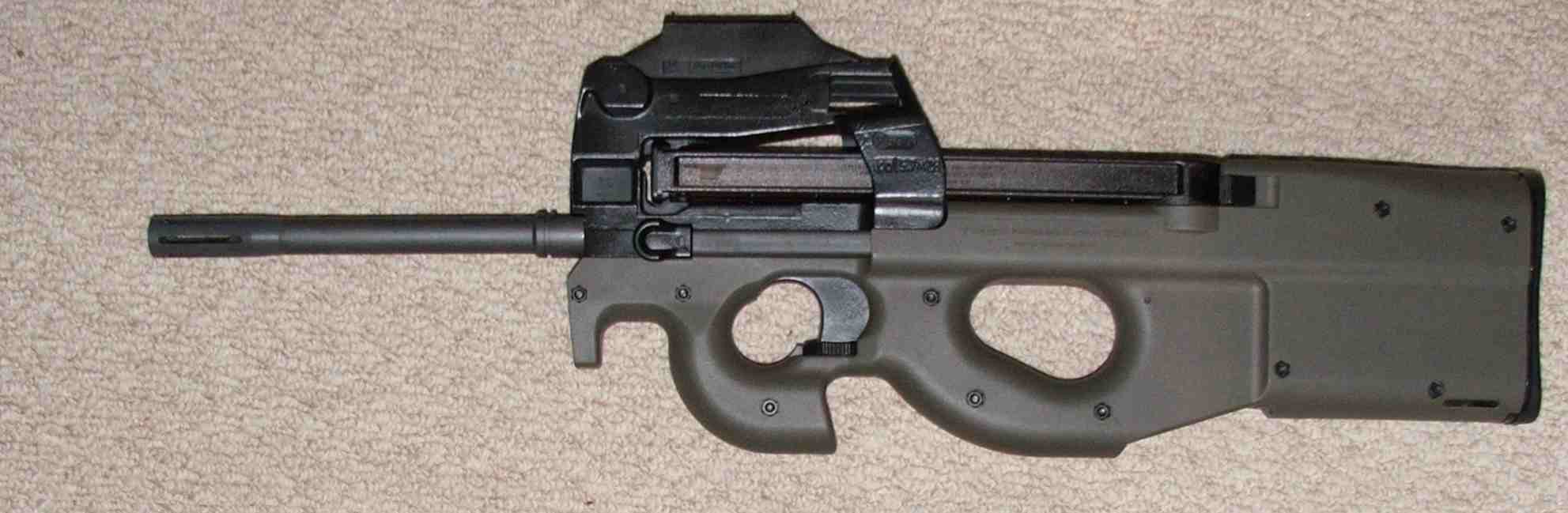
FN introduced the PS90 in 2005: the same weapon with a 16.04-inch barrel and a fire-control group that will only fire semi-automatically.12
Both changes exist for the same legal reason. Under the National Firearms Act a rifle with a barrel shorter than 16 inches is a short-barrelled rifle and a registered NFA item; a weapon that fires more than one shot per trigger function is a machine gun, and — after 19 May 1986 — one that no ordinary civilian may acquire at all.678 The PS90 is what the P90 has to become in order to be sold over a counter.
The 16-inch barrel is why the PS90 is easy to distinguish from a P90 in a photograph, and it is the identification tell used throughout these volumes: a P90’s barrel ends almost immediately ahead of the hand stop, while a PS90’s protrudes a long way forward of the shell, ending in a ported muzzle brake.
1.8 The Reading Order
Volume 2 is the cartridge: every loading FN has made and every current commercial offering, what each is for, ballistics computed by barrel length, and an honest treatment of the armour-penetration controversy and the press panic around it. It is the volume to read first if only one gets read, because nearly every argument about these weapons is really an argument about the cartridge.
Volume 3 is the military P90 — variants and generations, how select-fire operation actually works, the optics, and who bought them.
Volume 4 is the civilian PS90 and the law. It covers exactly what differs, the machine-gun registry arithmetic, the Form 1 route to a short-barrelled PS90, the imported-parts rule that complicates it, and Michigan’s specific position on short-barrelled rifles and suppressors.
Volume 5 is shooting it: ergonomics, the bullpup trigger and why it has the reputation it does, magazine loading and the ninety-degree rotation, ejection, ambidexterity, and what accuracy is realistic.
Volume 6 is modification and accessories — rails and optics, trigger work, barrels, magazines, and suppressor host considerations, which are cross-referenced to the existing suppressor dives rather than re-derived.
Volume 7 is ownership: field strip and detailed takedown, cleaning a bullpup, wear points, parts availability, what to inspect on a used example, and what feeding a 5.7×28 actually costs in 2026.
1.9 Three Things to Get Out of the Way Now
The P90 is a submachine gun by classification and a PDW by intent, and it is filed here with the rifles. That follows the same convention as the STEN dive in this hub, which is also a submachine gun and also lives under Rifles. The PS90, with its 16-inch barrel, is a rifle by the plain statutory definition regardless of what its ancestor was.7
“Armour-piercing” is doing two different jobs in this subject and conflating them is the root of most of the confusion. It has a physical meaning — will this projectile defeat this vest — and a separate US statutory meaning under 18 U.S.C. § 921(a)(17)(B) that turns on the projectile’s construction and materials, not its performance. A round can defeat a vest and not be statutorily armour-piercing, and a round can be statutorily armour-piercing and be a poor performer. Volume 2 keeps the two meanings apart throughout, because essentially no popular account of this cartridge does.
Nothing in these volumes was verified by handling the weapons. The dive is built on FN’s own published specifications and owner’s manual, the statutory and regulatory texts as published, and the reference literature. Where a figure could not be verified it is identified as unverified rather than smoothed over, and there are several such notes — the introduction date of the P90 USG variant, the existence and nature of a magazine generation change, and any independently measured accuracy figure among them.
Sources
Footnotes
-
“FN P90” and “FN 5.7×28mm”, English Wikipedia, consulted 2026-09-17, for the development chronology (NATO document D/296 of 1989, Project 9.0, René Predazzer, SS90 and SS190 dates), the P90 dimensional and performance specifications, the variant list, the magazine patent number, the adoption list, and the February 2021 NATO standardisation date. Figures reported there are FN Herstal’s own published specifications. ↩ ↩2 ↩3 ↩4 ↩5 ↩6 ↩7 ↩8
-
FN America, “FN PS90 Standard” product page, https://fnamerica.com/products/rifles/fn-ps90-standard/ — 16.04 in barrel, 26.23 in overall length, 6.28 lb, closed-bolt blowback, MIL-STD-1913 rail and back-up iron sight, integrated muzzle brake, MSRP $2,330.00, model numbers as listed. ↩ ↩2
-
FN Herstal / FN America, FN PS90 Owner’s Manual, document 1605_PS90_Owners_Manual_v3, https://fnamerica.wpenginepowered.com/wp-content/uploads/2016/10/1605_PS90_Owners_Manual_v3.pdf — § 11 technical specifications (trigger pull 6 to 11 lb, barrel 16.1 in, rifled length 14.8 in, 8 grooves, 1:9 in right-hand twist, height 7.8 in, width 2.3 in, weight 6.74 lb with empty 30-round magazine, effective range 200 m, magazine capacity 10/30/50) and § 5 field stripping. ↩
-
“4.6×30mm”, English Wikipedia, consulted 2026-09-17, for the 2002–2003 NATO comparative trials conducted in the United Kingdom and France, the expert group composition, the reported 27% effectiveness advantage, the German rejection of the recommendation, and the separate STANAG 4509 / STANAG 4820 standardisations. The CRISAT target definition (1.6 mm titanium, UK IMI Ti 318, plus 20 layers of Kevlar UK/SC/4468, under STANAG 4512) is taken from the CRISAT entry in the same reference work. ↩ ↩2
-
FN America, 5.7×28mm ammunition product pages (FN SS195LF, FN SS197SR, FN SS198LF, FN DFNS SS200, FN GUNR SS201), https://fnamerica.com/products/5-7x28mm/ — each states that the 5.7×28mm calibre was “standardized in 2020 by NATO” and was “originally designed in the late 1980s.” ↩
-
18 U.S.C. § 922(o), via the Legal Information Institute; and the Firearm Owners Protection Act, signed 19 May 1986, which is the date the subsection takes effect and therefore the registry cutoff. ↩
-
26 U.S.C. § 5845, definitions of “firearm”, “machinegun” and “rifle”; and 18 U.S.C. § 921, definition of “short-barreled rifle” — a rifle with a barrel under 16 inches, or an overall length under 26 inches. ↩ ↩2
-
26 U.S.C. §§ 5811 and 5821, transfer and making taxes, as amended by Public Law 119-21 (4 July 2025): $200 for a machine gun or destructive device, $0 for any other NFA firearm, effective for calendar quarters beginning more than 90 days after enactment. ↩
Comments (0)