The AR-15 in 5.56 · Volume 6
Optics, Furniture and Accessories — What Suits a 16-Inch Carbine
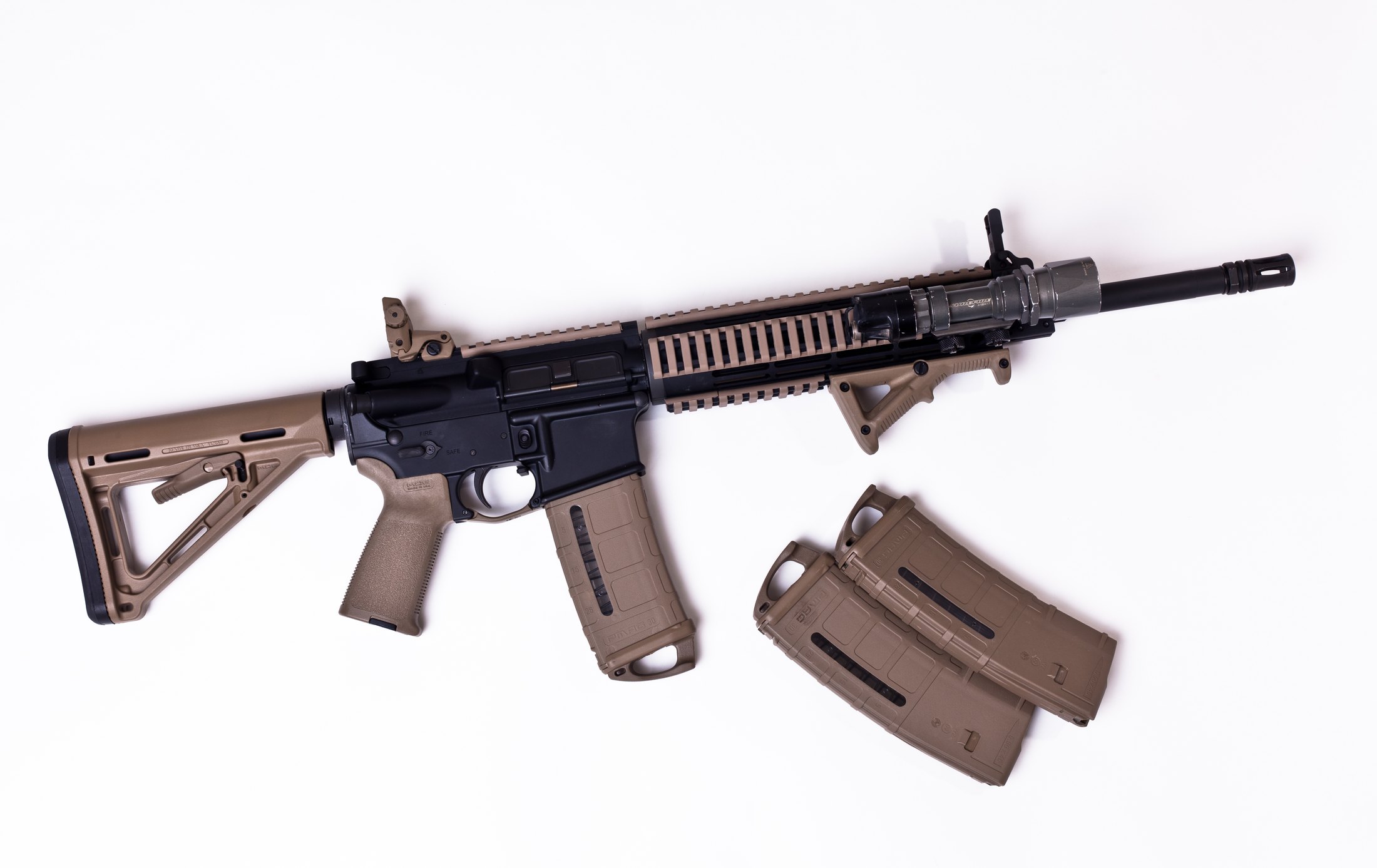
The flat-top upper described in Volume 3 turned the AR-15 into a mounting platform, and that is the fact this volume is organised around. A modern carbine does not come with a sighting system; it comes with a rail, and the sighting decision is the largest single determinant of what the rifle is good for.
Most of what follows is reversible and comparatively cheap. That is worth saying at the outset, because it is the opposite of the barrel and chamber decisions in Volumes 3 and 4, which are permanent and are made once.
6.1 The Sighting Decision
A 16-inch carbine in 5.56 is a general-purpose rifle. Its useful envelope runs from contact distance out to perhaps 300–400 metres, depending far more on the shooter and the sighting system than on the cartridge. Three sighting systems suit it, and they answer different questions.
A red dot is fastest at close range, works with both eyes open, has effectively unlimited eye relief, and does not magnify. It is the correct answer if the rifle’s primary job is speed inside 100 metres.
A low-power variable optic — an LPVO, typically 1–6× or 1–8× — is nearly as fast at 1× and adds magnification when it is wanted. It is heavier, more expensive, and demands a consistent head position. It is the correct answer if the rifle has to do everything.
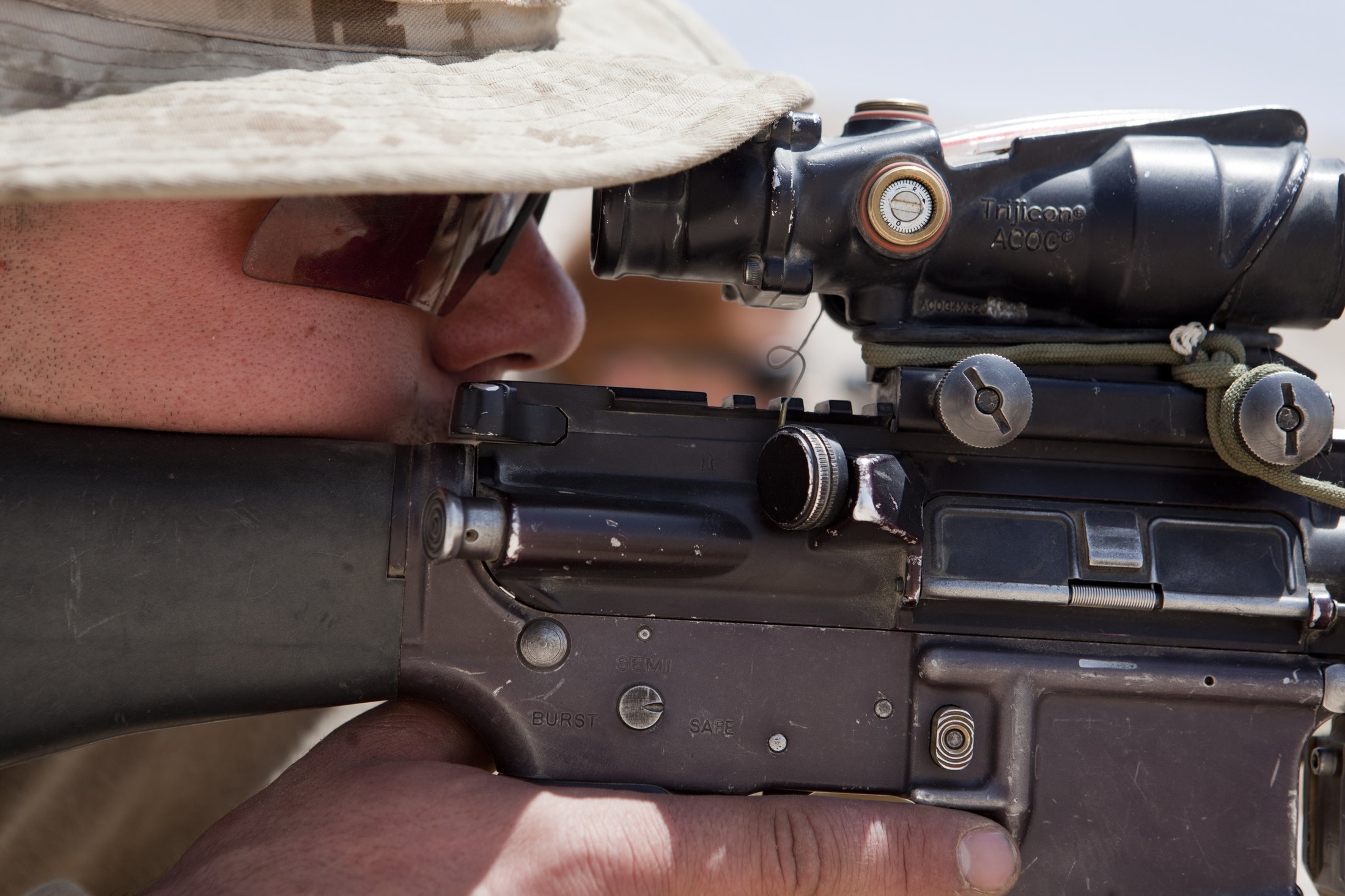
Magnified fixed optics of the ACOG type sit between them: rugged, no batteries in the illumination, but fixed magnification and a demanding eye box.
6.2 Red Dots
The mechanism is a partially reflective lens with a collimated emitter, producing a reticle that appears to lie on the target. Because the beam is collimated, the dot stays aligned with the bore across a range of head positions — the practical property that makes red dots fast.
The concrete example in the owner’s records is a Vortex SPARC — the records list a 2 MOA micro red dot with an AR riser, and name a “Vortex Sparc 2” as pending. Vortex’s own published specification for the SPARC AR gives a 2 MOA dot, 1 MOA adjustment per click, a single AAA battery, and battery life of “up to 300 hours on highest setting” and “up to 5,000 hours on lowest setting,” at an MSRP of $259.99.1
Two honesty notes attach to that. Vortex’s SPARC AR page is marked INACTIVE, indicating the model is discontinued.1 And the relationship between the SPARC II named in the owner’s records and the SPARC AR is not established by that page; the two are separate model designations and this dive does not assert that they are the same sight or that one replaced the other.
6.2.1 Battery life is the specification that matters
The 300-hour and 5,000-hour figures above are the most decision-relevant numbers on the page and they are usually skimmed past. A sight run at maximum brightness is a sight that is dead in under two weeks of being left on. A sight run at a usable indoor setting lasts most of a year. The practical consequence is that brightness discipline, not battery chemistry, determines whether a red dot is ready when it is picked up — and it is the argument for sights with a shake-awake or auto-off function.
6.3 Mounting Height
Mounting height is the variable most often got wrong, and the Vortex specification gives the two standard positions in concrete terms. The SPARC AR is supplied with a spacer providing two heights: lower 1/3 co-witness at 40 mm and absolute co-witness at 37 mm.1
Absolute co-witness puts the dot exactly on top of the iron sights, so that irons and dot share one sight picture. Nothing is lost if the sight fails, but the irons clutter the view permanently.
Lower 1/3 co-witness raises the dot so the irons sit in the bottom third of the window. The sight picture is clean, the irons are available by lowering the head slightly, and — the reason most people prefer it — the higher sight line is more comfortable with body armour, a helmet, or simply a head held upright.
The 3 mm between them is the entire difference, and it changes the feel of the rifle more than the figure suggests.
Height over bore is the consequence to understand. On an AR the sight line sits well above the barrel axis — higher than on almost any conventional rifle, because the stock runs straight back from the receiver. A rifle zeroed at 50 metres shoots low at very close range by roughly the height-over-bore distance. At contact distance that is the difference between a hit where it was aimed and a hit well below it. No specific height-over-bore figure is asserted here, because none could be verified from a manufacturer’s published specification for this dive; the effect is geometric and applies to every AR regardless of the exact number.
6.4 Low-Power Variable Optics
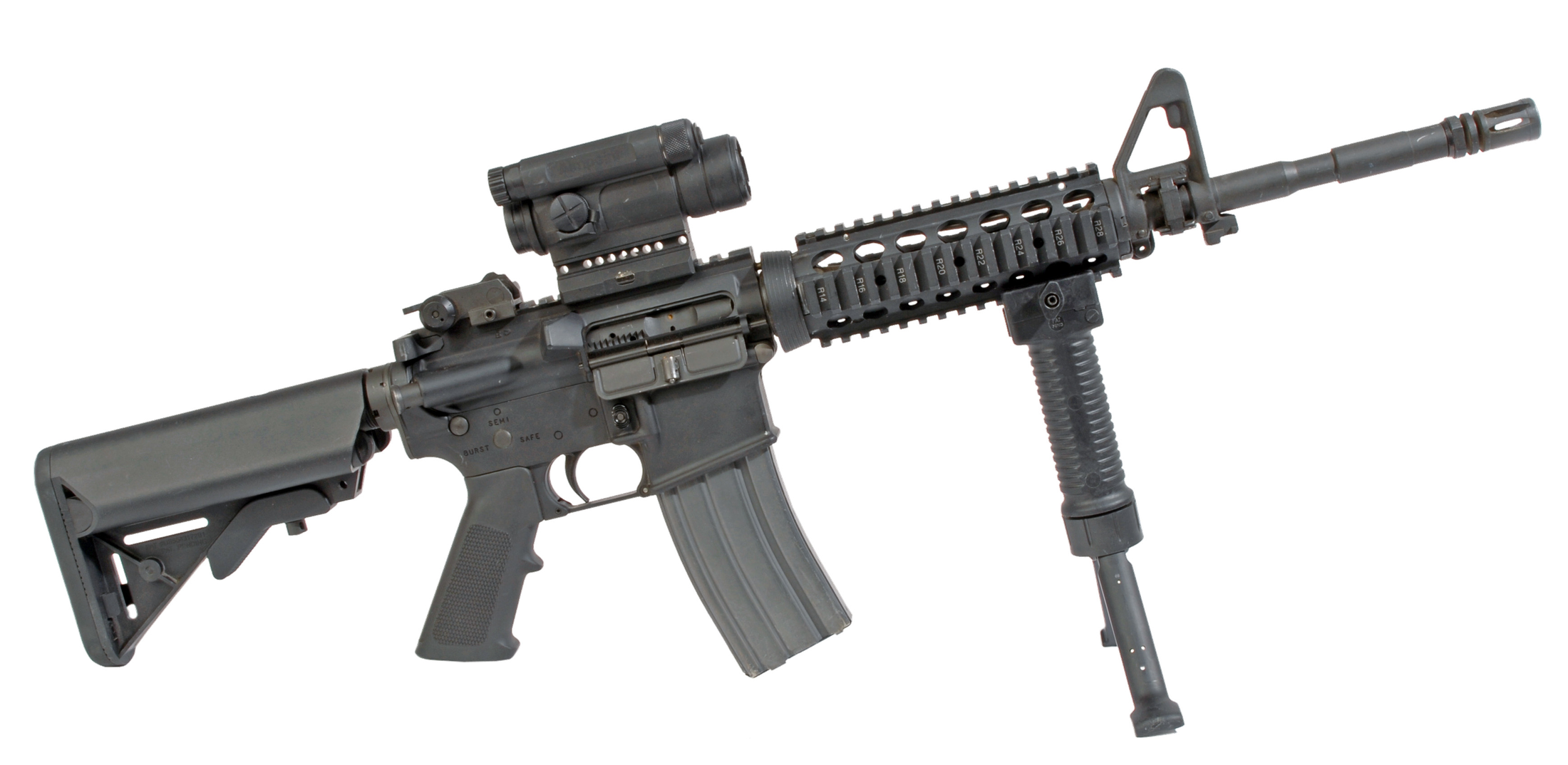
An LPVO is a conventional riflescope with a bottom end of 1× or close to it. At 1× it functions approximately as a red dot; wound up, it gives the magnification to identify and to shoot precisely at distance.
The trade-offs are real:
Weight. An LPVO with a mount is several times the mass of a micro red dot, and it is carried high, where it has the most effect on how the rifle handles.
Eye box. A red dot is forgiving of head position; an LPVO is not, and becomes less forgiving as magnification increases.
Cost. The gap between a competent LPVO and an incompetent one is large, and an LPVO that is poor at 1× is worse than a red dot for the job a red dot does.
True 1×. Many optics described as 1× are slightly magnified, which defeats both-eyes-open shooting.
An LPVO on a free-floated 16-inch barrel of the kind described in Volume 3 is essentially the Recce concept from Volume 1: a carbine that can be shot precisely. It is a coherent configuration and it is the one a scratch build with a stainless .223 Wylde barrel is pointed at.
6.5 Iron Sights
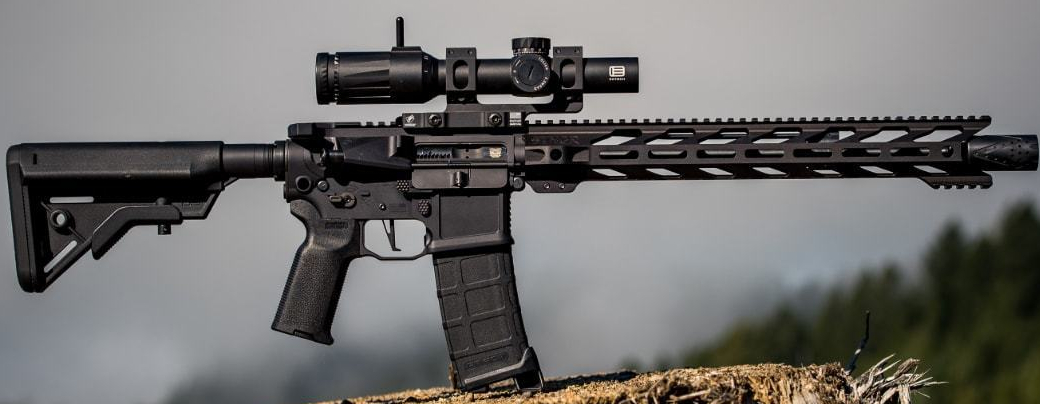
Iron sights on a flat-top carbine are a backup rather than a primary system, and the decision is whether to carry them at all.
A fixed front sight base is part of the gas block and cannot be removed without changing the gas block. It is robust and it puts a permanent post in the bottom of every optic’s field of view. The Colt carbine documented here has one.
A low-profile gas block with folding back-up sights front and rear gives an unobstructed optical view with irons available when deployed. This is what the scratch builds documented here use, and it is the reason those builds use low-profile blocks.
6.6 Magpul Furniture
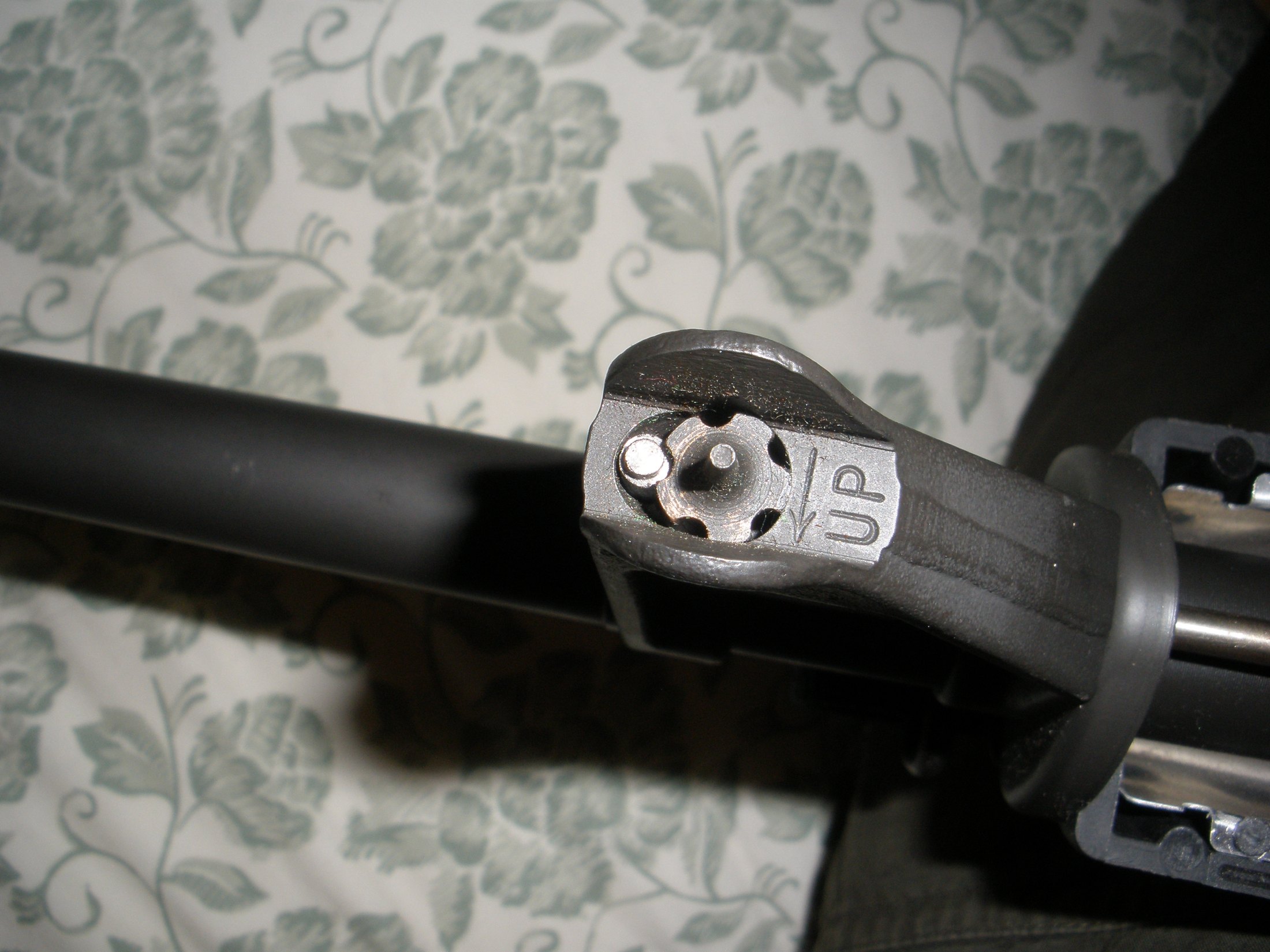
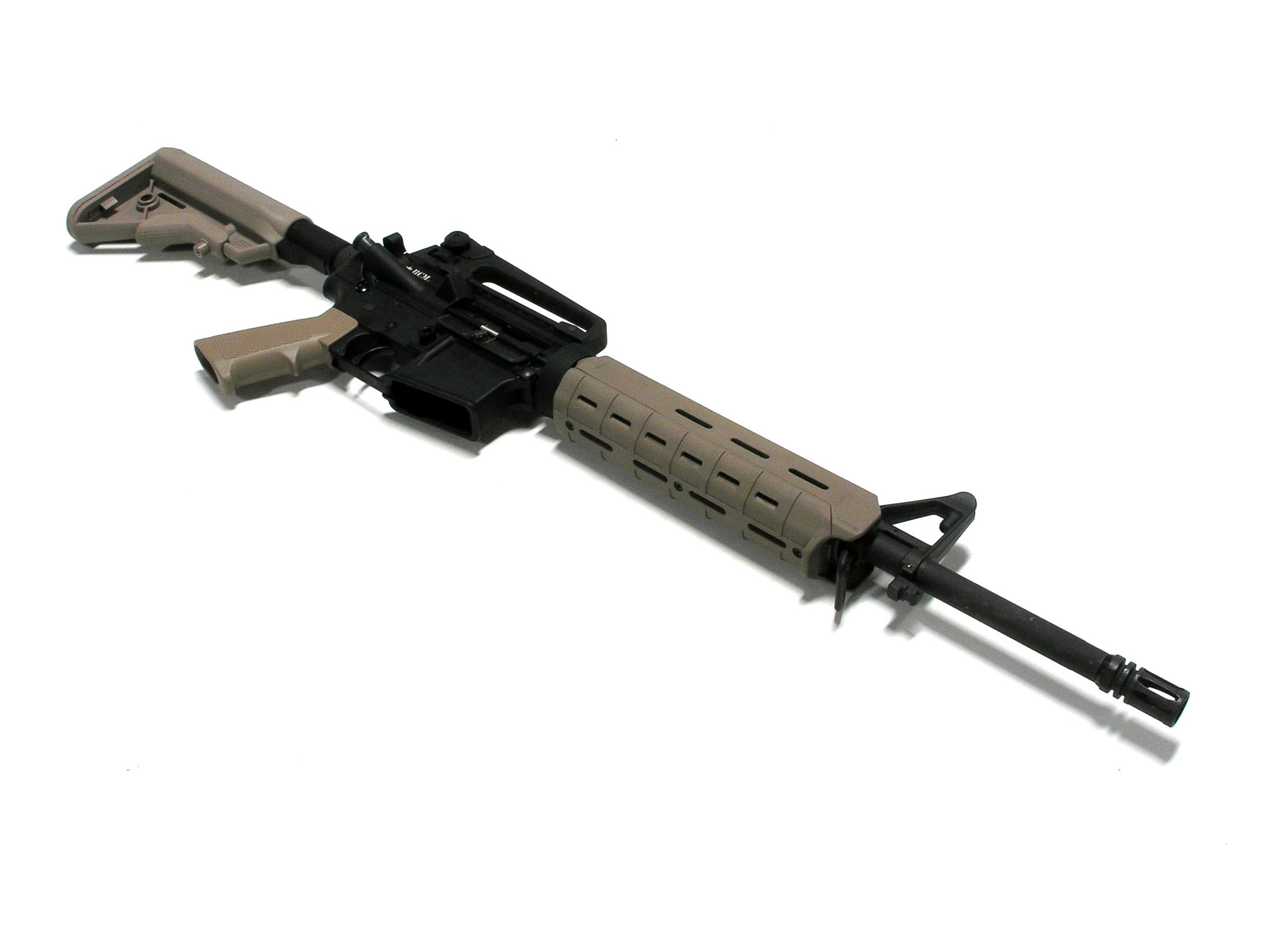
Magpul parts appear throughout the owner’s build records, and two of them have published specifications worth recording precisely, because Volume 2 established that the receiver extension diameter is the one place “mil-spec” is a real dimension.
CTR Carbine Stock, part number MAG310. Fits mil-spec tubes only, at 1.148 inches; not compatible with commercial-spec extensions at 1.170 inches. Weight 8.9 oz alone and about 12.7 oz with the receiver extension. Length of pull about 10.3 inches collapsed and 13.6 inches extended, adjustment range 3.3 inches. Chrome-silicon lock spring, removable 0.3-inch rubber butt pad. MSRP $69.95.2
MOE SL Carbine Stock, part number MAG347. Weight 9.3 oz alone, 13.1 oz with the receiver extension. Length of pull about 10.9 inches collapsed and 14.2 inches extended, the same 3.3-inch adjustment range. MSRP $69.95.3
Magpul’s own framing of the compatibility problem is that “there are two basic sizes of M4 Carbine receiver extensions (buffer tubes): Mil-Spec and Commercial-Spec,” and it names Colt, LMT, Ruger, S&W, SIG and others among the makers shipping mil-spec tubes.3 Both the Colt carbine and the Smith & Wesson complete lower documented here therefore take mil-spec stocks.
The CTR’s distinguishing feature is a friction lock that clamps the stock to the tube and removes the rattle a plain carbine stock has. That is the whole reason to buy one, and on a rifle that is going to be shot from a bag or a bipod it is worth having, because a stock that moves under cheek pressure moves the point of aim.
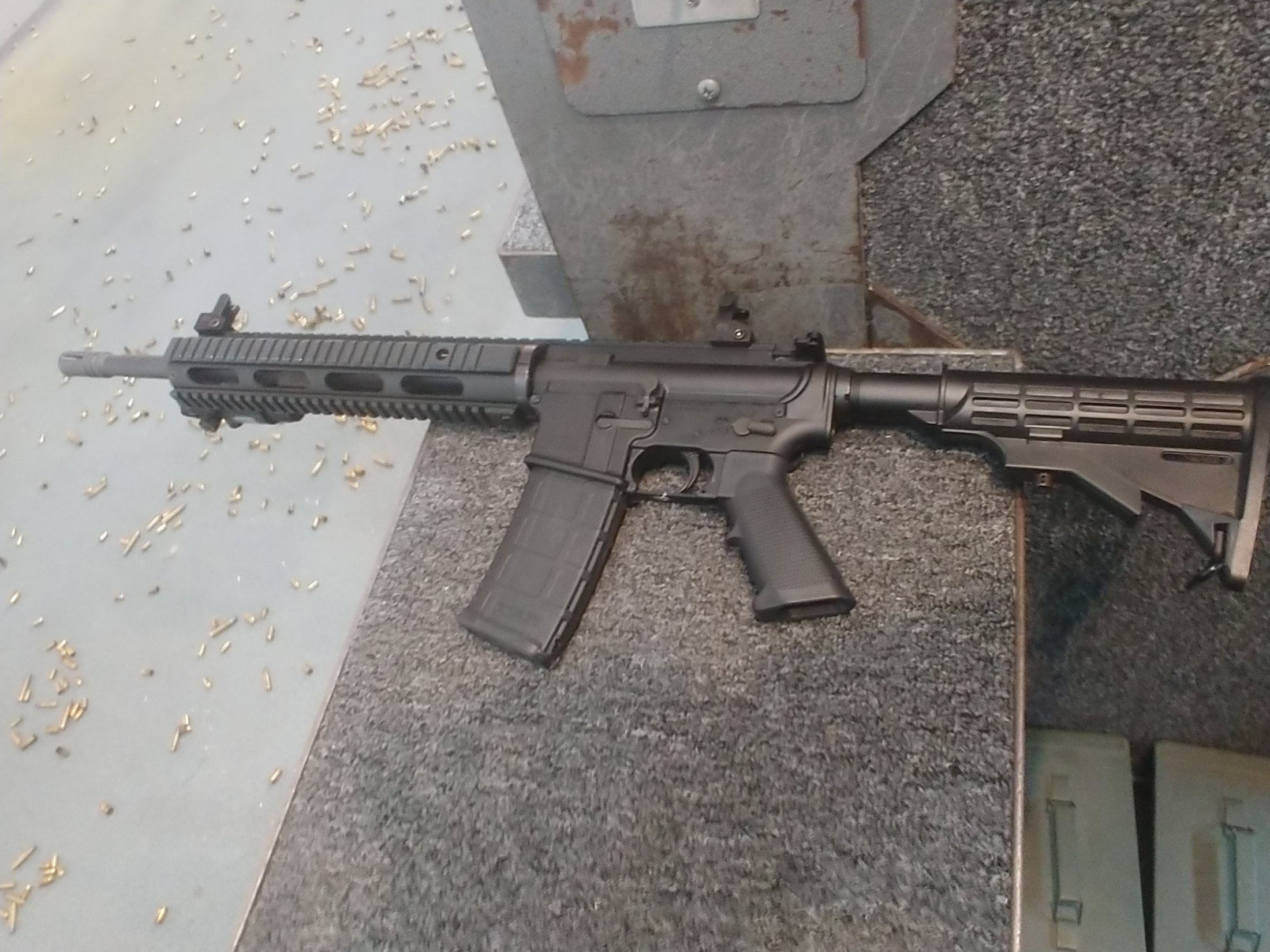
Handguards and grips are a matter of hand size and preference rather than specification, with one substantive point: M-LOK has displaced the quad rail for the reasons Volume 3 gave, and a handguard should be chosen for the mounting standard as much as for the shape.
6.7 Slings
The most under-rated accessory on the list, and the cheapest.
The owner’s records list two: an M16A2 sling from Charley’s Surplus and a CJ Weapons AR-15 cotton web sling from MidwayUSA. Both are simple two-point web slings of the service pattern.
Two-point slings carry the rifle across the body and — the part that matters — can be used as a shooting aid by loading the support arm against the sling to steady the rifle. This is a genuine accuracy technique and it is free.
Single-point slings let the rifle hang muzzle-down at the front of the body and transition between shoulders freely. They are faster to manipulate and considerably worse to carry, because the rifle swings.
Two-point convertible slings with a quick adjuster are the current general answer and combine most of both.
The caution that connects to Volume 3: a sling loaded hard against a non-free-floated handguard deflects the barrel and moves the group. Sling-supported shooting and a clamped handguard are a poor combination, and it is one of the clearest practical arguments for free-floating.
6.8 Muzzle Devices
The thread on a .22-calibre AR barrel is 1/2×28 UNEF-2A, which is why devices interchange across the platform.4
Flash hiders — the A2 birdcage being the standard — disrupt the muzzle flash. They do very little about recoil.
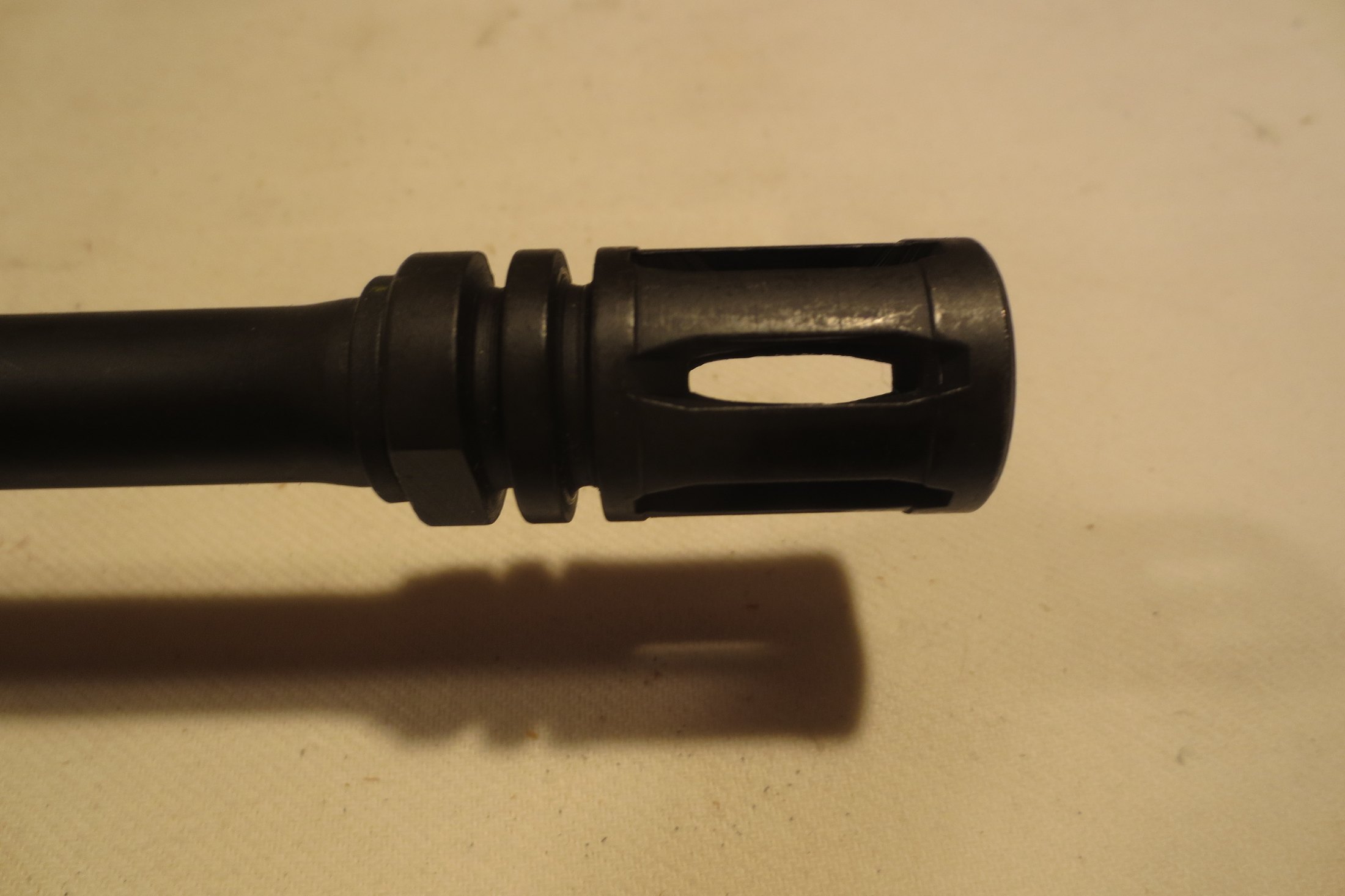
Muzzle brakes redirect gas sideways to reduce recoil and muzzle rise. On a 5.56 carbine the recoil being reduced is already mild, and the cost — a substantial increase in blast and noise experienced by anyone to the side — is real. On a rifle shot next to other people on a firing line, a brake is an antisocial choice for a modest gain.
Compensators sit between the two.
Suppressor mounts replace the device with one that indexes a suppressor. The mechanism, the legal position and the caliber-rating questions are owned by this project’s suppressor dives and are not restated here: see How Suppressors Work, Suppressor Law and Suppressors by Caliber.
One cross-reference that does belong here: a suppressor raises back-pressure, which over-gasses the rifle. The adjustable gas block of Volume 5 section 5.4 is the standard remedy, and the port-area arithmetic in Volume 3 is why it works.
6.9 Foregrips and Lights
Vertical and angled foregrips give a positive hand position and help control muzzle rise. On a rifle — that is, on a weapon with a barrel of 16 inches or more and a shoulder stock — a vertical foregrip raises no federal issue. The owner’s records for the Colt carbine list a forward vertical grip on the rail, or a slant grip as an alternative.
The configuration where a vertical foregrip does create a federal problem is a pistol-configured AR, where adding one can make the weapon an “any other weapon” under the National Firearms Act. That does not apply to any rifle documented in these volumes, and the pistol-configured builds in the owner’s collection are the subject of a separate dive.
A weapon light is the accessory with the strongest practical case and the least glamour. A rifle that might be used in a low-light setting without one cannot identify a target, and identification is not optional.
6.10 Zeroing, and Why Height Over Bore Decides It
A sighting system is not fitted until it is zeroed, and on this platform the zero choice interacts with the mounting height of section 6.3 more than on any conventional rifle.
The reason is geometric. The sight line on an AR sits unusually high above the barrel axis, because the stock runs straight back from the receiver rather than dropping to a comb. The bore and the line of sight are therefore two lines that are not parallel and not coincident: the bullet starts well below the aiming line, rises across it, and falls back through it further out. A zero is not a distance at which the bullet is on the line — it is the second of two crossings.
Three consequences follow, and all three are geometric rather than load-dependent, so they hold regardless of what the rifle is fed.
At very close range the rifle shoots low. Inside the first crossing the bullet has not yet risen to the sight line, and the miss distance approaches the full height-over-bore. At contact distance — clearing a doorway, shooting under a vehicle — the point of impact sits appreciably below the point of aim. This is the single most practically important consequence of the AR’s high sight line and it surprises shooters who have come from conventional rifles.
A higher mount makes it worse. The lower 1/3 co-witness position of section 6.3 sits 3 mm higher than absolute co-witness, and that 3 mm is added directly to the close-range offset. The comfort of the higher mount is bought with a slightly larger near-range discrepancy.
The useful zeros are the ones that keep the trajectory inside a small band. The common approach is a near zero at short range that produces a far zero at a useful distance, chosen so the bullet never rises or falls more than an inch or two from the line of sight across the rifle’s working range. That is why zeros are conventionally quoted as pairs.
No specific zero distances or trajectory figures are printed here. The crossing distances depend on muzzle velocity, bullet, and the exact height of the sight above the bore, and no verified height-over-bore figure for these rifles could be obtained from a manufacturer’s specification for this dive, as section 6.3 recorded. Quoting a zero pair without the sight height it was computed for would be quoting a number that does not apply to the reader’s rifle. The correct procedure is to zero at a measured distance on paper and then confirm the near-range offset by shooting at close range and observing it — which takes one target and five minutes, and produces a number that is true for that rifle rather than for somebody else’s.
The confirmation step is the part that gets skipped, and it is the part worth doing. A rifle zeroed carefully at distance and never fired at three metres has an uncharacterised close-range offset, and close range is where a carbine is most likely to be used quickly.
6.11 What Actually Suits a 16-Inch Carbine
Drawing the volume together, for a general-purpose 16-inch rifle of the kind documented here.
A red dot at lower 1/3 co-witness, with folding back-up irons, on a free-float handguard. This is the configuration with the best ratio of capability to weight, cost and complexity, and it is what the majority of these rifles should wear.
An LPVO where the rifle must also shoot precisely at distance — which on a free-floated stainless .223 Wylde barrel is a reasonable ambition, and is the Recce idea from Volume 1.
A two-point convertible sling, always.
A light, if the rifle has any defensive role at all.
A better trigger before any of the above, per Volume 5 section 5.3. It is the cheapest accuracy improvement available on the platform and it is bought last by almost everybody.
Footnotes
-
Vortex Optics, “SPARC AR Red Dot” product page, vortexoptics.com, consulted 2026-09-17, for the 2 MOA dot, 1 MOA per click adjustment, AAA battery, 300-hour and 5,000-hour battery life figures, the 40 mm lower 1/3 and 37 mm absolute co-witness mount heights supplied by the included spacer, and the $259.99 MSRP. The page is marked INACTIVE. ↩ ↩2 ↩3
-
Magpul Industries, “CTR Carbine Stock – Mil-Spec, Model MAG310”, magpul.com, consulted 2026-09-17, for the mil-spec 1.148 in versus commercial 1.170 in receiver extension diameters, the weights, lengths of pull, adjustment range, lock spring, butt pad and price. ↩
-
Magpul Industries, “MOE SL Carbine Stock – Mil-Spec, Model MAG347”, magpul.com, consulted 2026-09-17, for the weights, lengths of pull, adjustment range and price, the quoted explanation of the two receiver extension sizes, and the list of makers shipping mil-spec tubes. ↩ ↩2
-
File:M4 HK416 barrel comparison.svg, Wikimedia Commons, consulted 2026-09-17, for the 1/2×28 UNEF-2A muzzle thread callout on the M4 and M4A1 barrels. Contributor-made comparison drawing, not a manufacturer’s print. ↩
Comments (0)