The AR-15 in 5.56 · Volume 3
The Upper, the Barrel and the Gas System — Length, Dwell, Twist and Steel
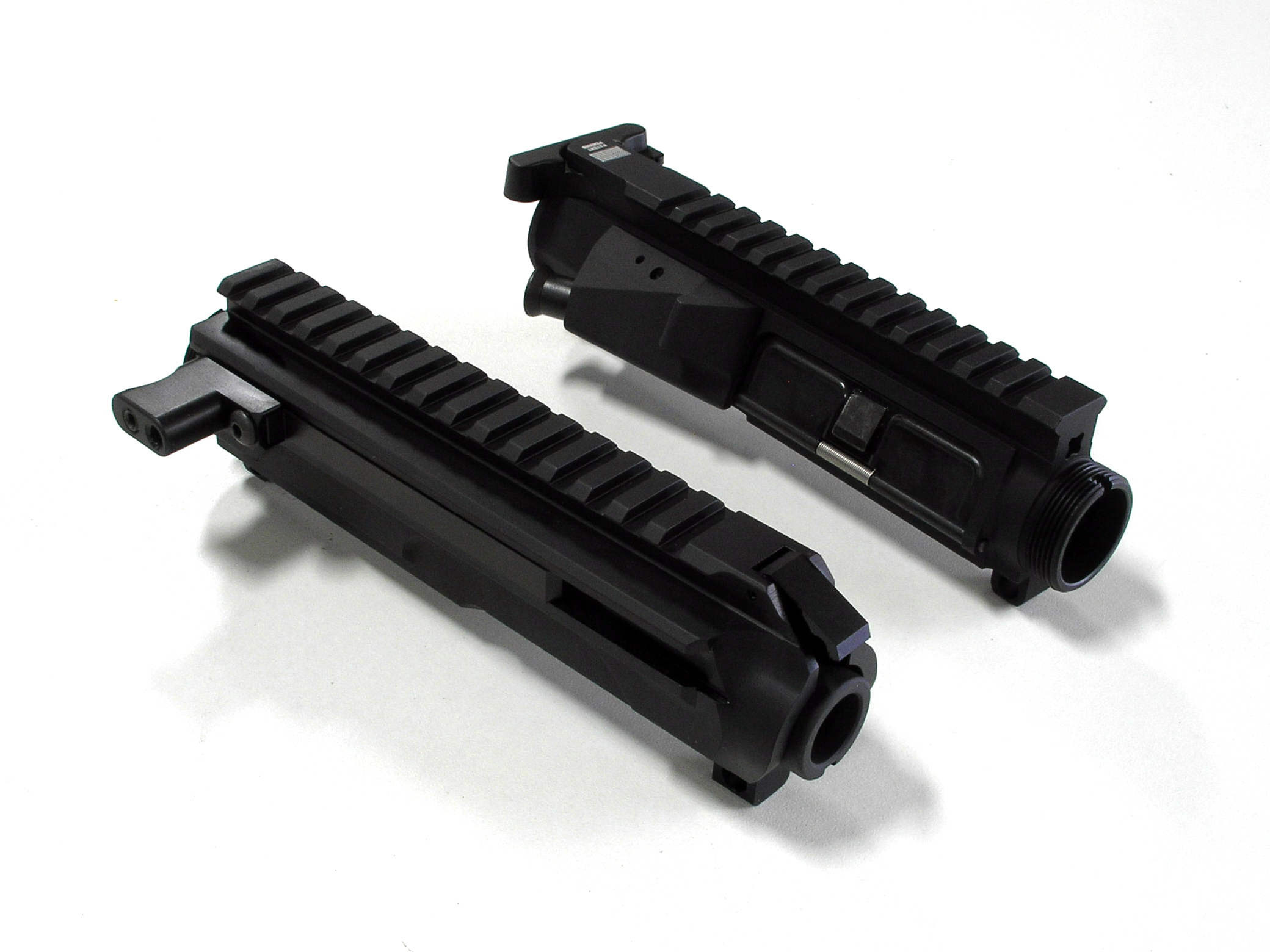
Everything that determines how an AR-15 shoots is on the upper. The barrel sets the accuracy and the velocity, the gas port and its distance from the chamber set how hard the action is driven, the twist rate sets what the rifle will stabilise, and the handguard determines whether any of the accuracy survives contact with a sling or a bipod. The lower, as Volume 2 argued, is a serial-numbered bracket.
This volume is where the arithmetic lives. Two claims in wide circulation are tested against it and both come apart: that gas system length is a matter of taste, and that twist rate is set by bullet weight.
3.1 The Upper Receiver
Structurally the upper is a extruded or forged aluminium tube with a barrel nut thread at the front, a raceway for the bolt carrier, an ejection port and a charging handle channel. Two variations are worth knowing.
Flat-top versus carry handle. The A2-pattern upper carries an integral carry handle with the rear sight built into it. The flat-top upper replaces that with a Picatinny rail. The flat-top is the current standard and the more useful part, because it allows the sighting system to be chosen rather than inherited — which is the whole subject of Volume 6.
M4 feed ramps. The M4-pattern upper has the feed ramps extended down into the receiver face to meet matching ramps cut into the barrel extension, giving a longer and shallower ramp surface. It was introduced for reliability at the higher cyclic rates of short carbines. The important practical point is that the ramps must match: an M4-ramped barrel extension in a rifle-ramped upper leaves a step exactly where a cartridge nose arrives. Mismatching them is one of the few genuine compatibility errors available on this platform, and it is easy to make because both parts will assemble happily.
3.2 Barrel Length, and What It Costs
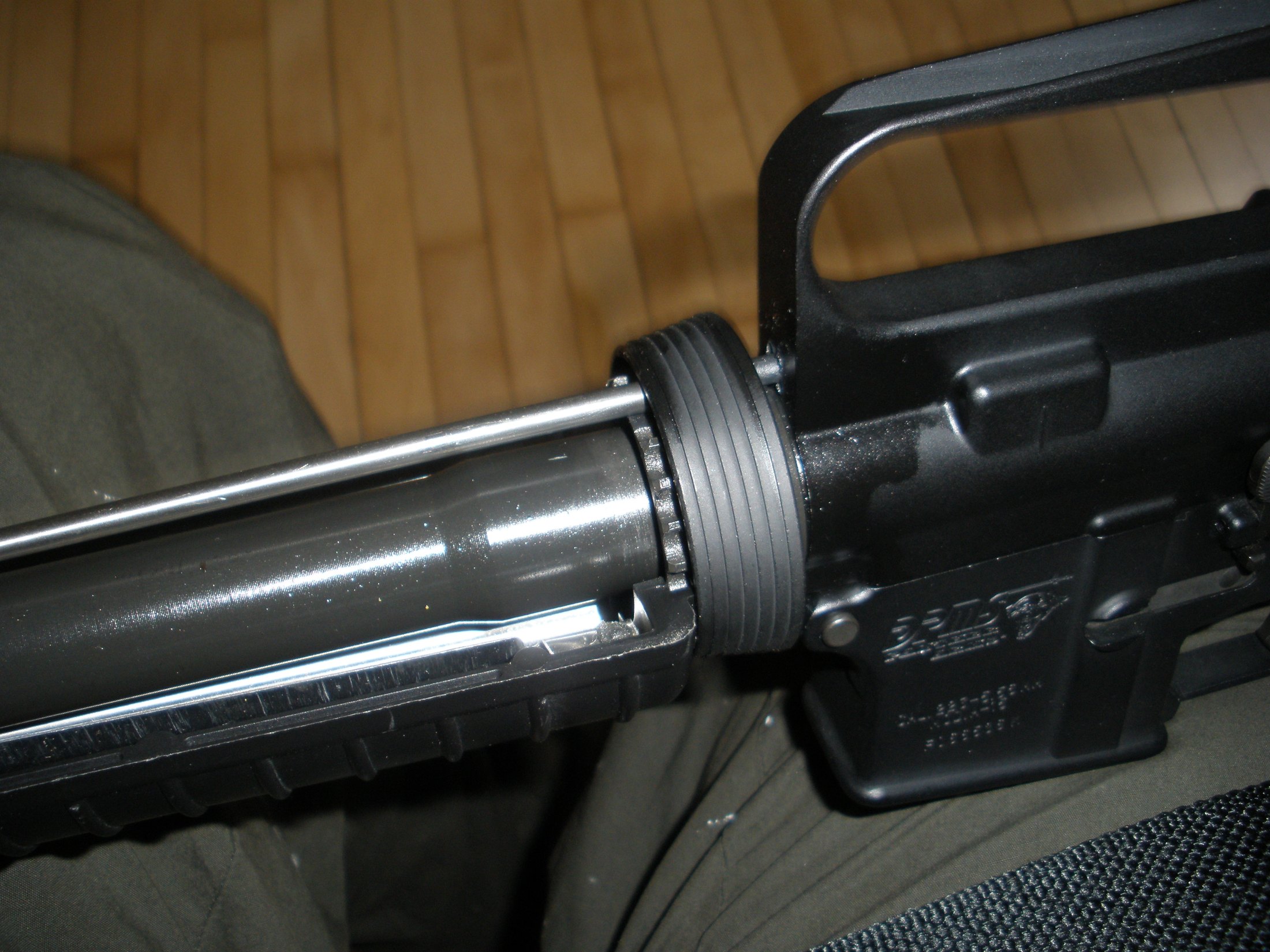
A rifle barrel shorter than 16 inches puts the weapon into the National Firearms Act as a short-barrelled rifle, with registration and approval before any metal is cut. That threshold, rather than any ballistic consideration, is why 16 inches is the most common barrel length in the civilian world and why 16.1 inches — the length of the Colt carbine documented here — exists as a number at all. It is a legal margin, not an engineering one.
The velocity cost of a short barrel is real and is best quoted from the service record, where it has been measured rather than estimated. Against a 20-inch barrel producing 3,071 ft/s, the Mk 18’s 10.3-inch barrel produces 2,585 ft/s — a loss of 486 ft/s.1 That is roughly 50 ft/s per inch across that span, though the loss is not linear and the rate falls off as barrels get longer.
A 16-inch barrel sits in a comfortable part of that curve. It gives up meaningful velocity against a 20-inch service rifle and very little against an 18-inch Mk 12, and it is the shortest barrel that requires no federal paperwork.
3.2.1 Profile
Barrel profile — the pattern of diameters along its length — is a separate variable from barrel length and is routinely confused with it.
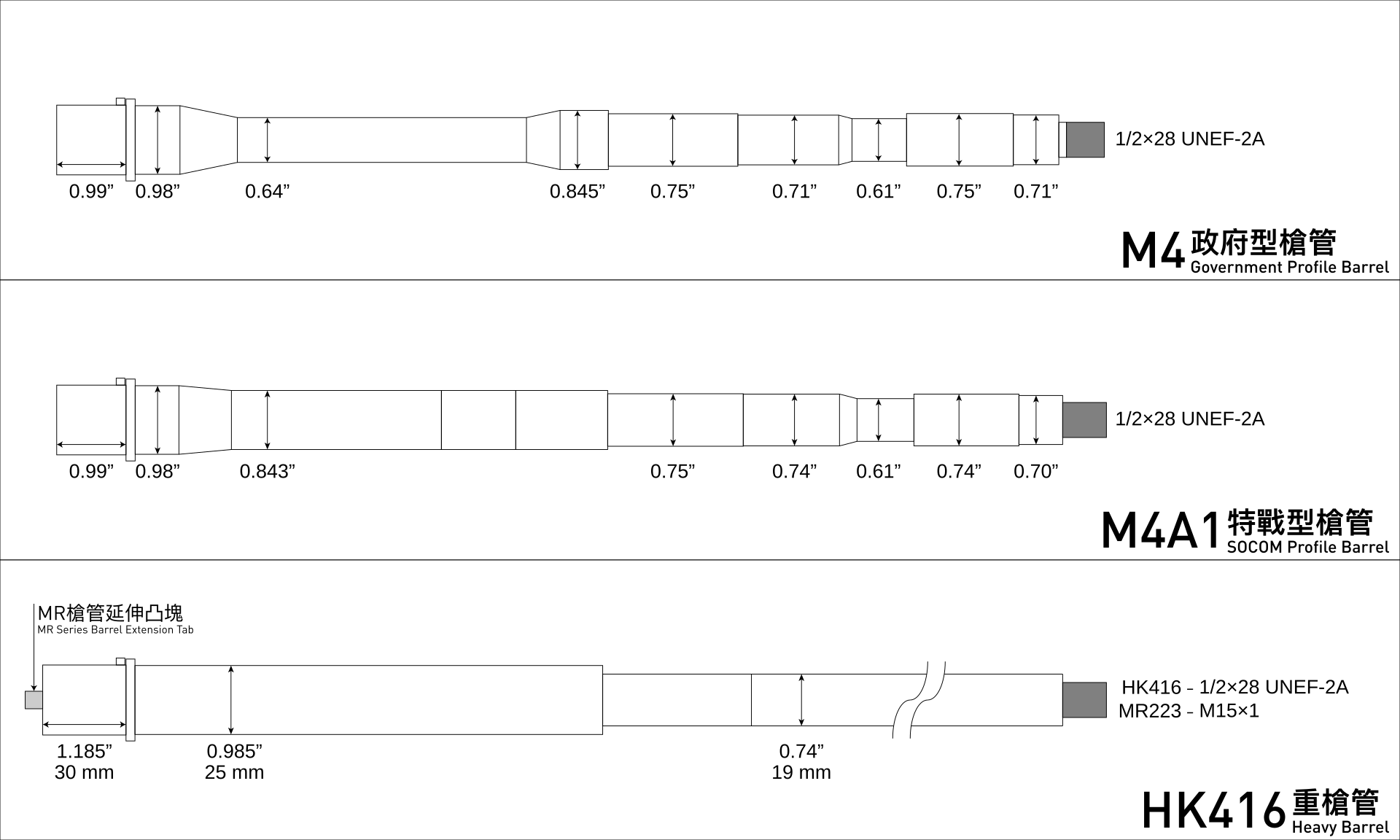
The comparison makes visible the change Volume 1 recorded from the service record — that the M4A1 took a heavier “SOCOM profile” barrel from 2004.2 The Government profile is cut down to 0.64 inch through the section under the handguard, a relief originally made to clear the M203 grenade launcher; the SOCOM profile holds 0.843 inch through the same region.3 That is the entire difference between the two, and it is concentrated in exactly the place a barrel gets hot and where a thin section sheds stiffness fastest.
The practical reading for a build: a thin profile is lighter and heats faster; a heavy profile is steadier across a string of fire and much less pleasant to carry. A 16-inch carbine used for general shooting is well served by something between the two, which is what most “mid-weight” or “Hanson-style” commercial profiles are.
The same drawing supplies a detail Volume 6 needs: the muzzle thread on these barrels is 1/2×28 UNEF-2A, which is the standard thread for .22-calibre AR barrels and the reason flash hiders, brakes and suppressor mounts interchange across the platform.3
3.3 Gas System Length — And an Honest Gap
The gas system is named for the distance between the chamber and the gas port: pistol, carbine, mid-length, intermediate and rifle, in ascending order. The gas tube runs from the port back to the upper receiver, where it enters the bolt carrier’s gas key.
A statement of what could not be verified. The specific tube lengths and breech-to-port distances for each of these systems are quoted constantly in the secondary literature. During this dive they were sought from barrel and parts manufacturers’ own published specifications across nine separate sources — barrel makers, parts houses, and technical explainers — and not one of those sources could be retrieved. This dive therefore prints no gas tube length figures. They are almost certainly correct as commonly quoted; they are simply not verified here, and this hub has previously shipped invented numbers, so the gap is declared rather than filled from memory.
What can be stated is the mechanism, which does not depend on the exact figures, and one hard number from the service record.
3.3.1 What the length actually changes
Moving the gas port further from the chamber changes two things at once, and they pull in the same direction.
Port pressure falls. The pressure in the bore drops continuously as the bullet travels and the gas behind it expands into an ever-larger volume. A port further down the barrel therefore sees a lower pressure at the moment the bullet passes it. The gas admitted to the carrier is admitted more gently.
Dwell time falls. Dwell is the interval between the bullet passing the gas port and the bullet leaving the muzzle — the window during which the bore is still sealed and gas is still being driven back down the tube. Moving the port forward shortens the remaining barrel, so it shortens dwell.
The combination is why a longer gas system on the same barrel length gives a softer, slower, more controllable impulse, and why a short system on a short barrel is violent. An over-gassed rifle unlocks early and fast: it batters brass, throws it forward, wears the extractor and the buffer, and can outrun the magazine spring.
3.3.2 The one verified number
The Mk 18 supplies the hard case. Its 10.3-inch barrel is far too short for the gas system to behave normally, and the fix is documented: the gas port is opened from 0.062 to 0.070 inch.1
That is worth dwelling on, because it shows which way the compensation runs. A very short barrel means a very short dwell — the bullet exits almost immediately after passing the port, so there is very little time to move gas. The port is therefore enlarged to move more gas in the time available. The bore-area increase is straightforward arithmetic: going from 0.062 to 0.070 inch increases the port’s cross-sectional area by a factor of (0.070/0.062)², which is 1.27 — a 27 percent increase in port area for an 8-thousandths change in diameter.
That sensitivity is the practical lesson of the whole section. Gas port diameter is an extremely powerful adjustment, it is measured in thousandths, and it is why an adjustable gas block exists as a product category.
3.3.3 What suits a 16-inch barrel
A 16-inch barrel will run on either a carbine-length or a mid-length system, and both are sold in quantity. The mid-length is the better engineering answer for the reasons above — lower port pressure, gentler impulse, less wear — and it is what the .223 Wylde barrel in the scratch builds documented here uses. The carbine-length system on a 16-inch barrel is the configuration the Colt carbine uses, and it is the configuration with by far the longest service history, which is its own kind of argument.
3.4 Twist Rate Versus Bullet Length
Here is the volume’s central correction, and it can be shown with arithmetic rather than asserted.
The rule everyone repeats is that heavier bullets need a faster twist. The rule is a proxy. What a bullet actually needs is enough spin to stabilise its length, and weight only tracks length because most bullets of a given calibre are made of roughly the same materials.
3.4.1 The formula
The Miller twist rule gives the gyroscopic stability factor as
s = 30m / (t² d³ l (1 + l²))
where m is bullet mass in grains, d is bullet diameter in inches, l is bullet length in calibers (length divided by diameter), and t is the twist rate in calibers per turn. The constant 30 embeds a reference velocity of 2,800 ft/s at standard conditions, and a velocity correction factor of (v/2800)^(1/3) is applied where velocity differs.4
Note what is and is not in that equation. Mass appears once, in the numerator. Length appears three times in the denominator — as l, and again inside (1 + l²). Length is the dominant term by a wide margin, and it enters cubically at long lengths.
3.4.2 The arithmetic
Holding mass fixed at 62 grains and diameter at 0.224 inch, and varying only length:
Table 1 — Holding mass fixed at 62 grains and diameter at 0.224 inch, and varying only length
| Twist | l = 3.0 | l = 3.5 | l = 4.0 | l = 4.5 | l = 5.0 |
|---|---|---|---|---|---|
| 1:7 | 5.65 | 3.65 | 2.49 | 1.77 | 1.30 |
| 1:8 | 4.32 | 2.80 | 1.91 | 1.36 | 1.00 |
| 1:9 | 3.42 | 2.21 | 1.51 | 1.07 | 0.79 |
| 1:12 | 1.92 | 1.24 | 0.85 | 0.60 | 0.44 |
A stability factor of about 1.5 is the conventional target; 1.0 is the theoretical threshold and no margin at all. The same 62-grain bullet goes from comfortably stable to unstable in a 1:9 barrel purely by getting longer, with no change in weight whatever.
Now hold length fixed at 3.3 calibers and vary the weight instead, in a 1:12 barrel:
Table 2 — Now hold length fixed at 3.3 calibers and vary the weight instead, in a 1:12 barrel
| Bullet mass | 45 gr | 55 gr | 62 gr | 69 gr | 77 gr |
|---|---|---|---|---|---|
| Stability factor | 1.07 | 1.30 | 1.47 | 1.64 | 1.83 |
Weight moves the answer, but it moves it upward — a heavier bullet of the same length is more stable, not less. The folk rule has the sign backwards. It survives only because in the real world a heavier bullet is nearly always a longer one, and the length effect swamps the mass effect.
The velocity correction is comparatively weak. For a 55-grain bullet of 3.3 calibers in a 1:12 barrel, the stability factor runs 1.30 at 2,800 ft/s, 1.35 at 3,100 ft/s and 1.37 at 3,250 ft/s — a cube-root term, and a small one.
Note on the inputs: the lengths above are stated as l values rather than attached to named commercial bullets, because verified length measurements for specific 5.56 projectiles could not be obtained from a primary source for this dive. The arithmetic demonstrates the relationship; it is not a load table, and no specific bullet is claimed to have any specific length.
3.4.3 The historical proof
The service record contains the clean experiment. The 1:7 twist was adopted with the M16A2, described in the literature as optimised for “the heavier NATO SS109 ball and long L110 tracer bullets.”5 The M855 ball bullet weighs 62 grains; the M856 tracer weighs 63.7 grains.6 Those are within three percent of each other.
If weight drove twist, the two would need almost identical twist rates and the 1:7 would be inexplicable — a 62-grain bullet does not need 1:7. What made 1:7 necessary was the tracer, whose base is packed with pyrotechnic composition far less dense than the lead and steel core of a ball round. Same weight, much greater length, much greater twist requirement. The rifling twist of every M16A2, M16A4, M4 and most commercial AR-15s made since 1983 was set by a projectile that is barely heavier than the one beside it and substantially longer.
That is as direct a refutation of the weight rule as the historical record offers, and it is sitting inside the sentence everybody quotes.
3.4.4 What this means in practice
A 1:7 barrel will stabilise everything from 55-grain ball to 77-grain match. A 1:9 barrel is comfortable in the middle of the range and marginal at the top. A 1:12 barrel — the SAAMI .223 Remington test barrel specification, and the original M16 rate — is a 55-grain barrel and should be treated as one.
The SAAMI standard test barrel for .223 Remington is specified with six grooves, groove width 0.074 inch, and a twist of one turn in 12.00 inches, right hand, with a bore diameter of 0.219 inch and a groove diameter of 0.224 inch.7 That is the reference against which factory .223 ammunition is proved, and it is a useful reminder that commercial .223 and service 5.56 were developed around different projectiles.
3.5 Barrel Steel and Lining
Three treatments dominate, and the trade-offs are genuinely different rather than marketing variations.
Chrome-lined. A layer of hard chrome electroplated into the bore and chamber. It is the service standard and it exists for barrel life and corrosion resistance under conditions of sustained fire and poor maintenance. The cost is that the plating is applied over the rifling and is not perfectly uniform, so a chrome-lined barrel is typically — not universally — slightly less accurate than an equivalent unlined one. The Colt carbine documented here has a chrome-lined bore, which is the correct choice for what that rifle is.
Nitrided. A thermochemical surface treatment rather than a coating: nitrogen is diffused into the surface of the steel to create a case-hardened layer. Salt-bath nitrocarburising — the process sold under various trade names — runs at 550 to 570 °C.8 Because it is a diffusion process the treated layer is part of the parent metal rather than a plating on top of it, so it does not alter the bore dimensions the way plating does, and it treats the outside of the barrel at the same time. It gives wear and corrosion resistance without the accuracy penalty of a plated bore. The published technical literature notes that the salts used in the bath are highly toxic and that the method has fallen out of favour in general industry for that reason.8
Stainless, unlined. Chosen for accuracy. No lining and no coating means nothing between the projectile and precisely cut rifling. Stainless resists corrosion in the metal itself rather than at a surface layer, but it does not match a chrome bore for erosion life under sustained fire. This is a target and precision choice, and it is the right one for a rifle that is going to be shot carefully rather than hard. The .223 Wylde barrel in the scratch builds documented here is a stainless barrel, which is consistent with what that build is for.
The honest hierarchy: stainless for accuracy, chrome for service life, nitride as the compromise that gives up least. None of them is wrong; they answer different questions.
3.6 Free-Float Handguards
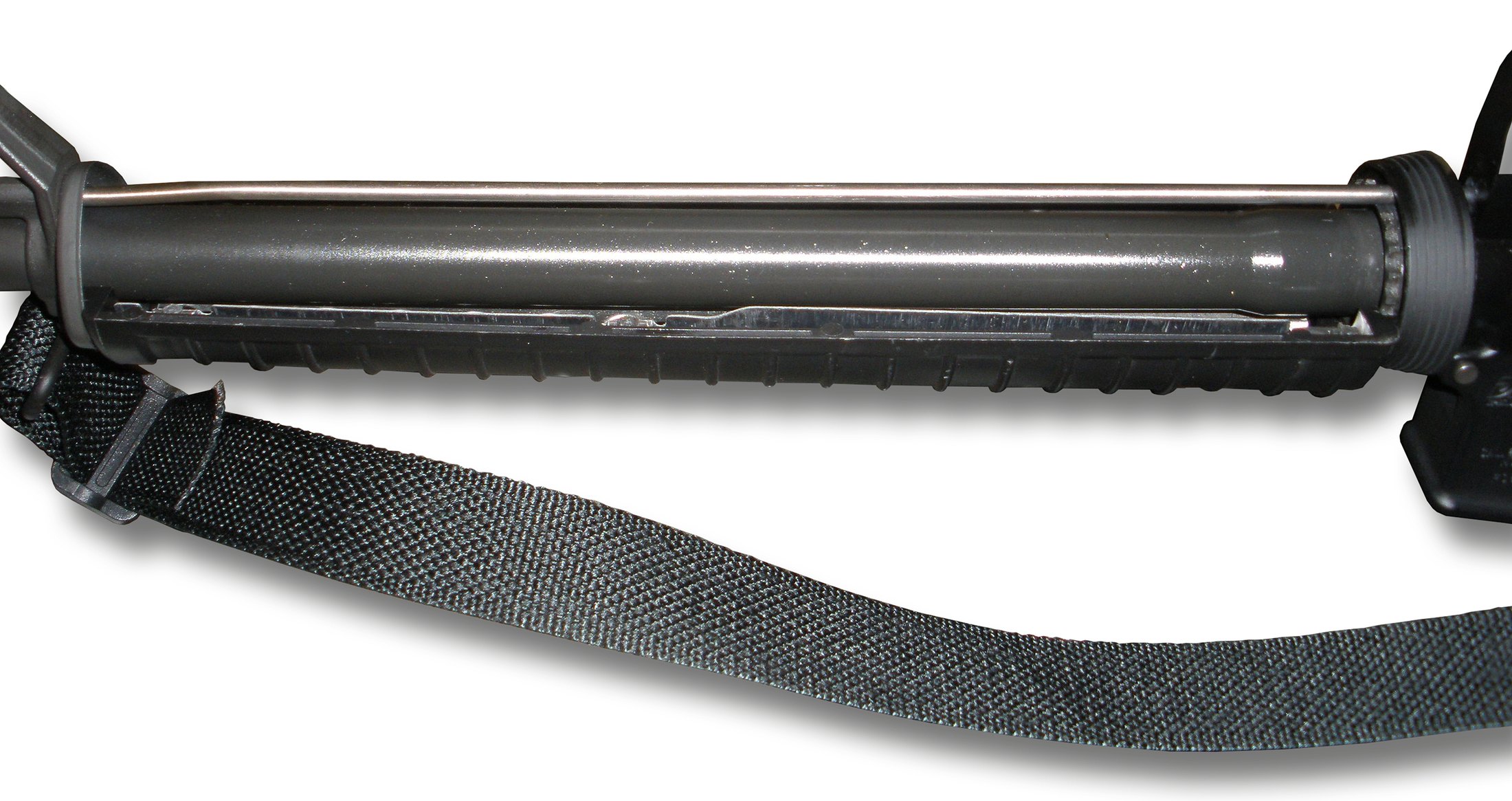
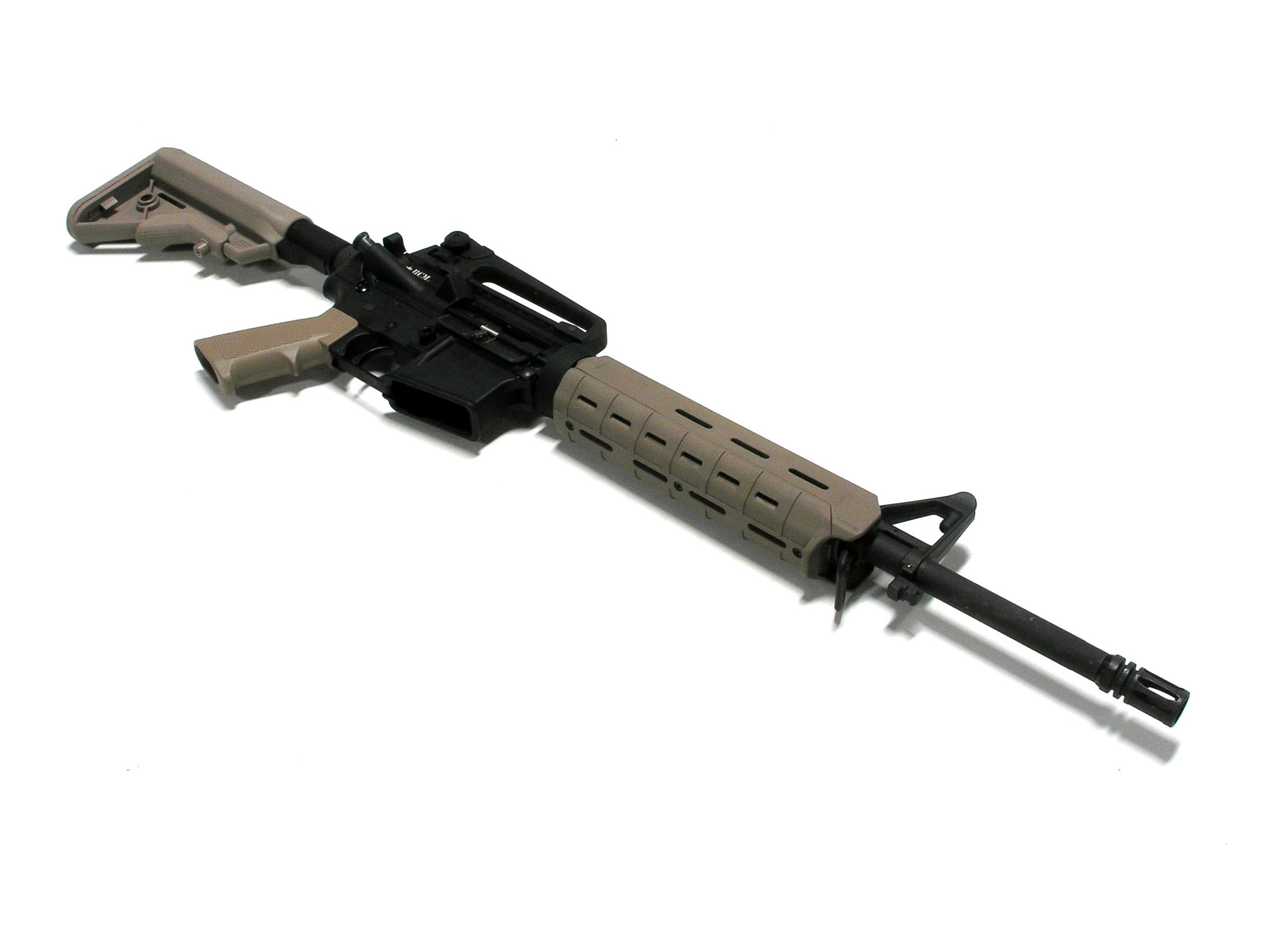
A conventional handguard clamps to the barrel nut at one end and to the front sight base or gas block at the other, so anything pressing on the handguard presses on the barrel. A free-float handguard attaches only at the receiver end and surrounds the barrel without touching it.
The benefit is not that the barrel vibrates more purely in some abstract sense. It is that the point of impact stops moving when the rifle is held differently. A sling under tension, a bipod loaded against a barricade, or a hand gripping hard all deflect a clamped barrel and move the group. Free-floating removes that variable entirely, and on a rifle shot from field positions it is usually a larger accuracy improvement than a better barrel would be.
This is not a civilian refinement. The Mk 12 SPR was built on free-float tubes from the outset — PRI Gen III tubes on the Mod 0, and the Knight’s Armament M4 Match Free-Floating Rail Adapter System on the Mod 1.9 A free-float tube is the single feature that most distinguishes an accuracy-oriented AR upper from a standard one, and it is the upgrade the scratch builds documented here all share.
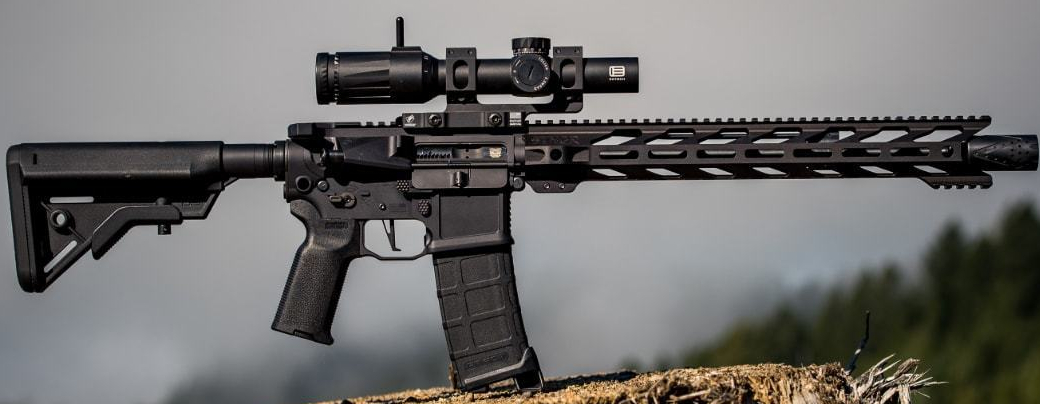
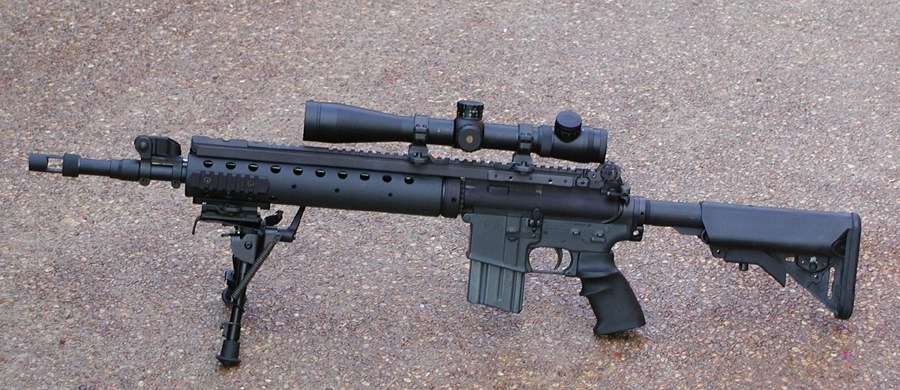
M-LOK has largely displaced the earlier quad-rail pattern for the same reason quad rails displaced plain tubes and then lost: a continuous Picatinny rail on all four faces is heavy, sharp in the hand, and provides mounting surface almost nowhere anybody needs it. M-LOK provides attachment slots on a slim tube and puts rail sections only where something is actually being mounted.
3.7 The Barrels in the Builds Documented Here
The owner’s build records list two Ballistic Advantage barrels: a 16-inch .223 Wylde Hanson-profile mid-length stainless barrel, described in those records as a Premium Series part, and a 16-inch 5.56 M4 carbine-length chrome-moly-vanadium barrel described as a Performance Series part, recorded at $185.00.
Two cautions attach to that paragraph, and both matter.
These are records, not verified catalogue entries. They are transcribed from the owner’s own build notes, which are some years old. Ballistic Advantage’s current site was checked during this dive; it confirms that the company sells both 5.56 NATO and .223 Wylde barrels, and it lists a 16-inch 5.56 Government-profile mid-length barrel at $185.00.10 That is the same price as the record above but a different profile and a different gas length from the carbine-length Performance Series barrel the record describes. The two are not the same product and this dive does not treat them as one. Which specific parts are currently catalogued could not be established.
A part number in a build log is not a specification. This project has previously been caught reading part numbers as though they were performance data. The .223 Wylde chambering is the substantive fact in the record above, and it is the subject of Volume 4.
Footnotes
-
“CQBR”, English Wikipedia, consulted 2026-09-17, for the 10.3-inch barrel, the gas port opening from 0.062 to 0.070 inch, and the 3,071 ft/s versus 2,585 ft/s velocity figures. The port-area ratio is this dive’s own arithmetic from those two diameters. ↩ ↩2
-
“M4 carbine”, English Wikipedia, consulted 2026-09-17, for the adoption of the heavier SOCOM-profile barrel on the M4A1 from 2004. ↩
-
File:M4 HK416 barrel comparison.svg, Wikimedia Commons, consulted 2026-09-17, for the M4 Government profile, M4A1 SOCOM profile and HK416 heavy barrel diameters and the 1/2×28 UNEF-2A muzzle thread callout. The drawing is a contributor-made comparison rather than a manufacturer’s engineering drawing; the diameters quoted in this section are read from it and have not been checked against a maker’s print. ↩ ↩2
-
“Miller twist rule”, English Wikipedia, consulted 2026-09-17, for the formula s = 30m / (t² d³ l (1 + l²)), the definition of each variable and its units, the constant’s embedded 2,800 ft/s reference condition, and the (v/2800)^(1/3) velocity correction. All stability figures tabulated in this volume are this dive’s own computation from that formula. ↩
-
“M16 rifle”, English Wikipedia, consulted 2026-09-17, for the 1:7 twist adoption and the description of it as optimised for the heavier SS109 ball and long L110 tracer bullets. ↩
-
“5.56×45mm NATO”, English Wikipedia, consulted 2026-09-17, for the 62-grain M855/SS109 and 63.7-grain M856/L110 tracer bullet weights. ↩
-
ANSI/SAAMI Z299.4-2015, Voluntary Industry Performance Standards for Pressure and Velocity of Centerfire Rifle Ammunition, “223 Remington V&P Test Barrel”, issued 1980-05-20, revised 2004-12-31, printed page 263, for the six grooves, 0.074-inch groove width, 12.00-inch right-hand twist, 0.219-inch bore diameter and 0.224-inch groove diameter. Held in the project Reference Library. ↩
-
“Nitriding”, English Wikipedia, consulted 2026-09-17, for the description of nitriding as a diffusion case-hardening process, the 550–570 °C salt-bath nitrocarburising temperature range, and the note on salt toxicity. ↩ ↩2
-
“Mk 12 Special Purpose Rifle”, English Wikipedia, consulted 2026-09-17, for the PRI Gen III free-float tubes on the Mod 0 and the Knight’s Armament M4 Match Free-Floating Rail Adapter System on the Mod 1. ↩
-
Ballistic Advantage, ballisticadvantage.com, consulted 2026-09-17: confirms 5.56 NATO and .223 Wylde barrel categories and lists a 16-inch 5.56 Government-profile mid-length barrel at $185.00. The specific Hanson-profile and Performance Series parts named in the owner’s build records could not be located in the current catalogue. ↩
Comments (0)