The AR-15 in 5.56 · Volume 1
What the AR-15 Actually Is — Stoner's Rifle and the Service Lineage
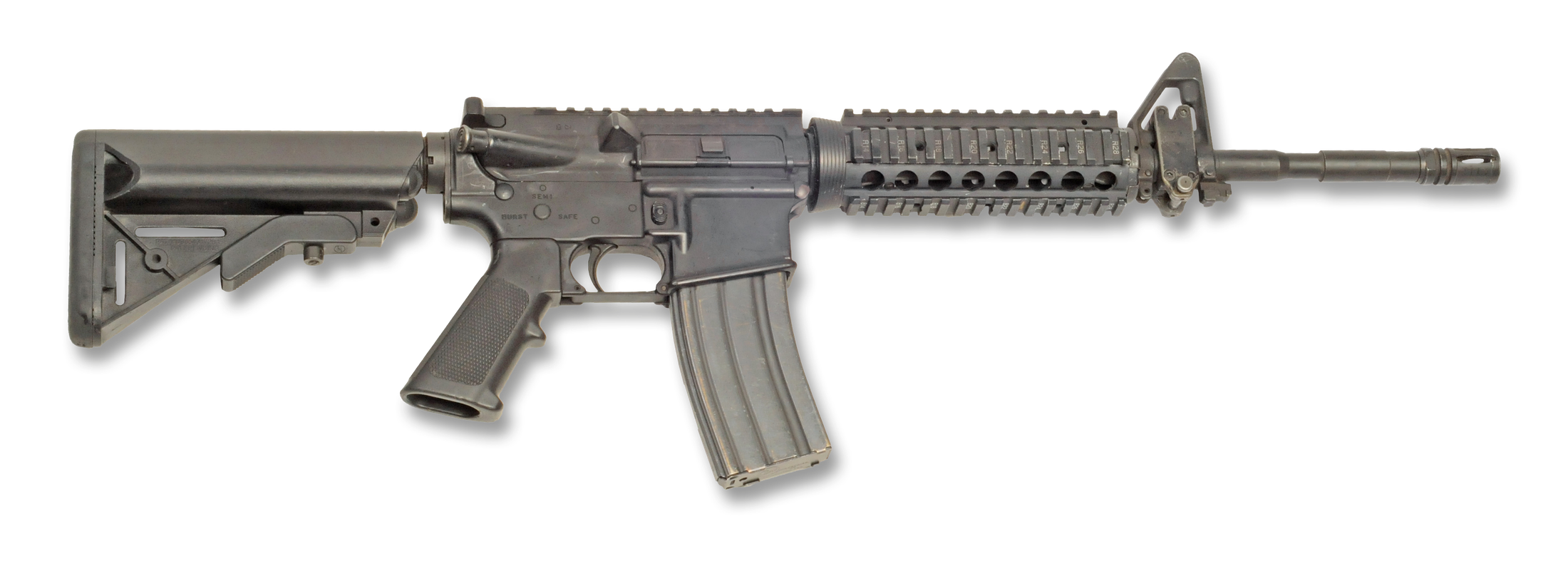
The AR-15 is the most written-about rifle in the world and one of the worst described. It attracts a volume of confident secondhand explanation that has largely displaced the primary record, and a surprising share of what is said about its operating system — including by people who own several — is either wrong or is a garbled version of something that was true about a different rifle.
These seven volumes are built on the primary documents wherever primary documents exist: Eugene Stoner’s own patent for the gas system, the SAAMI standard for the chamber and the cartridge, and the manufacturers’ own published specifications for the parts. Where the record is genuinely contested, both readings are printed and each is attributed. Where something could not be verified, it is left unverified and said so.
1.1 The Argument These Volumes Make
Three claims run through all seven volumes.
The operating system is not what it is usually called, and the patent says so in as many words. The AR-15 is routinely described as a direct-impingement rifle, and just as routinely defended or attacked on that basis. Stoner’s patent explicitly distinguishes his design from impingement operation. What the rifle actually has is a gas piston — the piston is the bolt, the cylinder is the bolt carrier, and both are inside the receiver instead of over the barrel. Section 1.4 works through this, because almost every downstream argument about fouling, heat and reliability depends on getting it right.
“Mil-spec” is a marketing term far more often than it is a specification. It means something precise in a small number of places — a receiver extension is either 1.148 inches in diameter or it is not — and almost nothing at all in most of the places it is printed. Volume 2 separates the handful of dimensions where the word is load-bearing from the large majority where it is decoration.
The 5.56-versus-.223 question has a correct answer, it is not the one in circulation, and it is checkable against a published standard. The popular version — “5.56 is loaded hotter” — is not what the standards say and is not where the hazard comes from. The difference is chamber geometry, principally the throat, and the two pressure figures people compare are not measured in the same place or by the same method. Volume 4 does this properly, with the numbers off the SAAMI chamber print.
1.2 What It Is, in One Table
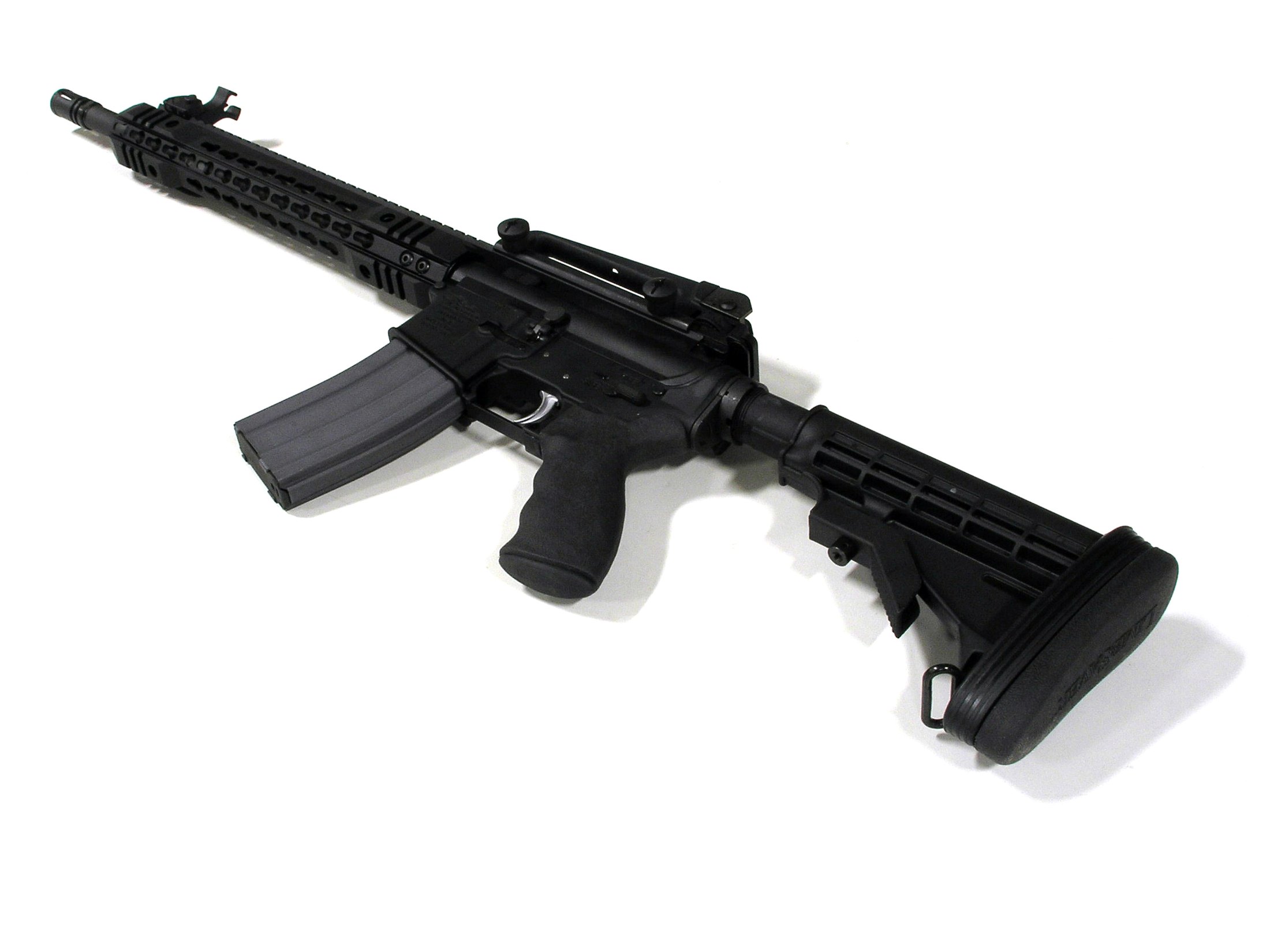
Platform-level figures, for a 16-inch carbine of the kind documented in these volumes.
Table 1 — 1.2 What It Is, in One Table
| Designer | Eugene M. Stoner, with L. James Sullivan and Robert Fremont on the scaled-down AR-15 |
| Origin | ArmaLite, a division of Fairchild Engine and Airplane Corporation; AR-15 designed 1956 from the AR-10 |
| Sold to Colt | 1959 |
| Operation | Gas, with the bolt acting as a piston inside the bolt carrier; rotating bolt with seven locking lugs plus an eighth formed by the extractor |
| Cartridge | 5.56×45mm NATO or .223 Remington, depending on chamber — Vol 4 |
| Receiver | Two-part, upper and lower, joined by two captive pins |
| Serialised part | The lower receiver — under US federal law this alone is the firearm |
| Barrel | 16 in minimum for a rifle without NFA registration; 16.1 in on the Colt carbine documented here |
| Twist | 1:7 on current service and most current commercial barrels; 1:9 and 1:12 also encountered — Vol 3 |
| Magazine | Detachable box, 20 and 30 rounds standard |
| Receiver extension | 1.148 in diameter (mil-spec) or 1.170 in (commercial) — the distinction matters, Vol 2 |
1.3 Where It Came From
The AR-15 is a scaled-down AR-10. Stoner designed the AR-10 in 7.62×51mm at ArmaLite in the mid-1950s; prototypes went to the Army’s Springfield Armory for testing in the autumn of 1956.1 When the Army’s interest turned toward a small-calibre, high-velocity cartridge, ArmaLite scaled the design down, and the work of doing so fell largely to L. James Sullivan and Robert Fremont. The AR-15 was first shown by Stoner at Fort Benning in May 1957.1
ArmaLite was in financial trouble and sold the rights to Colt in 1959.2 That sale is the hinge of the whole story: every subsequent military and commercial rifle of the pattern descends from a design its originating company no longer owned.
The adoption sequence is reported slightly differently by different sources and is worth stating carefully. Ten AR-15s were sent to South Vietnam in October 1961 by the Advanced Research Projects Agency.2 The reference literature records the rifle as adopted by the US military in January 1962 and designated the M16 in December 1963, with production and service entry in 1964.2 The M16 article puts the same events as “in 1964, the XM16E1 entered US military service as the M16” with production beginning in March 1964.1 These accounts are not contradictory so much as differently scoped — trials adoption against type standardisation — but this dive does not pretend to resolve them into a single date, and neither should anyone else without a procurement document in hand.
Colt began selling a semi-automatic version commercially in 1964 as the Colt AR-15 Sporter, in .223 Remington, with a 20-inch barrel and five-round magazines.3
1.4 The Direct-Impingement Argument, Told Accurately
This is the single most repeated technical claim about the rifle and it deserves the primary source.
Stoner’s patent is US 2,951,424, “Gas Operated Bolt and Carrier System”, filed 14 August 1956 and granted 6 September 1960, assigned to Fairchild Engine and Airplane Corporation.4 The mechanism it describes is this: gas is tapped from the barrel and carried rearward through a tube into a chamber formed between the bolt and the bolt carrier. The patent’s own summary of the idea is that “by having the bolt carrier act as a movable cylinder and the bolt act as a stationary piston, the need for a conventional gas cylinder, piston and actuating rod assembly is eliminated.”4
And then the sentence that settles the nomenclature question, in the patent’s own words:
“This invention is a true expanding gas system instead of the conventional impinging gas system.”4
The patent does not use the phrase “direct impingement” anywhere.4 It defines itself against impingement.
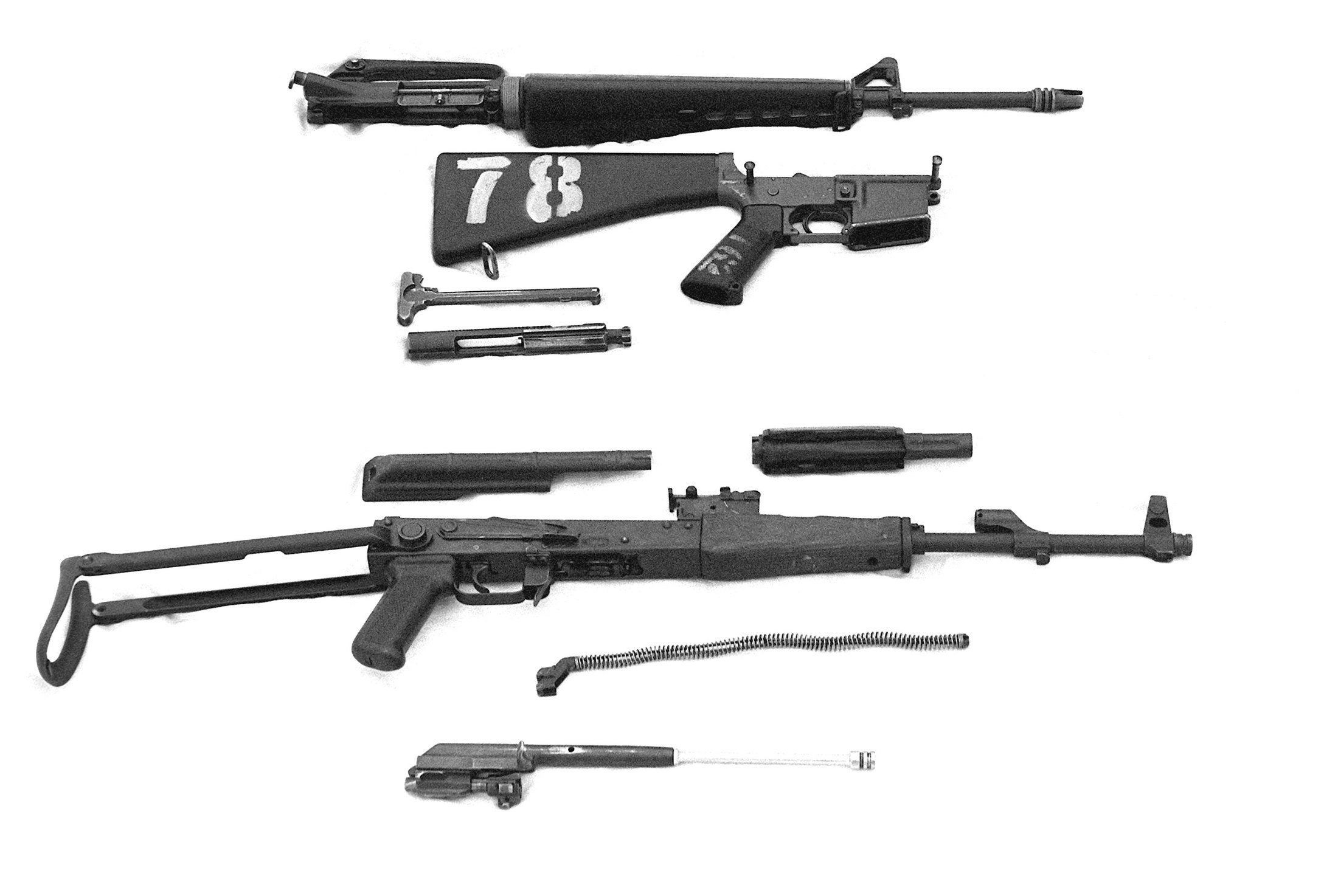
The distinction is mechanical, not semantic. In a genuine direct-impingement rifle — the Swedish Ag m/42 and the French MAS designs are the usual examples — gas is piped back and blown against the face of the bolt carrier, which is pushed like a sail.5 In Stoner’s design the gas does not blow against anything and then escape. It is admitted into a sealed volume bounded by the bolt rings and the interior of the carrier, it expands in that volume, and the expansion drives the carrier rearward relative to the bolt until the cam pin has rotated the bolt out of the barrel extension. That is a piston and cylinder, built into the working parts rather than over the barrel.
The reference literature splits on what to call this. The M16 article states flatly that “while the M16 is commonly said to use a direct impingement system, this is incorrect, and it is instead correct to say it uses an internal piston system.”1 The general article on gas operation takes the other line, describing the Stoner system as “a modified version” of direct impingement in which “a gas tube delivers gas into the bolt carrier to impinge on the bolt, which acts as a piston to cycle the rifle.”5 Both descriptions are in print; the mechanism both are describing is the same one, and the patent’s own account of it is the one quoted above.
1.4.1 The folklore, tested
The best-known slogan on this subject holds that the design “defecates where it eats” — that gas is dumped onto the bolt face and the rifle fouls itself. This is half right, and the half that is wrong is the half that matters.
What is true: gas admitted to the carrier does not vanish. After it has done its work it is vented through ports in the side of the carrier, into the receiver. Carbon and combustion residue are deposited inside the receiver and on the tail of the bolt. Anyone who has cleaned one has seen it.
What is wrong: the picture of gas being blasted at the bolt face like a hose. The bolt face is at the front of the bolt, inside the barrel extension, sealed against the cartridge case at the moment of firing. Gas enters behind it, into the ring-sealed annulus between bolt tail and carrier. Fouling accumulates on the bolt tail, the rings and the carrier interior — which is why those are the parts that get scraped — and not on the locking face.
And the real cost is better described as heat than as dirt. The general treatment of gas operation puts it directly: direct-gas operation “increases the amount of heat that is deposited in the receiver while firing, which can burn off and cover up lubricants.”5 A rifle of this type that is going to stop is far more likely to stop because it has run dry than because it is visibly dirty. That has a practical consequence, taken up in Volume 7: on this platform, lubrication is a more important maintenance variable than cleanliness, which is the reverse of the intuition most owners bring to it.
1.5 The Service Lineage, A1 Through A4
The military variants are the vocabulary everything else borrows, so they are worth getting straight. The visible differences are mostly furniture and sights; the consequential difference is the barrel.
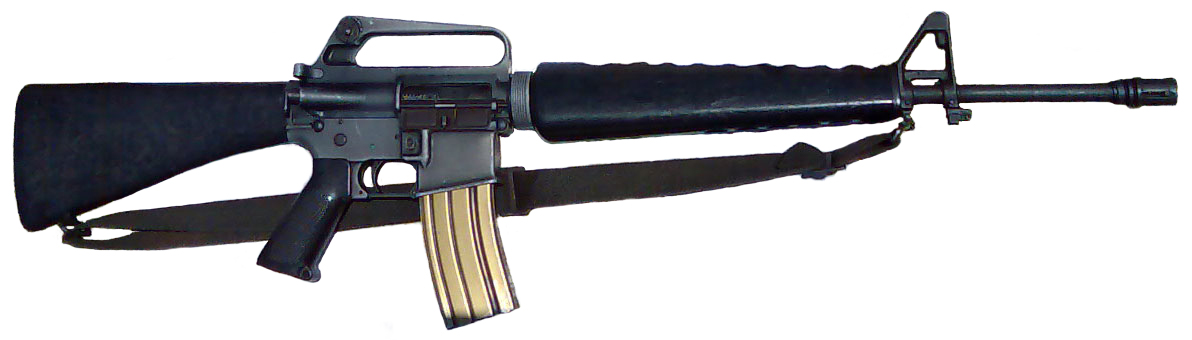
M16A1. The XM16E1 was standardised as the M16A1 in February 1967, and the M16A1 officially replaced the M14 in 1969.1 Triangular handguards, a fixed carry handle, a rear sight adjustable for windage with a two-position aperture, and a forward assist. Barrel twist one turn in 12 inches.1
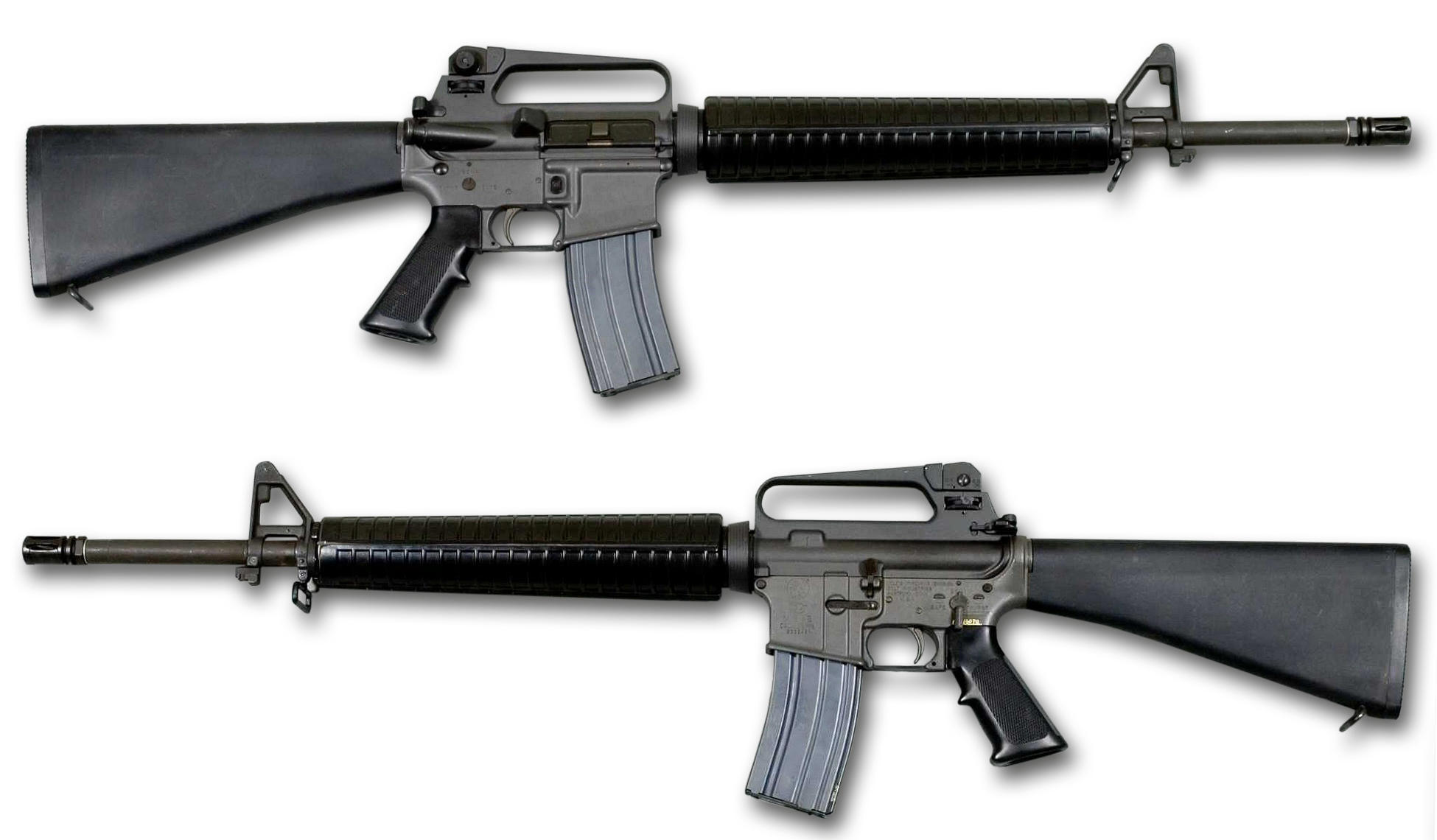
M16A2. Adopted by the US Marine Corps in 1983 and by the US Army in 1986.1 Round ribbed handguards interchangeable top and bottom, a heavier barrel forward of the front sight base, a fully adjustable rear sight, a three-round burst fire control group in place of automatic fire, and — the change that matters most — a twist rate of one turn in 7 inches.1
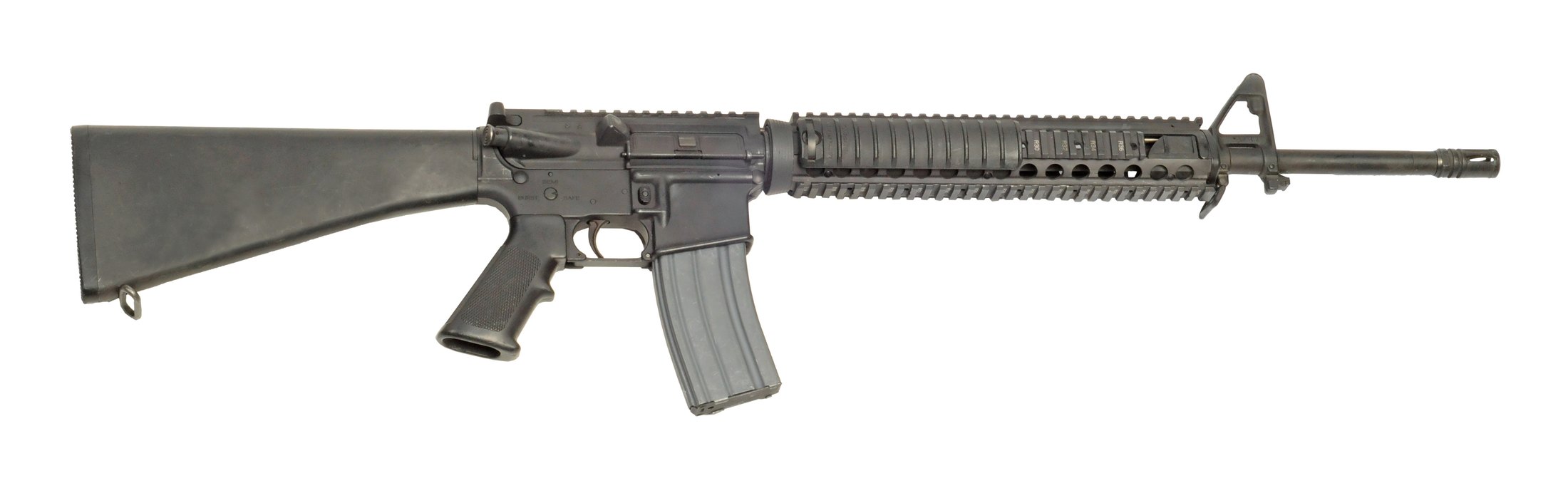
M16A4. A flat-top receiver with a removable carry handle and a railed handguard, intended from the outset to carry magnified optics rather than to be sighted over the top of the barrel.
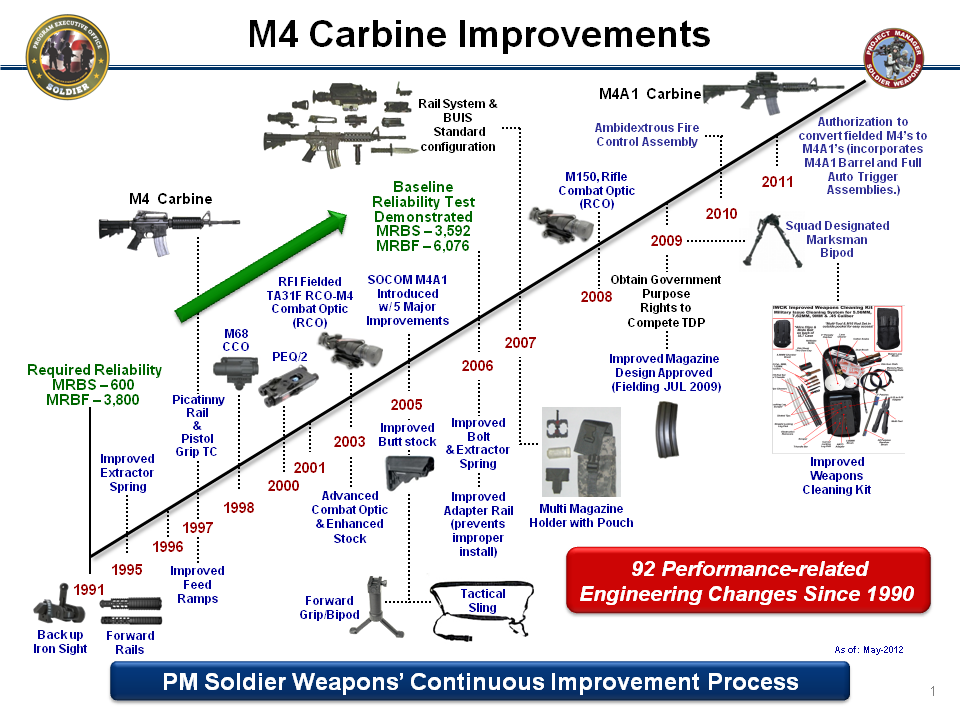
M4 and M4A1. The M4 has been in service since its adoption in 1994, with a 14.5-inch barrel and a 1:7 twist.6 The M4 carries a safe/semi/three-round-burst fire control group; the M4A1 carries safe/semi/automatic.6 From 2004 the M4A1 took the heavier “SOCOM profile” barrel.6
1.5.1 The twist-rate change, and why it was not about weight
The move from 1:12 to 1:7 is the most misremembered event in the rifle’s development. The original barrel was one turn in 14 inches; the M16A1 used one turn in 12; the M16A2 and everything after it used one turn in 7, described in the literature as optimised for “the heavier NATO SS109 ball and long L110 tracer bullets.”1
Read that phrase carefully, because it contains the correction. Two projectiles drove the decision, and the one that drove it hardest was the tracer. The M855 ball round carries a 62-grain bullet; the M856 tracer carries a 63.7-grain bullet.7 Those weights are nearly the same. A tracer, however, burns a column of pyrotechnic composition in its base — material far less dense than the lead and steel in a ball round — so for the same weight it is a substantially longer projectile. The twist was set fast enough to stabilise the longest thing the rifle had to fire, not the heaviest.
This matters because the folklore that came out of it — “heavier bullets need faster twist” — is a proxy statement that happens to work most of the time and fails exactly when it is interesting. Volume 3 does the arithmetic and shows that the governing variable is length, that weight is only correlated with it, and that the correlation breaks on precisely the projectile the 1:7 twist was adopted for.
1.6 Mk 12, Mk 18 and the Recce
Three names circulate as though they were three models. Two are real designations with documented specifications; the third is a concept, and the difference is worth stating plainly.
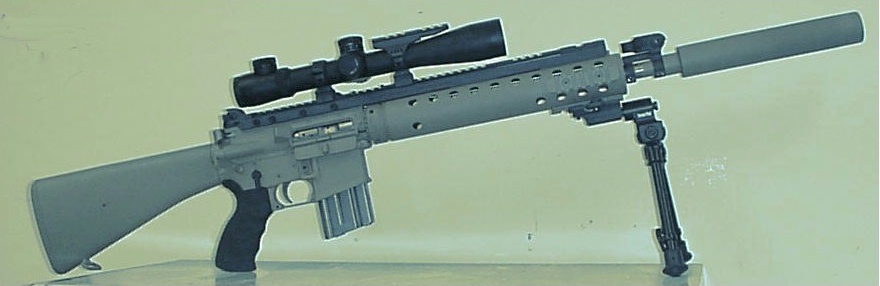
Mk 12 Special Purpose Rifle. A genuine type with a published specification. An 18-inch threaded-muzzle match-grade free-floating stainless heavy barrel with a 1:7 twist, the barrels manufactured by Douglas Barrels.8 The Mod 0 used PRI Gen III free-float tubes; the Mod 1 used the Knight’s Armament M4 Match free-floating Rail Adapter System.8 The Mod 0 was used by US Army Special Forces, the Mod 1 by Rangers, SEALs and Special Tactical Teams.8 It was built around the Mk 262 Open Tip Match round developed and manufactured by Black Hills Ammunition, the Mod 0 using a 77-grain Sierra MatchKing hollow point boat tail.8 An OPS Inc muzzle brake and collar aligned an OPS Inc 12th Model suppressor.8 First issued 2002, phased out of service in 2017, stated effective range 700 metres.8
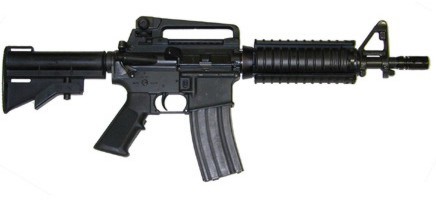
Mk 18 CQBR. Also a real designation, and an instructive one, because the thing itself is not a rifle. The Close Quarters Battle Receiver is a replacement upper receiver for the M4A1, developed by the US Navy; the complete carbine built on it is type-classified as the Mk 18 Mod 0.9 The barrel is 10.3 inches with a 1:7 twist.9 Design is credited to 1999, production from 2000.9
The detail worth carrying away from the Mk 18 is a gas-system fact, and it is one of the very few hard port numbers in the public record: to run reliably on so short a barrel, the gas port is opened from 0.062 to 0.070 inch.9 Volume 3 uses that figure, because it is a measured instance of the principle the whole gas-length argument turns on.
The velocity cost is equally concrete. Against a 20-inch barrel producing 3,071 ft/s, the 10.3-inch barrel produces 2,585 ft/s — a loss of 486 ft/s.9
The Recce. Here the honest answer is different in kind. The Recce is a concept — broadly, a 16-inch accurate general-purpose carbine with a free-floated barrel and a magnified optic, occupying the space between an M4 and a Mk 12. It is widely described and widely built. No official specification, type classification or primary procurement document for a “Recce rifle” could be located for this dive. What can be said is what the configuration consists of and why people build it, and that is a build description rather than a service history. It is treated that way in Volume 6, and no part numbers, dates or unit designations are asserted for it.
That distinction — two documented types and one widely-built idea — is worth holding onto, because the three names are usually recited in a single breath as though they carried equal evidentiary weight.
1.7 The Rifles These Volumes Are Written Around
The volumes are anchored on specific configurations rather than on a catalogue.
The first is a Colt LE6920, a 16.1-inch M4-pattern carbine, as delivered. It is the reference point throughout: a factory carbine built to the commercial descendant of the service specification, useful precisely because it is the thing every parts build is implicitly compared against.
The others are scratch builds. One is assembled on a Smith & Wesson complete lower, which is to say the fire control group, grip and stock came already fitted and the work was upper-side. Others are built up from Black Rain Ordnance lowers and uppers, starting from a stripped receiver. The recurring parts choices across those builds — FailZero and nickel-boron bolt carrier groups, Magpul furniture, PRI gas blocks, free-float handguards — are the subject of Volumes 5 and 6, and each is examined for what it actually buys rather than what it is sold as.
Configuration notes throughout are drawn from the owner’s own build records. Where a part number appears in those records it is reported as a record, not as a verified current catalogue entry — several of the products concerned are a decade old and some of the makers have since restructured their ranges. Volume 5 says explicitly which is which. A part number in a build log is evidence of what was bought; it is not a specification, and this project has previously been caught reading one as the other.
1.8 Reading Order
Volume 2 is the lower receiver: forgings, billets, what actually differs between makers, the fire control pocket, and the mil-spec question in full.
Volume 3 is the upper, the barrel and the gas system — gas length against barrel length, dwell and port pressure, twist against bullet length with the arithmetic shown, and barrel steels and linings.
Volume 4 is 5.56 NATO against .223 Remington, and it is the one to read first if only one gets read. It is built on the SAAMI chamber print and it contradicts the most widely repeated statement on the subject.
Volume 5 is building one from parts: bolt carrier coatings and what they actually do, triggers, gas blocks, the assembly order, and what a builder must check. It cross-links the Headspace dive rather than re-deriving that material.
Volume 6 is optics, furniture and accessories — red dots against low-power variable optics, mounting height, slings, and what suits a 16-inch carbine.
Volume 7 is ownership: cleaning and lubrication, wear points, ammunition, magazines, and the Michigan legal position for a rifle of this type.
Footnotes
-
“M16 rifle”, English Wikipedia, consulted 2026-09-17, for the AR-10 Springfield trials in autumn 1956, the May 1957 Fort Benning demonstration, the March 1964 production date, the February 1967 M16A1 standardisation, the 1969 replacement of the M14, the 1983 USMC and 1986 Army adoption of the M16A2, the 1:14 / 1:12 / 1:7 twist sequence, the SS109 and L110 rationale for the 1:7 twist, and the “internal piston system” statement. ↩ ↩2 ↩3 ↩4 ↩5 ↩6 ↩7 ↩8 ↩9
-
“ArmaLite AR-15”, English Wikipedia, consulted 2026-09-17, for the 1956 design date, the Stoner/Sullivan/Fremont attribution, the 1959 sale to Colt, the original 1:14 twist, the October 1961 ARPA shipment, and the January 1962 adoption and December 1963 M16 designation. ↩ ↩2 ↩3
-
“Colt AR-15”, English Wikipedia, consulted 2026-09-17, for the 1964 commercial introduction of the AR-15 Sporter in .223 Remington with a 20-inch barrel and five-round magazines, and the 1:12 to 1:9/1:7 twist progression on commercial models. ↩
-
US Patent 2,951,424, “Gas Operated Bolt and Carrier System”, Eugene M. Stoner, assigned to Fairchild Engine and Airplane Corporation; filed 14 August 1956, granted 6 September 1960. Consulted via Google Patents, 2026-09-17, for the filing and grant dates, the movable-cylinder/stationary-piston description, and the “true expanding gas system instead of the conventional impinging gas system” sentence. ↩ ↩2 ↩3 ↩4
-
“Gas-operated reloading”, English Wikipedia, consulted 2026-09-17, for the direct-impingement definition and the MAS-40 and Ag m/42 examples, the description of the Stoner system as a modified direct-impingement variant, and the statement that direct impingement deposits heat in the receiver which can burn off lubricants. ↩ ↩2 ↩3
-
“M4 carbine”, English Wikipedia, consulted 2026-09-17, for the 1994 adoption, the 14.5-inch barrel and 1:7 twist, the S-1-3 versus S-1-F fire control distinction, and the 2004 SOCOM-profile barrel. ↩ ↩2 ↩3
-
“5.56×45mm NATO”, English Wikipedia, consulted 2026-09-17, for the M193 55-grain round type-standardised September 1963, the 62-grain M855/SS109 adopted October 1980 under STANAG 4172, the 63.7-grain M856/L110 tracer, the 77-grain Mk 262, and the STANAG 4172 1:7 twist definition. ↩
-
“Mk 12 Special Purpose Rifle”, English Wikipedia, consulted 2026-09-17, for the 18-inch Douglas stainless barrel and 1:7 twist, the PRI Gen III and Knight’s Armament rail systems on Mod 0 and Mod 1, the using units, the Black Hills Mk 262 and its 77-grain Sierra MatchKing, the OPS Inc brake and 12th Model suppressor, the 2002 issue and 2017 withdrawal, and the 700 m effective range. ↩ ↩2 ↩3 ↩4 ↩5 ↩6
-
“CQBR”, English Wikipedia, consulted 2026-09-17, for the 10.3-inch barrel and 1:7 twist, the upper-receiver-group nature of the CQBR and the Mk 18 Mod 0 type classification, the 1999 design and 2000 production dates, the gas port opening from 0.062 to 0.070 inch, and the 3,071 ft/s versus 2,585 ft/s velocity comparison. ↩ ↩2 ↩3 ↩4 ↩5
Comments (0)