The AR-15 in 5.56 · Volume 4
5.56 NATO Versus .223 Remington — The Chamber, Not the Powder
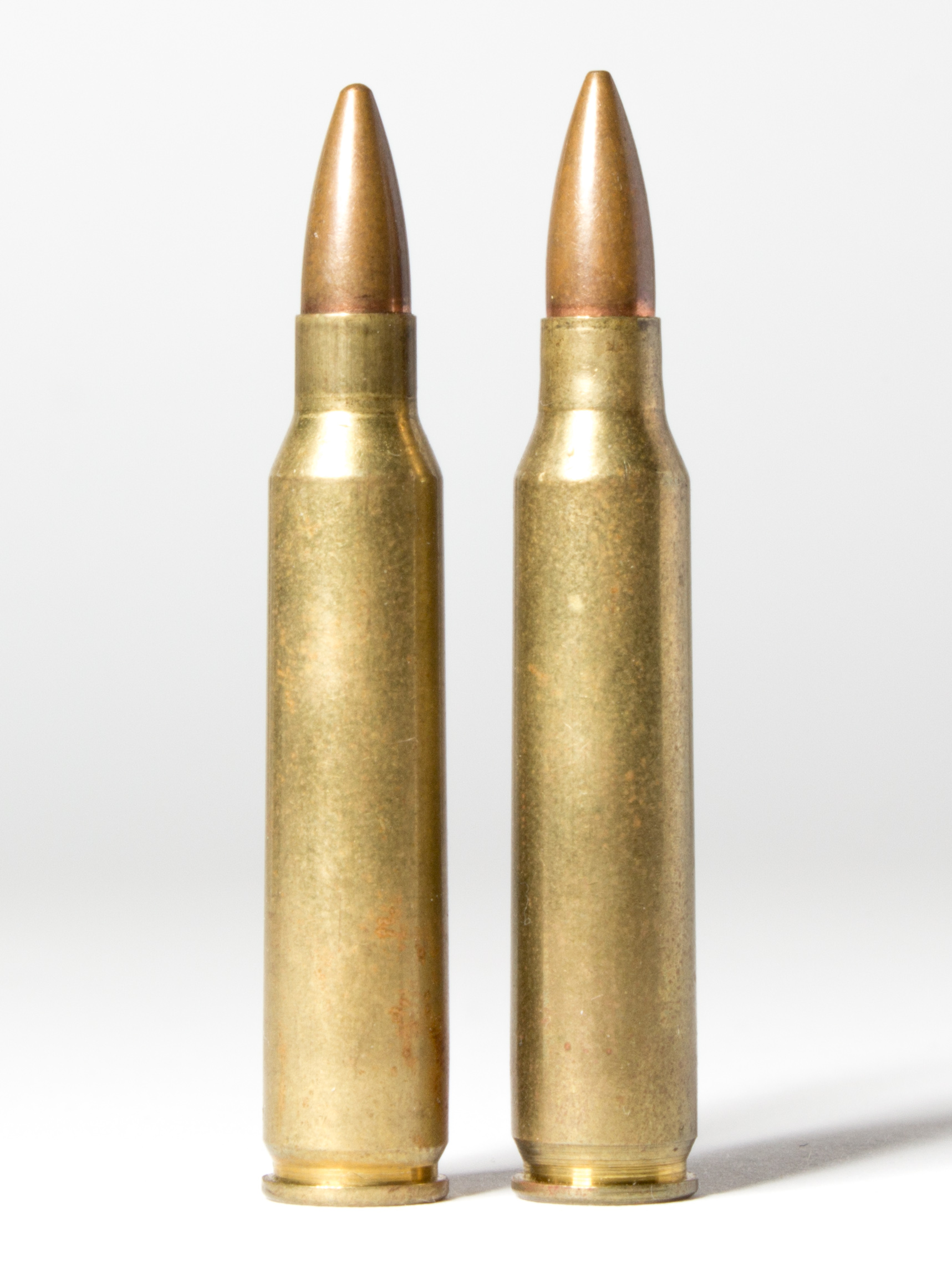
This is the most-repeated error in the subject, and it is repeated by people who are otherwise careful. The usual statement is some version of: 5.56 NATO is loaded to higher pressure than .223 Remington, so it is unsafe in a .223 chamber.
The conclusion is correct. The reason given for it is wrong, and because the reason is wrong the rule gets mis-applied constantly — most often by people who believe they can reason their way around it with a chronograph or a pressure-sign inspection.
The actual explanation is geometric. It is in a published standard, the relevant page of which is held in this project’s reference library, and the arithmetic on it closes exactly. This volume shows the work.
4.1 The Two Pressure Numbers Are Not Comparable
Start with the numbers people compare, because the comparison is invalid before it begins.
SAAMI, for .223 Remington. The maximum average pressure is 55,000 psi, measured “using a chamber conformal piston transducer.”1 The primary standard gives the full set: a maximum average pressure of 55,000 psi, a maximum probable lot mean of 56,400 psi and a maximum probable sample mean of 58,500 psi, alongside a parallel copper-crusher set of 52,000, 53,300 and 55,300 CUP.2
NATO, for 5.56×45mm. The EPVAT regime gives a proof pressure of 537.5 MPa (77,958 psi); dividing by 1.25 yields a maximum service pressure of 430 MPa (62,366 psi) — expressed as “case-mouth transducer pressure.”3
Set side by side, 55,000 against 62,366 looks like a 13 percent difference in loading, and that is exactly how it gets read. It is not one, because the two figures are not measurements of the same quantity.
4.1.1 Where each transducer sits
The SAAMI standard test barrel drawing for .223 Remington specifies the transducer location precisely. On the sheet titled 223 Remington V&P Test Barrel, issued 1980-05-20 and revised 2004-12-31, the transducer centreline is at 1.259 inches from the breech bolt face, with a piston hole of 0.206 inch and a transducer diameter of 0.250 inch.4
The .223 Remington case is 1.760 inches long. So the SAAMI transducer sits 0.501 inch behind the case mouth — part-way down the case body, over the powder column, reading through a hole in the case wall that the brass is pressed into.
The NATO figure is taken at the case mouth.3
Those are different stations in a system where pressure varies with position and with time. A number read over the powder column and a number read at the case mouth are not interchangeable, cannot be subtracted, and do not support any statement of the form “5.56 is N percent hotter.” The methods differ too — a chamber-conformal piston against a case-mouth transducer.
The honest formulation: the two standards specify different measuring systems, and the published maxima are not directly comparable. A claim that 5.56 runs 62,000 psi while .223 runs 55,000 psi quotes two instruments, not one difference.
This is not a claim that the two cartridges are loaded identically. It is a claim that the numbers usually cited do not establish what they are cited to establish — and, more importantly, that the pressure difference is not the mechanism by which the hazard arises.
4.2 What Actually Differs: The Throat
The chambers differ, and the throat is the dominant difference. Both major reamer makers say so.
Manson Precision Reamers lists the differences as: “the 5.56 chamber is slightly larger in diameter than the 223 in the body and neck areas, has slightly longer headspace and, most importantly, a throat configuration both larger in diameter and longer with a more gradual lead angle into the rifling.”5
The reference literature agrees on the direction: the NATO chamber “has a longer leade, the distance between the mouth of the cartridge and the point where the rifling engages the bullet,” while the .223 commercial chamber “is allowed to have a shorter leade” and “the chamber leade, i.e., the area where the rifling begins, is cut to a sharper angle on some .223 commercial chambers.”3
4.2.1 The .223 throat, off the print
The SAAMI test-barrel drawing gives the .223 Remington throat exactly, and the numbers on it can be checked against each other.4
Table 1 — The .223 throat, off the print
| Feature | Value on the drawing |
|---|---|
| Headspace, bolt face to datum | X 1.4636 +.0005 in |
| Datum diameter | .330 in BASIC |
| Shoulder angle | 23° BASIC |
| Case mouth (reference) | 1.7720 in |
| Freebore, cylindrical | 1.787 to 1.812 in, at .224 in |
| Leade angle | 3° 10’ 36” BASIC |
| Full rifling begins | 1.8570 in |
| Bore diameter | .219 in |
| Groove diameter | .224 in |
The geometry closes on itself, which is how one knows the drawing has been read correctly rather than merely quoted.
The leade taper runs from 1.812 to 1.8570 inches, a length of 0.0450 inch. At a per-side angle of 3° 10’ 36” — that is 3.1767°, whose tangent is 0.05550 — the taper reduces the diameter by
2 × 0.0450 × 0.05550 = 0.00500 inch
and 0.224 − 0.005 = 0.219, which is the bore diameter on the same drawing, exactly.
So the .223 Remington throat is: 0.025 inch of cylindrical freebore at groove diameter, then 0.045 inch of leade at 3° 10’ 36” per side, bringing the bore down from .224 to .219. Measured from the case mouth at 1.7720 to full rifling at 1.8570, the whole throat is 0.0850 inch long.
4.2.2 An independent cross-check
The C.I.P. drawing for the same cartridge — the European standards body rather than the American one — provides a check on two of those figures from a completely separate source.

C.I.P. gives the shoulder as alpha 46° 0’00.0”, which is the full included angle. SAAMI’s 23° BASIC is the same angle expressed per side. The two agree. C.I.P. gives case length L3 44,70 mm, which is 1.7598 inches — the 1.760-inch figure used in section 4.1 to place the transducer. And C.I.P.’s bullet diameter G1 5,70 mm is 0.2244 inch, matching SAAMI’s .224 groove diameter.
Three independent agreements between two standards bodies is a reasonable basis for confidence that the numbers above are right.
4.2.3 And what is not available
SAAMI publishes no 5.56×45mm NATO chamber drawing. The cartridge is a military and NATO standard, not a SAAMI one, so the two chambers under discussion are defined by different bodies in different documents with different conventions. That is a structural fact about this whole argument and it explains a good deal of the confusion: there is no single document in which the two chambers appear side by side.
The specific dimensional figures for the 5.56 NATO throat that circulate widely — a freebore roughly twice the .223 figure is the usual claim — could not be verified against a primary specification for this dive and are therefore not printed here. The .223 figures above are primary. The 5.56 figures in circulation are not, at least not to this dive. That asymmetry is worth stating plainly rather than papering over by quoting both from secondary sources as though they had equal standing.
4.3 Why a Short Throat Raises Pressure
The mechanism, now that the geometry is established.
A cartridge fires by burning powder in a closed volume until the pressure is high enough to push the bullet out of the case neck and down the bore. How hard that is depends on what the bullet has to do first.
If the bullet sits with a gap between its ogive and the start of the rifling, it accelerates into the throat and engraves as it moves, with a running start and an expanding volume behind it.
If the bullet is already touching the rifling when the round is chambered, there is no running start. The powder must generate enough pressure to engrave the bullet from a standstill, in the smallest volume the system will ever have. Pressure rises steeply before anything moves.
That is the hazard, and the literature describes exactly this case: “if a 5.56×45mm NATO cartridge is loaded into a chamber intended to use .223 Remington, the bullet will be in contact with the rifling and the forcing cone is very tight,” and this “generates a much higher pressure than .223 Remington chambers are designed for.”1
Note what this means. The dangerous pressure is not the pressure the ammunition was loaded to. It is pressure created by the combination of that ammunition and that chamber. The same cartridge in a 5.56 chamber never reaches it. This is why chronographing the load, or inspecting fired brass from a different rifle, settles nothing: the excess pressure is generated by the pairing, and it appears only in the pairing.
It also explains why the popular framing is actively harmful. Somebody who believes “5.56 is hotter” may reason that a mild 5.56 load, or a light bullet, or a cold day will provide margin. None of those addresses bullet-to-rifling contact, which is a geometric condition and is either present or absent.
4.4 The Headspace Question — Deliberately Not Settled Here
One part of the difference is genuinely disputed between the two largest gauge makers in the United States, and this dive does not resolve it because the Headspace dive already owns the material and settled on leaving it open.
In brief: Manson says the 5.56 chamber “has slightly longer headspace.”5 Forster sells the same part number — HG0223G — as both the .223 Remington GO gauge and the 5.56 NATO minimum gauge, and puts the 5.56 maximum at 1.4736 inch, which is the SAAMI .223 maximum exactly. On the headspace dimension alone, Forster treats the two as identical.
Two of the largest gauge makers in the country do not agree that the difference exists. The defensible statement is that the dominant difference between the chamberings is the throat — on which both makers agree — and that any headspace difference is small enough to be disputed. The Headspace dive also records that the widely circulated MIL-DTL figures for a 5.56 GO and NO-GO could not be verified against the specification itself and contradict Forster’s catalogue, so they are not printed there and are not printed here.
4.5 .223 Wylde
The .223 Wylde chamber is the deliberate engineering answer to the problem this volume describes, and it is the chambering in the scratch builds documented here.
It was developed by Bill Wylde, and the reference literature describes what it does with unusual precision: it “solves this problem by using the external dimensions and lead angle as found in the military 5.56×45mm NATO cartridge and the 0.224 inch freebore diameter as found in the civilian SAAMI .223 Remington cartridge.”1
Read that as two separate decisions:
From the 5.56 side, it takes the leade angle and the external dimensions. This is the safety half. The throat is generous enough that a 5.56 cartridge does not jam its bullet into the rifling, so the pressure excursion of section 4.3 does not occur.
From the .223 side, it takes the 0.224-inch freebore diameter. This is the accuracy half. A freebore cut at groove diameter rather than oversize supports the bullet concentrically as it leaves the case, so it enters the rifling straight.
The result is a chamber that will safely fire both cartridges and that is generally more accurate than a 5.56 NATO chamber with the same ammunition. It costs nothing to choose it on a new barrel. For a build where the barrel is being selected anyway — which is every scratch build — there is very little argument for choosing anything else, and that is why the barrel in the scratch builds documented here is a .223 Wylde.
The factory carbine documented here is a different case: a Colt LE6920 is a 5.56 NATO chamber, which is the correct chamber for what that rifle is, and it will fire both cartridges safely.
4.6 What Is Safe in What
The decision table, which is the practical output of the whole volume.
Table 2 — 4.6 What Is Safe in What
| Ammunition | .223 Remington chamber | 5.56 NATO chamber | .223 Wylde chamber |
|---|---|---|---|
| .223 Remington | Safe | Safe; may lose a little accuracy to the longer jump | Safe |
| 5.56×45mm NATO | Do not | Safe | Safe |
The guidance that both reamer makers agree on completely, stated as bluntly as they state it: do not fire 5.56 NATO ammunition in a chamber marked .223 Remington. The reverse is fine.5
The reference literature puts the same rule the same way: “.223 Remington ammunition can be fired safely from almost any rifle chambered in 5.56×45mm NATO,” while firing 5.56 in rifles designed for .223 may “cause unsafe chamber pressures.”3
The “may lose a little accuracy” note in the middle cell is the only nuance worth adding, and it is a small one: a .223 cartridge in a longer 5.56 throat has further to travel before it engages the rifling, and a longer jump is generally worth a little group size. It is a preference, not a caution.
4.7 Identifying an Unknown Chamber
Chamber markings are the first check and are not sufficient on their own.
Read the barrel. Quality barrels are marked with the chambering — “5.56 NATO”, “.223 REM”, “.223 WYLDE”. On an AR the marking is on the barrel, not the receiver, which is the whole point of Volume 2: the serialised part does not know what it is chambered for.
Distrust an unmarked barrel and distrust a marked upper. An upper receiver marked “MULTI” or “5.56/.223” is a receiver marking and says nothing about the barrel installed in it. A rifle that has had a barrel changed may carry a marking that was accurate when it left the factory and is not accurate now.
A chamber cast settles it. Where the marking is absent, ambiguous or suspect, the chamber can be cast and measured. That is a Headspace-dive procedure and is not re-derived here; Headspace Vol 8 covers chamber casting and, importantly, what a cast cannot establish.
The default in the absence of information is the conservative one. An unidentified chamber is treated as .223 Remington and fed .223 Remington, because that pairing is safe under every column of the table above.
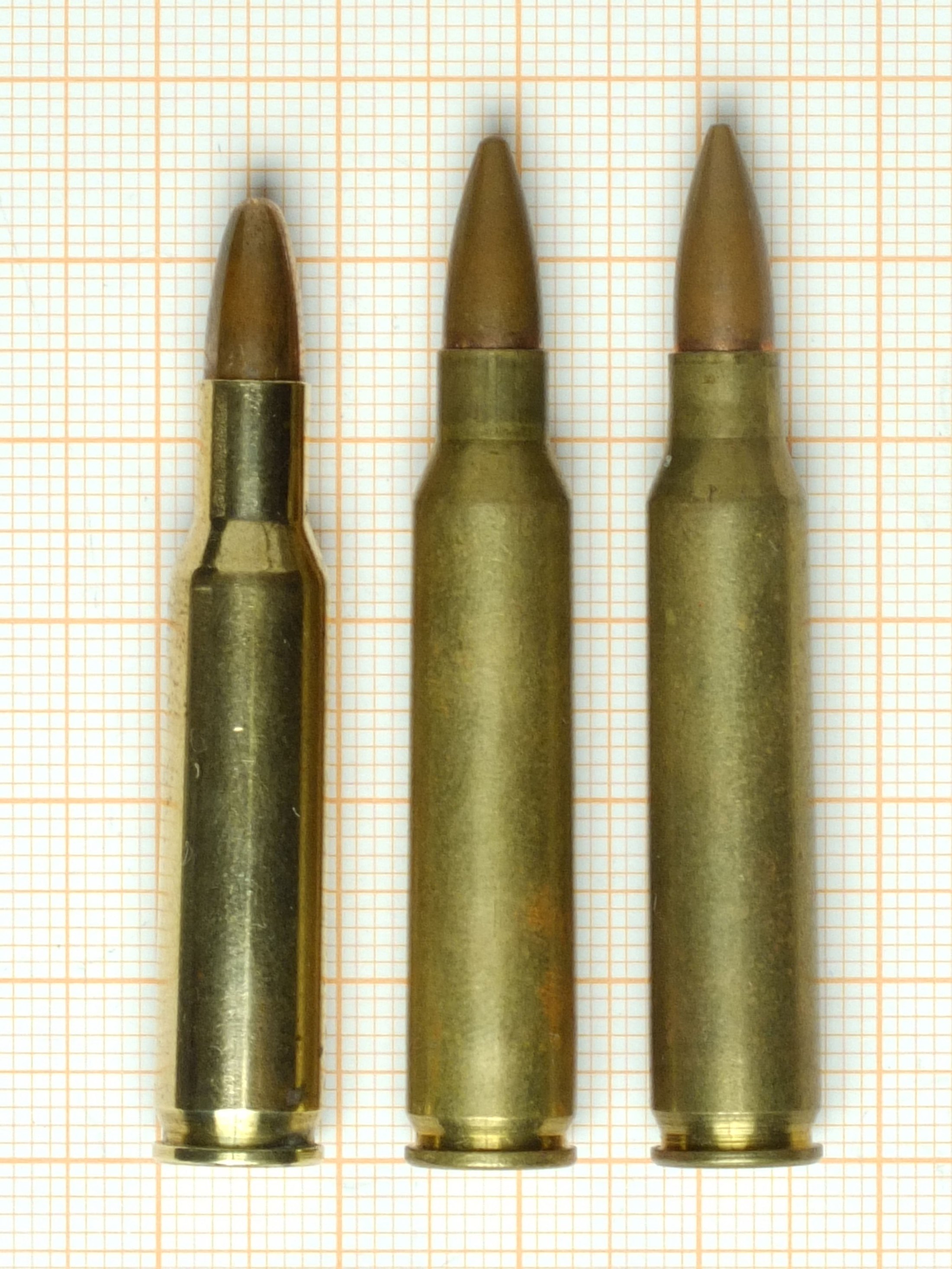
4.8 A Note on Current Service Ammunition
The M855A1 Enhanced Performance Round, adopted in 2010, uses a 62-grain bullet with a 19-grain steel penetrator over a copper alloy core.3 It is frequently asserted to run at higher pressure than M855 and to accelerate wear on bolts and barrels in commercial rifles.
Those specific claims could not be verified for this dive. The dedicated reference article could not be retrieved, and no manufacturer or government source stating a pressure figure or a wear rate was obtained. The claims are recorded here as claims in circulation, unverified, and no number is attached to them. An owner deciding what to feed a commercial rifle should note that the uncertainty runs in the cautious direction and that ordinary M193 and M855 equivalents are neither scarce nor expensive.
Footnotes
-
“.223 Remington”, English Wikipedia, consulted 2026-09-17, for the SAAMI 55,000 psi limit measured with a chamber conformal transducer, the description of a 5.56 cartridge contacting the rifling in a .223 chamber and generating much higher pressure, and the .223 Wylde definition attributed to Bill Wylde. ↩ ↩2 ↩3
-
ANSI/SAAMI Z299.4-2015, Voluntary Industry Performance Standards for Pressure and Velocity of Centerfire Rifle Ammunition, Section I, Velocity and Pressure Data — Transducer and — Crusher, .223 Remington row: MAP 55,000 psi, MPLM 56,400 psi, MPSM 58,500 psi; crusher MAP 52,000 CUP, MPLM 53,300 CUP, MPSM 55,300 CUP. Held in the project Reference Library. ↩
-
“5.56×45mm NATO”, English Wikipedia, consulted 2026-09-17, for the longer NATO leade and the sharper commercial .223 leade angle, the EPVAT 537.5 MPa proof and 430 MPa case-mouth service pressures, the statement that .223 can be fired safely in almost any 5.56 chamber while the reverse may cause unsafe pressures, and the M855A1 bullet construction and 2010 adoption. ↩ ↩2 ↩3 ↩4 ↩5
-
ANSI/SAAMI Z299.4-2015, “223 Remington V&P Test Barrel”, issued 1980-05-20, revised 2004-12-31, printed page 263, for the headspace dimension and datum, the 23° basic shoulder, the 1.7720 in case-mouth reference, the 1.787–1.812 in freebore at .224 in, the 3° 10’ 36” basic leade angle, the 1.8570 in start of full rifling, the .219 in bore and .224 in groove diameters, and the transducer centreline at 1.259 in from the breech bolt face with a .206 in piston hole and .250 in transducer. The leade arithmetic in section 4.2 is this dive’s own computation from those figures. ↩ ↩2
-
Manson Precision Reamers, “Why Does Firing 5.56 Ammo in a 223 Rem Chamber Result in Higher-Than-Normal Pressures?”, https://mansonreamers.com/why-does-firing-5-56-ammo-in-a-223-rem-chamber-result-in-higher-than-normal-pressures/ — quoted via the project’s own Headspace dive Vol 4, which holds the full comparison of Manson’s and Forster’s positions and the Forster HG0223G part-number finding. ↩ ↩2 ↩3
Comments (0)