SIG P320-M17 · Volume 6
The Muzzle End — Threaded Barrel, Compensator, and the Spring They Force
Two different parts on one thread, why a comp changes the recoil spring, and where a suppressor would fit instead
Three of the eleven items on the pistol documented here live at or behind the muzzle and have to be understood together: a threaded barrel, a compensator screwed onto it, and a lighter recoil spring on a solid guide rod that the compensator made necessary. As of September 2026 all three are installed.1
They are routinely talked about as though they were one upgrade. They are not. A threaded barrel is a mounting point and does nothing by itself; a compensator is one of two quite different things that mounting point can carry; and the spring is a consequence of the choice between them. This volume takes them in that order and ends with the other thing the same thread can carry — a suppressor — because it pushes the spring in the opposite direction.
6.1 Two Different Things on One Thread
The distinction is mechanical and it is also the cleanest way to read the product listings.
- A threaded barrel is a barrel with a length of external thread at the muzzle, and usually a shoulder behind it for a device to seat against. It changes nothing about how the pistol shoots until something is screwed on. With only a thread protector fitted, it is a longer barrel with a cap on the end.
- A compensator is a device that screws onto that thread and redirects some of the propellant gas leaving the muzzle, so that the gas’s momentum pushes the muzzle down or forward against the recoil that is trying to lift it. It needs a threaded barrel; the threaded barrel does not need it.
Both are unregulated parts under federal law. Neither is a firearm, neither is an NFA item, and neither changes the pistol’s legal category — the Michigan and federal position on the pistol as a whole is in Volume 5.
6.2 The Barrel: SilencerCo, 1/2×28, Full-Size
SilencerCo sells a single product called “Threaded Barrel” with a model selector, and the P320 option is listed as “SIG P320 Full Size (1/2 X 28)”. The maker’s variant table gives it as SKU AC2413, “9MM 1/2″–28”, “5.46″ length”.2
What the maker says about it, from its own product page:2
Table 1 — The Barrel: SilencerCo, 1/2×28, Full-Size
| SilencerCo’s statement | |
|---|---|
| Overall length | 5.46 in |
| Thread | 1/2″–28 |
| Material | ”Made of 416R stainless steel and finished in black nitride (some models remain stainless)” — which finish the P320 barrel carries is not stated per model |
| Accessory | ”SilencerCo threaded barrels come with a Thread Protector.” |
| Suppressor use | ”For use with a pistol silencer, you will also need a piston (sold separately)“ |
| Price | $169.00 on the maker’s page as captured 9 February 2026 |
The factory M17 barrel is 4.7 inches. The threaded replacement’s 5.46-inch figure is its overall length, including the portion that stands proud of the slide; SilencerCo gives only the overall number, and how that 0.76 inch divides between extra bore and thread shank is not stated.
6.2.1 🔴 The maker does not list the M17
This is the single most useful thing on SilencerCo’s page, and it is easy to miss. The compatibility statement reads:
“SIG 320 barrel compatibility: Our barrels have been proven to work with these 320 models only: P320 Full Size: P320 RX Full-Size, P320 Nitron Full-Size; P320 Compact: P320 RX Compact, P320 FDE Compact, P320 LIMA Compact, P320 Nitron Compact”2
The P320-M17 is not on the list. The M17’s slide is a full-size P320 slide in its length and barrel, and the barrel is fitted to and functioning in the pistol documented here, so fitment is demonstrated on this one gun. That is a different claim from “SilencerCo says it fits the M17”, which the maker does not say. A reader choosing a barrel for another M17 should treat the owner’s installation as one data point and the maker’s list as the maker’s list.
⚠ SilencerCo’s own site refused automated requests on 19 September 2026. The statements above are from the Internet Archive’s captures of SilencerCo’s own product pages — the maker’s words as published on the capture date — and the price in particular is dated to that capture, not to today.
6.2.2 What the thread is
1/2×28 is the common thread for 9 mm pistol barrels in the United States; SIG also produces metric left-hand-threaded barrels, which matters in the next section. The How Suppressors Work dive, Volume 7 has the thread-pitch table and the case for why the pitch on the barrel dictates everything that can go on it.
6.3 The Compensator: ArmoryCraft P320-COMP-RH
6.3.1 Which ArmoryCraft comp this is
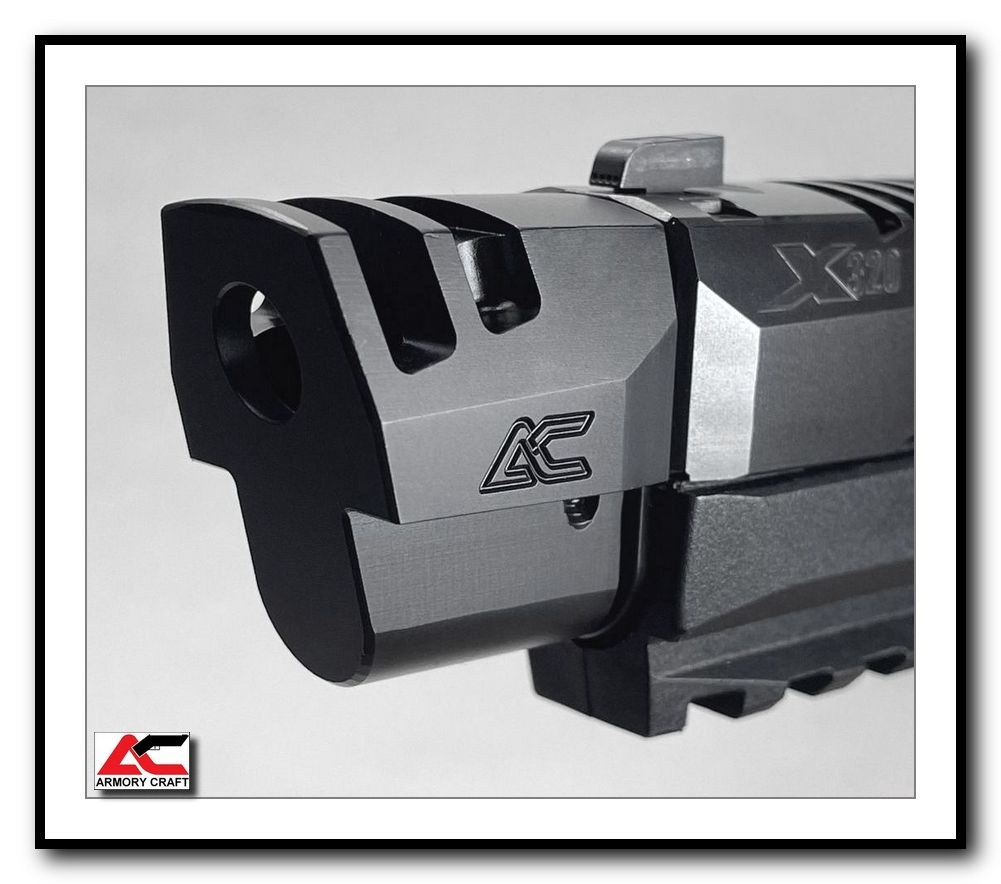
ArmoryCraft (Armory Craft, armorycraft.com) sells two P320 compensators, and search-engine summaries attach the part number to the wrong one. The SKU recorded for the pistol documented here, P320-COMP-RH, appears in the maker’s own product data as the “P320 1/2x28RH Steel” variant of the product titled “Sig Sauer Compensators – for 9mm P320 & P226, P228, P229, P225/P6”, which the page heads “1 Port / 2 Baffle Design.” The other product — “Sig Sauer P320 / P250 Compensator – 2 Port Design 1/2 x 28 RH” — is a longer two-port comp with its own SKU, P320-COMP-RH-2PORT-BLK.34
6.3.2 What “RH” means
Right-hand thread. The maker’s own warning: “Please make sure to order the correct thread pitch compensator that matches the thread pitch on your barrel. (i.e 1/2x28 RH compensator for a 1/2x28 RH threaded barrel and 13.5 x1 LH compensator for a 13.5x1 LH threaded barrel).” The left-hand metric version, P320-COMP-LH, exists for SIG’s own 13.5×1 left-hand-threaded barrels.3 A left-hand comp will not start on the SilencerCo barrel at all; a right-hand comp will not start on a SIG metric barrel. This is the whole reason the part number carries the suffix.
6.3.3 What the maker says about it
Table 2 — What the maker says about it
| ArmoryCraft’s statement | |
|---|---|
| Fit | ”P320/M17/M18/X5: 1/2x28 RH - black nitride over steel” |
| Needs | ”THREADED BARRELS REQUIRED.” Fits factory threaded barrels and aftermarket barrels that conform to the “industry standard” external dimensions of the protruding portion; “most BARSTO barrels do not conform” |
| Size | ”Length: 33.25 mm (1.3”), Weight: 88 g (3.1 oz)“ |
| Construction | ”CNC machined out of solid steel billet (NOT a MIM part)”; “A set screw and a wrench are included”; “MADE IN USA.” |
| Calibre | ”9mm only - NOT for .40S&W, .357 Sig or 45 ACP.” |
| Price | $99.75 on 19 September 2026 |
| Claim | ”Reduces perceived recoil by at least 30%” |
The 30 per cent figure is the maker’s claim, pointing to an image in its gallery; no test method is stated on the page, and it is reported here as a claim, not a measurement. “Perceived recoil” is not a quantity any standard defines.3
6.3.4 How a pistol compensator works, and its limits
A handgun’s muzzle rises because the bore axis sits above the hand: the rearward push of recoil acts above the point that resists it, and the result is a moment that rotates the muzzle upward. A compensator attacks that directly. Ports in the top of the device let a share of the gas escape upward as it leaves the muzzle; gas driven upward pushes the device, and so the barrel, downward. Baffles inside the device — the “two baffle” in ArmoryCraft’s description — are the surfaces the gas strikes on its way out, which is where the redirected momentum is actually transferred to the gun.
Two limits follow from the physics and are worth stating plainly, because they are not in any product description.
The effect scales with gas, and a 9 mm pistol does not make much. A compensator works on the propellant gas behind the bullet. A 9×19 charge in a 4.7- to 5.5-inch barrel is small in mass beside a rifle cartridge, and the gas is at far lower pressure when the bullet leaves a pistol muzzle than when a rifle’s does. A pistol comp is therefore modest in its effect beside a rifle brake, and it works better with ammunition that leaves more gas at the muzzle. How much better, for which load, is a measurement nobody publishes in a form that can be checked.
It does its work at the cost of blast. Gas sent upward and sideways at the muzzle is gas sent toward the shooter’s field of view and toward anyone beside the line. The How Suppressors Work dive, Volume 1 makes the rifle version of the point: a muzzle brake makes a gun louder at the shooter’s position because that is where it aims the blast.
⚠ Not recorded, and it matters for this build specifically: whether the ported top of the comp throws gas or carbon toward the DeltaPoint Pro’s front lens. On the Raider X the optic sits on the chassis rail rather than on the slide (Volume 7), and how far the lens is from the muzzle determines the answer. It is a question for the owner and a photograph after a range session.
6.4 Why the Spring Has to Change
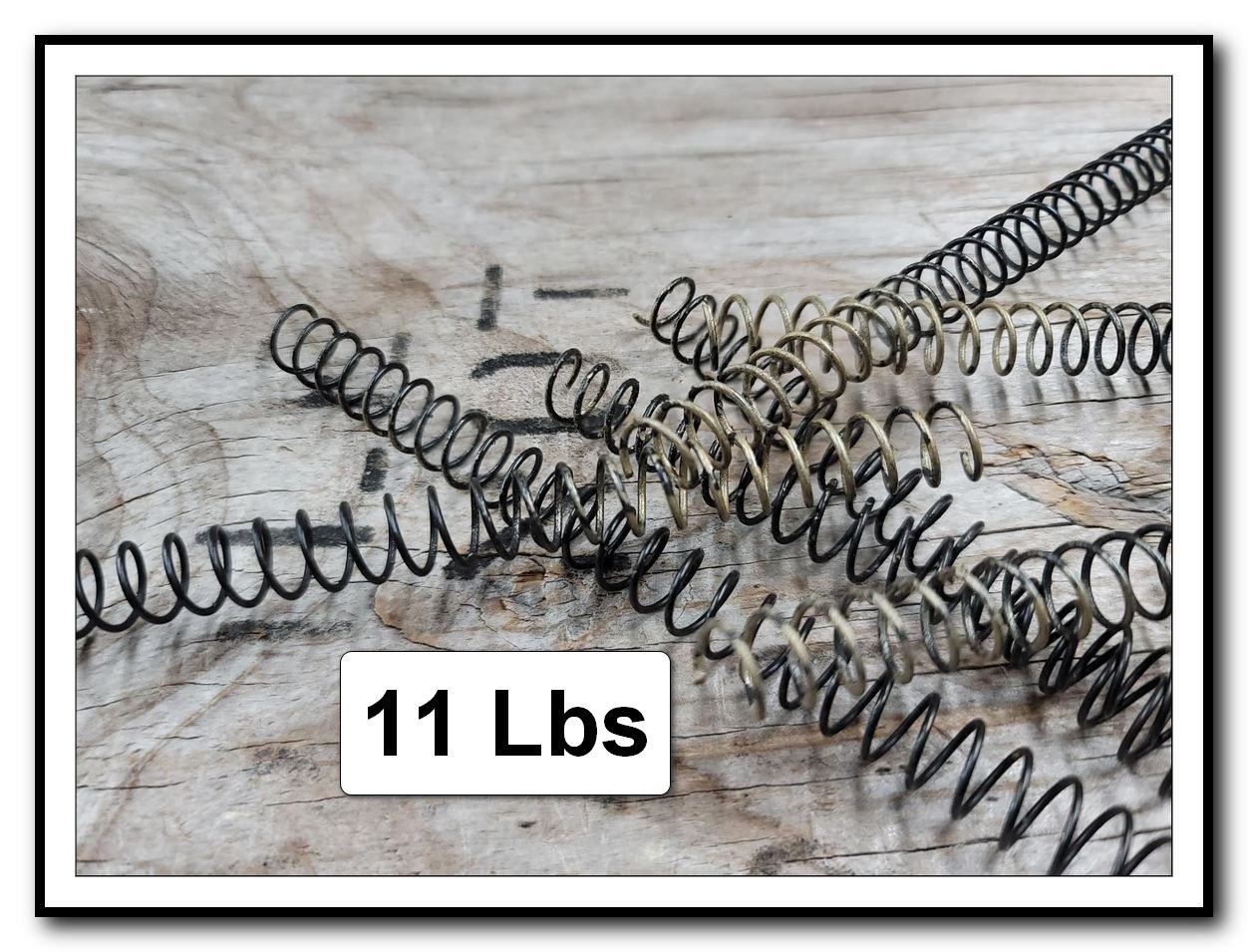
ArmoryCraft puts it in one sentence on both comp pages: “When utilizing a compensator, you will need to adjust your recoil spring weight.” Its tuning-kit page adds that its 12 lb and 11 lb springs “are designed specifically for tuning compensators and supressors, or to be used with lower power / competition reloads. If using a compensator, we highly suggest to purchase also the 11lb spring.”5 The maker gives no physics. The reasoning is straightforward and is set out here as reasoning, not as a maker’s statement.
The P320 is a short-recoil, tilting-barrel pistol: barrel and slide recoil locked together for a short distance, the barrel is cammed down out of engagement, and the slide continues rearward alone, compressing the recoil spring, then returns under the spring’s force to strip and chamber the next round. The energy available to do that work comes from the recoil impulse. The recoil spring is sized so that the slide has enough energy to travel fully rearward — far enough to eject the case, pick up the next round and lock open on an empty magazine — without arriving so hard that it batters the frame.
A compensator subtracts from that budget. Every bit of gas momentum it redirects is momentum that no longer drives the slide rearward, and the device’s own mass sits on the barrel that has to move before it unlocks. With the factory spring, the slide can arrive short: the classic symptoms are failures to eject, failures to feed, and a slide that does not lock back on the last round. A lighter spring restores the margin.
The ArmoryCraft parts that do this on the pistol documented here:
Table 3 — The ArmoryCraft parts that do this on the pistol documented here
| Part | Maker’s description | SKU | Price (19 Sept 2026) |
|---|---|---|---|
| Guide rod and spring tuning kit | ”P320 FULL (NOT X5/Compact) Kit - Guide Rod+3 Spgs” — “ONE Premium Hardened Steel Guide Rod in Black QPQ finish” + “THREE Recoil Springs (15, 14 and 12 lbs)“ | P320FULL-TUNING-KIT-BLK | $44.95 |
| 11 lb spring | ”11# GOLD Recoil Spring (Spring ONLY)“ | 11LB-GOLD-SPRING0 (as printed) | $8.95 |
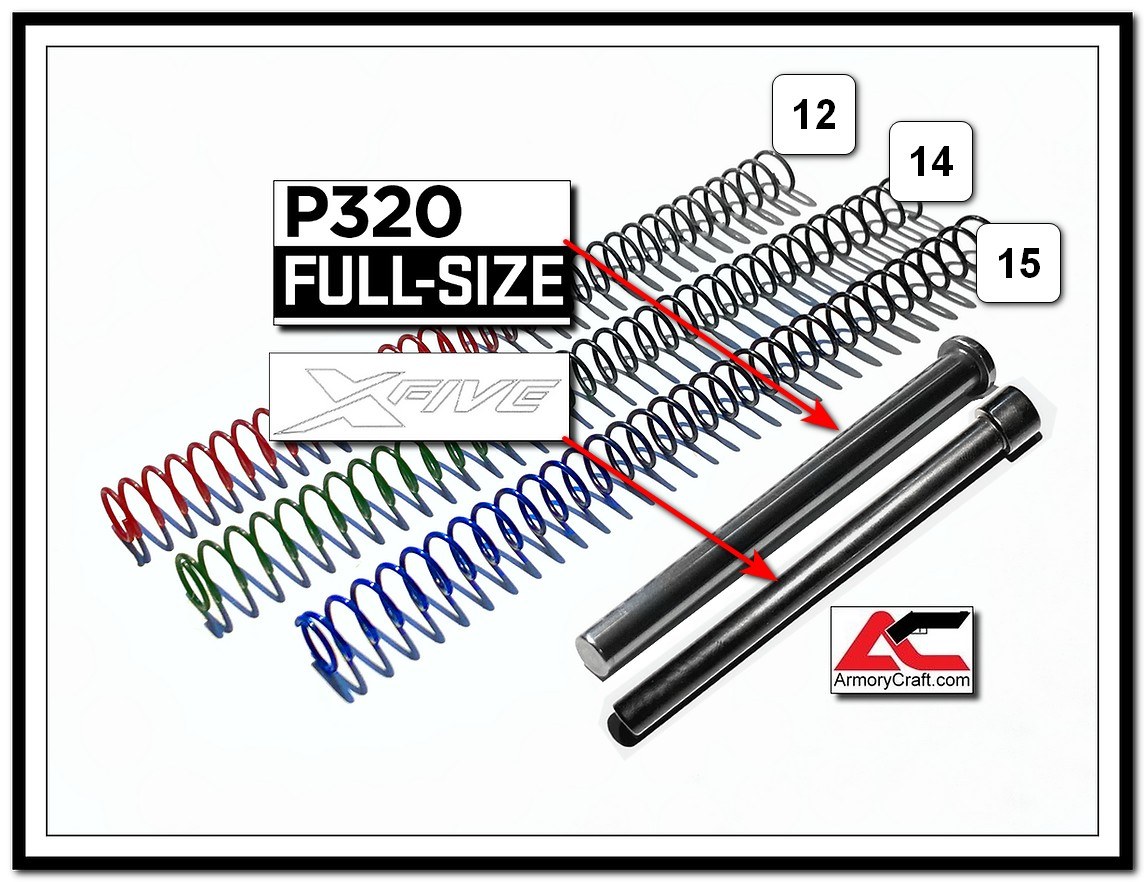
The kit’s fitment line is specific and matches this pistol: “For FULL size P320 pistols (incl. X-FULL, M17, AXG Pro, P320-AXG Legion & VTAC),” and it “Will NOT fit Sub-Compact, Compact, M18, X-Compact or X-Carry models.”5 Two design points separate it from the factory part. SIG’s recoil spring is a captive assembly — rod and spring held together as a unit. The ArmoryCraft kit is a solid rod with loose springs that the maker describes as “Top quality 1911 springs currently used in X-Five Legion,” which is what makes the spring weight a choice rather than a fixed part.5
⚠ The factory spring weight is not stated here because it could not be sourced. Neither ArmoryCraft nor any SIG page examined gives the rated weight of SIG’s full-size captive spring, so no “down from X pounds” comparison is made. ArmoryCraft’s own wording is that its springs “meet or exceed OEM strength and quality,” which is a claim about quality, not a like-for-like weight.
6.4.1 Tuning it: what the spring is being judged against
No maker publishes a procedure for choosing among 15, 14, 12 and 11 lb springs for a given comp and load, and none is invented here. What a correct choice must satisfy can be stated without one:
- The slide must lock open on an empty magazine, every time, with the ammunition actually carried. This is the most sensitive symptom of a slide arriving short, and it is the one the Army’s own initial test found most often on the issue pistol for other reasons (Volume 1).
- Empties should leave cleanly and consistently. Cases dribbling out, or stovepiping, point to too little slide energy; cases thrown violently a long way, and a hard impact at the rear, point to too little spring.
- The choice is load-specific. The spring that runs one 124-grain load reliably with the comp may not run a softer 115-grain practice load. ArmoryCraft’s own note that the light springs also suit “lower power / competition reloads” says the same thing from the other side.
- Recoil springs are consumables. A spring chosen on a new comp will weaken with use; the chosen weight is the starting point for a maintenance interval, not a permanent setting (Volume 8).
6.5 The Other Thing the Thread Can Carry — a Suppressor
The same 1/2×28 thread that carries the compensator would carry a pistol suppressor. The two are alternatives: the comp comes off (it is retained by a set screw ArmoryCraft supplies) before a can goes on. No suppressor is recorded for the pistol documented here; this section exists because the interaction with the spring runs the opposite way and a reader moving between the two configurations needs to know it.
A suppressor on a tilting-barrel pistol needs a booster. Hanging the mass of a can on the muzzle stops the barrel unlocking, and the fix is a Nielsen device — a spring-loaded piston in the rear of the can that lets the barrel move while the can briefly stays put. This hub treats it in full in the Suppressors by Caliber dive, Volume 6 and the How Suppressors Work dive, Volume 7; SilencerCo’s own barrel page makes the same point in its note that a piston is “sold separately.”2
And the spring goes heavier, not lighter. The chassis maker’s advice for suppressed use of this platform is explicit: “For the Raider X, it is highly encouraged to use a nicely broken in 14lbs spring with most suppressors on the market.”6 A comp takes energy away from the slide; a suppressor’s back-pressure, and a booster’s behaviour, can give it more. The same pistol can want an 11 lb spring in one configuration and a 14 lb spring in the other, which is a strong argument for keeping the spring choice written down with the configuration it belongs to.
On a full-size slide in the Raider X, the muzzle device is optional. Flux’s compatibility note says that “To use with P320 carry, compact, or subcompact slides, you must run a comp, threaded barrel, or suppressor — failure to do so may cause injury.” The requirement applies to the shorter slides; on the full-size slide of the M17 the chassis does not require any muzzle device, and the comp on this pistol is a choice, not a fitment necessity.7
References
Footnotes
-
The unit documented here: owner’s inventory sheet (last modified 2026-09-17) and the owner’s update of 2026-09-19 that all ordered parts are received and installed; the sheet lags. Recorded in the dive’s
00-inventory/. ↩ -
SilencerCo, “Threaded Barrel” product page, variant “SIG P320 Full Size (1/2 X 28)”, SKU AC2413, “5.46″ length”, $169.00; compatibility statement and material, thread-protector and piston notes quoted. silencerco.com refused automated access on 2026-09-19; read from the Internet Archive capture of the maker’s own page, 9 February 2026: https://web.archive.org/web/20260209140516/https://silencerco.com/shop/threaded-barrel/ (original https://silencerco.com/shop/threaded-barrel/). ↩ ↩2 ↩3 ↩4
-
Armory Craft, “Sig Sauer Compensators – for 9mm P320 & P226, P228, P229, P225/P6,” variant “P320 1/2x28RH Steel,” SKU P320-COMP-RH, $99.75; specification, thread warning, fitment and claim quoted. https://www.armorycraft.com/product-page/sig-sauer-compensators-p320-p226-228-229 (accessed 2026-09-19). ↩ ↩2 ↩3
-
Armory Craft, “Sig Sauer P320 / P250 Compensator – 2 Port Design 1/2 x 28 RH,” SKU P320-COMP-RH-2PORT-BLK, $99.75. Cited only to distinguish it from the one-port part. https://www.armorycraft.com/product-page/sig-sauer-p320-p250-compensator-2-port-design (accessed 2026-09-19). ↩
-
Armory Craft, “P320 Full Size / P320 X5 & X5 Legion Solid Guide Rod & Recoil Spring Tuning Kit,” variants P320FULL-TUNING-KIT-BLK ($44.95) and “11# GOLD Recoil Spring (Spring ONLY)” 11LB-GOLD-SPRING0 ($8.95); fitment, contents and spring notes quoted. https://www.armorycraft.com/product-page/p320-p320-x5-legion-style-solid-guide-rod-recoil-spring-tuning-kit (accessed 2026-09-19). ↩ ↩2 ↩3
-
Flux Defense, “Frequently Asked Questions,” item 47 quoted. https://fluxdefense.com/frequently-asked-questions (accessed 2026-09-19). ↩
-
Flux Defense, “Raider X P320” product page, compatibility section quoted. https://fluxdefense.com/shop/raider-x (accessed 2026-09-19). ↩
Comments (0)