SIG P320-M17 · Volume 1
The Modular Handgun System — the Trial, the Protest, and the Pistol the Army Got
From a 2004 requirement to a $580 million award, Glock's protest, and what the Army's own testers found
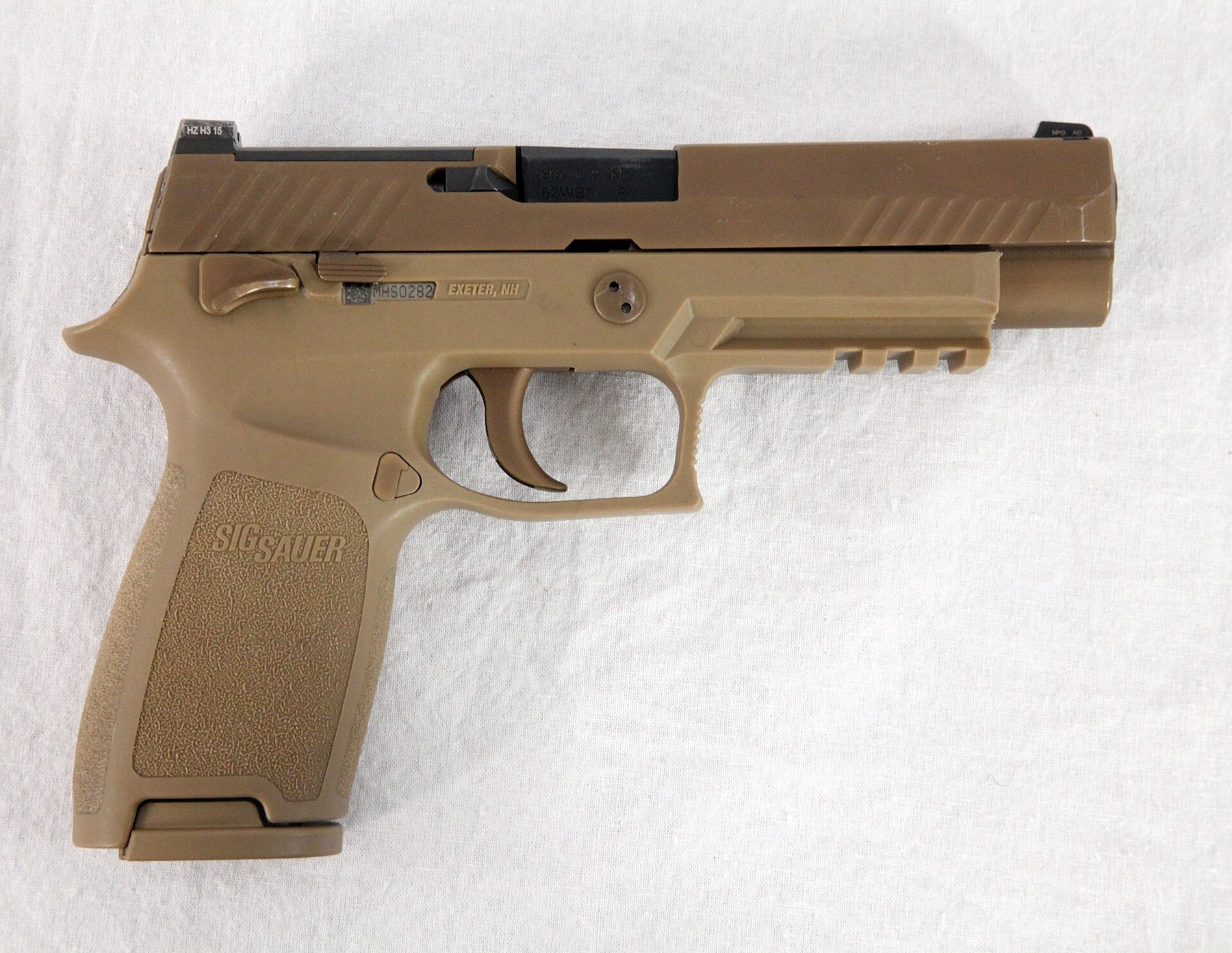
The P320-M17 is a commercial pistol named after a military one. Its name, its coyote-tan slide and its thumb safety all come from the United States Army’s Modular Handgun System (MHS) programme, which chose a variant of SIG Sauer’s P320 in January 2017 to replace the Beretta M9. To understand what the commercial M17 is, and why it has the features it has, it helps to know what the Army asked for, what it chose, and what its own testers found when they shot it.
That story is told here from the documents: the Government Accountability Office’s decision on Glock’s protest, the Department of Defense’s contract notice, the Director of Operational Test and Evaluation’s annual reports for 2017 and 2018, the Congressional Research Service’s summary of the procurement, and the services’ own fielding announcements. Where the documents give figures that do not agree, each is given with its source and none is averaged.
1.1 Replacing the M9
The M9 had been the standard American service pistol since the mid-1980s. The Army’s 1985 contract for it, the Congressional Research Service records, “was for 315,930 weapons for approximately $75 million and by 1988 had been increased to 321,260 weapons for approximately $77.3 million.”1
The effort to replace it began long before the MHS. In CRS’s summary: “The Army launched its effort to replace the Beretta in 2004, adopted the Capabilities Production Document from the Air Force in 2013, released the Request for Proposal in August 2015, and awarded a contract in January 2017.” The 2004 “Future Handgun System” was merged with Special Operations Command’s Combat Pistol programme into a “Joint Combat Pistol program”; “The Army eventually removed itself from this program in September 2006.”1
The programme was criticised for its length and cost while it ran. The Army’s Chief of Staff, General Mark Milley, is reported by CRS to have said in March 2015: “We’re not figuring out the next lunar landing. This is a pistol. Two years to test? At $17 million? … I’ll call Cabela’s tonight.” CRS itself flags the quotation as reported. A report from Senator John McCain’s office criticised a “lack of clarity within the request for proposal (RFP) regarding weapon caliber” and recommended suspending the solicitation “until the caliber issue was resolved”; CRS adds, drily, “(The RFP was not cancelled.)“1
1.2 What the Army Asked For
The solicitation was RFP W15QKN-15-R-0002, issued by Army Contracting Command on 28 August 2015 and amended six times.2 Its structure, as quoted by GAO, is the key to everything that followed.
- Up to three awards, then one. “The Government intends to award up to three (3) Firm Fixed Price (FFP), Indefinite Delivery/Indefinite Quantity (IDIQ) contracts based on the results of the initial evaluation … The Government will then make a final down-selection to a single contractor.”
- One pistol or two. “Each MHS offeror could propose either a one-handgun solution of a full-size handgun, or a two-handgun solution consisting of a full-size handgun and a compact handgun.”
- A pistol and its ammunition, together. Offerors priced “ball, special purpose, blank and dummy drilled inert ammunition” alongside the handgun, accessories and spare parts. “The period of performance is 10 years for the handgun and accessories and 5 years for the ammunition.”
- Scale. The pricing worksheets called for “up to 550,000 full size MHS pistols” and, in a two-gun bid, “up to an additional 150,000 compact MHS pistols.” The Army’s position was that “the Government requirement is for 550,000 guns.”
The evaluation had nine factors in descending importance, led by a bid-sample test — reliability, accuracy, projectile characteristics and ergonomics — and ending with price, past performance and small-business participation. “The combination of all non-price factors was significantly more important than price.” Full-size reliability was evaluated over “12,500 rounds to achieve a 90 percent confidence level of 2,000 MRBS” (mean rounds between stoppages).2
DOT&E’s later report sets out the numbers the pistol had to meet:3
Table 1 — What the Army Asked For
| Requirement | Figure |
|---|---|
| Accuracy | ”10 shots at 35 meters can be covered by a 4-inch disk, with the center of the grouping being no more than 4 inches from the point of aim, 90 percent of the time” |
| Reliability (failures) | 5,000 mean rounds between failures |
| Reliability (stoppages) | 2,000 mean rounds between stoppages |
| Service life | 25,000 rounds per pistol |
Two features that matter to the commercial pistol were part of the requirement. The manual safety was an evaluated item — “Offerors were informed that the Army would evaluate the ability of the user to operate the safety as part of the joint warfighter ergonomics subfactor” — although whether a safety was mandatory is not stated in the pages read.2 And the pistol was to be suppressor-ready: “The Army intends for the MHS to be operable with a future suppressor.”3
⚠ The calibre question. The MHS is often described as an “open calibre” competition in which 9 mm was not fixed. The primary evidence available is indirect: McCain’s complaint about calibre clarity, and GAO’s description of the two finalists as “the Glock 9mm one-gun proposal and the Sig Sauer 9mm two-gun proposal,” a qualifier that only makes sense if other calibres were possible. The RFP’s own calibre language was not retrieved, and specific penetration criteria quoted in secondary accounts could not be verified.
1.3 The Field
“The agency received a total of nine proposals from five offerors by the deadline of February 12, 2016.”2 Bid-sample testing ran from 16 February to 22 June 2016.3
Three of the five offerors are documented on primary pages. SIG Sauer and Glock are named in GAO’s decision. Smith & Wesson, with General Dynamics as its partner, disclosed its exit to the Securities and Exchange Commission on 23 September 2016: “We and our partner in the pursuit of the U.S. Army’s Modular Handgun System, or MHS, solicitation to replace the M9 standard Army sidearm have been notified by the Department of the Army that our proposal was not selected to advance to the next phase of the competition.”4 The other two offerors are named only in press accounts and are not named here.
On 29 August 2016 the Army “established a competitive range consisting of the Glock 9mm one-gun proposal and the Sig Sauer 9mm two-gun proposal.”2
1.4 The Award — 19 January 2017
The Department of Defense’s contract announcement of 19 January 2017 reads: “Sig Sauer Inc., Newington, New Hampshire, was awarded a $580,217,000 firm-fixed-price contract for the Modular Handgun System including handgun, accessories and ammunition to replace the current M9 handgun. Bids were solicited via the Internet with nine received. Work locations and funding will be determined with each order, with an estimated completion date of Jan. 19, 2027.” The contract number is W15QKN-17-D-0016.5
The $580 million is a ceiling in substance. CRS explains: “the Army can order as many or as few units as it requires, up to the $580 million contract cap.” “Under the terms of the contract, the Army cannot release unit price data.”1
The decisive factor was price. GAO’s decision reproduces the evaluated totals:2
Table 2 — The Award — 19 January 2017
| Glock | SIG Sauer | |
|---|---|---|
| Total evaluated price | $272,232,563 | $169,527,169 |
| Bid sample test – technical | Acceptable | Good |
| Initial reliability (full size) | Outstanding | Outstanding |
| System accuracy (isolated) | Marginal | Marginal |
| Ergonomics | Acceptable | Good |
| Early warfighter acceptance | Good | Acceptable |
| Licence rights – ammunition | Marginal | Outstanding |
| Production / manufacturing | Good | Outstanding |
⚠ These are total evaluated prices, not the contract value; the $580,217,000 figure is the ceiling of the awarded contract. The two are routinely confused.
The source selection authority’s reasoning, verbatim: “the Sig Sauer proposal has a slight technical advantage over the Glock proposal given that their proposal was rated higher in Factor 1 … Since there were so few other discriminators between the two proposals in most aspects, the least important factor, price, became a significant discriminator. … I cannot justify paying a price premium of over 37% for the Glock submission, even as a second award.”2
The arithmetic behind “over 37%” is easily misread as “Glock cost 37 per cent more.” The $102,705,394 difference is 37.7 per cent of Glock’s evaluated price — SIG’s price was 37.7 per cent lower. Measured against SIG’s price, Glock’s was 60.6 per cent higher. The source selection authority’s figure is the first of these.
SIG’s own release the next day called the P320 “the first modular pistol with interchangeable grip modules that can also be adjusted in frame size and caliber by the operator,” and said: “All pistols will be configurable to receive suppressors and will also include both standard and extended capacity magazines.”6
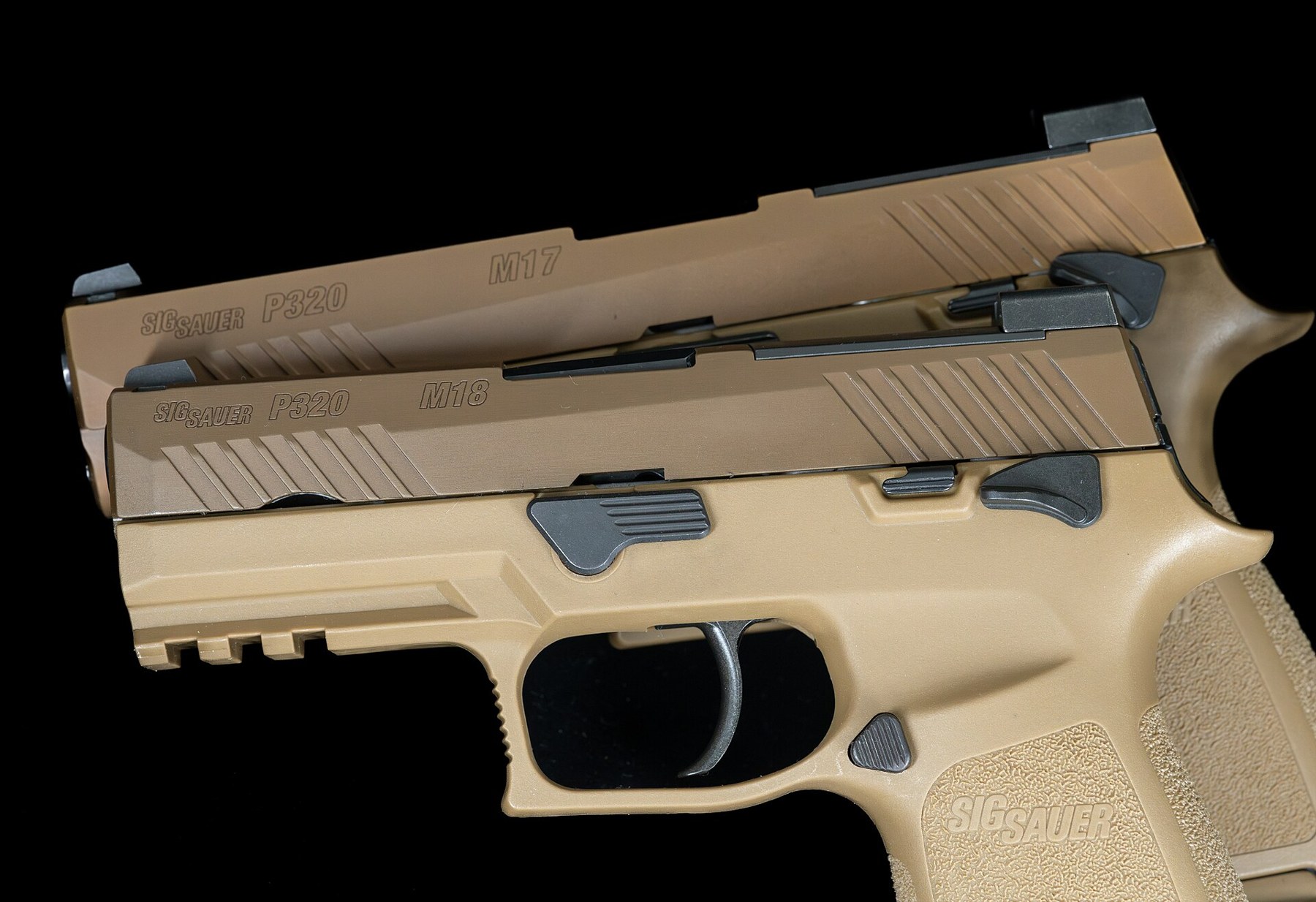
The two SIG pistols were the full-size XM17 and the compact XM18. DOT&E describes the selected submission as “the 9 mm MHS submission from SIG SAUER, which is a variant of their P320.”3
1.5 Glock’s Protest — GAO File B-414401
Glock protested on 24 February 2017. GAO decided it on 5 June 2017, file B-414401. ⚠ Other file numbers appear in circulation attached to this protest; the number printed on the decision is B-414401.2
The grounds and what GAO did with each:
Table 3 — The grounds and what GAO did with each
| Ground | GAO’s disposition |
|---|---|
| The RFP required at least two awards | Denied. “the most reasonable interpretation of the solicitation is that the Army is permitted to award only one base contract.” |
| The Army had not completed the phase-2 (section H) evaluation | Dismissed as premature; production orders had not yet been placed |
| The Army waived the compact pistol’s reliability evaluation | GAO agreed with Glock on the merits — “the Army did not evaluate the reliability test results of Sig Sauer’s compact weapon in accordance with the solicitation” — but found no prejudice |
| Errors in SIG’s price | The Army admitted compact spare parts “were not counted,” an undercount of $1,634,250; no prejudice |
| Glock’s ammunition licence-rights rating | Found “inconsistent with the terms of the solicitation”; no prejudice |
| Weighting of the manual safety | Denied (detail redacted) |
| Special-purpose ammunition penetration | The Army “acknowledges the error”; no prejudice |
“The protest is denied in part and dismissed in part.”2
The decision’s footnote 13 is the sentence most worth knowing, because it runs against the grain of how the award is usually told: “Under the factor 1 reliability evaluation, Sig Sauer’s full-sized handgun had a higher stoppage rate than Glock’s handgun, and there may have been other problems with the weapon’s accuracy.” GAO added that “Due to the Army’s redactions of the agency report, the results of Sig Sauer’s compact handgun test are unknown.”2 SIG won on price with a slight technical edge overall; on full-size stoppages in the bid-sample test, Glock’s pistol did better.
1.6 What the Army’s Testers Found
The Director of Operational Test and Evaluation reports annually to Congress, and its reports on the MHS for fiscal years 2017 and 2018 are the most detailed public record of how the pistol performed. They are quoted here because they are rarely read, and because they contain three findings that matter to anyone who owns a P320-M17.
1.6.1 Drop-fire, and a fix
From the FY2017 report: “During drop testing in which an empty primed cartridge was inserted, the striker struck the primer causing a discharge. The Army directed SIG SAUER to develop an ECP [engineering change proposal] to correct this deficiency. SIG SAUER modified the trigger mechanism to eliminate this deficiency. Subsequent testing validated that this ECP corrected the deficiency and the pistol no longer fired when dropped.” The report’s summary says the fix used “lightweight components in the trigger group mechanism,” and adds: “This fix may have contributed to the splintering of two triggers during the IOT&E.”3
⚠ This is the Army’s drop-test finding on the XM17 and XM18 during 2017. It is a different event from SIG’s commercial Voluntary Upgrade Program of August 2017, which Volume 3 covers. The two concern related mechanisms in related pistols in the same year, but no primary source consulted links them, and they are not conflated here.
1.6.2 Live rounds ejected with the empties
“During PVT [production verification testing] with the ball ammunition, both MHS variant pistols would occasionally experience double ejections in which it would eject unspent ammunition along with the spent ammunition. The frequency of this occurrence increased as more rounds were fired through the pistol.” As a result, “The ball ammunition was not included in the IOT&E because of the demonstrated reliability problems during PVT.”3
1.6.3 Reliability against the requirement
Initial operational test and evaluation took place at Fort Bragg from 14 August to 22 September 2017, with 132 shooters from every service, firing the special-purpose (hollow-point) round only. DOT&E’s verdict: “Neither weapon met the MRBS reliability requirement.” The predominant cause was the slide failing to lock back on an empty magazine — 60 of 120 stoppages on the XM17 and 63 of 85 on the XM18 — which DOT&E attributed largely to shooters’ thumbs riding the slide catch lever: “Sixty percent of all FSLR stoppages (75 of 123) were experienced by 8 shooters out of the 132.”3
The contractor then worked on the ball-ammunition problem from October 2017 to March 2018. The fix, in DOT&E’s words: “the vendor made adjustments to the magazine spring, magazine follower, slide geometry, and the internal components.”7 Retesting (PVT-2) produced the FY2018 figures below. They are on a different statistical basis from the FY2017 figures (80 per cent lower confidence bounds, with some medians) and are not merged with them.
Table 4 — Reliability against the requirement
| Mean rounds between stoppages | XM17 ball | XM17 JHP | XM18 ball | XM18 JHP |
|---|---|---|---|---|
| PVT-1 | 431* | 2,709 | 358* | 1,779* |
| PVT-2 | 1,566 | 1,880 | 3,185 | 7,833 |
* median values; all others 80 % lower confidence bound. Requirement: 2,000.7
🔴 The compact met the reliability requirement; the full-size did not. “The XM18 with both ball and jacketed hollow point ammunition exceeds the MRBS requirement of 2,000 MRBS,” while the XM17 “demonstrated 93 percent and 94 percent probability, respectively, of completing one 99-round mission without a single stoppage.” DOT&E nonetheless assessed both “operationally effective and operationally suitable with jacketed hollow point ammunition” and “lethal with the ball and jacketed hollow point ammunition,” and recommended that “The Army should confirm reliability fixes to both the XM17 and XM18 during initial fielding.”7
⚠ An oddity in DOT&E’s own table. The PVT-2 mean-rounds-between-failures figures printed for the XM18 (7,009 and 15,501) are identical to the PVT-1 figures printed for the XM17. That may be a transcription error in the report; it cannot be resolved from the page, and the failure figures are not used here.
1.6.4 What SIG said afterwards
SIG’s own account of the pistol’s reliability after fielding comes from its releases. In February 2019 it announced that the M18 had completed a lot acceptance test “with zero stoppages,” firing “three M18 pistols to an unprecedented 12,000 rounds each,” and contrasted this with a historical standard of 5,000 rounds and up to 12 stoppages — a baseline that is SIG’s statement, not a government document’s.8 The same release quotes DOT&E as finding both pistols “operationally effective and suitable.” ⚠ DOT&E’s own sentence ends “with jacketed hollow point ammunition”, and SIG’s quotation drops the qualifier.7
In November 2019 SIG reported delivering the 100,000th M17 and M18, and described the issue configuration at that date as “coyote-tan PVD coated stainless steel slides with black controls … SIGLITE front night sights, removable night sight rear plates, and manual safeties,” delivered “to all branches of the U.S. Military and the U.S. Coast Guard.”9
1.7 Quantities — Four Sources, Four Numbers
How many pistols the services intended to buy is given differently by every primary source, and the figures are not reconcilable:
Table 5 — How many pistols the services intended to buy is given differently by every primary source, and the figures are not reconcilable
| Source | Figure |
|---|---|
| RFP pricing worksheets (via GAO) | up to 550,000 full-size, plus up to 150,000 compact |
| DOT&E FY2017 | Army 238,000 (about 231,000 XM17 and 7,000 XM18); other services “may purchase 224,000” |
| DOT&E FY2018 | Army about 233,429, of which about 4.5 % XM18; other services “may collectively purchase 224,000” |
| CRS, June 2018 | Army 238,215; Air Force 130,000 compact; Navy 70,000 compact; Marine Corps funds for 35,000 compact in FY2019 |
The CRS service figures sum to 235,000, not DOT&E’s 224,000. Each is its source’s figure.
1.8 Fielding — Army M17, Everyone Else M18
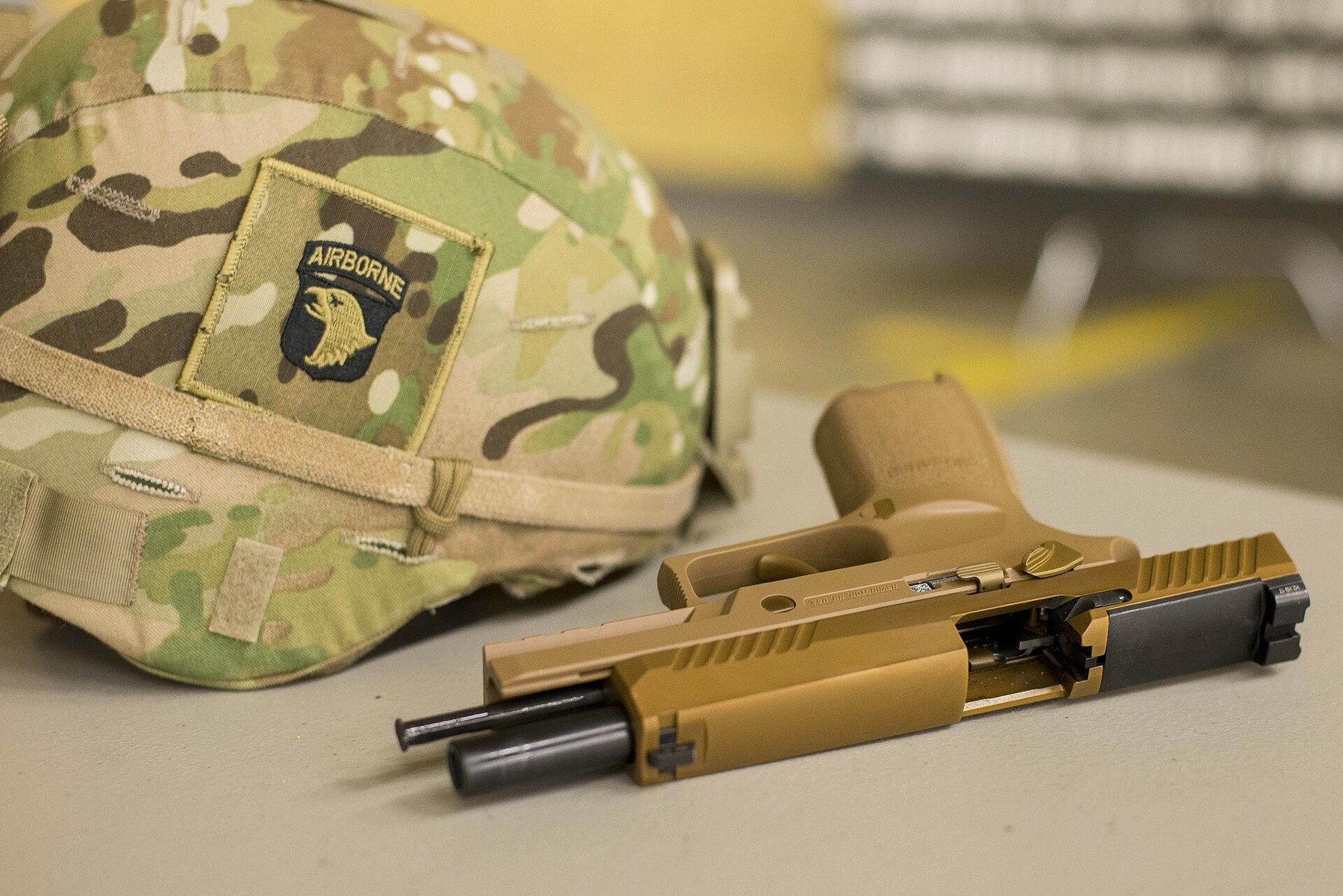
Army. “The 101st Airborne Division (Air Assault) is the first unit to receive the Army’s new Modular Handgun System that began fielding the M17 and M18 pistols, Nov 28” 2017, having received “more than 2,000 M17 and M18 handguns, Nov. 17.” The Army’s announcement lists the features a soldier would notice: “an external safety, self-illuminating sights for low-light conditions, an integrated rail for attaching enablers and an Army standard suppressor conversion kit.”10 The Army’s plan was for most soldiers to carry the full-size: “The majority of Army MHS users will use the XM17 variant. Individuals and units requiring a concealed weapon will use the XM18 variant.”3
Air Force. Fielding of the M18 to security forces began in early 2019; the Air Force announced on 4 March 2019 that “more than 2,000 M18s have been delivered,” and that the M18 replaces the M9 and is “also projected to replace the M11-A1 Compact used by the Air Force Office of Special Investigations.”11
Marine Corps. Marine Corps Systems Command began fielding the M18 in September 2020, and “The M18 will replace all other pistols in the Marine Corps inventory, including the M9, M9A1, M45A1 and M007.” “MCSC is only purchasing the M18, the compact variant.”12
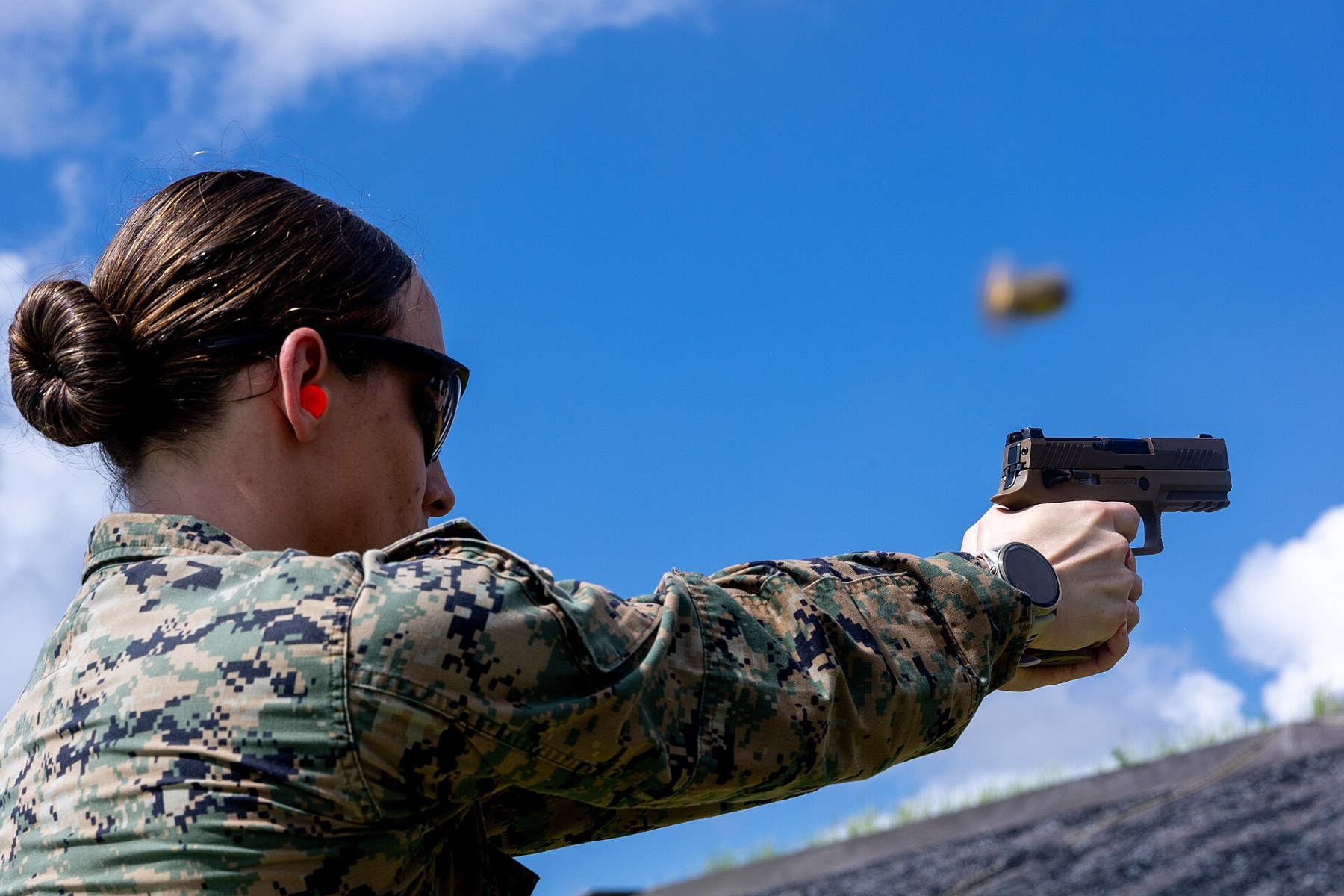
Navy. CRS records a Navy intention “to field 70,000 compact versions.”1 A Naval Safety Command dispatch on M18 mishaps notes two differences from the M9 that caught sailors out: “the ‘down’ position for the M18 manual safety is on fire” — the reverse of the M9 — and the M18 has a loaded-chamber indicator the M9 lacked.13
So the pattern is clear and slightly surprising: the Army took mostly the full-size M17; the Air Force, Marine Corps and Navy took the compact M18. The full-size pistol that gives the commercial P320-M17 its name was, outside the Army, the less-issued of the two.
1.9 The Ammunition
The MHS was an ammunition procurement as much as a pistol one, with Olin-Winchester as the ammunition contractor. DOT&E: “The XM1152 Ball cartridge uses a 115 grain truncated nose full metal jacket projectile and the XM1153 Special Purpose cartridge uses a 147 grain jacketed hollow point projectile.” Each pistol came with “two 21-round magazines and one 17-round magazine.”3 The type-classified designations without the X — M1152 and M1153 — are in common use; the date the X was dropped was not established from a government page.
1.10 What This Means for the Commercial Pistol
The commercial P320-M17 inherited from this programme its thumb safety, its coyote finish, its optic cut and its full-size slide. It did not inherit a reliability result that belonged to it: the testing above was of the Army’s XM17 and XM18, before and after fixes the contractor made in 2017 and 2018. Volume 2 takes up what the commercial pistol is, how it differs from the issue gun, and the part of it that is legally the firearm.
References
Footnotes
-
Congressional Research Service, The Army’s Modular Handgun Procurement, IF10911, version 2, 19 June 2018 (Moshe Schwartz, Jason A. Purdy). https://www.congress.gov/crs_external_products/IF/PDF/IF10911/IF10911.2.pdf (accessed 2026-09-19). ↩ ↩2 ↩3 ↩4 ↩5
-
U.S. Government Accountability Office, Matter of: Glock, Inc., File B-414401, 5 June 2017 (redacted public version). Source of the RFP number and date, structure, quantities, factors, field, competitive range, evaluated prices, ratings, source-selection reasoning, protest grounds and dispositions, and footnote 13. https://www.gao.gov/assets/b-414401.pdf (accessed 2026-09-19). ↩ ↩2 ↩3 ↩4 ↩5 ↩6 ↩7 ↩8 ↩9 ↩10
-
Director, Operational Test and Evaluation, FY2017 Annual Report, “XM17/XM18 Modular Handgun System (MHS),” Army programs, pp. 133–136. https://www.dote.osd.mil/Portals/97/pub/reports/FY2017/army/2017mhs.pdf (accessed 2026-09-19). ↩ ↩2 ↩3 ↩4 ↩5 ↩6 ↩7 ↩8 ↩9
-
Smith & Wesson Holding Corporation, Form 8-K, Item 8.01, filed 23 September 2016. https://www.sec.gov/Archives/edgar/data/1092796/000119312516718469/d264628d8k.htm (accessed 2026-09-19). ↩
-
U.S. Department of Defense, Contracts, Release No. CR-012-17, 19 January 2017, Army section. defense.gov refuses automated requests; read from the Internet Archive capture of the Department’s own page (23 January 2017): https://www.defense.gov/News/Contracts/Contract-View/Article/1054538 ↩
-
SIG Sauer, “SIG SAUER, Inc. Awarded U.S. Army Contract for New Modular Handgun System (MHS),” 20 January 2017. Read from the Internet Archive capture of SIG’s own page; sigsauer.com refuses automated requests. https://www.sigsauer.com/blog/sig-sauer-inc-awarded-u-s-army-contract-new-modular-handgun-system-mhs ↩
-
Director, Operational Test and Evaluation, FY2018 Annual Report, MHS, Army programs, pp. 111–112. https://www.dote.osd.mil/Portals/97/pub/reports/FY2018/army/2018mhs.pdf (accessed 2026-09-19). ↩ ↩2 ↩3 ↩4
-
SIG Sauer, “SIG SAUER M18 Sets New Standard for U.S. Army’s Modular Handgun System (MHS) Reliability Testing,” 5 February 2019; read from the Internet Archive capture of https://www.sigsauer.com/blog/sig-sauer-m18-sets-new-standard-for-u-s-armys-modular-handgun-system-mhs-reliability-testing ↩
-
SIG Sauer, “SIG SAUER Delivers Milestone 100,000th M17/M18 Handgun to U.S. Military,” dateline 19 November 2019; read from the Internet Archive capture of https://www.sigsauer.com/blog/sig-sauer-delivers-milestone-100000th-m17-m18-handgun-to-u-s-military ↩
-
Lt. Col. Martin O’Donnell, “101st Airborne Division fields Army’s new modular handgun system,” army.mil, 29 November 2017. https://www.army.mil/article/197497/101st_airborne_division_fields_armys_new_modular_handgun_system ↩
-
Vicki Stein, “AFSFC begins delivery of new Air Force-wide handgun,” af.mil, 4 March 2019. https://www.af.mil/News/Article-Display/Article/1773597/afsfc-begins-delivery-of-new-air-force-wide-handgun/ ↩
-
Matt Gonzales, Marine Corps Systems Command, “Marine Corps fields first new service pistol in 35 years,” 22 September 2020, DVIDS News ID 378381. https://www.dvidshub.net/news/378381 ↩
Comments (0)