SIG P320-M17 · Volume 4
The Build — Eleven Parts, One System, in a Flux Raider X
What each part is, what it changes mechanically, and why it is on the pistol documented here
The pistol documented here is the most heavily modified gun in the collection it belongs to. As of September 2026 it is a commercial P320-M17 fire control unit and slide, moved out of SIG’s grip module and into a Flux Defense Raider X chassis, carrying ten other non-factory items.1 This volume is the build as a whole. It takes each part in turn — what the part is, what it changes mechanically, why it is there — and then shows how they depend on one another, because they were not chosen independently and cannot be understood that way.
The muzzle parts (barrel, compensator, guide rod and spring) have their own volume, Volume 6, and the sighting parts (optic, mount, light) theirs, Volume 7. The legal questions the chassis raises are in Volume 5. This volume covers the chassis and the controls, and ties the rest together.
4.1 The Configuration, Dated
Configuration changes, so it is given here as a record at a date rather than as a description of the pistol. The source is the owner’s inventory sheet, last modified 17 September 2026, updated by the owner on 19 September 2026 to say that the five items the sheet still lists as ordered have been received and installed.
Table 1 — The Configuration, Dated
| # | Item | Maker’s name for it | Role | Where treated |
|---|---|---|---|---|
| 1 | Chassis | Flux Defense Raider X P320 | replaces the grip module | this volume |
| 2 | Safety-delete pin | (maker not recorded) | fills the manual-safety lever hole in the FCU | this volume |
| 3 | Charging handle | Tactical Development RipStik | side handle in the slide’s front-sight channel | this volume |
| 4 | Thumb rest | Tactical Development Forward Operating Pedal (“gas pedal”) | support-hand thumb rest on the chassis | this volume |
| 5 | Threaded barrel | SilencerCo Threaded Barrel, SIG P320 Full Size, 1/2×28 | replaces the factory barrel | Vol 6 |
| 6 | Compensator | Armory Craft P320-COMP-RH | muzzle device on the thread | Vol 6 |
| 7 | Guide rod + spring kit | Armory Craft P320 Full Size tuning kit | solid rod and loose springs | Vol 6 |
| 8 | Recoil spring | Armory Craft 11 lb | the spring actually chosen | Vol 6 |
| 9 | Reflex sight | Leupold DeltaPoint Pro, 6 MOA | optic | Vol 7 |
| 10 | Optic mount | Leupold DeltaPoint Pro Picatinny mount | puts the optic on a rail | Vol 7 |
| 11 | Weapon light | Streamlight TLR-1 HL | light | Vol 7 |
4.2 The Chassis — Flux Defense Raider X
4.2.1 What it is
Flux Defense calls the Raider X “a premium personal defense weapon chassis system engineered for the SIG Sauer® P320, M17, and M18 family of pistols,” and is careful to add: “It’s not a firearm — it’s a purpose-built chassis upgrade.”2 It is a polymer housing that takes the place of the P320’s grip module. The FCU and slide install into it “the same way you would a standard grip module,” in Flux’s words, and the barrel, recoil spring and slide travel exactly as they do in the grip module.3
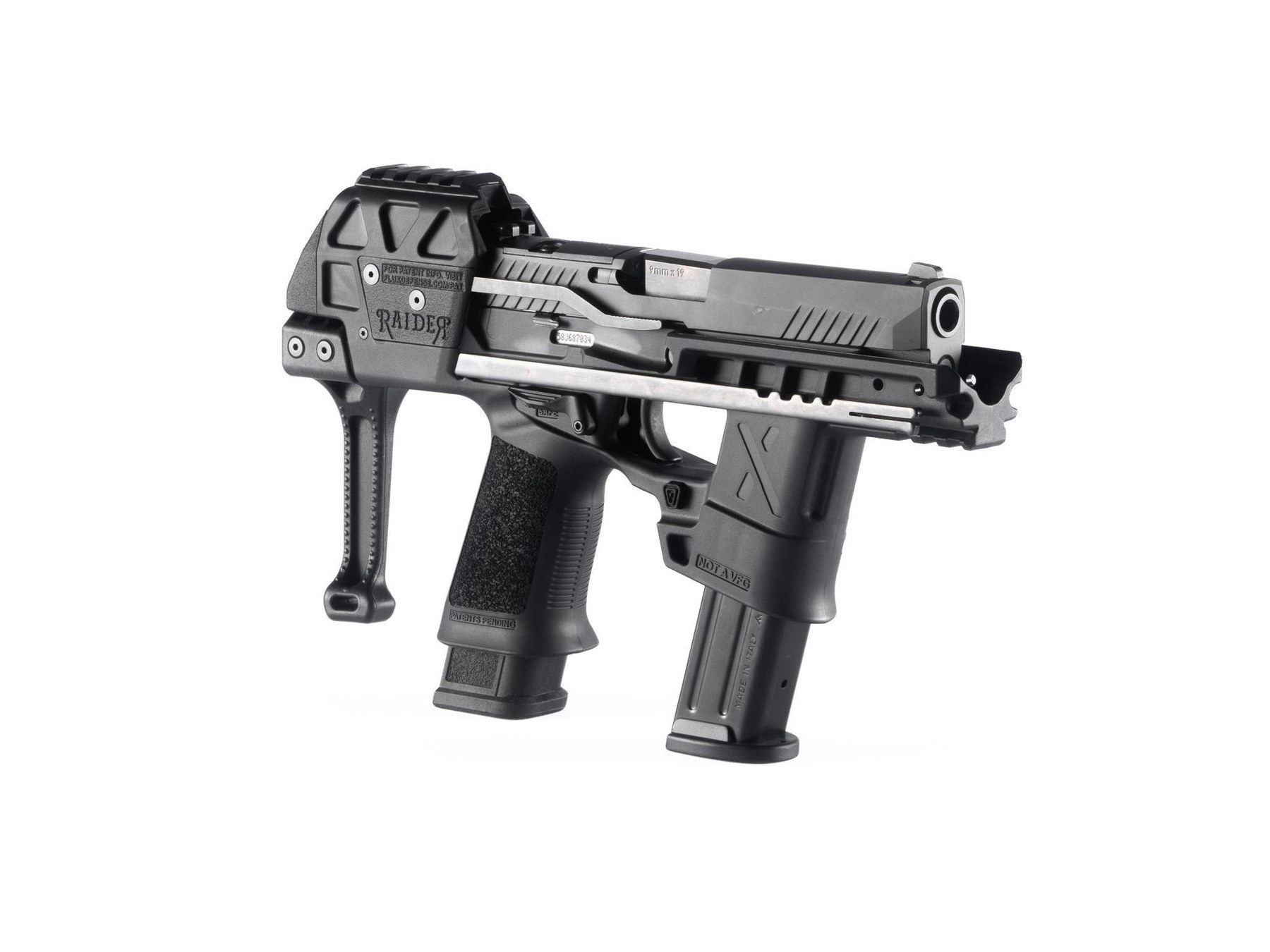
What Flux lists as built in, verbatim:2
- “Spring loaded telescopic brace/stock deployment”
- “Built in trigger block manual safety”
- “Built in spare magazine caddy”
- “Speedload System (faster magazine changes in tight spaces)”
- “2 built in QD sling mounts”
- “Built in non reciprocating optic mount”
The maker gives its weight as 18 oz. Its SKU is X-RAIDER and the page price was $419.99 on 19 September 2026. Side accessory rails are a separate item ($49.99 the same day). Flux does not publish the chassis’s overall length collapsed or extended, and none is stated here; it is a measurement, and it is owed.
4.2.2 What it changes mechanically
Nothing about the action. The pistol still fires, locks, unlocks and cycles as a P320: the FCU, slide and barrel are SIG’s (the barrel on this pistol is SilencerCo’s). What the chassis changes is everything around the action:
- How the pistol is held and braced. A telescoping rear member, a longer and wider body, a spare magazine carried in the front of the chassis (the “caddy” in Flux’s list). The P320’s own magazine still feeds from the grip.
- Where the sights and accessories live. The chassis carries a fixed top rail above the slide — the optic on this pistol sits there, not on the slide — and a 1913 rail underneath for a light.
- How the slide is reached. The chassis surrounds the slide’s sides, which is the reason a charging handle exists for it (the RipStik, below).
- Where the safety is. The chassis carries its own trigger-block safety, and it requires the M17’s thumb safety to be removed (next section).
4.2.3 Compatibility, from the maker
Flux’s compatibility statement is precise and every clause of it bears on this pistol:2
- “Compatible with SIG M17/18 and P320 (9mm, .40 S&W, .357 SIG).”
- “NOT compatible with: P320 XTEN, .45 ACP variants, suppressor-height iron sights, or 15-round magazines.”
- “M17/18 manual safeties must be removed and replaced with an OEM pin (simple mod).”
- “Safety mechanism may not work with all aftermarket or adjustable triggers — verify before use.”
- “To use with P320 carry, compact, or subcompact slides, you must run a comp, threaded barrel, or suppressor — failure to do so may cause injury.”
The last clause does not apply to this pistol’s full-size slide; the compensator here is a choice, not a requirement (Volume 6). And Flux’s warranty — lifetime and transferable — is voided by “Cutting or altering the optic mount,” “Removing safety notches,” and “Painting or cerakoting the chassis.”3
4.2.4 Why it is on this pistol
The owner’s record does not give a reason, and none is invented. What the chassis provides that the grip module cannot is stated above: a braced or stocked hold, a non-reciprocating optic rail, a light rail, a spare magazine, and sling points. Those are the chassis’s reasons for existing, as its maker describes them.
⚠ Brace or stock is not recorded. Flux sells the Raider X with a brace to the public and stocks separately for owners who register the pistol as a short-barrelled rifle. The distinction is the whole of Volume 5, and the record for this pistol says only “Raider X P320 Chassis System.” This series describes the chassis as sold with a brace and does not say which is fitted.
4.3 The Safety Delete — Why a Chassis Makes One Necessary
4.3.1 What the M17’s safety is
The commercial P320-M17 is sold with an ambidextrous thumb safety. SIG’s manual: “The manual safety mechanically blocks the movement of the trigger bar, preventing release of the striker.” The levers are linked — “Pressing up on the lever from either side will rotate the opposite lever upward, engaging the manual safety.”4 The safety lives in the FCU: SIG’s own manual-safety parts kit lists “Left & right manual safety lever,” “Manual safety detent,” “Manual safety detent spring” and a “Manual safety trigger bar,” and notes that “A manual safety configured FCU requires an accompanying manual safety grip module” — one with cut-outs for the levers.5
4.3.2 Why the chassis needs it gone
The Raider X has no cut-outs for the levers. Flux’s instruction is unambiguous — “M17/18 manual safeties must be removed and replaced with an OEM pin” — and its support page explains: “It WILL NOT work with M17/18 manual safety. You need to install a safety delete pin for the FCU to drop in,” recommending “the manual safety delete pin from Sig. This pin will allow you to convert your FCU to one without the manual safety.”6 The pin fills the hole the safety levers’ shaft occupied, so that the FCU presents the same outline as a non-safety FCU.
What it changes mechanically: the thumb safety that blocked the trigger bar is gone. In its place, the chassis’s own “Built in trigger block manual safety” does the equivalent job from outside the FCU.2 The pistol still has a manual safety; it is a different one, in a different part, made by a different maker.
4.3.3 Two statements that do not agree
Flux calls the removal a “simple mod.” SIG’s manual, at the end of its only procedure for removing the FCU from a grip module, says: “NO FURTHER DISASSEMBLY OF THE FIRE CONTROL UNIT (FCU) IS AUTHORIZED,” and restricts any disassembly beyond the manual “to a certified SIG SAUER Armorer.” SIG’s own manual-safety kit page says the same of its parts: “SIG SAUER requires that only certified SIG SAUER armorers install these parts kits.”45 Both positions are quoted as their makers state them. Who removed the safety on this pistol is not recorded.
4.3.4 Which delete, and what is not known
The record says “safety-delete pin.” Two products answer to that description, and they are not the same thing:
- SIG’s own pin, which Flux recommends. Retailer listings give it as SIG part 1300674-R; SIG’s own site refused automated access and the number could not be confirmed on a SIG page.
- Armory Craft’s “Safety Delete For The FLUX RAIDER Brace,” $9.95 on 19 September 2026, sold per side (SKUs AC-FLUX-SD-RS and AC-FLUX-SD-LS) and made “from high-strength and impact-resistant nylon polymer” — a button, not a pin.7
Which of the two is fitted is not recorded. One more question is open and is not answered here: SIG’s kit shows that a manual-safety FCU uses its own trigger bar. Whether a safety-deleted FCU should keep that bar or revert to the standard one is not addressed on any SIG page consulted, and third-party claims conflict. No rule is stated.
4.4 The Charging Handle — Tactical Development RipStik
4.4.1 What it is
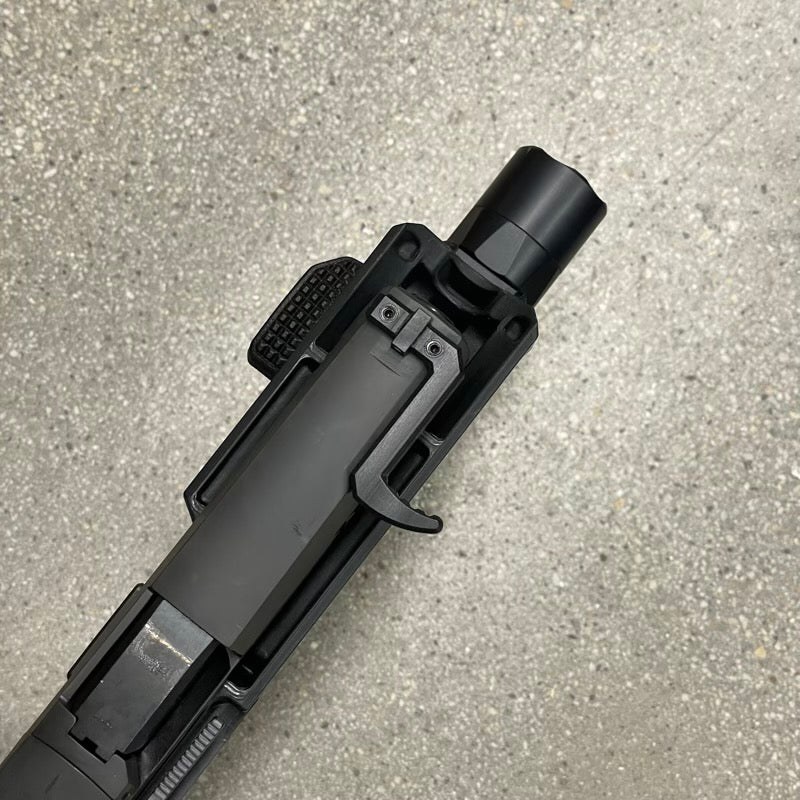
Tactical Development’s product title is “RipStik - Charging Handle for Sig Sauer P320,” and its description makes the connection to the chassis explicit: “When your P320 undergoes the ultimate upgrade of joining the Flux Defense Raider Brace this side charging handle adds the ease of racking your slide and bumping into battery without taking away your front iron sight (integrated sight aligns with the SIG #8 rear sight).“8
4.4.2 How it mounts, and what it changes
It is not a chassis part. It replaces the front sight: “Mounts in any SIG SAUER P320 slide that has a front sight channel on the slide.” It is “Made of 7075 Aluminum” and comes with either a tritium front sight or none (“blackout”), on the left or right side.8
Mechanically it adds a lever to the slide, at the front, standing out to one side. Tactical Development lists what that buys:
- “Doesn’t change the manual of arms, rack slide with hand or charge with handle”
- “Bump Forward Battery Assist: Ergonomic design for forward assist (slide not in battery, slap to seat)”
- “Allows easy one handed operation of slide and slide lock”
- “Drop back design to keep fingers safely behind muzzle”
4.4.3 Why it is on this pistol
Because the chassis covers the slide. In a grip module a P320’s slide is gripped at its rear serrations; in the Raider X the chassis surrounds it, and the RipStik puts a handle where a hand can reach. That is the maker’s stated reason and it follows directly from the chassis.
4.4.4 Installation cautions, from the maker
These are worth repeating because the part is aluminium in a channel made for a steel sight: “Only press this in from the center sight post, not from the side and especially not with a gamer these are 7075 CNC’d Aluminum not steel,” and “DO NOT HAMMER RIPSTIK - Hammering the RipStik in during install will cause stress fractures and possibly break the handle off. Use only a quality sight pusher via the middle sight protrusion.” Tactical Development warrants it only if installed by its own install service. It notes the part is “Not Compatible with Grey Ghost Slides.”8 Prices on 19 September 2026: $95.00 blackout, $120.00 tritium, either side.
4.5 The Forward Operating Pedal — the “Gas Pedal”
4.5.1 What it is, and its real name
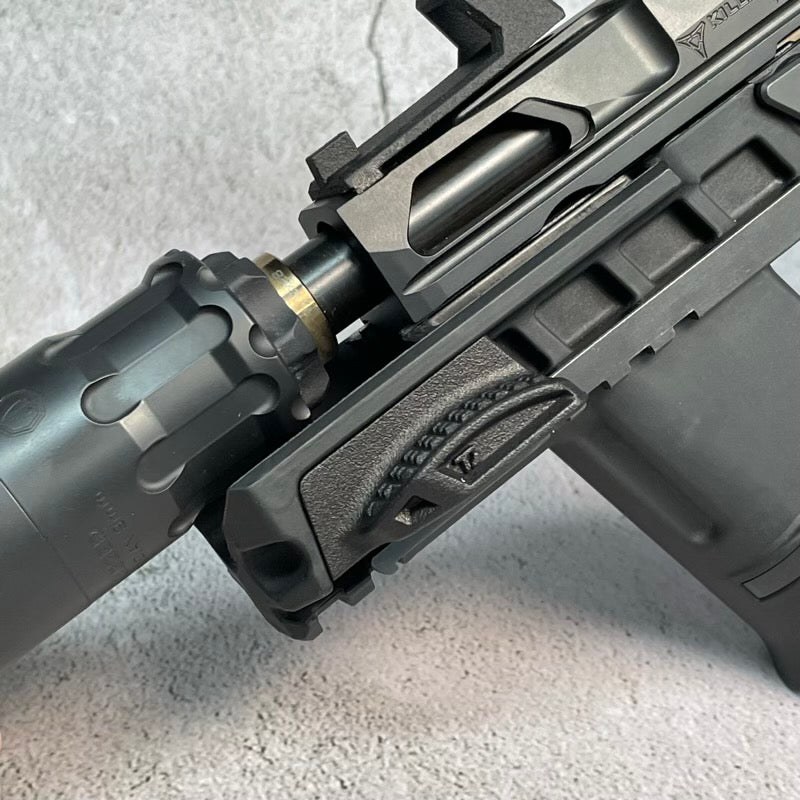
“Gas pedal” is the community’s name. Tactical Development sells it as the “Forward Operating Pedal for Flux Raider” (FOP), and describes it as “a hybrid brake pedal for the Flux Raider, putting the brakes on any muzzle rise during shooting. FOP has two main points of contact (as seen in pictures) a rearward or low position and a full thumb reach over for maximum recoil management.” It is “made of a Nylon polymer and includes mounting hardware for use on a Flux Raider,” fitted with a 5/64 in hex key; left and right versions, $44.10 on 19 September 2026.9
4.5.2 What it changes mechanically
It gives the support-hand thumb something to push against. A shooter’s support hand wraps the firing hand; with nothing forward to bear on, the support thumb contributes little to holding the muzzle down. A ledge forward on the side of the chassis lets the thumb press downward, adding a force ahead of the grip that opposes the muzzle’s rise. It works on the same problem the compensator works on (Volume 6) — one with the hand, the other with the gas.
4.5.3 Why it is on this pistol
Muzzle rise, in its maker’s words. It is also, like the RipStik, a part that exists because of the chassis: it screws to the Raider’s side.
⚠ Raider X fitment is not stated by its maker. The product predates the Raider X; its page names only the “Flux Raider,” and the maker’s Raider collection does not mention the X. That it fits the X is demonstrated by the pistol documented here, on which it is installed. That is a data point, not a maker’s statement.
⚠ It is a thumb rest, not a vertical fore grip. The distinction matters in law, and Volume 5 sets out what ATF has said about fore grips on handguns.
4.6 How the Parts Depend on One Another
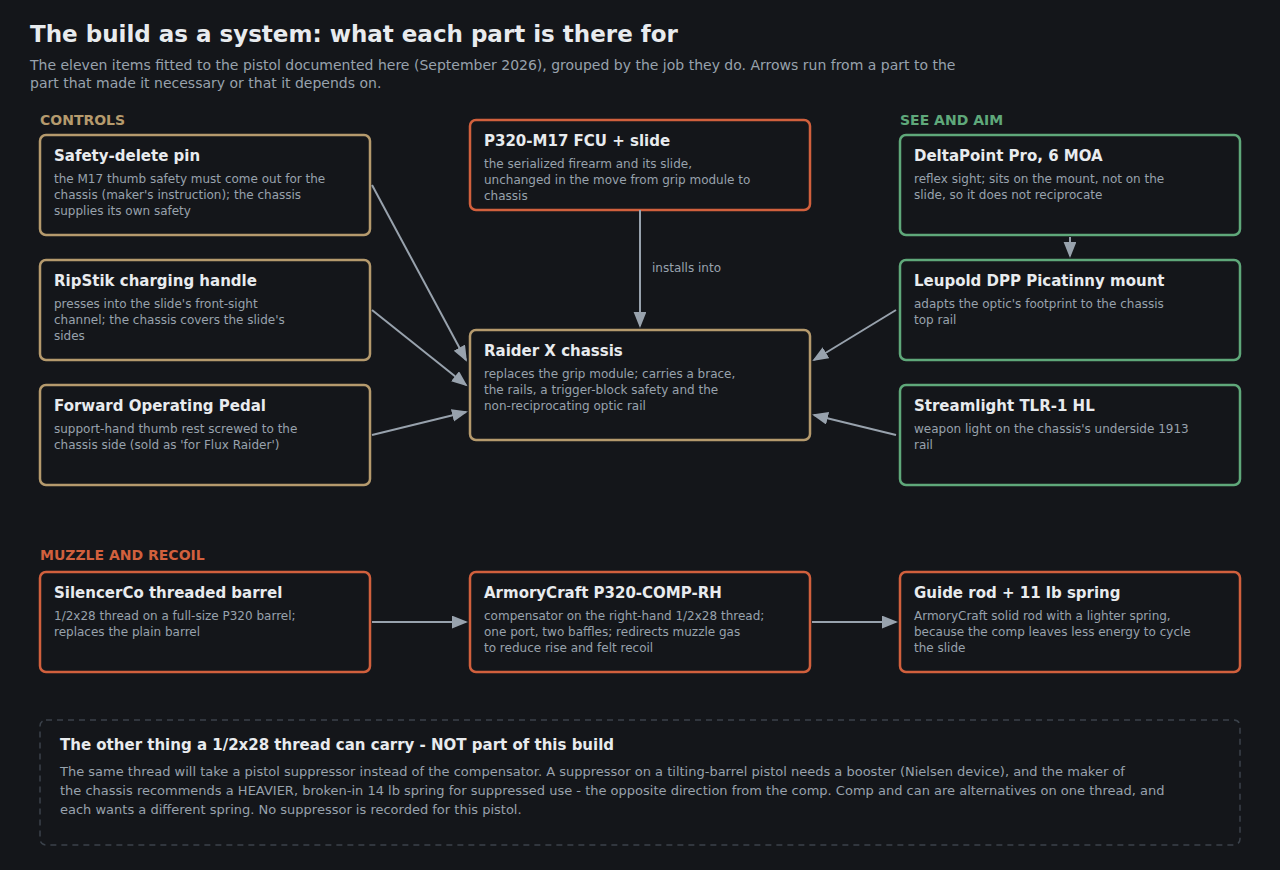
The figure near the top of this volume shows the dependencies; the chain of reasoning is worth writing out, because it is the argument for treating this as one build rather than eleven purchases.
- The chassis is the hub. Everything in the “controls” group exists because of it: the safety delete because the chassis cannot take the M17’s levers, the RipStik because the chassis covers the slide, the pedal because the chassis has a side to screw it to.
- The chassis also sets the sighting arrangement. Its fixed top rail is why the optic needs a Picatinny mount rather than the slide’s own cut, and why the dot does not reciprocate (Volume 7). Its bottom rail carries the light.
- The muzzle group is a chain of its own. The threaded barrel makes the compensator possible; the compensator makes the lighter spring necessary; and the choice of 11 lb over the kit’s heavier springs is a consequence of the compensator, not of the chassis (Volume 6).
- Two forces fight muzzle rise, from two directions. The compensator redirects gas upward at the muzzle; the pedal lets the thumb push down forward of the grip. Neither maker claims a figure for the combination, and none is given.
- The thread could carry something else. A suppressor in place of the comp would want a booster and — by the chassis maker’s advice — a heavier spring, the opposite of the comp. No suppressor is recorded for this pistol.
4.7 What SIG’s Warranty Says About All of It
SIG’s operator’s manual for the commercial M17 is blunt: “THE USE OF AFTERMARKET PARTS IS NOT AUTHORIZED AND WILL VOID THE WARRANTY OF THIS FIREARM.”4 Of the eleven items, only the FCU and slide are SIG’s. That is a statement about SIG’s warranty, not a judgement on the build, and Volume 8 takes up what it means for maintenance.
References
Footnotes
-
The unit documented here: owner’s inventory sheet
Firearms.xlsx.ods, last modified 2026-09-17; owner’s update of 2026-09-19 that the five items still marked ordered are received and installed (“the inventory sheet lags”). Recorded in the dive’s00-inventory/. ↩ -
Flux Defense, “Raider X P320,” SKU X-RAIDER; description, feature list, compatibility section, weight and price quoted. https://fluxdefense.com/shop/raider-x (accessed 2026-09-19). ↩ ↩2 ↩3 ↩4
-
Flux Defense, “Frequently Asked Questions,” items 25 and 54 quoted. https://fluxdefense.com/frequently-asked-questions (accessed 2026-09-19). ↩ ↩2
-
SIG Sauer, P320-M17 / P320-M18 Operator’s Manual, P/N 1302517-01 REV05 (©2025), §§3.0, 9.2, 12.8 and 16.0. https://www.sigsauer.com/media/sigsauer/resources/OPERATOR_MANUAL_M17_M18_COMMERCIAL_1302517-01_REV05_WEB_FILE.pdf (downloaded 2026-09-19). ↩ ↩2 ↩3
-
SIG Sauer, “P320 Manual Safety Parts Kit,” SKU 8901023, $99.99 as captured 25 October 2025; contents and installation statements quoted. sigsauer.com refuses automated requests; read from the Internet Archive capture of SIG’s own page: https://web.archive.org/web/20251025114717/https://www.sigsauer.com/p320-manual-safety-parts-kit.html ↩ ↩2
-
Flux Defense, support page, M17/M18 manual-safety questions quoted. https://fluxdefense.com/support (accessed 2026-09-19). ↩
-
Armory Craft, “Safety Delete For The FLUX RAIDER Brace,” SKUs AC-FLUX-SD-RS / AC-FLUX-SD-LS, $9.95. https://www.armorycraft.com/product-page/safety-delete-for-the-flux-raider-brace (accessed 2026-09-19). ↩
-
Tactical Development, “RipStik - Charging Handle for Sig Sauer P320”; description, features, mounting and installation notes, compatibility and prices quoted. https://tactical.dev/products/charging-handle-for-sig-sauer-p320 (accessed 2026-09-19). ↩ ↩2 ↩3
-
Tactical Development, “Forward Operating Pedal for Flux Raider”; description, material and price quoted. https://tactical.dev/products/forward-operating-pedal-for-flux-raider (accessed 2026-09-19). ↩
Comments (0)