SIG P320-M17 · Volume 5
The Law of a Chassis Pistol — Brace, Stock, Fore Grip, and Michigan
What moving a serialized fire control unit into a Raider X changes in law, and what it does not
A P320 in a Flux Raider X looks like something other than a pistol. It has a telescoping rear member, a top rail running over the slide, a charging handle, rails on three sides and, on the pistol documented here, a thumb pedal on the support side. Almost every question a reader asks about it is a legal one before it is a mechanical one: is it still a pistol, what makes it a short-barrelled rifle, whether the forward accessory changes anything, and what Michigan says.
The answers are tractable, because the P320 is the one pistol whose legal identity is written into federal regulation by name, and because most of the surrounding law has been fought over in court and settled — or at least documented — within the last three years. This volume works from the regulations, the statutes and the maker’s own published statements, and links to the parts of this hub that already carry the long versions.
🔴 Nothing in this series is legal advice. The law described is federal and Michigan law as it stood on 19 September 2026. One of the rulemakings it describes is still open.
5.1 What Moves, and What Stays the Same
Volume 2 establishes the point on which everything here rests: under 27 CFR 478.12(a)(4)(iv), the frame of a P320 “is the internal removable chassis of the pistol that provides housing for the sear or equivalent component” — the fire control unit, or FCU. The grip module is a part. So are the slide, the barrel and the recoil spring.
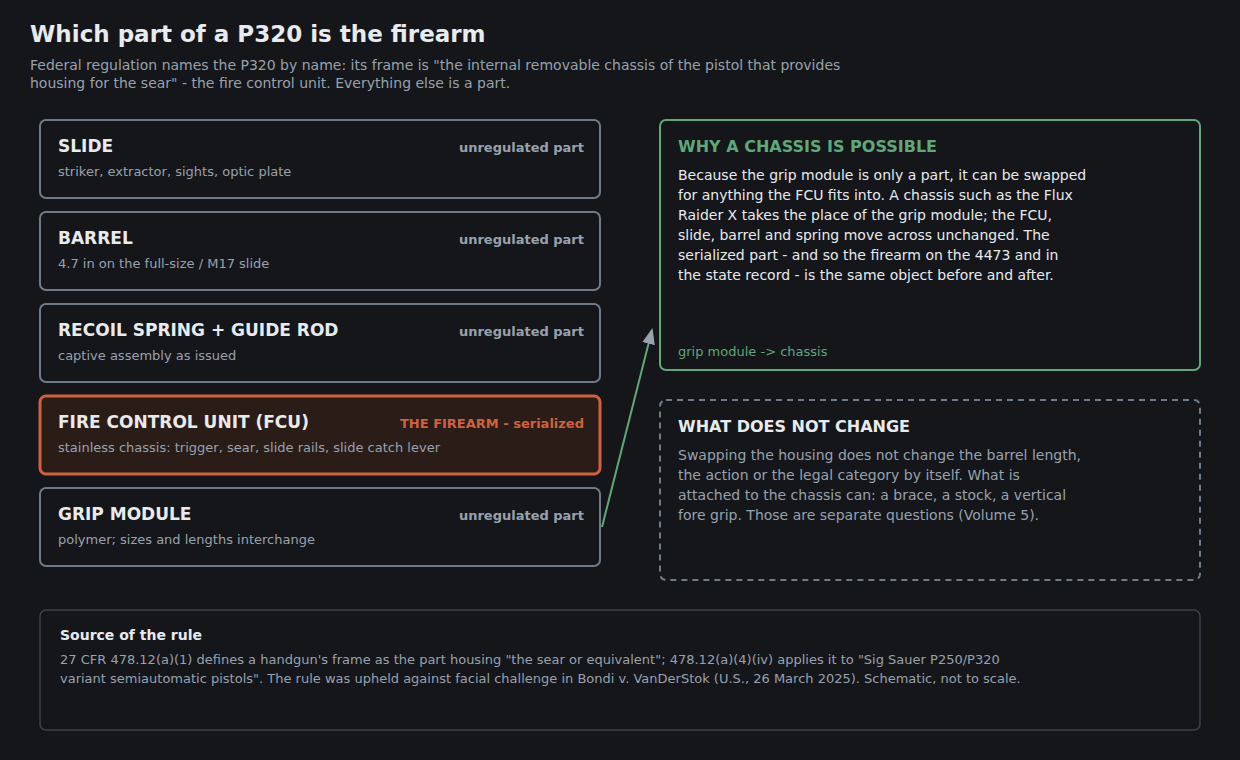
Three consequences follow, and they are worth stating before any of the harder questions.
The chassis is not a firearm and was not transferred as one. Flux Defense says as much in its own product description — “It’s not a firearm — it’s a purpose-built chassis upgrade” — and its frequently-asked-questions page puts the legal logic in one sentence: “With the P320 and P365 platforms, the FCU (fire control unit) is the serialized component that is considered the firearm. Our chassis system simply replaces the handgun grip module.”1 A Raider X ships by ordinary carrier, with no dealer and no background check, because it is a housing.
The firearm on the paperwork is the same object before and after. The FCU that was transferred on a Form 4473, and — in Michigan — recorded when the pistol was acquired, is the FCU inside the chassis. No new firearm has been made by moving it. That is not a loophole; it is simply what the regulation says the firearm is.
The legal category is not set by the housing but by what is attached to it. A P320 FCU with a 4.7-inch barrel is a handgun in a polymer grip module and remains a handgun in a chassis — until something is fitted that the law treats as changing what the weapon is designed to do. There are three candidates on a chassis like this one: a brace, a stock, and a forward grip. Each is taken in turn.
5.2 The Brace — a Pistol, as Sold
Flux sells the Raider X with a pistol brace as standard. The product page’s option list names brace and stock versions separately (“Black RH Brace”, “Black Flush Stock”, “Black +1.5inch Stock”, and so on), and on 19 September 2026 the options selectable by the public were only the three right-hand brace colours.2 The maker’s FAQ states its position in two sentences: “If equipped with the standard pistol brace, you do not need a tax stamp for the firearm,” and “Using our Raider platform while equipped with the standard pistol brace, does not reclassify the pistol as an SBR.”1
Whether a braced weapon is a pistol or a rifle is the subject this hub’s .300 Blackout AR pistol dive, Volume 4 tracks in full, from the Federal Register and the court orders, and it is not restated here. The summary a reader needs:
- The 2023 rule (“Factoring Criteria for Firearms With Attached ‘Stabilizing Braces’”, 88 FR 6478, 31 January 2023) wrote a set of factors into the definition of “rifle” under which many braced weapons would have been short-barrelled rifles.
- It was universally vacated on 13 June 2024 in Mock v. Garland, and ATF’s own later words are that “for all intents and purposes, ATF has never actively enforced the 2023 final rule.”
- On 6 May 2026 ATF published a proposed rule to delete the 2023 text (91 FR 24453). 🔴 As of 19 September 2026 it is still only a proposal. A query of the Federal Register’s own database that day returned that notice as the most recent ATF document on stabilising braces; no final rule has issued. The vacated text therefore remains printed in 27 CFR 478.11 and 479.11 while being unenforceable.3
Two cautions specific to this chassis.
The maker’s own pages disagree with each other. Flux’s FAQ still says, flatly, “In compliance with ATF regulations, you cannot shoulder a pistol brace” — the posture of the 2023 rule’s era — while a Flux knowledge-base article on the same site states that the 2023 rule is dead and that “Pistol braces returned to their original 2017 status at the federal level as pistols.”4 Neither is a legal authority; the point is only that a reader who takes a vendor’s page as the law will find two different answers on one domain.
The vacatur removed a rule, not the statute. A weapon is still a rifle if it is “designed or redesigned, made or remade, and intended to be fired from the shoulder” (26 U.S.C. § 5845(c)). The factors that the 2023 rule tried to codify were ATF’s reading of that language; the language itself survives, and what ATF does with it case by case is the reason the 2026 proposal says it prefers case-by-case classification. The braced Raider X is sold and marketed as a pistol, and that characterisation is the one currently supported federally. It is a characterisation, not a registration.
5.3 The Stock — a Short-Barrelled Rifle, and Now a $0 Tax
Flux also sells stocks for the Raider X, and it says why on the product page: “Stocks are available for customers who wish to legally SBR their P320.”2 Its FAQ is equally direct: “If using a stock on your Raider, you will need to register your firearm in accordance with ATF rules on short barreled rifles.”1
This is not a close question. A rifle with a barrel under 16 inches is a short-barrelled rifle under 26 U.S.C. § 5845(a)(3)–(4), and the P320’s barrel is 4.7 inches on the full-size slide — about 5.46 inches overall on the threaded replacement fitted to the pistol documented here (Volume 6), still less than a third of the minimum. Fit a stock to the chassis, and the weapon is an SBR; do it without an approved ATF Form 1 and it is an unregistered one.
5.3.1 What changed on 1 January 2026
The making tax on that Form 1 is now $0. Public Law 119-21, signed 4 July 2025, rewrote 26 U.S.C. § 5821(a) so that the tax “upon the making of a firearm” is “$200 for each firearm made in the case of a machinegun or a destructive device, and … $0 for any firearm made which is not described in paragraph (1).” The transfer tax in § 5811(a) was rewritten the same way. The change applies to “calendar quarters beginning more than 90 days after July 4, 2025” — the first of which began on 1 January 2026.5
Nothing else about the NFA process changed: the application, fingerprints, background check and approval before the stock goes on are all still required. The Suppressor Law dive, Volume 3 sets out exactly what the 2026 change did and did not do. What it means for this chassis is simply that the brace-or-stock decision is no longer a $200 decision. An owner who would rather not rely on the brace characterisation can register the pistol as an SBR and pay nothing in tax to do it.
5.3.2 Parts on the bench
A stock sitting in a drawer next to a braced Raider X raises the question the Supreme Court addressed in United States v. Thompson/Center Arms Co. (1992). The Court’s plurality held that a Contender pistol packaged with a carbine conversion kit had not been “made” into a short-barrelled rifle, because the parts could also be assembled into a long-barrelled rifle that the NFA does not regulate, and it applied the rule of lenity because the NFA “has criminal applications that carry no additional requirement of willfulness.” But the same opinion drew the line on the other side too: “the aggregation of separate parts that can be assembled only into a firearm … constitute the ‘making’ of a firearm.”6
A Raider X stock and a P320 with no barrel of 16 inches or more sits on the “only into” side of that line: there is no lawful configuration in which that stock goes onto that pistol other than a registered SBR. The Suppressor Law dive, Volume 8 treats the same trap for suppressor parts and its rule transfers directly: approval first, parts second.
5.4 The Forward Accessory — What ATF Has Said About Fore Grips
The Tactical Development product fitted to the pistol documented here is a support-hand thumb rest — the maker’s name for it is the Forward Operating Pedal (Volume 4). The reason it belongs in a legal volume is a longstanding ATF position on something that looks superficially similar.
In an open letter of April 2006, “Adding a Vertical Fore Grip to a Handgun,” ATF wrote:
“ATF has long held that by installing a vertical fore grip on a handgun, the handgun is no longer designed to be held and fired by the use of a single hand. Therefore, if individuals install a vertical fore grip on a handgun, they are ‘making’ a firearm requiring registration with ATF’s NFA Branch. Making an unregistered ‘AOW’ is punishable by a fine and 10 years’ imprisonment.”7
The letter rests on the Gun Control Act’s definition of a handgun as “a firearm which has a short stock and is designed to be held and fired by the use of a single hand” (18 U.S.C. § 921(a)(29)) and the NFA’s “any other weapon” category (26 U.S.C. § 5845(e)). It is still linked from ATF’s National Firearms Act page.
Three things are true at once, and a reader should keep them separate.
- The letter concerns a vertical fore grip. A thumb rest on the side of a chassis is not one, and the letter does not mention thumb rests, hand stops or angled grips.
- No ATF classification of the Forward Operating Pedal, or of any feature of the Raider X, was located for this volume. The maker’s page describes it as “a hybrid brake pedal for the Flux Raider” with “a rearward or low position and a full thumb reach over.”8 Whether a particular forward accessory makes a pistol “designed to be held and fired” with two hands is a classification ATF makes, not one this series can. The same is true of the chassis’s own “Built in spare magazine caddy,” which in Flux’s photographs holds a second magazine upright ahead of the trigger guard; no ATF statement on it was located either.
- The AOW tax is also $0 now. Before 2026 an AOW carried a $200 making tax and a $5 transfer tax; the rewritten §§ 5811 and 5821 put every NFA firearm other than a machinegun or destructive device at $0.5 Registration and approval before making are unchanged. The cost of guessing wrong has not fallen at all: the penalty the letter quotes is the penalty for an unregistered AOW.
⚠ A vertical fore grip does not belong on this chassis without a Form 1. Flux sells the Raider X with a bottom rail intended for a light, and a vertical grip would clamp to it as easily as the light does.
5.5 Michigan
The owner of the pistol documented here is in Michigan, so the state position is set out from the Michigan Compiled Laws as published by the Legislature. Michigan’s SBR statute and the licensing act are quoted at length in the .300 Blackout AR pistol dive, Volume 4; what follows is what bears on a chassis pistol, and one definition that dive left open.
5.5.1 The definition that settles what this is in Michigan
The licensing act defines its terms at MCL 28.421(1). Subdivision (i):
“‘Pistol’ means a loaded or unloaded firearm that is 26 inches or less in length, or a loaded or unloaded firearm that by its construction and appearance conceals it as a firearm.”9
That definition is length-based. It does not ask how a weapon is held, whether it has a brace, or what it looks like. A P320 in a Raider X is a small fraction of 26 inches long, so under Michigan’s licensing act it is a pistol by definition, whatever the chassis makes it resemble. (The same subdivision answers, for any weapon of 26 inches or less, the question the AR pistol dive recorded as unresolved: whether an AR-pattern pistol is a “pistol” for Michigan licensing purposes.)
5.5.2 Licence and record
MCL 28.422(1) provides that a person shall not “(a) Purchase, carry, possess, or transport a pistol in this state without first having obtained a license for the pistol as prescribed in this section.” Since 13 February 2024 subdivision (b) extends a licence requirement to purchases of firearms that are not pistols, prospectively; both amendments came in 2023 PA 19 and 2023 PA 37.10 Holders of a Michigan concealed pistol licence are exempt from the section 2 licence under MCL 28.422a(1)(a), but the seller still “shall complete a record in triplicate on a form provided by the department of state police,” and a material false statement on that record is a felony carrying up to four years.11
Michigan has no separate act called pistol registration. What is commonly called registration is the record those two sections create and the state police’s pistol entry database that receives it. For a P320 the record describes the firearm the transfer described — the FCU — and moving the FCU into a chassis does not create a new pistol for the state any more than it does for ATF.
5.5.3 If a stock is fitted
Michigan bans short-barrelled rifles at MCL 750.224b(1) and then exempts, at subsection (3), a weapon lawfully made and possessed under federal law. A registered federal SBR is therefore lawful in Michigan; an unregistered one is a Michigan felony as well as a federal one, with no exemption available because there is no federal registration to be lawful under. Subsection (4) adds that a lawfully held SBR of 26 inches or less must comply with the licensing sections — which, for a stocked Raider X, it already does as a pistol-length weapon. The AR pistol dive quotes these subsections in full.
5.5.4 Suppressors, briefly
The 1/2×28 thread on the pistol documented here will accept a suppressor (Volume 6). Suppressor ownership in Michigan requires nothing beyond the federal process, and suppressed hunting is lawful for all game and all seasons; the Suppressor Law dive, Volume 7 is the reference. No suppressor is recorded for this pistol.
5.6 What Is Settled, What Is Contested, What Is Open
Table 1 — What Is Settled, What Is Contested, What Is Open
| Question | Status (19 September 2026) | Where it rests |
|---|---|---|
| The P320’s FCU is the firearm; grip module, slide, barrel and chassis are parts | Settled | 27 CFR 478.12(a)(4)(iv); Bondi v. VanDerStok (2025) |
| Moving the FCU into a chassis makes a new firearm | No | Same |
| A braced Raider X is a pistol federally | Supported, not registered — the 2023 rule is vacated; the statute’s “intended to be fired from the shoulder” language survives | Mock v. Garland; 91 FR 24453 |
| The 2023 brace text removed from the CFR | Open — proposed 6 May 2026, not final | Federal Register, checked 19 Sept 2026 |
| A stocked Raider X with a sub-16-inch barrel is an SBR | Settled | 26 U.S.C. § 5845; Flux’s own FAQ agrees |
| NFA making tax on that SBR | $0 since 1 January 2026; approval still required | 26 U.S.C. § 5821(a) as amended |
| A vertical fore grip on a handgun makes an AOW | ATF’s stated position since at least 2006 | ATF open letter |
| A thumb rest such as the Forward Operating Pedal does | No classification located | — |
| A P320 in a chassis is a Michigan “pistol” | Settled by definition — 26 inches or less | MCL 28.421(1)(i) |
References
Footnotes
-
Flux Defense, “Frequently Asked Questions,” items 1/4, 37, 38, 40 and 43 quoted. https://fluxdefense.com/frequently-asked-questions (accessed 2026-09-19). ↩ ↩2 ↩3
-
Flux Defense, “Raider X P320” product page, SKU X-RAIDER, price $419.99 on 19 September 2026. Source of the quoted description (“It’s not a firearm…”), the option list, and the quoted statements “The brace version is not designed or intended to be shouldered” and “Stocks are available for customers who wish to legally SBR their P320.” https://fluxdefense.com/shop/raider-x (accessed 2026-09-19). ↩ ↩2
-
Federal Register document search, agency ATF, term “stabilizing braces,” newest first, queried 19 September 2026: most recent result “Removing Factoring Criteria for Firearms With Attached ‘Stabilizing Braces’,” Proposed Rule, 91 FR 24453, 6 May 2026, no effective date. https://www.federalregister.gov/documents/2026/05/06/2026-08930/removing-factoring-criteria-for-firearms-with-attached-stabilizing-braces . The history of the 2023 rule and its litigation is sourced in the AR pistol dive’s Volume 4. ↩
-
Flux Defense, “The 2023 ATF Pistol Brace Rule,” PDW knowledge base. A vendor’s account, quoted only to show the inconsistency with its own FAQ; not relied on for any legal proposition. https://fluxdefense.com/pdw-knowledge-base/pdw-pcc-legality-and-regulatory-framework/the-2023-atf-pistol-brace-rule (accessed 2026-09-19). ↩
-
26 U.S.C. § 5821(a) (making tax) and § 5811(a) (transfer tax), as amended by Pub. L. 119-21 § 70436; effective-date note: “applicable to calendar quarters beginning more than 90 days after July 4, 2025.” Prior § 5811(a) text set the AOW transfer tax at $5. https://www.law.cornell.edu/uscode/text/26/5821 and https://www.law.cornell.edu/uscode/text/26/5811 (accessed 2026-09-19). ↩ ↩2
-
United States v. Thompson/Center Arms Co., 504 U.S. 505 (1992), decided 8 June 1992; plurality opinion quoted. https://www.law.cornell.edu/supremecourt/text/504/505 (accessed 2026-09-19). ↩
-
Bureau of Alcohol, Tobacco, Firearms and Explosives, “Adding a Vertical Fore Grip to a Handgun,” open letter, April 2006. Original URL https://www.atf.gov/press/releases/2006/04/041006-openletter-nfa-adding-vertical-fore-grip.html ; atf.gov refuses automated requests, and the text was read from the Internet Archive’s capture of ATF’s own page. Still listed on ATF’s National Firearms Act page in 2025. The letter’s references to a $200 Form 1 tax and a $5 transfer tax predate Pub. L. 119-21. ↩
-
Tactical Development, “Forward Operating Pedal for Flux Raider,” product page. https://tactical.dev/products/forward-operating-pedal-for-flux-raider (accessed 2026-09-19). ↩
-
Michigan Legislature, Michigan Compiled Laws, MCL 28.421 (1927 PA 372), subdivision (1)(i) quoted; last amended 2023 PA 19, effective 13 February 2024. https://legislature.mi.gov/Laws/MCL?objectName=mcl-28-421 (accessed 2026-09-19). ↩
-
Michigan Legislature, MCL 28.422, subsection (1) quoted; amended 2023 PA 19 and 2023 PA 37, both effective 13 February 2024. https://legislature.mi.gov/Laws/MCL?objectName=mcl-28-422 (accessed 2026-09-19). ↩
-
Michigan Legislature, MCL 28.422a, subsections (1)(a), (2) and (5) quoted or summarised. https://legislature.mi.gov/Laws/MCL?objectName=mcl-28-422a (accessed 2026-09-19). ↩
Comments (0)