Remington XP-100 · Volume 7
Owning One
Modifications, the optic problem, takedown, maintenance, storage and troubleshooting
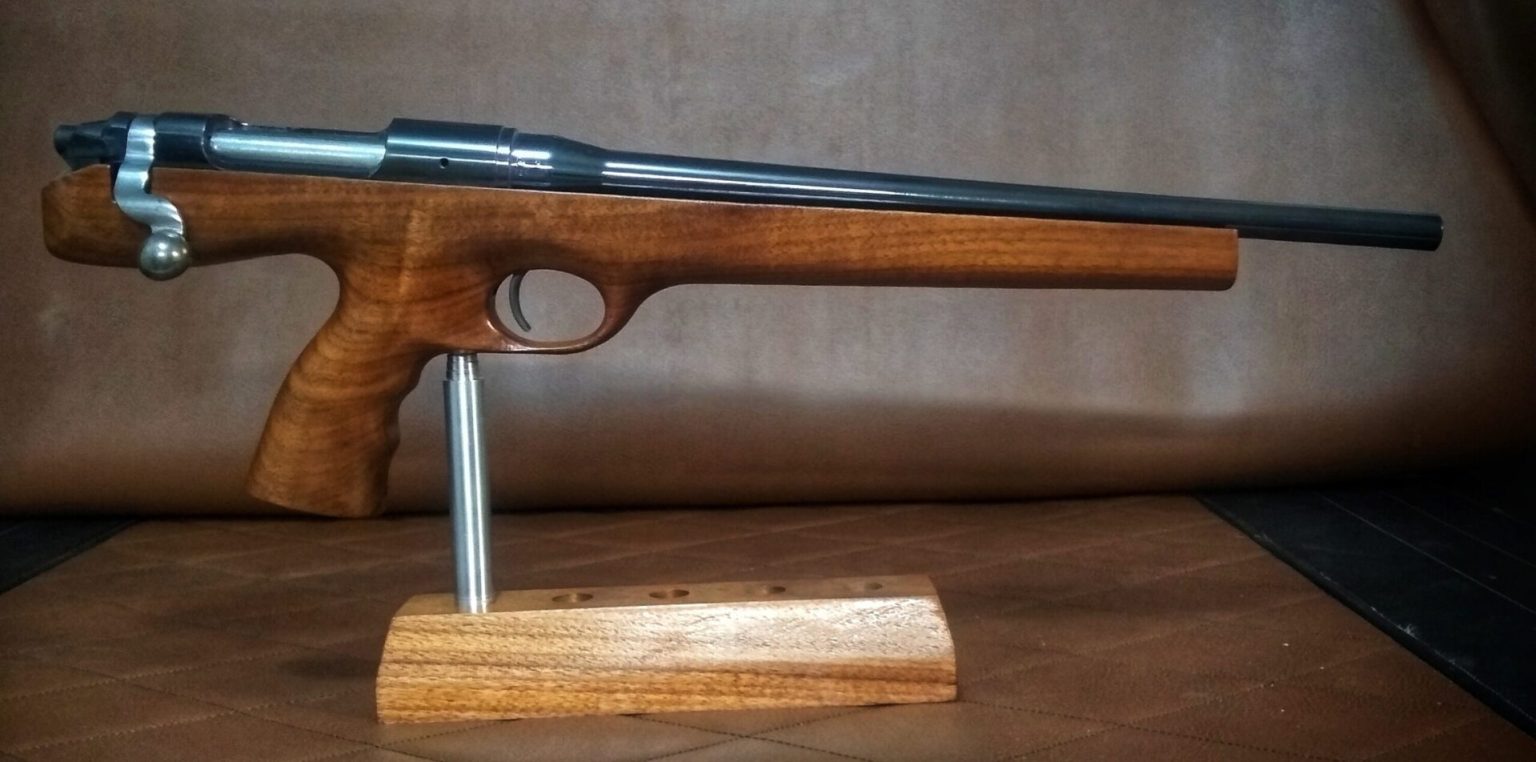
7.1 The modification tradition, and why it matters to a new owner
Almost no other firearm carries as strong a presumption that it will be altered. Within fifteen years of its introduction the XP-100 had generated an industry: Ron Power’s 135 chamberings, Reinhart Fajen’s stocks, Brown Precision’s fibreglass blanks, Fred Sinclair’s complete rebuild service at $281, Phil Crowley’s wildcats (Vol 1 §1.8). That industry has thinned but it has not disappeared; stockmakers still advertise XP-100 inlets and gunsmiths still rebarrel the action.
For a new owner this has three consequences:
Almost anything can be changed. Barrel, chambering, stock, trigger, sights and optic are all in play, and all have precedent going back to the 1970s.
Originality is a finite resource. An unaltered centre-grip .221 Fireball is a diminishing category (Vol 6 §6.3). Modifying one converts a collectable into a shooter, permanently. The reversible modifications — optic, rings, base — are where a new owner should start.
The parts that cannot be replaced are the ones to protect. The moulded nylon stock, the factory iron sights and the XP-100R’s magazine are discontinued and model-specific. Everything else has a substitute.
7.2 Stocks
The most common modification, and the one with the largest effect on how the pistol shoots.
What the original gives. The moulded Zytel 101 stock is dimensionally stable, immune to humidity, ambidextrous by geometry and about as light as a stock can be — American Handgunner in 1979: “great for not warping or changing shape like wood can sometimes do. It was made for either a right- or left-[handed shooter].” It is also a centre-grip stock, which is a distinctive way to hold a pistol and which some shooters get on with immediately and others never do.
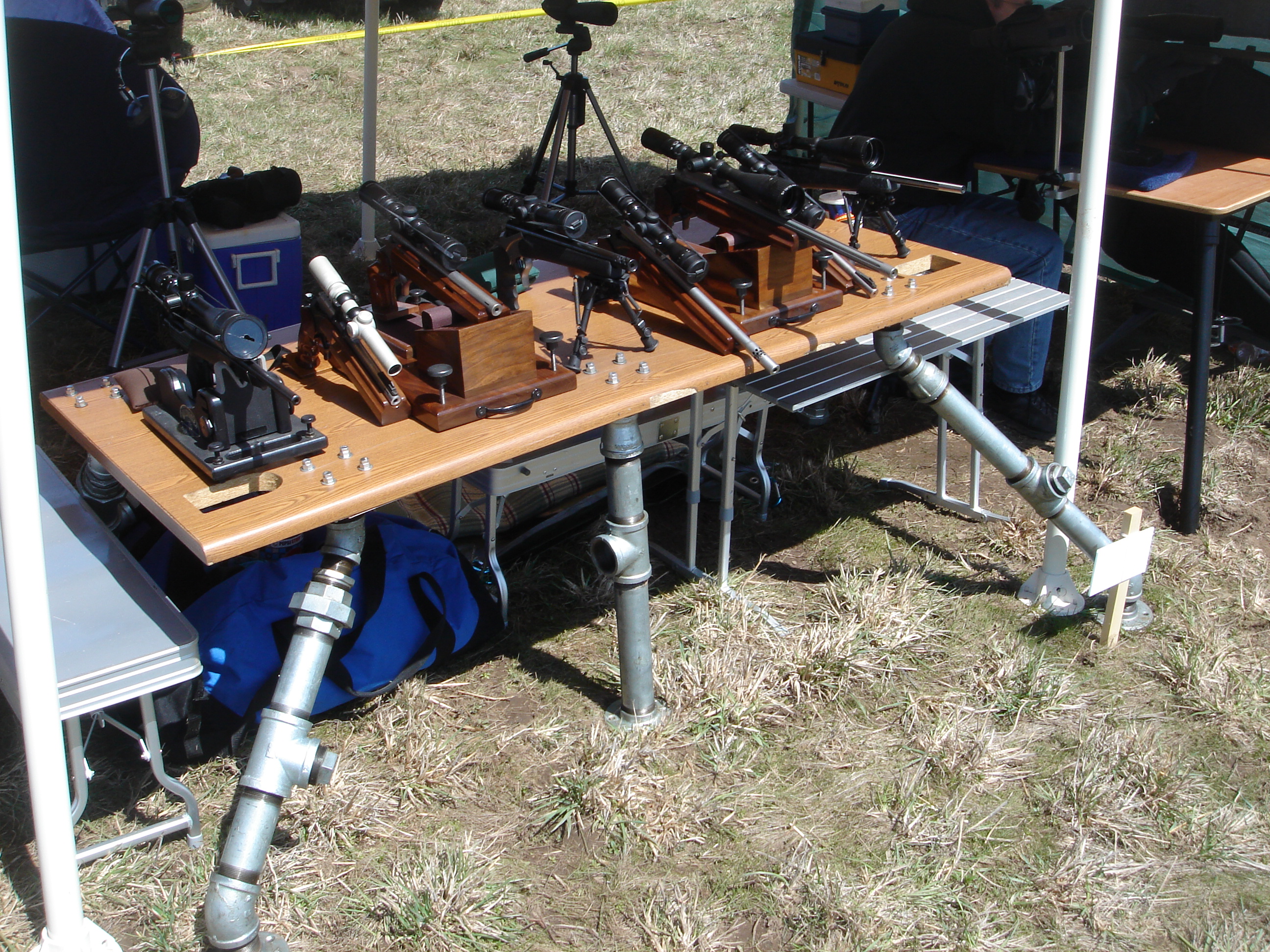
What the aftermarket gives. Weight, a rear grip, a wider forend for a rest, and a hold designed for two hands. The rationale was worked out in 1978 and has not changed. Ron Power designed his stocks around a two-handed hold that American Handgunner called the “Push Me-Pull You”: “The right hand grasps the stock and pushes out. The left hand grasps the rear of the stock and pulls back… recoil is bucking both hands with the result that it cannot punish the shooter.” The same article records the underlying reality: “One hand firing of the XP-100 was never a practical consideration.”
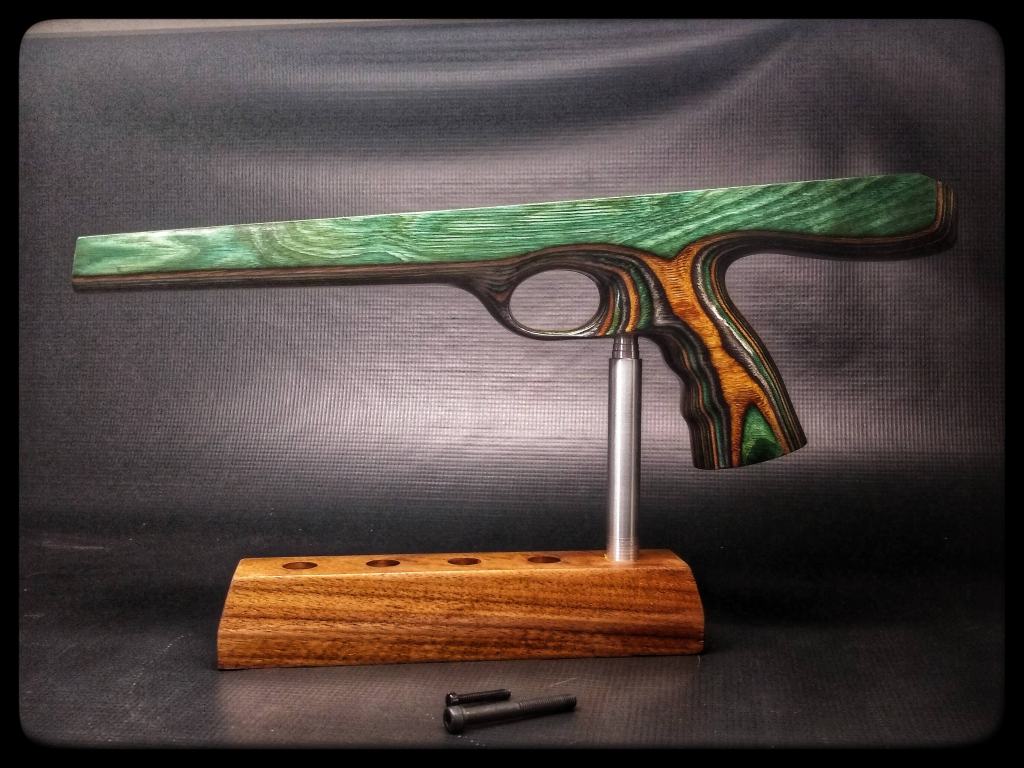
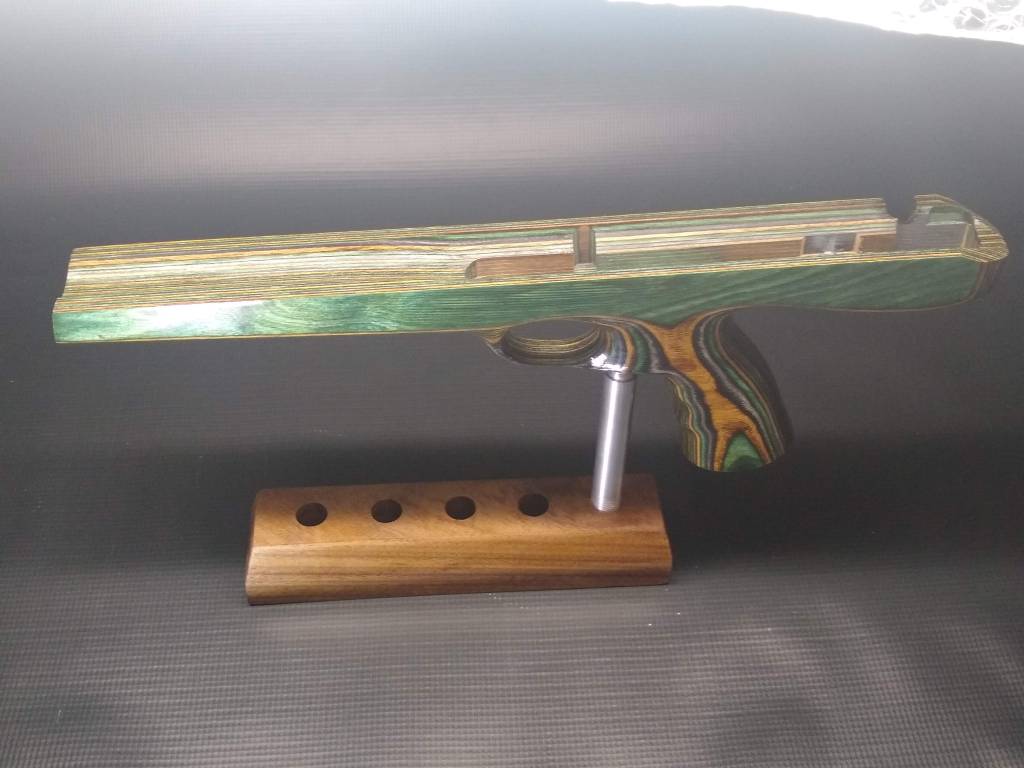
Current and historical options:
Table 1 — Current and historical options:
| Type | Makers, as documented here | Notes |
|---|---|---|
| Fibreglass | McMillan (Commons photographs); Brown Precision (1979); Sinclair (1979, ~12 oz finished) | Light, stable, and the silhouette tradition |
| Laminated wood | Rockwell Stocks (current listings); Remington’s own Hunter (1993) | Heavy, stable, and the current fashion |
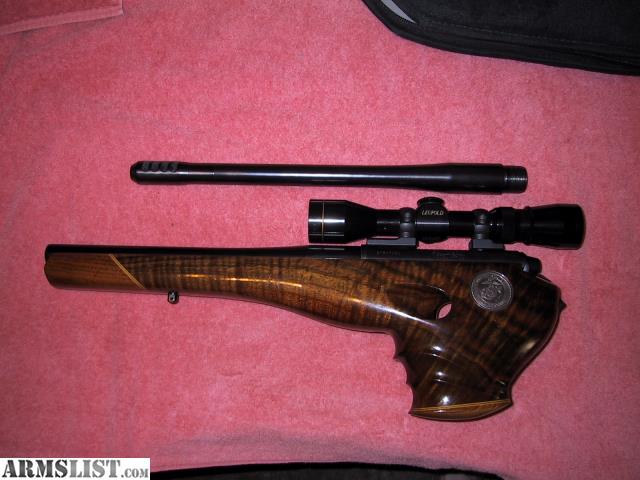
| Walnut / figured wood | Fajen (1970s–80s, fitted by Power); Remington Custom (1986) | The classic silhouette look |
| Semi-finished blank | Cottage Craft Works, sold “rough machine inlet unfinished” | For an owner doing the fitting |
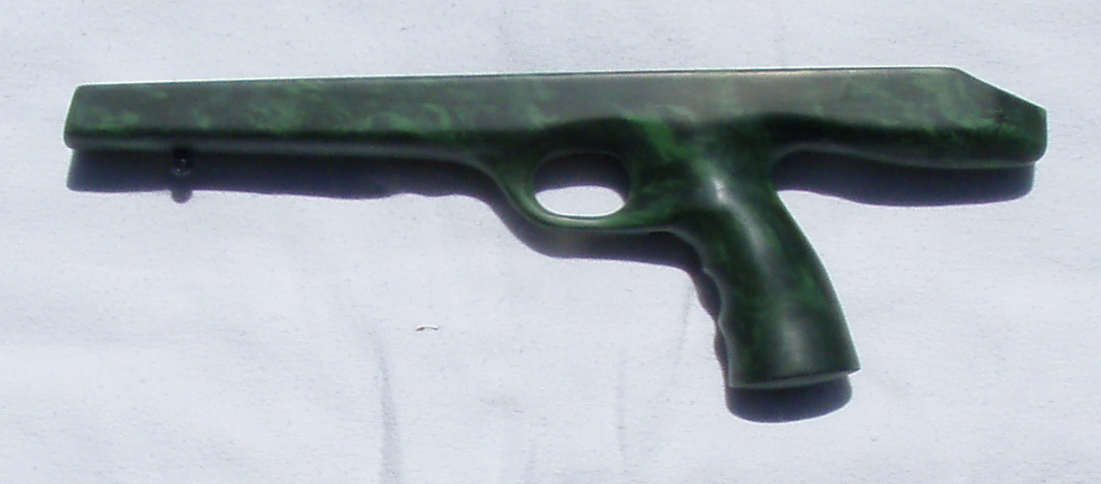
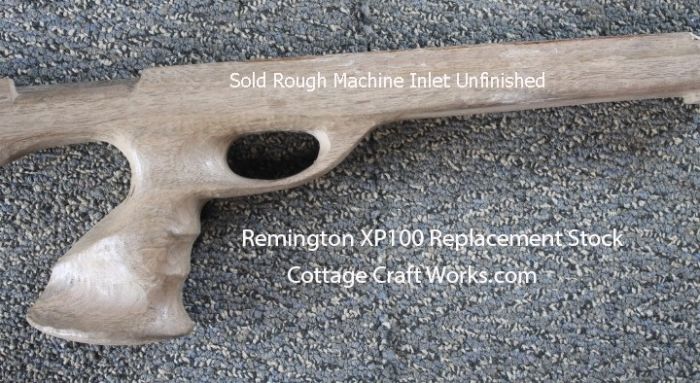
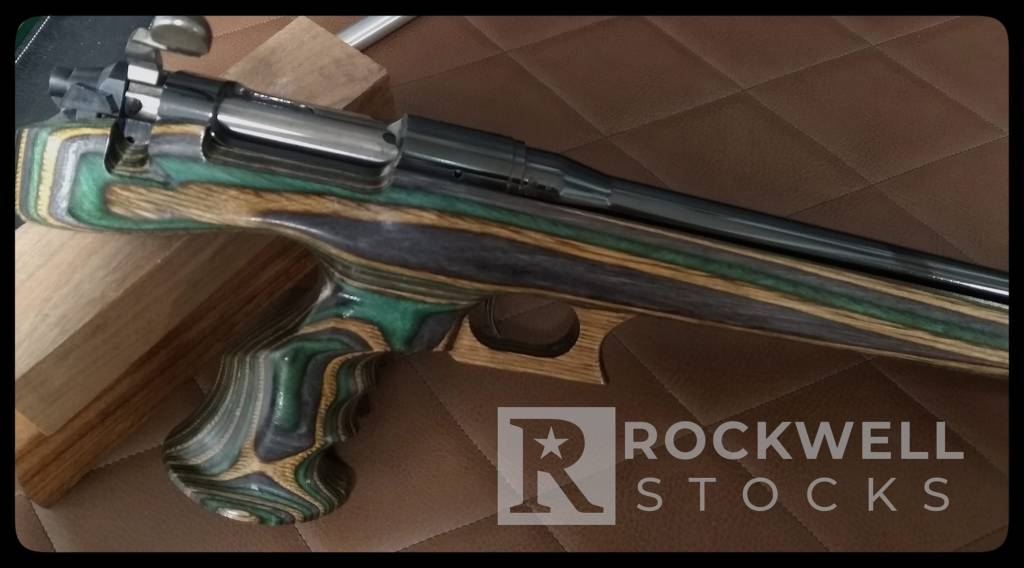
🔴 The trap: a stock swap is a trigger decision. This is Vol 3 §3.3’s finding and it is the thing most likely to surprise an owner mid-project. A centre-grip gun’s trigger reaches the sear through a long transfer bar; a rear-grip gun uses a standard Remington 700 trigger. Moving a centre-grip barrelled action into a rear-grip stock therefore requires sorting out the trigger as part of the job — it is not a drop-in, and the linkage that suited the old stock does not suit the new one. Any quote for the work that does not mention the trigger is a quote for half the job.
7.3 Triggers
Rear-grip guns take standard Remington 700 triggers, which means the entire Model 700 aftermarket — Timney, Jewell and the rest — is available. This is cheap, reversible and the highest-value-per-dollar improvement available on those guns.
Centre-grip guns do not. The interface is the transfer bar, not the trigger, and there is no drop-in market for it. A centre-grip trigger can be cleaned up and adjusted by a competent gunsmith; it cannot simply be replaced with a match unit. Gun Digest’s owner describes his original as “a smooth, crisp trigger to accentuate the XP-100’s inherent precision,” so a good one is entirely achievable — it just has to be achieved on the trigger the gun has.
7.4 Rebarrelling and rechambering
Routine since 1978, and still the normal answer to a worn barrel.
The decision for a modern owner is narrower than it was in 1979, because the reasons to rechamber have thinned. The case for staying in the factory chambering:
- A factory-chambered gun keeps its identity. A .221 Fireball XP-100 rebarrelled to 6mm PPC is worth what the work is worth, not what the model is worth (Vol 6 §6.3).
- Ammunition supply is a solved problem for the chamberings worth keeping. .221 Fireball, .223 and .308 are all supported (Vol 2 §2.13).
The case for rechambering:
- A shot-out high-intensity barrel needs replacing anyway, and a barrel job is the moment to reconsider.
- The gun is already not original — a rebarrelled, restocked gun loses nothing by being rebarrelled again.
- A specific task needs a specific cartridge, most obviously silhouette, which wants the 7mm BR the factory stopped chambering in 1985.
Two practical notes. First, barrel length is part of the decision, and Vol 4 is the argument: the difference between 10¾ and 14½ inches is worth about 235 ft/s in .223 and considerably more in anything larger. Second, fast powders belong in short barrels. A rechambered pistol should not simply inherit the rifle load; slow powders are exactly the ones that waste their charge past the muzzle (Vol 4 §4.2).
7.5 Muzzle brakes
Common on heavy-recoiling XP-100s, and the tradeoff is stark in a pistol.
A brake redirects propellant gas rearward to offset recoil. It works. It also redirects that gas — and its noise — toward the shooter, on a gun whose muzzle is already much closer to the shooter’s head than a rifle’s and which is already loud for the reasons in Vol 4 §4.15: an abbreviated barrel dumps a larger fraction of its charge into the air.
The honest summary: a braked .308 or 7mm-08 XP-100 is more pleasant to shoot and considerably less pleasant to be near, including for the shooter. Doubled hearing protection is the minimum, and it is the minimum on an unbraked gun too. For the .221 Fireball a brake is unnecessary; recoil from a 50-grain bullet in a 3.75-pound pistol is mild, and American Handgunner noted in 1979 that “the unique design gave only minimum whip, jump and recoil.”
A brake on a factory-original gun also means a threaded muzzle, which is irreversible and which Vol 6 §6.5 lists as an inspection flag for exactly that reason.
7.6 🔴 Optics: why a rifle scope will not work
This is the single most common and most expensive mistake a new XP-100 owner can make, and it is entirely avoidable.
The mechanism. A telescopic sight forms an image at a small exit pupil a fixed distance behind the ocular lens. That distance is the eye relief: the range over which the shooter’s eye sees the full field of view. A conventional rifle scope is designed for an eye a few inches behind the ocular, because that is where a rifle puts it — roughly three to four inches, which is why a rifle scope is mounted almost against the shooter’s cheek weld.
An XP-100 is fired at arm’s length. The eye is not three inches behind the ocular; it is something on the order of two feet. A rifle scope in that position does not give a reduced field of view — it gives a pinhole, or a black circle with a dot of image in the middle, and finding that dot repeatably under time pressure is not a skill worth acquiring.
There is also a safety dimension. A rifle scope mounted far enough back on a pistol to be usable puts a steel tube in the path of a recoiling gun, close to the shooter’s face.
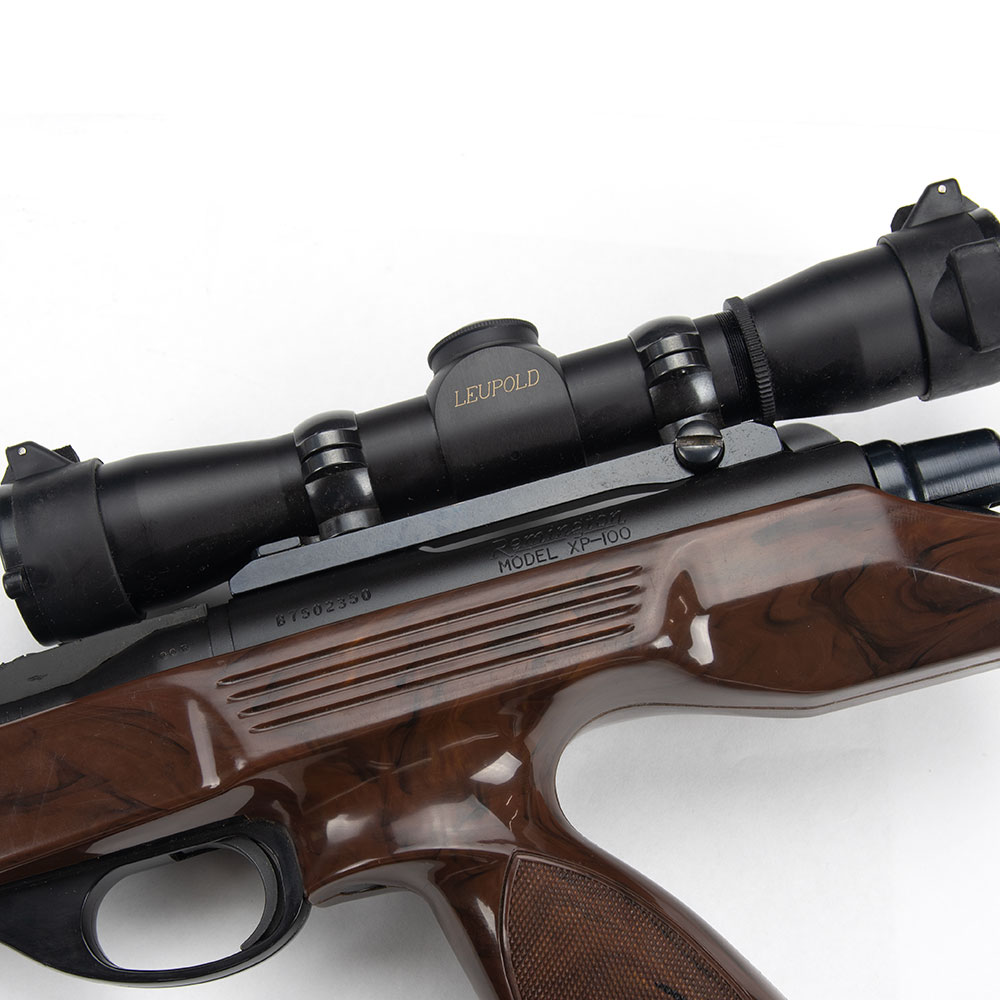
Handgun scopes are a different product category, not a marketing distinction. They are variously called handgun, extended eye relief (EER) or long eye relief (LER) scopes, and they are built with eye relief measured in many inches rather than a few — at the cost of a narrower field of view and, usually, lower magnification.
What could be confirmed about current products:
- Burris lists a handgun scope line comprising a 2x20mm, a 2-7x32mm and a 3-12x32mm, described by the maker as offering “Long eye relief, ideal when hunting with a powerful handgun.”
- Gun Digest’s XP-100 owner mounted a Burris 2-7x32mm Handgun on his pistol and, in his account, “sighted it on Saturday using proven Contender loads (printing sub-1-inch groups) and collected a called-in, 100-yard coyote with it on Sunday.” That is a specific, working combination on this specific pistol.
- Leupold produces handgun optics and lists handgun-specific mounts and red dots.
⚠ What could not be confirmed: the eye relief figures in inches. Burris’s and Leupold’s product pages returned HTTP 403 or 404 to every request made for this dive, and retailer pages served bot challenges. No specific eye-relief number is stated here, because a number invented or half-remembered would be exactly the kind of specification error this project has shipped before. The figures are printed on every manufacturer’s spec sheet and an owner should read them there before buying.
Red dots are the other answer, and for some uses the better one. A non-magnifying reflex sight has effectively unlimited eye relief — the dot is visible from any distance behind the glass — which removes the problem instead of managing it. The tradeoff is the loss of magnification, which matters on a pistol whose entire purpose is precision at 100 to 250 yards. For a big-game XP-100 used inside 100 yards, a red dot is a serious option. For a varmint gun, it is not.
7.7 Mounting
The receiver was drilled and tapped from the factory from 1963 (Vol 3 §3.9), which in that year was a statement about what the pistol was for.
The arrangement is a dedicated XP-100 base carrying standard one-inch rings — the accessory trade advertised exactly that in 1979: a “pistol base for Rem. XP-100 will fit all 1"" rings. A modern owner buying rings should confirm tube diameter against the scope, since 30mm tubes are now common and the historical XP-100 bases were built for one inch.
Two mounting points specific to this gun:
Mount it forward. The whole point of a handgun scope is that it works with the eye far behind it. Mounting it as far forward as the base allows maximises that clearance and keeps the ocular away from the shooter’s face under recoil.
Check ring torque after the first range session and again after the first fifty rounds. A four-pound pistol accelerates harder under recoil than a rifle of the same chambering, and everything bolted to it feels that.
7.8 Takedown
⚠ The factory owner’s manual could not be obtained for this dive. The copy referenced by Wikipedia is hosted on a document site that returned HTTP 403 to every request. A new owner should obtain the manual — Remington’s owner’s manuals were available from the company for decades and copies circulate among collectors — rather than rely on a general description. What follows is the general procedure for a bolt-action of this family, not a transcription of Remington’s instructions.
Field stripping an XP-100 means two operations, and neither requires tools beyond a screwdriver:
- Remove the bolt. Open the action and withdraw the bolt while operating the bolt stop/release. This is all that is needed for routine cleaning.
- Remove the barrelled action from the stock, by backing out the action screws. On the original nylon stock this is how the interior gets cleaned and how the transfer-bar linkage becomes visible (Vol 3 §3.3).
What not to take apart. The trigger assembly, the bolt’s internals and — on a centre-grip gun — the transfer-bar linkage are gunsmith territory. On a discontinued pistol with no factory parts supply, a spring lost on a carpet is a genuine problem rather than an inconvenience.
Reassembly note that applies to every bolt gun and matters more here: action screws should be retorqued to a consistent figure. A bolt-action’s accuracy depends on the action sitting in the stock the same way every time, and inconsistent action-screw torque is the commonest cause of a gun that shoots well one week and not the next (§7.11).
7.9 Cleaning
Nothing about the XP-100 is unusual here, with two exceptions that both favour the owner.
Clean from the breech. The bolt comes out, so a rod goes in from the chamber end with a bore guide — the correct direction, and the one a rifle owner already knows. There is no reason ever to clean an XP-100 from the muzzle, and given that the crown is the most accuracy-critical inch of the barrel (Vol 6 §6.5), there is every reason not to.
The barrel is short, which makes everything easier. A 10¾-inch bore takes a fraction of the rod travel, patches and solvent of a rifle barrel.
The chamberings that foul hardest are the ones that lose most to the barrel. The .22-250 and .223 burn the most powder per unit of bore and will carbon up fastest; the .221 Fireball, burning about 60 percent of the .223’s charge for 90 percent of its velocity (Vol 4 §4.6), is the gentlest cartridge in the family on a barrel as well as on a shooter.
Copper fouling matters more on a short barrel than a long one, in the sense that a short barrel has less bore over which to average out a rough patch. A borescope, if one is available, is worth more on this gun than on a rifle.
7.10 Storage
The nylon-stocked guns have a real and underappreciated advantage: the stock does not care about humidity. Zytel does not warp, swell, shrink or rot, which is the property Remington was buying in 1959 with the Nylon 66 and again in 1963 with this pistol. A nylon-stocked XP-100 stored in a damp basement will have a rusting barrel long before it has a stock problem — and the reverse is true of the walnut Custom, the laminated Hunter and every aftermarket wood stock.
That inverts the usual storage priority for this specific gun: on a nylon-stocked XP-100, all of the storage attention belongs on the metal.
Otherwise the ordinary rules apply, and one thing specific to a discontinued firearm: keep the original parts. If the gun is restocked, the original nylon stock is the single most valuable thing that can be put in a box, because it is what makes the gun original again (Vol 6 §6.9). The same is true of factory iron sights, which cannot be bought new.
⚠ Ammunition storage for the specialist chamberings is worth a thought that does not apply to a .223 rifle. A shooter whose .221 Fireball or 7mm BR brass supply arrived opportunistically (Vol 2 §2.13) is storing something that cannot simply be re-bought, and brass stored with any moisture in the container will corrode.
7.11 Troubleshooting
Table 2 — 7.11 Troubleshooting
| Symptom | First things to check | Notes |
|---|---|---|
| Groups have opened up | Action screw torque; scope ring and base screws; bedding contact | The order matters — action screws first, because they are free to check and the commonest cause |
| Groups were never good | Ring torque, then bedding, then the throat, then the load | A gun that has never grouped in an owner’s hands may simply want a different load; these are accurate pistols (Vol 3 §3.2) |
| Accuracy degraded over years, not weeks | Throat erosion (Vol 6 §6.5) | The normal wear-out mode of a high-intensity chambering, and a barrel conversation rather than a tuning one |
| Hard bolt lift or sticky extraction | Stop shooting that load | Classic overpressure signs. Check the load against a current manual for the barrel length, and note that Vol 4’s maximum loads come from a 1990s-era manual |
| Cannot unload with the safety on | Not a fault — see Vol 3 §3.4 | A pre-1975 gun that never had the recall modification. Handle accordingly, or have the modification done |
| Cannot find the image through the scope | The scope is probably a rifle scope | §7.6 |
| Light primer strikes | Firing pin protrusion; debris in the bolt; excessive headspace | Headspace should have been checked before purchase (Vol 6 §6.5) |
| XP-100R: rounds not feeding from the magazine | Follower and spring; magazine box alignment in the stock | Not a replaceable assembly (Vol 3 §3.6) — a gunsmithing problem, not a parts problem |
| Muzzle flash startling in low light | Nothing is wrong | It is the cartridge’s name. See Vol 4 §4.15; a faster powder will reduce it |
7.12 Building it into a competition gun
For an owner who wants the silhouette or benchrest platform rather than the factory pistol, the recipe was settled in 1979 and has not needed revising:
- A heavy barrel, in the region of 15 inches. American Handgunner’s 1979 custom conversions used 15-inch Obermeyer and Douglas barrels, and Remington’s own answer in 1988 was a 15½-inch heavy barrel (Vol 1 §1.10). Weight at the muzzle steadies the hold and absorbs recoil.
- A rear-grip stock built for a two-handed hold (§7.2).
- A Remington 700 trigger, which the rear-grip stock makes possible (§7.3).
- A handgun scope of adequate magnification, mounted forward (§7.6, §7.7).
- A cartridge that will topple a ram — 7mm BR by design, 7mm-08 or .308 by brute force (Vol 5 §5.2).
The 1979 accounts are worth reading for the weights involved. Helmut Sakschek’s “Ultimate Unlimited Pistol” came in “1½ ounces overweight” against the class limit and needed “a pass of the milling machine on the underside of the action, and a couple of lightening holes in the bolt handle” to make an even 4 pounds. Sinclair’s fibreglass thumbhole stock finished at “about 12 ounces.” These are guns built to a weight rule to the ounce, which is a different discipline from building a rifle.
7.13 References (Vol 7)
- American Handgunner, January/February 1979. The Power/Fajen push-pull stock rationale and the “one hand firing… was never a practical consideration” observation; Sakschek’s 15-inch Obermeyer build and its four-pound weight; Sinclair’s fibreglass stock and complete rebuild pricing; Brown Precision’s stock blanks; the XP-100 scope base advertised for one-inch rings; the minimum-whip-and-jump observation.
- Patrick Meitin, “Remington XP-100: The Successful Experiment,” Gun Digest, 26 October 2020. The Burris 2-7x32mm Handgun scope on an XP-100; the trigger description; bullet selection for a short-barrelled Fireball.
- Burris Optics, handgun scope listing (2x20mm, 2-7x32mm, 3-12x32mm) and the maker’s “long eye relief” description. Eye-relief figures in inches could not be retrieved; see §7.6.
- Rockwell Stocks and Cottage Craft Works product listings for current XP-100 stocks.
- Wikipedia, “Remington XP-100,” consulted 17 September 2026, for the trigger and stock relationship.
- Vol 3 for the mechanical detail behind the stock, trigger and mounting sections; Vol 4 for blast, powder-burn and load-length reasoning; Vol 6 for the originality and value consequences of every modification described here.
Comments (0)