Remington XP-100 · Volume 1
Origin and History — the Experimental Pistol That Outlived Its Experiment
1963 to 1998, every variant, and the discontinuation date nobody agrees on
The Remington XP-100 is the handgun that made long-range pistol shooting a thing that exists. It was introduced in 1963, it was discontinued somewhere between 1994 and 1998 depending on which source is consulted, and in between it did something no other production handgun had done: it put a bolt-action rifle’s accuracy, a rifle’s cartridge and a rifle’s trigger into an object that is legally a pistol, and then it found an audience that did not exist when it was designed.
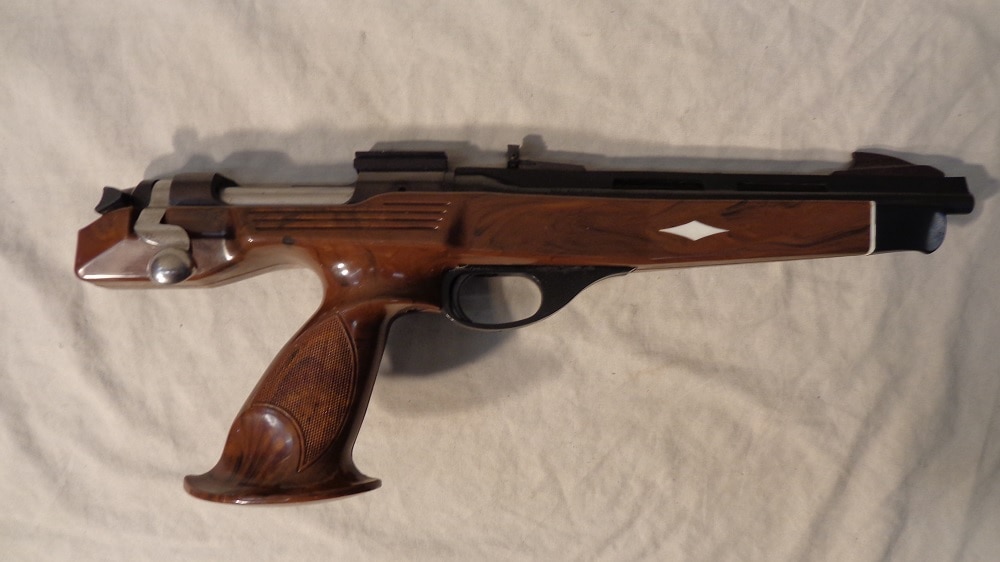
This volume covers where it came from and every variant it went through. The chamberings get their own volume (Vol 2), because that list is longer, messier and more frequently mis-stated than any other fact about the gun.
1.1 What the object actually is
Stripped of the styling, an original XP-100 is four decisions:
- A short bolt action, carrying a rifle trigger, fired from a rifle-pattern lockup rather than a revolver’s cylinder or a self-loader’s slide.
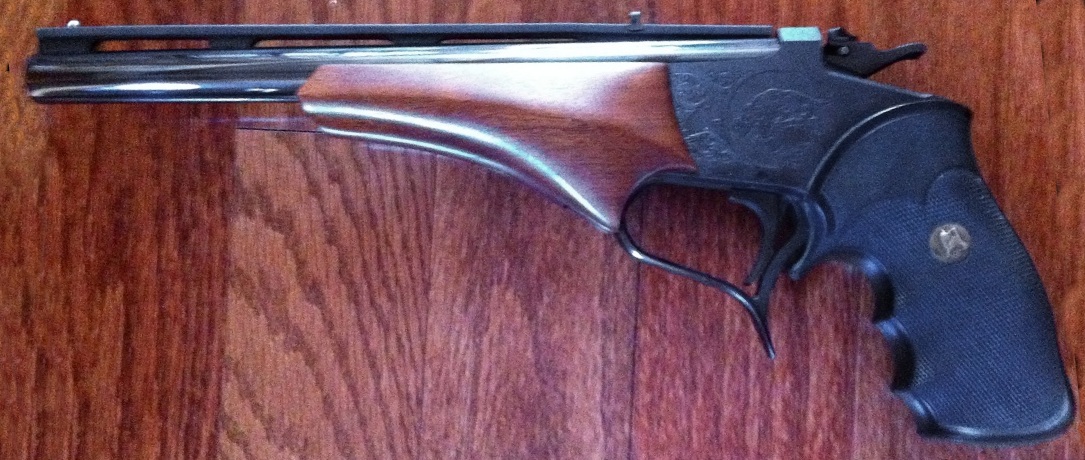
- A 10¾-inch barrel with a ventilated rib, drilled and tapped for a scope from the factory — in 1963 that was a statement of intent, not a convenience.
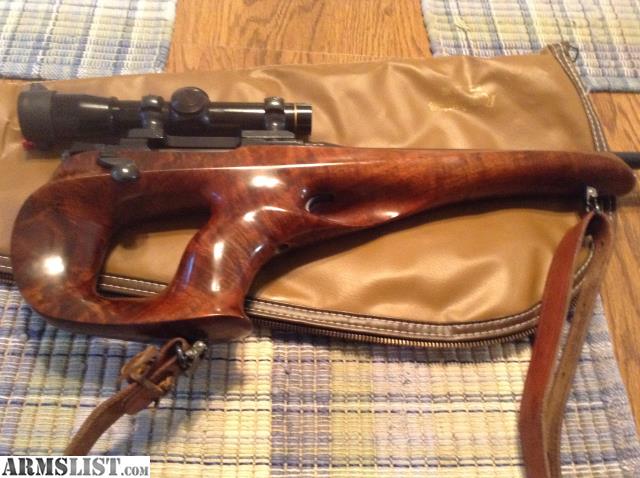
- A one-piece moulded nylon stock with the grip in the middle of the gun, so that the action and the bolt handle sit behind the firing hand.
- A bottlenecked, high-pressure centrefire cartridge designed from a blank sheet for the barrel length it would be fired from.
Weight was about 3¾ pounds with iron sights. Overall length was about 14 inches on the original barrel. Nothing about it was a handgun in the sense the word meant in 1963; nothing about it was a rifle either.
1.2 Where the name came from
“XP” is eXperimental Pistol, and 100 was the project number — so the model designation is, literally, “experimental pistol number 100.” Remington never renamed it. A gun that stayed in the catalogue for three decades kept a name that announced it as a trial.
1.3 The action it was built on — and a contradiction in the sources
The received account, and the better-supported one, is that the XP-100 was built on the short action of the Remington Model 40X target rifle, and that the same design work went on to inform the Model 600 carbine that appeared the following year. Roy Marcot’s The History of Remington Firearms is the source normally cited for that reading, and Gun Digest’s 2020 feature on the pistol states it the same way: Wayne Leek “based the XP-100 on Remington’s tack-driving Model 40X short-action, which would eventually influence Remington’s Model 600 rifle.”
Wikipedia’s article on the .221 Fireball says something different in passing — that Remington “was working on an experimental bolt-action pistol based on their Model 600 action.” That cannot be right as a matter of chronology: the Model 600 was manufactured from 1964, and the pistol reached the market in 1963 after prototypes in 1962. The XP-100 could not have been derived from a rifle that did not yet exist. The two Wikipedia articles contradict each other, and the XP-100 article has the better of it.
The practical consequence for a buyer is covered in Vol 3: the XP-100 action is a short Remington bolt action of the 700 family’s general architecture, which is why the aftermarket treats it as one and why rebarrelling it has always been routine.
1.4 The cartridge was invented because the barrel was short
The first prototypes were chambered in .222 Remington, which in 1962 was Remington’s prestige varmint round and the obvious choice. It did not work. A .222’s powder charge is sized for a 24-inch barrel; in 10¾ inches a large fraction of that powder is still burning when the bullet leaves, which produces muzzle blast and flash out of all proportion to the velocity gained.
Remington’s answer was to shorten the case to 1.400 inches, cutting powder capacity to something the barrel could actually consume, and to raise the pressure ceiling to compensate. The result was the .221 Remington Fireball, with a SAAMI maximum average pressure of 52,000 CUP against the .222 Remington’s 46,000 CUP. Accurate Arms’ own load manual states the reasoning in one sentence: “To minimize the velocity loss in a 10” barrel, Remington engineers established a Maximum Average Pressure of 52,000 C.U.P versus 46,000 C.U.P for the .222 Remington.”
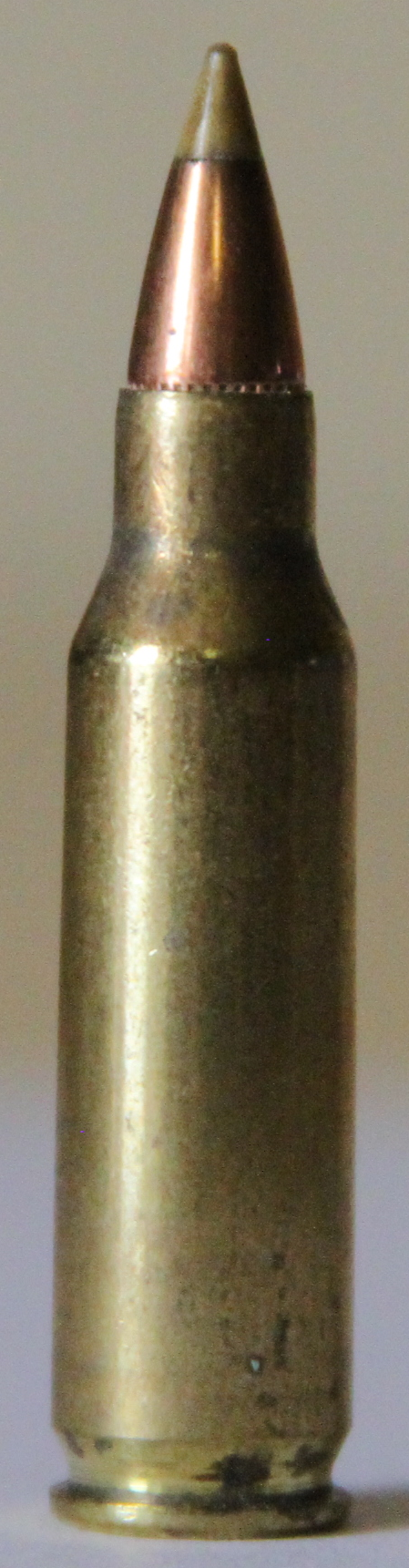
The shortened case still produced a visible muzzle flash, and by the account in Gun Digest the name “Fireball” was attached as an open joke inside Remington. The joke stuck to the cartridge and became one of the better product names in American ammunition.
Where the factory velocity is concerned the sources do not agree, and the disagreement matters enough that Vol 4 is built around it. Gun Digest says Remington “loaded a 50-grain bullet to 2,600 fps.” Wikipedia says the cartridge “produced factory-loaded velocities of over 825 m/s (2,700 ft/s) from the short barrel.” American Handgunner in January 1979 said 2,650. All three are describing the same factory load out of the same 10¾-inch barrel, and they span 100 ft/s.
1.5 The stock, and where it came from
The stock is the reason people either love the gun or call it the ugliest firearm ever made, and both descriptions are in the literature.
It is moulded in one piece from DuPont Zytel 101, a glass-free nylon resin, and it is a direct descendant of the Remington Nylon 66 rifle of 1959 — same material, same manufacturing idea, and the same cosmetic signature of white diamond inlays and white spacers. The connection is not a coincidence of styling: W. E. Leek was among the designers of the Nylon 66, and the XP-100 was his project too. Remington had spent four years proving that a nylon rifle stock would not warp, split or need bedding, and the XP-100 is what it did with that knowledge next.
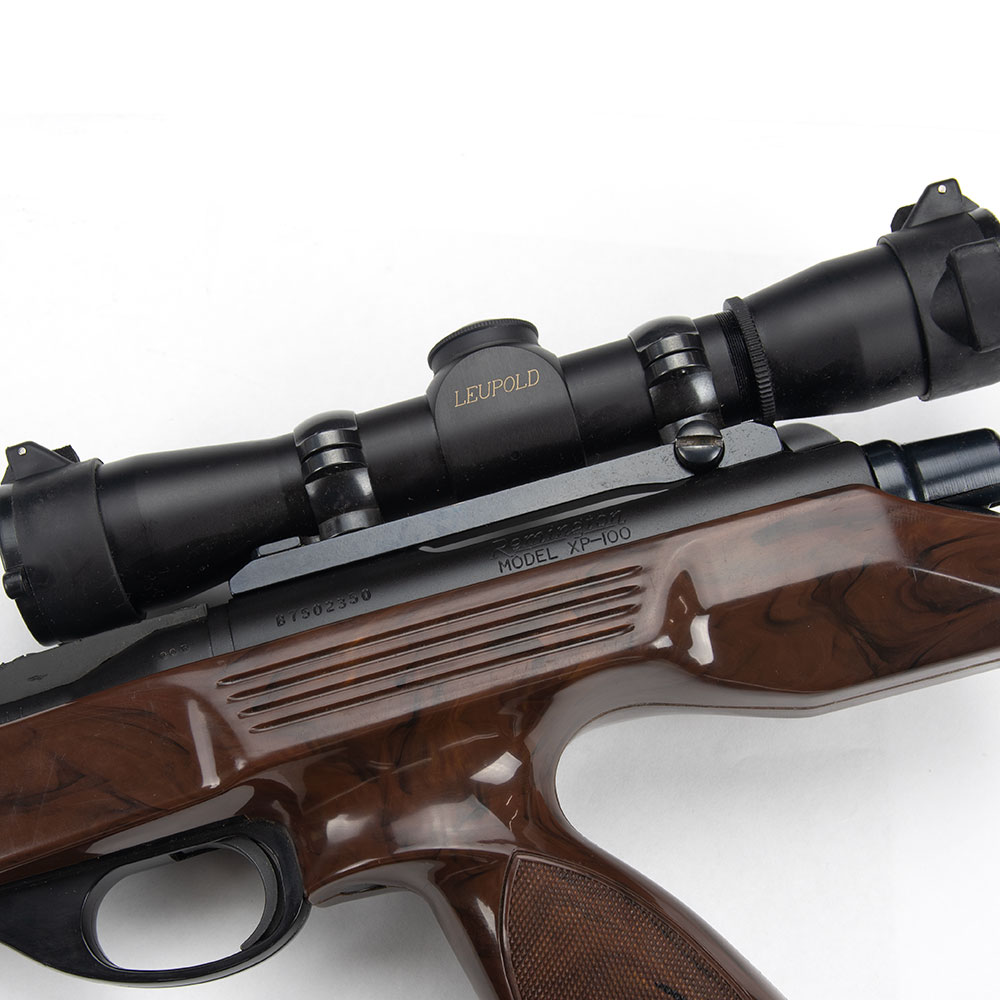
The centre-mounted grip is the other half of the design. Placing the hand at the balance point rather than behind the action does two things: it puts the shooter’s mass under the centre of the gun for offhand shooting, and it moves the bolt handle behind the hand, where it cannot be worked without shifting grip. The first is why silhouette shooters took to it. The second is why, when Remington eventually built variants with the grip at the rear, it had to redesign the trigger linkage to suit (Vol 3).
1.6 1962–1963: prototypes, first run, and the price
Gun Digest’s account, which is the most specific available, gives approximately 13 prototypes leaving Remington in 1962 and an official 1963 launch of 5,564 firearms. Those figures could not be independently corroborated against a Remington production record for this dive; they are reported here with their source attached rather than as settled fact. Remington’s own archived model-history page for the XP-100 lists total production as “N/A” and gives no serial-number blocks at all.
The launch retail price was $99.
1.7 Is it a bullpup? Half of one
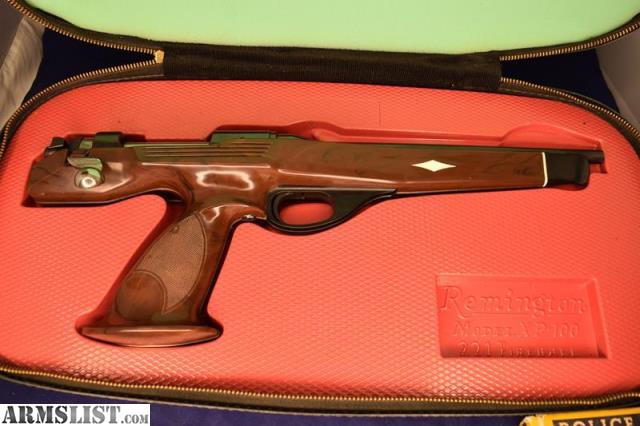
Wikipedia’s infobox classifies the XP-100 as a “Bullpup bolt-action pistol,” and Gun Digest notes that “some have called the original Remington XP-100 Long Range Pistol a ‘bullpup’ handgun, because its bolt is located at the rear of the firearm, behind the shooting hand.”
The label is defensible for the original and wrong for roughly half the family. A bullpup places the action behind the trigger, which is exactly what the centre-grip stock does. But the later rear-grip variants — Silhouette, Varmint Special, most Custom Shop guns, and the XP-100R — put the hand behind the action in the conventional way, and those are not bullpups by any definition. A reader who has learned “the XP-100 is a bullpup” from one photograph will mis-identify the other half of the range. Grip position is the single most useful thing to look at in a photograph of one of these pistols, and Vol 6 uses it as the first step of identification.
1.8 The second life: metallic silhouette, 1975–1985
The XP-100 was designed for long-range varminting, and it sold modestly at that for a decade. What made it significant was a sport that did not exist in the United States when it was introduced.
Metallic silhouette shooting — steel chickens, pigs, turkeys and rams at 50, 100, 150 and 200 metres, which must be knocked over rather than merely hit — came north from Mexico in the 1960s and 1970s and acquired an American handgun governing body, the International Handgun Metallic Silhouette Association, in 1976. The game asks for exactly two things: precision at 200 metres, and enough retained momentum to topple a steel ram weighing on the order of 55 pounds. Revolvers could do the first badly and the second not at all.
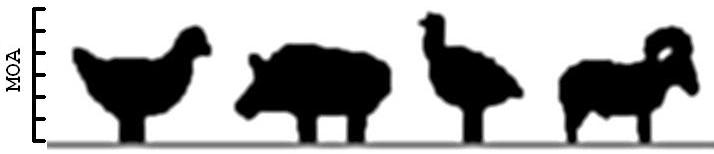
American Handgunner devoted most of its January/February 1979 issue to the resulting boom, and its framing of the XP-100 was blunt: “the sport of metallic silhouette shooting is a fun-gun thing that is catching on everywhere… At this point in time, some anonymous deep thinker must have said, ‘What about the Remington XP-100?’”
The same article records the limitation that drove everything afterwards. The .221 Fireball “was a good, flat-shooting cartridge. But, neither the factory nor the handloaded round had enough stuff for the punch that was needed to always knock ‘em flat.” Chickens and pigs fell; rams did not. So the shooters rebuilt the guns.
By 1979 a full custom industry existed around a pistol Remington was selling in small numbers. Ron Power of Independence, Missouri had, by American Handgunner’s count, a stock of over 135 chamberings he could cut for the XP-100, “running basically from 17 caliber through 45 caliber,” and had worked with the stockmaker Reinhart Fajen to design the two-handed “Push Me-Pull You” grip that became the silhouette standard. Brown Precision sold fibreglass XP-100 stock blanks. Fred Sinclair of New Haven, Indiana would rework the action, fit and chamber a Douglas barrel, install Redfield and Williams sights and epoxy-bed the result for $281. Phil Crowley was chambering 7×57, .35 Remington, .308, .250 Savage, 7mm/.308, .257 Roberts and the wildcat .338 CJ.
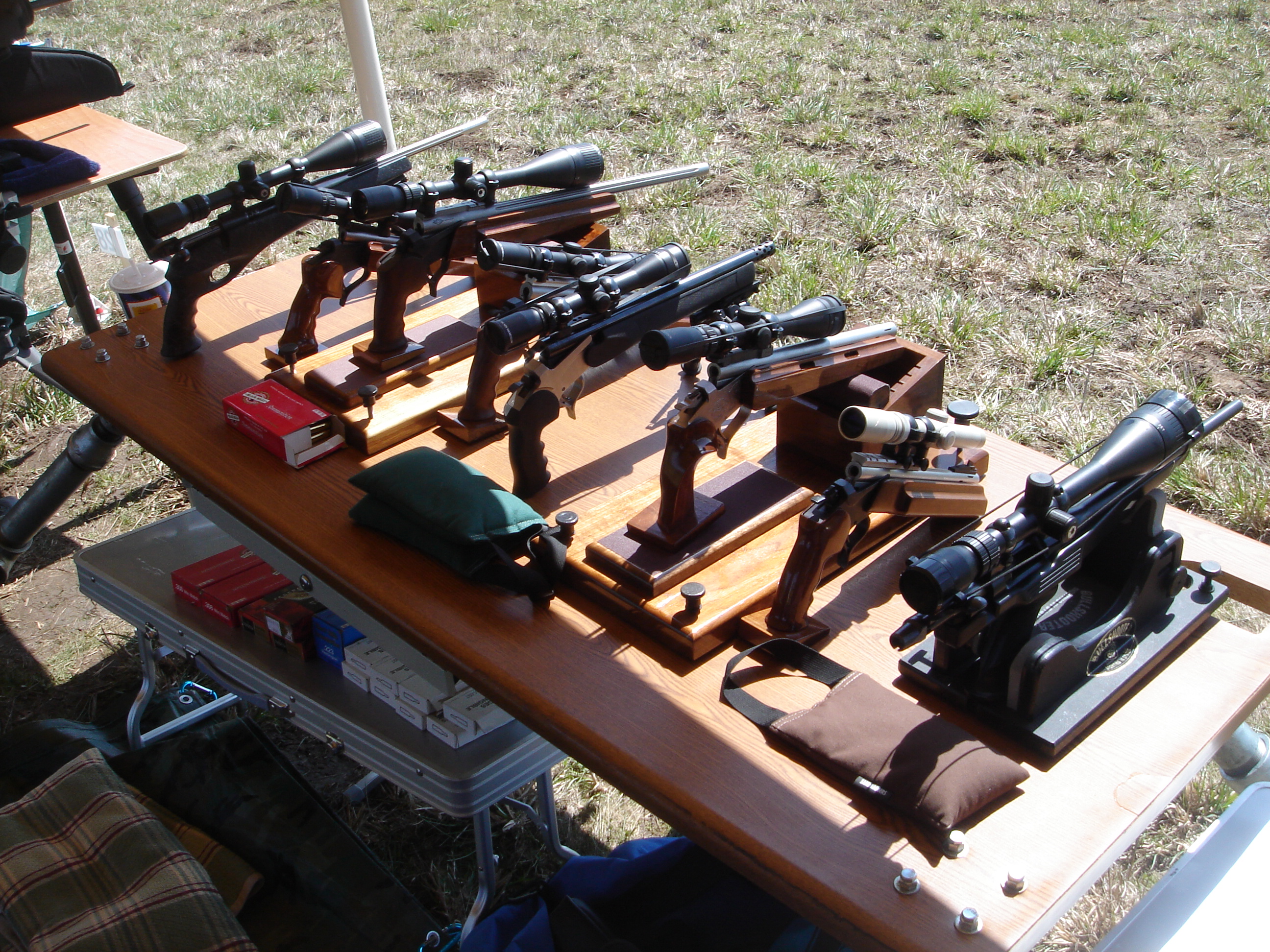
This matters for a buyer in a way that no other part of the history does. Most XP-100 actions on the used market have been apart. The custom trade was larger than the factory line for years, and a great many of the guns offered for sale today are Power, Sinclair, Crowley or anonymous shop conversions carrying a Remington serial number. Vol 6 treats that as the central inspection problem rather than a footnote.
Remington’s own response was to follow the aftermarket. In 1980 it introduced the XP-100 Silhouette with a 14½-inch barrel and a purpose-built silhouette cartridge, the 7mm BR Remington — a cartridge designed for the game, in a barrel length chosen for the game, seventeen years after the pistol was designed for something else.
1.9 The 1979 safety recall
In 1979 Remington recalled XP-100 pistols and Model 600 rifles over a design fault in the safety: engaging the safety locked the bolt closed, so the gun could not be unloaded without first taking it off safe. Remington offered a free modification that let the bolt be opened with the safety engaged.
This is a serviceable dating tool. By Gun Digest’s account the change point is 1975: guns made after that year can have the bolt worked with the safety on; earlier guns could not unless the recall modification was performed. A pre-1975 XP-100 that still locks its bolt on safe is a gun that never went back to Remington — which is worth knowing both as a collector fact and as a handling fact, since unloading it requires taking the safety off with a live round chambered.
1.10 The variant sequence, 1980–1994
The variant list below reconciles three sources: Remington’s own archived model-history page (the most authoritative for years), Gun Digest’s 2020 feature (the most specific on configuration), and Wikipedia (the most widely copied, and, as §1.12 shows, the least reliable on dates).
Table 1 — 1.10 The variant sequence, 1980–1994
| Variant | Introduced | Configuration | Source for the configuration |
|---|---|---|---|
| XP-100 (Long Range Pistol) | 1963 | 10¾ in vented-rib barrel, 1:14 twist, centre-grip Zytel 101 nylon stock, iron sights | Gun Digest 2020 |
| XP-100 Silhouette (Silhouette Target Pistol) | 1980 | 14½ in barrel; 7mm BR Remington | Gun Digest 2020 |
| XP-100 Varmint Special | 1986 | 14½ in barrel; no iron sights; .223 Remington | Gun Digest 2020 |
| XP-100 Custom Long Range Pistol | 1986 | Custom Shop; carved walnut stock; 7mm-08 and .35 Remington introduced | Gun Digest 2020 |
| XP-100 Custom LRP Heavy Barrel | 1988 | Custom Shop; 15½ in heavy barrel; .22-250, .250 Savage, 6mm BR, .308 Winchester added | Gun Digest 2020 |
| XP-100R Custom KS Repeater | 1991 | Custom Shop; rear-grip Kevlar stock; blind box magazine | Gun Digest 2020 |
| XP-100 Hunter | 1993 | Ambidextrous laminated stock | Gun Digest 2020 |
| XP-100 Silhouette Pistol | 1993 | 10½ in barrel; walnut stock | Gun Digest 2020 |
⚠ The last row is reported as Gun Digest states it and could not be confirmed elsewhere. A second Silhouette model introduced in 1993 with a shorter barrel than the 1980 Silhouette is counter-intuitive, and no Remington source consulted for this dive lists it. Treat it as unconfirmed.
Remington’s own model-history page gives the variant list in a different and shorter form, with the years it considered authoritative:
XP-100 (1963-1985) · XP-100 Varmint Special (1986-1992) · XP-100 Silhouette (1980-1994) · XP-100 Hunter (1993-1994) · XP-100 Custom (1986-1994)
The two lists are compatible on introductions and irreconcilable on the Custom Shop’s sub-models, which Remington’s page does not break out at all. That is the expected shape of the evidence: Custom Shop guns were catalogue exceptions, and the catalogue is a poor record of them.
1.11 The XP-100R
The XP-100R — R for repeater — is the only member of the family that is not a single-shot. It feeds from a blind box magazine holding four rounds, has a rear grip, and in its 1991 Custom Shop form wore a Kevlar stock.
Everything else about it is disputed, including when it existed. Remington’s archived model-history page for the XP-100R gives an introduction year of 1998 and a discontinuation year of 1998 — a one-model-year product — in .22-250 Remington, .223 Remington, .260 Remington and .35 Remington. Gun Digest dates the “XP-100R Custom KS Repeater” to 1991. Wikipedia’s prose says it “was made 1991–1997” in six chamberings “and was reintroduced in 1998, this time without sights,” in four.
The reading that makes all three sources consistent is that the XP-100R began as a Custom Shop offering in 1991 and was brought into the standard catalogue for a single year in 1998 — which would explain why Remington’s own model-history page, a catalogue document, records only 1998. That reconciliation is this dive’s inference and is labelled as such; no source states it. What is certain is that XP-100R pistols exist in both rear-grip Kevlar Custom Shop form and in the 1998 catalogue form, and that they are far scarcer than single-shot XP-100s. Vol 2 resolves the chambering lists and Vol 6 treats the scarcity as a buying problem.
1.12 🔴 When did it actually end? Three answers
This is the first place where the most-copied source on the internet is demonstrably wrong against the source it cites.
Table 2 — 1.12 🔴 When did it actually end? Three answers
| Reading | XP-100 line ends | XP-100R | Source |
|---|---|---|---|
| A | 1994 | 1998 only | Remington’s own archived model-history pages for the XP-100 and XP-100R |
| B | 1997 | 1991–1997, then 1998 | Wikipedia’s “Model production by year” and “Caliber production by year” lists |
| C | 1998 | — | Wikipedia’s lead sentence: “produced by Remington Arms from 1963 to 1998” |
The decisive detail is that Wikipedia’s lists cite the Remington pages as their source, and then disagree with them. Remington’s page gives “Year Discontinued: 1994,” and lists XP-100 Silhouette (1980-1994), XP-100 Hunter (1993-1994) and XP-100 Custom (1986-1994). Wikipedia renders those as 1997, 1994 and 1997 respectively, and shifts the Custom Shop chamberings by a year as well ( .250 Savage and 6mm BR are 1990-1991 on Remington’s page and 1990-1992 on Wikipedia’s).
There is no visible basis for the shifted dates in the cited source. The honest statement is:
- The single-shot XP-100 line ran from 1963 to 1994 on Remington’s own record.
- 1998 is defensible only as the end of the XP-100 name, because of the one-year XP-100R catalogue run.
- 1997 appears to be an error that has propagated widely because Wikipedia carries it.
A buyer does not need to care about a three-year discrepancy in a discontinuation date. A buyer does need to care that the most-copied chambering-and-year table for this pistol has been shown to diverge from its own source, because that same table is the one used to decide whether a given gun’s chambering is factory-correct — and Vol 2 shows where that goes wrong.
1.13 What came after: XR-100 and XP-40
The action outlived the pistol twice.
In 2005 Remington reintroduced it as the XR-100 Rangemaster, a single-shot bolt-action rifle built on the XP-100 action, in .204 Ruger, .223 Remington and .22-250 Remington. Remington’s archived history page for it gives a serial block starting at 00001 and lists it as current production as of 2007.
Separately, Gun Digest reports that the rear-grip blind-magazine pistol “survives today as a Custom Shop offering” under the name XP-40, adding parenthetically that “apparently, there are legal issues with the original XP-100 label.” Neither the current availability of the XP-40 nor the nature of the trademark problem could be confirmed for this dive; Remington Arms went through bankruptcy and asset break-up in 2020, and the brand’s product lines since then are outside what could be verified here.
1.14 What killed it
Three things, in order of importance.
The Thompson/Center Contender. Introduced in 1967, the Contender is a break-action single-shot pistol whose barrels are interchangeable by the owner in about a minute. Against a bolt-action pistol that requires a gunsmith and a lathe to change chambering, a gun that changes chambering for the price of a barrel is a different value proposition entirely. By the 1980s the Contender was the default handgun-hunting and silhouette platform in the United States, and much of the load data published for “handgun” versions of rifle cartridges — including data quoted in this series — was developed in Contender barrels rather than XP-100s.
The sport contracted. IHMSA silhouette peaked in the early 1980s. The specialist market that had justified a 14½-inch bolt-action pistol in 7mm BR shrank, and the cartridges shrank with it.
Remington’s own product logic. Wikipedia summarises the endgame as competition “from other bolt-action pistols such as the Savage Striker as well as the versatile Thompson Center Arms break-action Contender,” and that is fair as far as it goes. The Savage Striker (1999) arrived after the XP-100 had already gone.
1.15 How this series is organised
Table 3 — 1.15 How this series is organised
| Vol | Title | What it settles |
|---|---|---|
| 1 | Origin and History | This volume — where it came from, every variant, the discontinuation muddle |
| 2 | Every chambering, documented | The full verified chambering table, by variant and year, factory versus Custom Shop |
| 3 | The action and the hardware | Action lineage, the XP-100R magazine, stocks, trigger, optic mounting |
| 4 | Ballistics as a pistol | What each chambering actually does from 10¾ and 14½ inches, measured versus estimated |
| 5 | Caliber selection by task | Silhouette, varmint, target, big game — argued from Vol 4, plus Michigan law |
| 6 | Buying one today | Market reality, XP-100 versus XP-100R, the used-gun inspection checklist |
| 7 | Owning one | Modifications, long eye relief optics, takedown, cleaning, storage, troubleshooting |
A reader deciding between chamberings should read Vol 4 and then Vol 5, and can treat Vols 1–3 as background. A reader about to inspect a specific gun should read Vol 6 first and then come back to Vol 2 to check whether the chambering stamped on the barrel is one Remington ever made.
1.16 References (Vol 1)
- Remington Arms Company, “Firearm Model History — Model XP-100,” remington.com, archived 13 December 2009 (Internet Archive). Introduction 1963, discontinued 1994; caliber and variation lists.
- Remington Arms Company, “Firearm Model History — Model XP-100R,” remington.com, archived 15 October 2006 (Internet Archive). Introduced 1998, discontinued 1998; four chamberings.
- Remington Arms Company, “Model History — XR-100 Rangemaster,” remington.com, archived 9 December 2007 (Internet Archive).
- Patrick Meitin, “Remington XP-100: The Successful Experiment,” Gun Digest, 26 October 2020 (originally Gun Digest the Magazine, 2020). Prototype and first-run figures, $99 launch price, variant configurations, Zytel 101 and the Nylon 66 connection, the 1975 safety change and 1979 recall.
- Mike Thill, “In the Beginning” and related features, American Handgunner, January/February 1979. The silhouette boom, the custom trade, Ron Power, Fajen, Brown Precision, Sinclair, Crowley.
- Accurate Arms, Per-Caliber Guide, handgun section, “.221 Remington Fireball,” archived 20 November 2008 (Internet Archive). The 52,000 CUP versus 46,000 CUP rationale.
- Wikipedia, “Remington XP-100” and “.221 Remington Fireball,” consulted 17 September 2026. Used as a source of record for the widely-copied dates that §1.12 corrects.
- Roy Marcot, The History of Remington Firearms (Globe Pequot, 2005). Cited at second hand through Wikipedia; not consulted directly for this dive.
Comments (0)