Remington XP-100 · Volume 6
Buying One Today
Market reality, single-shot versus repeater, the inspection sequence, and what a fair price looks like
6.1 What the market is
Four structural facts govern everything else in this volume.
Production ended thirty years ago and nothing replaced it. The single-shot line ran to 1994 on Remington’s own record; the XP-100R had a one-year catalogue run in 1998 (Vol 1 §1.12). The XR-100 Rangemaster of 2005 is a rifle. Remington Arms went through bankruptcy and asset break-up in 2020. There is no new-production XP-100 and no prospect of one.
Supply is overwhelmingly weighted to one chambering. .221 Fireball had twenty-two catalogue years; .223 and .35 Remington had nine; everything else had two to six, much of it Custom Shop (Vol 2). The market a buyer will actually encounter is mostly .221 Fireball centre-grip guns, with .223 Varmint Specials a distant second.
A large fraction of surviving guns have been modified. The custom trade was, for a period, busier than the factory line (Vol 1 §1.8). Ron Power alone kept over 135 chamberings in stock for this action. Rebarrels, restocks, and full rebuilds are not the exception in this market; they are a substantial minority and possibly a majority of the guns that come up.
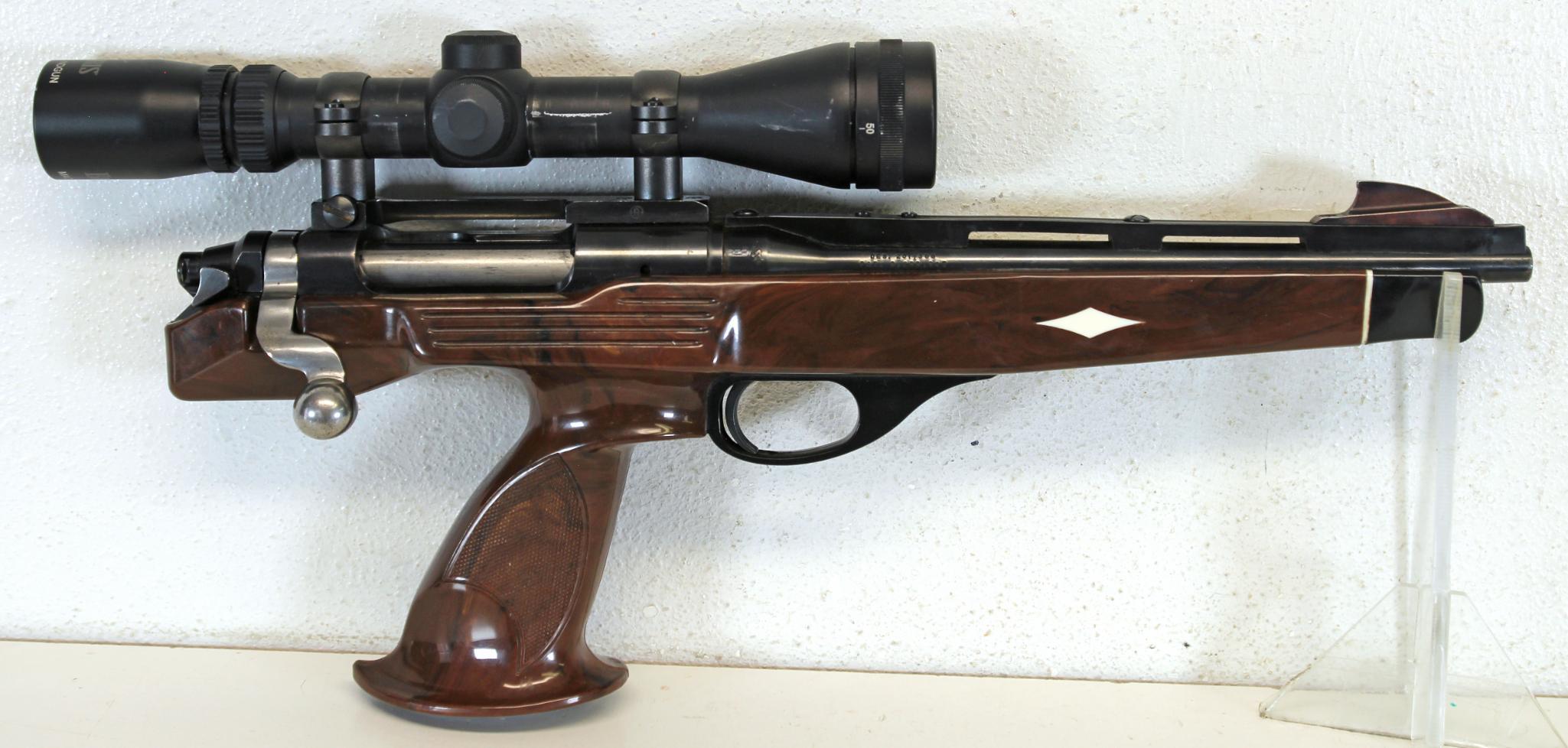
The gun is a collectable and a shooter at the same time, which is unusual and which makes the pricing bimodal. An unmolested 1960s .221 Fireball in its case is a collector’s object. The same action in a Fajen stock with a Douglas barrel is a shooter’s object. They are priced by different logics and a buyer should know which one they are participating in.
6.2 🔴 Prices: what could be established and what could not
This section is deliberately explicit about its own limits, because a confident price figure invented from nothing would be worse than no figure.
What could not be done. A systematic survey of realised prices was attempted and failed. GunsInternational, Rock Island Auction, GunsAmerica, Proxibid’s search, Invaluable and TrueGunValue all returned HTTP 403 or served JavaScript-only pages to every automated request made for this dive. GunBroker’s completed-listing data requires an account. No 2026 realised-price dataset is presented here because none could be obtained. A buyer with a browser can do in ten minutes what this dive could not do at all: search completed listings on the major auction sites and look at what guns actually sold for.
What could be established. Two sourced anchors, both from 2020:
Table 1 — What could be established. Two sourced anchors, both from 2020
| Anchor | Figure | Source |
|---|---|---|
| Retail price at launch | $99 (1963) | Gun Digest, 2020 |
| Secondhand price in the 1980s | ”perhaps $200” | Gun Digest, 2020 |
| Typical price, working original .221 Fireball | ”today fetches $1,200 (on average) if it’s in good working order” | Gun Digest, October 2020 |
| Retail listing price at that date | ”Remington XP-100 starting at $899” | Guns.com, quoted in the same article |
One further observation, from LiveAuctioneers: fifteen past auction results for “Remington XP-100” spanning 2018 to 2026, in .221 Remington Fireball, .223 Remington, 7mm BR — and .17 Remington Fireball, which is not a factory XP-100 chambering (Vol 2) and is therefore a rebarrel appearing in an auction catalogue under the model name. That is the market’s rebarrel problem in a single data point. The realised prices for those fifteen lots could not be retrieved.
The honest statement: a working, original-configuration .221 Fireball XP-100 was a roughly $900–$1,200 gun in 2020, and a buyer should expect 2026 prices to be higher than that by whatever general firearms-market inflation has run since, which this dive did not measure and does not estimate. Everything in §6.9 is expressed as a multiple of that baseline rather than as a number, because the multiple is the durable part.
6.3 The value ladder
Relative, not absolute. Each rung is justified by scarcity from Vol 2’s production years.
Table 2 — 6.3 The value ladder
| Rung | What it is | Why it sits there |
|---|---|---|
| Baseline | .221 Fireball, centre-grip nylon stock, shooter condition, no box | Twenty-two years of production; the commonest configuration by a wide margin |
| Baseline + | The same with the factory case, papers and original scope rings | Completeness, not rarity |
| Above baseline | .223 Varmint Special; .35 Remington | Nine catalogue years each, and both are useful guns |
| Well above | XP-100 Hunter (1993–94), XP-100 Custom (walnut) | One to two years for the Hunter; Custom Shop pricing |
| Scarce | Custom Shop chamberings: .308 Winchester, .22-250, .250 Savage, 6mm BR | Two to three years each, made to order |
| Scarcest | XP-100R, any chambering | A Custom Shop product from 1991 and a single catalogue year in 1998 |
| Scarcest of all | XP-100R in .260 Remington | One model year, in the scarcest variant, in a chambering that was one year old at the time |
| Priced separately | Any rebarrel, restock or full custom rebuild | Not a factory XP-100. Priced on the quality of the work, not the model |
That last rung is not a dismissal. A documented Ron Power or Fred Sinclair conversion in a Fajen stock is a piece of American gunsmithing history with its own following, and the work is often better than the factory’s. It is simply a different object, and a seller who prices one as a rare factory variant is either mistaken or hoping.
6.4 🔴 Is it factory? The identification sequence
Run these in order. The first three take seconds and eliminate most ambiguity.
1. Look at the grip position. Centre grip means the original pattern — 1963–1985, and .221 Fireball unless something has been changed. Rear grip means Silhouette, Varmint Special, Custom, Hunter, XP-100R, or an aftermarket stock (Vol 3 §3.3).
2. Read the barrel rollmark and check it against Vol 2’s table. Ten factory chamberings exist across the whole family. Anything else — 6×45mm, .17 Remington Fireball, 6mm PPC, 6.5 Creedmoor, .30-calibre wildcats — is a rebarrel. This is the single highest-yield check in the sequence and it costs nothing.
3. Check that the chambering, the barrel length and the stock agree. A .221 Fireball in a 14½-inch rear-grip configuration is not a factory combination; .221 Fireball ended in 1985 and the rear-grip guns began in 1980 with 7mm BR. A 7mm BR in a 10¾-inch barrel — as one listing consulted for this dive claims (Vol 2 §2.6) — is not a documented combination either. Disagreement between these three does not mean the gun is bad; it means the gun has a history the seller has not described.
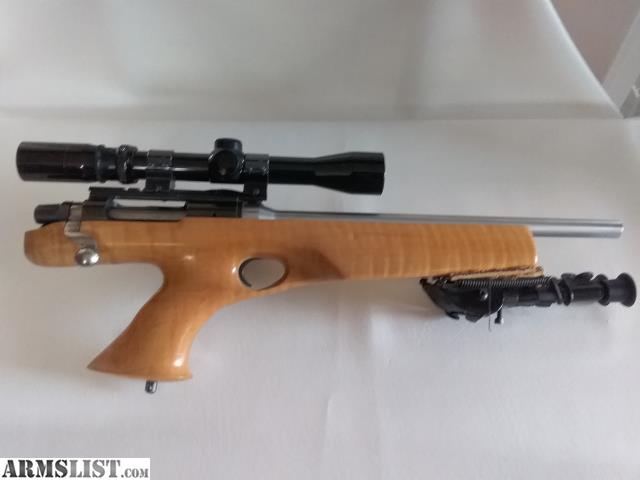
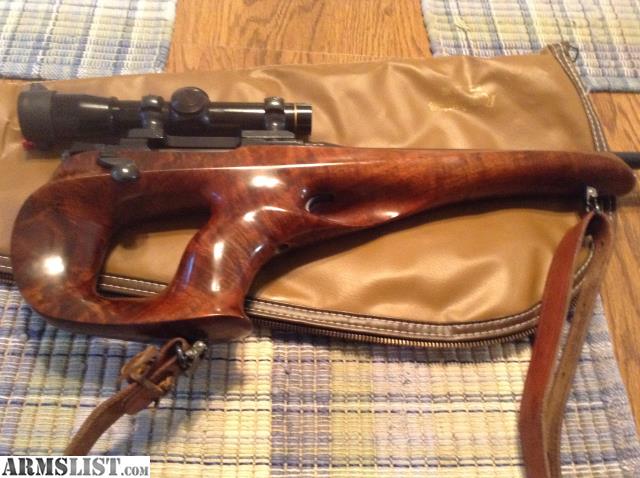
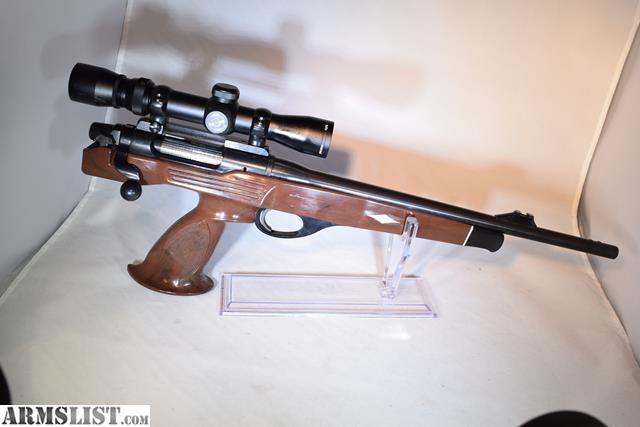
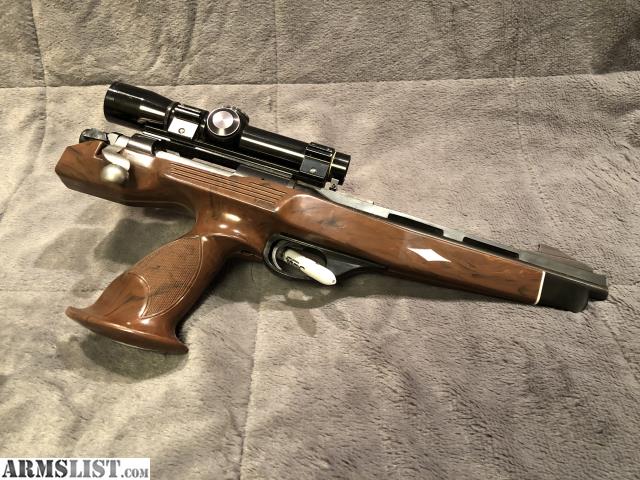
4. Check the stock against the variant. Moulded nylon with white diamond inlays and white spacers is factory 1963–1985. Carved walnut is the Custom. Ambidextrous laminate is the Hunter. Kevlar with a rear grip and a magazine is the XP-100R KS. Fibreglass, thumbhole wood, modern laminate and anything with a maker’s name on it is aftermarket (Vol 3 §3.7).
5. Check the trigger against the grip. A centre-grip gun has a transfer-bar linkage. A rear-grip gun takes a Remington 700 trigger, and may well have an aftermarket one. A centre-grip gun with an obviously aftermarket trigger has had work done that is worth asking about.
6. Count the scope holes. The receiver was drilled and tapped from the factory (Vol 3 §3.9). Extra holes, filled holes, or a base that does not match the factory pattern indicate a gun that has been through several setups — which is normal and which is also information about how hard it has been used.
6.5 The inspection checklist
⚠ A framing note that matters. No XP-100-specific pattern of mechanical failure could be found in any source consulted for this dive, apart from the 1979 safety recall in §6.6. The checks below are therefore general used-bolt-action checks applied to this gun’s particulars, not a list of known XP-100 defects. Presenting them as documented weak points would be inventing a defect history, and this dive does not do that. The absence of a documented failure pattern is itself mildly reassuring about a thirty-year-old design.
6.5.1 Before money changes hands
Table 3 — Before money changes hands
| # | Check | How | What a bad answer means |
|---|---|---|---|
| 1 | Safety and bolt interlock | With the action empty, engage the safety and try to open the bolt | See §6.6 — this is a dating test, not a defect test |
| 2 | Headspace | Go and no-go gauges for the chambering | A gun that closes on a no-go gauge needs a gunsmith’s judgement before it is fired. ⚠ Note that SAAMI standardises go and no-go gauges but does not define a field gauge, which is why two gunsmiths can give the same rifle two different verdicts — the hub’s headspace dive covers this at length |
| 3 | Throat erosion | Seat a bullet long and measure to first contact with the rifling; compare against a known-good reference for the chambering | A throat eroded well forward costs accuracy and is the normal wear-out mode of a high-intensity cartridge. On a .221 Fireball it should be modest; on a .22-250 or .223 it is the first thing to look at |
| 4 | Bore and crown | Bore light; look at the crown with a loupe | Pitting matters less than a damaged crown, which is cheap to recut. Both are barrel-replacement conversations, not deal-breakers — this action has always been rebarrelled routinely (Vol 3 §3.2) |
| 5 | Nylon stock condition | Flex it gently; look closely at the grip-to-action junction, the action screw bosses and the forend tip | Moulded nylon is tough and does not warp or rot, which is why Remington used it (Vol 3 §3.7). A crack in a discontinued moulded stock is, however, not repairable in the way a wood stock is, and replacement means the aftermarket (Vol 7) |
| 6 | Bedding and action screws | Check torque and the witness marks; look for movement between action and stock | Loose action screws are the commonest cause of a bolt-action that “won’t shoot” |
| 7 | Trigger | Dry-fire with permission; check for creep and for the safety holding | On a centre-grip gun the transfer bar adds slack; a gritty or heavy centre-grip trigger is harder to fix than a rear-grip one (Vol 3 §3.3) |
| 8 | Extraction and ejection | Cycle dummy rounds | Routine |
| 9 | XP-100R only: feeding from the blind magazine | Load four dummy rounds, cycle all four | The magazine is not replaceable (Vol 3 §3.6). A feeding problem here is a gunsmithing problem, not a parts problem |
| 10 | Iron sights, if present | Check both are original and undamaged | Model-specific discontinued parts (Vol 3 §3.8) |
| 11 | Muzzle threads or brake | Look | A threaded or braked muzzle is aftermarket work and a signal that the gun has been shot a great deal in a hard-recoiling chambering |
| 12 | Paperwork and case | Ask | Adds value; its absence is not a fault |
6.5.2 After purchase, before serious use
Chronograph it. Every velocity figure in Vol 4 is somebody else’s measurement in somebody else’s barrel, and for two of the ten chamberings — .35 Remington and .250 Savage — no pistol-barrel figure could be found at all. Ten rounds over a chronograph converts this dive’s best estimate into the buyer’s own fact.
6.6 The one documented factory defect
The XP-100 has exactly one, and it is in Vol 3 §3.4: until a design change around 1975, engaging the safety locked the bolt closed, so the pistol could not be unloaded with the safety on. Remington recalled XP-100 pistols and Model 600 rifles in 1979 and offered a free modification.
As an inspection item this is a three-state test:
Table 4 — As an inspection item this is a three-state test
| Result | Reading |
|---|---|
| Bolt opens with the safety engaged | Post-1975, or a pre-1975 gun that had the recall work done |
| Bolt is locked with the safety engaged | A pre-1975 gun that never went back to Remington |
| Gun is pre-1975 and the bolt opens | The modification was performed — better as a shooter, arguably less original as a collectable |
None of the three is a reason not to buy. The middle one is a reason to think carefully about the unloading procedure, which requires disengaging the safety with a live round chambered.
Dating. Gun Digest’s author dates his own pistol to 1978 and gives its serial number. Remington firearms are conventionally dated by a letter code stamped on the barrel rather than by serial number; that account uses the serial. The decoding method could not be verified for this dive, so a buyer wanting a firm manufacture date should take the barrel code to a Remington collector resource rather than rely on a serial-number inference.
6.7 🔴 XP-100 versus XP-100R: the verdict
6.7.1 Buy the single-shot.
The repeater is the more interesting object and the worse purchase, and the reasons are not close.
Scarcity works against the buyer, not for him. The XP-100R is the scarcest variant in the family — a Custom Shop product from 1991 and a single catalogue year in 1998 (Vol 1 §1.11). For a collector, scarcity is the point. For a buyer who wants to own and shoot an XP-100, it means waiting longer, paying more, and having fewer examples to compare — which, in a market where a large fraction of guns have been modified (§6.1), is a real disadvantage. Comparison is how a buyer avoids a bad gun.
The chambering this series recommends was never offered in it. Vol 5 concludes on .221 Remington Fireball. The XP-100R’s four documented chamberings are .22-250, .223, .260 Remington and .35 Remington. A buyer following the chambering conclusion is buying a single-shot by construction.
The magazine’s advantage is smaller than it sounds, and it comes with a cost. Four rounds in a blind box means no floorplate: unloading is done by cycling every round through the chamber (Vol 3 §3.6). For the tasks this pistol is actually good at — a varmint shot from a rest, a deliberate shot at a silhouette ram, a single shot at a deer — a repeater’s value is modest. Where it genuinely helps is a hunting follow-up shot, which is the one scenario where a single-shot bolt pistol is genuinely awkward.
Nothing else about it is better. Same action, same trigger family, same optic mounting. It is a rear-grip gun, so it takes a Remington 700 trigger — but so does every other rear-grip variant (Vol 3 §3.3).
The buy case for an XP-100R, stated fairly, is: a collector completing the family; a hunter who specifically wants a follow-up shot and has settled on .35 Remington or .260 Remington; or a buyer who simply finds one at a price that ignores its scarcity, which does happen.
⚠ And one honesty note that belongs in the verdict: no photograph of an XP-100R could be found from any source that identified it as one, so this dive describes the repeater without illustrating it (Vol 3 §3.6). A buyer evaluating one is working from less published material than for any other variant, which is itself an argument for buying the gun that has been photographed ten thousand times.
6.8 Is owning both justified?
Not as a first move, and the reason is arithmetic rather than taste.
An XP-100 and an XP-100R share the action, the trigger family, the optic mounting and the handling. What a second gun buys is a second chambering and a magazine. If the second chambering is the objective, the cheaper and more available route to it is a second single-shot, or a rebarrel of the first — an operation this action has tolerated routinely since 1978 (Vol 3 §3.2) and which the entire custom trade was built on.
So the sequence that makes sense is:
- One single-shot, in .221 Remington Fireball (Vol 5 §5.10). Learn the platform, the optic, the hold and the trigger on the cheapest and most available version of it.
- If a big-game chambering becomes the objective — a second gun in .308 Winchester or 7mm-08, bought opportunistically rather than held out for, with the shared-components argument from Vol 5 §5.7 doing real work on running cost.
- An XP-100R only if the collection is the point, or if a specific example appears underpriced.
Owning both is justified for a collector and is not justified for a shooter. A shooter who wants two XP-100s should own two single-shots in two chamberings.
6.9 What a fair price looks like
Expressed against the 2020 anchor of roughly $900–$1,200 for a working, original-configuration .221 Fireball (§6.2), because the multiples are durable in a way that a dollar figure from a blocked price survey would not be.
Table 5 — 6.9 What a fair price looks like
| Configuration | Fair, as a multiple of the baseline | Reasoning |
|---|---|---|
| .221 Fireball, centre grip, shooter condition, worn finish, no box | 0.7–0.9× | Common; condition is the only variable |
| .221 Fireball, excellent, with case and papers | 1.0–1.3× | The reference article’s “good working order” case |
| .223 Varmint Special or .35 Remington, good condition | 1.0–1.3× | Nine catalogue years each, and genuinely useful |
| XP-100 Hunter or Custom, good condition | 1.3–1.8× | One to two years; Custom Shop finish |
| Custom Shop chambering (.308, .22-250, .250 Savage, 6mm BR) | 1.5–2.5× | Two to three years, made to order |
| XP-100R, any chambering | 2×+ | The scarcest variant, and the one with the least published reference material |
| Rebarrel or full custom rebuild | Priced on the work, not the model | A documented Power or Sinclair gun may be worth more than a tired factory one; an anonymous rebarrel is worth less |
Three things that should move the price and often do not:
- Throat condition on a high-intensity chambering. A .22-250 or .223 XP-100 with a badly eroded throat is a gun plus the cost of a barrel. That cost should come off the price, and sellers rarely volunteer it.
- A cracked or replaced nylon stock on an otherwise original gun. The moulded stock is the variant’s identity (§6.4); a replacement drops the gun from “original” to “shooter.”
- Which chambering it really is. §6.4, step 2. A rebarrel priced as a factory Custom Shop chambering is the commonest overpay in this market, and the LiveAuctioneers observation in §6.2 — an XP-100 catalogued in .17 Remington Fireball — shows it happening in a professional auction listing.
Three things that should not move the price much and often do:
- A mounted scope. Unless it is a genuine long eye relief handgun scope in good condition, in which case it is worth real money on its own (Vol 7).
- Aftermarket triggers on rear-grip guns. Cheap and reversible.
- Cosmetic finish wear on a nylon-stocked gun. The stock does not deteriorate structurally the way a wood stock does; scuffs are scuffs.
6.10 Where to look
The general auction and classified sites are where these appear: GunBroker, GunsInternational, Armslist, and the auction houses — every image in this dive that shows a complete pistol came from one of them. Estate and collection sales are worth watching for the Custom Shop chamberings, which rarely come to market from their first owners.
Two practical notes:
Search for the variant names, not just “XP-100.” A Varmint Special, Hunter or Custom will frequently be listed under its variant name alone. An XP-100R will sometimes be listed simply as an “XP-100 repeater.”
Expect the description to be wrong about the chambering years. Vol 1 §1.12 documents that the dates in general circulation are not the manufacturer’s dates. A seller quoting “1986–1997” for a .223 is quoting Wikipedia; it does not mean the gun is misrepresented, and it does mean the description is not independent evidence of anything.
6.11 References (Vol 6)
- Patrick Meitin, “Remington XP-100: The Successful Experiment,” Gun Digest, 26 October 2020. The $99 launch price, the 1980s secondhand price, the “$1,200 (on average) if it’s in good working order” figure, the “starting at $899” retail listing, the 1975 safety change, and the serial-number dating account noted as unverified in §6.6.
- LiveAuctioneers, search results for “Remington XP-100,” consulted 17 September 2026. Fifteen past auction results 2018–2026 in .221 Remington Fireball, .223 Remington, 7mm BR and .17 Remington Fireball; realised prices not retrievable.
- Remington Arms Company, archived model-history pages for the XP-100 and XP-100R (Internet Archive). The production years underlying the value ladder.
- American Handgunner, January/February 1979. The scale of the custom trade, which is the source of this volume’s central buying caution.
- Vol 2 for the chambering table used in the identification sequence; Vol 3 for the mechanical checks; Vol 5 for the chambering conclusion this volume’s verdict follows.
Comments (0)