Remington XP-100 · Volume 4
Ballistics as a Pistol
What each chambering actually does from 10¾ and 14½ inches — and why most published XP-100 numbers are somebody else's barrel
This is the volume the rest of the series is built on. A buyer choosing between XP-100 chamberings is choosing between numbers, and the numbers in general circulation for this pistol are, more often than not, produced by a barrel the XP-100 does not have.
4.1 🔴 The problem: most XP-100 ballistics are a different gun’s numbers
Three different substitutions happen, and all three are easy to miss.
Substitution 1: a rifle barrel labelled as a pistol figure. The .221 Fireball’s Wikipedia ballistics table gives 45-grain at 2,947 ft/s and 55-grain at 2,700 ft/s under the heading “Pistol,” and 45-grain at 3,203 and 55-grain at 2,950 under “Rifle.” That much is honest. But the whole table is then described with “test barrel length: 14 in, 24 in” — and the XP-100 that made this cartridge famous has a 10¾-inch barrel. The “pistol” column is not an XP-100 column.
Substitution 2: a Thompson/Center barrel labelled as a pistol figure. Those Wikipedia numbers trace to Accurate Arms’ handgun load data, and Accurate’s data page states its test gun explicitly at the top:
Gun: T/C · Barrel Length: 14”
A Thompson/Center Contender with a 14-inch barrel is a fine pistol and a completely different one. Because the Contender dominated the handgun-cartridge market from the 1970s onward (Vol 1 §1.14), most published “handgun” load data for rifle cartridges was developed in Contender barrels, and it gets quoted for XP-100s without the substitution being noticed.
Substitution 3: a catalogue velocity with no barrel stated at all. The .221 Fireball’s factory velocity is variously given as 2,600 ft/s (Gun Digest), 2,650 (American Handgunner, 1979) and “over 2,700” (Wikipedia). All three describe the same 50-grain factory load. None of them is wrong by much, and the spread between them — 100 ft/s — is larger than several of the differences that buyers agonise over.
The rule this volume applies throughout: every number gets a barrel length, and every number is labelled measured or estimated.
4.2 What a short barrel actually does
A cartridge is a pressure vessel whose useful work ends when the bullet leaves the muzzle. Whatever powder has not finished burning by that point is spent as blast and flash rather than velocity. Shortening a barrel therefore does two things at once: it takes away the last, least-productive inches of acceleration, and it dumps a larger fraction of the charge into the air.
Two consequences follow, and both are visible in the measured data.
The loss per inch is not constant — it accelerates. Rifleshooter’s .308 Winchester work, quoted in §4.10, found an average of 23.4 ft/s per inch between 28 and 16.5 inches, and between 60.7 and 81.7 ft/s per inch below 15 inches depending on the load. The same source states the general finding directly: “the rate of velocity loss increases significantly per inch of barrel once you get below a 16″ barrel length.”
The penalty scales with how overbore the cartridge is. A cartridge with a small charge behind a given bore finishes burning early and loses little; one with a large charge behind the same bore is still burning at the muzzle and loses a great deal. This is the entire reason the .221 Fireball exists (Vol 1 §1.4) and it is why §4.11 is as short and as negative as it is.
Remington understood this in 1962 and acted on it. The .221 Fireball’s SAAMI ceiling was set at 52,000 CUP against the .222 Remington’s 46,000 for exactly this reason — Accurate’s manual: “To minimize the velocity loss in a 10” barrel, Remington engineers established a Maximum Average Pressure of 52,000 C.U.P versus 46,000 C.U.P for the .222 Remington.”
4.3 The anchor dataset: .223 Remington, one barrel, cut down
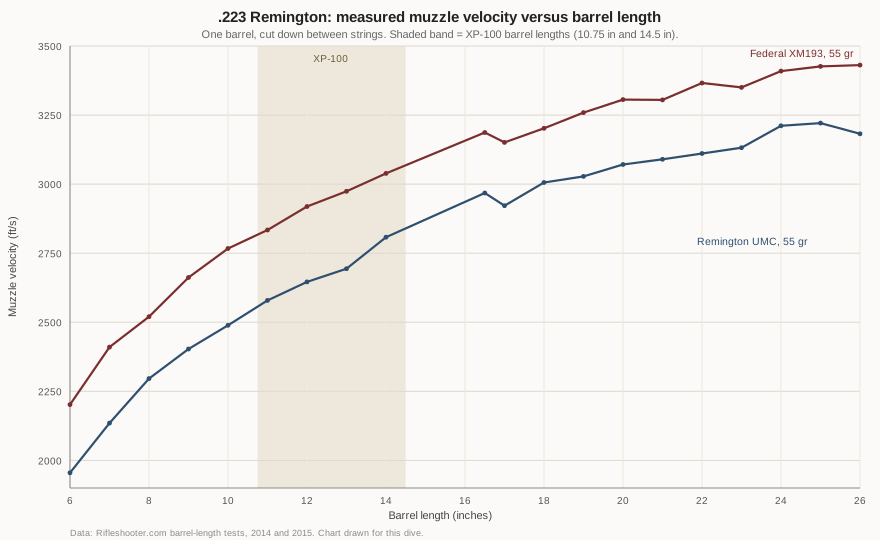
The best short-barrel data available for any XP-100 chambering is Rifleshooter.com’s .223 Remington work, and it is good because of its method: one barrel, shortened an inch at a time between chronograph strings, with a MagnetoSpeed chronograph, five rounds per length. That controls for bore dimensions, chamber, headspace and throat, which is precisely what comparing different rifles of different lengths does not.
The barrel went from 26 inches to 6 inches. Two 55-grain loads are reproduced here in full.
Table 1 — 4.3 The anchor dataset: .223 Remington, one barrel, cut down
| Barrel length (in) | Remington UMC 55 gr FMJ (ft/s) | Federal XM193 55 gr FMJ (ft/s) |
|---|---|---|
| 26 | 3,182 | 3,431 |
| 24 | 3,211 | 3,409 |
| 22 | 3,111 | 3,366 |
| 20 | 3,071 | 3,306 |
| 18 | 3,006 | 3,202 |
| 16.5 | 2,968 | 3,187 |
| 14 | 2,808 | 3,039 |
| 13 | 2,694 | 2,974 |
| 12 | 2,646 | 2,919 |
| 11 | 2,579 | 2,834 |
| 10 | 2,489 | 2,767 |
| 9 | 2,403 | 2,662 |
| 8 | 2,296 | 2,520 |
| 7 | 2,135 | 2,410 |
| 6 | 1,955 | 2,202 |
All measured. Note that the long-barrel end of the table is not monotonic — 24 inches beat 26 for the UMC load, and 16.5 beat 17 for both — which is ordinary shot-to-shot and string-to-string variation and a useful reminder that a single string is not a law of physics. The trend below 16 inches is not variation; it is a cliff.
4.4 ⚠ A defect in the source table
The same source publishes a third table, for Winchester M855 62-grain, and every velocity in it below 16.5 inches is identical to the Remington UMC 55-grain row: 2,808, 2,694, 2,646, 2,579, 2,489, 2,403, 2,296, 2,135, 1,955. Two different bullet weights from two different makers do not produce nine identical velocities in a row.
That is a copy-and-paste error in the published table, not a coincidence. The M855 sub-16.5-inch numbers are not used anywhere in this dive, and they are not plotted on the chart. They are recorded here because a reader who goes to the source will find them and should know not to trust them — and because the same caution applies to every number in this volume that was not gathered first-hand.
4.5 .223 Remington at XP-100 barrel lengths
Neither 10¾ nor 14½ inches is a length the test covered exactly, so both are interpolated between adjacent measured points — which is a much smaller liberty than extrapolating, and is stated here so the reader can see it.
Table 2 — 4.5 .223 Remington at XP-100 barrel lengths
| 20 in (rifle) | 14½ in (XP-100) | 10¾ in (XP-100) | |
|---|---|---|---|
| Remington UMC 55 gr | 3,071 ft/s (measured) | ~2,840 ft/s (interp.) | ~2,556 ft/s (interp.) |
| Federal XM193 55 gr | 3,306 ft/s (measured) | ~3,069 ft/s (interp.) | ~2,817 ft/s (interp.) |
And in energy, which is what actually gets compared across cartridges (E = mv²/450,240 with mass in grains and velocity in ft/s):
Table 3 — And in energy, which is what actually gets compared across cartridges (E = mv²/450,240 with mass in grains and velocity in ft/s)
| 20 in | 14½ in | 10¾ in | |
|---|---|---|---|
| UMC 55 gr | 1,152 ft·lbf | 985 ft·lbf | 798 ft·lbf |
| XM193 55 gr | 1,335 ft·lbf | 1,151 ft·lbf | 969 ft·lbf |
The headline, and it deserves to be unmissable: a .223 from a 10¾-inch XP-100 barrel gives up roughly 490 to 515 ft/s against the same load from a 20-inch rifle — about 15 to 17 percent of its velocity and 27 to 31 percent of its energy. From 14½ inches the loss is about 235 ft/s, roughly 7 percent of velocity and 14 percent of energy.
Put differently: an XP-100 in .223 with the short barrel is delivering roughly what a .22 Hornet-class cartridge delivers from a rifle, and the buyer should choose it because the package is a pistol, not because the ballistics survived the transition.
⚠ One honest caveat on this table. Remington’s record (Vol 2) has the .223 arriving in 1986 with the 14½-inch Varmint Special, after the 10¾-inch barrel had gone. A factory .223 XP-100 with a 10¾-inch barrel is therefore not a documented configuration; the 10¾-inch column is here because rebarrelled guns in that configuration exist and because the comparison makes the barrel-length point.
4.6 .221 Remington Fireball
The .221 Fireball is the one chambering designed for a 10¾-inch barrel, and it is the one for which the published numbers are most consistently attributed to the wrong gun.
What is measured, and in what:
Table 4 — What is measured, and in what:
| Source | Gun and barrel | Load | Velocity |
|---|---|---|---|
| Accurate Arms load data | T/C Contender, 14 in | Nosler 45 gr SP, 18.3 gr AA1680, 51,300 CUP | 2,947 ft/s |
| Accurate Arms load data | T/C Contender, 14 in | Hornady 50 gr SX, 17.8 gr AA1680, 51,500 CUP | 2,813 ft/s |
| Accurate Arms load data | T/C Contender, 14 in | Nosler 55 gr SBT, 17.0 gr AA1680, 52,000 CUP | 2,700 ft/s |
| Wikipedia, sourced to Accurate | ”Rifle,” 24 in | 45 gr SP | 3,203 ft/s |
| Wikipedia, sourced to Accurate | ”Rifle,” 24 in | 55 gr SBT | 2,950 ft/s |
| Gun Digest | Factory load, XP-100 10¾ in implied | 50 gr | 2,600 ft/s |
| American Handgunner 1979 | Factory load, XP-100 10¾ in | 50 gr | 2,650 ft/s |
| Wikipedia lead | Factory load, “the short barrel” | — | “over 2,700 ft/s” |
What an XP-100 actually gives up. The most useful single observation available is first-hand and comes from someone who owns both: Gun Digest’s author reports that “my 10¾-inch XP-100 barrel gives up about 500 to 600 fps to my 24-inch-barreled Fireball rifle.” Against the 24-inch figures above, that puts a 10¾-inch .221 Fireball at roughly 2,600–2,700 ft/s with 45 grains and in the same neighbourhood with 50 — which is exactly where the three factory-velocity claims sit. The sources converge once the barrels are lined up.
So the defensible statement is: a factory .221 Fireball load from a factory XP-100 barrel does 2,600 to 2,700 ft/s with a 50-grain bullet, for 750 to 810 ft·lbf of muzzle energy. The often-quoted 2,947 ft/s is real, is measured, and belongs to a 14-inch Thompson/Center barrel with a 45-grain handload at near-maximum pressure.
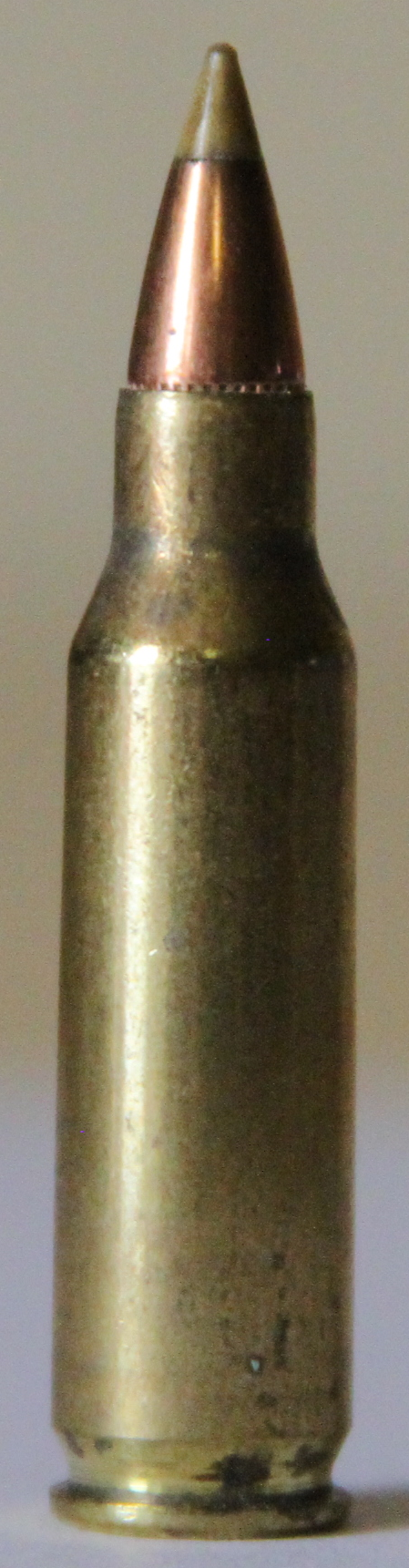
The efficiency claim that gets made for this cartridge holds up. Gun Digest quantifies it as 90 percent of .223 Remington velocity on 60 percent of the powder, and 170–212 ft/s per grain of powder against the .222 Remington’s 163–169 (averaged maximum loads, 40-grain bullets, 24-inch barrels). In a 10¾-inch barrel that efficiency is not a bragging right, it is the reason the cartridge works there at all.
4.7 🔴 The 780 foot-pound error, and the arithmetic that kills it
American Handgunner, January/February 1979, in the article that introduced the XP-100 to the silhouette crowd:
“the .221 Fireball was good for game with 2650 velocities. But on the armored rams, sustained energy way out was lacking. Remington said its Fireball would sustain 780 foot pounds of energy at 300 yards. But the metal menagerie wasn’t impressed by that 50 grain pill no matter what Remington said.”
That figure is not a 300-yard figure. It is the muzzle energy, and the arithmetic is exact:
E = m·v² / 450,240 E = 50 × 2,650² / 450,240 E = 50 × 7,022,500 / 450,240 E = 779.8 ft·lbf
A 50-grain bullet at the 2,650 ft/s the same paragraph quotes produces 780 ft·lbf at the muzzle, to within a fifth of a foot-pound. The coincidence is not a coincidence.
What the cartridge actually retains at 300 yards is a different order of magnitude. A 50-grain .224 spitzer has a G1 ballistic coefficient in the region of 0.20 to 0.24; launched at 2,650 ft/s it arrives at 300 yards somewhere near 1,400 to 1,550 ft/s, for roughly 220 to 270 ft·lbf — a figure estimated here rather than measured, and given as a range for that reason. The published claim overstates 300-yard energy by about a factor of three.
This matters beyond the correction itself, for two reasons.
First, it is a worked example of the commonest failure mode in handgun ballistics writing: a muzzle number migrating down the page into a range column. A reader who checks E = mv²/450,240 against any quoted energy figure catches this class of error in about fifteen seconds.
Second, the conclusion the 1979 article drew was right even though its number was wrong. The Fireball genuinely will not topple a 200-metre ram. It reaches that conclusion by observation — “the metal menagerie wasn’t impressed” — and the observation survives the arithmetic being repaired. Vol 5 builds on the observation, not the number.
4.8 7mm BR Remington
The purpose-built silhouette cartridge, and the numbers are better documented than any other in the family except the .223.
Table 5 — 4.8 7mm BR Remington
| Source | Gun and barrel | Load | Velocity | Energy |
|---|---|---|---|---|
| Accurate Arms | Factory load | 140 gr PSP | 2,215 ft/s | 1,525 ft·lbf |
| Wikipedia | 15 in | 139 gr | 2,200 ft/s | 1,494 ft·lbf |
| Wikipedia | 15 in | 154 gr | 2,100 ft/s | 1,509 ft·lbf |
| American Handgunner 1979 | 15 in Obermeyer, custom XP-100 conversion | 139 gr Hornady, 28.0 gr H335 | 2,201 ft/s (measured) | 1,495 ft·lbf |
| American Handgunner 1979 | same | 139 gr Hornady, 30.0 gr H335 | 2,309 ft/s (measured) | 1,645 ft·lbf |
| American Handgunner 1979 | same | 139 gr Hornady, 31.0 gr H335 (max) | 2,351 ft/s (measured) | 1,706 ft·lbf |
Accurate’s load pages for this cartridge use a Douglas 15-inch barrel, and Accurate notes the reason the cartridge existed: “The 7mm BR provides an excellent combination of accuracy and power for metallic silhouette shooting. It is also suitable for hunting of deer-sized game within 200 yards.”
Four independent sources land between 2,200 and 2,350 ft/s with a 139–140-grain bullet from a 15-inch barrel. That convergence is the strongest ballistic fact in this dive, and it is what a 7mm BR XP-100 should be expected to do.
Note what happens against the .221 Fireball: roughly double the muzzle energy, 1,500 against 780, from a pistol of similar weight. That is the entire reason Remington built the Silhouette model, and it is the reason Vol 5 reaches the conclusion it does about silhouette work.
⚠ Two of the three measured loads above carry the same note in the original: “large muzzle flash.” See §4.15.
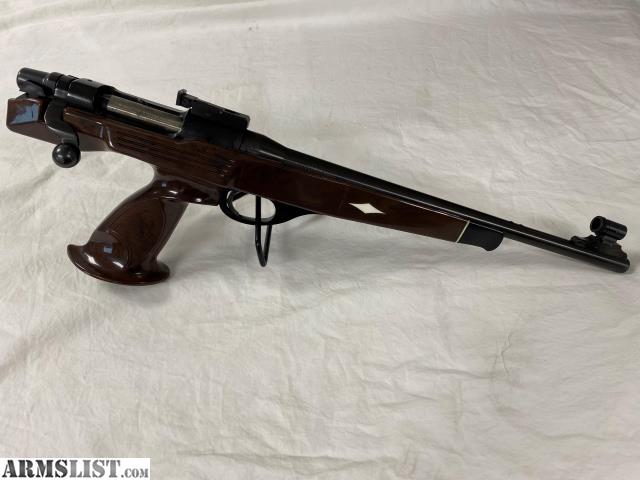
4.9 7mm-08 Remington — the only data measured in an XP-100
This is the best document in the entire ballistic record for this pistol, because of one line at the top of the page.
Gun: XP-100 · Barrel Length: 15” · Primer: CCI 200 · Case: REM — Accurate Arms, Per-Caliber Guide, handgun section, “7mm-08 Remington”
Not a Contender. Not a Douglas test barrel in a universal receiver. An XP-100. Every other pistol-barrel number in this volume is a proxy; this one is the gun.
Table 6 — 4.9 7mm-08 Remington — the only data measured in an XP-100
| Bullet | Powder | Charge (max) | Velocity | Pressure | Energy |
|---|---|---|---|---|---|
| Sierra 100 gr HP | AA2460 | 43.0 gr | 2,917 ft/s | 49,500 CUP | 1,890 ft·lbf |
| Sierra 100 gr HP | AA2230 | 42.5 gr | 2,906 ft/s | 49,800 CUP | 1,876 ft·lbf |
| Sierra 100 gr HP | AA2520 | 44.5 gr | 2,908 ft/s | 48,400 CUP | 1,878 ft·lbf |
| Nosler 120 gr SP | AA2230 | 40.3 gr | 2,656 ft/s | 48,900 CUP | 1,880 ft·lbf |
| Nosler 120 gr SP | AA2015 | 38.2 gr | 2,627 ft/s | 49,000 CUP | 1,839 ft·lbf |
All measured, all in an XP-100, all at 15 inches. SAAMI maximum average pressure for 7mm-08 is 52,000 CUP, so these are working loads rather than proof loads.
⚠ The excerpt consulted covers 100- and 120-grain bullets. Heavier 7mm bullets — 140, 154, 160 grains — are the ones a hunter would actually want, and their pistol-barrel velocities could not be confirmed from this source. On the trend of the data above, 140-grain loads from 15 inches should fall somewhere near 2,400–2,500 ft/s; that is an estimate by extrapolation and is not measured.
Accurate’s own summary of the combination is worth quoting because it is the manufacturer of the powder saying it, not a magazine: “This cartridge/handgun combination should provide all the performance from a 7mm handgun that anyone could want.”
Roughly 1,880 ft·lbf from a pistol. That is the highest confirmed, measured-in-an-XP-100 energy figure in this dive.
4.10 .308 Winchester
No measured .308 data from an XP-100 barrel could be found. What exists instead is unusually good cut-down-barrel data that brackets the XP-100’s 14½ inches from both sides, and an estimate built from it is honest as long as it is labelled.
Measured, from Rifleshooter’s .308 work:
- IMI Samson 150 gr FMJ, 30-shot strings: 28 in → 2,824 ft/s; 16.5 in → 2,555 ft/s. Average loss 23.4 ft/s per inch over that range.
- Below 15 inches, average loss per inch rises sharply and varies by load: Winchester 147 gr FMJ 77.6 · IMI 150 gr 81.7 · Federal 168 gr Gold Medal 73.1 · Winchester 180 gr Power-Point 60.7 ft/s per inch.
Estimate for 14½ inches, shown so it can be checked:
Start: 2,555 ft/s at 16.5 in (measured, 150 gr) Remove 2 inches at the measured sub-15-inch rates of 60.7–81.7 ft/s per inch Loss: 121–163 ft/s Result: approximately 2,390–2,435 ft/s, 150 gr, from 14½ inches — ESTIMATED Energy at 2,410 ft/s: 150 × 2,410² / 450,240 = 1,935 ft·lbf
Against 2,657 ft·lbf from the 28-inch barrel, a 14½-inch .308 retains roughly 73 percent of its energy and about 85 percent of its velocity. That is a better showing than the .223’s, and the reason is the mechanism in §4.2: a .308 is less overbore than a .223 relative to its bore area, so it finishes more of its burn sooner.
The practical reading: a .308 XP-100 with a 14½-inch barrel is a roughly-1,900-ft·lbf handgun. It is the most powerful chambering in the family for which any defensible number exists, and it comes at a recoil cost that Vol 5 takes seriously.
4.11 .22-250 Remington — the worst match in the list
No measured .22-250 short-barrel data could be found, and no estimate is offered here, because an estimate would need a sourced long-barrel baseline this dive does not have.
What can be said from mechanism and from the measured data already on the table is enough to decide with. The .22-250 fires the same .224-inch bullets as the .223 Remington behind roughly twice the powder charge. The .223’s own penalty from 20 inches to 14½ is about 235 ft/s, and to 10¾ inches about 500; the .22-250’s must be at least as large per inch and is very probably larger, because the mechanism that causes the loss — unburnt powder at the muzzle — scales with charge weight.
The comparison that settles it is the one Remington already ran in 1962. Faced with a .222 Remington that was too much cartridge for a 10¾-inch barrel, Remington did not shorten the barrel’s ambitions; it shortened the case. The .22-250 is a considerably larger cartridge than the .222 that failed that test.
A .22-250 XP-100 is a Custom Shop rarity and a collectable object. As a shooting proposition it is the chambering that gives away the most of what it was built to deliver.
4.12 .35 Remington and the low-pressure exception
The .35 Remington is the one chambering in the family that a short barrel treats gently, and the reason is worth stating because it generalises.
A cartridge that operates at modest pressure, with a large bore area relative to its charge, and with a fast-burning powder, finishes its burn early. Its last inches of barrel are contributing little, so removing them costs little. Accurate’s manual makes exactly this point about the closest analogue for which it publishes pistol data — the .30-30 Winchester in a 14-inch Contender:
“The velocity loss in the 14” Contender barrel versus a 20” rifle is minimal.”
and opens the page with the question that belongs in this volume:
“Question: When is a cartridge considered more suitable for deer hunting when fired from a handgun than when fired from a rifle? Answer: When it’s a .30-30 Winchester.”
The .35 Remington sits in the same class: a 1906 cartridge, low pressure, .358-inch bore, 150- to 200-grain bullets, normally seen in lever guns.
⚠ No measured .35 Remington pistol-barrel velocity could be found for this dive, from Accurate, from Remington, or from any of the period sources consulted. The class argument above is sound and the analogy to the .30-30 is the manufacturer’s own; the specific numbers are not available and are not invented here. A buyer seriously considering a .35 Remington XP-100 for hunting should chronograph it rather than trust a table, and that recommendation applies more strongly to this chambering than to any other in the family.
4.13 .250 Savage, 6mm BR, .260 Remington: what cannot be said
No pistol-barrel data of any kind could be found for these three. All are Custom Shop or single-year chamberings (Vol 2), and the reloading industry never built the data pages for them that it built for the .221 Fireball, 7mm BR and 7mm-08 — which is itself informative about how many were made.
The class placements are safe enough to state:
- .250 Savage — moderate pressure, moderate charge, .257-inch bore. Should behave more like the .308 than like the .22-250.
- 6mm BR Remington — small, efficient, short case, the parent of the 7mm BR. Should behave well in a short barrel for the same reason the 7mm BR does.
- .260 Remington — a full-size .308-family case necked to 6.5mm. Should behave much like the .308, with the usual 6.5mm advantage in retained velocity downrange rather than at the muzzle.
Those are placements, not numbers, and they are labelled as such.
4.14 The summary table
Every row carries its barrel length, its status and its source. This table is what Vol 5 argues from.
Table 7 — 4.14 The summary table
| Cartridge | Barrel | Bullet | Velocity | Energy | Status | Source |
|---|---|---|---|---|---|---|
| .221 Fireball | 10¾ in | 50 gr factory | 2,600–2,700 ft/s | 750–810 ft·lbf | Measured (three sources, converging) | Gun Digest; American Handgunner; Wikipedia |
| .221 Fireball | 14 in (T/C) | 45 gr handload | 2,947 ft/s | 868 ft·lbf | Measured, wrong gun | Accurate Arms |
| .223 Rem | 14½ in | 55 gr FMJ | ~2,840–3,069 ft/s | 985–1,151 ft·lbf | Interpolated from measured | Rifleshooter.com |
| .223 Rem | 10¾ in | 55 gr FMJ | ~2,556–2,817 ft/s | 798–969 ft·lbf | Interpolated from measured | Rifleshooter.com |
| 7mm BR | 15 in | 139–140 gr | 2,200–2,350 ft/s | 1,495–1,706 ft·lbf | Measured (four sources, converging) | Accurate; Wikipedia; American Handgunner |
| 7mm-08 | 15 in, in an XP-100 | 120 gr | 2,656 ft/s | 1,880 ft·lbf | Measured, in an XP-100 | Accurate Arms |
| 7mm-08 | 15 in, in an XP-100 | 100 gr | 2,917 ft/s | 1,890 ft·lbf | Measured, in an XP-100 | Accurate Arms |
| 7mm-08 | 15 in | 140 gr | ~2,400–2,500 ft/s | ~1,790–1,940 ft·lbf | Estimated by extrapolation | This dive |
| .308 Win | 14½ in | 150 gr | ~2,390–2,435 ft/s | ~1,935 ft·lbf | Estimated from measured loss rates | Rifleshooter.com |
| .22-250 | 14½ in | — | — | — | No data; none invented | — |
| .35 Rem | 14½ in | — | — | — | No data; class argument only | Accurate (.30-30 analogue) |
| .250 Savage / 6mm BR / .260 Rem | — | — | — | — | No data; class placement only | — |
4.15 Blast and noise: the cost nobody tabulates
Velocity tables do not have a column for this, and for a short-barrelled centrefire it is the thing an owner notices first.
The evidence runs through the whole history of the gun:
- 1962. The .222 Remington prototype was abandoned because, in Wikipedia’s words, “the short barrel produced significant noise and muzzle flash.” The cartridge that replaced it was named for the flash it still produced.
- 1979. Two of the three measured 7mm BR loads in American Handgunner’s custom-conversion data carry the note “large muzzle flash” — at 30.0 and 31.0 grains of H335, the loads that actually reach silhouette velocity. The 28.0-grain load, noted “good accuracy,” does not.
- 2016. Rifleshooter’s short-barrelled .308 experiment, at lengths bracketing the XP-100’s: “Yes, it did. I’ve shot a lot of different firearms in my life and this wasn’t pleasant. My ears were ringing for a long time after the test, I shot it wearing double ear protection and without overhead cover. It was LOUD.”
Two practical conclusions follow, and they belong in a buying decision rather than a footnote:
Hearing protection on an XP-100 is not optional and doubling up is reasonable. The muzzle is closer to the shooter’s head than a rifle’s, it is unshielded by a stock, and the fraction of the charge burning outside the barrel is larger.
The blast penalty scales the same way the velocity penalty does. The chamberings that lose the most velocity to the short barrel are the ones that make the most noise and flash doing it, because those are the same unburnt grains. That gives a buyer a useful heuristic with no arithmetic in it: the more a chambering is hurt by the barrel, the more unpleasant it is to shoot. The .221 Fireball sits at the good end of that trade on purpose; the .22-250 sits at the other end.
4.16 References (Vol 4)
- Rifleshooter.com, “223 Remington/5.56mm NATO barrel length and velocity: 26 inches to 6 inches” (December 2015) and “223 Remington/5.56 NATO, velocity versus barrel length” (April 2014). One barrel cut down, MagnetoSpeed chronograph, five-round strings. The source of the anchor dataset and of the M855 table defect noted in §4.4.
- Rifleshooter.com, “308 Winchester / 7.62x51mm NATO Short barrel length and velocity” (February 2016) and the companion 28-to-16.5-inch series (January 2015). The per-inch loss rates and the 30-shot IMI string.
- Accurate Arms, Per-Caliber Guide, handgun section: “.221 Remington Fireball” (T/C, 14 in); “7mm BR Remington” (Douglas, 15 in); “7mm-08 Remington (XP-100, 15 in)”; “.30-30 Winchester” (T/C, 14 in). Archived via the Internet Archive.
- American Handgunner, January/February 1979. The 2,650 ft/s factory figure, the “780 foot pounds at 300 yards” claim corrected in §4.7, and Helmut Sakschek’s measured 7mm BR loads from a 15-inch Obermeyer barrel in a custom XP-100 conversion.
- Patrick Meitin, “Remington XP-100: The Successful Experiment,” Gun Digest, 26 October 2020. The 500–600 ft/s observation between a 10¾-inch pistol and a 24-inch rifle in the same cartridge, and the efficiency figures.
- Wikipedia, “.221 Remington Fireball” and “7mm BR Remington,” consulted 17 September 2026.
Comments (0)