Remington XP-100 · Volume 2
Every Chambering, Documented
What Remington actually offered, in which variant, in which years — and the three entries that do not survive checking
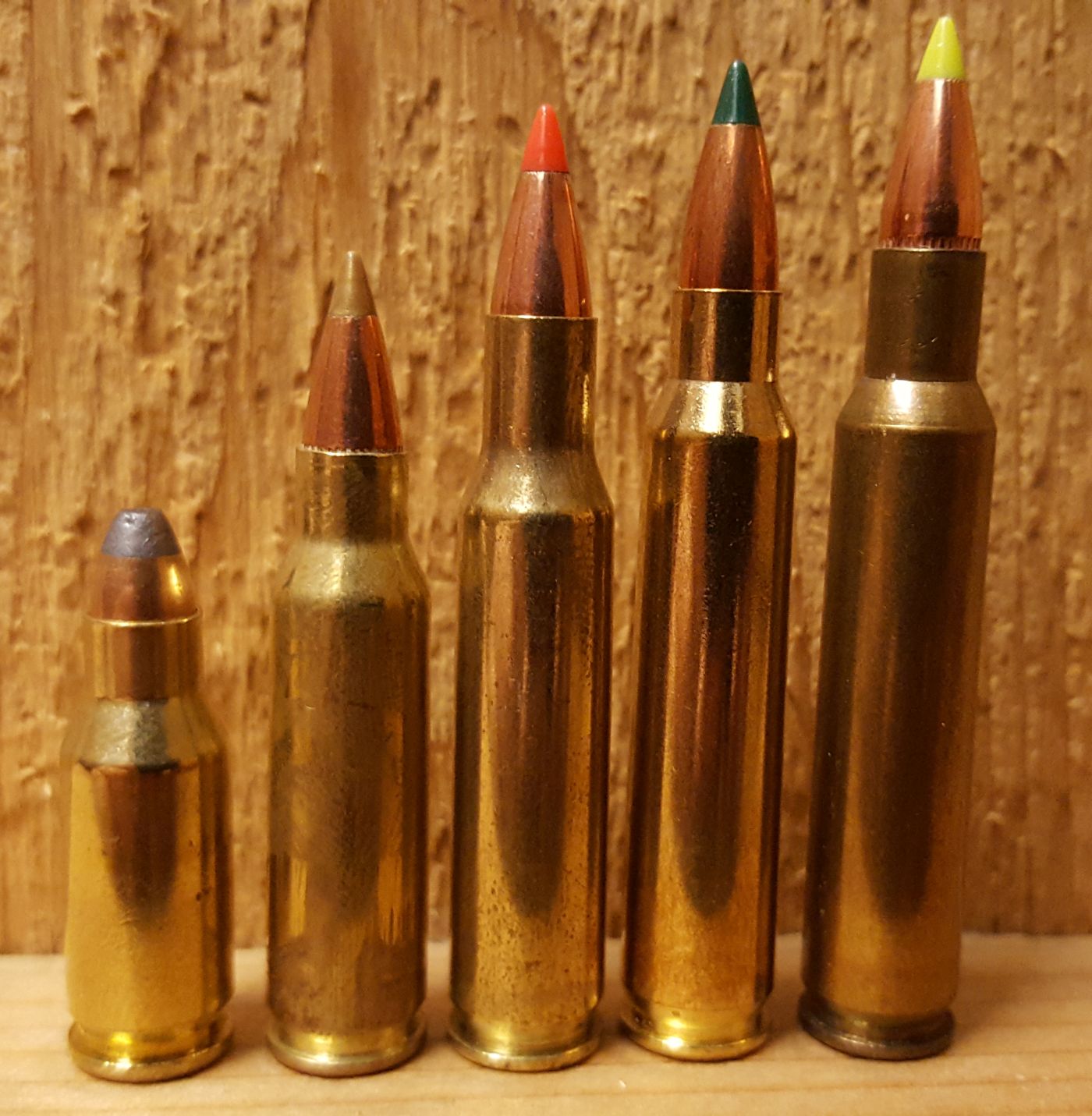
Anyone buying an XP-100 needs this list for one practical reason: it is how a barrel rollmark is checked against the factory record. A pistol stamped with a chambering Remington never offered is not necessarily a bad buy — the custom trade was enormous and much of its work is excellent — but it is a different object with a different value, a different parts situation and a different ammunition problem, and it should be recognised as such before money changes hands rather than afterwards.
2.1 Why this list is hard
Three reasons, all of them structural.
The Custom Shop was not a catalogue. A large share of XP-100 chamberings were Custom Shop offerings, made to order in small numbers. Catalogue documents record catalogue products. A Custom Shop gun can exist in numbers too small to appear in any published list and still be entirely factory.
Remington’s own record is thin and now only exists in an archive. The manufacturer’s model-history pages for the XP-100 and XP-100R are the closest thing to a primary source available, and they list total production as “N/A” with no serial blocks. They survive only in the Internet Archive; Remington Arms went through bankruptcy and asset break-up in 2020.
The most-copied secondary source disagrees with the primary one it cites. As Vol 1 §1.12 sets out, Wikipedia’s chambering-by-year list cites Remington’s model-history pages and then gives different end dates for six of the nine entries. Because Wikipedia is what a search returns, those dates are now the ones most often repeated.
2.2 The sources, and what each one is worth
Table 1 — 2.2 The sources, and what each one is worth
| Source | What it is | Weight given here |
|---|---|---|
| Remington model-history pages (XP-100, archived 2009; XP-100R, archived 2006) | The manufacturer’s own model summary | Highest for whether a chambering existed and for catalogue years |
| Gun Digest, Meitin 2020 | A feature article by a working gun writer who owns one | High for configuration (barrel lengths, stock materials, which variant introduced what); weaker on years |
| Wikipedia (XP-100; .221 Fireball) | Aggregated from the above plus Marcot | Low for dates; useful as a record of what most people believe |
| Marcot, The History of Remington Firearms (2005) | A book-length history | Cited at second hand only; not consulted directly for this dive |
| Accurate Arms per-caliber load guide | A powder maker’s load manual | Highest for which cartridges were treated as XP-100 chamberings by the reloading industry, because its data pages name the test gun |
That last row does real work. Accurate’s 7mm-08 Remington handgun data page names its test gun as “XP-100” and its barrel as 15 inches — a powder company does not build a 15-inch 7mm-08 pistol for a chambering that does not exist.
2.3 The verified table
Years below are Remington’s own, from the archived model-history pages, because that is the best available record. Where another source gives a materially different year the disagreement is noted in the row and discussed in the cartridge’s own section.
2.3.1 Single-shot XP-100 family
Table 2 — Single-shot XP-100 family
| Cartridge | Years (Remington’s record) | Availability | Notes and disagreements |
|---|---|---|---|
| .221 Remington Fireball | 1963–1985 | Catalogue | The original and the only chambering for the first seventeen years |
| 7mm BR Remington | 1980–1985 | Catalogue | Introduced with the 14½-inch Silhouette model |
| .223 Remington | 1986–1994 | Catalogue | Wikipedia says 1986–1997 |
| .35 Remington | 1986–1994 | Catalogue | Wikipedia says 1986–1997 |
| .250 Savage | 1990–1991 | Custom Shop only | Wikipedia says 1990–1992; Gun Digest dates its introduction to 1988 |
| 6mm BR Remington | 1990–1991 | Custom Shop only | Wikipedia says 1990–1992; Gun Digest dates its introduction to 1988 |
| .22-250 Remington | 1992–1994 | Custom Shop only | Gun Digest dates its introduction to 1988 |
| .308 Winchester | 1992–1994 | Custom Shop only | Gun Digest dates its introduction to 1988 |
| 7mm-08 Remington | 1993–1994 | Catalogue | Gun Digest dates its introduction to 1986, with the Custom Long Range Pistol — a seven-year gap between sources |
2.3.2 XP-100R repeater
Table 3 — XP-100R repeater
| Cartridge | Years (Remington’s record) | Notes |
|---|---|---|
| .22-250 Remington | 1998 | |
| .223 Remington | 1998 | |
| .260 Remington | 1998 | Appears in no other XP-100 list, including Wikipedia’s infobox |
| .35 Remington | 1998 |
Wikipedia’s prose adds a longer earlier XP-100R run — “made 1991–1997 in .223 Rem., .250 Savage, 7mm-08 Rem., .308 Win., .35 Rem., and 350 Rem. Mag.” — sourced to Marcot. Gun Digest independently dates an “XP-100R Custom KS Repeater” to 1991. The reconciliation offered in Vol 1 §1.11 is that the XP-100R was a Custom Shop product from 1991 and a catalogue product for one year in 1998; that is an inference, not a sourced statement.
So: nine factory chamberings in the single-shot, four in the repeater, three of which repeat the single-shot list. The unique total across the whole family, on the best record, is ten: .221 Fireball, 7mm BR, .223, .35 Remington, .250 Savage, 6mm BR, .22-250, .308 Winchester, 7mm-08, .260 Remington.
2.4 🔴 Three entries that do not survive checking
.350 Remington Magnum — UNCONFIRMED. This chambering is widely attached to the XP-100 and it appears in Wikipedia’s caliber-by-year list as “350 Rem. Mag (1991–1997)” and in Wikipedia’s XP-100R prose. It appears in neither of Remington’s own caliber lists: not on the XP-100 page, not on the XP-100R page. It is also absent from Wikipedia’s own infobox cartridge list, so that article contradicts itself on it. Gun Digest’s variant walkthrough does not mention it.
The claim is not absurd — the .350 Remington Magnum is a short-action cartridge, it was a Model 600 chambering, and the XP-100R’s action would accept it — so it may well be a genuine Custom Shop chambering that never reached a catalogue document. But it could not be verified for this dive, and a buyer offered an XP-100R in .350 Remington Magnum should treat the chambering as unverified against the factory record and price it as an unknown rather than as a confirmed rarity. The recoil implications alone are worth thinking about: a 250-grain bullet leaving a 6½-pound rifle is unpleasant; leaving a 4½-pound pistol it is something else.
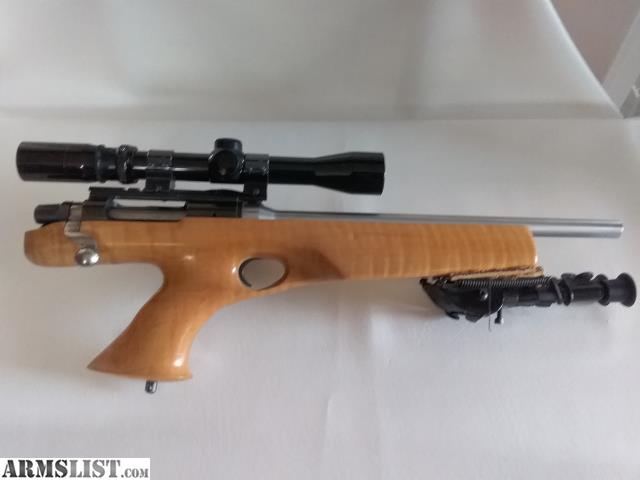
6×45mm — REJECTED as a factory chambering. Wikipedia’s lead sentence says the XP-100 “introduced the .221 Fireball and 6×45mm.” The .221 Fireball half is correct and well documented. The 6×45mm half is not: 6×45mm is a wildcat, a .223 Remington case necked up to 6mm, and no source consulted here shows Remington cataloguing it in anything. XP-100s in 6×45mm exist in quantity — one is pictured below — but they are custom rebarrels, which is a different claim entirely.
The 1997 end dates — REJECTED. Wikipedia’s “(1986–1997)” for .223 Remington and .35 Remington, and “(1990–1992)” for .250 Savage and 6mm BR, are inconsistent with the Remington pages those entries cite, which give 1994 and 1991 respectively. Use 1994 and 1991.
2.5 .221 Remington Fireball
Years: 1963–1985. Catalogue. 10¾-inch barrel, 1:14 twist.
The cartridge the pistol was built around, and the reason the pistol exists in the form it does (Vol 1 §1.4). A .222 Remington case shortened to 1.400 inches, running at 52,000 CUP against the .222’s 46,000.
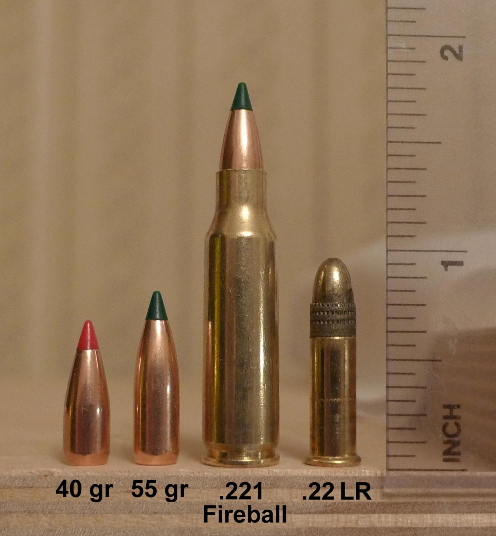
It is the most efficient cartridge in the family by a distance. Gun Digest quantifies it: the Fireball produces “90 percent of the wildly popular .223 Remington’s velocity — while burning only 60 percent of the powder,” and yields 170 to 212 ft/s per grain of powder against the .222 Remington’s 163 to 169 (averaged maximum loads, 40-grain bullets, 24-inch barrels). Efficiency is not an abstraction in a 10¾-inch barrel; it is the difference between a cartridge that works there and one that wastes a third of its charge as muzzle flash.
Two things it is not. It is not a silhouette cartridge — American Handgunner in 1979 and Gun Digest in 2020 agree that it will not reliably topple a 200-metre ram, and Gun Digest states it flatly: the Fireball “soon developed a reputation for lacking enough punch to reliably tip over 200-meter rams.” And it is not a big-game cartridge, in Michigan or anywhere else, for reasons Vol 5 makes arithmetic.
What it is, is the best varmint and predator chambering in the family and one of the best in any handgun. That case is made in Vol 5.
The cartridge outlived the pistol. Remington chambered the Model 700 for it from 2002, CZ chambered the 527, and Thompson/Center offered Contender and Encore barrels in it. It is also the parent of a small dynasty: the .17 Mach IV, which Remington legitimised as the .17 Remington Fireball in 2007; the .20 VarTarg; and — the one most people have heard of without knowing the ancestry — the .300 Whisper / .300 Blackout family, which is a .221 Fireball case opened up to .30 calibre.
2.6 7mm BR Remington
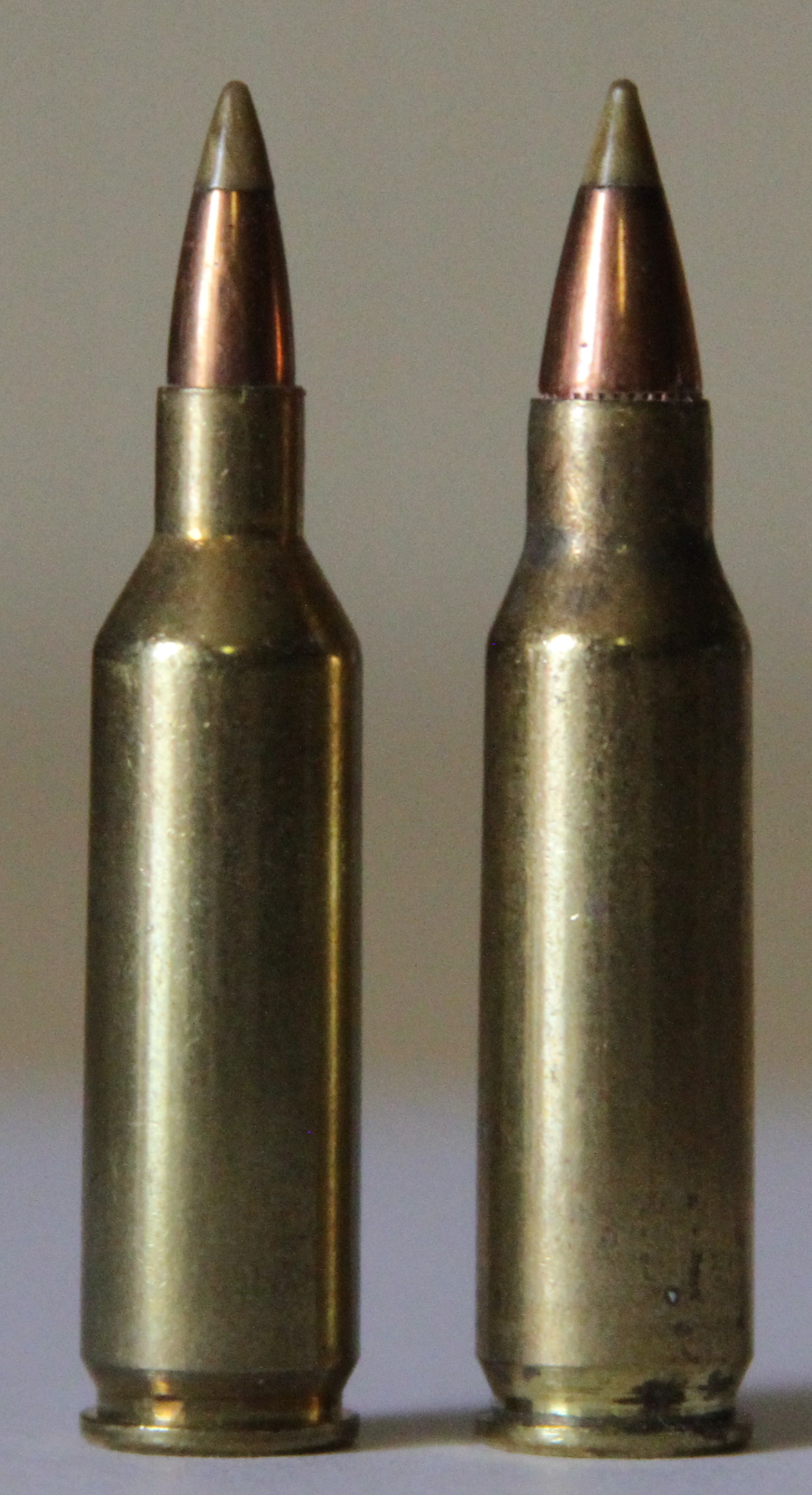
Years: 1980–1985. Catalogue. Introduced with the 14½-inch Silhouette model.
The only cartridge in the family designed for the sport rather than the gun. It is a thin-walled .308 Winchester case with a small primer pocket, shortened to 1.5 inches and necked to 7mm, developed from the 6mm BR Remington. Accurate’s manual describes the purpose without varnish: “The 7mm BR provides an excellent combination of accuracy and power for metallic silhouette shooting. It is also suitable for hunting of deer-sized game within 200 yards. A major factor in this cartridge’s popularity is the excellent accuracy and great strength of the XP-100 bolt action pistol.” SAAMI maximum average pressure is 52,000 CUP — the same ceiling as the .221 Fireball, and for the same reason.
Wikipedia credits the design to Mike Walker and dates it to 1978, developed “for the Unlimited Class in the sport of Metallic silhouette shooting.”
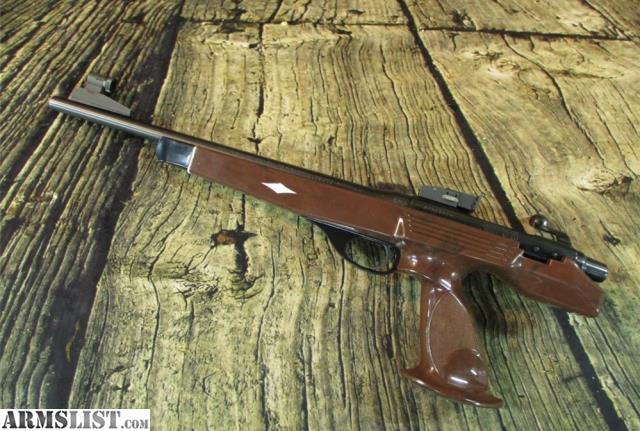
⚠ That listing is worth pausing on, because it is a good example of the identification problem. Remington introduced 7mm BR with the 14½-inch Silhouette. A 7mm BR in a 10¾-inch barrel is either a configuration not described in any source consulted here, or a rebarrel, or a seller’s error. Nothing about the photograph resolves it. This is the normal condition of the XP-100 market and Vol 6 treats it accordingly.
The 7mm BR’s problem today is brass, and it is the single most important availability fact in this volume. See §2.13.
2.7 .223 Remington
Years: 1986–1994 (Remington’s record). Catalogue. The Varmint Special’s chambering, in a 14½-inch barrel with no iron sights.
When the 10¾-inch barrel went away, the reason for a purpose-built short cartridge went away with it. Wikipedia puts the logic well: “with the elimination of the original 10¾ in barrel, the reduced powder capacity was no longer such a requirement, and the chamberings switched to standard commercial rifle cartridges.”
.223 Remington is the most practical chambering in the family for anyone who intends to shoot rather than collect, and Vol 5 argues that it and the .221 Fireball are the only two serious answers for a first XP-100. It is also the chambering with by far the best measured short-barrel data, which is why Vol 4 is built on it.
It carried forward: .223 Remington is one of the three XR-100 Rangemaster chamberings from 2005, and one of the four XP-100R chamberings in 1998.
2.8 .35 Remington
Years: 1986–1994 (Remington’s record). Catalogue and Custom Shop. Also an XP-100R chambering in 1998.
The big-bore answer, and the only factory XP-100 chambering that throws a bullet heavy enough to be a serious deer proposition without argument. A rimmed-looking but actually rimless .35-calibre cartridge from 1906, normally seen in lever guns and pumps, running at modest pressure with 150- to 200-grain bullets.
Its virtue in a pistol is exactly its vice in a rifle: it is a low-pressure, large-bore, short cartridge, so it loses less to a short barrel in proportional terms than a high-intensity round does. Accurate’s manual makes the equivalent point about the .30-30 Winchester in a 14-inch Contender — “The velocity loss in the 14” Contender barrel versus a 20” rifle is minimal” — and asks the question that belongs in this volume: “When is a cartridge considered more suitable for deer hunting when fired from a handgun than when fired from a rifle? Answer: When it’s a .30-30 Winchester.” The .35 Remington sits in the same class of answer, and Vol 4 takes the argument up properly.
The custom trade got there first, as usual: American Handgunner in 1979 lists Phil Crowley chambering XP-100s in .35 Remington seven years before Remington did, and building the .338 CJ wildcat by necking .35 Remington brass down to .338.
2.9 The 1990–1994 Custom Shop four: .250 Savage, 6mm BR, .22-250, .308 Winchester
These four arrived together in spirit if not in the same year, and all four are Custom Shop guns, which means small numbers and poor documentation.
.250 Savage (1990–1991 on Remington’s record). The .250-3000, a 1915 cartridge, in a pistol. Sensible on paper — mild, accurate, efficient, and short enough to suit the action.
6mm BR Remington (1990–1991). The parent of the 7mm BR, and one of the most accurate cartridges ever standardised. In a pistol it is a target and varmint proposition.
.22-250 Remington (1992–1994). The high-intensity varmint round. It is the worst possible match to a short barrel in the whole list — a large charge of slow powder behind a light bullet is precisely the combination that needs 24 inches to be worth what it costs in blast — and Vol 4 shows the arithmetic. It also carried forward into the XR-100 rifle, where it makes complete sense.
.308 Winchester (1992–1994). The one that matters most to a buyer who already owns a .308 rifle, for reasons Vol 5 develops at length. Its short-barrel behaviour is the best-measured in the family after the .223.
Gun Digest dates all four to a single 1988 introduction with the “Custom Long Range Pistol Heavy Barrel” and its 15½-inch heavy barrel. Remington’s record puts them two to four years later. The disagreement cannot be resolved from the sources available, and the honest reading is that Custom Shop chamberings have no reliable start dates.
2.10 7mm-08 Remington
Years: 1993–1994 on Remington’s record; 1986 on Gun Digest’s.
The widest date disagreement in the whole table — seven years — and neither source can be checked against the other. Gun Digest attaches it to the 1986 Custom Long Range Pistol, together with .35 Remington; Remington’s caliber list puts it in 1993–1994 alongside the Hunter.
What is not in dispute is that the reloading industry treated it as an XP-100 cartridge. Accurate’s data page for 7mm-08 Remington names the test gun as XP-100 with a 15-inch barrel, and opens: “Available from Remington as a chambering in the XP-100 bolt action pistol, the 7mm-08 is a rifle cartridge that has gained a following among the ranks of IHMSA shooters as well as handgun hunters. This cartridge/handgun combination should provide all the performance from a 7mm handgun that anyone could want.”
That page is also the single most useful ballistic document for this pistol that could be found anywhere, because it is XP-100-specific rather than Contender-derived. Vol 4 uses it.
2.11 .260 Remington
Years: 1998 only, XP-100R only.
The chambering that most lists leave out. It is on Remington’s own XP-100R model-history page and it is absent from Wikipedia’s infobox cartridge list, which is the list most people check. A .308 Winchester case necked to 6.5mm, standardised by Remington in 1997 — so an XP-100R in .260 Remington was chambered for a cartridge that was one year old.
It is a good short-action cartridge with excellent bullets available, and it is the only 6.5mm in the family. A buyer who finds one has found something genuinely scarce: a one-model-year chambering in the scarcest variant.
2.12 .222 Remington — the prototype that was never catalogued
The first XP-100 prototypes were .222 Remington. No production XP-100 was chambered for it; the whole point of the .221 Fireball was to replace it (Vol 1 §1.4). A pistol offered as “a .222 XP-100” is either a rebarrel, a mis-read rollmark, or — if the approximately thirteen 1962 prototypes are real and one has survived — something that would need far better provenance than a seller’s description.
2.13 Ammunition, brass and dies: the tiers that matter to a buyer
This section drives a large part of Vol 5’s conclusion, so it is worth being precise about what it does and does not claim.
⚠ What could not be done for this dive: a survey of current retail stock. No claim is made below about what is on a shelf in September 2026, what it costs, or who has it. The tiering is structural — whether a cartridge is a current SAAMI-standard commercial round with mainstream factory loadings, a surviving specialist round, or a round whose supply depends on forming brass from a different case. That structure changes slowly and is what a buying decision should rest on; retail stock changes weekly and is checkable by the buyer in five minutes.
Table 4 — 2.13 Ammunition, brass and dies: the tiers that matter to a buyer
| Tier | Cartridges | What it means in practice |
|---|---|---|
| 1 — Mainstream | .223 Remington, .308 Winchester, .22-250 Remington, 7mm-08 Remington | Factory ammunition from every major maker, brass everywhere, dies from every die maker, load data in every manual. No planning required. |
| 2 — Current but specialist | .221 Remington Fireball, .35 Remington, .260 Remington, .250 Savage | Standard cartridges still supported by the industry, but with few loadings and intermittent availability. A shooter should expect to buy brass when it appears rather than when it is needed, and should expect handloading to be the normal mode rather than the enthusiast’s option. |
| 3 — Handloading proposition | 7mm BR Remington, 6mm BR Remington | Factory ammunition is not a realistic supply. Shooting one of these means handloading, and for the 7mm BR it may mean forming brass from another case. |
The 7mm BR is the case that decides purchases. Accurate’s manual, written when the cartridge was alive, says “The 7mm BR unprimed cases are now available from Remington” — a sentence that only gets written about a cartridge whose brass supply was a problem. Remington is no longer the company that wrote that sentence. The 6mm BR, by contrast, was rescued by the benchrest community and by Lapua’s brass, which is why the smaller of the two siblings is the easier one to feed.
The practical consequence, stated plainly because Vol 5 will rest on it: an XP-100 in 7mm BR is a handloading project before it is a shooting gun. That is not a reason to avoid one — the cartridge is superb and the guns are the desirable silhouette configuration — but it is a reason not to buy one as a first XP-100 for someone who does not already load.
2.14 Wildcats and rechamberings a buyer will meet
The custom trade’s output is part of the market, and pretending otherwise is how a buyer overpays. American Handgunner recorded in 1979 that Ron Power alone kept over 135 chamberings in stock for the XP-100, “running basically from 17 caliber through 45 caliber.” The chamberings named in that one issue include .222, .222 Magnum, .223, 6×47, 6mm, .250 Savage, .257 Roberts, 6.5×.250, 7×57, 7×.250, .30 Remington, .308, .35 Remington, .350 Remington Magnum, .338, .358 and the .338 CJ wildcat (a .35 Remington necked to .338, with dies then being cut by RCBS).
Note what that list contains: .350 Remington Magnum appears in the 1979 custom trade — nine years before Wikipedia’s claimed factory introduction of it, and in a context that makes clear it was gunsmith work. That does not disprove a later factory offering, but it does supply an obvious mechanism by which a well-documented custom chambering could be remembered as a factory one.
The commonest rechamberings a buyer will actually meet today are 6×45mm (as pictured in §2.4), 6mm PPC and 6 BR variants, .243 and .308-family wildcats, and increasingly 6.5 Creedmoor, which the modern stockmakers advertise fitted to XP-100 actions.
None of this is a defect. A Power or Sinclair XP-100 in a Fajen stock is a piece of American gunsmithing history in its own right. It is simply not a factory XP-100, and it should be bought as what it is. Vol 6 gives the inspection sequence for telling them apart.
2.15 References (Vol 2)
- Remington Arms Company, “Firearm Model History — Model XP-100,” remington.com, archived 13 December 2009 (Internet Archive). The nine-chambering caliber list with years.
- Remington Arms Company, “Firearm Model History — Model XP-100R,” remington.com, archived 15 October 2006 (Internet Archive). The four 1998 chamberings including .260 Remington.
- Patrick Meitin, “Remington XP-100: The Successful Experiment,” Gun Digest, 26 October 2020. Variant configurations and the competing introduction years; the Fireball efficiency figures.
- Accurate Arms, Per-Caliber Guide, handgun section: “.221 Remington Fireball” (T/C, 14 in), “7mm BR Remington” (Douglas, 15 in), “7mm-08 Remington” (XP-100, 15 in), “7mm IHMSA” (Douglas, 14 in), “.30-30 Winchester” (T/C, 14 in). All archived November 2008 – December 2003 (Internet Archive).
- American Handgunner, January/February 1979. The custom-trade chambering lists, Ron Power’s 135 chamberings, Crowley’s .338 CJ.
- Wikipedia, “Remington XP-100,” “.221 Remington Fireball,” “7mm BR Remington,” consulted 17 September 2026.
Comments (0)