Remington XP-100 · Volume 3
The Action and the Hardware
What it shares with the 40X, 600, 700 and Seven — and the two things that make a centre-grip gun different from every other Remington
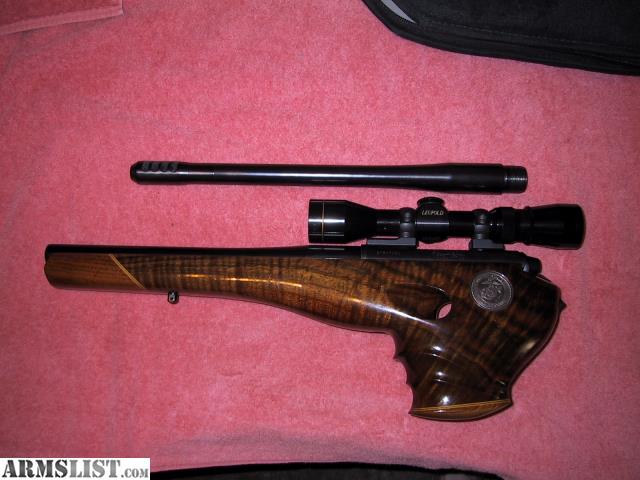
The XP-100 is a rifle action in a pistol stock, and almost everything useful about owning one follows from that sentence. The action is conventional, well-supported and outlived the pistol twice. The stock is where the design is unusual, and the stock is what dictates the trigger, the ergonomics and most of the modification options.
3.1 The family tree, stated carefully
The lineage is worth getting right because it determines what parts and what gunsmithing knowledge apply.
What is well supported: the XP-100 was built on the short action of the Remington Model 40X target rifle, and that work influenced the Model 600 carbine that followed in 1964. Marcot’s history is the normal citation; Gun Digest states it the same way. The Model 600 ran 1964–1968, with the Model 660 (1968–1971), Mohawk 600 (1972–1979) and Model 673 (2003–2004) descending from it. The Model Seven of 1983 is the modern short-action carbine in that line, and the Model 700 of 1962 is the architecture that the whole family’s trigger and bedding conventions come from.
What is not supported: the claim, made in passing in Wikipedia’s .221 Fireball article, that the XP-100 was “based on their Model 600 action.” The Model 600 was manufactured from 1964; the pistol shipped in 1963 and was prototyped in 1962. The direction of influence runs the other way (Vol 1 §1.3).
What is inferable but should be labelled as such: the working relationship between the XP-100 action and the Model 700. Wikipedia states that rear-grip XP-100 stocks “use standard Remington 700 triggers,” which establishes trigger interchangeability as a fact. It does not establish that receivers, bolts or barrel threads interchange with a 700 short action, and no source consulted for this dive states that they do. The aftermarket treats XP-100 actions as their own pattern — stockmakers advertise “XP-100” inlets specifically — which is the practical signal that matters.
The action’s afterlife confirms the quality of the original design. Remington brought it back in 2005 as the XR-100 Rangemaster, a single-shot bolt-action rifle, in .204 Ruger, .223 Remington and .22-250 Remington.
3.2 What “a short Remington bolt action” buys the owner
Four things, all of which show up in Vol 6 and Vol 7:
Accuracy that does not need excuses. Contemporary and modern accounts agree on this. American Handgunner’s 1979 writer put a scope on his and “ended up firing less than one inch groups.” Gun Digest’s 2020 account reports a 0.59-inch group from a 45-grain Hornady Hornet softpoint over 18.5 grains of Alliant 2400, from a 10¾-inch .221 Fireball. Those are rifle numbers from a pistol barrel.
Rebarrelling is routine. The custom trade’s whole business was cutting new chamberings for this action (Vol 2 §2.14), and it remains routine today. A worn or shot-out barrel on an XP-100 is a cost, not a write-off.
Rifle triggers. On the right stock — see §3.3.
A strong action for the pressure. Both .221 Fireball and 7mm BR run at a SAAMI maximum of 52,000 CUP, and 7mm-08 at the same figure. Accurate’s manual credits the pistol directly: “A major factor in this cartridge’s popularity is the excellent accuracy and great strength of the XP-100 bolt action pistol.”
3.3 🔴 The trigger, and why grip position decides it
This is the most consequential mechanical fact in the whole dive, and it is almost never mentioned in a sales listing.
“Stocks with a rear grip use standard Remington 700 triggers, while stocks with a center grip need a special trigger linkage system with a long transfer bar.” — Wikipedia, “Remington XP-100”
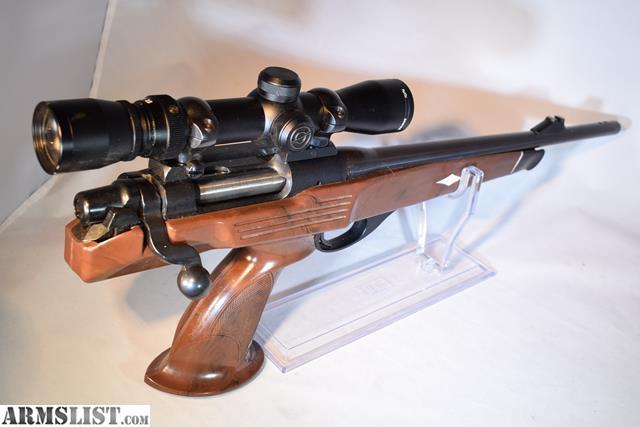
On a centre-grip gun — the original 1963 pattern and everything that looks like it — the hand is forward of the action. The trigger the finger touches is therefore not the trigger that releases the sear; it is a lever connected to the sear by a long transfer bar running back through the stock. That linkage is the reason the original XP-100’s trigger is a distinct part rather than a Remington 700 part.
On a rear-grip gun — Silhouette, Varmint Special, most Custom Shop guns, Hunter, XP-100R — the hand is behind the action in the conventional place, and the gun takes a standard Remington 700 trigger.
Three consequences for a buyer, in descending order of importance:
- Aftermarket trigger options are a rear-grip privilege. A Timney, Jewell or similar Remington 700 trigger drops into a rear-grip XP-100. A centre-grip gun cannot take one without re-engineering, because the interface it needs is the transfer bar, not the trigger.
- A stock swap is a trigger decision. Converting a centre-grip gun to a rear-grip stock — which is one of the commonest modifications, see Vol 7 — is not a drop-in. The linkage that suited the old stock does not suit the new one.
- Trigger feel is not comparable across the family. A long transfer bar adds mass and a second set of tolerances between finger and sear. Gun Digest’s owner describes his 1978 centre-grip gun’s trigger as “smooth, crisp,” so the original is clearly capable of being very good — but a centre-grip trigger and a rear-grip trigger are not the same mechanism and should not be judged against each other.
3.4 The safety, the bolt interlock, and the 1979 recall
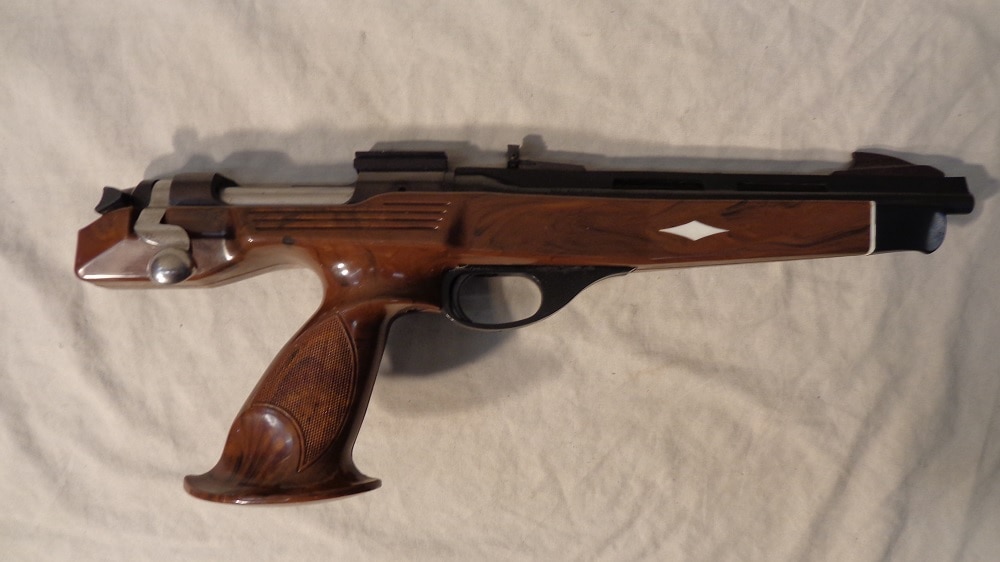
The original safety was a rotating thumb safety placed near the bolt handle — American Handgunner, 1979: “A rotating thumb safety was placed near the bolt handle.”
It had a fault that Remington eventually recalled. Engaging the safety locked the bolt closed, so a loaded pistol could not be unloaded without first pushing the safety off. The same fault existed on the Model 600, and in 1979 Remington recalled both and offered a free modification that allowed the bolt to be opened with the safety engaged.
The dating detail comes from Gun Digest, whose author’s 1978-vintage gun can work the bolt on safe: guns made after 1975 have the improved arrangement; earlier guns do not unless the recall modification was performed. That gives a three-state test on any used gun, and Vol 6 puts it in the inspection checklist:
Table 1 — The dating detail comes from Gun Digest, whose author's 1978-vintage gun can work the bolt on safe: guns made after 1975 have the improved arrangement; earlier guns do not unless the recall modification was performed. That gives a three-state test on any used gun, and [Vol 6](/actual-firearms/pistols/remington-xp-100/vol-6/) puts it in the inspection checklist
| Test result | What it means |
|---|---|
| Bolt opens with safety ON | Post-1975 production, or a pre-1975 gun that had the recall work done |
| Bolt locked with safety ON | A pre-1975 gun that never went back to Remington |
| Gun is pre-1975 and bolt opens | Recall modification performed — a small positive for a shooter, arguably a small negative for a strict collector |
The handling consequence of the second case is not academic. Unloading such a pistol requires taking the safety off with a live round in the chamber, which is a procedure to think about before doing rather than during.
3.5 Barrels: four lengths, and what each one was for
Table 2 — 3.5 Barrels: four lengths, and what each one was for
| Length | Where it appears | What it was for |
|---|---|---|
| 10¾ in (273 mm) | Original XP-100, 1963–1985, with ventilated rib and 1:14 twist in .221 Fireball | The length the .221 Fireball was designed around |
| 14½ in (368 mm) | Silhouette from 1980; Varmint Special from 1986 | Silhouette competition, where the extra sight radius and velocity matter and the weight is welcome |
| 15½ in heavy barrel | Custom Long Range Pistol Heavy Barrel, from 1988 by Gun Digest’s dating | The Custom Shop’s answer for the larger cartridges |
| 10½ in | An “XP-100 Silhouette Pistol” that Gun Digest dates to 1993 | ⚠ Unconfirmed. No Remington source consulted lists it, and a shorter Silhouette introduced thirteen years after the 14½-inch one is counter-intuitive |
Wikipedia’s infobox gives barrel lengths as “270 mm or 370 mm (10.75 in or 14.5 in)” and overall lengths as “360 mm or 460 mm (14 in or 18 in).”
The 10¾-inch and 14½-inch figures are the two that matter, and they are the two barrel lengths Vol 4 works all its ballistics to.
3.6 The XP-100R magazine system
The XP-100R is the only member of the family that is not a single-shot, and its magazine is a blind box magazine holding four rounds.
“Blind” is the important word. A blind magazine has no hinged floorplate and no detachable box — the magazine well is closed at the bottom by the stock itself. Rounds go in through the top of the open action, and they come out the same way. Wikipedia describes it as “a small internal magazine (holding four rounds), similar to most bolt-action rifles”; Gun Digest names it specifically as a “blind box magazine.”
Four practical consequences, and a buyer should weigh all four against the appeal of a repeater:
- Unloading means cycling. With no floorplate to drop, every round in the magazine has to be fed into the chamber and extracted to get it out. On a hunt, at the end of the day, in the field, that is four chamberings of a live round.
- Nothing to lose and nothing to buy. There is no detachable magazine to misplace, and equally none to buy a spare of. For a discontinued pistol this cuts in the owner’s favour.
- Capacity is fixed at four. Extended magazines are not a thing that exists for this gun.
- It is a rear-grip gun by definition, so it takes a Remington 700 trigger (§3.3).
⚠ No photograph of an XP-100R could be found from any source that identified it as one, so this dive contains none. Illustrating a repeater with a photograph of a single-shot is exactly the error this project has shipped before, and the honest alternative is to describe the mechanism and say that the picture is missing. A reader who wants to see one should look for the 1998 catalogue or the Custom Shop KS literature.
3.7 Stocks: nylon, walnut, Kevlar, laminate, fibreglass
The stock is where the XP-100 is genuinely unusual, and it is the component most likely to have been changed on any given gun.
Nylon — DuPont Zytel 101, 1963–1985. One-piece moulded, centre grip, with white diamond inlays and white spacers inherited from the Nylon 66 rifle. It does not warp, does not need bedding and does not rot. American Handgunner in 1979: “The one piece molded Du Pont ‘Zytel’ structural nylon grip and stock was great for not warping or changing shape like wood can sometimes do. It was made for either a right- or left-[handed shooter].”
That last point is worth noting: the original stock is ambidextrous by geometry, which very few sporting stocks of any era are.
Walnut — Custom Long Range Pistol, from 1986. Carved walnut, rear grip.
Kevlar — XP-100R Custom KS Repeater, 1991. Rear grip. “KS” is Remington’s Custom Shop designation for its Kevlar-reinforced synthetic stocks.
Laminate — XP-100 Hunter, 1993. Ambidextrous laminated wood.
Fibreglass and laminate, aftermarket — 1978 onwards. This is the largest category by volume. Brown Precision was selling fibreglass XP-100 stock blanks by 1979; Fred Sinclair was offering a fibreglass thumbhole stock “approximately $135.00 (including blank)” with a finished weight “about 12 ounces”; Reinhart Fajen made the wood stocks that Ron Power fitted. McMillan fibreglass stocks and modern laminated stocks from makers such as Rockwell are current.
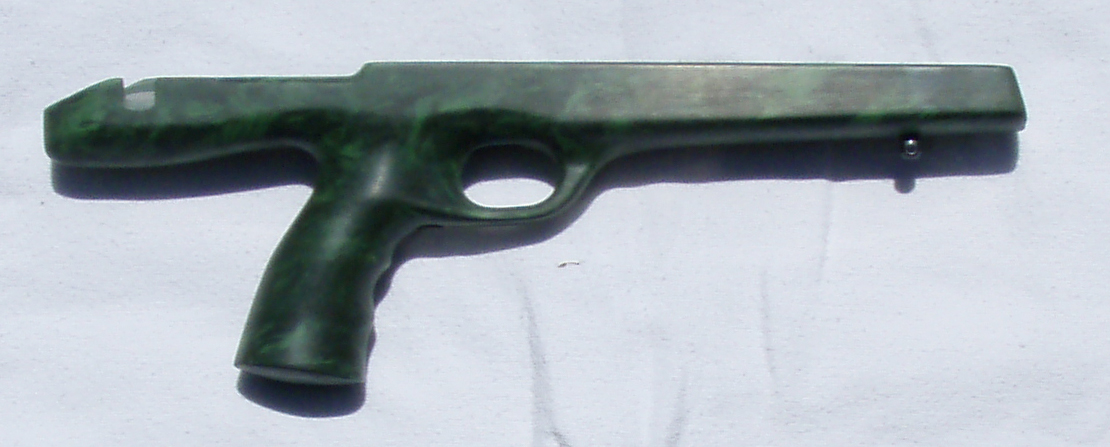
The 1979 design logic behind the rear-grip aftermarket stocks is worth recording, because it explains why so many XP-100s look the way they do. Ron Power’s stocks were built around a two-handed hold that American Handgunner called the “Push Me-Pull You”: “The right hand grasps the stock and pushes out. The left hand grasps the rear of the stock and pulls back… recoil is bucking both hands with the result that it cannot punish the shooter.” One-handed firing of an XP-100, the article says, “was never a practical consideration.”
3.8 Iron sights, and which guns have them
The original XP-100 shipped with a blade front sight and a rifle-type rear sight on a ventilated rib — American Handgunner, 1979: “Remington put on a ventilated rib to improve the sighting plane and a blade front sight and a rifle-type rear sight.”
The Varmint Special of 1986 shipped with no iron sights at all — it was a scope gun by design.
The XP-100R in its 1998 catalogue form was, by Wikipedia’s account, offered “without sights.”
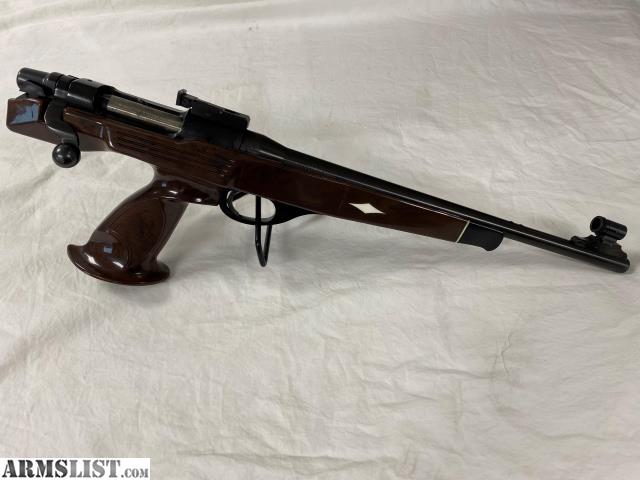
This is a real consideration for a buyer who wants to shoot irons, because the sights are model-specific discontinued parts. A Varmint Special will not grow iron sights without gunsmithing, and a set of original XP-100 sights is a used-parts hunt.
3.9 Optic mounting
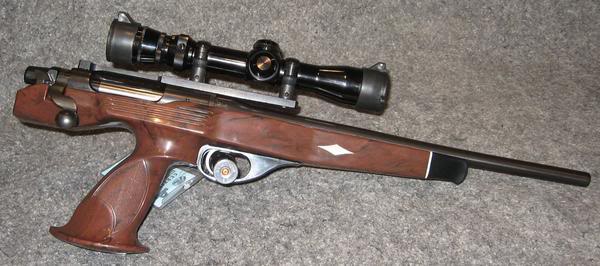
The XP-100 was drilled and tapped for a scope from the factory in 1963 — American Handgunner: “Drilled and tapped for scope it was made with a 10¾ barrel.” In 1963 that was not the default; it is a direct statement that Remington expected this pistol to wear glass.
The mounting pattern is its own — by 1979 the accessory trade advertised a “pistol base for Rem. XP-100 will fit all 1"" rings, which is to say a dedicated XP-100 base carrying standard one-inch rings.
The scope itself is the part that cannot be improvised, and it is important enough to get its own treatment in Vol 7. A conventional rifle scope has roughly three to four inches of eye relief, which is the distance from the ocular lens at which a full field of view is visible. An XP-100 is fired at arm’s length. A rifle scope mounted on one presents a pinhole of image if it presents anything at all, and on a recoiling chambering it is also in the wrong place to be safe. Handgun scopes — sometimes called extended or long eye relief, EER or LER — are built for eye relief measured in many inches rather than a few, and they are a different product category, not a marketing distinction.
3.10 Dimensions and weights
Table 3 — 3.10 Dimensions and weights
| Figure | Value | Source |
|---|---|---|
| Weight, iron sights, 10¾-inch barrel | 1.7 kg (about 3.7 lb) | Wikipedia infobox |
| Weight | 3.75 lb | Gun Digest |
| Barrel lengths | 10¾ in / 14½ in (270 mm / 370 mm) | Wikipedia infobox |
| Overall lengths | 14 in / 18 in (360 mm / 460 mm) | Wikipedia infobox |
| Rifling twist, .221 Fireball | 1:14 RH | Gun Digest; Wikipedia .221 Fireball article |
| Magazine | Single shot; 4-round blind box on XP-100R | Wikipedia; Gun Digest |
Under four pounds is the number to hold on to. It is a pleasant weight to carry and a hostile one to shoot anything powerful from — a theme Vol 4 and Vol 5 both return to, because the recoil arithmetic of a 200-grain bullet in a four-pound gun is not the same conversation as the same bullet in an eight-pound rifle.
3.11 What this means before buying
Five hardware facts that change what a given XP-100 is worth to a given buyer:
- Grip position decides the trigger options. Rear grip takes Remington 700 triggers; centre grip does not (§3.3).
- The safety-on bolt test dates the gun and tells whether the recall was done (§3.4).
- The barrel is replaceable and always has been, so throat erosion is a cost rather than a disqualification (Vol 6).
- The XP-100R’s magazine is blind, which means unloading it is a cycling operation and there is nothing to buy or lose.
- Iron sights are model-specific discontinued parts. Decide whether they are wanted before shortlisting.
3.12 References (Vol 3)
- Wikipedia, “Remington XP-100,” consulted 17 September 2026. The rear-grip/700-trigger versus centre-grip/transfer-bar statement; barrel and overall lengths; the XP-100R magazine; the 1979 recall.
- Wikipedia, “Remington Model 600,” consulted 17 September 2026. Model 600 / 660 / Mohawk 600 / 673 production years.
- Patrick Meitin, “Remington XP-100: The Successful Experiment,” Gun Digest, 26 October 2020. Barrel length and twist, stock materials by variant, the 1975 safety change, the 0.59-inch group.
- American Handgunner, January/February 1979. The ventilated rib and sights, the thumb safety, the Zytel stock’s ambidextrous geometry, the Power/Fajen push-pull stock, Brown Precision and Sinclair stock pricing, the XP-100 scope base.
- Accurate Arms, Per-Caliber Guide, handgun section, “7mm BR Remington,” archived November 2008 (Internet Archive). The action-strength comment.
- Remington Arms Company, archived model-history pages for the XP-100, XP-100R and XR-100 Rangemaster (Internet Archive).
Comments (0)