Luger P08 (Parabellum) · Volume 8
Making One: From Parts and From Scratch
What has been made since 1945 and by whom, the law of a self-made Luger and the question of which part is the firearm, building a shooter from parts, and a from-scratch lab build from the Swiss federal drawings
8.1 The short answer
A Luger is semi-automatic, and a builder may lawfully make one for personal use under federal law. Two routes:
- From parts: an original frame (the part that has always carried the serial and been treated as the firearm) with original or new parts, fitted. The parts exist; the fitting is the work.
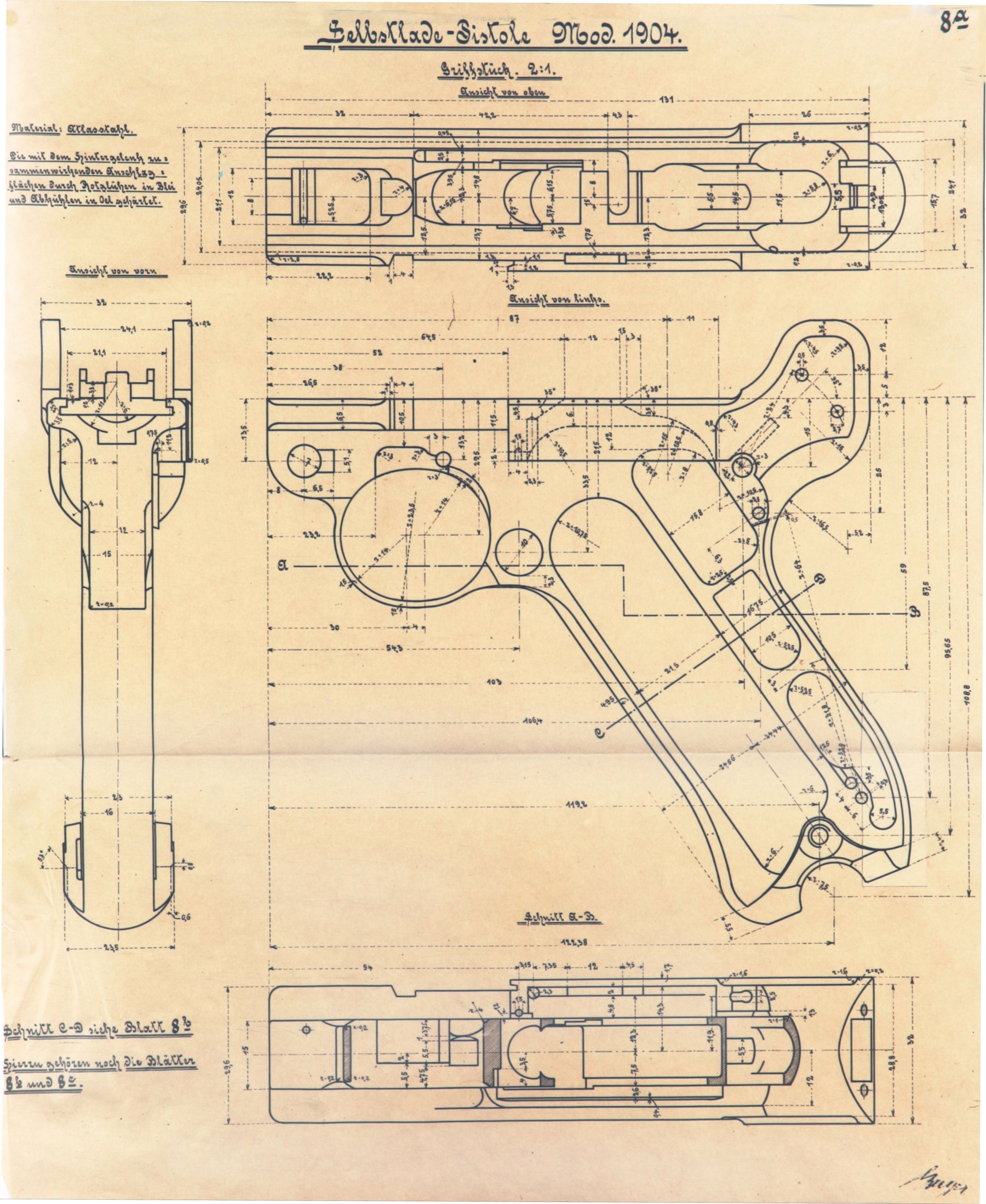
- From scratch: unusually for a pistol of its age, the Luger has published dimensioned drawings. The Swiss federal arms factory’s own drawing sets for the Pistole 1900 and the “Mod. 1904” are online, and a small American firm has made new .45 Lugers from blueprints since about 2017. This is a realistic project for a lab with CNC mills and a lathe.
What makes the Luger harder than most: every original was hand-fitted (Volume 4); the toggle geometry and the spring must be right for the pistol to run at all; and the sear is on the receiver, which makes the legal question of “which part is the firearm” a real one.
8.2 Lugers made since 1945: proof that it can be done
Table 1 — Lugers made since 1945: proof that it can be done
| Maker | When | What | How it was made | Source |
|---|---|---|---|---|
| VEB Ernst Thälmann, Suhl | to about 1968 | Parts, magazines and about 100 pistols | From the Erfurt/Simson/Krieghoff tooling | Luger Forum reference |
| Mauser, Oberndorf | about 1970 onward | Swiss-pattern and P08-pattern pistols, commemoratives | New tooling after the Swiss Bern tooling, which proved unusable | Forum; ATF list |
| AIMCO, Mitchell, Stoeger, Orimar (Houston) | to about 2003 | Stainless pistols | Tooling “reverse engineered … from extant Luger samples”; not to German dimensions | Forum |
| Krieghoff, Ulm | 2006 | 200 P08s, serials 18001–18200 | ”Using authentic specifications”; “machined from the best grade solid steel” | Krieghoff |
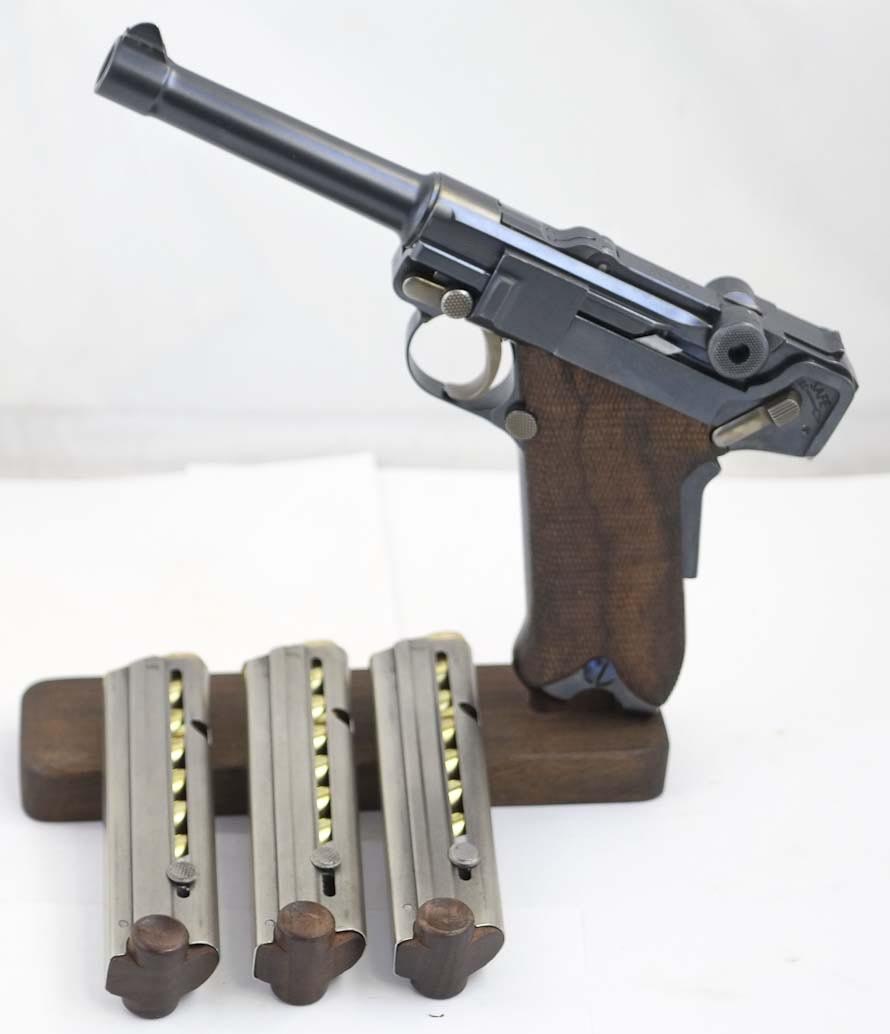
| Lugerman, Langhorne, Pennsylvania | from about 2017 | .45 Lugers in three models | CNC from 4140 billets; magazines of 1095 spring steel; from “blueprints taken off the original 1907 US Army Trial Luger” | Guns & Ammo; Lugerman |
12345 The last is the most instructive for a home lab. Patrick Sweeney’s account in Guns & Ammo (2018) describes the firm’s problem as reconciling “the dimensions of a metric-based pistol designed at a time when hand labor was cheap and steel was expensive with modern CNC manufacturing”, noting that “the amount of hand-fitting that would have been considered normal back then in Germany would bring a modern production engineer to tears”. The parts were “machined … out of billets of 4140 steel”; the magazines “made out of 1095 spring steel and hardened after they have been formed”; the small parts straw-heated.4 The firm says the project began in February 2015 and took a company of five two years.5
8.3 The law, and the Luger-specific question
The general law of making a pistol is set out in the Borchardt C-93 dive, Volume 9, and applies to a Luger without change. In brief, from that volume’s quoted sources:
- An unlicensed individual may make a firearm for personal use; a licence is needed to make firearms for sale. ATF: “No, a license is not required to make a firearm solely for personal use.”
- A new Luger is not an antique and not a curio or relic (27 CFR 478.11 excludes replicas).
- A stock makes it a short-barrelled rifle, which requires an approved ATF Form 1 before the stock is attached; the tax is $0 from 1 January 2026 under Public Law 119-21, the approval is not optional. None of ATF’s collector’s-item listings (Volume 7) covers a new pistol.
- A pistol that fires more than once per pull of the trigger is a machine gun under 26 U.S.C. § 5845(b), which an individual may not make.
- An all-steel pistol meets the detectability rule of 18 U.S.C. § 922(p).
- Marking falls on licensees, who must mark a privately made firearm they take in (27 CFR 478.92); a builder who marks his own first lets the licensee adopt it.
Michigan. The Borchardt dive’s Michigan analysis applies: no Michigan statute located creates a registration step for a self-made pistol, but MCL 28.422(1) on its words requires a licence to “possess” a pistol, and the clean path is a concealed pistol licence; a builder without one should ask the Michigan State Police in writing first. Senate Bill 331 of 2025, which would require serial numbers on all firearms and components, passed the Senate 19 to 17 on 25 June 2025 and was referred to the House Committee on Government Operations the same day, with no later action listed on the Legislature’s page when it was checked on 19 October 2026.6 It is not law. A stocked Luger in Michigan also meets MCL 750.224b (Volume 7).
8.4 Which part is the firearm?
This is the question to settle before the first cut, and for the Luger it has an awkward answer.
The regulation’s definition. Since 2022, 27 CFR 478.12(a)(1) defines a handgun’s frame as “the part of a handgun, or variants thereof, that provides housing or a structure for the component (i.e., sear or equivalent) designed to hold back the hammer, striker, bolt, or similar primary energized component prior to initiation of the firing sequence”.7
Where the Luger’s sear is. On the receiver. The Swiss service booklet lists the sear bar among the parts “on the fork housing” (am Gabelgehäuse), and says that the striker “stays caught on the sear bar’s notch”.8 Krieghoff’s manual warns that the upper assembly can fire on its own: “The dismantled Pistol is able to fire, when the sear bar is pushed!! Even without the grip frame mounted!!!!”9 On the words of paragraph (a)(1), the part that houses the sear is the receiver (the fork that carries the barrel and toggle), not the grip frame.
The grandfather clause. But paragraph (f)(1) says that “the terms ‘frame’ and ‘receiver’ shall include the specific part of a complete weapon, including variants thereof, determined (classified) by the Director to be defined as a firearm frame or receiver prior to April 26, 2022”, and that “any such part that is identified with an importer’s or manufacturer’s serial number shall be presumed, absent an official determination by the Director or other reliable evidence to the contrary, to be the frame or receiver of the weapon”.7 The regulation’s own short list of such weapons does not include the Luger. Collectors and the trade call the grip frame the frame and treat it as the firearm; no ATF document classifying either part was found for this dive. And on a Luger the full serial number appears on three parts, the frame, the barrel and the receiver (Volume 5), so the presumption in (f)(1) does not point to one.
The consequence. The C-93 has the same structure and the same problem, as the Borchardt dive found. For a builder, the safe course is the same: treat both the frame and the receiver as the firearm for every purpose (serial, record, keeping, disposal of scrap and failed attempts), and if certainty matters, ask ATF’s Firearms and Ammunition Technology Division for a classification before building. For a buyer of parts, a receiver bought without a dealer transfer is a question to ask first.
8.5 Path A: a shooter from parts
There are no Luger “parts kits” in the sense the STEN dive uses the term: no demilitarised Lugers sold as sets of parts with a cut receiver. A Luger built from parts starts with an original frame, acquired through a dealer as a firearm, and the rest of the parts from collectors’ stocks, East German production, or new-made springs and small parts (Volume 6).
What makes it hard is fitting. Every original pistol was hand-fitted, and the Forum reference’s account of numbered parts (Volume 5) exists because they were not interchangeable in practice. The parts that need fitting, in the order they cause trouble:
- The barrel to the receiver. Screwed in, timed so the front sight stands upright, and headspaced. A specialist restorer lists this as a service (Volume 6). The hub’s Headspace dive covers gauges and method.
- The breechblock and toggle to the receiver: the toggle must close fully straight and slightly below centre, and the axle pin fit without play.
- The receiver to the frame’s guides, and the toggle knobs to the frame’s ramps: the timing of unlocking.
- The sear bar, its snap pin, and the side plate’s trigger lever: the trigger pull and the disconnector.
- The coupling and the closing spring, matched to the ammunition.
Two rules for a parts gun. Do not renumber parts to match, because a renumbered pistol in someone else’s hands later is a fake (Volume 5). And do not build from a collectable frame: the frame of a matching or rare pistol is worth more as it is.
8.6 Changing calibre
The 7.65 mm and 9 mm Parabellum share the head size and overall length (Volume 3), and DWM made both on the same pistol. Changing calibre is a barrel change, fitted and headspaced as above, with a spring to suit the new load; the Swiss 1906 recoil spring in the Harry Jones table is a different specification from the 1908 P08’s, for example (Volume 6). Confirm that the magazine feeds the new cartridge before firing.
8.7 Path B: from scratch
The from-scratch path is the one this lab is equipped for, and the Luger is a better candidate for it than most period pistols because its drawings survive.
8.8 Where the dimensions come from
1. The Swiss federal drawings. Two hand-drawn, dimensioned sets from the Swiss Federal Archives in Bern are online: “Ordonnanz zur Pistole 1900” (17 sheets, titled “Selbstlade-Pistole System Borchardt-Luger”) and “Pistole 1900/1906” (19 sheets, archive number 18176, titled “Selbstlade-Pistole Mod. 1904”).1011 They are drawn at 2:1 and 4:1, with tolerances on critical dimensions, materials and heat treatment notes, part by part: barrel, receiver, breechblock, toggle links, frame (three sheets), trigger parts, magazine, and the cartridge. They are 7.65 mm drawings.
2. One Mauser drawing. Mauser-Werke drawing 1MD06-61, the left grip panel, is also online (Volume 5).12 Whether more of the Mauser set exists in public was not established.
3. The cartridge and chamber. For 9 mm, the SAAMI and C.I.P. chamber drawings, as used by the hub’s Headspace dive and the Ballistics Overview.
4. An original pistol, measured. As with any drawing a century old, the drawings should be checked against a real pistol, because what was made may differ from what was drawn.
8.9 Design decisions before any metal is cut
- Calibre. The drawings are 7.65; most builders will want 9 mm. A 9 mm build changes the barrel and chamber, possibly the magazine’s feed lips and follower, and the spring, and nothing else in the drawings needs to change, because the head size and length are shared.
- Pattern. The 1906 drawings carry a grip safety, as all Swiss pistols did; the P08 omitted it. A P08-pattern build can follow the 1906 frame and leave out the grip safety and its lock; the P08’s thumb safety and sliding bar then need designing from an original, as the Swiss drawings do not show them.
- Will it ever wear a stock? Decide now (Volume 7). If not, a P08-pattern frame can omit the stock lug, which removes the question.
- The pressure it is built for. A new pistol will be fed commercial 9 mm. It should be designed, heat treated and proved for SAAMI standard pressure (Volume 3), not for a lighter historical load, and its manual should say “no +P”, as Krieghoff’s does.9
- Fidelity or modern materials. The drawings name period materials (below); modern equivalents with known heat treatment are the responsible choice, as Lugerman’s 4140 is.
- The disconnector. Treat it as a designed and tested subsystem (below).
8.10 Materials and heat treatment
What the Swiss drawings and other sources say, quoted, and what a modern builder might substitute:
Table 2 — What the Swiss drawings and other sources say, quoted, and what a modern builder might substitute
| Part | Period specification | Source | Modern suggestion (this dive’s, not a period specification) |
|---|---|---|---|
| Barrel | Böhlersches Gewehrlaufmaterial, “Böhler rifle-barrel steel” | Swiss drawing, sheet 1 | A commercial 9 mm rifled blank in 4140/4150 or 416 stainless |
| Frame | ”Atlasstahl”; the ramps “hardened by heating to red in lead and quenching in oil” | Swiss drawing, sheet 8a | 4140 prehardened, with the ramps locally hardened |
| Front sight | Federstahl, spring steel | Swiss drawing, sheet 1 | Spring steel |
| Closing spring | 1934: “cast steel spring wire ‘Extra-Extra’, carbon content 0.8 %. Anneal to yellow colour”; 1913: crucible steel wire, 22 turns | Mauser and I.K.B. specifications via Görtz and Sturgess, quoted on the Luger Forum | Music wire or oil-tempered spring wire to the load figures below |
| Major parts | ”Billets of 4140 steel” | Lugerman, 2018 | 4140 |
| Magazine body | ”1095 spring steel … hardened after they have been formed” | Lugerman, 2018 | 1095 or similar |
| Small parts | Strawed (heat-coloured) | Forum; Lugerman | Heat colour after hardening |
101341 The barrel thread on the Swiss drawing deserves a note: it is drawn as 20 threads per inch with a 55° flank angle, a Whitworth form, in a pistol otherwise dimensioned entirely in millimetres.10 A builder copying an original barrel should measure the thread, not assume a metric one.
8.11 The build, group by group
Following the Swiss booklet’s parts list (Volume 4):
Group 1: barrel and receiver. The barrel from a rifled blank: turn the profile, thread the shank, cut the chamber with a 9 mm reamer, and time the thread so the sight stands upright when the shoulder seats. The receiver (Gabelgehäuse) is the hardest part after the frame: a fork with internal guides for the breechblock, external rails for the frame, the threaded barrel seat, the axle-pin bores at the rear, the stop lug underneath that meets the takedown lever, and the sear bar’s recess and pivot on the right. Treat it as a firearm from the moment it is recognisably a receiver (above).
Group 2: the breech. Breechblock with its guides, the striker channel and the bayonet seat for the plug (Bodenstück), the extractor seat; front and rear links; the knobs and their impact cheeks; the coupling hook; the three pins. The geometry of the three pin centres and the knobs against the frame’s ramps is the heart of the mechanism. Take it from the drawings, check it in a CAD motion study, and prove it in a printed model before cutting steel.
Group 3: the frame. From billet on the mill, in several setups: the receiver guides, the magazine well, the trigger and side-plate recesses, the hold-open, the safety, the spring well in the grip, and the ramps. The ramps are hardened (above) and polished; their profile and the knobs’ impact cheeks decide whether the action opens.
Group 4: the trigger work. Trigger and spring in the frame; the side plate with its bell crank (Abzugwinkelhebel), whose step gives the two-stage pull; the sear bar with its notch, its snap pin and that pin’s tiny spring; the safety and its bar.
Group 5: the closing spring. The spring, its pull rod and the bell crank at the top of the grip, and the coupling to the rear link. See the springs below.
Group 6: the magazine. Folded sheet body, follower with its side button, spring, and base (wood on the early pattern, aluminium or plastic later). The feed lips are where most magazine problems live.
8.12 Springs
The closing spring is the part a Luger’s function depends on most (Volume 4), and its specifications are published. From Görtz and Sturgess as quoted on the Luger Forum: DWM’s 1904 spring of 19 turns, loading 7 to 8 kg at a length of 50 mm and 15 to 16.5 kg at 34 mm; early P08s with 18 turns of 1.5 mm wire, later P08s with 22 turns of 1.4 mm.13 Harry Jones’s table, reproduced in the Forum reference, gives wire size, turns, free length and load at solid height for a dozen models (Volume 6).1 A builder can wind to those figures or buy a commercial Luger spring and test. Either way, expect to tune: start at the specification, then adjust by trial against the chosen ammunition until the toggle opens fully and closes fully straight, every time.
8.13 What each machine in the lab is for
CNC mills. The frame, receiver, breechblock, toggle links, side plate, trigger parts and sear bar. Four-axis work helps on the frame and receiver. Make fixtures for the second and later setups; a scrapped frame or receiver is a lot of steel and time, and legally a firearm (above).
The lathe. Barrel, threads and chamber; striker; plug; pins; the axle pin; bushings.
3D printers. A full-scale kinematic model of barrel, receiver, toggle and frame, to prove the motion study (the knobs meeting the ramps, the knee rising, the breechblock clearing the magazine, the coupling’s path) before metal. Keep the models visibly non-functional and never print a part capable of serving as the frame or receiver of a working pistol.
The CO2 laser. Wood and leather work: the grip panels’ outline and chequering layout, the holster’s pattern pieces, engraved markings on wooden parts. It does not cut the steel parts.
The gunsmithing bench. Fitting, which on a Luger is most of the work: barrel timing and headspace, toggle fit, the trigger and disconnector, spring tuning, and the final polish of the ramps and guides. Then bluing and strawing.
8.14 Assembly, timing and the disconnector
Assemble by the Swiss booklet (Volume 6), including the step that matters: the coupling must hook into the spring lever’s claws as the barrel group goes onto the frame. Before any live round, check by hand, unloaded:
- Lock-up. From half open, the toggle closes fully straight under spring power alone, and sits slightly below centre.
- Unlocking. Pushing the barrel group back, the knobs meet the ramps and the knee lifts smoothly; the breechblock travels fully back.
- Headspace, with gauges, after final fitting (Headspace dive).
- Striker protrusion and the plug’s index mark, which must stand vertical when correctly assembled.8
- Safety. On, the trigger cannot release the striker.
- Disconnector. With the trigger held, cycle the action by hand: the striker must stay cocked as the receiver returns; release the trigger and the snap pin must pop out under the lever; the next pull must fire. The Swiss booklet’s specification is the test: as the receiver runs forward, “the snap pin at first stays behind the bell crank, and only gets under it when the trigger is let go”.8
The disconnector is the part on which the pistol’s legal status depends. A pistol that doubles is, in law, potentially a machine gun (Borchardt dive, Volume 9), and the snap pin, its spring and its retaining pin are small, hard to make and easy to get wrong. Design and test them as a subsystem.
8.15 Proving and first firing
There is no civilian proof house in the United States. The general practice set out in the Borchardt dive applies: fire the first rounds remotely from a fixture, behind cover; start with standard-pressure factory ammunition, one round at a time; inspect the barrel, breechblock face, toggle pins, ramps and case heads after each stage; load one round, then two, to prove one shot per pull before ever loading a full magazine; and crack-test the stressed parts if the means are available.
8.16 Markings: do not make a fake
A new Luger marked “DWM”, with a crowned “ERFURT”, a code like “byf”, Imperial or Waffenamt proofs, or a date, would in a few years be indistinguishable in photographs from an original worth thousands of dollars. Volume 5 records that this already happens with honest restorations sold on without their history. Mark a new pistol plainly as what it is: the builder’s name and town, the year, the word “reproduction” or “replica”, and a serial number on the frame and on the receiver. That is a matter of ethics and good sense rather than a quoted legal rule; it also serves the builder under 27 CFR 478.92 (Borchardt dive).
8.17 What could not be established
- ATF’s classification of the Luger’s frame or receiver, in writing.
- Whether further Mauser or DWM production drawings are publicly available.
- The P08’s thumb-safety parts in dimensioned drawings (the Swiss sets show the grip safety).
- Whether the Swiss drawings match production pistols in every dimension.
- Wolff’s current Luger spring specifications, from the maker.
References
Footnotes
-
Luger FAQs, last updated 1 August 2019, Luger Forum and Jan Still Luger Forum, Internet Archive, https://archive.org/details/20190801lugerfaqs, consulted 2026-10-19. ↩ ↩2 ↩3
-
ATF, Firearms Curios or Relics List, January 1972 through April 2025 (ATF P 5300.11), https://www.atf.gov/media/19856/download, consulted 2026-10-19. ↩
-
Krieghoff, “2006 Limited Edition Krieghoff PARABELLUM” catalogue sheet, Internet Archive copy of 15 December 2013 of https://www.krieghoff.de/fileadmin/krieghoff_filelist/Downloads/Kataloge/PDF/parabellum_e.pdf, consulted 2026-10-19. ↩
-
Patrick Sweeney, “A Luger in .45 ACP”, Guns & Ammo, 25 April 2018, as reproduced at https://lugerman.com/?p=709, consulted 2026-10-19. ↩ ↩2 ↩3
-
Lugerman Inc., Langhorne, Pennsylvania, home page, https://lugerman.com/, consulted 2026-10-19 (“Luger 45 project … started by LugerMan Inc in February 2015”; “Standard 1907 starting at $6975”). ↩ ↩2
-
Michigan Senate Bill 331 (2025), bill history, https://legislature.mi.gov/Bills/Bill?ObjectName=2025-SB-0331, consulted 2026-10-19. ↩
-
27 CFR 478.12(a)(1) and (f)(1), eCFR, https://www.ecfr.gov/current/title-27/chapter-II/subchapter-B/part-478/subpart-B/section-478.12, consulted 2026-10-19 through the eCFR renderer API. ↩ ↩2
-
Anleitung zur Kenntnis und Behandlung der Pistole 1900/06, approved by the Swiss Federal Council on 31 January 1911, pp. 3–4, 8–9, 13–15, Internet Archive, https://archive.org/details/gunmanual_Luger_1900-06, consulted 2026-10-19. Translations are this dive’s. ↩ ↩2 ↩3
-
Krieghoff, Instruction Manual, Krieghoff Automatic Pistol PARABELLUM – Caliber 9mm, pp. 5–9, Internet Archive copy of 5 July 2016 of https://www.krieghoff.de/fileadmin/krieghoff_filelist/Downloads/Bedienungsanleitung/PDF/instruction_manual_parabellum.pdf, consulted 2026-10-19. ↩ ↩2
-
Swiss Federal Archives (Bundesarchiv Bern), Bestand 27, Archiv-Nr. 18176, “Pistole 1900/1906”, sheets headed “Selbstlade-Pistole Mod. 1904”, digitised as “The Luger Pistol Blueprints, Pistol 1900 1906”, Internet Archive, https://archive.org/details/TheLugerPistolBlueprintsPistol19001906, consulted 2026-10-19. Transcriptions from 200–220 dpi renders. ↩ ↩2 ↩3
-
Swiss Federal Archives, “Ordonnanz zur Pistole 1900”, sheets headed “Selbstlade-Pistole System Borchardt-Luger”, digitised as “The Luger Pistol Blueprints Ordonnanz Zur Pistole 1900”, Internet Archive, https://archive.org/details/TheLugerPistolBlueprintsOrdonnanzZurPistole1900, consulted 2026-10-19. ↩
-
Mauser-Werke A.-G., Oberndorf a.N., drawing 1MD06-61, “Griffschale, linke”, Internet Archive, https://archive.org/details/TheLugerPistolBlueprintsFromMauserWerkeAG1MD0661GriffschaleLinke, consulted 2026-10-19. ↩
-
Luger Forum, post #2 by the moderator “mrerick”, 17 April 2015, https://forum.lugerforum.com/forum/showthread.php?p=270349, consulted 2026-10-19, quoting Görtz and Sturgess, The Borchardt and Luger Automatic Pistols, pp. 905, 1061, 1093. ↩ ↩2
Comments (0)