Luger P08 (Parabellum) · Volume 4
How It Works: The Toggle, the Ramps and the Sear Bar
The parts by their German service names, the over-centre lock, what unlocks it, how the striker is cocked and released, the disconnector, the safeties and the hold-open, and why the Luger is particular about its ammunition
4.1 Sources for this volume
The description below is built from four documents that describe the mechanism in their own words, quoted wherever the wording matters: the Swiss Army’s instruction booklet for the Pistole 1900/06 (1911), which has a section headed Funktionen; Georg Luger’s US patent 753,414 (1904); a 1940 German army instruction book, Dienstunterricht im Heere, whose Pistole 08 plate names the parts; and the instruction manual Krieghoff wrote for its new P08 of 2006.1234 Hugh Pollard’s 1920 description and the US Army board’s reports of 1907 and 1943 add what users found. The Borchardt C-93’s arrangement, from which this one descends, is in the Borchardt dive, Volume 4, and is not repeated.
4.2 The parts, by their service names
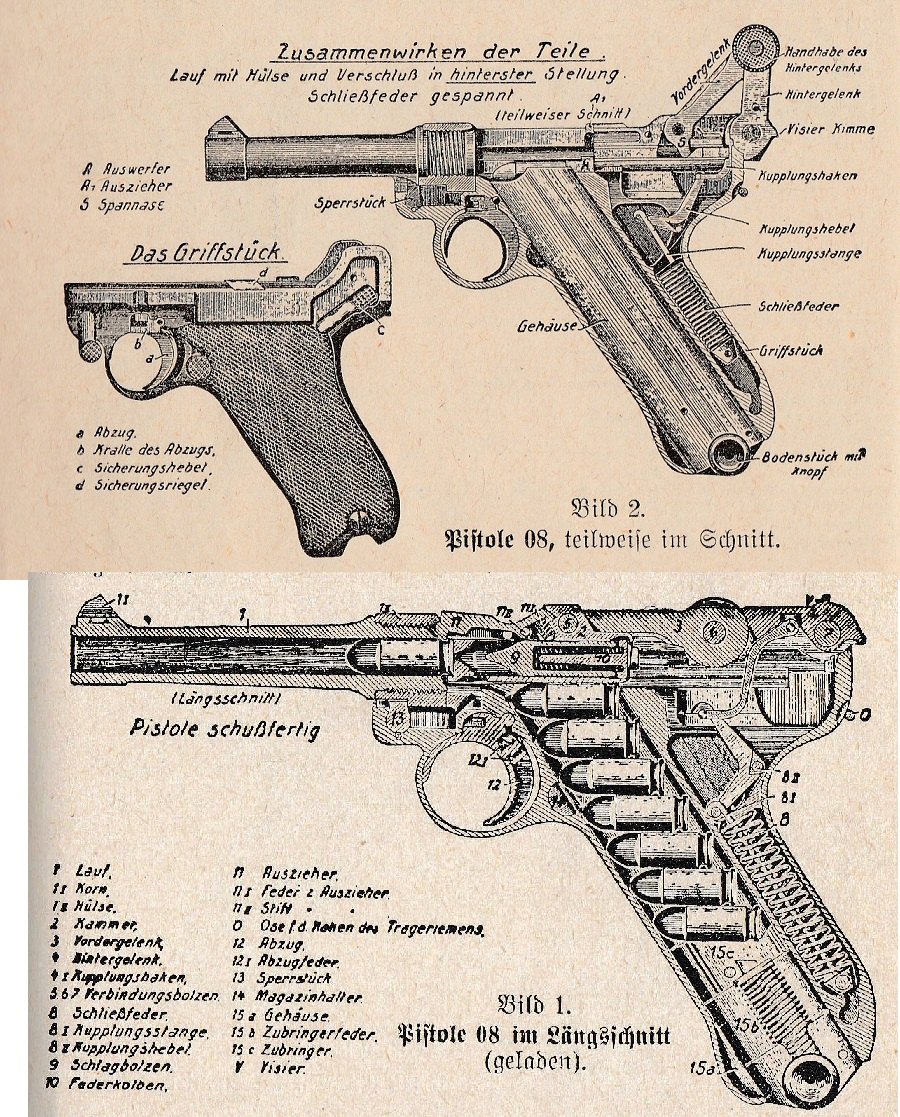
The Swiss booklet divides the pistol into “a part that moves on firing and a part that does not”.1 The German army’s 1940 plate uses slightly different names for some parts; both are given, because a reader working from a German manual or a German parts list will meet them.
Table 1 — The parts, by their service names
| Part | Swiss 1911 (no.) | German army 1940 | What it does |
|---|---|---|---|
| Barrel | Lauf (1) | Lauf | Screwed into the receiver; carries the front sight |
| Receiver | Gabelgehäuse (3), “fork housing” | Hülse | The fork that carries barrel, breech and toggle; recoils with them |
| Axle pin | Verschlussbolzen (4) | Verbindungsbolzen | Joins the rear toggle link to the receiver’s fork |
| Ejector | Auswerfer (5), a spring | Auswerfer | Mounted on the receiver |
| Sear bar | Abzugstange (6) with notch and snap pin (7) | — | On the right of the receiver; holds and releases the striker |
| Breechblock | Verschlusszylinder (9) | Kammer | Carries striker, spring and extractor |
| Striker and spring | Schlagstift (10), Schlagfeder (11), plug Bodenstück (12) | Schlagbolzen, Federkolben | Striker-fired; no hammer |
| Extractor | Auszieher (13) | Auszieher | Also the loaded-chamber indicator |
| Front link | Vordergelenk (15) with cocking nose (a) | Vordergelenk; Spannase | Joins breechblock to the centre joint; its nose cocks the striker |
| Rear link | Hintergelenk (16) with rear sight, knobs and their impact cheeks | Hintergelenk; Handhabe | Joins the centre joint to the axle pin; its knobs strike the frame |
| Coupling | Kette (17), “chain” | Kupplungshaken, Kupplungsstange | Hooks the rear link to the spring lever in the grip |
| Frame | Griffstück (18) with ramps Anschlagkurven (c) | Griffstück, Gehäuse | Fixed; grip, magazine well, ramps, trigger, safety, spring |
| Takedown lever | Riegel (19) | Sperrstück | Holds the side plate; also the forward stop for the receiver |
| Hold-open | Verschlussfanggelenk (25) | — | Raised by the empty magazine’s follower |
| Closing spring | Schliessfeder (27), pull rod (28), bell crank (29) | Schließfeder, Kupplungshebel | A coil in the grip from 1906 |
| Side plate and trigger lever | Deckplatte (35), Abzugwinkelhebel (36) | — | Covers the trigger work; the lever drives the sear bar |
| Safety | Grip safety (30) and its lock (32), on the 1900/06 | Sicherungshebel, Sicherungsriegel | On the P08 a thumb lever and a sliding bar |
4.3 The lock: a knee pressed just past straight
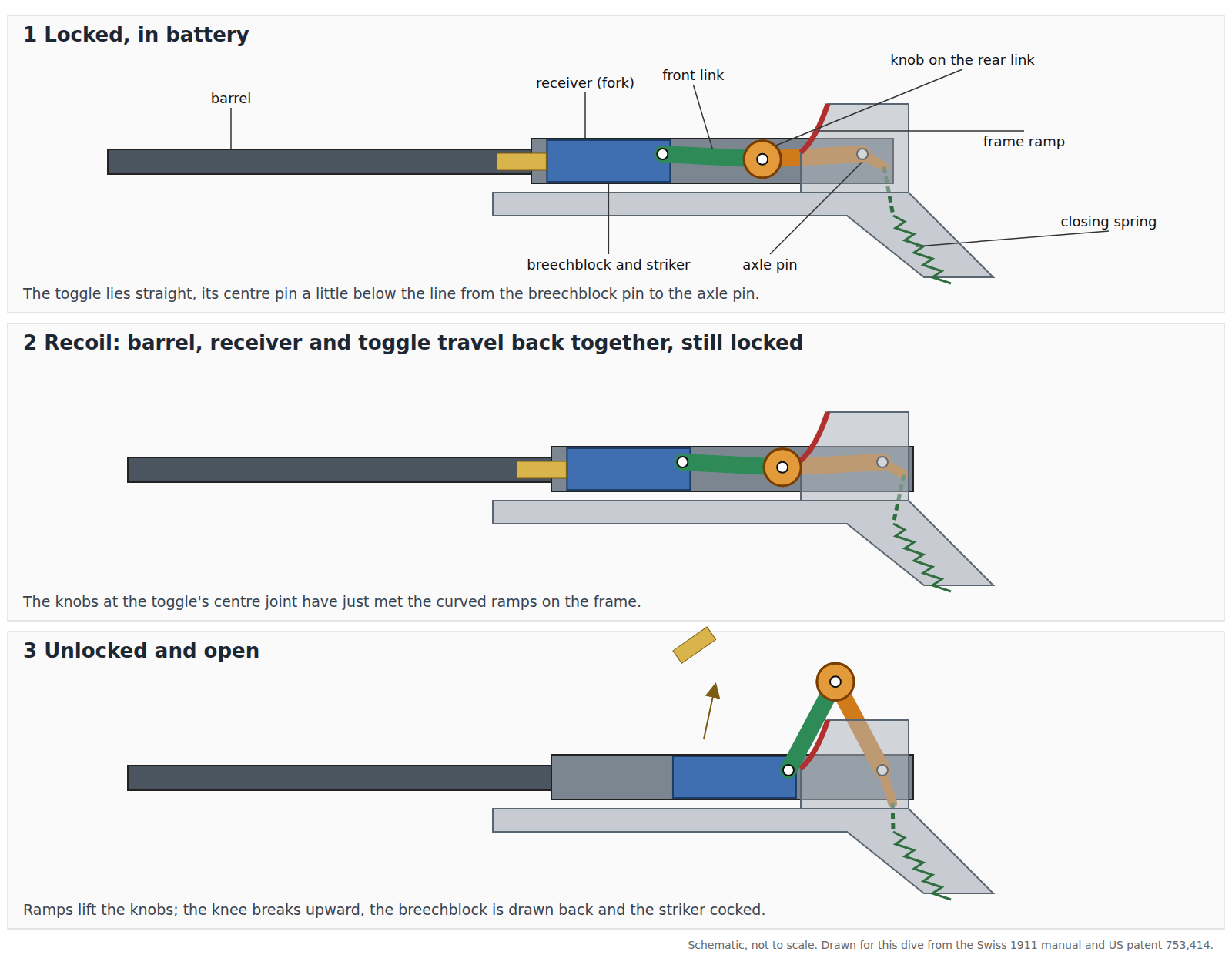
The breechblock is not locked to the barrel by any lug or shoulder. It is held closed by the geometry of the two links behind it. Luger’s patent describes the closed toggle as one whose “central hinge comes to be situated a little below the end points of the joint”, working “on the ‘knee-press’ principle”, so that a push from the cartridge on the breechblock tries to bend the knee further down, which the receiver’s floor prevents.2 The Borchardt dive sets this passage of the patent beside Borchardt’s own and notes that whether the C-93’s toggle also closes below centre is unrecorded.
So long as the toggle stays straight, the breechblock, toggle, receiver and barrel are one rigid unit. The closing spring, pulling through the coupling on the rear link, holds the knee down.
4.4 Firing and recoil
When the cartridge fires, the whole moving assembly recoils together, still locked. The Swiss booklet: “Recoil drives barrel with receiver and breech back, until the toggle knobs strike the ramps. Living force — not the gas pressure — carries the breech parts further back.”1 That sentence answers a confusion in print. The Koblenz museum’s label for its 1911 P08 says the pistol works “by direct gas pressure” (durch direkten Gasdruck), and a 1946 Czechoslovak police text describes the pistol as using “the backward pressure of the gas acting on the base of the case”.56 In the sense that every recoil-operated arm is driven by the reaction to its powder gas, the Czech wording is harmless; the Koblenz label’s “direct gas pressure” is a slip. The Luger has no gas port and no gas piston. It is short-recoil operated, the barrel and breech moving together a short distance before they separate.
4.5 Unlocking: the knobs and the ramps
The knobs that the shooter grips to load the pistol are on the rear link at the toggle’s centre joint, and behind them the frame rises in two curved ramps. The Swiss booklet says the rear link “carries the rear sight and has impact cheeks at the toggle knobs” (an den Gelenkknöpfen mit den Stossbacken versehen), and that in recoil “the toggle knobs slide on the ramps and thereby unlock the breech”.1 Luger’s patent puts the same thing as “suitably-curved guide surfaces … on both sides of the handle-piece”, struck by studs on the rear link “when the barrel recedes”.2
The ramps are the only thing that breaks the lock. As the knobs ride up them, the centre joint is lifted over centre and the knee breaks upward; from then on the receiver has nearly stopped, and the breechblock, drawn by the folding front link, continues to the rear on its own momentum. A Swiss federal drawing of the frame, dimensioned at 2:1, notes that “the stop surfaces that work with the rear link” were hardened “by heating to red in lead and quenching in oil”.7 The ramps are wear surfaces, and Volume 6 returns to them.
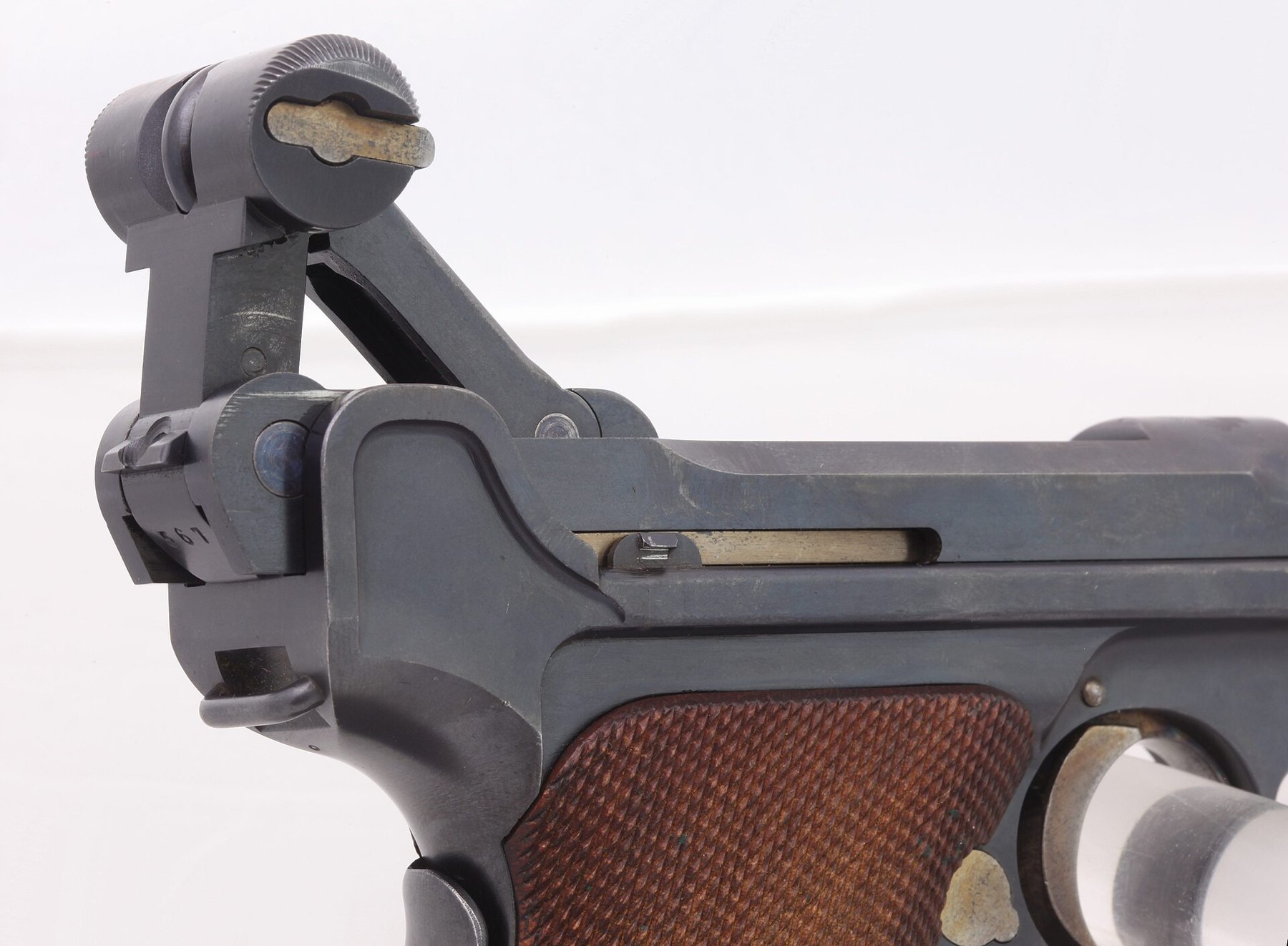
Krieghoff’s manual describes the same moment differently: “the center part of the toggle joint strikes against a sloping part of the frame, buckling the toggle joint behind the breechblock”.4 It is the knobs on the rear link, at the centre, that strike, so the two descriptions agree in substance; the Swiss wording is the more exact.
4.6 Extraction, ejection, cocking
As the knee rises the breechblock is pulled back along the guides in the receiver. Three things happen in that stroke, in the Swiss booklet’s order:1
- Cocking. “The cocking nose of the front link compresses the striker spring through the striker.” The striker is caught at the rear and held back.
- Extraction. The spent case, held by the extractor’s claw in the extraction groove, comes back with the breechblock.
- Ejection. The case “strikes the ejector”, a sprung part mounted on the receiver, and is thrown up and out. The 1907 US board noted “vertical ejection” among the Luger’s characteristics.8
The rear link, meanwhile, pulls through its coupling hook (Kupplungshaken) on the coupling and the lever in the grip, and compresses the closing spring. The 1940 German plate’s Bild 2 shows that position: “barrel with receiver and breech in rearmost position; closing spring compressed”.3
4.7 Return and feed
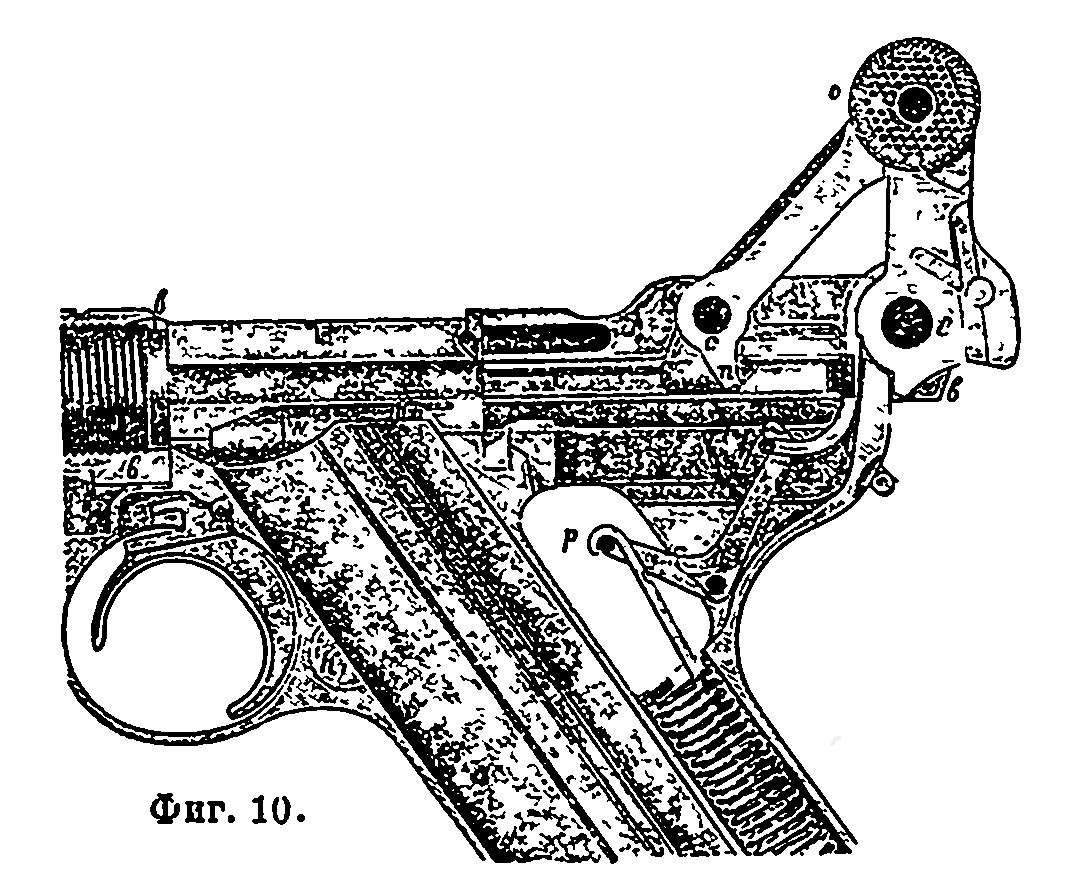
“The closing spring, no longer held in tension, straightens the joint system through the chain, and at the same time brings receiver and barrel forward, until the stop lug rests against the takedown lever.”1 On the way, the breechblock strips the top cartridge from the magazine and pushes it into the chamber; the striker stays caught on the sear bar’s notch; and the extractor’s claw rides over the rim.
Two details of that sentence are easy to miss. The forward travel of the barrel and receiver is stopped by the takedown lever (Riegel) bearing on a stop lug (Grenzstollen) under the receiver, which is why the lever matters to more than disassembly. And the toggle is straightened, and the cartridge seated, by the closing spring acting through a lever system that loses mechanical advantage as the toggle straightens. The 1907 US board picked that out at once: “The final seating of the cartridge is mainly dependent upon remaining momentum and not upon spring action.”8
4.8 The trigger, the sear bar and the disconnector
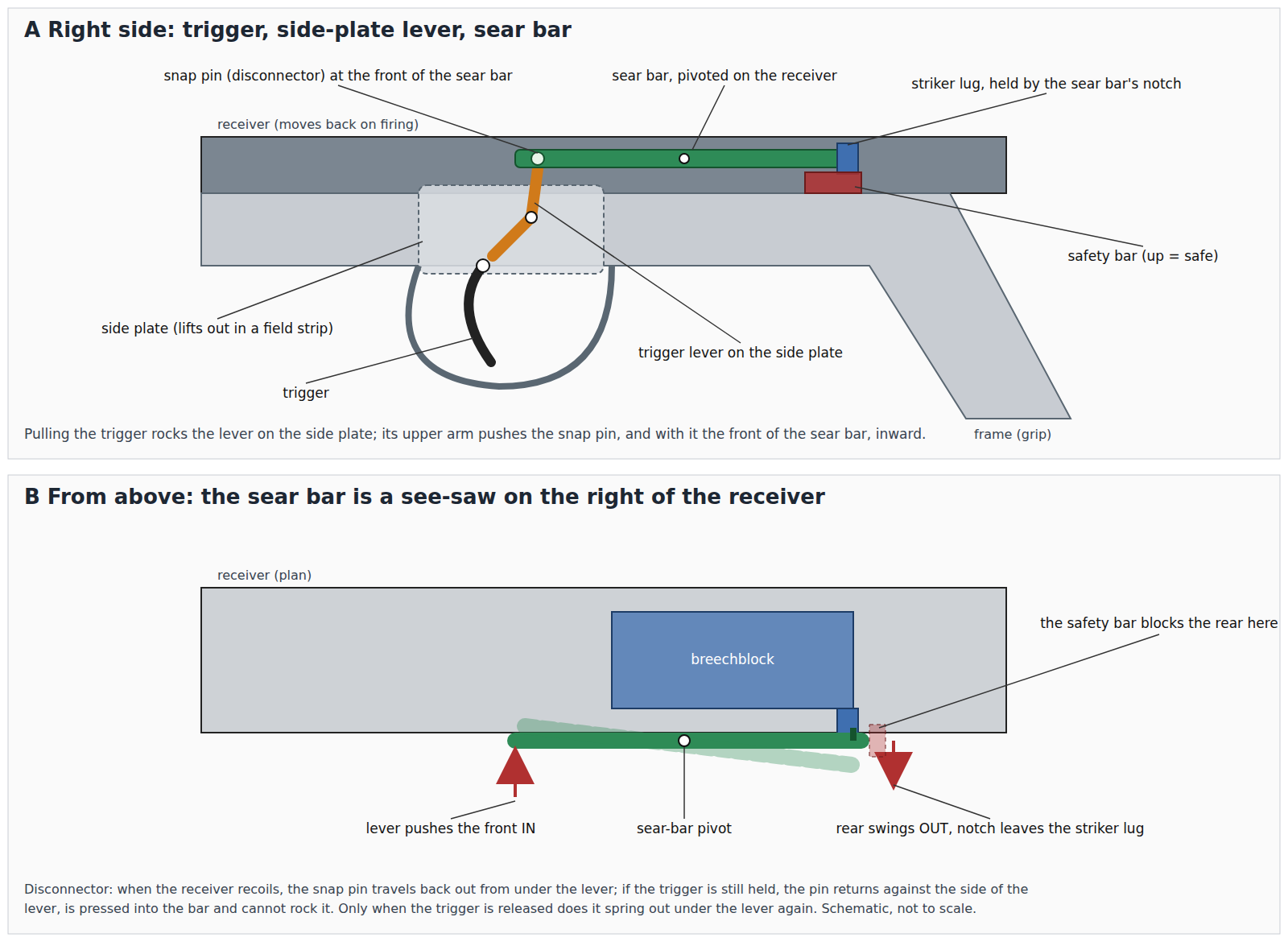
The Luger is striker-fired, and its sear is not in the frame. The sear bar (Abzugstange) is a flat bar lying in a groove on the right side of the receiver, pivoted near its middle, with a notch at the rear that holds the striker and a small spring plunger, the snap pin (Schnappstift), at the front. The Swiss booklet describes the release:
“The pressure on the trigger is transmitted, by means of the bell crank on the side plate, to the front part, the snap pin, of the sear bar, which acts as a double lever, whereby the bar’s notch is lifted and released from engagement with the striker’s nose.”1
The two-stage pull comes from the side plate’s lever: “The pressure point (Druckpunkt) is produced by the step on the short arm of the bell crank.”1 Pollard thought the pull “rather long and creeping”, and noted that the sear, “unusually placed being at the side of the action”, was “somewhat free to clog”.9
The disconnector is the snap pin. The Swiss booklet: “As the receiver runs forward, the snap pin at first stays behind the bell crank, and only gets under it when the trigger is let go, so that the trigger’s movement becomes independent of the receiver’s forward run.”1 The Luger Forum reference describes it in modern terms: when the upper moves back, the plunger moves “back and out from under the trigger lever on the side plate. When the upper returns to battery, and if the trigger is still being held, the tip of the plunger encounters the side of the trigger lever instead of tucking under it”, and is pushed into the bar; releasing the trigger lets it “pop back out, placing it once again under the trigger lever”.10 It is a small spring and a small pin, and they are the difference between a semi-automatic pistol and something else. Volume 6 and Volume 8 treat them accordingly.
Because the sear bar rides on the receiver, the upper assembly can fire without the frame. Krieghoff’s manual warns, in capitals: “WARNING!! The dismantled Pistol is able to fire, when the sear bar is pushed!! Even without the grip frame mounted!!!!”4 That is the danger the German police’s 1933 sear safety was introduced to prevent (Volume 2), and it is the fact on which the legal question in Volume 8 turns.
4.9 The safeties
The P08’s thumb safety is a lever at the rear of the frame’s left side. Swung down and back, it exposes the word Gesichert (“made safe”) and raises a sliding bar (the 1940 plate’s Sicherungsriegel) against the rear of the sear bar, so that the sear bar cannot rock and release the striker. Krieghoff: “To engage the safety pull lever back and down, exposing the word ‘GESICHERT’”; “If the breech is cocked, the Pistol can be unloaded while the safety is engaged.”43 The US handbook of 1943 gives the same direction.11 The early Navy pistols, before 1912, worked the other way, with “safe” up (Volume 1).
Whether the action can be cycled with the safety on depends on the pistol. The Luger Forum reference distinguishes “unrelieved” sear bars, with which “the receiver cannot be pulled back and the action cannot be hand cycled with the safety on”, from “relieved” ones cut back so that it can.10
The grip safety of the 1900 and 1906 patterns, kept on every Swiss service pistol, is a lever in the back strap. The Swiss booklet: its tongue, “by its own spring action, lies over the rear, stepped part of the sear bar and prevents in this position most reliably both the recoil and the release of the striker, which is always cocked when the pistol is loaded”. A second lever, the Sperrhebel, locks the grip safety on.1 The German Army’s P08 has no grip safety.
4.10 The loaded-chamber indicator
The extractor is the indicator. When a cartridge is chambered, the Swiss booklet explains, “the extractor’s claw enters the groove of the cartridge. As a result the extractor stays in a somewhat raised position, and on its left side the word Geladen can be read. By this arrangement it is visible and can be felt at any time whether there is a cartridge in the barrel.”1 The US Army board in 1907 counted it among the Luger’s advantages: “an automatic indication that the chamber is loaded, visible to the eye, and sensible to the touch”.8 Pistols for the English-speaking market had “Loaded” on the extractor instead (Volume 2).
4.11 The hold-open
After the last shot the toggle stays open. “If the magazine is empty, the follower button is able to push the hold-open upward, which, as soon as it is free, snaps into the catch notch of the breechblock, holding it back.”1 Pulling the magazine does not release it; the hold-open “lies down by its own spring action as soon as, by drawing back the joint, the pressure on it ceases”, so the shooter pulls the toggle back slightly and lets go. Krieghoff’s manual gives the same procedure.4
4.12 Why a Luger is particular
Every source that tested the pistol found it sensitive to ammunition and dirt, and the mechanism explains why:
- The final closing is by momentum. The 1907 board said so in as many words.8 This dive’s reading of the geometry is that a toggle pulled straight from below has least leverage in its last few degrees, so the end of chambering depends on the speed the breech has already gained; no source was found that states this explicitly. Weak ammunition, a dry or dirty breechblock, or a tired or wrong spring all leave the toggle short of straight. The 1907 board’s jams were “corrected by striking the link”.8
- The toggle must be driven open by recoil alone. It has no assistance from a gas system. Too little recoil and the knobs do not climb the ramps far enough; too much and the toggle slams the frame.
- The action is open on top. The US handbook of 1943: “When the Luger is kept clean, it functions well. However, the mechanism is rather exposed to dust and dirt.”11 The 1907 board’s dust test took nearly three minutes to empty a magazine.8
- Each pistol was hand-fitted. Dwight Gruber, in the Luger Forum reference, calls them “finely crafted (and considerably hand-fitted) machines”.10 Parts that look interchangeable often are not, which is why German armourers numbered them (Volume 5), and why a “parts gun” may not run (Volume 8).
4.13 What this volume could not settle
- The geometry of the over-centre lock: how far below centre the toggle sits, in millimetres, from a factory drawing rather than the patent’s words.
- The exact coupling of the rear link to the closing-spring lever in the P08, which this volume draws schematically.
- Which German document the 1940 Dienstunterricht plate was taken from.
References
Footnotes
-
Anleitung zur Kenntnis und Behandlung der Pistole 1900/06, approved by the Swiss Federal Council on 31 January 1911, “Bestandteile” and “Funktionen”, pp. 3–5 and 13–15, Internet Archive, https://archive.org/details/gunmanual_Luger_1900-06, consulted 2026-10-19. Translations are this dive’s. ↩ ↩2 ↩3 ↩4 ↩5 ↩6 ↩7 ↩8 ↩9 ↩10 ↩11 ↩12 ↩13
-
Georg Luger, US Patent 753,414, “Recoil-Loading Small-Arms”, granted 1 March 1904; in the central Library as
us-patent-753414-luger-1904-recoil-loading-small-arms. The passages quoted are also quoted, with the same wording, in the Borchardt C-93 dive, Volume 3. ↩ ↩2 ↩3 -
Dienstunterricht im Heere (1940 edition), Pistole 08 plate (Bild 1 and 2), photographed by GipeDZ as File:Pistole 08 group.jpg, CC BY-SA 4.0, Wikimedia Commons, https://commons.wikimedia.org/wiki/File:Pistole_08_group.jpg, consulted 2026-10-19. The publisher and edition beyond the uploader’s description were not verified. ↩ ↩2 ↩3 ↩4
-
Krieghoff, Instruction Manual, Krieghoff Automatic Pistol PARABELLUM – Caliber 9mm, pp. 9, 13, 15, Internet Archive copy of 5 July 2016 of https://www.krieghoff.de/fileadmin/krieghoff_filelist/Downloads/Bedienungsanleitung/PDF/instruction_manual_parabellum.pdf, consulted 2026-10-19. ↩ ↩2 ↩3 ↩4 ↩5
-
Wehrtechnische Studiensammlung Koblenz, label for the Erfurt Pistole 08 of 1911, File:Pistole 08 Erfurt 1911 Tafel in der WTS-Koblenz.jpg (Archiv WTS-Koblenz, CC BY-SA 4.0), https://commons.wikimedia.org/wiki/File:Pistole_08_Erfurt_1911_Tafel_in_der_WTS-Koblenz.jpg, consulted 2026-10-19. ↩
-
Muzeum Policie ČR, “Opis z nauky o zbraních pro příslušníky SNB z r. 1946: Pistole vz. 08 (něm.)”, https://vojensko.cz/upload/9mm-pi-vz-08-n-parabellum-p-08-popis.pdf, consulted 2026-10-19. Translation this dive’s. ↩
-
Swiss Federal Archives (Bundesarchiv Bern), Bestand 27, Archiv-Nr. 18176, “Pistole 1900/1906”, sheet 8a, “Griffstück 2:1”, Internet Archive, https://archive.org/details/TheLugerPistolBlueprintsPistol19001906, consulted 2026-10-19. Transcription from a 200-dpi render. ↩
-
“Report of Board on Tests of Revolvers and Automatic Pistols”, Annual Report of the Chief of Ordnance, 1907, Appendix, paras. 14, 20, 24 and pp. 102–104, Internet Archive, https://archive.org/details/1907pistoltrials, consulted 2026-10-19. ↩ ↩2 ↩3 ↩4 ↩5 ↩6
-
Hugh B. C. Pollard, Automatic Pistols (London, 1920), pp. 9 and 29, Internet Archive, https://archive.org/details/automaticpistolspollard1920, consulted 2026-10-19. ↩
-
Luger FAQs, last updated 1 August 2019, Luger Forum and Jan Still Luger Forum, “How do you de-cock a Luger properly?” and “What is an unrelieved sear and a relieved sear bar?”, Internet Archive, https://archive.org/details/20190801lugerfaqs, consulted 2026-10-19. ↩ ↩2 ↩3
-
War Department, Military Intelligence Service, German Infantry Weapons, Special Series No. 14, 25 May 1943, pp. 3–9, Internet Archive, https://archive.org/details/GermanInfantryWeapons1943, consulted 2026-10-19. ↩ ↩2


Comments (0)