Luger P08 (Parabellum) · Volume 5
Identifying a Luger: Makers, Codes, Dates, Proofs and the Many Variants
Where every mark is, what it means, how to tell the models apart from the left side and from the top, which numbers should match, and the fakes
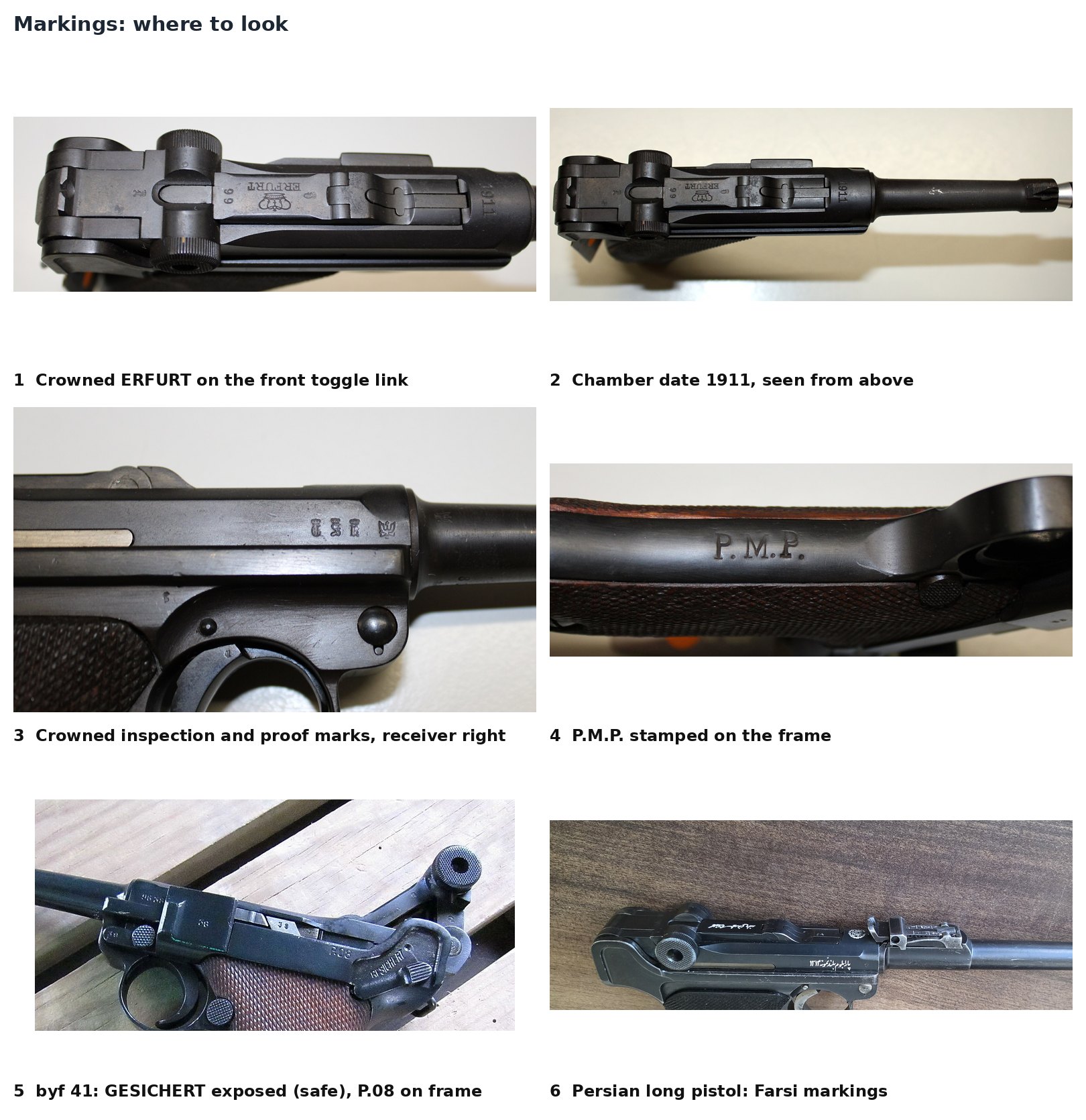
5.1 The five places to look
A Luger carries its history in five places, and a buyer who knows them can identify most pistols in a minute. The collectors’ reference compiled on the Luger Forum and the auction houses’ catalogue descriptions agree on the layout:12
- The front toggle link (the top of the link nearest the muzzle): the maker’s name, monogram or code.
- The top of the chamber: a date, a date letter, a national crest, or nothing.
- The right side of the receiver and the barrel: proof and acceptance marks.
- The left side of the receiver, the frame and the barrel: the serial number.
- The small parts: the last two digits of the serial number, on the parts listed below.
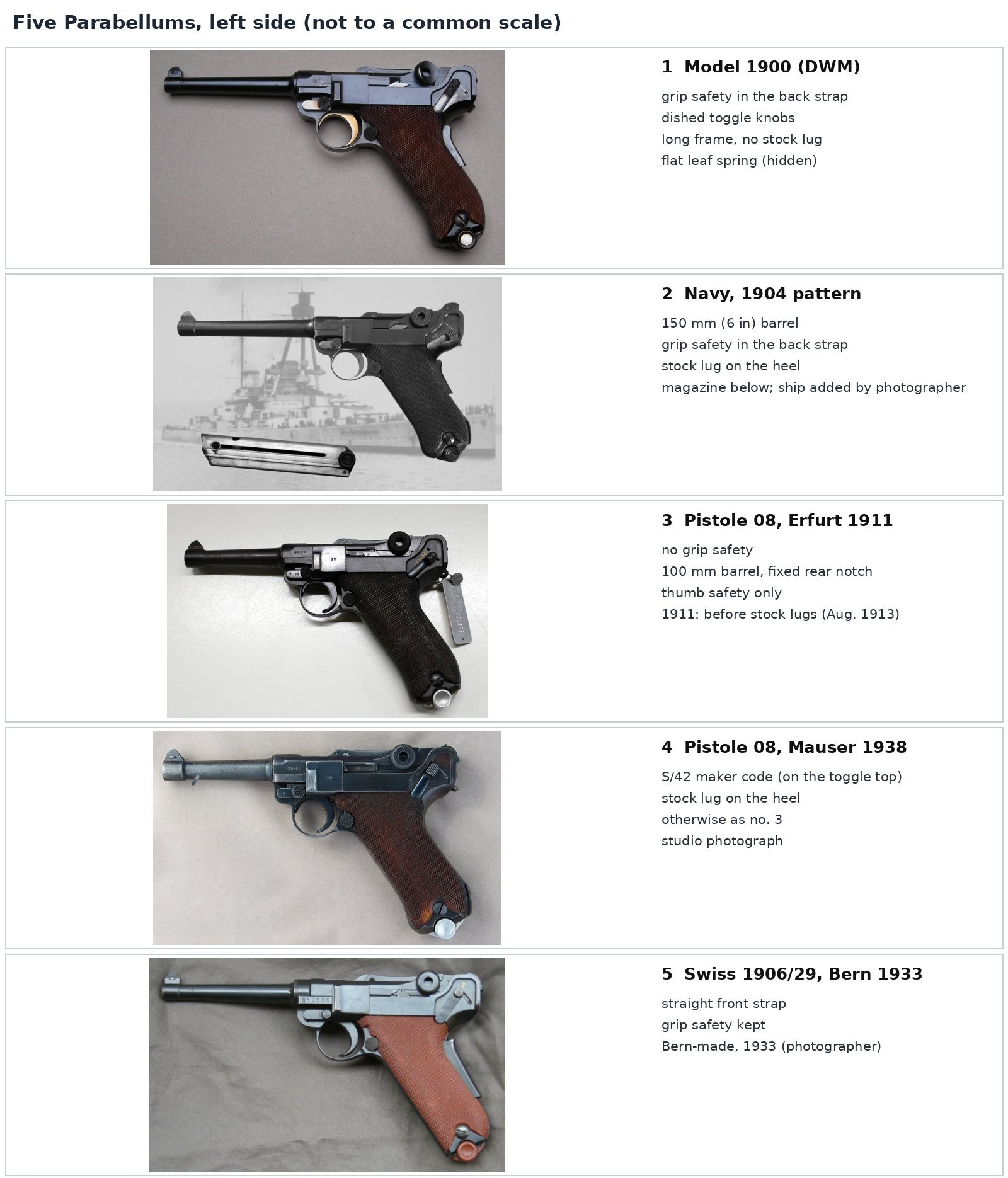
5.2 Five patterns from the left side
The plate at the head of this volume shows the main visible differences:
- Model 1900 (and 1902): grip safety in the back strap with a small locking lever above it; dished toggle knobs; a toggle lock on the knee (the Forum reference describes an external lock that “holds the toggle down against the receiver when the Luger is in battery”); a long frame; no stock lug; a flat leaf spring inside the grip.13
- Navy pistols: a 150 mm (6-inch) barrel; a rear sight on the rear toggle link adjustable for 100 and 200 m; a stock lug; grip safety on the first issues; and, before 1912, a safety that was “safe” when up (Volume 1).4
- The 1906 “New Model”: round knurled knobs, no toggle lock, a coil spring, and a shorter frame. Still with a grip safety.
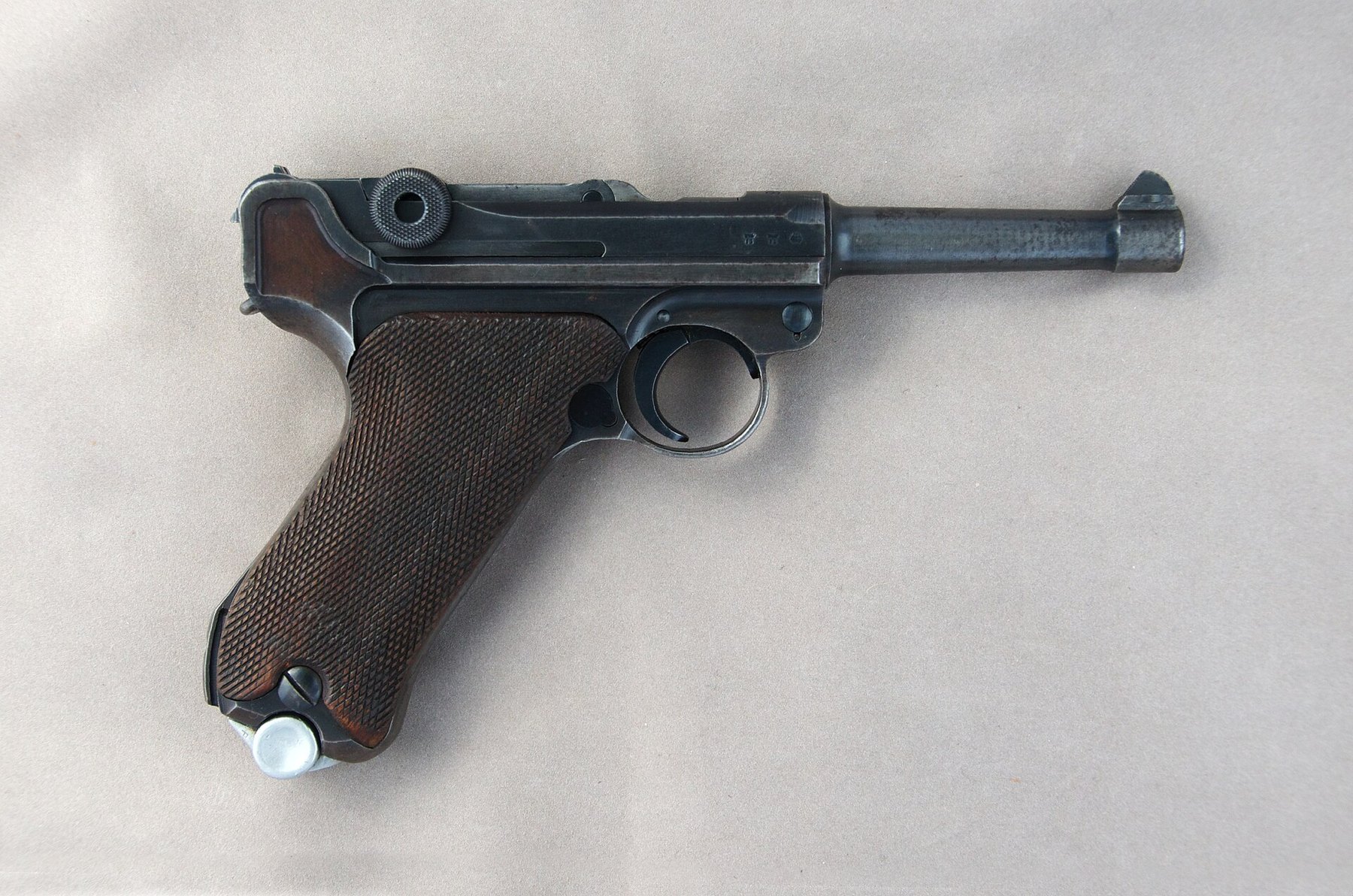
- Pistole 08: no grip safety; a 100 mm barrel; the thumb safety alone; a stock lug from August 1913.1
- Swiss 1906/29: a straight front strap to the grip, the grip safety kept, a simpler finish.5
The long pistol (LP08) is a P08 with a 200 mm barrel and a tangent rear sight on the barrel; the Navy pistols’ long barrels carry their sight on the toggle, which is the quickest way to tell a Navy pistol from an artillery one at a distance. The carbine has an 11¾-inch barrel and a forend (Volume 1).
5.3 Tell them apart
Table 1 — Tell them apart
| Feature | Model 1900 / 1902 | Navy 1904 / 1906 | 1906 New Model | Pistole 08 | LP08 | Swiss 06/29 | Where to look |
|---|---|---|---|---|---|---|---|
| Grip safety | Yes | Yes (until 1908) | Yes | No | No | Yes | Back strap, below the toggle |
| Toggle knobs | Dished, with toggle lock | Round | Round | Round | Round | Round | Top rear |
| Closing spring | Flat leaf | Not checked | Coil | Coil | Coil | Coil | Inside the grip (field strip) |
| Barrel | ~120 mm 7.65; 9 mm “fat” 1902 | 150 mm | 120 mm (Swiss 7.65); varies | 100 mm | 200 mm | Not checked | Measure from the receiver |
| Rear sight | V notch on rear link | Two-range, on rear link | V notch on rear link | V notch on rear link | Tangent, on barrel | V notch | Top |
| Stock lug | No | Yes | Varies | From Aug. 1913 | Yes | Not checked | Heel of the grip |
| Front strap | Curved | Curved | Curved | Curved | Curved | Straight | Front of grip |
| Chamber | Crest or blank | Blank (dated from 1916) | Crest or blank | Date or code | Date | Swiss cross | Top of chamber |
34156 Dimensions vary by contract and maker, and the table gives the common forms. A barrel’s length on its own proves nothing, because barrels were changed in service, by importers and by owners.
5.4 Makers’ marks and codes on the toggle
Table 2 — Makers' marks and codes on the toggle
| Front toggle link | Maker | Period | Source |
|---|---|---|---|
| Interlaced DWM monogram | Deutsche Waffen- und Munitionsfabriken, Berlin | 1900–1930 | Luger Forum reference |
| Crown over ERFURT | Royal Prussian rifle factory, Erfurt | 1911–1918 | WTS Koblenz pistol; Forum |
| S/42 | Mauser, Oberndorf | from 1934 (with K and G dates) to 1939 | Rock Island Auction; Forum |
| 42 (large) | Mauser | 1939 to early 1941 | Forum |
| byf | Mauser | 1941–1942 | Forum |
| Mauser banner | Mauser, commercial | from 1934; again postwar | Forum |
| H, anchor, K over SUHL | Krieghoff, Suhl | from the mid-1930s | Rock Island Auction |
| Vickers name | Vickers, assembling DWM parts for the Dutch | 1919–1922 | Forum |
| W+F Bern marks | Waffenfabrik Bern | 1918–1947 | Forum; German Wikipedia |
| Krieghoff anchor and name | Krieghoff, Ulm (limited edition of 200) | 2006 | Krieghoff catalogue |
12785 The Forum reference notes that “some special orders fulfilled by DWM … required a government’s heraldic mark” on the middle toggle, as on Bulgaria’s 1908 pistols, and that some military buyers marked the barrel instead, as with the Finnish triangle-and-T mark.1 It also warns that a small “42” or “S/42” on an individual part is not a maker’s code but marks a Mauser armourer’s replacement part.1
5.5 The chamber: dates, letters and crests
- A four-digit year, from 1910–11 onward on Army pistols and from 1916 on Navy pistols: the year of manufacture.4
- Two numbers, the second 1920: the Reichswehr’s property stamp of 1920–21, not a date, according to Jan Still as quoted in the Forum reference (Volume 2). True double dates are rare.1
- A letter: K (1934) and G (1935) on Mauser S/42 pistols; S on early Krieghoff pistols (variously 1935 or 1936).297
- “41” or “42” on Mauser pistols: the year 1941 or 1942.1
- A crest: the American eagle (the Great Seal) on the US test pistols and DWM’s American commercial pistols; the Swiss cross in a sunburst on early Swiss pistols and in a shield on later ones; Portugal’s “M2”; and others.13
- Nothing: most DWM commercial pistols, the early Navy pistols, and the 1920s commercial and export pistols.
5.6 Proof and acceptance marks
German proof law changed several times during the Luger’s production, and the marks change with it. The Forum reference sets out the commercial sequence:1
- “BUG” proofs on early DWM commercial pistols: crown over B, crown over U and crown over G. “B is the overload test proof specified by the proof law of 1892; it also denotes a completely finished pistol. U represents the word Untersuchung (inspected). G is found only on the barrel.” Crown/B and crown/U are on the breechblock and the left of the receiver.
- Crown over N, the nitro proof that replaced them; the “lazy” crown/N of about 1912 is the same mark struck horizontally.
- Imperial military pistols carry crowned inspectors’ letters on the right of the receiver, as on the Koblenz pistol, and a crown over RC on parts accepted by the Revisions-Commission despite small flaws.1
- Mauser and Krieghoff pistols of the 1930s and 1940s carry a “droop wing eagle” firing proof on barrel, receiver and breechblock, as Rock Island’s cataloguers describe them, and Waffenamt acceptance marks, an eagle over a number such as 63 or 135, whose size and number change through the production years; the Forum gives the details by year.21 Late Mauser parts may carry an intertwined “WR”, thought to be the factory’s own Werks-Revision inspection mark.1
- Pistols sold through Britain carry British proofs and, before the Proof Act of 1955, “NOT ENGLISH MAKE”; the letters in the crossed sceptres give the year (the Forum’s example: “OB” for 1963).1
- East German and Soviet reworks: a large “X” on receiver, frame or toggle, on most Soviet reworks and about a quarter of Volkspolizei ones, its meaning unknown; East German parts and magazines may carry the code “2/1001”.1
Barrels of military pistols also carry the measured bore in hundredths of a millimetre (Volume 3).
5.7 Serial numbers and the numbered parts
Military pistols were numbered in blocks of up to four digits with a letter suffix (for example 1234a); DWM’s commercial pistols in a continuous five-digit sequence until 1921, then in the military style.1 The Forum reference lists the parts that should carry numbers:1
- The full serial number on the frame (with suffix), under the barrel (with or without suffix) and on the left side of the receiver (without suffix).
- The last two digits on the firing pin, extractor, sear bar, breechblock, front toggle link, rear toggle link, takedown lever, side plate (with exceptions), trigger and safety lever; and on the inside of the grips and the magazine on many pistols.
- The rear toggle axle pin was numbered only from 1934, by Mauser.
A pistol in which every number matches is worth much more than one that does not (Volume 7), which is exactly why numbers are faked. “All matching” is a claim to be checked part by part under a glass, not taken from a listing.
5.8 Finish, grips and magazines
Finish. The Forum reference: “In the early eras (including WW-I, the Weimar era and early Mauser production …) Lugers were Rust Blued”, with small parts strawed, heat-tempered to a yellow or golden colour, including the trigger, the safety lever, the rear toggle axle end, the magazine release, the ejector and the safety bar, and the firing pin probably left in the white.1 Mauser changed to salt (hot) bluing about 1937, with a transition period of mixed parts.1 A Luger with bright blue on every part, crisp edges rounded off and markings shallow is almost certainly refinished.
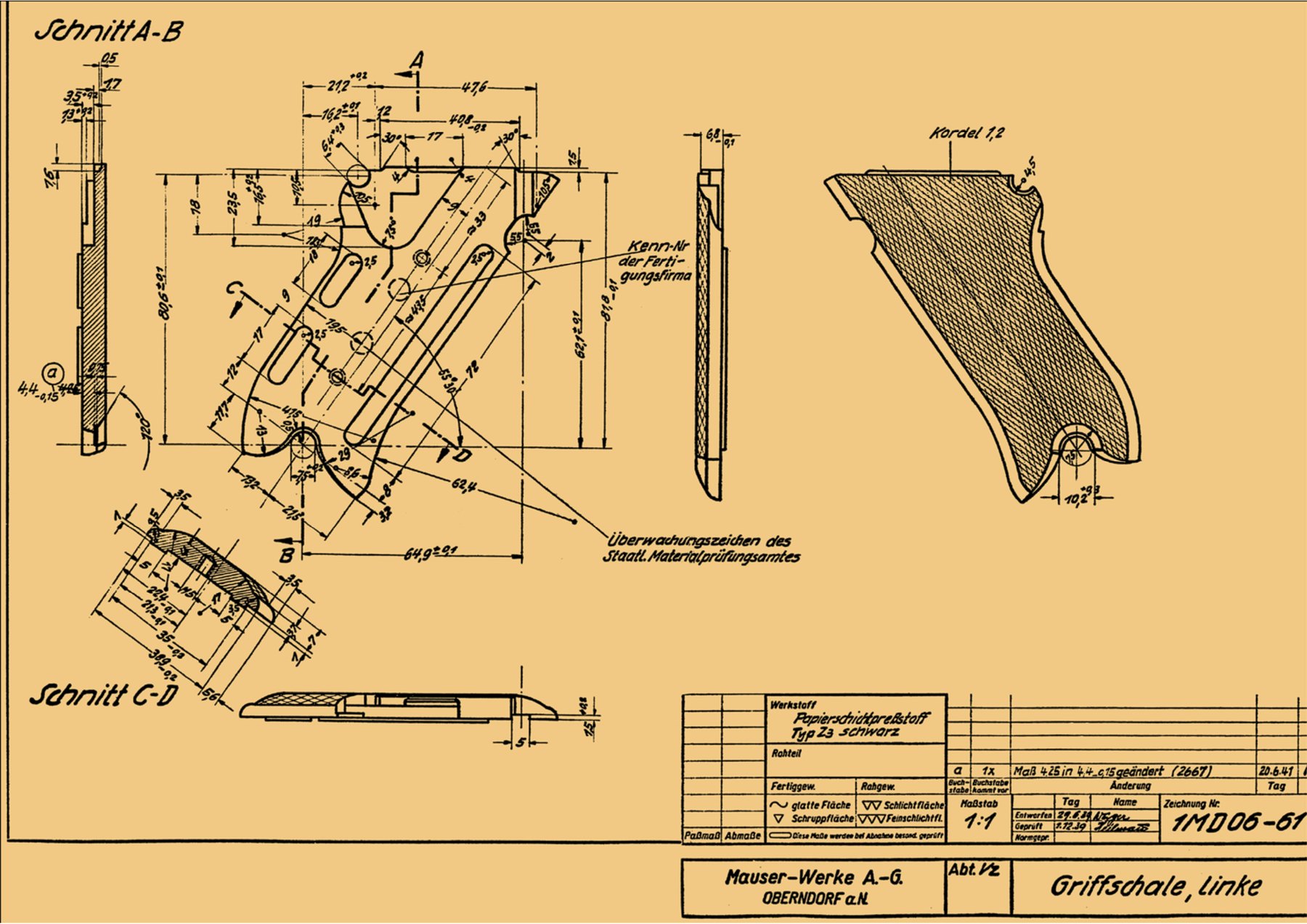
Grips. Checkered walnut until the Second World War. The Forum reference says that “Black Bakelite grips were approved for use in mid 1941” on Mauser pistols, and that “early grips used by Krieghoff and Mauser were brown in color. Later black grips were used.”1 A Mauser-Werke drawing of the left grip, number 1MD06-61, now online, specifies the material as Papierschichtpreßstoff Typ Z3 schwarz, a black laminated paper-phenolic, and is dated “drawn 29 June 1939, checked 7 December 1939”, with a change of 20 June 1941.10 So a black plastic grip existed on paper at Oberndorf two years before the approval date the collectors give. The two facts are not contradictory (a drawing is not an issue order), and both are recorded.
Magazines. P08 magazines have a wooden base on early pistols and aluminium or plastic bases later; many are numbered to the pistol, and Mauser magazines carry maker codes (the Forum discusses a change from “655” to “122” codes in the “42”-coded production of 1939–40).1 A matching magazine adds value; it is also the easiest part to fake.
5.9 Words on the parts
Table 3 — Words on the parts
| Part | German | English (export) |
|---|---|---|
| Extractor, left side | Geladen (loaded) | LOADED |
| Frame, under the safety lever | Gesichert (made safe) | SAFE |
16 Pistols for the American market carry the English words, sometimes with “Germany” or “Made in Germany” on the receiver. ATF’s curio list names these features in its description of the Stoeger pistols (Volume 2).11
5.10 Fakes, forgeries and “improvements”
The Luger is one of the most faked collector arms. The sources consulted name these traps:
- Rare-variant copies. Gun Digest’s price-guide entry for the .45 Luger warns that “perfect copies of this model have been made”.12 The same applies to any variant worth more than the labour of making it.
- Conversions and restorations that look original. Guns & Ammo recorded in 2018 that the pistolsmith John Martz made .45 Lugers by “taking two 9mm Lugers, cutting them into halves, welding them together, and then refitting the needed parts”, at $3,000 in 1979.13 A restorer today offers, for a replacement long-pistol barrel, the “application of proper factory proofs and numbers”.14 Honest work, both; but once sold on without its history, either can pass for original.
- Spurious unit and “death’s head” marks. The Forum reference: “Lugers with stamped ‘Deaths head’ symbols dating to WW2 are fake”, though some First World War and Bavarian examples “could very well be real”.1
- Faked provenance. “It’s become more common to find faked capture papers and related documentation recently.”1
- Forced matching. Renumbered parts, and parts restamped to match. The Forum reference’s “witness marks” and “halos” (bluing worn in a ring around a refinished stamp) are the tells it describes.1
- Refinishing. The Forum offers several tests: the smell of copper sulphate from cold bluing, and a polish test for the slight oxidation that “no piece of blued steel can survive 50+ years” without.1
- Spurious makers. “Spandau” and “Russian” Lugers are doubted by the collectors; the Forum dismisses Spandau manufacture outright.1
A buyer who cannot do these checks should pay for an expert who can, and should buy the pistol, not the story (Volume 7).
5.11 Museum labels corrected
Two labels photographed for Commons misstate the pistol beside them:
- Wehrtechnische Studiensammlung, Koblenz, label for the Erfurt P08 of 1911: “Eigenantrieb durch direkten Gasdruck” (operated by direct gas pressure). The Luger is short-recoil operated; the Swiss service booklet says in terms “living force, not the gas pressure” (Volume 4).15 The same label’s statement that Erfurt made the P08 “only until 1917” is contradicted by the 1918-dated Erfurt pistols the collector literature records (Volume 1).
- Athens War Museum, label for a Navy pistol: “Navy model used by the German Navy (Kriegsmarine) during World War I and II”. The Kriegsmarine was the navy of 1935 to 1945; in the First World War it was the Kaiserliche Marine.16
5.12 What this volume could not settle
- The meaning of “P.M.P.” on the Koblenz pistol’s frame.
- The date ranges of individual Waffenamt numbers from a primary list rather than the collectors’ tables.
- The meaning of the “X” on Soviet and East German reworks.
- When the black Mauser grip of the 1939 drawing was first fitted to issued pistols.
References
Footnotes
-
Luger FAQs, last updated 1 August 2019, Luger Forum and Jan Still Luger Forum, Internet Archive, https://archive.org/details/20190801lugerfaqs, consulted 2026-10-19. Entries on manufacturers’ marks, numbered parts, BUG and nitro proofs, “1920” stamps, strawed parts, grips, magazines, VoPo and RC pistols, death’s head marks, capture papers, refinishing, and the “42” marks. ↩ ↩2 ↩3 ↩4 ↩5 ↩6 ↩7 ↩8 ↩9 ↩10 ↩11 ↩12 ↩13 ↩14 ↩15 ↩16 ↩17 ↩18 ↩19 ↩20 ↩21 ↩22 ↩23 ↩24 ↩25 ↩26 ↩27 ↩28
-
Rock Island Auction Company, “Mauser ‘K’ Date ‘S/42’ Code P.08 Luger”, auction 80, lot 3485, https://www.rockislandauction.com/detail/80/3485/mauser-k-date-s42-code-p08-luger, consulted 2026-10-19. ↩ ↩2 ↩3 ↩4
-
File:DWM 7.65mm Luger.jpg, photograph by Elshad, CC BY 4.0, Wikimedia Commons, https://commons.wikimedia.org/wiki/File:DWM_7.65mm_Luger.jpg, consulted 2026-10-19 (display card). ↩ ↩2 ↩3
-
Stephen A. Petroni, “Gouv. Kiau. 4: An Extraordinary Navy Luger”, Small Arms Review V10N7, April 2007, https://smallarmsreview.com/?p=4644, consulted 2026-10-19. ↩ ↩2 ↩3
-
“Pistole 08”, German Wikipedia, https://de.wikipedia.org/wiki/Pistole_08, consulted 2026-10-19. ↩ ↩2 ↩3
-
Anleitung zur Kenntnis und Behandlung der Pistole 1900/06 (Swiss Federal Council, 31 January 1911), Internet Archive, https://archive.org/details/gunmanual_Luger_1900-06, consulted 2026-10-19. ↩ ↩2
-
Rock Island Auction Company, “Krieghoff ‘S’ Code Luftwaffe Contract Luger Pistol”, auction 73, lot 1696, https://www.rockislandauction.com/detail/73/1696/krieghoff-s-code-luftwaffe-contract-luger-pistol, consulted 2026-10-19. ↩ ↩2
-
Krieghoff, “2006 Limited Edition Krieghoff PARABELLUM” catalogue sheet, Internet Archive copy of 15 December 2013 of https://www.krieghoff.de/fileadmin/krieghoff_filelist/Downloads/Kataloge/PDF/parabellum_e.pdf, consulted 2026-10-19. ↩
-
Rock Island Auction Company, “Mauser ‘G’ Date ‘S/42’ Code Luger”, auction 86, lot 1537, https://www.rockislandauction.com/detail/86/1537/mauser-g-date-s42-code-luger, consulted 2026-10-19. ↩
-
Mauser-Werke A.-G., Oberndorf a.N., drawing 1MD06-61, “Griffschale, linke”, digitised as “The Luger Pistol Blueprints From Mauser Werke AG 1 MD 06 61 Griffschale Linke”, Internet Archive, https://archive.org/details/TheLugerPistolBlueprintsFromMauserWerkeAG1MD0661GriffschaleLinke, consulted 2026-10-19. ↩
-
ATF, Firearms Curios or Relics List, January 1972 through April 2025 (ATF P 5300.11), https://www.atf.gov/media/19856/download, consulted 2026-10-19. ↩
-
“1906 U.S. Army Test Luger .45 Caliber”, Gun Digest gun values, https://gunvalues.gundigest.com/lugers/7611/1906-u-s-army-test-luger-45-caliber/, consulted 2026-10-19. ↩
-
Patrick Sweeney, “A Luger in .45 ACP”, Guns & Ammo, 25 April 2018, as reproduced at https://lugerman.com/?p=709, consulted 2026-10-19. ↩
-
Lugerman, “Luger LP08 Artillery – 8″ Barrel Replacement”, https://lugerman.com/?p=1271, consulted 2026-10-19. ↩
-
Wehrtechnische Studiensammlung Koblenz, label for the Erfurt Pistole 08 of 1911, File:Pistole 08 Erfurt 1911 Tafel in der WTS-Koblenz.jpg (Archiv WTS-Koblenz, CC BY-SA 4.0), https://commons.wikimedia.org/wiki/File:Pistole_08_Erfurt_1911_Tafel_in_der_WTS-Koblenz.jpg, consulted 2026-10-19. ↩
-
File:Luger P04 Parabellum at Athens War Museum on November 22, 2022.jpg, photograph by George E. Koronaios, CC BY-SA 4.0, Wikimedia Commons, https://commons.wikimedia.org/wiki/File:Luger_P04_Parabellum_at_Athens_War_Museum_on_November_22,_2022.jpg, consulted 2026-10-19; the quotation is the museum’s label as transcribed by the photographer. ↩


Comments (0)