Luger P08 (Parabellum) · Volume 3
Two Cartridges: 7.65 and 9 mm Parabellum
The bottlenecked 7.65 and the straight 9 mm, what the factories and armies loaded, what they measure, what is made today, and what to feed an old Luger
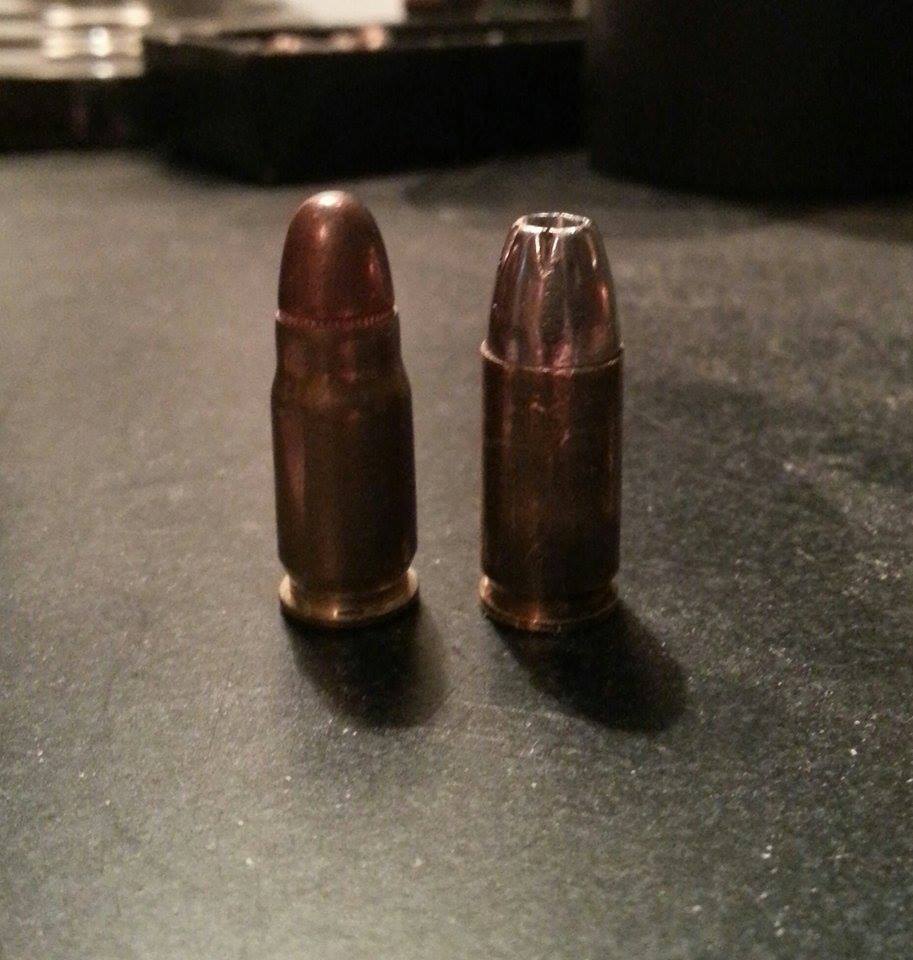
3.1 Two cartridges from one case
The Parabellum was designed around its cartridge, and its cartridge was a shortened Borchardt. The lineage from the 7.65 mm Borchardt to the 7.63 mm Mauser is set out in the Mauser C96 dive, and the Borchardt C-93 dive records Luger’s shortening of the case from 25 mm to 21 mm, which let him shorten the toggle stroke and narrow the grip. The 7.65 mm Parabellum of 1900 is that short bottlenecked case. The 9 mm Parabellum, introduced in 1902, is the same case blown out straight, with a slight taper, to take a 9 mm bullet (Volume 1).
Because the head and the overall length are essentially the same, the two calibres share the breechblock, magazine and frame of the pistol: changing calibre is a matter of the barrel. That is why DWM sold both, why the Swiss and Finns could have 7.65 pistols and the Germans 9 mm ones off the same design, and why a buyer must check which barrel a given Luger wears (below).
3.2 The 7.65 mm Parabellum, from the Swiss drawings and manual
The Swiss documented their service cartridge more completely than any other source located. The instruction booklet for the Pistole 1900/06, approved by the Federal Council on 31 January 1911, gives the load:1
- Cartridge 10.5 g; charge 0.30 g of “fine-grained white powder” (feinkörniges Weisspulver), which “fills the case completely”;
- Bullet 6.0 g, 15 mm long, of hard lead “with a nickel-copper-plated steel jacket”;
- Velocity 350 m/s at 10 m (V₁₀);
- Maximum range about 1,800 m at a departure angle of 27° 30’;
- Penetration at 50 m: 150 mm of pine, 60 mm of beech;
- packed 24 to a carton; a blank cartridge that does not cycle the action; and a drill round identified by a groove in the case.
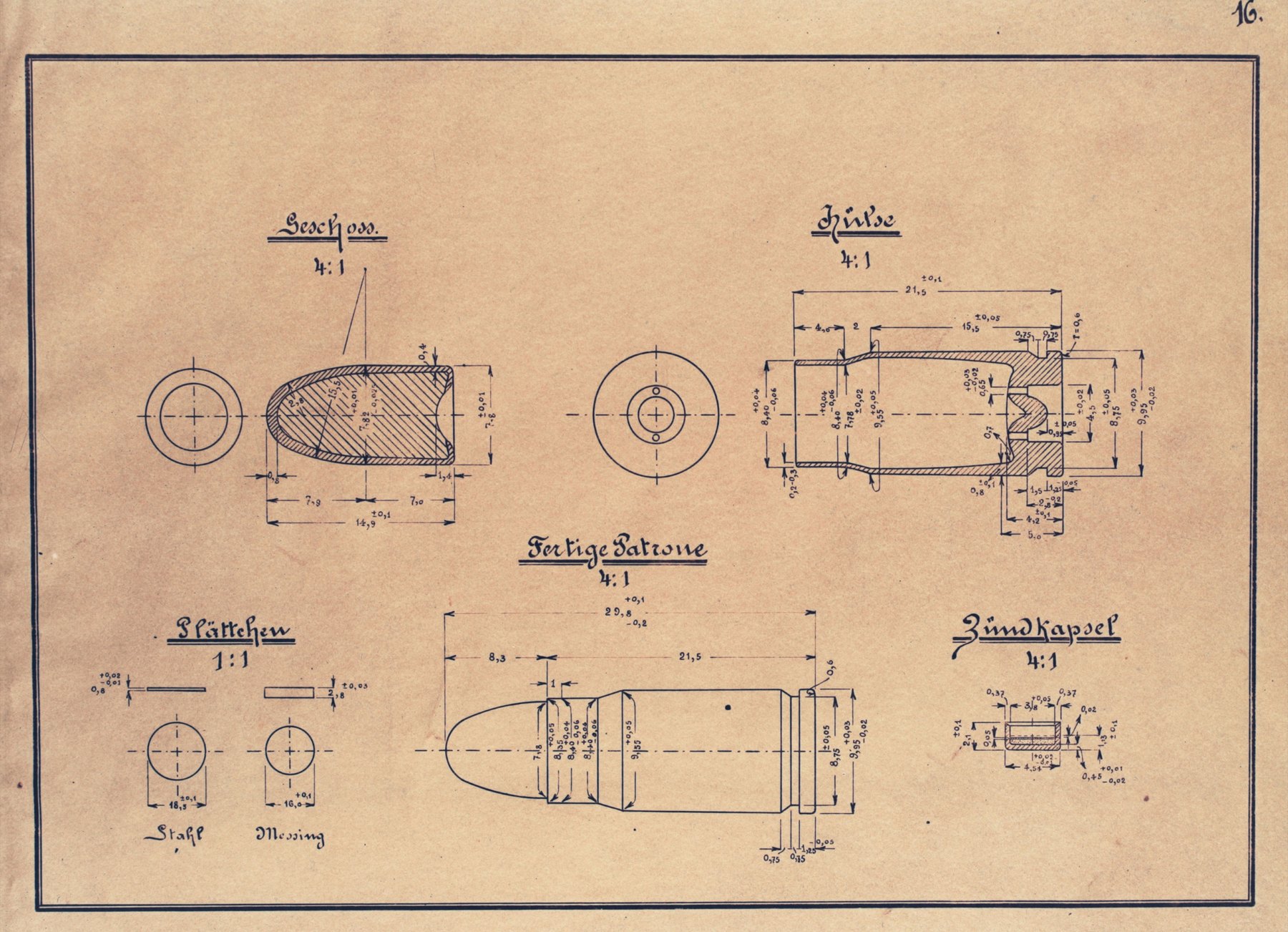
The Swiss federal drawing set of the “Mod. 1904” pistol ends with a sheet that draws the same cartridge at 4:1. It gives the case length as 21.5 mm, the loaded cartridge as 29.8 mm (+0.1/−0.2), and the bullet as 14.9 mm long, against the manual’s rounded “15 mm”; a separate detail shows the steel and brass discs from which jackets were drawn.2 Modern published figures for the case put it at 21.59 mm, as the Mannlicher dive records from the C.I.P. data, together with a head diameter of about 9.93 mm and a C.I.P. maximum pressure of 235 MPa (2,350 bar).3 The Swiss 21.5 mm is the drawing’s figure and is not averaged with the modern one.
3.3 The 9 mm Parabellum as the Germans loaded it
The German service round was the Pistolenpatrone 08. The US Army’s 1943 handbook on German weapons describes the boxes as reading “Pistolenpatronen 08”, to be distinguished from “Exerzierpatronen 08” (drill cartridges), and the ball round as having “coated steel jackets and lead cores”, with “the edge of the primer of the ball cartridge … painted black”. British and American 9 mm, it says, “will function well in this pistol; the German ammunition will of course give the best results.”4 The same handbook’s ammunition section adds that “Pist. Patr. 08” on a label “indicates 9-mm pistol and submachine-gun ammunition”, the round being common to the P08, the P38 and the MP 38 and 40.4
Hugh Pollard, describing the service pistol in 1920, gives the bullet as “either nickel or copper-coated with a sharp coned nose cut off square”, the flat-nosed truncated cone of the early 9 mm, and in his ballistic table “9 mm. Parabellum, 5 grs. powder, 125 gr. bullet”.5 Wartime material shortages produced cartridges with iron cores: English Wikipedia, citing Dunlap’s Ordnance Went Up Front (1948), describes an “08 mE” round with an iron core inside lead, and a sintered-iron “08 sE”.6
3.4 Velocities side by side
The figures below are not comparable in any strict sense: different barrel lengths, measuring distances and decades. They are tabled, not averaged, because each is what its source says.
Table 1 — Velocities side by side
| Cartridge | Velocity | Where measured | Source |
|---|---|---|---|
| 7.65 Swiss service, 6.0 g | 350 m/s (1,148 ft/s) | 10 m, Pistole 1900/06 | Swiss instruction booklet, 1911 |
| 7.65 Luger | 1,150 ft/s | Not stated | Pollard, 1920 |
| 7.65 Luger | 1,134 ft/s | Not stated | Pollard, 1920 (another passage) |
| .30 Luger, Fiocchi Heritage 93 gr FMJ | 1,200 ft/s | Not stated | Fiocchi USA, 2026 |
| 9 mm German service | 1,150 ft/s | Not stated | Pollard, 1920 (description) |
| 9 mm, 125 gr | 1,039 | Units garbled in the scan; read as ft/s | Pollard, 1920 (table) |
| 9 mm German service | 1,040 ft/s | Not stated | US German Infantry Weapons, 1943 |
| 9 mm German service | 365 m/s (1,198 ft/s) | Not stated | WTS Koblenz museum label |
| .45 Luger, Luger’s own ammunition | mean 762.6 ft/s | 25 ft | US Army board, 1907 |
| .45 Luger, Frankford Arsenal ammunition | mean 808.9 ft/s | 25 ft | US Army board, 1907 |
3.5 Dimensions and pressures today
The 9 mm Parabellum’s modern specifications are those of C.I.P. in Europe and SAAMI in America. English Wikipedia’s tabulation of the C.I.P. sheet gives a case length of 19.15 mm, an overall length of 29.69 mm, a bullet diameter of 9.01 mm, a rim diameter of 9.96 mm and a maximum pressure of 235 MPa (34,084 psi) by piezo transducer; SAAMI’s maximum average pressure is 35,000 psi.6 SAAMI’s +P load is rated higher; the Ballistics Overview, Volume 2 has the hub’s pressure table and explains why piezo and copper-crusher figures are not interchangeable.
None of these modern figures is a specification the Luger was proved to. German and Swiss proof was to the national proof laws of the day (the Imperial proof marks are in Volume 5), and a pistol a century old has had a century to wear, rust, be refinished or be rebarrelled.
3.6 Telling a 7.65 from a 9 mm pistol
Do not assume a calibre from the model, the country or the markings. Many Lugers were rebarrelled in service, at the factory, for importers or by owners; commercial pistols were sold in both calibres; and a 7.65 barrel on a 9 mm-marked pistol, or the reverse, is common. Three checks, in rising order of certainty:
- The bore, by eye or with a pencil. The Luger Forum reference’s “pencil test”: “Take a normal No. 2 sized, round, old fashioned pencil and drop it down the bore. If its fairly tight, its 30 Luger (aka 7.65mm Luger). If it falls easily and loosely into the barrel and there is plenty of room, its 9mm.”10
- The barrel markings. German military barrels are commonly stamped with the measured bore in hundredths of a millimetre; the Forum reference says acceptable 9 mm barrels were gauged between 8.81 and 8.85 mm, and that Mauser stopped marking the figure in 1942.10 British-proofed commercial pistols may carry the English gauge numbers “118,35” (9 mm) or “172,28” (7.65 mm), the number of lead balls of that diameter in a pound.10
- A chamber cast, which settles both calibre and condition. This is the only check that should precede firing an unknown pistol.
A 9 mm cartridge will not fully enter a 7.65 chamber, being stopped by the neck; the Forum reference notes this as part of its test.10 The reverse, a 7.65 round in a 9 mm chamber, is the dangerous combination for any bottlenecked-into-straight mismatch and must simply never be attempted.
3.7 What to shoot in an old Luger
The sources an owner can rely on agree on three rules and are silent on loads, and this dive gives no charge weights.
Standard pressure only. Krieghoff, the only maker of a new P08 whose manual was found, tells owners: “Never use ammunition which exceeds industry standard pressure specifications”, and “Do not use any ammunition other than original high quality commercially manufactured ammunition in good condition.”11 That rules out +P and +P+ in a new pistol made to the original drawings; it applies with more force to an old one.
Not every standard load cycles every Luger. The 1907 board recorded that the Luger’s “final seating of the cartridge is mainly dependent upon remaining momentum and not upon spring action” and that Luger himself said a particular powder was “necessary for its satisfactory use”.9 A Luger with a strong or new spring may short-cycle with light commercial loads; one with a weak spring will batter. Dwight Gruber, in the Forum reference, puts the collectors’ view: Lugers are “designed to use ammunition more powerful than that found commercially, at least in the U.S.”10 That is an opinion, attributed as such. The cure is a spring matched to the pistol and the ammunition, discussed in Volume 6, not a hotter load.
Reloads at the owner’s risk. Krieghoff: “The use of reloaded cartridges can cause damage to the firearm and also injury, death or damage to property.”11 The hub’s Reloading Bench covers load development as method; nothing in it is a Luger load, and nothing here is either.
3.8 The 7.65 today
The 7.65 mm Parabellum is still loaded. Fiocchi’s American site listed two loads on 19 October 2026, both in its Heritage line at $37.99 for 50: a 93-grain full metal jacket at a stated 1,200 ft/s, and a 93-grain semi-jacketed soft point at 1,210 ft/s, with no barrel length given for either velocity.7 The Mannlicher dive records that Buffalo Arms, the American specialist in obsolete cartridges, also lists “.30 Luger (7.65x21)” brass. Fiocchi’s 93 grains (6.03 g) matches the Swiss service bullet’s 6.0 g almost exactly.
Two warnings from that dive apply here too. A box marked only “7.65 mm” is most likely 7.65 Browning (.32 ACP), a different, semi-rimmed, much shorter round; and 7.65×21 is also used as a name for the blowback Mannlicher’s straight-cased cartridge. Match the cartridge to the chamber, never to a name.
3.9 How it shoots
Sights. The P08 has a fixed V notch on the rear toggle link and an inverted-V front blade.4 Pollard admired the foresight, “transversely milled so as to appear of darker colour to the polished point”.5 The Forum reference records that “Early P08’s were sighted in at 100 meters and had front sight blades 5.0mm tall. From mid 1913 onward this was reduced to 50 meters by fitting a 5.5mm blade”; a member shooting at 25 m reports needing a six o’clock hold with 115-grain bullets.10 A Luger that shoots high at short range is doing what it was regulated to do.
Trigger. Pollard: “rather long and creeping, but it shoots extremely well, lies low in the hand”.5 The trigger’s leverage runs through a lever on the side plate to the sear bar on the receiver, and its feel varies from pistol to pistol; Volume 4 explains the parts.
Accuracy and handling. The 1907 board measured a mean absolute deviation of 1.3 in at 75 ft with the .45 Luger, and praised the grip as conforming “to the anatomical features of the hand” with the centre of gravity “well to the rear”.9 The 1943 US handbook gave an effective range of 25 yards and called the pistol “well-balanced” and “accurate”, but warned that “the mechanism is rather exposed to dust and dirt”.4 Both reports found the toggle hard to retract by hand; the 1907 board listed “the retraction of the breech mechanism by hand is difficult” among its distinguishing characteristics.
Ejection. The case goes straight up. The 1907 board noted “vertical ejection”; a shooter who wears a hat with a brim will learn why.9
3.10 What this volume could not settle
- The original German 9 mm load in factory terms: bullet weight in grams, charge and velocity from a German document rather than Pollard’s ballistic table.
- When the truncated-cone 9 mm bullet gave way to the round nose in German service.
- The Swiss 21.5 mm case against C.I.P.’s 21.59 mm, from the C.I.P. sheet itself.
- Fiocchi’s test-barrel length for the 7.65 velocities.
References
Footnotes
-
Anleitung zur Kenntnis und Behandlung der Pistole 1900/06, approved by the Swiss Federal Council on 31 January 1911, “Die Munition” and “Einige Angaben betreffend die Pistole 1900/06”, pp. 20–24, Internet Archive, https://archive.org/details/gunmanual_Luger_1900-06, consulted 2026-10-19. Translations are this dive’s. ↩ ↩2
-
Swiss Federal Archives (Bundesarchiv Bern), Bestand 27, Archiv-Nr. 18176, “Pistole 1900/1906”, sheet 16, digitised as “The Luger Pistol Blueprints, Pistol 1900 1906”, Internet Archive, https://archive.org/details/TheLugerPistolBlueprintsPistol19001906, consulted 2026-10-19. ↩
-
“7.65×21mm Parabellum”, English Wikipedia, https://en.wikipedia.org/wiki/7.65%C3%9721mm_Parabellum, as cited in the hub’s Mannlicher dive, Volume 7. ↩
-
War Department, Military Intelligence Service, German Infantry Weapons, Special Series No. 14, 25 May 1943, pp. 3–10 and 163, Internet Archive, https://archive.org/details/GermanInfantryWeapons1943, consulted 2026-10-19. ↩ ↩2 ↩3 ↩4 ↩5
-
Hugh B. C. Pollard, Automatic Pistols (London, 1920), pp. 29–30 and the ballistic tables, Internet Archive, https://archive.org/details/automaticpistolspollard1920, consulted 2026-10-19. ↩ ↩2 ↩3 ↩4
-
“9×19mm Parabellum”, English Wikipedia, https://en.wikipedia.org/wiki/9%C3%9719mm_Parabellum, consulted 2026-10-19 (C.I.P. TDCC data; SAAMI; Dunlap 1948 on the 08 mE and sE). ↩ ↩2
-
Fiocchi USA, site search for “30 luger”, https://www.fiocchiusa.com/search?q=30%20luger, consulted 2026-10-19: items 765A and 765B. ↩ ↩2
-
Wehrtechnische Studiensammlung Koblenz, label for the Erfurt Pistole 08 of 1911, File:Pistole 08 Erfurt 1911 Tafel in der WTS-Koblenz.jpg (Archiv WTS-Koblenz, CC BY-SA 4.0), https://commons.wikimedia.org/wiki/File:Pistole_08_Erfurt_1911_Tafel_in_der_WTS-Koblenz.jpg, consulted 2026-10-19. ↩
-
“Report of Board on Tests of Revolvers and Automatic Pistols”, Annual Report of the Chief of Ordnance, 1907, Appendix, Internet Archive, https://archive.org/details/1907pistoltrials, consulted 2026-10-19. ↩ ↩2 ↩3 ↩4
-
Luger FAQs, last updated 1 August 2019, Luger Forum and Jan Still Luger Forum, Internet Archive, https://archive.org/details/20190801lugerfaqs, consulted 2026-10-19. ↩ ↩2 ↩3 ↩4 ↩5 ↩6
-
Krieghoff, Instruction Manual, Krieghoff Automatic Pistol PARABELLUM – Caliber 9mm, safety instructions 19–21, Internet Archive copy of 5 July 2016 of https://www.krieghoff.de/fileadmin/krieghoff_filelist/Downloads/Bedienungsanleitung/PDF/instruction_manual_parabellum.pdf, consulted 2026-10-19. ↩ ↩2

Comments (0)