Luger P08 (Parabellum) · Volume 2
War, Weimar, Mauser and After, 1914–2006
Two world wars, the drum magazine, Versailles and Simson, Vickers and the Dutch, Bern, Mauser's code years and Krieghoff's Luftwaffe pistols, the end of production, and the Lugers made since 1945
2.1 Who made Lugers, and how many
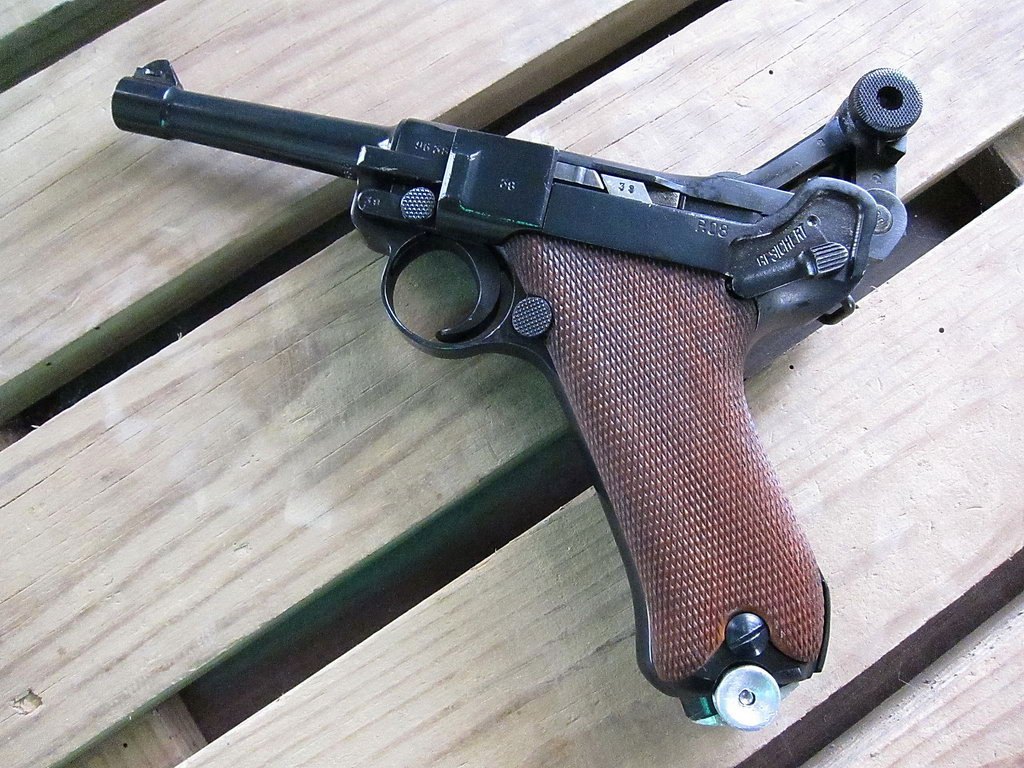
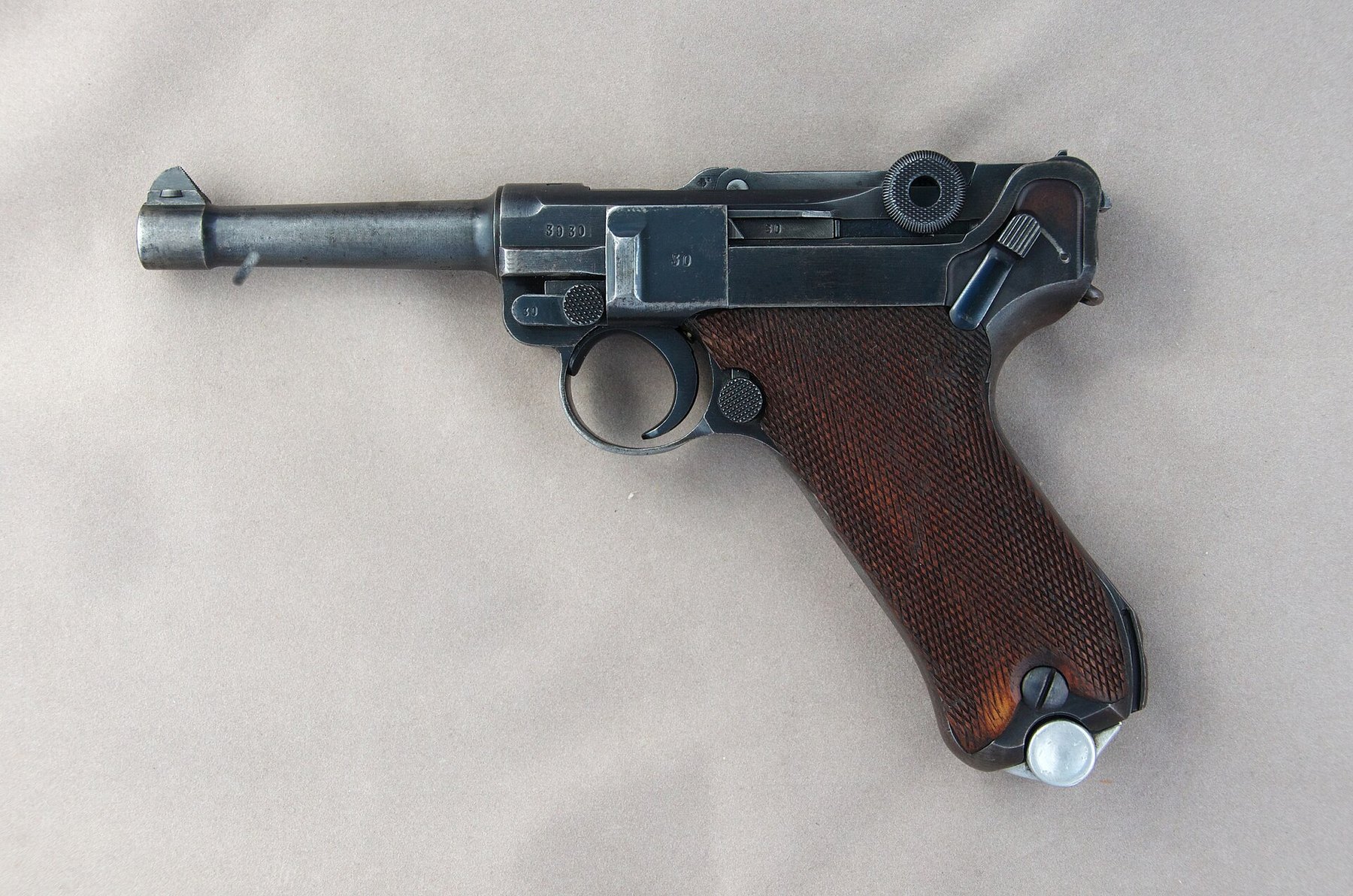
The Luger collectors’ reference compiled on the Luger Forum gives production totals for every maker up to 1945, each credited to the collector-author who compiled it. They are the best figures published in one place, and they are collectors’ estimates, not factory ledgers.1
Table 1 — Who made Lugers, and how many
| Maker | Years | Estimated production | Compiled by (per the Forum reference) |
|---|---|---|---|
| DWM, Berlin | 1900–1930 | about 818,000 (743,000 military, 74,955 commercial) | Jan Still |
| Erfurt arsenal | 1911–1918 | about 519,000, all military | Jan Still |
| Simson & Co., Suhl | 1925–1934 | about 11,900, military and police | The Forum’s authors |
| Mauser-Werke, Oberndorf | 1930–1942 (see below) | about 943,500 (900,000 military, 43,000 commercial) | Jan Still |
| Heinrich Krieghoff, Suhl | 1934/35–1944/45 | about 13,825 (12,200 Luftwaffe, 1,625 commercial) | Randall Gibson |
| Waffenfabrik Bern | 1918–1947 | 47,701 (45,784 military, 1,917 commercial) | Fred Datig |
Krieghoff’s own catalogue gives “approximately 13,850 Model ‘08’ pistols” between 1934 and 1945, “approximately 1650” of them civilian.2 German Wikipedia, citing Krieghoff’s website, gives the same 13,850.3 The two Krieghoff figures are close but not identical, and both are given.
The table sums to roughly 2.35 million. Against that, the Century International Arms importer’s guide supplied with surplus P08s in the 1990s says that “nearly two million pistols were made during the war”, meaning the First World War.4 The Forum’s DWM and Erfurt totals together, for every year from 1900 to 1930, come to about 1.34 million, so the importer’s figure cannot be right as stated. English Wikipedia’s phrase, “over 2 million Luger pistols were used by German forces from 1914 to 1918”, is about use rather than manufacture, and is also not supported by these totals.5
According to John Walter’s The Luger Story, as quoted in the Forum reference, “only four sets of machinery were ever made”: DWM’s, which moved from Charlottenburg to Wittenau in 1916 and to Mauser at Oberndorf in 1930; Erfurt’s, installed in 1909–10, sold to Simson in 1920 and used by Krieghoff in the mid-1930s as a guide for its own; Bern’s, of 1917; and postwar Mauser’s.1
2.2 The First World War
The war made the P08 a mass-produced pistol at DWM and at Erfurt, and the collectors’ categories of wartime pistols follow the changes that production and service forced:
- Chamber dates. Army pistols carry the year of manufacture over the chamber (the Erfurt pistol at Koblenz reads 1911); Navy pistols only from 1916.6
- Stock lugs. From August 1913 new P08s had a lug on the heel of the grip, and the long pistol of the same year (see Volume 1) went into wartime production alongside the standard pistol.1
- Artillery notching. In November 1916, according to Still as quoted in the Forum reference, an amendment to the P08 dimensional tables allowed the receiver to be cut for the long pistol’s rear sight, and “many Erfurt pistols dated 1916, 1917 and 1918 will be found with the receiver cut this way”.1
- Rejected parts. The crown over RC stamp, the mark of the Revisions-Commission that accepted serviceable parts rejected for minor flaws, is commonest on Erfurt pistols.1
The Forum reference also dismisses a persistent wartime “maker”: the Spandau arsenal. About a dozen genuine pistols marked there are known, dated 1917 and 1918, but they were not made at Spandau, which had no Luger tooling or gauges.1
2.3 The drum magazine
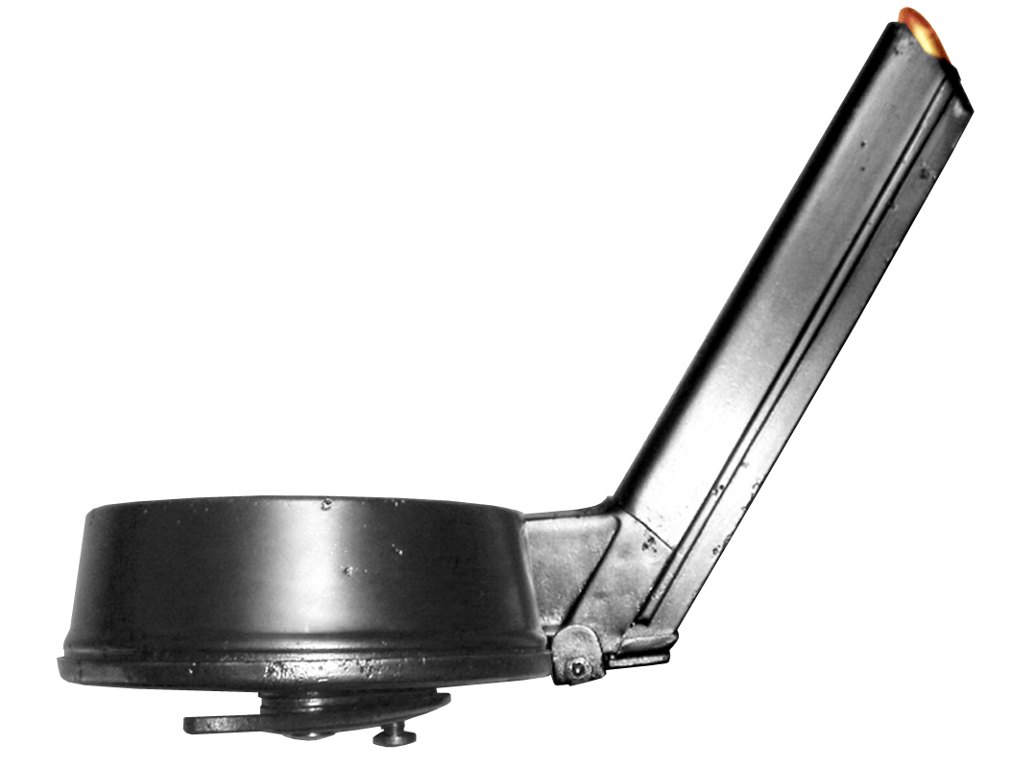
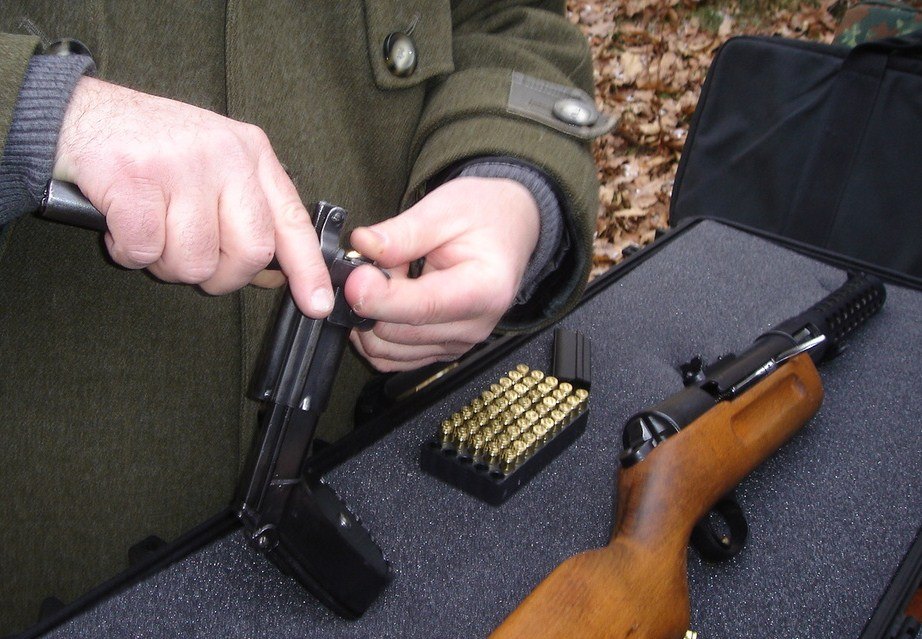
The Trommelmagazin 08, the 32-round “snail” drum, was designed for the long pistol and served with the first submachine gun as well: the MP 40 dive records that Hugo Schmeisser’s MP 18 was issued with the same drum, “adapted from the artillery model Luger pistol”. Hugh Pollard, a British officer writing in 1920, described its working from war trophies: the drums “contain a powerful spring which forces the cartridges round the groove of the drum up the straight magazine shaft to the chamber feed”, and they “are difficult to load by hand and were supplied in sets of six with a little lever loading tool to each box”. His plate shows a drum fitted to a standard four-inch P08, captured in 1918.7
2.4 1920: the property stamp that looks like a date
Many wartime P08s carry two numbers over the chamber, typically the wartime year and “1920”. The Forum reference, quoting Jan Still’s Weimar Lugers, is emphatic that the second is not a date: “The 1920 stamp was added sometime between August 1920 and April 1921. It is a Reichswehr property stamp applied to identify the Luger as German Army property to prevent theft. Civilians were paid a bounty for turning in their unauthorized weapons to be destroyed. The Army feared the theft of its unmarked Lugers for the bounty.”1 “True double dates”, two genuine years, are rare by the same account, and a small number of DWM pistols carry only the “1920”.
That reading matters for an owner, because ATF’s list of stocked Lugers removed from the National Firearms Act describes Weimar Navy long pistols as “having chamber dates of 1914 through 1918 or 1920”.8 ATF treats the 1920 as a date; the collectors do not. Volume 7 takes the consequence.
2.5 Simson, the only licensed maker
After the war, German military arms production was confined to a few licensed firms. Erfurt’s Luger machinery was sold to Simson & Co. of Suhl in 1920, and Simson became the Reichswehr’s pistol contractor, making, by the Forum’s figure, about 12,000 pistols between 1925 and 1934, all for the military and police.1 The Weimar years were also the years of rework: tens of thousands of wartime pistols were refurbished, renumbered or re-proofed by the army and police, which is why so many P08s now show mixed dates, property stamps and replacement parts. The Forum says Simson’s Luger tooling went to Krieghoff in 1934 “when the Jewish owned Simpson [sic] & Co. firm was disbanded by the Nazis”.1
2.6 Vickers and the Dutch
The Netherlands bought Lugers for the colonial army in the Dutch East Indies (the KNIL) before and after the war. The Forum reference records that 6,000 pistols were assembled by Vickers in England from DWM-made parts for the Dutch East Indies between 1919 and 1922, with about 35 more assembled from surplus parts for promotion; further Dutch pistols were made without the Vickers name on the toggle.1 English Wikipedia records Dutch Navy contracts from 1923 and Dutch Air Force purchases in 1928.5 Why the assembly was done by a British company is not explained in the sources consulted.
2.7 DWM’s commercial pistols and the American market
DWM restarted commercial production in late 1919. The Forum reference, following Still, calls the result the “1920 DWM” commercial (formerly “1923 Commercial”), numbered from about 74745 and reaching about 92000 by mid-1921, after which DWM switched to military-style four-digit numbers with letter suffixes, the “DWM Alphabet Commercial”.1 Many went to the United States through the New York importer A. F. Stoeger, including long-barrelled pistols in 7.65 and 9 mm. ATF’s list describes the type: “Model 1920 and 1923, semiautomatic pistols, cal.’s 7.65mm or 9mm Parabellum, in barrel lengths of 8, 10, 12, and 12-1/2”, having either American Eagle chamber crests and/or Stoeger frame and/or upper receiver marks”, with extractors marked “Loaded” or “Geladen” and safeties marked “Gesichert” or “Safe”.8 English-language markings on the extractor and safety are the mark of DWM’s American export pistols.
2.8 Bern: the Swiss make their own
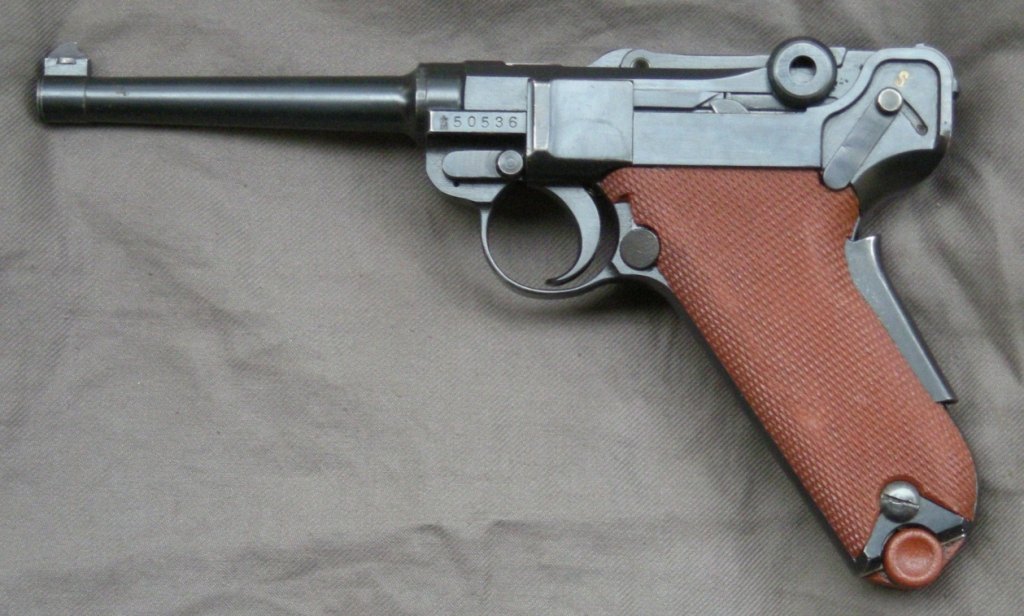
When the war stopped deliveries from Berlin, the Swiss federal arms factory at Bern (Eidgenössische Waffenfabrik, “W+F”) set up its own line in 1917 and delivered from 1918. German Wikipedia, citing Lidschun and Wollert, gives Bern’s numbering: the 1906 pattern from 15216 to 33089 between 1918 and 1933, and the simplified Model 1906/29, with a straight front grip strap and a plainer finish, from 50001 to 77941 between 1933 and 1946.3 The Forum reference credits Fred Datig with Bern production of 17,873 of the 1906 pattern and 27,940 military plus 1,917 commercial 06/29s.1 The 06/29 is easy to tell apart and appears in Volume 5.
2.9 Mauser, 1930
In 1930 Luger manufacture moved from DWM in Berlin to Mauser at Oberndorf, both companies then belonging to the same group; the Forum reference says the move was “managed by August Weiss” and insists that “Mauser didn’t absorb DWM. In fact, Mauser was a 100% subsidiary of DWM.”1 The DWM line, with parts in progress, tooling and gauges, went to Oberndorf. The first Mauser pistols, assembled with DWM parts, are the subject of a good deal of collector argument (the “29 DWM” or “sneak” pistols with s, t and u suffixes are among them) and are not resolved here.1
2.10 The code years: K, G, S/42, 42 and byf
From 1934 the German government hid the makers and dates of its rearmament weapons. On the Luger the codes sit in two places: the chamber (the date) and the front toggle link (the maker).1
Table 2 — The code years: K, G, S/42, 42 and byf
| Period | Chamber | Front toggle | Source |
|---|---|---|---|
| 1934 | ”K" | "S/42” (Mauser) | Rock Island Auction lot descriptions (“the ‘K’ date Lugers were manufactured in 1934”) |
| 1935 | ”G" | "S/42” | Rock Island Auction (“Manufactured by Mauser in 1935 … with the ‘G’ date mark on the chamber, ‘S/42’ on the front toggle link”) |
| 1935 or 1936 | ”S” | Krieghoff “H(anchor)K / SUHL” | Rock Island Auction (one lot says “approximately 1935”, others 1936) |
| 1936–1939 | Four-digit year | ”S/42” | Luger Forum reference |
| 1939–early 1941 | Four-digit year, then “41" | "42” (Mauser) | Luger Forum reference |
| 1941–1942 | ”41”, then “42" | "byf” (Mauser) | Luger Forum reference |
| Commercial, 1934 on | Year or none | Mauser “banner” | Luger Forum reference |
910111 The Forum reference adds two traps. A large “42” on the toggle is the maker’s code, while a “42” over the chamber is the year 1942. And a small (2 mm) “42” or “S/42” on a single part marks a Mauser armourer’s replacement part, evidence of a depot repair.1 The Forum reference also gives the S/42 code as used “from 1936 until 1939” in one entry and describes “K-date S/42 (1934)” pistols in another; the auction houses agree with the second.
2.11 Krieghoff and the Luftwaffe
Heinrich Krieghoff of Suhl took a Luftwaffe contract for P08s in the mid-1930s and became, in the phrase several Rock Island catalogue descriptions repeat, the Luftwaffe’s only official Luger supplier. Krieghoff’s first pistols carry an “S” over the chamber and the firm’s anchor between “H” and “K” with “SUHL” below on the front toggle link; Rock Island’s cataloguers describe three variants of the S-code pistol.11 Krieghoff made its own tooling, using the Simson set as a guide.1 Its own figure, quoted above, is about 13,850 in all, of which about 1,650 commercial. English Wikipedia records a second Luftwaffe contract for 15,000 pistols “only partially completed when Krieghoff ceased Luger production in 1944”; Krieghoff’s catalogue gives production “between 1934 and 1945”.52
2.12 Police pistols
The German police were a large Luger user, and two police devices identify their pistols. A sear safety, a Z-shaped flat spring riveted to the hood over the sear bar with a pin that drops into a hole in the bar when the side plate is off, was introduced by Prussian police order of 30 August 1933; it stops a partly dismantled pistol being fired by pressing the sear bar. A magazine safety was introduced under the same orders and directed to be removed in 1937; most were, and the frames show the welded or cut-off remains.1 The danger the sear safety answered is real: Krieghoff’s modern manual warns in capitals that “the dismantled Pistol is able to fire, when the sear bar is pushed!! Even without the grip frame mounted!!!!”12 A Reichswehr order of 17 September 1930, according to Görtz and Sturgess as cited by the Forum, required firing pins to be fluted, and the police followed between 1932 and 1935.1
2.13 Export contracts
The Parabellum’s buyers between the wars, named in the sources consulted, included:
- Finland, which bought DWM pistols as the m/23 in 7.65 mm and 9 mm, issued with board stocks;8
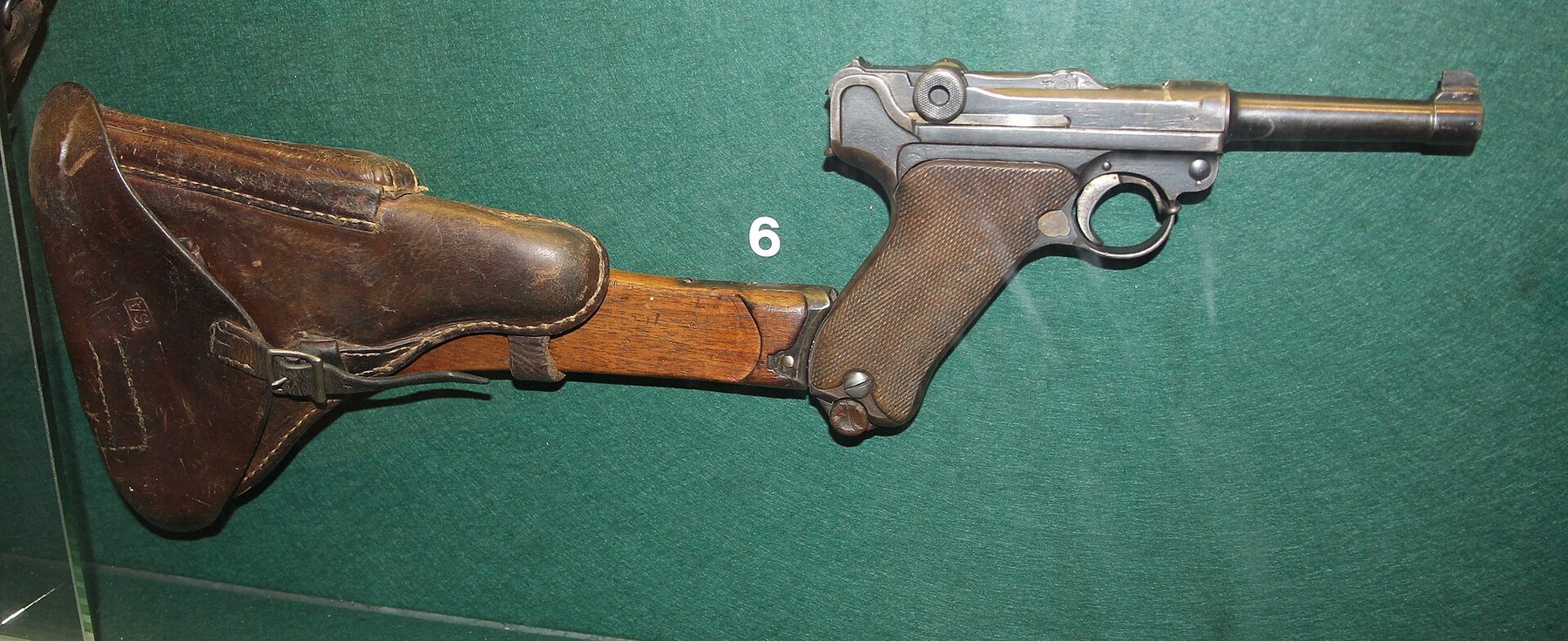
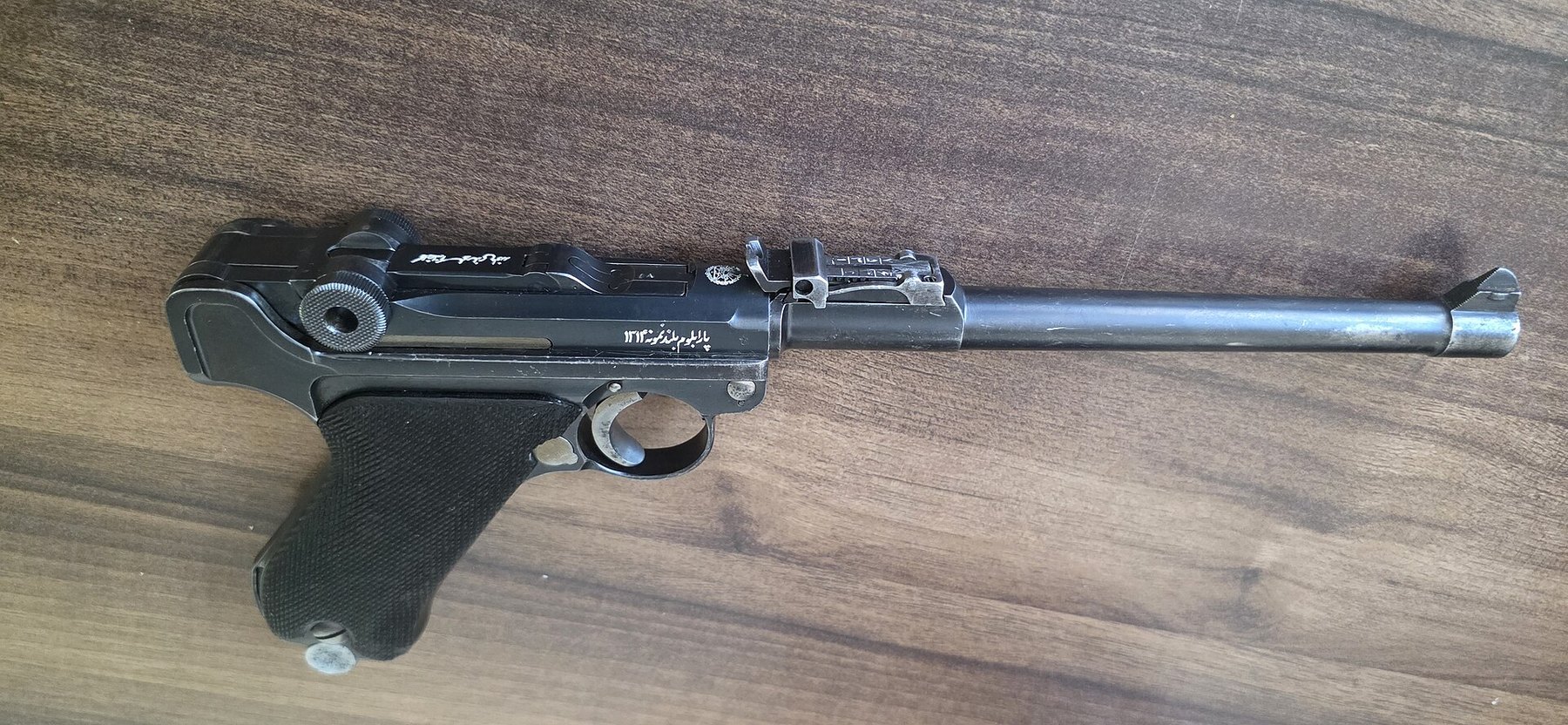
- Persia, which took Mauser-made long pistols with a Farsi serial number stamped into the stock (German Wikipedia says delivered 1935–36);83
- Thailand, whose police took Mauser banner-marked long pistols with stocks;8
- Portugal, whose pistols carry an “M2” over the chamber, and Bulgaria, whose 1908 DWM pistols carry the royal arms on the toggle;1
- Sweden and Switzerland, which bought Mauser banner commercials.1
2.14 The end of production
The Walther P38 began to replace the P08 from 1938, according to German Wikipedia’s sources, and Luger production was run down over the following years.3 The sources do not agree on when it stopped:
Table 3 — The Walther P38 began to replace the P08 from 1938, according to German Wikipedia's sources, and Luger production was run down over the following years.[^dewiki] The sources do not agree on when it stopped
| Claim | Source |
|---|---|
| ”all production ceased in 1942” | Century International Arms importer’s guide |
| Mauser 1930–1942 | Luger Forum reference |
| P08 production “until September 1942” | English Wikipedia, one citation |
| Mauser production “until December 1943”; Army’s “last delivery of 1,000 Mauser-made pistols” November 1943 | English Wikipedia, other citations |
| Krieghoff “ceased Luger production in 1944” | English Wikipedia |
| Krieghoff “between 1934 and 1945” | Krieghoff catalogue |
| Assembly under French occupation “from June 1945 until mid-1946”, about 4,000 pistols | English Wikipedia |
| Bern Model 06/29 numbered to 1946 | German Wikipedia |
| Bern production 1918–1947 | Luger Forum reference (Datig) |
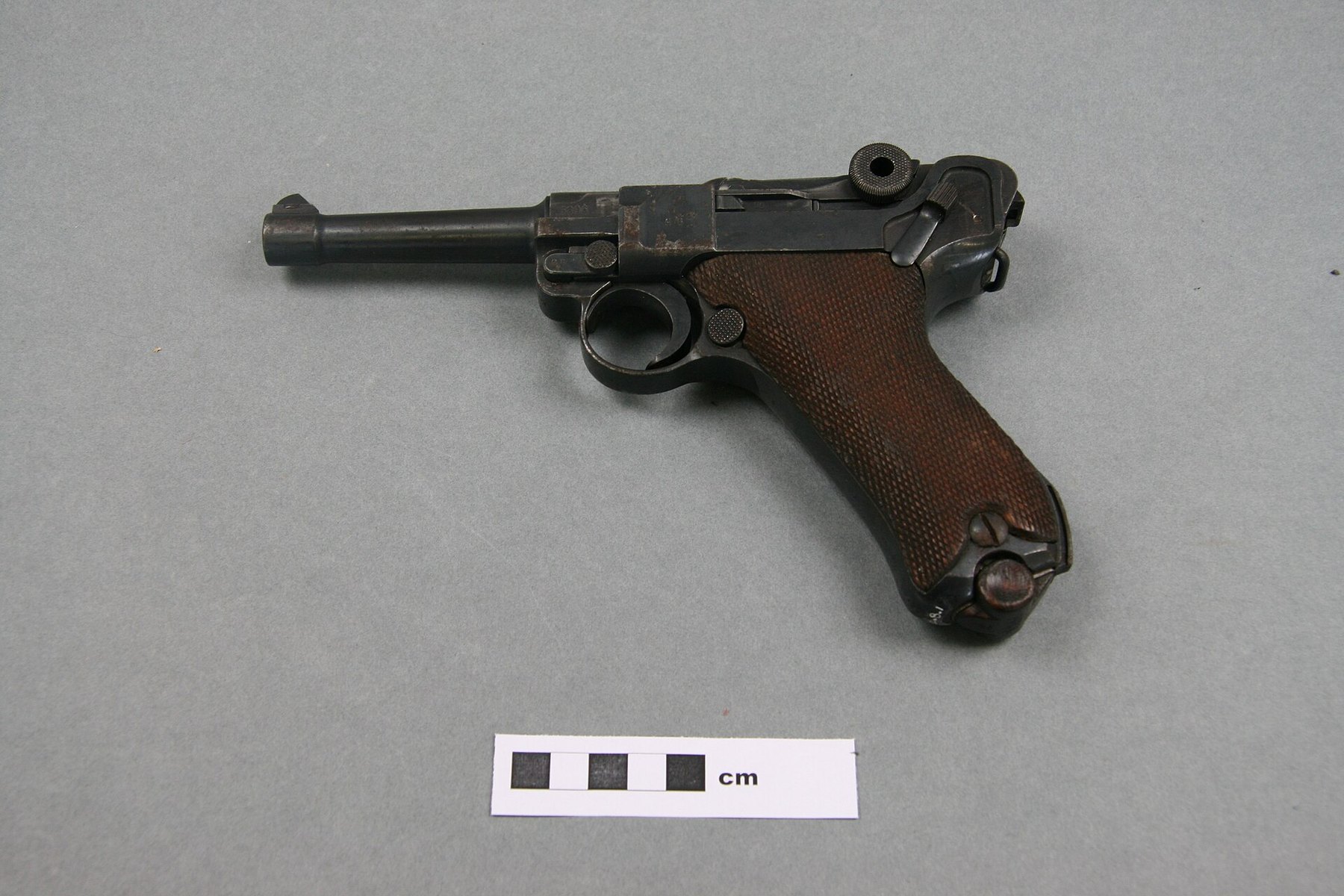
41523 The most that can be said from these is that German military contracts ended in 1942 or 1943, that Krieghoff and Mauser assembled pistols later from parts, and that pistols were assembled at Oberndorf under French control after the war.
2.15 After 1945
East Germany. The Forum reference records that VEB Ernst Thälmann at Suhl, the nationalised successor of the Suhl arms firms, made parts, magazines and about 100 complete Lugers, marked with the code “2/1001”, until about 1968; and that many captured pistols were refurbished for the East German Volkspolizei (“VoPo”) and in the Soviet Union, some marked with a large “X” whose meaning is unknown.1
Mauser again. Mauser restarted Parabellum production at Oberndorf around 1970, using the Swiss Bern tooling as its pattern; the Forum says the Swiss jigs themselves proved unusable “due to differences in standards between Germany and Switzerland” and a new line was built. The dates in print differ: 1969 to 1986 (English Wikipedia), 1972 to 1993 (the Forum), and, for the Swiss-pattern pistol with grip safety and American Eagle sold through Interarms, “made from 1970 to 1978” (ATF).518 Mauser also made a series of commemoratives, several of which ATF lists by name: a “70 Jahre Parabellum-Pistole” marked for Imperial Russia, a “75 Jahre” marked for the Kingdom of Bulgaria, a 1900–1975 anniversary pistol, a 1902 cartridge-counter reproduction of 1982, and a 75th-anniversary carbine of 1979.8
Stainless Lugers in Texas. Mitchell Arms and associated firms in Houston (the Forum names AIMCO, Mitchell, Stoeger and Orimar) made stainless-steel Lugers “to manufacturing and metallurgy standards that … diverge from those found in German and Swiss made Lugers”, the tooling reverse-engineered from surviving pistols, up to about 2003.1
Krieghoff again. In 2006 the modern Krieghoff company at Ulm made a limited edition of 200 Parabellums, serial numbered 18001 to 18200 to continue the wartime sequence, “machined from the best grade solid steel” and “100% dimensionally identical to the first Krieghoff pistols”. Its instruction manual is the only maker’s manual of a new P08 found, and Volume 6 quotes it.212
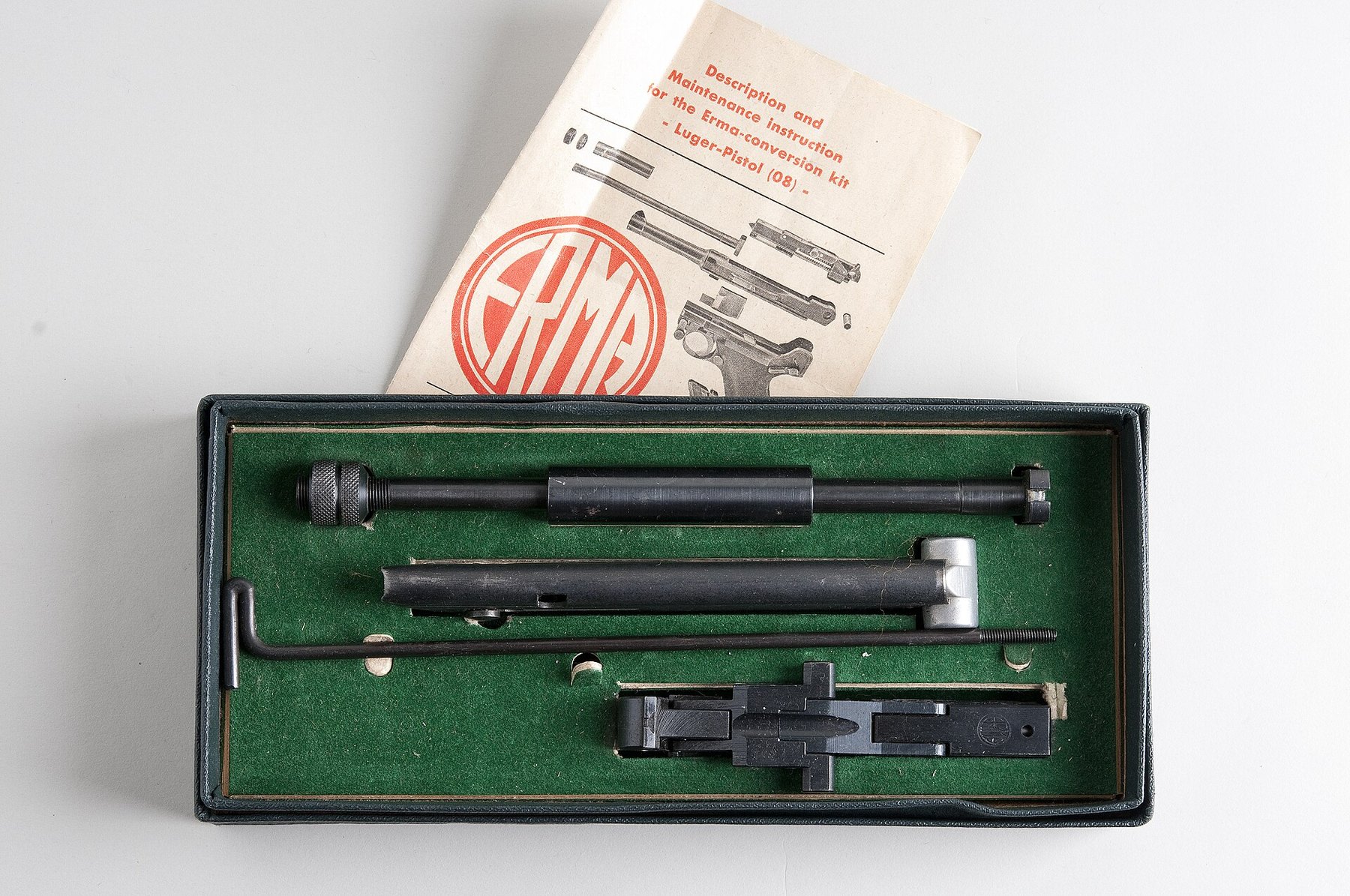
.22 conversions and look-alikes. The German army trained with a .22 insert barrel for the P08, the Selbstlade-Einstecklauf (S.E.L.), under a 1938 regulation, Vorschrift D 123, according to German Wikipedia’s bibliography.3 Erma later sold .22 conversion sets for the P08. The Stoeger “.22 Luger” and Erma’s KGP pistols look like Lugers but are different, blowback designs; they are not Parabellums and are not covered here.
2.16 What this volume could not settle
- Production totals from factory records, as distinct from collectors’ estimates.
- When German production ended, and how many pistols were assembled after 1942.
- The date of the S/42 code’s first use, 1934 or 1936, from a primary document.
- Postwar Mauser production dates (1969, 1970 or 1972; 1978, 1986 or 1993).
- Why Vickers assembled the Dutch pistols and how many more Dutch pistols came direct from DWM.
- The Krieghoff “S” date, 1935 or 1936.
References
Footnotes
-
Luger FAQs, last updated 1 August 2019, Luger Forum and Jan Still Luger Forum, Internet Archive, https://archive.org/details/20190801lugerfaqs, consulted 2026-10-19. Figures are attributed in the text to the authors the compilation credits (Still, Walter, Gibson, Datig, Görtz and Sturgess). ↩ ↩2 ↩3 ↩4 ↩5 ↩6 ↩7 ↩8 ↩9 ↩10 ↩11 ↩12 ↩13 ↩14 ↩15 ↩16 ↩17 ↩18 ↩19 ↩20 ↩21 ↩22 ↩23 ↩24 ↩25 ↩26
-
Krieghoff, “2006 Limited Edition Krieghoff PARABELLUM” catalogue sheet, Internet Archive copy of 15 December 2013 of https://www.krieghoff.de/fileadmin/krieghoff_filelist/Downloads/Kataloge/PDF/parabellum_e.pdf, consulted 2026-10-19. ↩ ↩2 ↩3 ↩4
-
“Pistole 08”, German Wikipedia, https://de.wikipedia.org/wiki/Pistole_08, consulted 2026-10-19, citing Lidschun and Wollert, Enzyklopädie der Infanteriewaffen 1918 bis 1945 (1998), vol. 2 p. 387 for the Bern serial ranges. ↩ ↩2 ↩3 ↩4 ↩5 ↩6
-
Century International Arms, Guide on the Use of the German Model P.08 Pistol, Caliber 9mm Parabellum (9x19mm), p. 2, Internet Archive, https://archive.org/details/gunmanual_Luger_P08, consulted 2026-10-19. ↩ ↩2
-
“Luger pistol”, English Wikipedia, https://en.wikipedia.org/wiki/Luger_pistol, consulted 2026-10-19. ↩ ↩2 ↩3 ↩4 ↩5
-
Stephen A. Petroni, “Gouv. Kiau. 4: An Extraordinary Navy Luger”, Small Arms Review V10N7, April 2007, https://smallarmsreview.com/?p=4644, consulted 2026-10-19. ↩
-
Hugh B. C. Pollard, Automatic Pistols (London, 1920), pp. 94–95 and Plate XV, Internet Archive, https://archive.org/details/automaticpistolspollard1920, consulted 2026-10-19. ↩
-
ATF, Firearms Curios or Relics List, January 1972 through April 2025 (ATF P 5300.11), https://www.atf.gov/media/19856/download, consulted 2026-10-19. Sections II, III and IV. ↩ ↩2 ↩3 ↩4 ↩5 ↩6 ↩7
-
Rock Island Auction Company, “Mauser ‘K’ Date ‘S/42’ Code P.08 Luger”, auction 80, lot 3485, https://www.rockislandauction.com/detail/80/3485/mauser-k-date-s42-code-p08-luger, consulted 2026-10-19. ↩
-
Rock Island Auction Company, “Mauser ‘G’ Date ‘S/42’ Code Luger”, auction 86, lot 1537, https://www.rockislandauction.com/detail/86/1537/mauser-g-date-s42-code-luger, consulted 2026-10-19. ↩
-
Rock Island Auction Company, “Krieghoff ‘S’ Code Luftwaffe Contract Luger Pistol”, auction 73, lot 1696, https://www.rockislandauction.com/detail/73/1696/krieghoff-s-code-luftwaffe-contract-luger-pistol, consulted 2026-10-19. ↩ ↩2
-
Krieghoff, Instruction Manual, Krieghoff Automatic Pistol PARABELLUM – Caliber 9mm, p. 9, Internet Archive copy of 5 July 2016 of https://www.krieghoff.de/fileadmin/krieghoff_filelist/Downloads/Bedienungsanleitung/PDF/instruction_manual_parabellum.pdf, consulted 2026-10-19. ↩ ↩2
Comments (0)