Luger P08 (Parabellum) · Volume 1
From the Borchardt to the Pistole 08, 1898–1914
Georg Luger's redesign, the Swiss 1900, the American trials and the .45, the 9 mm cartridge, the Navy's 1904, the coil-spring 'New Model', the P08 and the long-barrelled artillery pistol
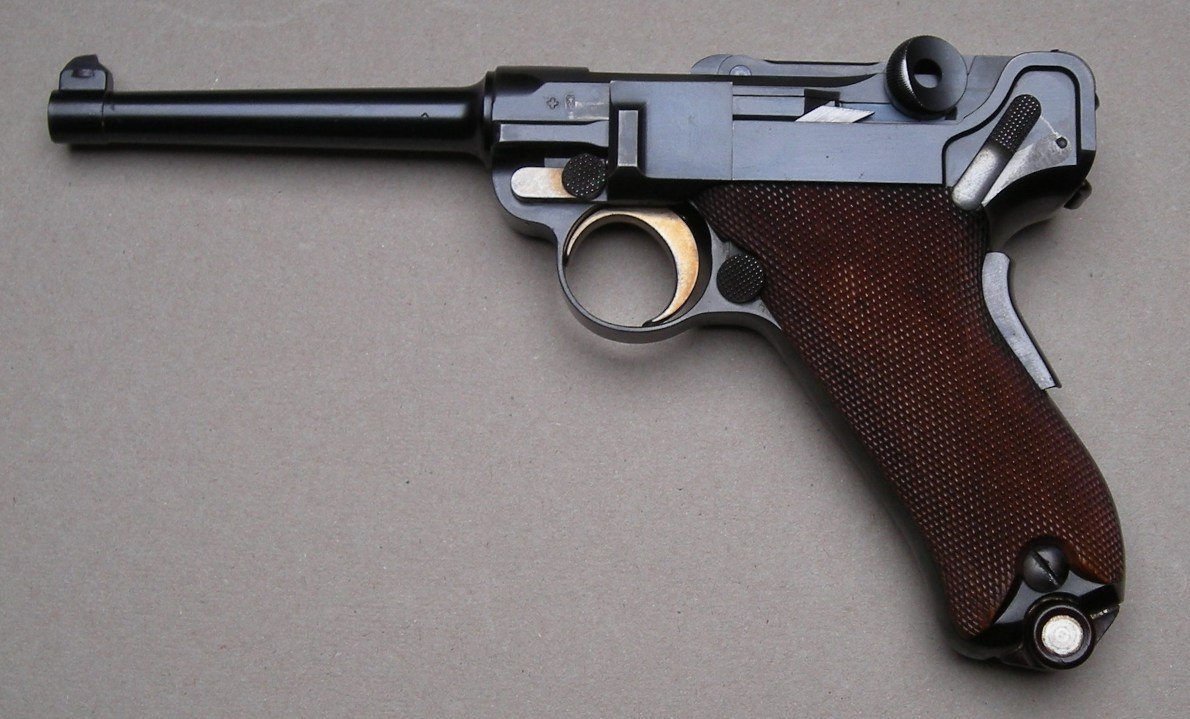
1.1 What this dive covers, and what it leaves to others
The Luger, properly the Pistole Parabellum, is the pistol that Deutsche Waffen- und Munitionsfabriken (DWM) made out of Hugo Borchardt’s C-93 at the end of the 1890s. Switzerland adopted it in 1900, the German Navy in 1904 and the German Army in 1908 as the Pistole 08, and it stayed in German service through two world wars. It was made by DWM, by the Prussian arsenal at Erfurt, by Simson, by Mauser and by Krieghoff in Germany, by the federal arms factory in Bern, and, after 1945, again by Mauser and by makers in Texas and Ulm.
This dive is a reference work; nothing here is owned. It runs to eight volumes: two of history (this one to 1914, the next from 1914 onward), the two cartridges, the mechanism, identification, field strip and repair, the market and the law, and a build volume. The Borchardt-to-Luger lineage is already told in full in the Borchardt C-93 dive, Volume 3, including the trials of 1894 to 1898, Borchardt’s refusal to shrink his pistol, the Borchardt-Luger transitional pistols, the Swiss adoption and a side-by-side reading of the two patents. That story is not repeated here. The cartridge’s descent from the 7.65 mm Borchardt and the 7.63 mm Mauser is in the Mauser C96 dive, Volume 3.
1.2 The redesign in one paragraph
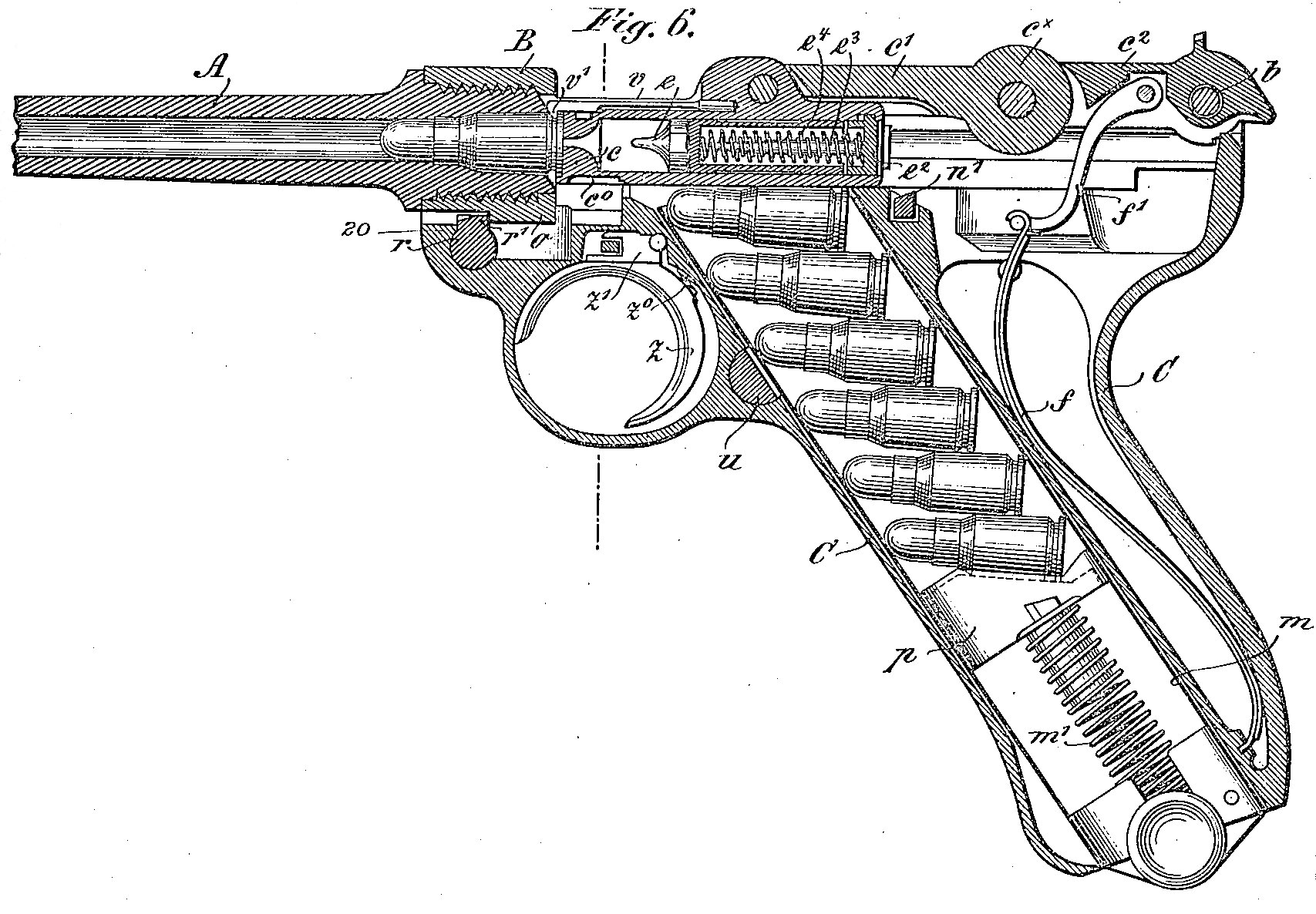
What Georg Luger changed is visible in any photograph of a C-93 and a Parabellum side by side, and the Borchardt dive sets it out from the two patents: the closing spring moved from a box behind the hand into the grip; the curved thrust surface that breaks the toggle moved from inside the rear of the C-93’s receiver to two ramps on the frame, struck by knobs on the rear toggle link; the grip was raked; and the cartridge was shortened, from the Borchardt’s 25 mm case to 21 mm. Luger’s US patent 753,414, filed 17 March 1900 and granted 1 March 1904, describes the result and its hold-open.1 Everything after 1900 is refinement of that arrangement, and the rest of this volume follows those refinements.
1.3 The name
“Parabellum” was DWM’s telegraphic address, from the Latin si vis pacem, para bellum, “if you want peace, prepare for war”. That is how the Luger collectors’ reference compiled on the Luger Forum explains it, and the company also used the word for its cartridges and, later, its aircraft machine gun.2 The name “Luger” is the inventor’s and was the English-speaking market’s; the German service called the pistol by its year of adoption, Pistole 08, and the Swiss by theirs, Pistole 1900 and 1900/06.
1.4 The Swiss Pistole 1900 and the first commercial pistols
Switzerland’s adoption is told from the Swiss federal foundation’s own report in the Borchardt dive: recommended by the commission on 3 April 1900, adopted by the Federal Council on 4 May 1900, declared regulation issue on 19 February 1904. Dates elsewhere differ; English Wikipedia’s account of the Luger gives 4 April 1901 in one section and 1900 in another.3 The Swiss instruction booklet was approved on 2 April 1901.
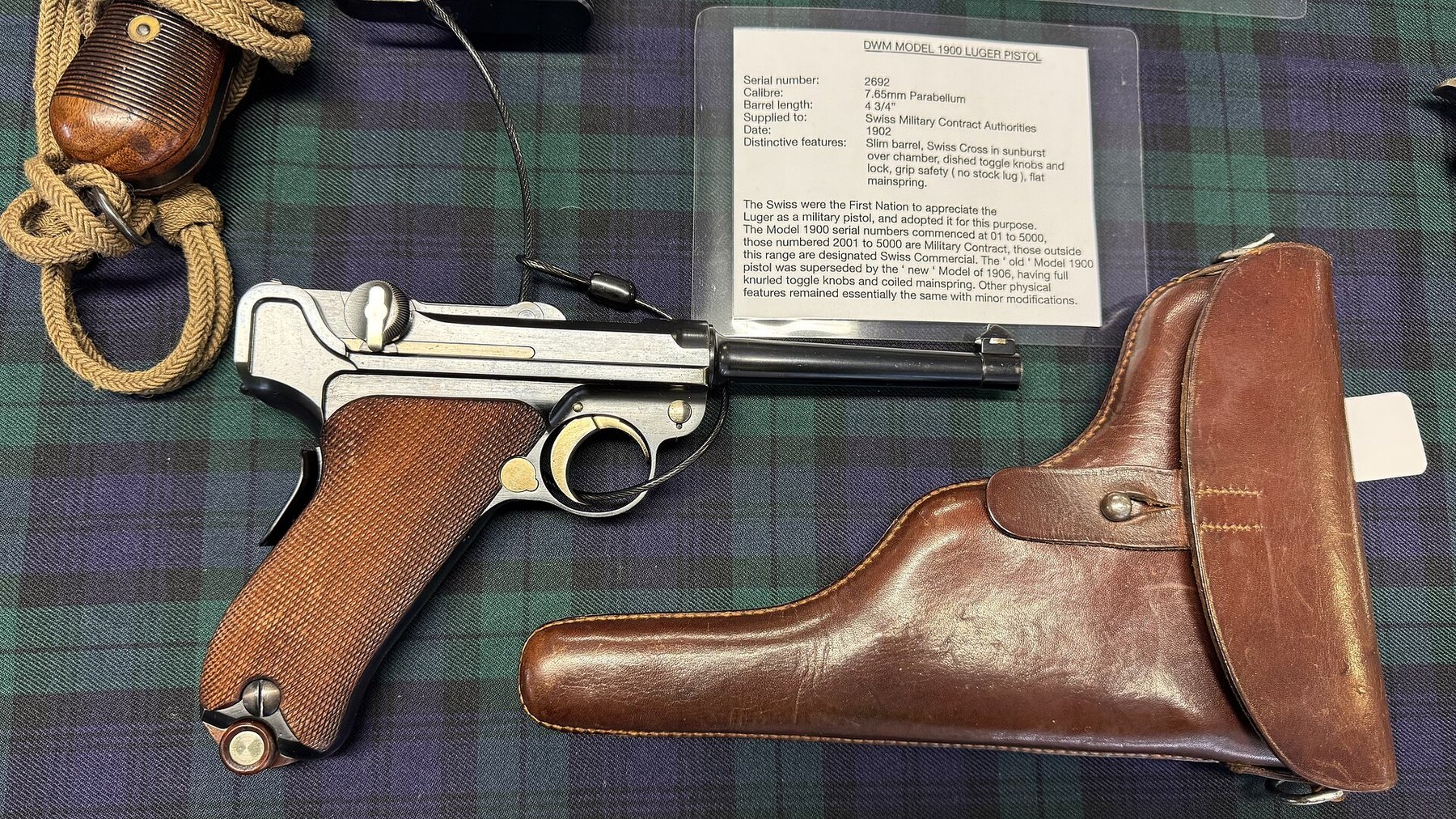
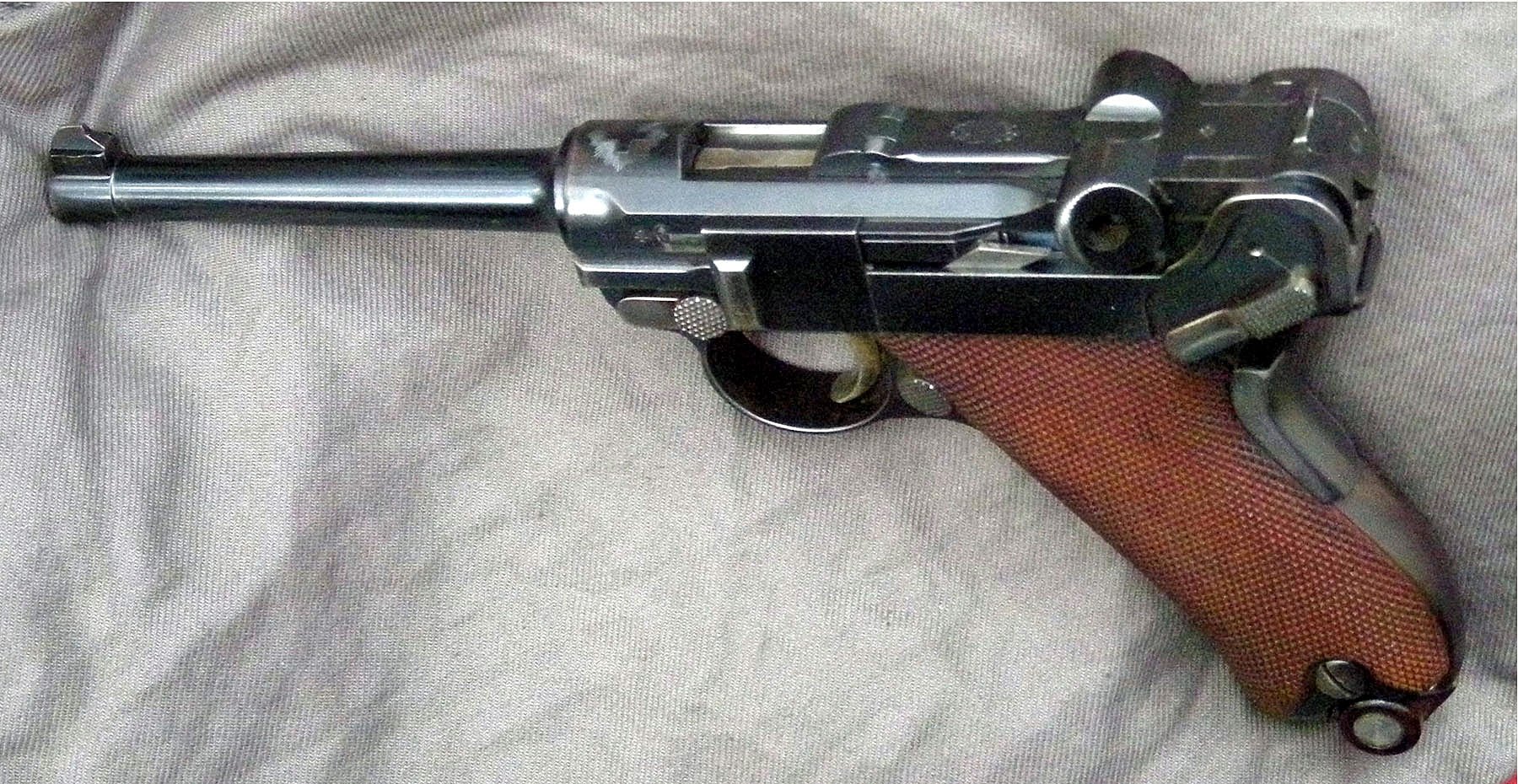
The 1900 pattern, in Switzerland and on the commercial market, is identified by a set of features that later models dropped or changed:
- a grip safety in the back strap, together with a small thumb lever that locks it;
- a flat leaf closing spring in the grip, not a coil;
- flat or dished toggle knobs;
- no stock lug on the heel of the grip;
- a long frame and a slim 7.65 mm barrel of about 120 mm.
A DWM Model 1900 shown at a collectors’ exhibition carries a display card that states exactly those features for its serial range: “Slim barrel, Swiss Cross in sunburst over chamber, dished toggle knobs and lock, grip safety (no stock lug), flat mainspring.”4 The card’s account of Swiss serial ranges (military contract numbers from 2001 to 5000) is the exhibitor’s and is not checked here.
1.5 The United States: a thousand test pistols, 1901
The Parabellum’s first large foreign trial after Switzerland was American. According to the Luger Forum’s collector reference, the United States bought 1,000 standard Model 1900 pistols from DWM, received in two shipments of 800 and 200 at the end of October; 900 went to the Cavalry and 100 were held for the Field Artillery and for test.2 The pistols carry the Great Seal of the United States over the chamber, the “American Eagle” that DWM went on to use on its commercial pistols for the American market, and their serial numbers fall roughly between 6100 and 7100. English Wikipedia dates the purchase to 16 April 1901.3 Some went later to the dealer Francis Bannerman.2
The American Eagle commercial pistols that followed are counted in Jan Still’s Imperial Lugers (1991), as summarised in the Forum reference: for the 1900 American Eagle test pistols an estimated production of 1,000, and a few dozen to a few hundred surviving pistols reported for each of the other American Eagle models.2 The Forum table is garbled in its online copy beyond that one pair of figures, and the others are not repeated here.
1.6 Nine millimetres, 1902
Luger’s 7.65 mm cartridge was a bottlenecked descendant of the Borchardt round. The 9 mm Parabellum was the same case with the bottleneck taken out and opened up to take a 9 mm bullet. English Wikipedia, citing Hogg and Weeks, dates its development to 1901, and records that Luger presented it to the British Small Arms Committee in 1902 and gave three prototype pistols to the US Army for testing in mid-1903; the same article’s pistol section says fifty 9 mm “cartridge counter” Parabellums were tested at Springfield in 1904.53 None of those statements was checked against a primary record for this dive, and they are given as the encyclopaedia gives them. The cartridge itself is the subject of Volume 3.
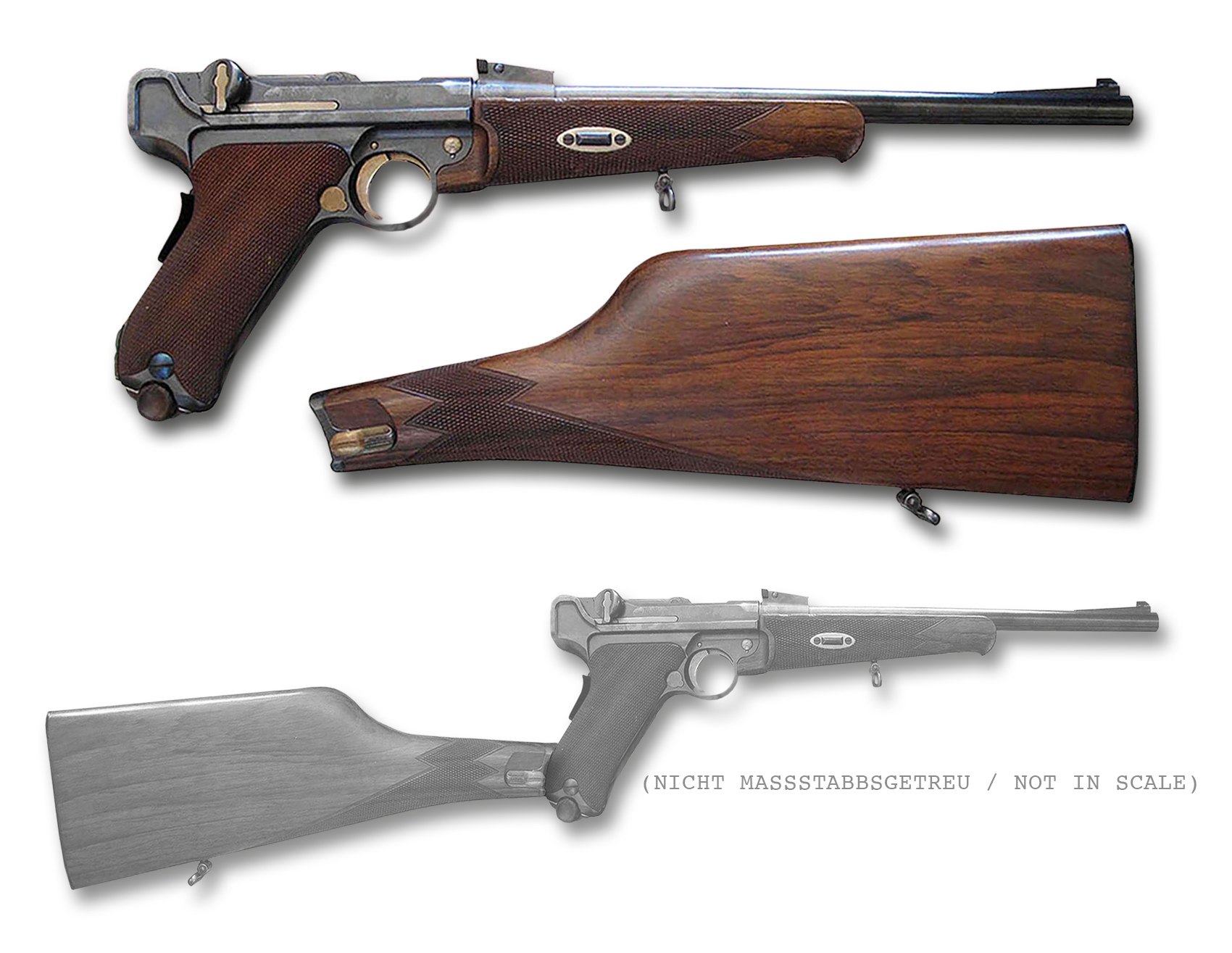
The 9 mm pistol of 1902 had a heavier barrel than the 7.65, the “fat barrel” of the collectors, and the 1902 period also produced the Parabellum carbine, a long-barrelled pistol with a forend and a detachable stock, in 7.65 mm. ATF’s curios-and-relics list names it: “Model 1902, Pistol-Carbine, cal. 7.65mm Luger, with original commercial type shoulder stock and forearm and 11-3/4” barrel.”6 The listing matters to an owner today and is taken up in Volume 7.
1.7 The Navy’s pistol, 1904
The first German service to adopt the Parabellum was the Imperial Navy, in 9 mm. Stephen A. Petroni’s study of a named Navy pistol in Small Arms Review gives the sequence: on 1 August 1904 the Reichs-Marine-Amt ordered five 9 mm pistols from DWM for trials; an urgent order for 2,000 followed, of which perhaps 1,200 were delivered; on 12 December 1904 an order for 8,000 “9mm Selbstladepistole Modell 1904” was placed (Petroni attributes it to the War Ministry, which is not explained); the first contract pistols were delivered in March 1906.7
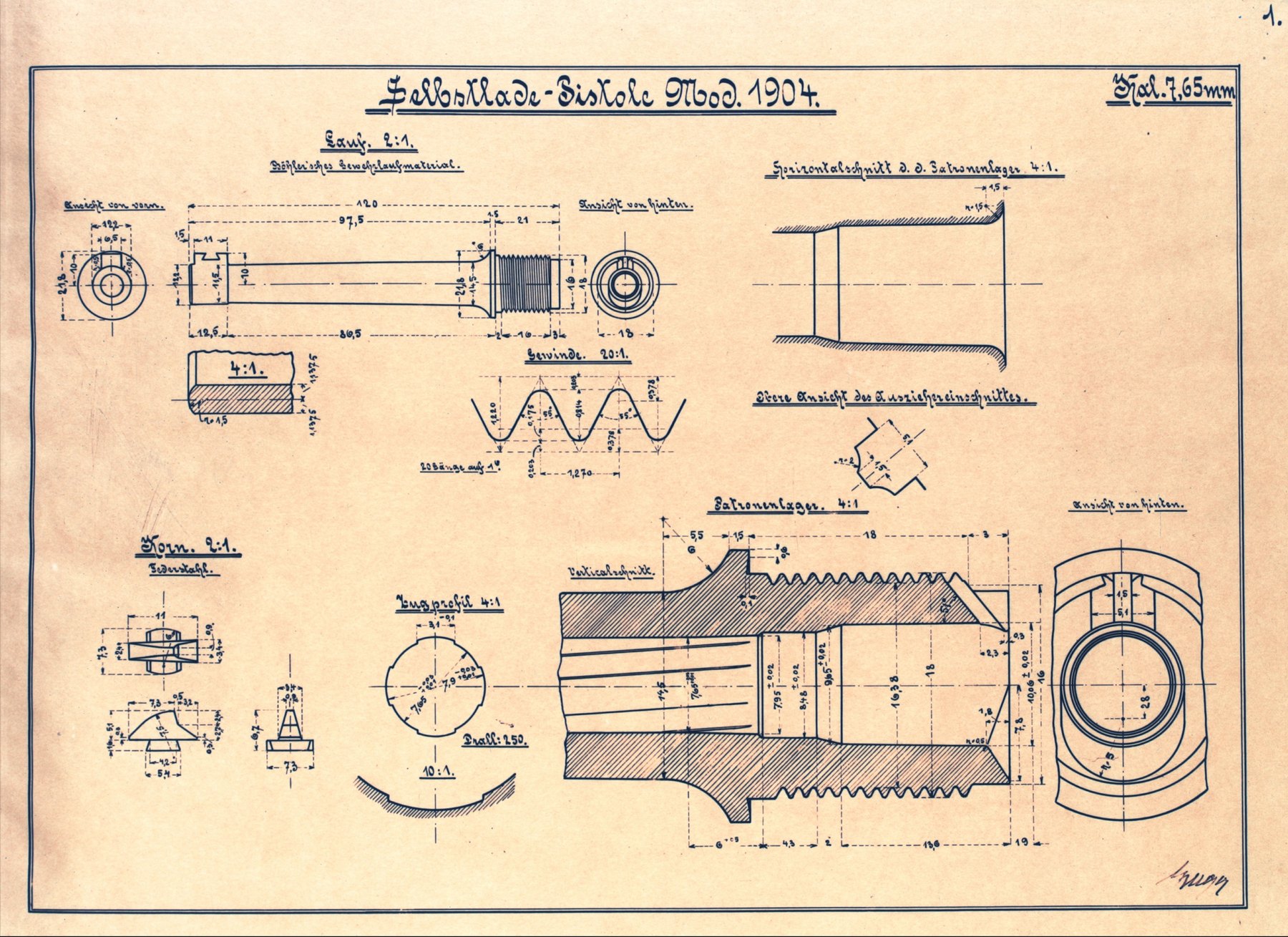
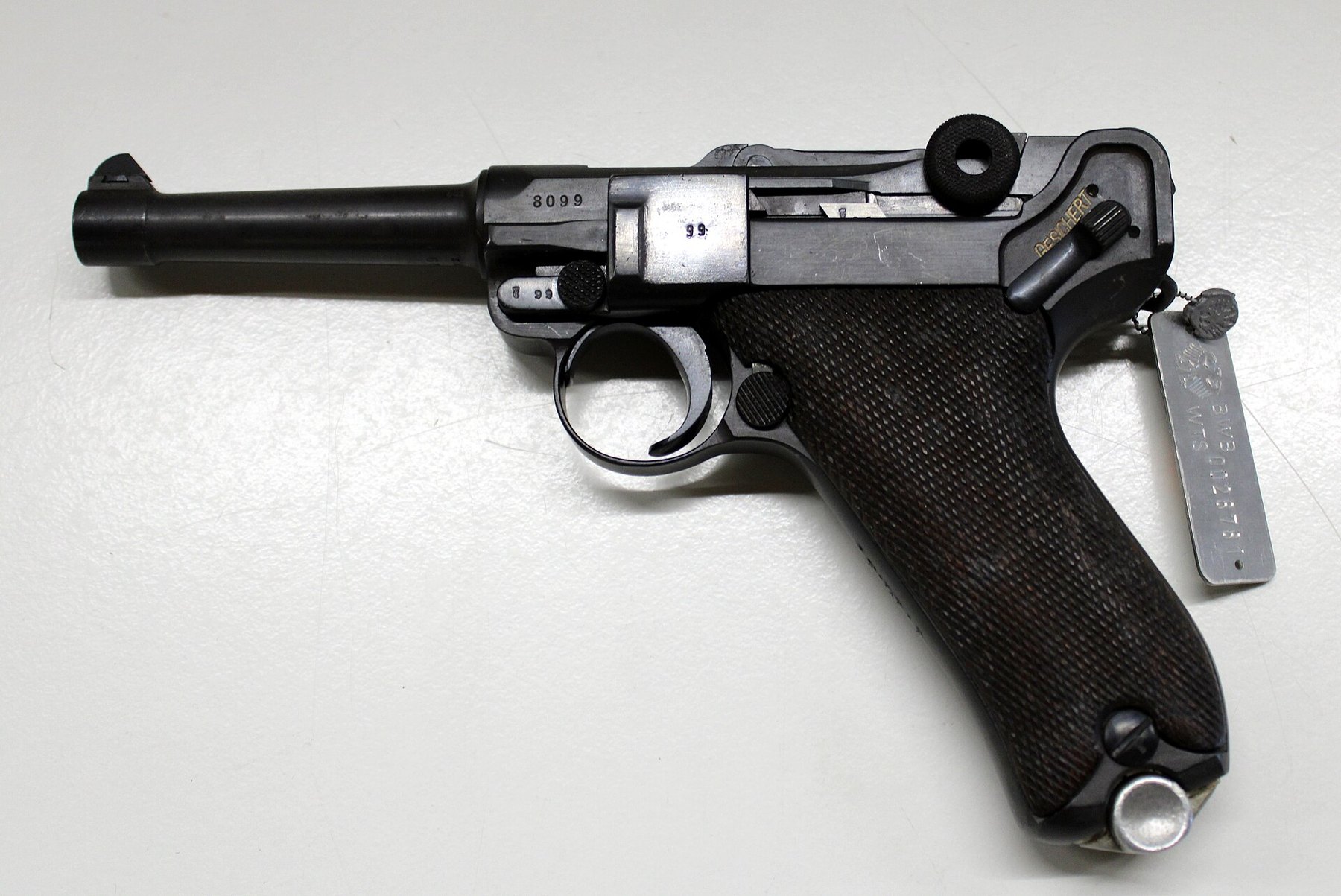
The first-issue Navy pistol had a six-inch (150 mm) barrel, the older long frame, a grip safety, a rear sight on the rear toggle link adjustable for 100 and 200 metres, a lug on the back strap for a shoulder stock, no date on the chamber and the DWM monogram on the front toggle link.7 Its safety was originally arranged so that “safe” was the upper position. That was found dangerous, because the lever could be pushed to “fire” as the pistol came out of the holster; a second issue of 1912 put “safe” at the bottom, like the Army’s, and most first-issue pistols were recalled, the old Gesichert marking ground off and re-stamped.7 The grip safety went in 1908; in 1916 the frame was shortened to the Army length; only the wartime pistols carry a chamber date. Petroni puts total Navy production by the end of the First World War somewhere between 32,000 and 53,000.7
Two details of the Navy story return in Volume 7, because ATF’s list of stocked Lugers removed from the National Firearms Act was written around them: the Navy stocks fitted with a marking disc from 1910, and the “altered and unaltered safety markings in the Model 1906”.6
1.8 The “Mod. 1904” drawings and the coil spring
The pattern usually called the “New Model” or Model 1906 changed two things that show in any photograph and one that does not. The toggle knobs became fully round and knurled; the frame was shortened at the back; and the flat leaf closing spring in the grip became a coil. The coil spring is the change the Borchardt dive flags as the end of the C-93’s double leaf spring.
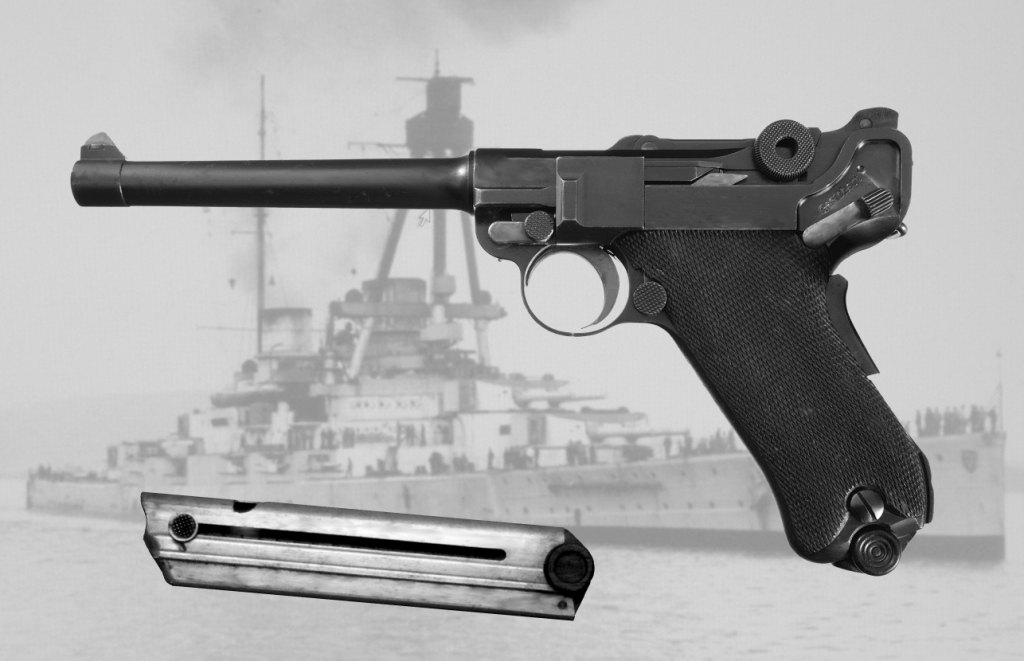
A set of Swiss federal workshop drawings now online, from the Swiss Federal Archives in Bern, is labelled on its cover “Pistole 1900/1906” and carries the archive stamp “Bestands-Nr. 27, Archiv-Nr. 18176”.8 Every sheet is headed “Selbstlade-Pistole Mod. 1904”, not 1906. The drawings are dimensioned at 2:1 and 4:1 and give materials and heat treatment: the barrel in “Böhler rifle-barrel steel” (Böhlersches Gewehrlaufmaterial), 120 mm long overall, in 7.65 mm, with a twist of one turn in 250 mm, screwed into the receiver by a thread of 20 turns to the inch and 55° flank angle, a Whitworth form, in a pistol otherwise drawn wholly in millimetres.8 That the Swiss drawing office called the pattern “Mod. 1904” fits a design settled in 1904 and adopted by the Swiss in 1906; it is recorded here as a finding from the drawings, without a document that explains the name. The set is used again in Volume 8, where it is the starting point for anyone making parts.
1.9 The .45 Luger and the Army board of 1907
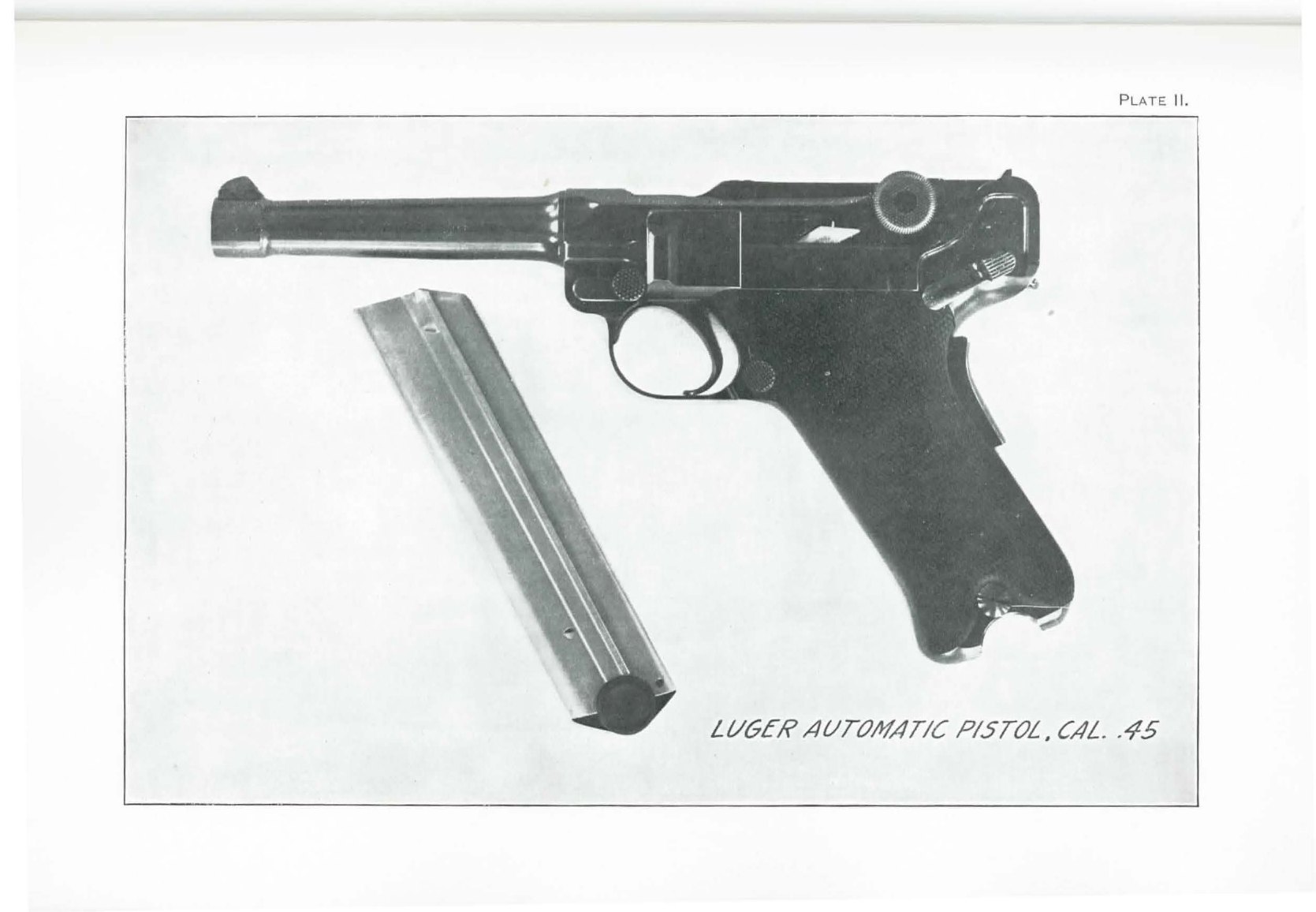
In 1906 and 1907 the US Army looked again for a self-loading pistol, now in .45 calibre. The board’s report, printed as an appendix to the Annual Report of the Chief of Ordnance for 1907, is the primary record, and it is unusually detailed about the Luger.9
The board was convened at Springfield Armory by Special Orders No. 305 of 28 December 1906 and sat until 28 March 1907. It listed the Luger’s weight, with magazine, as 2 lb 8 oz, against 2 lb 2½ oz for the Colt and 2 lb 3 oz for the Savage. Its list of the Luger’s “distinguishing characteristics” reads, in part: “The shape of the grip conforms to the anatomical features of the hand. The center of gravity is well to the rear … An automatic and a mechanical safety are provided. There is an automatic indication that the chamber is loaded, visible to the eye, and sensible to the touch … The final seating of the cartridge is mainly dependent upon remaining momentum and not upon spring action. The retraction of the breech mechanism by hand is difficult. The magazine holds seven cartridges.”9
The firing record in the appendix is the best published account of how a Luger behaved under a government test:9
Table 1 — The .45 Luger and the Army board of 1907
| Test | Luger .45 result (1907 report) |
|---|---|
| Strip and assemble, by Georg Luger | Dismounted in 3 min 24⅗ s, assembled in 4 min 13⅕ s; two drifts and one screwdriver |
| Parts | 48, of which the breechblock with both toggle links and the recoil spring, the trigger plate and its lever, and the magazine follower and button were not dismounted (riveted or permanently joined) |
| Velocity at 25 ft | Frankford Arsenal ammunition 802–835 ft/s, mean 808.9; Luger ammunition 729–790 ft/s, mean 762.6 |
| Accuracy at 75 ft | Mean absolute deviation 1.3 in |
| Rapid fire with accuracy, 100 ft | 21 shots in 1 min 3⅗ s by the inventor, 14 hits on a 6 × 2 ft target |
| Endurance, 506 rounds | Jams at rounds 125, 175, 231, 398, 446 and 451, “corrected by striking the link”; one failure to extract; two double feeds |
| Penetration, soft pine | 4½ in average |
| Over- and under-pressure loads | Action “normal” at 25 % over and at 10–25 % under |
| Dust | One magazine fired in 2 min 50 s (empty) and 2 min 32 s (loaded when dusted) |
| Rust (sal ammoniac) | All 14 rounds “fired by hand”, the bolt withdrawn and forced home after each shot |
Its verdict, paragraph 24, is quoted here in full: “The Luger automatic pistol, although it possesses manifest advantages in many particulars, is not recommended for a service test because its certainty of action, even with Luger ammunition, is not considered satisfactory, because the final seating of the cartridge is not by positive spring action, and because the powder stated by Mr. Luger to be necessary for its satisfactory use is not now obtainable in this country.”9
That was not quite the end. On 18 May 1907 the Chief of Ordnance wrote that Colt had quoted ten months for 200 pistols and that Savage was “unwilling to accept an order for the number of pistols specified”: “It is therefore proposed to purchase 200 Luger automatic pistols in lieu thereof.”9 The report does not record what followed, and the story usually told, that Savage relented and DWM withdrew, rests on secondary accounts. A Greg Martin Auctions press release of 2010 says DWM withdrew after the first round of tests.10
How many .45 Lugers? The sources do not agree, and the disagreement is set out rather than resolved:
Table 2 — How many .45 Lugers? The sources do not agree, and the disagreement is set out rather than resolved
| Source | Number made | Survivors | Price claims |
|---|---|---|---|
| Greg Martin Auctions press release, 1 March 2010 | Two, carried to the US by Luger | Only serial 2 “is known to have survived” | Paid $1,000,000 in 1989; estimate $500,000–1,000,000 for the 2010 sale |
| Gun Digest price guide entry | ”Only five” | Not stated | ”One sold in the late ’80s for $430,000” |
| Luger Forum collectors’ reference | Unknown | Serial 2 privately owned, and an unserialled example displayed at the R. W. Norton Art Gallery, Shreveport | — |
| Patrick Sweeney, Guns & Ammo, 2018 | ”Five or six … if we can believe the records” | One tested to destruction, one kept by the War Department (whereabouts unknown), the rest left in Germany; “one or two” found there in 1945 | — |
1011212 The result of the 2010 sale was not found. Gun Digest’s entry also warns that “perfect copies of this model have been made”, a point Volume 5 returns to.
1.10 The Pistole 08
The German Army’s adoption is documented by the Kaiser’s cabinet order of 22 August 1908, which English Wikipedia gives as an order for 50,000 pistols within a total of 170,000; the date is also the one cited, from John Walter’s The Luger Book, by the Land of Borchardt collection in its account of the long pistol.313 The pistol adopted was the coil-spring New Model with two changes that define the P08 to this day:
- no grip safety: the thumb lever on the left of the frame is the only manual safety, and it blocks the sear bar when pushed down and back to show Gesichert;
- a 4-inch (100 mm) 9 mm barrel, with a fixed rear notch on the rear toggle link.
Contemporary data from three sources are tabled side by side, as they differ in small ways:
Table 3 — Contemporary data from three sources are tabled side by side, as they differ in small ways
| WTS Koblenz label (Erfurt 1911 pistol) | US German Infantry Weapons, 1943 | Krieghoff instruction manual (new P08, 2006) | |
|---|---|---|---|
| Barrel | 100 mm, 6 grooves, right twist | ”4.25 inches” | 100 mm, 6 grooves, twist 250 mm |
| Length | 215 mm | — | 220 mm |
| Weight | 890 g | 1 lb 14 oz (850 g), empty | approx. 835 g |
| Muzzle velocity | 365 m/s | 1,040 ft/s (317 m/s) | — |
141516 The US manual’s 4.25 inches is not the P08’s barrel length, which every other source puts at 100 mm (3.94 in) or 102 mm; Krieghoff’s own catalogue gives 102 mm and 870 g against its manual’s 100 mm and 835 g.17 The P08 as adopted had no stock lug. In the Forum reference, Dwight Gruber, who tracks commercial serial numbers, writes that “the army instituted the change in P08 production to include a stock lug in August, 1913”, and that the lug appears in commercial production from about serial 70185.2 Why that matters to an owner is in Volume 7.
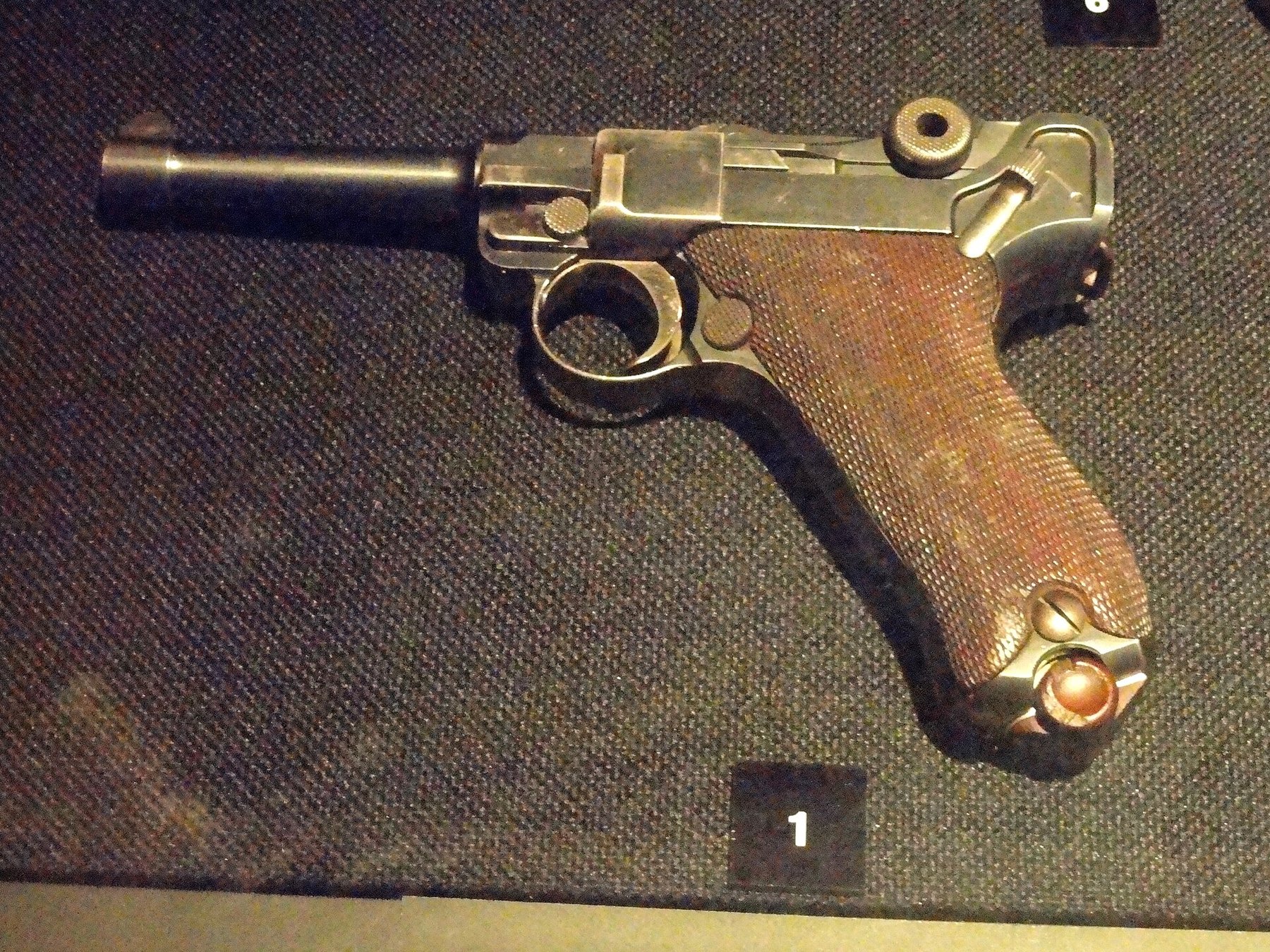
1.11 Erfurt
The second production line for the P08 was the Prussian rifle factory at Erfurt. John Walter’s history, as quoted in the Forum reference, says it was installed in 1909–10; the Forum dates Erfurt production to 1911–1918, and the Erfurt pistol in the Wehrtechnische Studiensammlung at Koblenz is dated 1911 on the chamber.214 The same Koblenz label says that “at the Royal rifle factory in Erfurt the P-08 was made only until 1917”, which does not square with the Erfurt pistols dated 1918 that the collector literature records; the label is given as the museum’s statement, not adopted.14 After the war the Erfurt machinery went to Simson & Co. at Suhl; Volume 2 follows it.
1.12 The long pistol, 1913
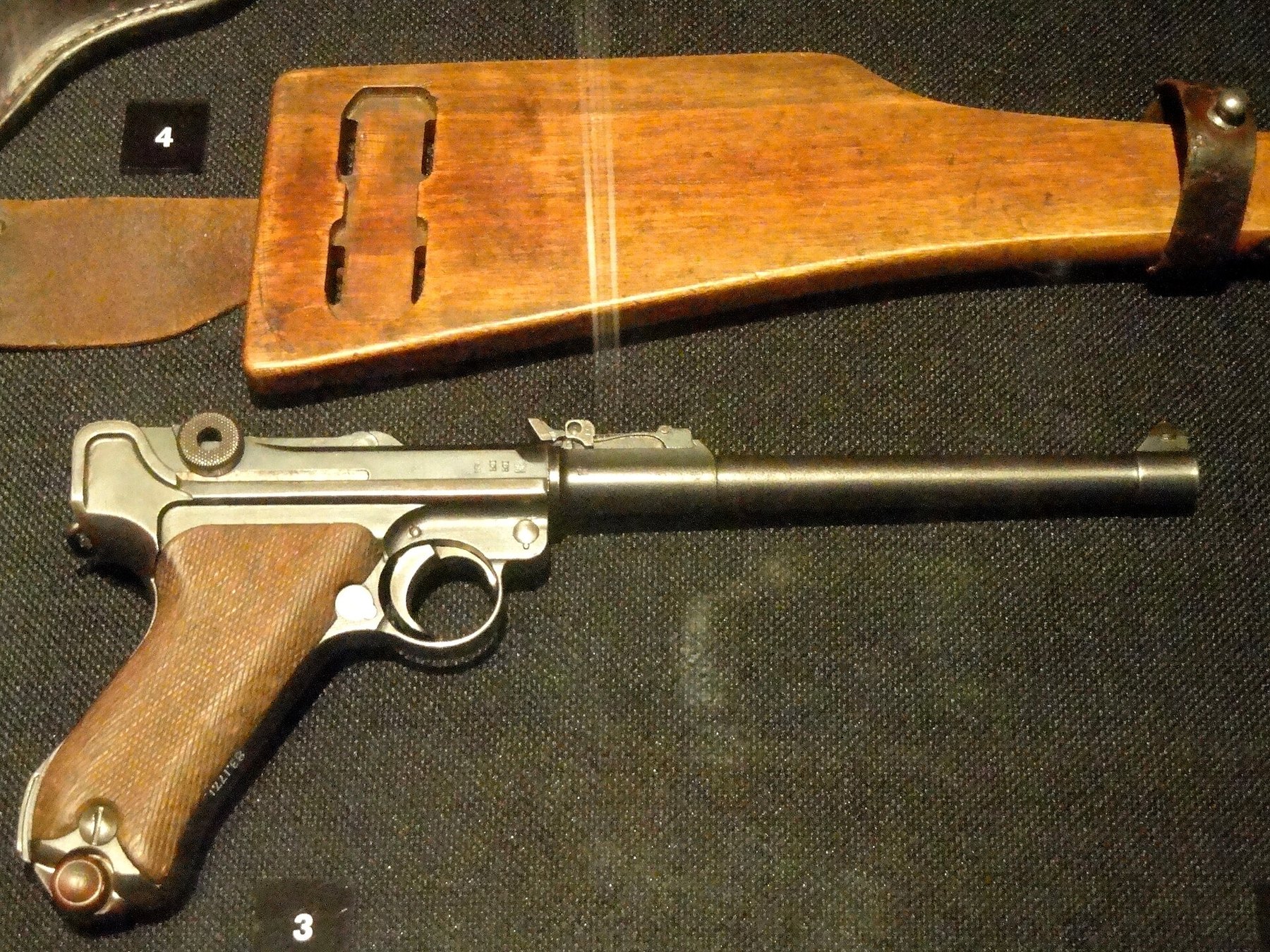
The Lange Pistole 08 (LP08), the “Artillery Luger” of the collectors, is a P08 with a 200 mm barrel, a tangent rear sight on the barrel ahead of the receiver, and a board stock with a holster attached. The Land of Borchardt collection quotes the Kaiser’s order, from Walter’s The Luger Book, dated 3 June 1913: “I approve of adoption of a self-loading pistol with shoulder stock”, with the field artillery and “the airmen” to be armed with the long pistol as funds allowed.13 English Wikipedia, without a footnote, dates the authorisation 2 July 1913 and describes the rear sight as an eight-position tangent graduated to 800 metres.3 Both dates are given.
The 32-round drum, the Trommelmagazin 08, came in the war and is described in Volume 2. It was designed for the long pistol, but it fits any P08: Hugh Pollard, writing in 1920, illustrated a “special 32-shot magazine fitted to standard 9 mm. Parabellum pistol”, a war trophy of 1918. He also reported that the long-barrelled models “were not normally issued to the troops”, which is not consistent with the 1913 order and is quoted only as his.18
1.13 Dates that disagree
Table 4 — Dates that disagree
| Event | Date | Source |
|---|---|---|
| Swiss adoption | 4 May 1900 (Federal Council) | Stiftung HAM, via the Borchardt dive |
| 4 April 1901 | English Wikipedia, Swiss section | |
| US purchase of 1,000 | 16 April 1901 | English Wikipedia |
| Shipments received 26 and 29 October (year not stated) | Luger Forum reference | |
| 9 mm prototypes to the US | mid-1903 | English Wikipedia, 9×19 article |
| 1904 (fifty “cartridge counter” pistols) | English Wikipedia, Luger article | |
| Navy orders | 1 Aug 1904 (five), 12 Dec 1904 (8,000) | Petroni, Small Arms Review |
| Army adoption | 22 Aug 1908 | Walter via Land of Borchardt; English Wikipedia |
| Erfurt line | Installed 1909–10; production 1911–1918 | Walter via the Forum; the Forum |
| Production “only until 1917” | WTS Koblenz label | |
| LP08 order | 3 June 1913 | Walter via Land of Borchardt |
| 2 July 1913 | English Wikipedia |
1.14 What this volume could not settle
- A primary US record of the 1901 purchase, and the year of the October shipments.
- The 1903–1904 9 mm tests at Springfield, from the Ordnance Department’s own reports.
- Why the Swiss drawings call the New Model “Mod. 1904”, and who signed them.
- The number of .45 Lugers made, and the result of the 2010 sale.
- The LP08’s adoption date, between 3 June and 2 July 1913, from the cabinet order itself.
- The last Erfurt pistols, 1917 or 1918.
References
Footnotes
-
Georg Luger, US Patent 753,414, “Recoil-Loading Small-Arms”, filed 17 March 1900, granted 1 March 1904. Fig. 6 from File:Georg Luger 1900 page 4 rotated.png, Wikimedia Commons (public domain), https://commons.wikimedia.org/wiki/File:Georg_Luger_1900_page_4_rotated.png, consulted 2026-10-19. The patent is also in the central Library (
us-patent-753414-luger-1904-recoil-loading-small-arms). ↩ -
Luger FAQs, last updated 1 August 2019, compiled by members of the Luger Forum and Jan Still Luger Forum, Internet Archive, https://archive.org/details/20190801lugerfaqs, consulted 2026-10-19. A collectors’ compilation; it cites Still, Walter, Görtz and Sturgess and others, and is attributed as such. ↩ ↩2 ↩3 ↩4 ↩5 ↩6 ↩7
-
“Luger pistol”, English Wikipedia, https://en.wikipedia.org/wiki/Luger_pistol, consulted 2026-10-19. ↩ ↩2 ↩3 ↩4 ↩5
-
File:DWM 7.65mm Luger.jpg, photograph by Elshad, CC BY 4.0, Wikimedia Commons, https://commons.wikimedia.org/wiki/File:DWM_7.65mm_Luger.jpg, consulted 2026-10-19; the quotation is from the display card in the photograph. ↩
-
“9×19mm Parabellum”, English Wikipedia, https://en.wikipedia.org/wiki/9%C3%9719mm_Parabellum, consulted 2026-10-19 (citing Hogg and Weeks, and Barnes, Cartridges of the World, 11th ed., p. 295). ↩
-
ATF, Firearms Curios or Relics List, January 1972 through April 2025 (ATF P 5300.11), https://www.atf.gov/media/19856/download, consulted 2026-10-19 from a copy saved for this hub. Section III. ↩ ↩2
-
Stephen A. Petroni, “Gouv. Kiau. 4: An Extraordinary Navy Luger”, Small Arms Review V10N7, April 2007, https://smallarmsreview.com/?p=4644, consulted 2026-10-19. ↩ ↩2 ↩3 ↩4
-
Swiss Federal Archives (Bundesarchiv Bern), Bestand 27, Archiv-Nr. 18176, “Pistole 1900/1906”, sheets headed “Selbstlade-Pistole Mod. 1904”, digitised as “The Luger Pistol Blueprints, Pistol 1900 1906”, Internet Archive, https://archive.org/details/TheLugerPistolBlueprintsPistol19001906, consulted 2026-10-19. Transcriptions are this dive’s, from renders at 200 dpi. ↩ ↩2
-
“Report of Board on Tests of Revolvers and Automatic Pistols”, Annual Report of the Chief of Ordnance, 1907, Appendix (Government Printing Office, 1907), Internet Archive, https://archive.org/details/1907pistoltrials, consulted 2026-10-19. Paragraphs 3, 14, 20, 21, 24; the Chief of Ordnance’s letter of 18 May 1907; “Test of Luger Automatic Pistol, Caliber .45”, pp. 102–104; Plate II. ↩ ↩2 ↩3 ↩4 ↩5
-
Greg Martin Auctions, “Greg Martin Auctions Proudly Presents ‘The Million Dollar Luger’”, Newswire, 1 March 2010, https://www.newswire.com/news/greg-martin-auctions-proudly-presents-the-million-dollar-luger-166480, consulted 2026-10-19. ↩ ↩2
-
“1906 U.S. Army Test Luger .45 Caliber”, Gun Digest gun values, https://gunvalues.gundigest.com/lugers/7611/1906-u-s-army-test-luger-45-caliber/, consulted 2026-10-19. ↩
-
Patrick Sweeney, “A Luger in .45 ACP”, Guns & Ammo, 25 April 2018, as reproduced by Lugerman at https://lugerman.com/?p=709, consulted 2026-10-19. ↩
-
Land of Borchardt, “LP08” article, https://landofborchardt.com/LP08-article.html, consulted 2026-10-19, quoting John Walter, The Luger Book (1986), p. 149. ↩ ↩2
-
Wehrtechnische Studiensammlung Koblenz, label “Selbstladepistole P-08 System Luger”, photographed for Commons as File:Pistole 08 Erfurt 1911 Tafel in der WTS-Koblenz.jpg (Archiv WTS-Koblenz, CC BY-SA 4.0), https://commons.wikimedia.org/wiki/File:Pistole_08_Erfurt_1911_Tafel_in_der_WTS-Koblenz.jpg, consulted 2026-10-19. ↩ ↩2 ↩3
-
War Department, Military Intelligence Service, German Infantry Weapons, Special Series No. 14, 25 May 1943, pp. 3–10, Internet Archive, https://archive.org/details/GermanInfantryWeapons1943, consulted 2026-10-19. ↩
-
Krieghoff, Instruction Manual, Krieghoff Automatic Pistol PARABELLUM – Caliber 9mm, “General Data”, read from the Internet Archive copy of 5 July 2016 of https://www.krieghoff.de/fileadmin/krieghoff_filelist/Downloads/Bedienungsanleitung/PDF/instruction_manual_parabellum.pdf, consulted 2026-10-19. ↩
-
Krieghoff, “2006 Limited Edition Krieghoff PARABELLUM” catalogue sheet, Internet Archive copy of 15 December 2013 of https://www.krieghoff.de/fileadmin/krieghoff_filelist/Downloads/Kataloge/PDF/parabellum_e.pdf, consulted 2026-10-19. ↩
-
Hugh B. C. Pollard, Automatic Pistols (London, 1920), pp. 29–30, 94–95 and Plate XV, Internet Archive, https://archive.org/details/automaticpistolspollard1920, consulted 2026-10-19. ↩


Comments (0)